

Introduction
The comprehensive implementation of Oral Peptide Drug Product Characterization requires an integrated assessment of intestinal permeation enhancers, enzymatic degradation behavior, and stability-indicating analytical assays to address the systemic bioavailability challenges associated with macromolecular therapeutics. Although parenteral administration has traditionally been the principal route for therapeutic peptides because of extensive gastrointestinal (GI) degradation and limited mucosal permeability, recent formulation advancements have incorporated chemical permeation enhancers (PEs), localized pH buffering systems, and advanced enteric coatings to develop clinically viable oral solid dosage forms. Characterization of these complex drug products requires specialized analytical frameworks that can elucidate the functional interactions among hydrophobic active pharmaceutical ingredients (APIs), functional excipients, and biological matrices. In accordance with contemporary regulatory expectations outlined in the International Council for Harmonisation (ICH) guidelines Q2(R2) and Q14, comprehensive characterization includes structural identification, conformational behavior, dissolution kinetics, and degradation pathway assessment throughout the synthetic and biological lifecycle.
The principal challenge associated with oral peptide delivery is a dual biological barrier consisting of a physical barrier formed by the densely connected intestinal epithelial monolayer and a biochemical barrier created by aggressive luminal, brush-border, and cytosolic proteases. Unmodified therapeutic peptides generally demonstrate oral bioavailabilities below 1% because they undergo rapid enzymatic hydrolysis within the stomach and small intestine and have limited ability to passively cross lipophilic enterocyte membranes or paracellular tight junction complexes. To address these limitations, oral solid dosage forms incorporate multifunctional permeation enhancers, including medium-chain fatty acids and amino acid derivatives, that are designed to temporarily modify mucosal permeability. Therefore, comprehensive characterization must concurrently determine how these enhancers influence membrane structure, protect the active peptide against enzymatic degradation, and perform within stability-indicating analytical assay conditions.
| Barrier Type | Biological Target | Primary Mechanism of Invalidation | Characterization Objective |
|---|---|---|---|
| Physical Barrier | Enterocyte lipid bilayer & tight junctions (Claudins/Occludins) | Exclusions based on high molecular weight (>700 Da) and hydrophilicity | Quantify transcellular vs. paracellular transport and reversible membrane perturbation |
| Biochemical Barrier | Pepsin, Trypsin, Chymotrypsin, Aminopeptidase N | Rapid cleavage of amide bonds, generating inactive metabolite fragments | Identify cleavage sites, degradation kinetics, and protectant excipient efficacy |
| Formulation Barrier | Unsynchronized API and enhancer dissolution | Luminal dilution leading to enhancer concentrations dropping below critical micellar thresholds | Measure co-release kinetics and colloidal phase integrity in biorelevant media |
Share via:
Quick Summary:
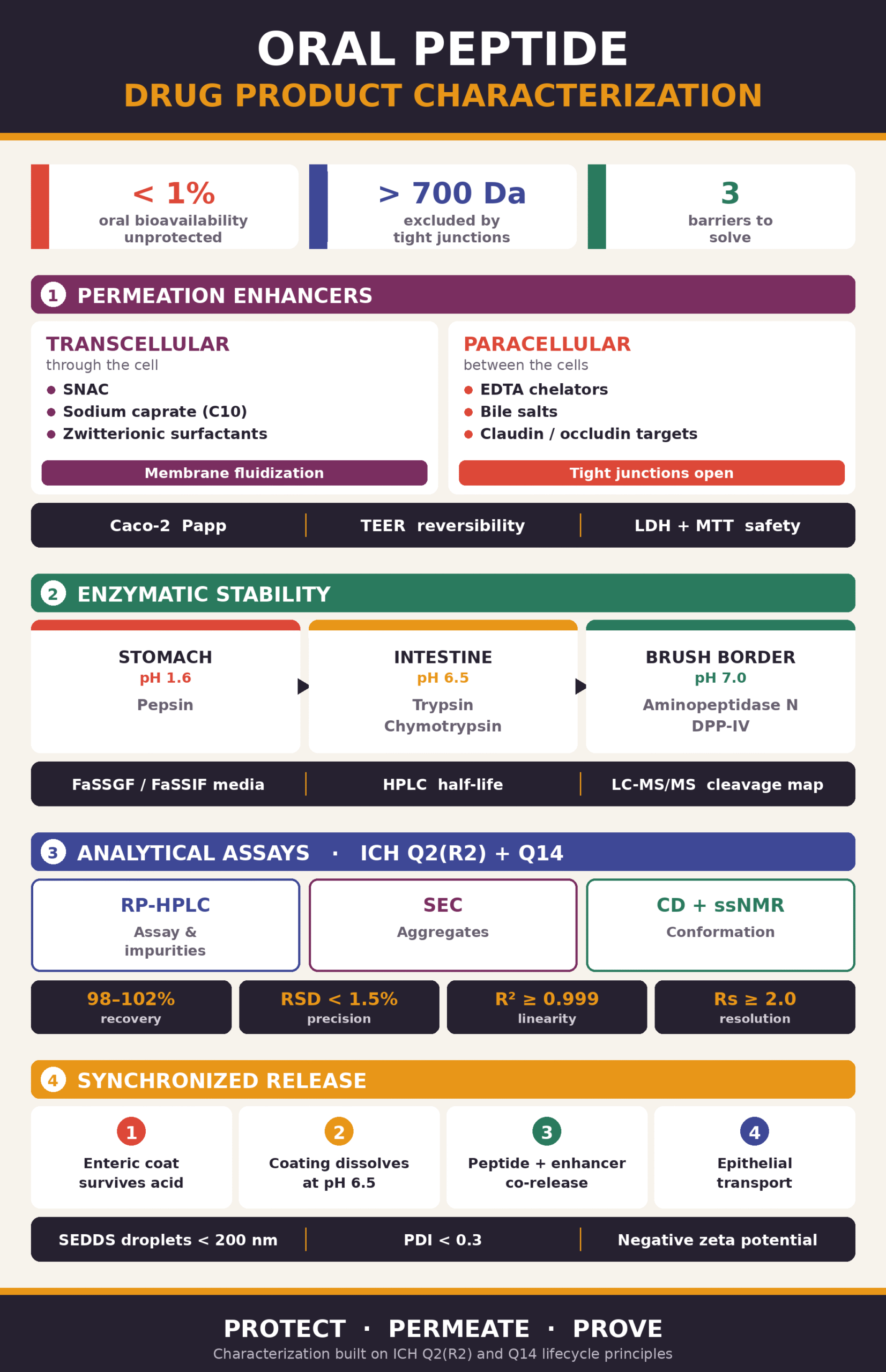
- The core problem: unmodified therapeutic peptides show oral bioavailability below 1%, blocked by a physical barrier (tight junctions excluding molecules above ~700 Da) and a biochemical one (pepsin, trypsin, chymotrypsin, brush-border peptidases).
- Permeation enhancers: transcellular agents like SNAC and sodium caprate (C10) fluidize the lipid bilayer, while paracellular agents like EDTA and bile salts open tight junctions. Both need characterization by ssNMR on DMPC liposomes and Caco-2 Papp measurement.
- Separating enhancement from damage: TEER monitoring shows whether junction opening reverses, and LDH release plus MTT viability assays confirm the permeability gain isn’t just membrane lysis.
- Enzymatic stability: degradation is mapped across gastric (pH 1.2–2.0), luminal intestinal (pH 6.5–7.5), and brush-border phases using biorelevant media (FaSSGF, FaSSIF/FaSSIF-V3 with pancreatin), with HPLC giving half-life and degradation rate constants.
- Cleavage-site identification: LC-MS/MS with CID paired with EAD pinpoints labile bonds and preserves fragile lipidated or cyclic structures — the approach that showed MEDI7219 retaining over 60% intact peptide after 2 hours in FaSSIF/pancreatin.
- Analytical assays under ICH Q2(R2) and Q14: RP-HPLC for assay and impurities, SEC for aggregates, CD and ssNMR for conformation — validated against an Analytical Target Profile and Method Operable Design Region, with targets like 98–102% recovery, RSD under 1.5%, and R² ≥ 0.999.
- Synchronized release is the make-or-break: the peptide and enhancer must co-release in the same micro-environment, verified by biorelevant dissolution (USP Apparatus 2 or 4) and, for SEDDS, by droplet size under 200 nm and PDI under 0.3 through digestion.
Permeation Enhancers in Oral Peptide Drug Product Characterization
Permeation enhancers play an important role in oral peptide drug product characterization because they can reversibly modify epithelial membrane fluidity or tight junction integrity, thereby promoting macromolecular transcellular and paracellular transport. Assessing their mechanisms of action requires complementary analytical approaches, including solid-state nuclear magnetic resonance (ssNMR), Caco-2 cell monolayers, transepithelial electrical resistance (TEER) measurements, and cell toxicity markers. These approaches help distinguish genuine permeability enhancement from structural damage or cytotoxic effects.
Chemical permeation enhancers comprise a structurally diverse group of excipients capable of increasing the permeability of macromolecular drugs of up to 70 kDa across the intestinal epithelium. Their activity is primarily associated with two major transport mechanisms: the transcellular pathway and the paracellular pathway.
- Transcellular Transport Pathways: Formulations containing transcellular enhancers, including sodium salcaprozate (SNAC), medium-chain fatty acid salts (sodium caprate, C10), and zwitterionic surfactants, depend on non-covalent hydrophobic interactions with the peptide payload. These enhancer molecules integrate into the enterocyte lipid bilayer, producing localized membrane fluidization and temporary structural defects that facilitate passive intracellular transport while preserving long-term membrane viability.
- Paracellular Transport Pathways: Formulations incorporating paracellular enhancers, such as chelating agents like EDTA and selected bile salts, act within the intercellular region. These compounds sequester extracellular calcium ions (Ca2+) or interact with junctional complex proteins, including Claudins, Occludins, and E-cadherins. This interaction temporarily increases the opening of epithelial tight junctions, enabling macromolecular diffusion between neighboring cells.
Characterization of these mechanisms requires biophysical methods capable of monitoring molecular interactions within representative lipid membrane systems. High-resolution solid-state NMR (ssNMR) using dimyristoylphosphatidylcholine (DMPC) liposomes can provide atomic-level information on the effects of SNAC and medium-chain fatty acids on lipid headgroup dynamics, acyl chain order parameters, and phase transitions. These spectroscopic observations can be supported by cell culture studies using Caco-2 human colon adenocarcinoma cell monolayers cultured on Transwell inserts.
Explore advanced NMR approaches for peptide characterization:
Learn more about 2D NMR for peptide characterization
The characterization protocol determines the Apparent Permeability Coefficient (Papp), which is defined as:
Papp = (dQ/dt) / (A × C0)
Where:
- dQ/dt represents the cumulative transport rate of the peptide across the monolayer (µmol/s),
- A represents the surface area of the membrane (cm2),
- C0 represents the initial peptide concentration in the donor compartment (µmol/cm3).
At the same time, transepithelial electrical resistance (TEER) is continuously monitored with volt-ohmmeters to determine the onset, extent, and reversibility of tight junction opening. To establish whether increases in Papp result from physiological permeability enhancement rather than membrane lysis, complementary cytotoxicity assessments are performed. Lactate dehydrogenase (LDH) release assays measure cytosolic enzyme leakage associated with plasma membrane disruption, whereas 3-(4,5-dimethylthiazol-2-yl)-2,5-diphenyltetrazolium bromide (MTT) or tetrazolium-based viability assays assess mitochondrial metabolic activity following exposure to the enhancer. Novel zwitterionic surfactants, including palmityldimethyl ammonio propane sulfonate, have demonstrated substantial Papp enhancement for peptide drugs while maintaining low LDH release profiles, supporting their potential application in safe intracellular transcellular delivery.
| Enhancer Class | Representative Excipients | Primary Route of Enhancement | Key Biophysical Assay | Safety / Cytotoxicity Metric |
|---|---|---|---|---|
| Fatty Acid Derivatives | Sodium Caprate (C10), Sodium Caprylate (C8) | Dual: Transcellular lipid fluidization & Paracellular tight junction opening | Solid-State NMR (DMPC liposome dynamics) | TEER reversibility timeline & LDH leakage baseline |
| Amino Acid Derivatives | Sodium Salcaprozate (SNAC) | Transcellular: Non-covalent hydrophobic complexation & local membrane defect generation | Isothermal Titration Calorimetry (ITC) & ssNMR phase profiling | MTT cell viability assay & apical membrane recovery |
| Zwitterionic Surfactants | Palmityldimethyl ammonio propane sulfonate | Transcellular: Reversible membrane perturbation without pore formation | Caco-2 Papp transport modeling | Low LDH release (<5% above control baseline) |
| Bile Salts & Surfactants | Sodium Deoxycholate, C12E8 | Transcellular: Membrane lipid extraction & micellar solubilization | Differential Scanning Calorimetry (DSC) of lipid bilayers | High-throughput ATP luminescence cytotoxicity assay |
Evaluating Enzymatic Stability for Oral Peptide Drug Product Characterization
Assessment of enzymatic stability during oral peptide drug product characterization involves measuring degradation kinetics across simulated gastric, intestinal, and brush-border enzyme environments to identify proteolytically susceptible amide bonds. Combining high-resolution tandem mass spectrometry with biorelevant media supports rational peptide engineering and the development of appropriate formulation protection strategies.
The human gastrointestinal tract contains a sequential enzymatic cascade that is responsible for breaking dietary proteins into dipeptides, tripeptides, and individual amino acids. For therapeutic peptides administered orally, this enzymatic environment can result in rapid inactivation unless suitable protective strategies are characterized and incorporated.
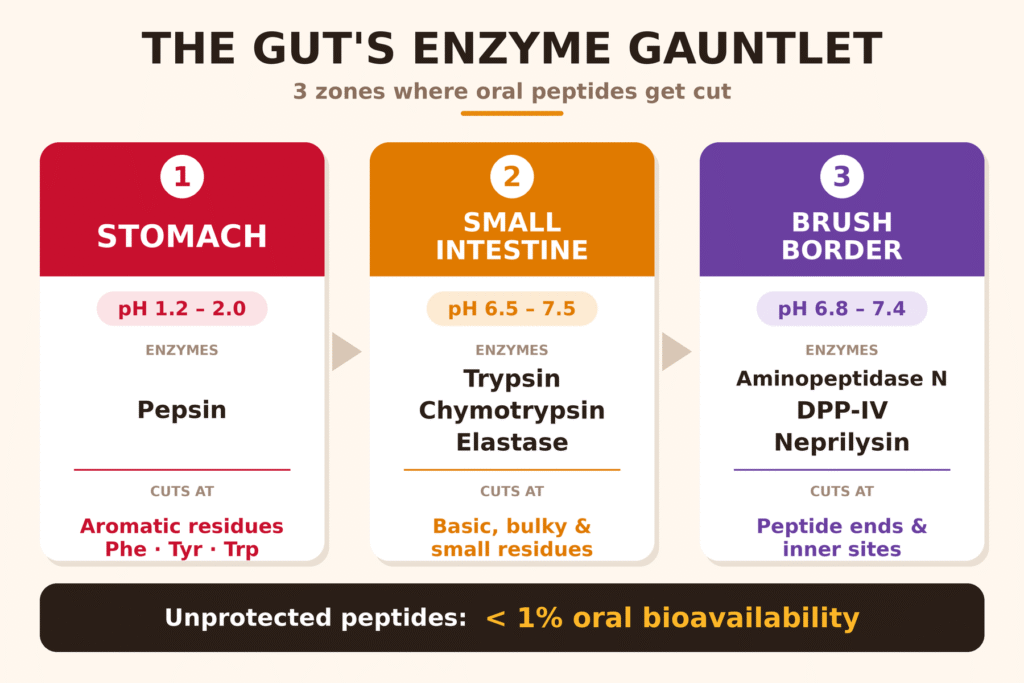
- Gastric Enzymatic Phase (pH 1.2–2.0): Within the stomach, pepsin functions as the principal endopeptidase and preferentially attacks peptide bonds located adjacent to aromatic amino acids, including phenylalanine, tyrosine, and tryptophan.
- Luminal Intestinal Phase (pH 6.5–7.5): After reaching the duodenum and jejunum, pancreatic enzymes hydrolyze the peptide backbone. Trypsin cleaves peptide bonds on the carboxyl side of basic residues, particularly lysine and arginine. Chymotrypsin preferentially acts on bulky hydrophobic residues, while elastase hydrolyzes small aliphatic residues such as alanine, glycine, and valine. Carboxypeptidases A and B subsequently remove C-terminal amino acids.
- Enterocyte Brush-Border Phase (pH 6.8–7.4): Peptidases associated with the microvillar membrane perform terminal peptide processing. Aminopeptidase N sequentially removes N-terminal residues, dipeptidyl peptidase IV (DPP-IV) cleaves X-Proline or X-Alanine dipeptides, and endopeptidase 24.11 (neprilysin) hydrolyzes internal hydrophobic sequences.
Accurate in vitro characterization of enzymatic stability cannot generally rely on conventional aqueous buffers alone. Instead, researchers use biorelevant media designed to reproduce important characteristics of human GI fluids, including surface tension, osmolality, lipid composition, and enzymatic activity. Fasted-State Simulated Gastric Fluid (FaSSGF) contains low concentrations of pepsin, sodium taurocholate, and lecithin at pH 1.6. Fasted-State Simulated Intestinal Fluid (FaSSIF and updated FaSSIF-V3) contains bile salts, phospholipids, and cholesterol to reproduce the solubilization environment of fasted human intestinal fluid (HIF). For proteolysis studies, FaSSIF can be supplemented with USP pancreatin or intestinal fluid extracts (SIFP) containing defined levels of pancreatic protease activity. In vitro stability protocols monitor the quantity of intact peptide remaining over time using high-performance liquid chromatography (HPLC) to determine half-life (t1/2) and degradation rate constants (kdeg):
C(t) = C0 × e−kdeg × t
t1/2 = ln(2) / kdeg
Assess peptide stability using specialized analytical workflows:
Explore GLP-1 peptide stability analytical methods
Identification of metabolic degradation products relies on Liquid Chromatography-Tandem Mass Spectrometry (LC-MS/MS) combined with complementary fragmentation approaches. Collision-Induced Dissociation (CID) can be paired with Electron-Activated Dissociation (EAD) to characterize labile post-translational modifications, lipid side chains, and cyclic peptide backbones. EAD helps preserve fragile non-covalent or lipidated structures while fragmenting the peptide backbone, producing distinct c- and z•-type fragment ions that can identify precise cleavage sites. For example, LC-MS/MS metabolite profiling of engineered GLP-1 analogs such as MEDI7219 demonstrated more than 60% intact peptide remaining following 2 hours of incubation in FaSSIF/pancreatin, with specific resistance to cleavage associated with sterically hindered methylated phenylalanine substitutions that reduce chymotrypsin digestion.
For detailed GLP-1 structural analysis and sequence confirmation:
Explore peptide sequencing of GLP-1 drugs
Advanced Analytical Assays in Oral Peptide Drug Product Characterization
Advanced analytical assays used for oral peptide drug product characterization must provide high specificity, accuracy, and precision when measuring active peptide content, related impurities, and conformational integrity within complex multi-excipient matrices. The implementation of the revised ICH Q2(R2) and new ICH Q14 guidelines establishes an Analytical Target Profile (ATP) and Method Operable Design Region (MODR), supporting analytical method robustness throughout the product lifecycle.
Characterization of oral peptide drug products presents significant analytical difficulties because of the low drug-to-excipient ratio, the presence of high concentrations of permeation enhancers, such as SNAC at 300 mg per tablet compared with semaglutide at 3–14 mg, and potential interference originating from enteric polymers. Reversed-Phase High-Performance Liquid Chromatography (RP-HPLC) combined with UV spectrophotometry or mass spectrometry serves as a fundamental approach for assay determination and related substances quantification. RP-HPLC stationary phases commonly employ wide-pore (300 Å) C18 or C4 silica particles together with trifluoroacetic acid (TFA) or formic acid ion-pairing modifiers to separate subtle degradation products, including deamidation products, diastereomers, oxidation products, and cleavage fragments. Size-Exclusion Chromatography (SEC) functions as an orthogonal technique for detecting soluble high-molecular-weight species and irreversible non-covalent aggregates. Dynamic Light Scattering (DLS) and Circular Dichroism (CD) spectroscopy provide additional information regarding secondary structure, including α-helix and β-sheet conversion, as well as changes in hydrodynamic radius resulting from interactions with permeation enhancers.
Evaluate peptide conformation and secondary-structure integrity with complementary spectroscopy:
Learn more about CD spectroscopy for peptide secondary-structure characterization
The development and validation lifecycle for these analytical procedures follows a structured multi-phase workflow consistent with contemporary regulatory expectations:
- Analytical Target Profile (ATP) Definition: Establish quantitative performance requirements according to Critical Quality Attributes (CQAs), including predefined expectations for accuracy, precision, and range for assay (≥ 99.0% purity threshold).
- Risk Assessment and Parameter Mapping: Apply prior chemistry knowledge and failure mode evaluations to determine chromatographic parameters, such as mobile phase pH, gradient slope, and column temperature, that can influence separation performance.
- Design of Experiments (DoE) Execution: Perform systematic multi-factorial experiments to establish the Method Operable Design Region (MODR) and determine operational limits that maintain analytical method performance.
- Method Validation Protocol (ICH Q2(R2)): Conduct formal validation studies covering accuracy, repeatability, intermediate precision, specificity under forced degradation conditions, and linearity across the reportable range.
- Analytical Procedure Control Strategy (APCS): Implement ongoing routine System Suitability Testing (SST) parameters and lifecycle performance verification to preserve a state of control during routine testing.
Under ICH Q2(R2), analytical validation requires demonstration of the following performance characteristics:
- Specificity: The assay must unequivocally distinguish the target peptide from co-formulated permeation enhancers, excipients, and degradation products produced during forced degradation studies involving acid, base, peroxide, thermal, and photolytic stress.
- Accuracy: Accuracy is evaluated through recovery studies in which known quantities of intact peptide reference material are spiked into a matrix placebo across a range of 80% to 120% of the nominal concentration. Average recoveries should fall between 98.0% and 102.0% for the active payload and between 80% and 120% for trace degradants.
- Precision: Precision is assessed through repeatability, using a minimum of 6 replicates at 100% test concentration or 3 replicates across 3 concentration levels, together with intermediate precision across different days, analysts, and column lots. The target relative standard deviation (RSD) is <1.5% for assay and <5.0% for impurities.
- Linearity and Range: Linearity and range are assessed from the Limit of Quantitation (LOQ) through 120% of the maximum specification limit, with a linear regression coefficient of determination (R2) of ≥ 0.999.
- System Suitability Tests (SST): Standardized criteria established during method development include peak tailing factors (T ≤ 1.5), theoretical plate counts (N > 5000), and chromatographic resolution (Rs ≥ 2.0) between the principal peptide peak and adjacent degradation products.
| Parameter | Assay (Content Uniformity / Release) | Related Substances / Impurities | Structural / Conformational Analysis |
|---|---|---|---|
| Primary Technique | Isocratic / Gradient RP-UHPLC-UV | Gradient RP-HPLC-MS/MS (CID/EAD) | Circular Dichroism (CD) & ssNMR |
| Acceptance Criteria (Assay) | 98.0% – 102.0% recovery | Reporting threshold: ≥ 0.05%; Quantitation: ≥ 0.10% | Conformation matching standard reference spectrum (≥ 95% similarity) |
| Precision Criteria | Intermediate Precision RSD <1.5% | Repeatability RSD <5.0% at LOQ level | Replicate ellipticity RSD <2.0% |
| ICH Q2(R2) Validation Scope | Accuracy, Precision, Specificity, Linearity, Range | Accuracy, Precision, Specificity, LOD, LOQ, Linearity | Specificity, Robustness, System Suitability |
Discover multi-attribute monitoring approaches for peptide characterization:
Explore MAM for peptide characterization
Integrated Protocols for Oral Peptide Drug Product Characterization
Integrated characterization protocols combine solid-state dissolution profiles, drug-enhancer co-release kinetics, and nano-particulate colloidal stability to support optimal in vivo performance of oral peptide drug products. Maintaining synchronized release kinetics between the peptide active pharmaceutical ingredient and the permeation enhancer is essential for minimizing premature luminal dilution and subsequent enzymatic degradation.
Explore specialized approaches for GLP-1 peptide impurity characterization:
Learn more about GLP-1 peptide impurity characterization
An important factor influencing oral peptide efficacy is the spatial and temporal co-localization of the peptide active ingredient and permeation enhancer at the mucosal surface. When the enhancer dissolves substantially faster than the peptide, it can diffuse away or become diluted within the lumen below its critical concentration threshold, thereby exposing the unprotected peptide to enzymatic degradation. In contrast, if the enhancer dissolves too slowly, the peptide may encounter an intact mucosal barrier that remains poorly permeable. Characterization of co-release kinetics therefore requires specialized dissolution methodologies using modified USP Apparatus 2 (Paddle) or Apparatus 4 (Flow-Through Cell) in biorelevant media. The dissolution procedure monitors the concentrations of both analytes over time through simultaneous HPLC-UV or multi-channel LC-MS and calculates the release ratio (Masspeptide / Massenhancer) to determine whether the release profiles remain synchronized throughout the relevant release period.
For broader physicochemical assessment of peptide drug substances and products:
Explore peptide physicochemical characterization services
The physiological transit and disintegration sequence of a co-formulated oral solid dosage form involves the following successive mucosal interaction stages:
- Gastric Protection Phase: The solid dosage form remains intact in gastric fluid (FaSSGF, pH 1.6) because of an external enteric polymer coating that prevents premature peptide release and acid-catalyzed denaturation.
- Duodenal Transit and Coating Dissolution: After entering the small intestine (FaSSIF, pH 6.5), the enteric coating dissolves and exposes the tablet core to the intestinal fluid.
- Synchronized Core Disintegration: Rapid and localized dissolution releases the permeation enhancer, such as SNAC or C10, together with the active peptide payload into a localized micro-environment.
- Localized Micro-environment Generation: High local concentrations of the enhancer temporarily fluidize the enterocyte membrane and neutralize local luminal proteases.
- Epithelial Transport: The protected peptide payload crosses the mucosal barrier through transcellular or paracellular pathways before substantial systemic dilution occurs.
For advanced lipid-based formulations, including Self-Emulsifying Drug Delivery Systems (SEDDS) and self-nanoemulsifying platforms, characterization requires evaluation of colloidal phase stability throughout digestion. SEDDS spontaneously generate fine oil-in-water nanoemulsions when they contact aqueous GI fluids under gentle agitation. Characterization protocols therefore require assessment of droplet size distribution, Polydispersity Index (PDI), and Zeta potential using Dynamic Light Scattering (DLS), both before and during exposure to simulated digestion media containing lipases and peptidases. Formulations that maintain a narrow droplet size (<200 nm) and low PDI (<0.3) during a 4-hour incubation period demonstrate adequate colloidal stability for traversing the mucus gel layer while maintaining their structural integrity. In addition, monitoring electrostatic repulsion through negative Zeta potential under intestinal pH conditions confirms that fatty acid deprotonation helps stabilize emulsion droplets against coalescence, thereby protecting the encapsulated peptide payload from brush-border enzymes such as aminopeptidase N.
Assess aggregation behavior as part of comprehensive peptide characterization:
Explore peptide aggregation analysis
Conclusion
Comprehensive Oral Peptide Drug Product Characterization provides the scientific foundation necessary to transform unstable biopharmaceuticals into commercially viable oral solid dosage forms. Integrating physical and biochemical barrier mitigation strategies requires robust analytical methodologies capable of evaluating permeation enhancers, enzymatic stability pathways, and quantitative assay performance within standardized regulatory frameworks. Applying the lifecycle principles of ICH Q2(R2) and ICH Q14 ensures that analytical procedures are supported by defined Analytical Target Profiles (ATPs) and Method Operable Design Regions (MODRs), thereby promoting long-term method robustness from early-stage candidate screening through commercial release testing.
Support regulatory-focused peptide characterization with a structured analytical strategy:
Review regulatory requirements for GLP-1 peptide characterization
As formulation technologies progress beyond chemical permeation enhancers toward ingestible mechanical devices, gut shuttles, and macrocyclic peptide architectures, analytical requirements will continue to develop. High-resolution tandem mass spectrometry (CID/EAD), solid-state NMR, and biorelevant dissolution testing remain essential for identifying degradation hotspots, verifying drug-enhancer co-release, and supporting quality control. Establishing and applying these integrated characterization protocols allows pharmaceutical scientists to navigate regulatory approval pathways more efficiently while addressing longstanding challenges associated with oral peptide bioavailability.
For specialized analytical support across peptide characterization workflows:
Explore peptide characterization CRO services
To learn more about advanced analytical services and characterization methodologies, visit the ResolveMass Contact Us Page.
Frequently Asked Questions
SNAC is primarily an amino acid-derived enhancer that interacts non-covalently with peptide molecules and supports their partitioning into intestinal cell membranes. Sodium caprate (C10), a medium-chain fatty acid salt, can influence both membrane fluidity and paracellular permeability. Therefore, while SNAC mainly promotes transcellular transport, sodium caprate can contribute through both transcellular and tight-junction-related mechanisms.
Fasted-State Simulated Intestinal Fluid (FaSSIF) provides a more physiologically representative environment than a simple phosphate buffer. It contains bile salts and phospholipids that form micellar structures capable of affecting peptide solubility, conformation, aggregation, and enzyme accessibility. Consequently, FaSSIF can provide a more meaningful assessment of peptide stability under simulated intestinal conditions.
Specific cleavage sites can be mapped using high-resolution LC-MS/MS combined with complementary fragmentation approaches such as Collision-Induced Dissociation (CID) and Electron-Activated Dissociation (EAD). The resulting sequence-informative fragment ions are compared with the known peptide sequence to locate modified or cleaved regions. This approach helps determine which peptide bonds are preferentially hydrolyzed by enzymes such as pepsin, trypsin, and chymotrypsin.
ICH Q14 establishes a systematic, science-based approach for developing and managing analytical procedures throughout their lifecycle. It introduces concepts such as the Analytical Target Profile (ATP), Quality by Design (QbD), and risk-based method development. The use of Design of Experiments (DoE) can help define a Method Operable Design Region (MODR), supporting consistent method performance under controlled operating conditions.
Solid-state NMR (ssNMR) can provide detailed information about molecular interactions between peptides, permeation enhancers, and membrane components. Studies using model membranes such as dimyristoylphosphatidylcholine (DMPC) liposomes can reveal changes in lipid organization, molecular mobility, and membrane phase behavior. These observations help explain how an enhancer interacts with and modifies the membrane environment without relying exclusively on fluorescent labeling.
Important SEDDS characterization parameters include droplet size, Polydispersity Index (PDI), Zeta potential, and emulsification performance after dispersion in aqueous media. Dynamic Light Scattering (DLS) is commonly used to determine particle or droplet size distribution and assess dispersion uniformity. Stability measurements under biorelevant intestinal conditions can further indicate whether the formulation maintains its physical integrity during peptide delivery.
Lipidation and cyclization can alter peptide structure, flexibility, and interactions with proteolytic enzymes. Cyclization may restrict access to susceptible peptide bonds, while lipidation can increase hydrophobicity and promote interactions with membrane-associated delivery systems or permeation enhancers. These structural modifications may therefore improve resistance to enzymatic degradation while potentially supporting membrane partitioning and intestinal absorption.
A stability-indicating RP-HPLC method should demonstrate suitable accuracy, precision, specificity, linearity, range, and sensitivity for its intended application under ICH Q2(R2). Typical assay validation may target approximately 98.0%–102.0% recovery for the API, while impurity procedures require appropriately justified ranges based on their concentration levels. Acceptance limits for RSD, regression performance, and chromatographic resolution should be scientifically justified according to the method purpose, product characteristics, and applicable regulatory expectations.
Reference:
- Maher, S., Brayden, D. J., Casettari, L., & Illum, L. (2019). Application of permeation enhancers in oral delivery of macromolecules: An update. Pharmaceutics, 11(1), 41. https://pmc.ncbi.nlm.nih.gov/articles/PMC6359609/
- Ling, J., Schroder, R., Wuelfing, W. P., Higgins, J., Kesisoglou, F., Templeton, A. C., & Su, Y. (2025). Molecular investigation of SNAC as an oral peptide permeation enhancer in lipid membranes via solid-state NMR. Molecular Pharmaceutics, 22(1), 459–473. https://pubmed.ncbi.nlm.nih.gov/39690106/
- Liu, K., Huang, Y., Wang, T., Mu, R., & Rosenbaum, A. I. (2025). In-vitro metabolite identification for MEDI7219, an oral GLP-1 analog, using LC-MS/MS with CID and EAD approaches. Bioanalysis, 17(13), 881–888. https://pubmed.ncbi.nlm.nih.gov/40827388/
- Tran, H., & ElSayed, M. E. H. (2022). Progress and limitations of oral peptide delivery as a potentially transformative therapy. Expert Opinion on Drug Delivery, 19(2), 163–178. https://pubmed.ncbi.nlm.nih.gov/35255753/
- International Council for Harmonisation of Technical Requirements for Pharmaceuticals for Human Use. (2025). Validation of analytical procedures ICH Q2(R2) and analytical procedure development ICH Q14: Module 7—Additional case studies and examples. https://database.ich.org/sites/default/files/ICH_Q2%28R2%29Q14_TrainingMat_Module7_2025_0620.pdf
- International Council for Harmonisation of Technical Requirements for Pharmaceuticals for Human Use. (2023). ICH guideline Q14 on analytical procedure development. European Medicines Agency. https://www.ema.europa.eu/en/documents/scientific-guideline/ich-guideline-q14-analytical-procedure-development-step-2b_en.pdf
Get In Touch With Us
About The Author


