


Introduction:
A Peptide Assay Discrepancy Investigation is a systematic review that explains why two analytical results for the same peptide batch do not agree, using orthogonal methods such as amino acid analysis (AAA), counter-ion testing and water determination. At ResolveMass Laboratories Inc., a Canadian analytical CRO/CDMO specializing in mass spectrometry and complex biomolecule characterization, we see this problem often: a certificate of analysis says one thing, formulation or potency data say another, and development timelines stall while teams look for the cause.
This case study walks through an illustrative investigation: what the discrepancy looks like, which tests are used, what they show, and what a sponsor should change afterward. The approach applies to synthetic peptides, peptide APIs and peptide-based drug candidates alike, and sits within our wider peptide characterization services.
Summary:
- A peptide assay discrepancy usually means two methods are measuring different things: HPLC measures purity, while content assays measure how much peptide is actually in the vial.
- In this case, an HPLC-based assay reported 98.7% while amino acid analysis (AAA) found only 81.6% net peptide content.
- Counter-ion testing found 14.1% trifluoroacetate (TFA) and Karl Fischer found 3.9% water, which closed the mass balance at 99.6%.
- Root cause: the reference standard was an acetate salt, the test sample was a TFA salt, and no salt or water correction had been applied.
- A structured Peptide Assay Discrepancy Investigation combines orthogonal methods: HPLC, AAA, ion chromatography, Karl Fischer and mass spectrometry.
- Fixing it required a re-assigned reference standard and a content-corrected assay procedure, not a re-run of the same test.
Note: This case study is an illustrative, de-identified analytical scenario, not a report of a specific client project. All numerical values are hypothetical examples and are not actual laboratory results.
1: What Is a Peptide Assay Discrepancy?
A peptide assay discrepancy is a disagreement between two assay or content results for the same peptide lot, typically larger than the method’s expected variability. The usual cause is not an instrument fault. It is that the methods answer different questions.
- HPLC-UV purity reports the percentage of peptide-related peak area, not the mass of peptide per mass of powder.
- Net peptide content reports how much of the lyophilized powder is peptide, after subtracting water, counter-ions and other non-peptide material.
- Assay against a reference standard is only as accurate as the standard’s own assigned content.
Lyophilized peptides are rarely 100% peptide. They carry bound water and counter-ions from synthesis and purification, most often TFA, acetate or chloride. If these are ignored, a result can look excellent on paper and still overstate the dose.
2: Case Background: A 17-Point Gap
The sponsor, a development-stage peptide therapeutics company, had two datasets that did not agree for one 30-mer peptide lot.
| Observation | Reported Value |
|---|---|
| HPLC assay vs. in-house reference standard | 98.7% (w/w) |
| HPLC-UV chromatographic purity | 98.9% (area) |
| Potency observed in formulation and bioassay | About 80% of expected |
| Gap between assay and observed potency | About 17–18 percentage points |
The sponsor asked ResolveMass to find the source of the gap before releasing the lot into a stability study.
3: Common Causes of a Peptide Assay Discrepancy
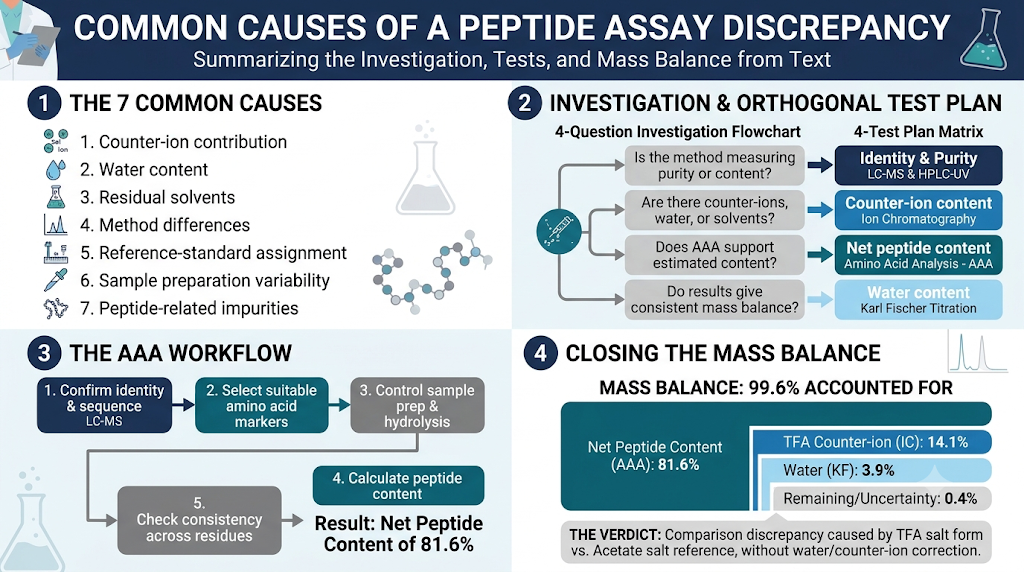
A discrepancy arises when the reported result reflects a different property than the one being compared, or when the sample contains components that change its measured mass or response. Typical causes include:
- Counter-ion contribution: TFA, acetate or other associated ions add to the total mass of a peptide salt.
- Water content: Residual moisture dilutes peptide content when results are expressed against total sample weight.
- Residual solvents: Solvents left after synthesis, purification or drying affect mass-based assay results.
- Method differences: Chromatographic area percentage, quantitative assay and amino acid-based content do not measure the same property.
- Reference-standard assignment: An incorrect potency assignment or unsuitable correction factor introduces systematic bias.
- Sample preparation variability: Incomplete dissolution, adsorption, transfer losses or inconsistent dilution affect recovery.
- Peptide-related impurities: Deletion sequences, truncated peptides, degradation products or modified species can influence results, depending on method selectivity.
A difference between 98% purity and 85% peptide content does not automatically mean the methods disagree. They may simply be measuring different attributes. Each suspected cause also needs analytical evidence: a synthetic peptide salt does not prove that counter-ions are the explanation.
Step 1: Structuring the Peptide Assay Discrepancy Investigation
The first step is to define what each reported number measures, and to remove every assumption that cannot be verified. We reviewed the sponsor’s data package and set up an orthogonal test plan.
Data Review Findings
- The reference standard had been assigned 100% on an as-is basis, with no water or counter-ion correction.
- The reference standard was an acetate salt; the test lot was a TFA salt from the final purification step.
- No independent content method, such as AAA, had been run on either material.
These three points did not prove the cause, but they told us where to look. We then planned four measurements: identity and purity confirmation, AAA for net peptide content, counter-ion quantification and water content.
The investigation is built to answer four questions:
- Is the chromatographic method measuring purity rather than absolute peptide content?
- Does the sample contain significant counter-ions, water or residual solvents?
- Can amino acid analysis independently support the estimated peptide content?
- Do the combined results give a consistent mass balance and a scientifically justified conclusion?
Test Plan Used
| Test | Technique | Question Answered |
|---|---|---|
| Identity and purity | LC-MS and HPLC-UV | Is the peptide correct and clean? |
| Net peptide content | Amino acid analysis (acid hydrolysis) | How much peptide is in the powder? |
| Counter-ion content | Ion chromatography (TFA, acetate, chloride) | How much salt is bound? |
| Water content | Karl Fischer titration | How much moisture is present? |
Step 2: Why Amino Acid Analysis Was the Deciding Test
Amino acid analysis determines net peptide content by hydrolyzing the peptide into its constituent amino acids and quantifying them against certified standards. Because it counts amino acid residues rather than UV absorbance, it is independent of chromatographic purity and of the salt form.
Our workflow followed accepted compendial principles, such as those described in USP <1052> and Ph. Eur. 2.2.56, with method suitability checks suited to the intended use:
- Acid hydrolysis (6 N HCl, 110 °C, 24 hours) in sealed, oxygen-free vials.
- Quantification of stable residues against an internal standard.
- Correction for known hydrolysis behavior: tryptophan is destroyed, asparagine and glutamine convert to aspartic and glutamic acid, and serine and threonine show partial loss.
- Calculation of net peptide content from residues with stable recovery, with replicate preparations.
The AAA Workflow Step by Step
- Confirm identity and sequence. Verify the expected sequence before calculating content, using LC-MS, high-resolution MS or MALDI-TOF mass spectrometry for peptide characterization where appropriate. This also shows whether sequence-related impurities need further work.
- Select suitable amino acid markers. Choose residues by sequence composition, hydrolysis stability and recovery, interference risk, availability of calibration standards and demonstrated repeatability. Non-standard residues and ring structures need extra care; see our notes on cyclic peptide characterization.
- Control sample preparation and hydrolysis. Weigh accurately and include blanks, calibration standards, system-suitability checks and recovery controls, since incomplete cleavage underestimates some residues while degradation reduces others.
- Calculate peptide content. Convert amino acid quantities to peptide amount using the known sequence composition and the molecular-weight relationship between the intact peptide and its residues, on a stated reporting basis.
- Check consistency across residues. Agreement between several residues strengthens the result; material differences point to residue-specific losses, calibration bias, interference, heterogeneity or degradation that must be resolved first.
AAA gives an estimate of peptide content, not automatically a definitive absolute assay. Its reliability depends on hydrolysis recovery, calibration, sequence integrity and the suitability of the calculation model.
Result: AAA gave a net peptide content of 81.6%, with a relative standard deviation under 2% across replicate hydrolyses. This was consistent with the potency the sponsor had seen, and far below the 98.7% HPLC assay value.
Step 3: How Counter-Ion Testing Explained the Missing Mass
Counter-ion testing identifies and quantifies the salt ions bound to the peptide, which is the most common hidden contributor to the gap between purity and content. Peptides purified by reversed-phase HPLC with TFA typically retain TFA at positively charged residues such as lysine, arginine, histidine and the N-terminus.
We used ion chromatography to quantify TFA, acetate and chloride, and Karl Fischer titration for water:
- TFA: 14.1% (w/w)
- Acetate: below the quantitation limit
- Chloride: below the quantitation limit
- Water (Karl Fischer): 3.9% (w/w)
This showed that the lot was a TFA salt, while the sponsor’s reference standard was an acetate salt. The two materials had different molecular weights per mole of peptide, so comparing them without correction guaranteed a biased assay.
Step 4: Closing the Mass Balance
A mass balance check confirms that every component of the powder is accounted for. When the independent results add up to about 100%, the explanation is credible.
| Component | Method | Result (% w/w) |
|---|---|---|
| Net peptide content | Amino acid analysis | 81.6 |
| TFA counter-ion | Ion chromatography | 14.1 |
| Water | Karl Fischer | 3.9 |
| Total accounted for | 99.6 |
The remaining 0.4% sits within the combined uncertainty of the methods. LC-MS confirmed the correct molecular mass and no unexpected modifications, so the discrepancy was not caused by a wrong or degraded peptide.
4: Root Cause of the Peptide Assay Discrepancy
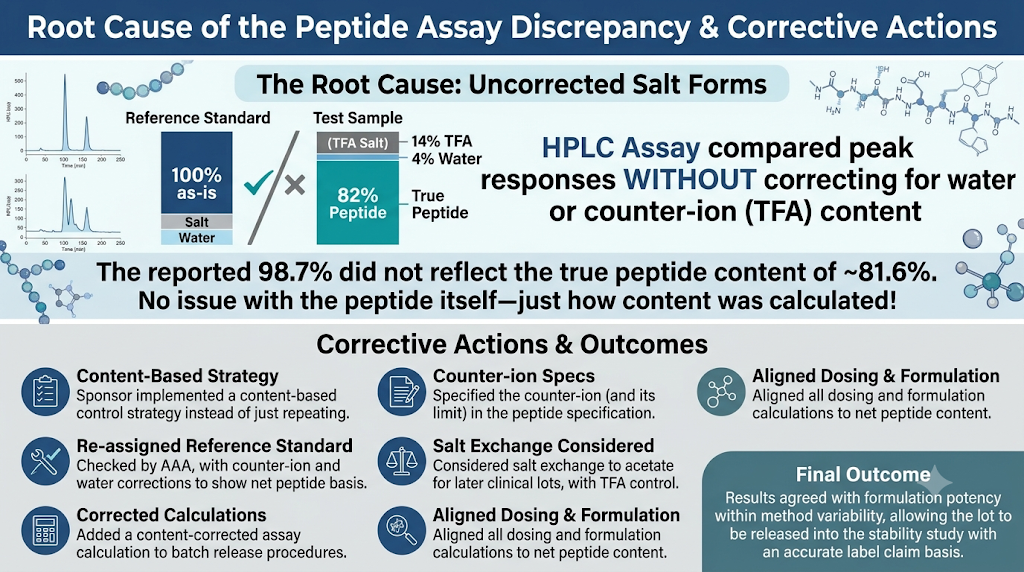
The root cause was a reference standard and a test sample in different salt forms, with neither corrected for water or counter-ion content. In short:
- The reference standard was assigned 100% as-is, though it also contained salt and water.
- The sample was a TFA salt with roughly 14% TFA by weight, plus about 4% water.
- The HPLC assay compared peak responses without correcting either material to a peptide-only basis.
- The reported 98.7% therefore did not reflect the true peptide content of about 81.6%.
Nothing was wrong with the peptide itself. The problem was how content was assigned.
Corrective Actions and Outcome
The sponsor implemented a content-based control strategy rather than only repeating the original assay:
- Re-assigned the reference standard by AAA, with counter-ion and water corrections, so it is expressed on a net peptide basis.
- Added a content-corrected assay calculation to the batch release procedure.
- Specified the counter-ion (and its limit) in the peptide specification.
- Considered salt exchange to acetate for later clinical lots, with TFA control as a criterion.
- Aligned dosing and formulation calculations to net peptide content.
After correction, assay results agreed with formulation potency within method variability, and the lot was released into the stability study with an accurate label claim basis.
Best Practices for Any Peptide Assay Discrepancy Investigation
- Define what each method measures before comparing numbers.
- Always report whether a value is on an as-is, anhydrous or peptide-only basis.
- Use an orthogonal content method (AAA or quantitative NMR) to assign reference standards; see NMR vs LC-MS for peptide characterization for how the techniques compare.
- Test counter-ions and water together, then close the mass balance.
- Keep salt forms consistent between standard and sample, or apply a documented correction.
- Validate or verify methods for their intended use in line with ICH Q2(R2) principles, and build a data package that supports therapeutic peptide characterization for NDA and ANDA submissions.
- Document every assumption so the investigation is auditable.
Why Work With ResolveMass Laboratories Inc.
ResolveMass Laboratories Inc. is a Canadian analytical CRO/CDMO with deep experience in mass spectrometry, biosimilar characterization, PLGA-based drug delivery and nitrosamine testing. Our scientists design peptide investigations around the question your data raise, not a fixed menu of tests. Our peptide characterization CRO deliverables checklist shows what a complete data package should contain, and our guide to the peptide characterization timeline helps you plan realistic turnaround.
- Orthogonal toolkit: LC-MS, HPLC, amino acid analysis, ion chromatography and Karl Fischer under one roof.
- Documented, defensible data: methods and reports written to support regulatory submissions and audits.
- Scientist-led communication: clear explanation of what was tested, why, and what the result means for your program.
- Confidentiality: client data and materials are handled under strict confidentiality.
If you are facing a conflicting peptide result, you can contact ResolveMass Laboratories to discuss your data with our team.
Conclusion:
A well-run Peptide Assay Discrepancy Investigation replaces guesswork with a closed mass balance. In this case, amino acid analysis, counter-ion testing and water determination showed that a 98.7% assay and an 81.6% net peptide content were both “correct” for what each measured, and that mismatched salt forms and missing corrections caused the gap.
Frequently Asked Questions:
Amino acid analysis (AAA) measures constituent amino acids, typically following hydrolysis. Using the known peptide sequence and suitable calibration and recovery controls, the results can help estimate peptide content and independently assess an initial assay result.
Counter-ions such as trifluoroacetate (TFA), acetate, and chloride may contribute to the total mass of an isolated peptide salt. When peptide content is reported as a percentage of the total sample weight, this additional mass can reduce the apparent peptide percentage.
Peptide purity describes the relative proportion of the target peptide compared with detected impurities under a defined analytical method. Peptide content estimates the amount of peptide in the sample, often relative to its total weight. These measurements are different and should not be used interchangeably.
Yes. TFA associated with a peptide can contribute to the total sample mass and lower the peptide percentage on an as-received mass basis. However, its contribution must be quantified before concluding that it explains the assay discrepancy.
Water increases the total sample mass without increasing the amount of peptide. Consequently, elevated moisture can lower the apparent peptide content when the result is expressed on an as-received basis. Karl Fischer titration is commonly used to determine water content.
A peptide mass-balance assessment compares the measured or estimated contributions of peptide, counter-ions, water, residual solvents, and other relevant components. It helps determine whether the sample’s composition explains the observed assay result, while accounting for uncertainty and avoiding double-counting.
Reference
- Guo D, Mant CT, Hodges RS. Effects of ion-pairing reagents on the prediction of peptide retention in reversed-phase high-resolution liquid chromatography. Journal of Chromatography A. 1987 Jan 1;386:205-22.https://www.sciencedirect.com/science/article/pii/S0021967301945984
- Melanson JE, Thibeault MP, Stocks BB, Leek DM, McRae G, Meija J. Purity assignment for peptide certified reference materials by combining qNMR and LC-MS/MS amino acid analysis results: application to angiotensin II: Melanson JE et al. Analytical and bioanalytical chemistry. 2018 Oct;410(26):6719-31.https://link.springer.com/article/10.1007/s00216-018-1272-7
- Gucinski AC, Boyne MT. Identification of site‐specific heterogeneity in peptide drugs using intact mass spectrometry with electron transfer dissociation. Rapid Communications in Mass Spectrometry. 2014 Aug 15;28(15):1757-63.https://analyticalsciencejournals.onlinelibrary.wiley.com/doi/abs/10.1002/rcm.6957
- Josephs RD, Martos G, Li M, Wu L, Melanson JE, Quaglia M, Beltrão PJ, Prevoo-Franzsen D, Boeuf A, Delatour V, Öztug M. Establishment of measurement traceability for peptide and protein quantification through rigorous purity assessment—a review. Metrologia. 2019 Aug 1;56(4):044006.https://iopscience.iop.org/article/10.1088/1681-7575/ab27e5/meta
About the Author