


Introduction
Peptide characterization data produced by a Contract Research Organization (CRO) may be submitted to the U.S. Food and Drug Administration (FDA) through a Drug Master File (DMF) or supplied to an applicant sponsor for inclusion in Electronic Common Technical Document (eCTD) Module 3. However, a CRO cannot submit standalone analytical characterization data as an independent, unassociated regulatory application. The data must be connected to an active DMF or incorporated into a sponsor’s specific investigational or commercial regulatory dossier.
Within the framework of a Peptide Characterization CRO FDA Submission, biopharmaceutical sponsors and specialized analytical laboratories must work through complex regulatory pathways overseen by the Center for Drug Evaluation and Research (CDER). Peptides, which the FDA defines as polymers consisting of 40 or fewer amino acids, occupy a regulatory category that differs from both small molecules and large biologics. Whether the product involves a novel synthetic peptide being developed under an Investigational New Drug (IND) application or a generic synthetic peptide submitted through an Abbreviated New Drug Application (ANDA), comprehensive analytical characterization is essential for demonstrating physical stability, higher-order structure, and active pharmaceutical ingredient (API) sameness. Since advanced peptide characterization frequently requires high-field nuclear magnetic resonance (NMR), high-resolution tandem mass spectrometry (HR-MS/MS), and circular dichroism (CD), biopharmaceutical developers commonly work with specialized contract laboratories. A clear understanding of the formal regulatory pathways governing the transfer of CRO-generated analytical data to the agency is therefore critical for protecting intellectual property and supporting regulatory approval.
Explore GLP-1 peptide characterization services:
Learn more about CRO for GLP-1 peptide characterization
Share via:
Quick Summary:
- FDA submission pathway: CRO-generated peptide characterization data cannot be submitted independently; it must be incorporated into a sponsor’s eCTD Module 3 or maintained in a referenced Drug Master File (DMF).
- Two main routes: Sponsors can use direct Module 3 integration for full data transfer or a Type II DMF when confidential CRO/CDMO methods and trade secrets need protection. Type V DMFs are limited and generally require FDA clearance.
- LOA is essential: A Letter of Authorization (LOA) connects a DMF to a specific IND, NDA, or ANDA, allowing FDA reviewers to access confidential characterization information.
- Comprehensive characterization: Peptide API sameness requires orthogonal techniques such as HR-MS/MS, 2D-NMR, circular dichroism (CD), FTIR, and SEC-MALS to evaluate primary, secondary, tertiary, and aggregation characteristics.
- Impurity assessment: Synthetic peptide impurities—including deletions, truncations, racemization, insertions, and aggregates—must be characterized. New impurities above 0.5% require additional structural and immunogenicity risk assessment.
- Data integrity & quality: CRO data should be generated under appropriate GLP/cGMP controls, with 21 CFR Part 11, validated analytical methods, secure audit trails, and appropriate peak-purity assessments.
- Four-phase workflow: Successful submissions progress through method qualification → comparative batch/impurity analysis → dossier/DMF preparation → FDA query and response management, supporting a complete and defensible regulatory package.
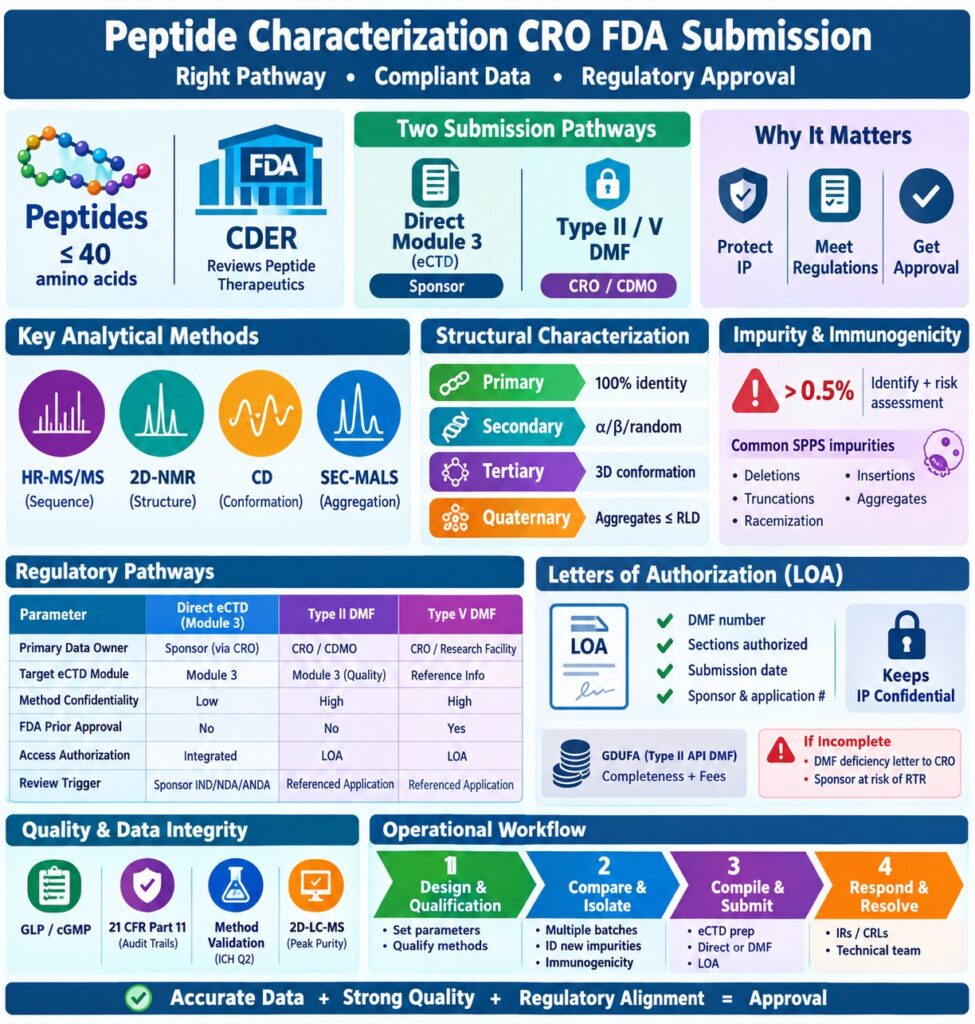
Regulatory Mechanisms for a Peptide Characterization CRO FDA Submission
The FDA recognizes two primary regulatory mechanisms through which third-party analytical characterization data can support a regulatory submission: direct integration by the sponsor into the eCTD Module 3 dossier or confidential submission by the CRO through a Drug Master File (DMF). The appropriate approach depends on factors such as the proprietary nature of the analytical methods, ownership of the information, and contractual arrangements established between the testing laboratory and the drug applicant.
Federal requirements under Title 21 of the Code of Federal Regulations (21 CFR) establish that the FDA does not review standalone analytical reports independently of an associated regulatory submission. Analytical characterization information must be connected to an authorized regulatory dossier. When a biopharmaceutical sponsor engages an independent testing laboratory to perform sophisticated structural elucidation, two separate administrative pathways are available for communicating the resulting technical information to CDER reviewers.
Direct Module 3 Integration vs. Drug Master File Submissions
Direct Module 3 integration occurs when the CRO provides complete analytical reports to the sponsor, who then incorporates the information into sections 3.2.S.3.1 and 3.2.S.3.2 of the application dossier. By comparison, a Drug Master File submission enables a CRO or Contract Development and Manufacturing Organization (CDMO) to submit confidential analytical information directly to the FDA through a Type II or Type V file, allowing a sponsor to reference the information without receiving access to protected trade secrets.
Under a direct data-transfer model, the CRO functions as a contract analytical testing provider. After completing characterization activities—such as amino acid sequencing, disulfide bond mapping, or secondary structure determination—the CRO prepares a validated analytical package. This package may contain certificates of analysis (CoAs), raw spectra, analytical results, and method validation documentation. The sponsor subsequently incorporates these deliverables into Module 3 (Quality) of the eCTD submission. Structural elucidation information is specifically presented in Section 3.2.S.3.1 (Elucidation of Structure and Other Characteristics), while synthetic impurity profiles, deletion sequences, and aggregate evaluations are reported under Section 3.2.S.3.2 (Impurities).
A different approach may be appropriate when the CRO relies on proprietary analytical algorithms, specialized ionization techniques, or proprietary synthesis-characterization platforms that constitute protected trade secrets. In such circumstances, transferring the complete information directly to the sponsor may not be appropriate. Instead, the CRO may submit a Type II DMF covering drug substances, drug substance intermediates, or API characterization directly to the FDA through the Electronic Submissions Gateway (ESG). In limited circumstances involving non-manufacturing reference information, a Type V DMF may be considered; however, the FDA specifically discourages Type V filings unless prior agency approval has been obtained. Once submitted, the agency assigns a unique DMF number to the file, although the DMF remains unreviewed until it is referenced by a sponsor’s regulatory application.
Need support with a regulatory-ready characterization package?
Explore the peptide characterization CRO deliverables checklist
| Regulatory Parameter | Direct Sponsor eCTD Integration | Type II Drug Master File (DMF) | Type V Drug Master File (DMF) |
|---|---|---|---|
| Primary Data Owner | Sponsor (via CRO Data Transfer) | CRO / CDMO / API Manufacturer | CRO / Independent Research Facility |
| Target eCTD Module | Module 3 (3.2.S.3.1 & 3.2.S.3.2) | Module 3 Quality Dossier (Type II) | Reference Information Dossier (Type V) |
| Method Confidentiality | Low (Full methods shared with sponsor) | High (Methods hidden from sponsor) | High (Methods hidden from sponsor) |
| FDA Prior Approval Needed | No | No | Yes (Explicit agency clearance required) |
| Access Authorization | Integrated within Sponsor Application | Letter of Authorization (LOA) | Letter of Authorization (LOA) |
| Review Trigger | Sponsor IND, NDA, or ANDA Review | Referenced Application Review Cycle | Referenced Application Review Cycle |
Legal Mechanics and Intellectual Property Protection via Letters of Authorization
A Letter of Authorization (LOA) is a formal administrative document submitted to the FDA by a Drug Master File holder. It gives FDA reviewers explicit permission to examine confidential third-party information in support of a particular sponsor application. Without an active LOA connecting the DMF to the sponsor’s regulatory dossier, the FDA cannot review the referenced DMF characterization information as part of an IND, NDA, or ANDA review cycle.
The administrative structure surrounding DMF references is designed to preserve the confidentiality of proprietary laboratory methods while allowing the FDA to conduct the comprehensive quality assessment required for regulatory review. When a sponsor submits a regulatory application that depends on characterization data maintained within a CRO’s DMF, the CRO must provide an LOA to the FDA in eCTD format. The LOA must identify the DMF number, the specific technical sections being authorized for review, the submission date, and the exact name and application number associated with the sponsor’s incoming regulatory filing. At the same time, the CRO provides a copy of the LOA to the sponsor, which places the document in Module 1 (1.4.1) of its own eCTD submission.
Under the Generic Drug User Fee Amendments (GDUFA), Type II API DMFs supporting generic synthetic peptide ANDAs must undergo a detailed completeness assessment and meet applicable fee requirements before the sponsor’s application can proceed through the review process. If the characterization information contained in a CRO’s DMF is incomplete or deficient—for example, if it does not contain validated 2D-LC-MS peak purity assessments or sufficiently comprehensive higher-order conformational analyses—the FDA may issue a DMF deficiency letter directly to the CRO. The sponsor is informed that deficiencies exist but does not receive the confidential technical details. If the CRO does not address the deficiencies within the required timeframe, the sponsor’s ANDA may be at risk of receiving a Refusal-to-Receive (RTR).
Technical Standards and Analytical Guidance for Peptide Characterization
Regulatory assessment of peptide therapeutics requires extensive characterization of the primary amino acid sequence, higher-order tertiary structures, and synthetic impurity profiles through orthogonal analytical approaches. To meet FDA expectations for API sameness and quality control, characterization packages must follow applicable agency guidances and product-specific requirements.
Synthetic peptide therapeutics create specific analytical challenges because of their tendency toward aggregation, conformational flexibility, and complicated synthetic impurity profiles. FDA regulatory guidance—including ANDAs for Certain Highly Purified Synthetic Peptide Drug Products That Refer to Listed Drugs of rDNA Origin—requires generic synthetic peptides, including glucagon, liraglutide, semaglutide, teriparatide, and tirzepatide, to establish active ingredient sameness relative to the Reference Listed Drug (RLD).
Review regulatory considerations for GLP-1 peptide characterization:
Explore regulatory requirements for GLP-1 peptide characterization
Structural Characterization and API Sameness Demonstration
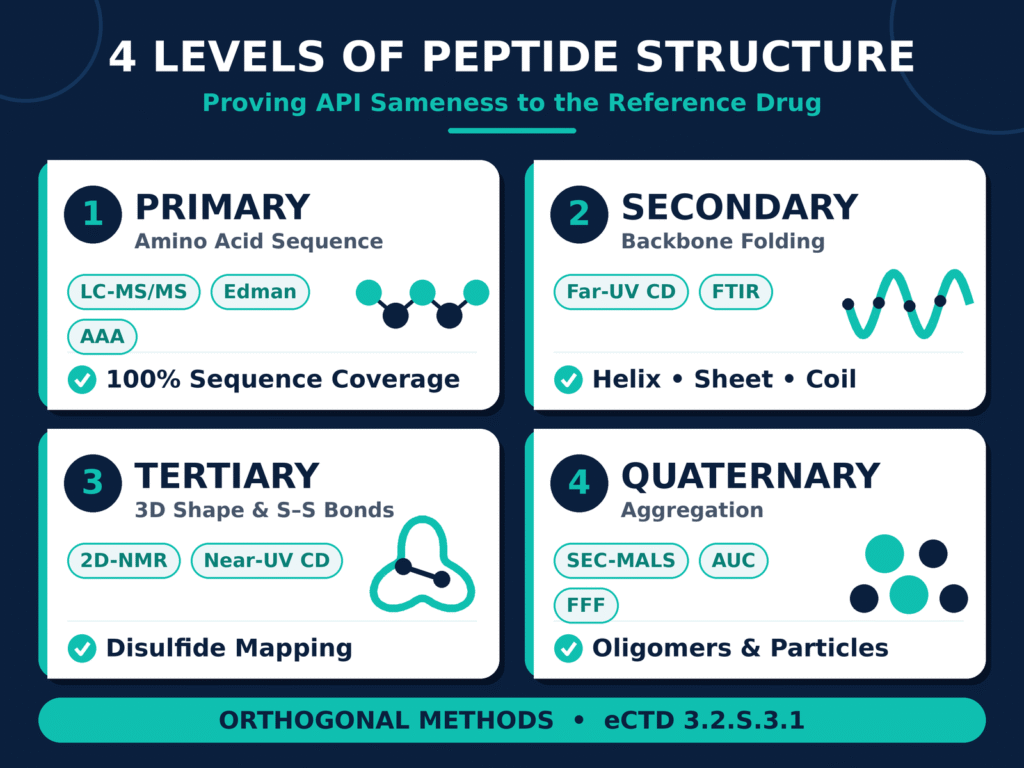
Demonstrating API sameness for generic synthetic peptides requires comprehensive evidence that the primary, secondary, tertiary, and oligomeric structures correspond to those of the Reference Listed Drug (RLD) across multiple manufacturing batches. CRO analytical testing should therefore incorporate orthogonal technologies such as high-resolution tandem mass spectrometry, circular dichroism, 2D-NMR, and SEC-MALS to address the requirements associated with eCTD Section 3.2.S.3.1.
A compliant structural characterization package generated by a contract laboratory should address four distinct structural levels:
- Primary Structure Verification: The complete amino acid sequence must be established with 100% sequence coverage using high-resolution tandem mass spectrometry (LC-MS/MS peptide mapping), Edman degradation, and amino acid analysis (AAA). Mass accuracy must reach parts-per-million (ppm) precision to distinguish between isobaric residue substitutions.
- Secondary Structure Elucidation: Backbone conformational folding, including alpha-helical, beta-sheet, and random coil percentages, must be characterized under both native and stress conditions using Far-UV Circular Dichroism (CD) and Fourier-Transform Infrared (FTIR) spectroscopy.
- Tertiary Structure Assessment: Three-dimensional molecular conformation, side-chain spatial orientation, and disulfide bonding patterns must be characterized using high-field multi-dimensional Nuclear Magnetic Resonance (2D-NMR) spectroscopy and Near-UV CD.
- Quaternary Structure and Aggregation Profiling: Oligomeric self-association and sub-visible particle formation must be assessed using Size-Exclusion Chromatography with Multi-Angle Light Scattering (SEC-MALS), Analytical Ultracentrifugation (AUC), and Field-Flow Fractionation (FFF).
Learn more about GLP-1 peptide sequencing:
Explore peptide sequencing of GLP-1 peptides
Impurity Profiling and Immunogenicity Risk Evaluation
FDA requirements state that new peptide-related impurities present in a generic synthetic peptide above 0.5% of the API require comprehensive structural identification and immunogenicity risk assessment. Characterization studies must establish that the impurity profile of the generic product does not introduce novel T-cell epitopes or contain impurity levels exceeding those observed in the reference product.
Solid-Phase Peptide Synthesis (SPPS) commonly produces side-products, including deletion sequences, insertion variants, truncated peptides, racemized diastereomers, and beta-sheet aggregates. The FDA requires comparative impurity assessments involving multiple batches of the generic peptide and commercial lots of the RLD.
Learn more about peptide secondary-structure analysis:
Explore CD spectroscopy for peptide secondary-structure characterization
For specified common impurities found in both generic and RLD batches, the concentration in the generic product must not be higher than the corresponding level in the RLD. For proposed new peptide impurities occurring at concentrations between 0.1% and 0.5% of the API, structural identification is required. A new peptide impurity present above the 0.5% threshold requires an immunogenicity risk assessment. CROs may perform these assessments using in silico T-cell epitope prediction tools together with in vitro human peripheral blood mononuclear cell (PBMC) cytokine release assays to determine whether the impurity introduces an increased immunogenic risk compared with the RLD.
Explore impurity characterization for GLP-1 peptides:
Learn more about GLP-1 peptide impurity characterization
| Quality Attribute | Primary Analytical Methodology | Regulatory Acceptance Criteria |
|---|---|---|
| Primary Sequence | High-Resolution LC-MS/MS, Edman Degradation | 100% sequence identity to RLD |
| Secondary/Tertiary Structure | Far/Near-UV CD, FTIR, 2D-NMR (¹H, ¹³C, ¹⁵N) | Spectral overlay matching RLD conformation |
| Aggregation Profile | SEC-MALS, Analytical Ultracentrifugation (AUC) | Aggregates ≤ RLD maximum levels |
| Peptide Impurity Profiling | 2D-LC-MS, Ion-Exchange Chromatography (IEX) | Impurities >0.5% identified & screened |
| Biological Activity | Cell-Based Functional Bioassays, Receptor Binding | Equivalent bioactivity and potency to RLD |
Quality Management Systems and Data Integrity Mandates
Analytical characterization datasets submitted to the FDA must be generated in facilities operating under applicable Good Laboratory Practice (GLP) or current Good Manufacturing Practice (cGMP) requirements and appropriate 21 CFR Part 11 controls. FDA reviewers may reject analytical datasets that do not contain fully audited and unalterable electronic records, appropriate method validation documentation, or adequate peak purity verification in accordance with ICH Q2(R1)/Q2(R2) criteria.
The regulatory reliability of a CRO characterization package is closely linked to the strength of its Quality Management System (QMS). Data produced during structural elucidation or API sameness investigations must comply with 21 CFR Part 11 requirements. This includes ensuring that mass spectrometers, NMR spectrometers, and chromatography data systems maintain secure, automated, and time-stamped audit trails.
Analytical methods applied to purity quantification and impurity profiling must undergo formal validation in accordance with ICH Q2(R1)/Q2(R2) guidelines. Validation should demonstrate specificity, linearity, accuracy, precision, and robustness. In addition, contract laboratories must verify chromatographic peak purity using advanced two-dimensional liquid chromatography coupled with high-resolution mass spectrometry (2D-LC-MS) to ensure that co-eluting degradants or isomeric impurities do not compromise purity measurements.
Learn more about analytical approaches for peptide stability:
Explore GLP-1 peptide stability and analytical methods
Operational Strategic Workflow for Sponsors and Testing Laboratories
A successful regulatory submission incorporating CRO-generated peptide characterization data requires a structured phase-gate approach. This process extends from initial method validation and comparative batch testing through electronic dossier preparation and coordinated regulatory responses. Establishing clear quality agreements and assigning eCTD submission responsibilities at an early stage can help reduce the risk of costly Refusal-to-Receive (RTR) decisions and submission holds.
To support an efficient regulatory filing that incorporates third-party analytical characterization data, sponsors and testing laboratories should follow a structured four-phase operational workflow:
- Phase 1: Analytical Protocol Design and Method Qualification
- Establish characterization parameters according to relevant FDA Product-Specific Guidances (PSGs) and the requirements applicable to the peptide class.
- Qualify orthogonal analytical platforms, including HR-MS/MS, 2D-NMR, CD, and SEC-MALS, under formal quality agreements.
- Phase 2: Comparative Batch Analysis and Impurity Isolation
- Conduct comparative testing using multiple API lots and multiple commercial RLD lots.
- Isolate and structurally characterize unknown peptide impurities exceeding 0.1%, followed by in silico and in vitro immunogenicity screening for new impurities above 0.5%.
- Phase 3: Dossier Compilation and Submission Formatting
- Option A (Direct Transfer): Prepare validated analytical reports and raw data for direct incorporation by the sponsor into eCTD Sections
3.2.S.3.1and3.2.S.3.2. - Option B (DMF Filing): Organize proprietary CRO data into a Type II DMF eCTD package, submit it through the FDA Electronic Submissions Gateway, satisfy GDUFA fee requirements, and provide the sponsor with an official LOA.
- Option A (Direct Transfer): Prepare validated analytical reports and raw data for direct incorporation by the sponsor into eCTD Sections
- Phase 4: Post-Submission Defense and Query Resolution
- Maintain coordinated technical response teams capable of addressing FDA Information Requests (IRs) or Complete Response Letters (CRLs) during the application review process.
Explore advanced peptide quality-attribute monitoring:
Learn about multi-attribute monitoring for peptide characterization
Conclusion
Navigating a Peptide Characterization CRO FDA Submission involves selecting an appropriate pathway between direct Module 3 data transfer and confidential Type II or Type V Drug Master File filings supported by formal Letters of Authorization. Applying orthogonal analytical techniques within compliant cGMP quality systems supports API sameness assessment, data integrity, and the overall regulatory submission process. Through the use of high-resolution mass spectrometry, multi-dimensional NMR, and validated impurity profiling, biopharmaceutical applicants and testing partners can develop comprehensive characterization packages aligned with CDER regulatory expectations.
To learn more about advanced mass spectrometry, structural elucidation, and regulatory characterization support for peptide submissions, visit ResolveMass Laboratories Contact Page.
Frequently Asked Questions
Peptide characterization information is generally included within eCTD Module 3, which covers Quality and CMC information. Structural elucidation and physical characterization are reported in Section 3.2.S.3.1, while impurity profiles and aggregate-related information are addressed in Section 3.2.S.3.2. The specific placement depends on the nature of the analytical data.
For generic synthetic peptides, new peptide-related impurities present above 0.5% of the active pharmaceutical ingredient require structural identification and appropriate immunogenicity risk evaluation. New impurities occurring between 0.1% and 0.5% also require structural identification. The applicable regulatory assessment should follow the relevant FDA guidance.
Peptide API sameness is supported through complementary analytical techniques that examine different structural characteristics. High-resolution LC-MS/MS can assess the primary sequence, while Far/Near-UV CD and FTIR evaluate secondary structure. 2D-NMR provides information on tertiary conformation, while SEC-MALS and AUC support aggregation and quaternary structure assessment.
A Type II DMF is used for information concerning drug substances, drug substance intermediates, and related technical information. A Type V DMF contains miscellaneous reference information that does not fall within other DMF categories. The FDA generally discourages using Type V DMFs for analytical information unless the agency has provided prior permission.
A Letter of Authorization (LOA) permits the FDA to access specified confidential information contained within a CRO’s DMF for a particular sponsor application. The sponsor can reference the information without receiving the CRO’s proprietary analytical methods or protected technical details. This mechanism helps maintain confidentiality while allowing the FDA to conduct its regulatory review.
Certain synthetic peptides containing 40 or fewer amino acids that reference eligible rDNA-origin products may use the ANDA pathway under section 505(j). The applicant must satisfy applicable FDA requirements for active pharmaceutical ingredient (API) sameness and other quality attributes. Comparative analytical characterization is an important component of demonstrating the required relationship to the Reference Listed Drug.
2D-LC-MS combines two-dimensional chromatographic separation with high-resolution mass spectrometry to improve the characterization of complex peptide mixtures. It can help distinguish co-eluting or structurally related impurities that may not be adequately resolved using conventional 1D-LC. This makes the technique valuable for peak purity assessment and impurity characterization.
When the FDA requests additional information related to confidential data contained in a CRO’s DMF, the DMF holder generally provides the required response directly to the agency. The CRO may submit a DMF amendment or other appropriate regulatory response addressing the technical questions. Confidential information can therefore remain within the DMF while supporting the sponsor’s application review.
Reference:
- U.S. Food and Drug Administration. (2023). Clinical pharmacology considerations for peptide drug products [Draft guidance]. https://www.fda.gov/regulatory-information/search-fda-guidance-documents/clinical-pharmacology-considerations-peptide-drug-products
- U.S. Food and Drug Administration. (2022). Sameness evaluations in an ANDA—Active ingredients: Guidance for industry [Draft guidance]. https://www.fda.gov/media/163018/download
- U.S. Food and Drug Administration. (2022). Draft pharmaceutical quality/chemistry manufacturing and controls (PQ/CMC) data exchange. https://www.fda.gov/media/157293/download
- U.S. Food and Drug Administration. (1989). Guideline for drug master files (DMF). Center for Drug Evaluation and Research, U.S. Department of Health and Human Services. FDA: Guideline for Drug Master Files
- U.S. Food and Drug Administration. (2026, July 28). FDA publishes revised draft product-specific guidances for certain generic peptide products. https://www.fda.gov/drugs/drug-alerts-and-statements/fda-publishes-revised-draft-product-specific-guidances-certain-generic-peptide-products
Get In Touch With Us
About The Author


