

Introduction
Peptide drugs require highly specialized containment and handling measures at a contract development and manufacturing organization (CDMO) because their high biological potency, potential to cause immunological sensitization, and the hazardous reagents used during synthesis can create significant risks of operator exposure and batch cross-contamination. Selecting infrastructure designed to support an expert Peptide Drug Containment CDMO workflow enables drug developers to satisfy stringent worker safety requirements and global regulatory expectations throughout development and commercial manufacturing activities.
For sponsors evaluating specialized manufacturing infrastructure, understanding the capabilities of a peptide CDMO in Canada can help when assessing containment, development, analytical, and manufacturing requirements.
In the past, biopharmaceutical developers often considered synthetic peptides to be relatively low-hazard biological molecules because they are composed primarily of naturally occurring amino acids. However, contemporary therapeutic peptide candidates commonly contain non-natural amino acids, macrocyclic structures, and chemical modifications intended to substantially improve metabolic stability and target receptor affinity. These structural modifications can reduce therapeutic daily doses to the microgram range, placing many modern peptide products within high-potency active pharmaceutical ingredient (HPAPI) hazard classifications. As a result, performing peptide synthesis, cleavage, purification, lyophilization, and powder handling without appropriate isolation measures can expose facility personnel to toxicological hazards while also increasing the risk of compromising cleanroom sterility.
Learn more about the differences between peptide and small-molecule drugs and their development considerations.
Share via:
Quick Summary:
- Specialized containment is essential for peptide drugs because high biological potency, immunological sensitization, and hazardous synthesis reagents can create serious operator-exposure and cross-contamination risks.
- OEB/OEL classification guides containment: peptides may range from OEB 1 to OEB 6, with advanced HPAPIs and conjugates requiring increasingly stringent controls, including isolators and fully closed systems.
- Peptide hazards are both biological and chemical: microgram-level potency and possible IgE sensitization add biological risks, while SPPS reagents such as HATU, DCC, piperidine, TFA, EDT, and TIS create chemical hazards.
- Layered engineering controls protect workers and products: primary barriers include negative-pressure isolators, SBVs/RTPs, and continuous liners, while secondary controls include pressure cascades, single-pass HVAC, and HEPA/ULPA filtration.
- Cleaning validation must be toxicology-based: PDE/ADE and MACO calculations establish scientifically justified carryover limits, supported by analytical methods such as TOC, HPLC-CAD, and LC-MS.
- CDMO selection requires documented evidence: sponsors should assess containment performance, HVAC infrastructure, cleaning validation, cGMP compliance, and analytical capabilities, including SMEPAC testing and regulatory inspection records.
- Effective containment supports safer manufacturing: properly designed containment systems help protect personnel, reduce cross-contamination, maintain regulatory compliance, and support reliable peptide development through commercialization.
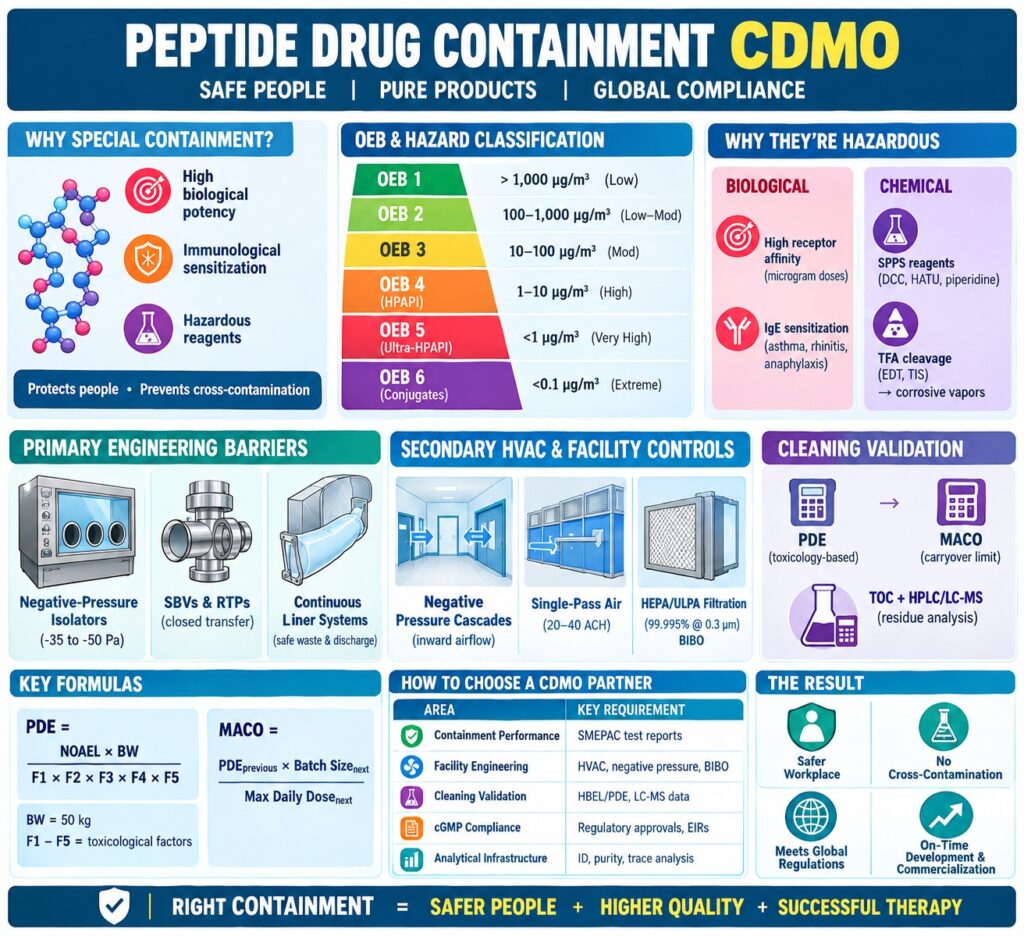
Occupational Exposure Bands and Hazard Classification for Peptide Drug Containment CDMO Facilities
Contract development and manufacturing organizations determine appropriate containment requirements by assigning therapeutic peptides to Occupational Exposure Bands (OEBs) according to their toxicological potency and Occupational Exposure Limits (OELs). Applying a structured exposure-banding framework within a Peptide Drug Containment CDMO establishes the appropriate primary barrier controls, facility pressurization requirements, and operating procedures needed for safe processing.
An active pharmaceutical ingredient is generally classified as an HPAPI when its occupational exposure limit is below 10 µg/m³ as an 8-hour time-weighted average (TWA), or when its therapeutic daily dose is below 10 mg. While un-modified linear peptides may fall within OEB 2 (100–1,000 µg/m³) or OEB 3 (10–100 µg/m³), advanced long-acting peptide agonists, cyclic structures, and peptide-drug conjugates (PDCs) can fall within OEB 4 (1–10 µg/m³), OEB 5 (<1 µg/m³), or OEB 6 (<0.1 µg/m³).
| Occupational Exposure Band (OEB) | Occupational Exposure Limit (OEL) Range | Hazard Severity Classification | Required Primary Engineering & Containment Controls |
|---|---|---|---|
| OEB 1 | > 1,000 µg/m³ | Low | General room ventilation, open benches with basic local exhaust ventilation (LEV). |
| OEB 2 | 100–1,000 µg/m³ | Low to Moderate | Ventilated powder handling hoods, localized extraction, standard PPE. |
| OEB 3 | 10–100 µg/m³ | Moderate | High-efficiency containment hoods, downflow booths, dedicated extraction systems. |
| OEB 4 (HPAPI) | 1–10 µg/m³ | High | Rigid or flexible barrier isolators, split butterfly valves (SBVs), restricted access barrier systems (RABS). |
| OEB 5 (Ultra-HPAPI) | <1 µg/m³ | Very High | Negative-pressure glovebox isolators, rapid transfer ports (RTPs), continuous liner systems, integrated CIP. |
| OEB 6 (Conjugates) | <0.1 µg/m³ (<100 ng/m³) | Extreme | Fully contained isolator suites, dedicated single-use technology, automated closed-loop systems. |
During technology transfer, when a candidate peptide does not have sufficient preclinical toxicological information available, CDMO safety committees may assign a default high-containment classification, commonly OEB 4 or OEB 5. This precautionary approach helps limit operator exposure until sufficient empirical health hazard information becomes available for a more definitive assessment.
Explore custom peptide synthesis services for development programs requiring specialized peptide synthesis capabilities.
Toxicological and Immunological Mechanisms Driving Specialized Handling
Therapeutic peptides require specialized containment because of their high target affinity at microgram-level doses, their potential to cause IgE-mediated Type I respiratory sensitization, and the significant hazards associated with chemical reagents used during solid-phase synthesis. Together, these biological and chemical characteristics mean that even non-cytotoxic peptides can create substantial occupational hygiene concerns when adequate containment is not implemented.
Biological Potency and Immunological Sensitization Hazards
Inhalation or absorption of trace quantities of active peptide particulates can produce systemic biological responses and potentially cause significant respiratory sensitization among facility personnel. Unlike conventional small molecule toxins that may primarily produce cumulative systemic organ toxicity, therapeutic peptides function as high-affinity ligands capable of selectively modulating cell surface receptors at very low concentrations. In addition, macrocyclic and chemically modified peptides can possess occupational sensitization potential. Inhalation of atomized peptide dust may result in IgE-mediated Type I immediate hypersensitivity reactions and, following repeated low-level exposure, may contribute to occupational asthma, rhinitis, or systemic anaphylaxis. Because immunological sensitization does not necessarily have a clearly established toxicological threshold or No Observed Adverse Effect Level (NOAEL), stringent control of peptide dust is essential.
Chemical Hazards in Solid Phase Peptide Synthesis and Cleavage
Solid Phase Peptide Synthesis (SPPS) involves hazardous organic reagents, toxic solvents, and corrosive acids well before the final peptide API is recovered. The synthesis cycle can require coupling agents such as N,N’-dicyclohexylcarbodiimide (DCC) and O-(7-azabenzotriazol-1-yl)-N,N,N’,N’-tetramethyluronium hexafluorophosphate (HATU), together with base deprotection agents such as piperidine. These materials can present substantial dermal and respiratory hazards. During the final cleavage step, the peptide is released from the solid resin support using concentrated trifluoroacetic acid (TFA) cocktails that may contain hazardous scavengers such as ethanedithiol (EDT) and triisopropylsilane (TIS). Because TFA can produce corrosive acid vapors, the process requires local exhaust ventilation, chemical scrubbers, and appropriately designed corrosion-resistant primary enclosures.
Review GMP peptide API manufacturing services for considerations related to controlled peptide API production.
Primary and Secondary Engineering Controls in Peptide Manufacturing
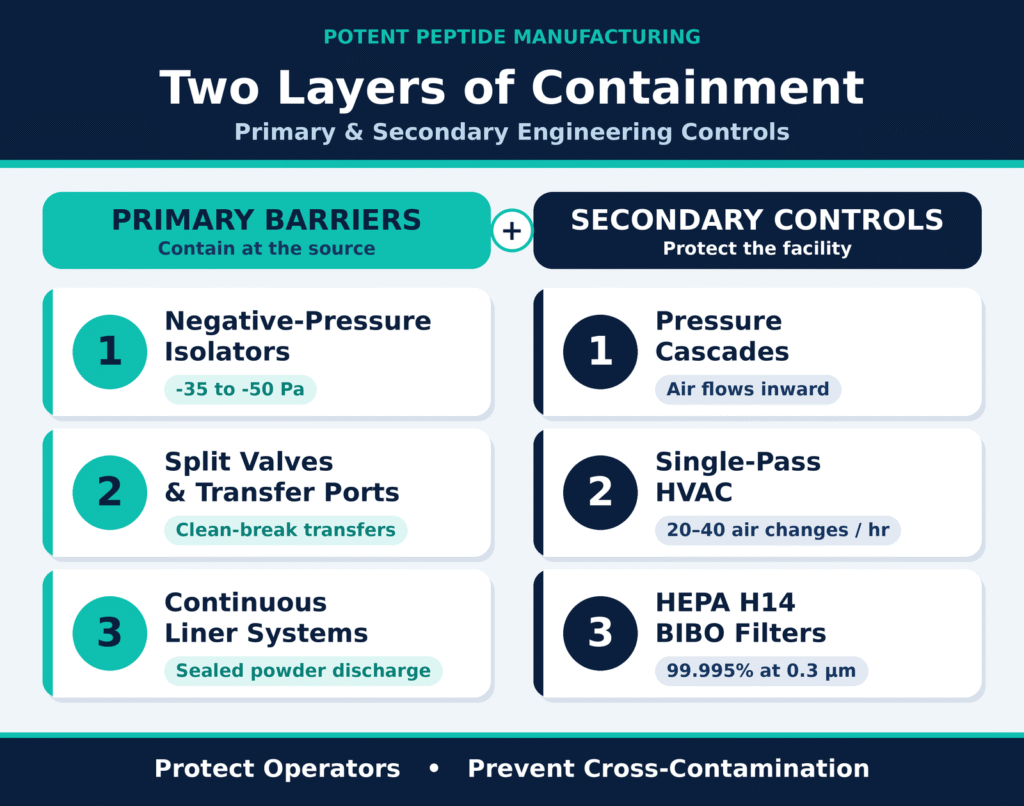
CDMOs use multiple layers of engineering controls, combining primary containment barriers with secondary HVAC and facility controls to isolate potent peptide compounds from operators and surrounding cleanroom areas. This layered containment strategy reduces the potential for product migration and protects personnel during open powder manipulation, liquid transfers, equipment cleaning, and other operations that could result in exposure.
Primary Engineering Barriers
Primary engineering controls create a physical barrier around the compound or reaction vessel, thereby controlling exposure directly at the point where the operation occurs. Important containment technologies include:
- Rigid-Wall Negative-Pressure Isolators: Isolator enclosures maintained under continuous negative pressure, typically between -35 Pa and -50 Pa, are used for activities such as powder weighing, charging, and sampling. Inward airflow through glove ports helps ensure that, if a containment breach occurs, airborne particles are prevented from escaping into the surrounding environment.
- Split Butterfly Valves (SBVs) and Rapid Transfer Ports (RTPs): Closed transfer technologies are used when materials need to move between processing vessels, such as transferring dried peptide cake from a filter-dryer to a micronizer. Active-passive split valves or double-door transfer ports provide clean-break interfaces that can minimize particulate release during connection and disconnection activities.
- Continuous Liner Systems: Continuous polyethylene liner tubes connected to containment ports can be used for dry powder discharge and solid waste removal. These systems allow operators to crimp and seal filled bags while limiting direct exposure of the open product stream to the surrounding room atmosphere.
Secondary Facility Infrastructure and HVAC Controls
Secondary engineering controls regulate the surrounding cleanroom environment and help prevent cross-contamination between adjacent manufacturing areas. Important facility design elements include:
- Differential Pressure Cascades: High-potency peptide suites are maintained at negative atmospheric pressure relative to adjoining corridors and buffer areas. This pressure arrangement encourages air to move inward toward areas with greater contamination potential, helping retain airborne particulates within controlled processing zones.
- Single-Pass Air Handling: HVAC systems serving containment suites may use a single-pass air configuration with high air exchange rates, typically 20 to 40 air changes per hour. This approach reduces the possibility that contaminated air will be recirculated and transfer active dust into other areas of the facility.
- Safe-Change HEPA/ULPA Filtration: Exhaust air from containment areas can be routed through double-stage High-Efficiency Particulate Air (HEPA H14) or ULPA filtration systems. These filters may be rated for 99.995% efficiency at 0.3 µm and installed within bag-in/bag-out (BIBO) safe-change housings to support controlled filter replacement.
Learn more about sterile fill-finish services for peptide injectables when containment requirements extend into sterile injectable manufacturing.
Cleaning Validation and Health-Based Exposure Limits in Shared CDMO Facilities
Cleaning validation within multi-product manufacturing facilities depends on scientifically established toxicological Permitted Daily Exposure (PDE) values to determine whether residual peptides could create cross-contamination risks for subsequently manufactured drug products. Regulatory expectations require cleaning limits for shared production equipment to be supported by appropriate toxicological evaluations rather than relying solely on arbitrary or historically established threshold values.
The primary metrics used to establish cleaning limits are the Permitted Daily Exposure (PDE) and Acceptable Daily Exposure (ADE). PDE represents the maximum daily intake of a substance that is not expected to result in adverse effects in an individual following lifetime daily exposure.
The PDE is calculated using toxicological information and the following standard scientific formula:
PDE = (NOAEL × Body Weight) / (F1 × F2 × F3 × F4 × F5)
Where:
- NOAEL: No Observed Adverse Effect Level established using animal model or human clinical trial data (mg/kg/day).
- Body Weight: Standard human adult body weight assumption (50 kg).
- F1 to F5: Toxicological adjustment factors that account for species extrapolation (F1), inter-individual variability (F2), study duration (F3), severe effects such as teratogenicity or reproductive toxicity (F4), and the completeness of the available toxicological database (F5).
Following calculation of the PDE, the Maximum Allowable Carryover (MACO) of the active peptide into the subsequent commercial batch can be established:
MACO = (PDEprevious × Batch Sizenext) / Maximum Daily Dosenext
Because peptides can degrade when exposed to aggressive Clean-In-Place (CIP) conditions involving hot alkaline or acidic washing solutions, CDMOs typically validate cleaning through a dual analytical approach. Total Organic Carbon (TOC) analysis provides a non-specific measurement of residual organic material, whereas High-Performance Liquid Chromatography with Charged Aerosol Detection (HPLC-CAD) or LC-MS methods can be used to identify intact peptide residues at nanogram-level sensitivity.
See the available peptide analytical testing services for analytical approaches used to assess peptide identity, purity, and related quality attributes.
Evaluating a Peptide Drug Containment CDMO Partner
Selecting a contract manufacturing partner requires a detailed technical assessment of the facility’s containment validation activities, air-handling infrastructure, cleaning verification procedures, and cGMP compliance history. Sponsors should evaluate documented operational performance and supporting evidence rather than relying solely on general claims regarding containment capabilities.
| Assessment Category | Essential Technical Requirement | Audit Verification Evidence |
|---|---|---|
| Containment Performance | Validated capability to contain target OEB/OEL levels under actual operational conditions. | Review third-party SMEPAC air sampling reports and localized surrogate testing data. |
| Facility Engineering | Multi-stage HVAC systems, negative-pressure differential cascades, BIBO HEPA filtration. | Inspect real-time facility management systems (FMS) and differential pressure alarm logs. |
| Cleaning Validation | Scientific HBEL/PDE derivation framework and validated residual analytical methods. | Audit cleaning validation master plans, swab recovery studies, and LC-MS sensitivity data. |
| cGMP Compliance | Active regulatory agency approvals for high-potency processing suites. | Review recent FDA/EMA audit reports, Establishment Inspection Reports (EIR), and CAPA logs. |
| Analytical Infrastructure | Advanced analytical instrumentation for peptide identification, purity testing, and trace analysis. | Evaluate method validation data for Limit of Detection (LOD) and Limit of Quantitation (LOQ). |
Contract buyers should require candidate CDMOs to provide Containment Performance Testing reports performed in accordance with ISPE SMEPAC guidelines under simulated operational conditions before technical transfer begins. Working with a properly qualified facility can help reduce occupational safety risks while supporting reliable project execution and maintaining development and manufacturing timelines.
Compare peptide CDMO services in the United States when assessing potential manufacturing locations and containment capabilities.
Conclusion
Ultimately, implementing specialized Peptide Drug Containment CDMO strategies is critical for protecting personnel from biological and chemical exposure while supporting patient safety through rigorous cross-contamination controls. Primary engineering barriers, including negative-pressure isolators, combined with secondary facility pressure cascades can help protect operators, while scientifically established HBEL cleaning validation approaches help control the potential for batch-to-batch cross-contamination.
Drug developers progressing complex peptide entities toward commercialization should evaluate contract partners based on documented SMEPAC performance records, comprehensive toxicological risk assessments, and established cGMP quality systems.
For programs involving scale-up of advanced peptide therapeutics, explore GLP-1 analog scaling from preclinical synthesis to GMP manufacturing for additional development and manufacturing considerations.
To consult with experts regarding specialized containment, process development, and advanced analytical services for complex peptide therapeutics, contact the technical team through the ResolveMass Contact Portal.
Frequently Asked Questions
Solid Phase Peptide Synthesis (SPPS) requires appropriate engineering controls throughout different stages of the process. Local exhaust ventilation can control vapors during resin loading, while negative-pressure fume hoods or isolators can support piperidine deprotection operations. TFA cleavage requires corrosion-resistant primary enclosures with suitable acid-vapor scrubbing, supported by secondary HVAC containment.
An Occupational Exposure Limit (OEL) for a novel peptide API is established through a toxicological assessment that considers available pharmacological, preclinical, and toxicological information. Factors may include animal NOAEL values, target receptor binding affinity, and structural alert profiles. When sufficient data are unavailable, a CDMO may apply a conservative OEB classification until additional safety information becomes available.
Single-use technologies can be appropriate for high-potency peptide processing when they are properly designed, qualified, and integrated into the containment strategy. Flexible film isolators, disposable transfer bags, and continuous liner systems can reduce direct operator contact with potent materials. They may also simplify equipment changeover and reduce cleaning-related cross-contamination concerns.
SMEPAC (Standardized Methodology for Equipment Performance Air Cleanup) testing is an ISPE methodology used to assess airborne emissions from containment equipment under simulated operating conditions. The testing uses surrogate materials to evaluate containment performance during representative handling activities. Results provide empirical evidence that equipment can maintain airborne exposure within specified containment targets.
Cleaning validation for peptide compounds begins with establishing a health-based Permitted Daily Exposure (PDE) and determining the applicable Maximum Allowable Carryover (MACO). Equipment surfaces can then be evaluated through validated swab or rinse sampling procedures. Analytical techniques such as HPLC-CAD or LC-MS are used to quantify residual peptide and confirm that levels remain within established acceptance criteria.
Certain peptides may act as immunological sensitizers and can produce Type I IgE-mediated hypersensitivity following inhalation exposure. Repeated exposure to very small quantities of peptide powder may potentially contribute to occupational asthma or other allergic responses. Since a definitive sensitization threshold may not be established, strict containment is particularly important during weighing, milling, dispensing, and other dry-powder operations.
HVAC pressure differentials are designed to maintain high-containment processing areas at a lower pressure than adjacent corridors or surrounding cleanroom zones. This pressure relationship encourages airflow toward the containment area if an unintended breach occurs. As a result, airborne contaminants are retained within the controlled processing zone, reducing the potential for migration into neighboring areas.
Peptide-drug conjugates (PDCs) can require more stringent containment because they combine a peptide-based targeting component with a potentially highly potent small-molecule payload. Depending on the toxicological characteristics of the specific conjugate, containment may fall within OEB 5 or OEB 6. Processing may therefore require negative-pressure isolators, rapid transfer ports, and dedicated single-use processing systems.
Split butterfly valves (SBVs) provide a controlled interface between processing equipment during the transfer of powders. The active and passive valve components connect to form a sealed pathway before the internal valve mechanisms are opened for material movement. After transfer, the valves close and separate while minimizing exposed surfaces, thereby helping restrict particulate release and maintain containment.
Reference:
- Meudt, A., Becker, J., & McCleary, K. (2020). Understanding the requirements of safe HPAPI manufacturing. CHEManager International, 3, 10–12. ResearchGate article
- Elsayed, Y. Y., Kühl, T., & Imhof, D. (2025). Regulatory guidelines for the analysis of therapeutic peptides and proteins. Journal of Peptide Science, 31(3), e70001. PMC full-text article
- Yuan, S., Kaur, B., Fuchs, N. S., Cho, S., Abdo, A. N., & Gabr, M. T. (2026). Peptides as programmable molecular scaffolds: From chemical synthesis and engineering to translational medicine. RSC Chemical Biology, 7(7), [page range not yet assigned]. https://doi.org/10.1039/D6CB00117C
- Kekessie, I., Wegner, K., Martinez, I., Kopach, M. E., White, T. D., Tom, J. K., Kenworthy, M. N., Gallou, F., Lopez, J., Koenig, S. G., Payne, P. R., Eissler, S., Arumugam, B., Li, C., Mukherjee, S., Isidro-Llobet, A., Ludemann-Hombourger, O., Richardson, P., Kittelmann, J., … van den Bos, L. J. (2024). Process mass intensity (PMI): A holistic analysis of current peptide manufacturing processes informs sustainability in peptide synthesis. Journal of Organic Chemistry, 89(7), 4261–4282. https://doi.org/10.1021/acs.joc.3c01494
Get In Touch With Us
About The Author


