
Introduction:
Peptide Identity and Purity Testing is essential for determining whether a compounded or research-grade peptide is the correct molecule and carries an acceptable impurity profile. Peptides are prone to synthesis-related impurities, chemical degradation, sequence variants, and formulation-dependent changes that no single analytical technique can fully characterize.
The terms research-grade, high purity, and pharmaceutical-grade are not interchangeable. A peptide described as 98% pure by HPLC may still need additional testing to confirm its sequence, quantify its content, or investigate impurities the chromatographic method does not detect well. For compounded preparations, the assessment may also need to consider the formulation, excipients, container system, and microbial quality. Research-grade material is not automatically suitable for human administration.
At ResolveMass Laboratories Inc., a Canadian analytical CRO/CDMO with expertise in mass spectrometry and biologics characterization, we see how often a CoA headline number leaves key questions open. This guide explains what each test can and cannot establish, so you can verify a peptide properly.
Summary:
- Peptide Identity and Purity Testing determines whether a peptide has the expected sequence, molecular mass, and composition, and whether its impurity profile is acceptable.
- Identity, purity, and content are three different attributes. A mass spectrum supports identity, HPLC reports relative purity of detected components, and content tells you how much peptide is actually in the powder.
- A high HPLC purity percentage does not confirm identity, content, sterility, biological activity, or the absence of all impurities.
- Combine methods. HPLC/UPLC, LC-MS, HRMS, and MS/MS work best together, with amino acid analysis, NMR, Karl Fischer, and GC added when the peptide’s risk profile justifies them.
- Know the usual impurities: deletion sequences, truncated peptides, oxidation and deamidation products, epimers, residual protecting groups, and residual solvents.
- Compounded and research-grade peptides need different assessments, depending on intended use, formulation, and applicable regulations.
- Do not rely on a supplier’s certificate of analysis (CoA) alone. Check methods, acceptance criteria, limitations, and traceability, and consider independent verification.
1. Why Is Peptide Identity and Purity Testing Important?
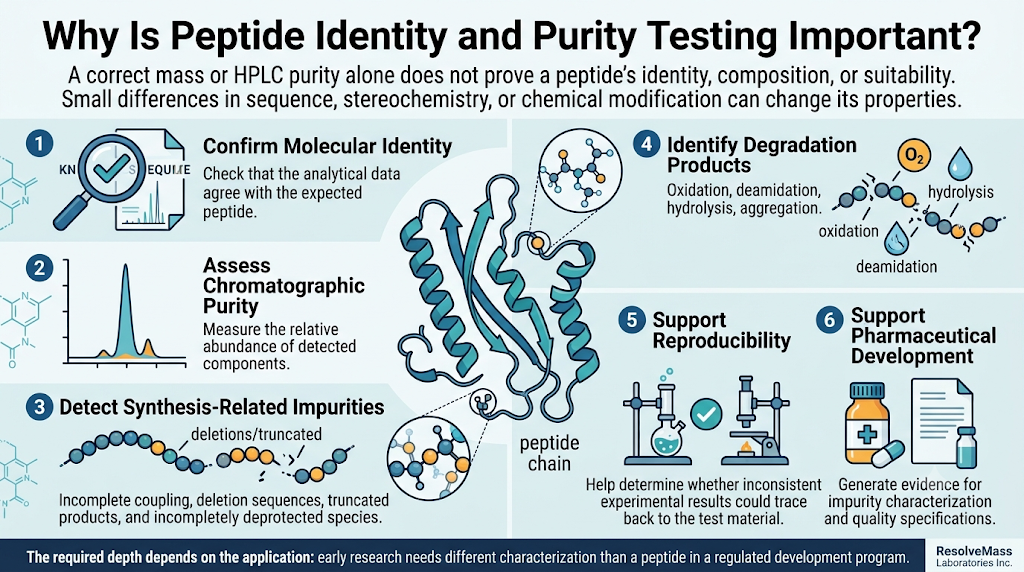
Peptide Identity and Purity Testing matters because a correct nominal mass or a high chromatographic purity does not, on its own, establish a peptide’s complete identity, composition, or suitability for a given application. Even small differences in sequence, stereochemistry, or chemical modification can change a peptide’s properties.
Key reasons to verify peptide quality:
- Confirm molecular identity: check that the analytical data agree with the expected peptide.
- Assess chromatographic purity: measure the relative abundance of detected components under a defined method.
- Detect synthesis-related impurities: incomplete coupling, deletion sequences, truncated products, and incompletely deprotected species.
- Identify degradation products: oxidation, deamidation, hydrolysis, aggregation.
- Support reproducibility: help determine whether inconsistent experimental results could trace back to the test material.
- Support pharmaceutical development: generate evidence for impurity characterization and sensible quality specifications.
The required depth depends on the application. A preliminary research experiment needs a different level of characterization than a peptide in a regulated development program.
2. What Is the Difference Between Peptide Identity, Purity, and Content?
Identity establishes what the material is, purity describes the relative distribution of detected components, and content states how much peptide is present in the tested material. These answer different questions and are not interchangeable.
| Quality attribute | What it evaluates | Common analytical approaches |
|---|---|---|
| Identity | Whether the material matches the expected structure or sequence | LC-MS, HRMS, MS/MS, sequence analysis |
| Chromatographic purity | Relative abundance of detected components | HPLC, UPLC, LC-MS |
| Peptide content | Amount of peptide in a defined mass of material | Amino acid analysis, qNMR, validated quantitative assays |
| Impurity profile | Types and levels of relevant impurities | LC-HRMS, LC-MS/MS, HPLC, targeted assays |
| Water and residual solvents | Contribution to sample mass and material quality | Karl Fischer titration, headspace GC |
| Counterions and salt form | Non-peptide mass (e.g., TFA, acetate) | Ion chromatography, NMR |
| Microbial quality | Sterility, bioburden, endotoxin where applicable | Appropriate microbiological methods |
A sample can show 98% chromatographic purity yet contain water, counterions, and salts, so it may hold well under 98% peptide by weight. Likewise, a mass consistent with the expected value supports identity but does not prove high purity or the absence of closely related impurities.
3. Which Analytical Methods Support Peptide Identity and Purity Testing?
A reliable strategy combines chromatographic separation with mass spectrometric analysis, then adds specialized techniques when the peptide’s structure or risk profile requires them.
3.1 HPLC and UPLC for Purity
HPLC is widely used to separate the target peptide from detectable impurities. Reversed-phase methods use a nonpolar stationary phase with a water/organic mobile phase, typically with a modifier, and UV detection commonly at 214-220 nm.
HPLC can help evaluate:
- Main peak area relative to detected impurities
- Retention time compared with a suitable reference material
- Batch-to-batch chromatographic consistency
- Degradation products resolved under the selected conditions
- Impurity profile changes during stability studies
Its limits matter: co-eluting impurities can hide under a single peak, different compounds respond differently to the detector, and UV purity does not establish content unless the method is designed and calibrated for that purpose. Interpret any reported purity percentage together with the chromatogram, detection conditions, integration parameters, and method limitations.
3.2 LC-MS for Mass Confirmation and Impurity Screening
LC-MS pairs separation with mass detection, so you learn both what separated and what each component’s mass-to-charge ratio is. It is particularly useful for truncated peptides, deletion sequences, and oxidation products. A mass increase of about 16 Da, for example, suggests a single oxygen addition, although mass alone does not say where the modification sits.
LC-MS is useful for confirming the principal peptide mass, screening for related substances, investigating unexpected peaks, and comparing samples before and after stress testing. Ion suppression, variable ionization efficiency, and isobaric species are its main limitations.
3.3 High-Resolution Mass Spectrometry (HRMS)
HRMS delivers accurate-mass measurements that help distinguish the expected peptide from candidates with different elemental compositions. Electrospray ionization typically yields multiple charge states, which are deconvoluted to estimate the neutral mass.
Accurate mass is still not complete structural proof. Isomeric peptides, epimers, and some positional modifications share the same formula and exact mass, so HRMS should be read alongside chromatography, reference data, and fragmentation results.
For rapid intact-mass confirmation, MALDI-TOF mass spectrometry for peptide characterization offers a complementary approach to electrospray LC-MS.
3.4 Tandem MS/MS for Sequence Confirmation
MS/MS selects a precursor ion, fragments it, and interprets the product-ion spectrum to confirm sequence and localize certain modifications. It is the strongest single piece of sequence evidence for a synthetic peptide, and it helps investigate truncated or deletion peptides, oxidation sites, and unexpected LC-MS products. Fragmentation coverage can be incomplete for some sequences or modified residues, so results should be judged against the peptide’s structure and data quality.
3.5 Amino Acid Analysis, NMR, and Other Orthogonal Methods
Amino acid analysis (AAA) confirms composition and, with a validated procedure, supports quantitative content. Because hydrolysis destroys sequence information and can alter or incompletely recover some residues, AAA does not independently establish the sequence.
Other techniques fit specific situations:
- NMR: structural characterization when enough material and suitable methods exist. See NMR vs LC-MS for peptide characterization for how the two compare.
- Capillary electrophoresis: an alternative separation mechanism for selected impurities.
- Karl Fischer titration: water content, which affects peptide content calculations.
- Gas chromatography: relevant volatile residual solvents.
- Microbiological testing: applicable microbial quality of compounded preparations.
Not every peptide needs every method. Base the plan on the questions left unresolved after initial characterization.
4. Which Impurities Should You Investigate in Peptides?
Testing should target plausible impurities for the specific peptide, process, and storage conditions rather than assuming every peptide has the same risks.
| Impurity category | Potential origin | Possible analytical approach |
|---|---|---|
| Deletion sequences | Incomplete coupling during synthesis | LC-MS, LC-HRMS, MS/MS |
| Truncated peptides | Incomplete synthesis or cleavage | LC-MS/MS, sequence analysis |
| Oxidized peptides | Oxidative exposure in processing or storage | LC-HRMS, MS/MS |
| Deamidated peptides | Chemical degradation of susceptible residues | LC-MS, optimized separation, MS/MS |
| Epimers / stereoisomers | Racemization during synthesis | Chiral or other stereochemical methods |
| Incompletely deprotected products | Incomplete protecting-group removal | LC-MS, targeted methods |
| Residual solvents | Synthesis, purification, processing | Headspace GC |
| Counterions and water | Salt form, purification, drying, handling | Ion analysis, Karl Fischer |
| Aggregates / higher-order species | Association, formulation, storage | Size-based or other orthogonal methods |
This table is a screening guide, not a universal specification. Some impurities require specialized separations, reference standards, or targeted assays. Modified peptides add their own complexity; for example, see ResolveMass’s overview of PEGylated peptide characterization.
Why Can a High-Purity Result Still Be Misleading?
A purity value only means something relative to the method that produced it. Watch for:
- Co-elution: two compounds appearing as one peak.
- Detector response: impurities responding more weakly or strongly than the main peptide.
- Undetected components: nonchromophoric or poorly ionizing species may be underestimated.
- Unresolved structural differences: isomers with the same mass and similar retention.
- Incomplete mass balance: water, salts, and counterions that the chromatographic calculation ignores.
Interpret chromatographic purity alongside identity, content, and impurity-characterization results.
5. How Do You Verify a Peptide Certificate of Analysis (CoA)?
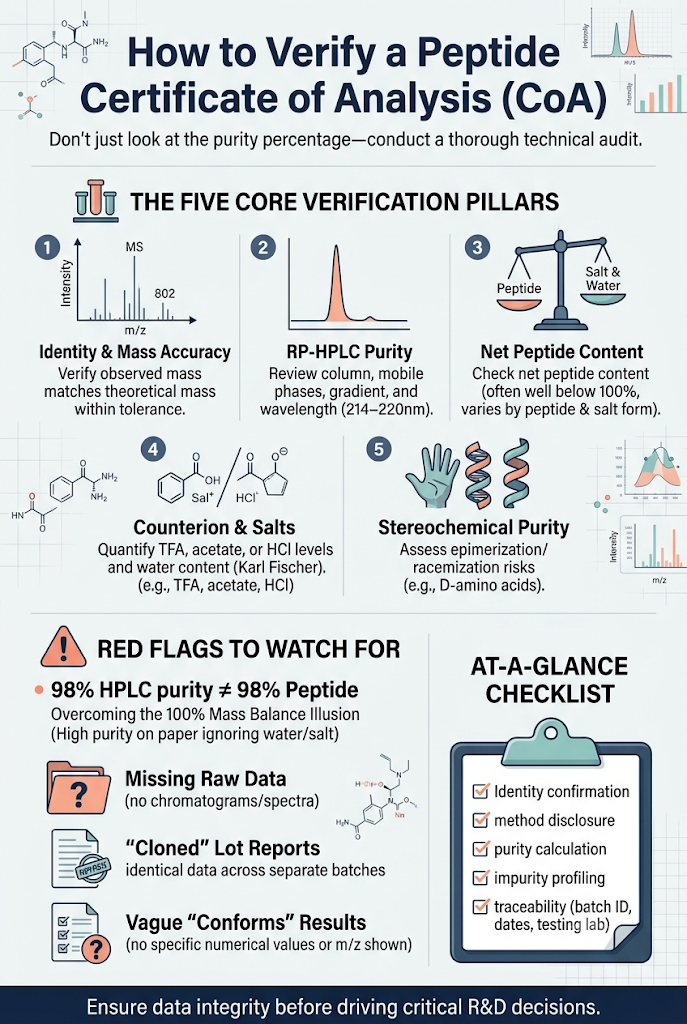
Verify a CoA by examining the actual test results, methods, acceptance criteria, and traceability, not just the purity percentage. A useful checklist:
- Identification: is the identity test named, with interpretable results (e.g., observed vs. theoretical mass)?
- Purity method: are the technique and, where available, chromatographic conditions stated?
- Purity calculation: peak-area normalization, external standard, or another approach?
- Impurity reporting: are relevant related substances identified or quantified?
- Content and salt form: does the report separate peptide content from total mass and state the counterion?
- Reference materials: are suitable standards used where needed?
- Traceability: are batch ID, test date, method reference, and testing laboratory documented?
- Limitations: does the report say which attributes were not tested?
Even a seemingly complete CoA may not address stereochemical integrity, sterility, endotoxin, or biological activity. Generic templates, missing chromatograms or spectra, and identical results across different lots are red flags. When material will drive important research or development decisions, independent verification is appropriate.
6. How Does Testing Differ for Compounded vs. Research-Grade Peptides?
Compounded and research-grade peptides should be evaluated against their intended use, applicable requirements, and specific quality risks. Neither should be assumed to meet pharmaceutical standards just because a supplier reports high purity.
Compounded Peptide Preparations
A compounded product may contain excipients, buffers, or preservatives, so assessment can extend beyond the peptide ingredient. Depending on the preparation and requirements, consider:
- Identity and strength of the active ingredient
- Formulation compatibility and stability
- Degradation during storage and container-closure effects
- Microbial quality, plus sterility and endotoxin testing where required
- Documentation of the compounding process and quality controls
Requirements vary by jurisdiction, dosage form, and route of administration. An identity or purity test alone cannot establish that a compounded preparation is safe for human use.
Research-Grade Peptides
Specifications vary widely between suppliers. Consider whether:
- The sequence and molecular form are confirmed
- The reported purity method is appropriate
- Synthesis-related and degradation impurities were assessed
- Peptide content is known well enough for the experiment
- Water, counterions, or residual solvents could affect sample preparation
- The material fits the experimental objective
Research-grade status does not establish sterility, endotoxin control, clinical suitability, or authorization for human use.
7. What Is a Practical Workflow for Peptide Identity and Purity Testing?
A staged workflow establishes basic identity and purity first, then expands characterization when unexplained peaks, elevated impurities, or application-specific risks justify it.
- Define the objective: peptide sequence, expected molecular form, intended application, available reference material, and whether you need identity, purity, impurity profiling, content, or a combination.
- Review existing documentation: the CoA, batch information, reported methods, expected mass, storage conditions, and known impurity risks. This avoids unnecessary testing and exposes gaps.
- Run a chromatographic assessment: use a suitable HPLC/UPLC method with adequate separation and detection for the objective.
- Confirm molecular mass: LC-MS or HRMS, investigating unexpected mass differences rather than dismissing them.
- Characterize unresolved impurities: MS/MS, alternative chromatographic conditions, or other orthogonal techniques.
- Assess content and additional attributes: peptide content, water, counterions, residual solvents, microbial quality where relevant.
- Interpret against predefined criteria: compare results with specifications, validated method performance, and the intended use, and document methods, deviations, limitations, and uncertainties.
At a glance: Define objective → Review documentation → HPLC/UPLC → LC-MS/HRMS → Impurity characterization → Additional tests → Report.
8. What Should You Look for in a Peptide Testing Laboratory?
Choose a laboratory that can answer your specific analytical questions, demonstrate suitable method performance, and deliver interpretable, traceable results. Evaluate:
- Technical expertise: peptide chemistry, chromatography, and mass spectrometry experience.
- Instrumentation: HPLC/UPLC, LC-MS, HRMS, and tandem MS where needed.
- Method development: ability to handle difficult separations and unexpected impurities.
- Method validation: evidence that methods suit their purpose, with validation or qualification appropriate to the application (ICH Q2(R2) principles are a common reference).
- Transparent reporting: results, acceptance criteria, relevant chromatograms or spectra, and stated limitations.
- Quality systems: documented procedures, instrument controls, and data integrity practices.
- Scientific interpretation: clarity on what the evidence supports and what remains uncertain.
Assess any accreditation or certification against the specific laboratory, method, and scope. No single credential makes every assay suitable for every application. If your work heads toward a regulatory filing, it helps to work with a partner experienced in peptide characterization for FDA submissions, and to understand the expectations for therapeutic peptide characterization for NDA and ANDA filings. Regulators have published expectations on impurity characterization for synthetic peptides, including FDA’s guidance on ANDAs for synthetic peptide products.
9. How Can ResolveMass Laboratories Inc. Support Peptide Characterization?
ResolveMass Laboratories Inc. provides analytical chemistry capabilities relevant to pharmaceutical and biotechnology development, including mass spectrometry-based characterization and investigation of complex samples. Its peptide characterization services can support projects such as:
- LC-MS-based assessment of peptide identity
- HRMS investigation of unexpected molecular masses
- MS/MS characterization of selected peptide-related impurities
- Chromatographic method development for challenging separations
- Investigation of degradation products and chemical modifications
- Analytical support for research and pharmaceutical development decisions
The scope depends on the peptide, sample matrix, reference materials, required sensitivity, and intended use. Before testing starts, the laboratory and client should agree on the objective, sample requirements, deliverables, and method limitations. ResolveMass does not replace the responsibilities of a compounding pharmacy, manufacturer, or product authorization holder, and findings must be interpreted within the appropriate quality and regulatory framework.
Conclusion:
Peptide Identity and Purity Testing takes more than a supplier-reported purity percentage or a single mass measurement. A robust assessment combines chromatographic separation, molecular-mass confirmation, and targeted impurity characterization, then adds content determination, water and counterion assessment, microbial testing, and other evaluations as the application demands. The most reliable approach is to define the objective, review the documentation, select complementary methods, interpret results against appropriate criteria, and report limitations transparently.
Frequently Asked Questions:
Peptide purity describes the proportion of the detected chromatographic signal attributed to the main peptide relative to other detected components. Peptide content measures the actual amount of peptide in a given mass or volume of material. A peptide with 98% HPLC purity may contain less than 98% peptide by weight because of water, counterions, salts, or other substances.
HPLC is useful for assessing chromatographic purity and separating detectable impurities, but it does not independently confirm the complete molecular identity of a peptide. LC-MS or HRMS can provide complementary molecular-mass information, while MS/MS may help investigate sequence-related impurities. Combining suitable techniques provides stronger analytical evidence than relying on HPLC alone.
Research-grade peptides may contain deletion sequences, truncated peptides, oxidation products, deamidated species, epimers, incompletely deprotected products, or residual synthesis-related contaminants. Water, counterions, and residual solvents may also affect material composition. The likely impurities depend on the synthesis process, purification method, peptide sequence, and storage conditions.
No. A reported purity of 98% does not establish safety, sterility, endotoxin control, biological activity, or suitability for human administration. The result depends on the analytical method and the impurities it can detect. Additional testing and appropriate quality documentation are necessary to evaluate suitability for a specific application.
Peptide degradation can be investigated by comparing samples using suitable HPLC or UPLC and LC-MS methods. Changes in the main chromatographic peak, the appearance of new peaks, or unexpected mass shifts may indicate degradation. Depending on the peptide, investigations may target oxidation, deamidation, hydrolysis, aggregation, or other stability-related changes.
Reference
- Mendias CL, Awan TM. Evaluation of Research Grade Peptides Marketed Directly to Consumers Reveals Extensive Variability in Purity and Measured Abundance.https://www.preprints.org/manuscript/202604.1748
- Sarmiento S. The Science of Research Peptides for Muscle Support.https://licensedpeptides.com/peptides-for-muscle-support/
- Matters WR. How to Reconstitute TB-500 for Travel and Transport Without Losing Potency.https://healthrx.com/peptide-recon-tb-500/travel-and-transport
About the Author