
Introduction
Peptide Manufacturing Cost with a Canadian CDMO varies considerably depending on peptide length, manufacturing scale, synthesis complexity, and regulatory requirements. Initial analytical and production runs involving 15–30+ amino acid sequences generally cost approximately $1,500–$5,000. Early New Chemical Entity (NCE) development budgets are estimated at $20,000–$30,000, while a 100–200 gram early clinical cGMP batch may require an investment of approximately $250,000–$400,000. For complex targeted peptides, industry estimates place manufacturing costs at $1,200–$1,800 per gram. However, no independent, audited pricing index currently provides standardized Canadian-only cGMP CDMO rates. Most available benchmarks are derived from broader North American regulatory manufacturing practices and vendor process data rather than a consistent national pricing structure.
Across Canada and the broader North American market, which accounted for 36.3% of global peptide and oligonucleotide CDMO revenue in 2025, according to Grand View Research, manufacturing budgets are influenced much more by cleanroom operating expenses, chromatographic purification limitations, and Health Canada or FDA analytical release requirements than by the basic cost of amino acids. Understanding the relationship between batch size, synthesis methodology, and regulatory testing enables biopharmaceutical sponsors to estimate the Total Cost of Ownership (TCO) more accurately instead of depending exclusively on initial Request for Proposal (RFP) quotations.
Share via:
Quick Summary:
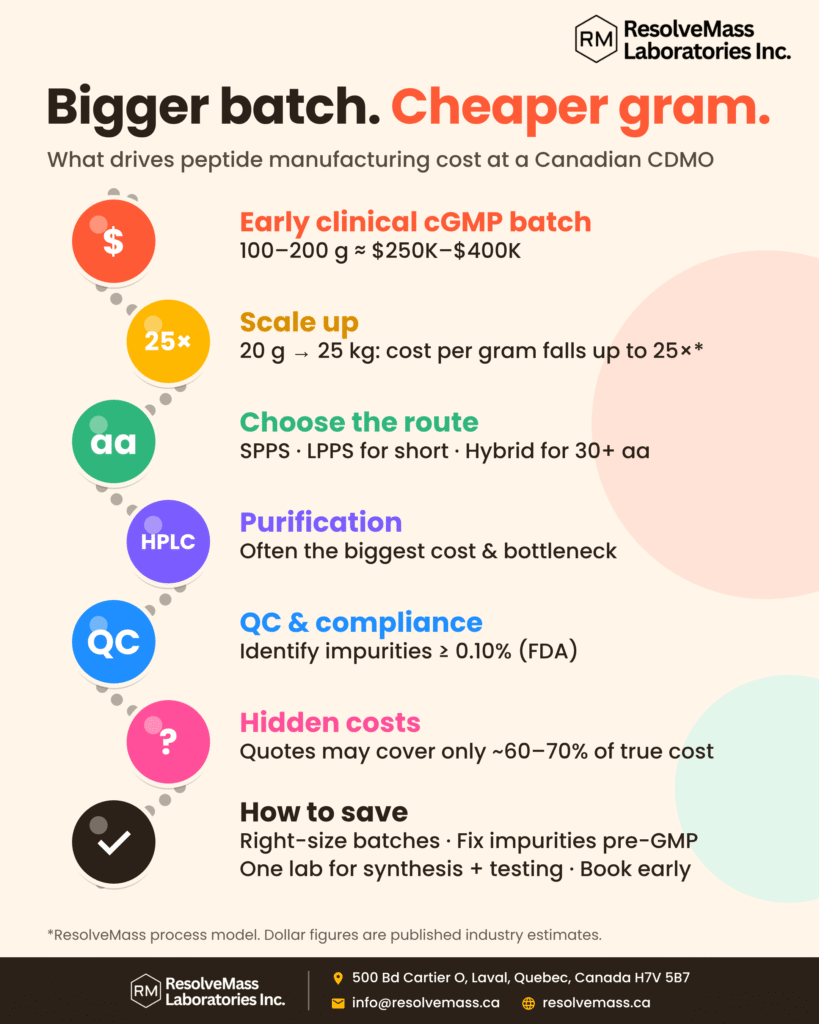
- Batch size matters more than amino acid prices. An early clinical cGMP batch of 100–200 g is estimated at about $250K–$400K. Moving from a 20 g batch to a 25 kg commercial run can cut the per-gram cost by roughly 15–25×, because cleanroom, QA and testing costs stay largely fixed regardless of batch size.
- The synthesis route drives unit economics. SPPS dominates for sequences up to about 40 residues but uses a lot of solvent. LPPS suits short peptides (2–15 residues) at large scale. Hybrid SPPS + LPPS is increasingly preferred for long sequences (30–60+ residues) such as GLP-1 analogues, and improves yields at scale.
- Downstream purification is the main bottleneck. Separating closely related impurities to reach ≥95% purity often takes several chromatography steps (IPRP, IEX, HILIC). Each step lowers recovery and adds cost and time.
- Regulatory and QC work multiplies costs. Requirements include Health Canada GMP (GUI-0104, plus ICH Q7 for clinical-trial APIs), PIC/S alignment, FDA impurity expectations (identifying impurities at 0.10% or above for generic peptides), and stability and release testing. In small batches, destructive QC sampling and QA review can make up most of the fixed overhead.
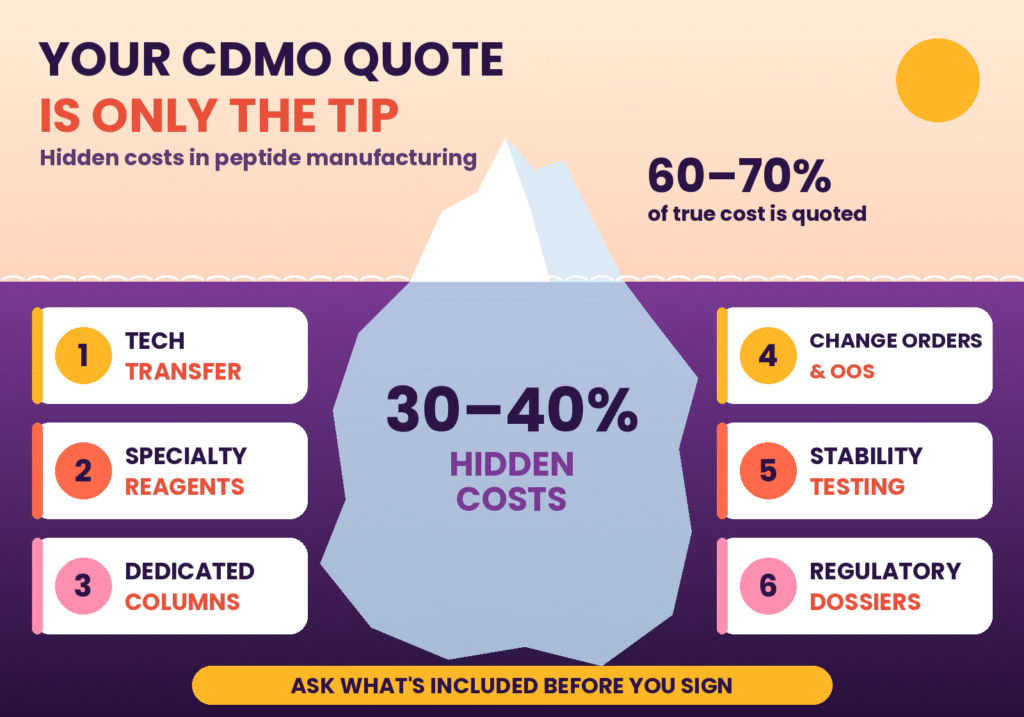
- Initial quotes rarely show the full cost. RFP prices may cover only about 60–70% of the true total. Common extras are tech transfer, specialty reagents, dedicated columns and resins, change orders and OOS investigations, stability storage, and regulatory dossier writing.
- Sponsors can save without cutting quality. They can right-size Phase 1 batches, de-risk impurities and aggregation before GMP, evaluate hybrid synthesis early for long peptides, use one provider for both synthesis and analytics, and book manufacturing slots ahead of GLP-1-driven demand.
- Bottom line: Budget on total cost of ownership, not headline quotes. A CDMO with integrated synthesis, analytical and regulatory capabilities, such as ResolveMass in Laval, Quebec, improves cost predictability.
What Determines Peptide Manufacturing Cost with a Canadian CDMO Across Development Phases?
Peptide Manufacturing Cost with a Canadian CDMO can decrease by approximately 15× to 25× on a per-gram basis when production moves from an early 20-gram cGMP batch to a 25-kilogram commercial manufacturing campaign, based on ResolveMass Laboratories’ process engineering benchmarks. This substantial difference occurs because several manufacturing expenses remain relatively constant regardless of the quantity produced. Cleanroom preparation, quality assurance (QA) batch record review, and compendial release testing all require considerable facility resources and skilled personnel. Consequently, smaller clinical batches, particularly those below one kilogram, carry significantly higher manufacturing costs per gram.
During the discovery phase, non-GMP custom peptide synthesis is comparatively affordable. Commercial peptide suppliers commonly offer starting prices of $1.50–$3.00 per amino acid, with certain short peptides available for as little as $80 per sequence for preliminary bench screening. Industry commentary estimates that standard analytical and initial production runs involving 15–30 amino acid sequences cost approximately $1,500–$3,000, while sequences exceeding 30 residues may require $3,000–$5,000 or more. Separately, Mordor Intelligence reports that catalog-grade cosmetic and diagnostic peptides have become available for less than USD 500 per gram.
Moving into Good Laboratory Practice (GLP) toxicology studies generally requires approximately 2–5 grams of potent hormone-like peptides. Higher-dose peptide categories, including certain antimicrobials, may require quantities of up to 10 grams. Industry estimates place initial NCE peptide development budgets at approximately $20,000–$30,000. Once a candidate progresses to cGMP Phase 1 manufacturing, the required production quantity typically ranges from 10–250 grams. Published early-clinical cost models estimate that supplying 100–200 grams of API can cost approximately $250,000–$400,000. Despite this substantial investment, the peptide API manufacturing expense represents only around 2%–3% of the overall early clinical trial budget.
Understanding how peptide manufacturing requirements evolve across development stages can help sponsors plan their production budgets more effectively. Explore peptide CDMO services in Canada to understand the capabilities involved in supporting peptide development and manufacturing.
| Development Stage | Typical Batch Scale | Indicative Cost Benchmark | Fixed Overhead Share of COGS | QC Release Material Loss | Relative Unit Cost per Gram | Primary Cost Drivers |
|---|---|---|---|---|---|---|
| Discovery / Research (Non-GMP) | Milligram to gram scale | $1.50–$3.00/aa; $1,500–$5,000 industry estimate for 15–30+ aa runs | Low (automated synthesis) | Minimal (basic LC-MS/HPLC) | Research baseline | Sequence length, purity tier (>85% to >98%), turnaround time |
| Preclinical / NCE Development | 2 g – 10 g (GLP/Tox supply) | Approximately $20,000–$30,000 industry estimate for initial NCE peptide budgets | Moderate | Moderate | High | Route scouting, impurity profiling, sequence confirmation |
| Phase 1 Clinical Supply (cGMP) | 10 g – 250 g | $250,000–$400,000 modeled for 100–200 g; $1,200–$1,800/g cited for complex targeted APIs | >80% (at 20 g scale) | 20%–40% of isolated lot (at 20 g scale) | 15× – 25× commercial baseline | Destructive QC release testing, QA batch review, method qualification |
| Phase 2 / 3 Pivotal Trials (cGMP) | 250 g – 5 kg | Project-specific; approximately 2×–3× commercial unit cost at 1 kg scale | Approximately 35%–45% (at 1 kg scale) | 0.5%–1.0% of isolated lot (at 1 kg scale) | 2× – 3× commercial baseline | ICH Q2 analytical validation, ICH Q1 stability, prep-HPLC loading limits |
| Commercial Supply (cGMP) | 1 kg – 50+ kg | Industry optimization benchmark targets costs as low as approximately $100/g (compared with historical $1.2M/kg) | <15% (at 25 kg scale) | <0.05% of isolated lot (at 25 kg scale) | 1× (Optimized baseline) | Raw material volume, hybrid synthesis efficiency, solvent recycling |
Note: Unit cost multipliers, overhead shares, and QC material loss percentages are based on ResolveMass process engineering modeling. Dollar estimates for NCE development, early clinical manufacturing, and commercial production are derived from published industry models and secondary market estimates rather than audited Canadian CDMO rate cards.
How Do Synthesis Methodologies and Equipment Constraints Impact Unit Economics?
Selecting an appropriate manufacturing approach requires evaluating Solid-Phase Peptide Synthesis (SPPS), Liquid-Phase Peptide Synthesis (LPPS), and Hybrid synthesis alongside the available reactor capacity and chromatography column dimensions. These decisions directly influence raw material consumption, net isolation yield, and equipment hold-up losses. Industry cost breakdowns indicate that raw materials, including protected amino acids, specialty unnatural or D-amino acids, resins, and coupling reagents, account for approximately 30%–40% of general peptide production costs. Labor and overhead contribute another 25%–35%. However, during very small 20-gram cGMP manufacturing campaigns, fixed facility overhead alone can exceed 80% of the total Cost of Goods Sold (COGS).
According to a 2026 Roots Analysis report, chemical synthesis represents approximately 85% of outsourced peptide API manufacturing. Within this segment, SPPS accounts for nearly 50%, primarily because it offers automated processing and shorter manufacturing cycles for peptide chains containing up to 40+ residues. Despite these advantages, SPPS requires substantial quantities of solvents and reagents. For complex peptide-oligonucleotide conjugates, the Process Mass Intensity (PMI) can reach approximately 4,000–13,000 kg of raw materials per kilogram of API.
For shorter sequences containing 2–15 residues, LPPS eliminates the need for resin and can support efficient manufacturing campaigns exceeding 100 kg. Hybrid synthesis, which combines SPPS-generated peptide fragments through LPPS condensation, is emerging as a preferred approach for longer sequences. This methodology is experiencing a reported 7.2% CAGR and is particularly relevant for molecules containing 30–60+ residues, including GLP-1 analogues. With appropriate process optimization, net isolation yields can improve from approximately 12%–18% during early 20-gram production runs to 35%–45% at commercial manufacturing scales of 25 kilograms.
| Synthesis / Hardware Parameter | Operational Specification | Economic & Yield Impact | Optimal Use Case |
|---|---|---|---|
| Solid-Phase Peptide Synthesis (SPPS) | 30 mL – 3,000 L reactors; grams to 25+ kg/batch | Fast automated cycles; high solvent washing volume and reagent excess | Up to 40+ residues; Phase 1 supply; cyclic or neoantigen peptides |
| Liquid-Phase Peptide Synthesis (LPPS) | 300 L – 5,000 L reactors; 50–500 kg/batch | Lower consumable cost; high volumetric productivity; slower workup | Short peptides (2–15 residues); linkers; large diagnostic/API lots |
| Hybrid Strategy (SPPS + LPPS) | Multi-kilogram to 500 kg/batch | Reduces deletion impurities; requires >99% per-step coupling efficiency on long fragments | 30–60+ residue polypeptides; commercial GLP-1 analogues |
| Bench/Pilot SPPS & Mid-Scale Prep-HPLC | 1–15 L vessel; 15–30 cm HPLC column | 5%–10% vessel wall adhesion loss; 10%–20% column void-volume tailing loss | Sub-kilogram preclinical and Phase 1 batches |
| Large-Scale Prep-HPLC & Tray Lyophilizer | 60–100 cm HPLC column; 200–500 L lyophilizer | >30% dilution/fraction cut loss if underloaded; 15%–25% tray wall film loss | Multi-kilogram clinical and commercial API isolation |
Equipment dimensions and processing capacity establish important minimum batch-size requirements for cGMP manufacturing campaigns. For example, processing a 20-gram batch using a 60–100 cm preparative HPLC column or an industrial 200–500 L tray lyophilizer can result in substantial unrecoverable losses due to dilution, fraction collection, and product adhesion to tray surfaces.
Canadian GMP facilities operating multi-product manufacturing suites must also meet cleaning validation requirements based on Maximum Allowable Carryover (MACO). This calculation considers the permitted daily exposure of the previously manufactured API, the minimum mass of the subsequent batch, its maximum daily dose, and the applicable safety factor. When manufacturing highly potent peptides with particularly stringent exposure limits, CDMOs may need to conduct extensive analytical swab verification. In some situations, dedicated resins and chromatography columns must be assigned to an individual client to minimize cross-contamination risks. These additional requirements can significantly increase equipment changeover expenses and overall manufacturing costs.
How Downstream Purification Drives Peptide Manufacturing Cost with a Canadian CDMO
For complex peptide molecules, downstream chromatographic purification can account for more than half of the overall manufacturing time and production expenditure. Consequently, purification capacity and processing efficiency are major determinants of Peptide Manufacturing Cost with a Canadian CDMO.
The primary challenge is separating the target peptide from closely related impurities, including deletion sequences, truncated variants, and D-isomers. These impurities can exhibit similar chromatographic properties and may co-elute with the desired peptide during purification. Achieving clinical purity levels of ≥95% therefore frequently requires multiple orthogonal separation techniques instead of relying on a single reversed-phase chromatography step.
GMP manufacturing facilities commonly combine Ion-Pair Reversed-Phase (IPRP) chromatography, which separates compounds according to their hydrophobic properties, with Ion-Exchange (IEX) chromatography for charge-based separation. Hydrophilic Interaction Liquid Chromatography (HILIC) may also be used when additional resolution of polar impurities is necessary.
Following chromatographic purification, the manufacturing process may involve counter-ion exchange, which replaces trifluoroacetate with acetate or hydrochloride salts, tangential flow filtration (TFF), and carefully optimized lyophilization cycles. Each additional chromatographic purification or recycling step can reduce overall product recovery while increasing solvent consumption and waste generation.
For this reason, industry analyses increasingly identify downstream purification capacity as a more significant global CDMO bottleneck than the availability of upstream peptide synthesis reactors. Limited access to appropriately sized chromatography systems and purification infrastructure can extend manufacturing timelines, increase operating expenses, and restrict the ability of CDMOs to accommodate growing peptide production requirements.
Efficient purification and manufacturing scale-up require appropriate process design and specialized equipment. Discover how peptide CDMO scale-up services can support the transition from development batches to larger manufacturing campaigns.
Why Are Regulatory Compliance and Analytical QC Major Cost Multipliers in Canada?
Compliance with Health Canada’s Good Manufacturing Practices for Active Pharmaceutical Ingredients (GUI-0104), international PIC/S standards, and increasingly stringent FDA and EMA impurity requirements makes analytical testing and quality assurance oversight substantial components of Canadian peptide manufacturing expenses. According to market intelligence from Mordor Intelligence, stricter regulatory frameworks, including the EMA’s 2025 impurity guideline, have increased per-batch QC expenses by as much as USD 100,000.
Canadian CDMOs must operate in accordance with Part C, Division 2 of Canada’s Food and Drug Regulations and applicable Pharmaceutical Inspection Co-operation Scheme (PIC/S) requirements. Canada became a member of PIC/S in 2002. Health Canada’s Regulatory Operations and Enforcement Branch (ROEB) administers Mutual Recognition Agreements (MRAs), which facilitate the harmonization of GMP batch certification across participating jurisdictions.
However, manufacturers supplying the US market must also maintain direct FDA inspection readiness and prepare the necessary Chemistry, Manufacturing, and Controls (CMC) documentation and Type II Drug Master File (DMF) packages. These additional regulatory responsibilities increase documentation requirements, analytical testing obligations, and the overall workload associated with commercial peptide manufacturing.
| Regulatory / Analytical Requirement | Applicable Standard | Acceptance Threshold / Scope | Cost & Schedule Impact |
|---|---|---|---|
| Impurity Identification | FDA Synthetic Peptide Guidance / ICH Q3A | Required for impurities ≥0.10% of drug substance through UHPLC-HRMS / MS-MS | Requires high-resolution mass spectrometry method development |
| New Impurity Qualification & Immunogenicity | FDA Synthetic Peptide Guidance | Qualification <0.5%; immunogenicity testing if >0.10% | Increases expenses through in silico MHC binding and in vitro T-cell assay requirements |
| Chromatographic Method Validation | USP / ICH Q2 | Resolution ≥1.5 with peak symmetry compliance (RP-HPLC / UHPLC-UV) | Requires dedicated analytical scientist FTEs before batch release |
| Microbiological & Endotoxin Release | USP Requirements | Endotoxin limits (e.g., <5 EU/mg); 14-day sterility assay | Destructive sampling can consume 20%–40% of a 20 g Phase 1 batch |
| Stability Testing Program | ICH Q1A(R2) / ICH Q1 | Long-term, accelerated, and stress-testing protocols | Among the most expensive and time-consuming CMC analytical activities |
| Canadian & Global GMP Alignment | Health Canada GUI-0104 / PIC/S / Rx-360 | Full QA batch review, audit readiness, DMF/CMC documentation | Can account for >80% of fixed overhead during small clinical manufacturing campaigns |
Since every new peptide sequence requires customized analytical method development and qualification before manufacturing can begin, integrating synthesis and analytical laboratories within the same facility can offer considerable operational advantages. This arrangement reduces inter-facility shipping delays, minimizes repeated method transfers, and avoids unnecessary duplication of analytical work.
For example, ResolveMass Laboratories Inc., located in Laval, Quebec, combines custom peptide synthesis with in-house NMR, LC-MS, amino acid analysis, MALDI-TOF, peptide sequencing, nitrosamine screening, and extractables and leachables (E&L) testing.
This integrated approach has supported rapid preclinical project execution. One example involved delivering 285 mg of a 25-mer antimicrobial peptide with 98.7% purity within 19 working days. In another project, the laboratory characterized two side-products and confirmed 98.5% purity across three 15-mer peptide batches, supported by an ICH-compliant Certificate of Analysis. Such analytical capabilities allow sponsors to identify and address potential impurity-related risks before committing substantial resources to full-scale cGMP manufacturing.
Accurate peptide characterization and impurity assessment are essential for establishing reliable analytical specifications and supporting regulatory submissions. Explore GLP-1 peptide analytical characterization to learn more about the analytical approaches used for complex peptide molecules.
What Hidden Expenses Are Excluded from Initial Peptide CDMO Quotes?
An industry CDMO assessment estimates that initial Request for Proposal (RFP) quotations generally account for only 60%–70% of the actual costs associated with a manufacturing partnership. The remaining 30%–40% may arise from additional technical, regulatory, and material-related expenses that are not included in the initial manufacturing estimate.
Sponsors comparing Canadian CDMO proposals with lower headline quotations from Asian manufacturers should evaluate these additional expenses carefully. Although lower labor and operating costs in certain Asian markets can reduce base synthesis charges, the overall financial comparison may change considerably after accounting for technology transfer difficulties, raw material markups, and multiple change orders.
Comparing manufacturing partners requires evaluating more than their initial production quotations. Read about Canadian versus US peptide CDMOs to understand the differences that can influence outsourcing decisions.
Procurement and CMC teams evaluating Canadian CDMO proposals should establish whether the following expenses are included in the initial quotation or billed separately:
1. Technology Transfer and Route Feasibility Fees: Sequence feasibility assessments, engineering batches, and analytical method transfers from discovery laboratories to GMP quality control suites are frequently charged separately from the primary manufacturing fee. These activities require specialized technical personnel, additional laboratory resources, and process documentation.
2. Specialty Reagent and Exotic Amino Acid Markups: Peptides containing conjugated, lipidated, PEGylated, or radiolabeled-chelator components, as well as D-amino acid sequences, may require expensive specialty raw materials. Vendor pass-through charges, minimum order quantities, and limited material availability can further increase procurement costs.
3. Dedicated Chromatography Columns and Resins: To meet Maximum Allowable Carryover (MACO) requirements and minimize cross-contamination risks in shared GMP manufacturing facilities, CDMOs may require sponsors to purchase dedicated preparative HPLC columns and synthesis resins. These materials can represent a significant additional investment, particularly for highly potent peptide APIs.
4. Change Orders and OOS Investigations: Manufacturing challenges such as peptide aggregation, coupling efficiency below 99% on longer fragments, or out-of-specification (OOS) impurity increases during scale-up can trigger unexpected expenses. Additional deviation investigations, process modifications, and repeat purification cycles may be necessary to achieve the required quality specifications.
5. ICH Stability Chamber Storage and Pull-Point Testing: Long-term refrigerated stability studies conducted under ICH Q1A(R2) requirements generate recurring expenses. These costs are generally calculated according to the number of storage conditions, study duration, and analytical pull points rather than being included in the initial batch production charge.
6. Regulatory Dossier Authoring: Preparing and compiling Type II DMFs, ANDA sameness evaluations, and IND/NDA CMC documentation requires dedicated regulatory affairs expertise. Unless explicitly included in the manufacturing agreement, these documentation and submission-support activities may be invoiced separately.
Comprehensive analytical and regulatory documentation can help sponsors avoid unexpected expenses during submission preparation. Learn about CMC documentation requirements for ANDA development and the activities involved in preparing regulatory-ready manufacturing records.
How Can Sponsors Optimize Peptide CDMO Budgets Without Compromising Quality?
Biopharmaceutical sponsors can substantially reduce peptide manufacturing expenses by selecting batch quantities that match available equipment dimensions, identifying potential impurity-related challenges before GMP manufacturing, and consolidating synthesis with analytical characterization. However, reducing costs by compromising analytical validation or regulatory compliance can create much greater financial risks, including clinical holds, unsuccessful toxicology studies, and manufacturing failures.
A more effective strategy focuses on process engineering improvements, efficient material utilization, and eliminating unnecessary duplication of technical and regulatory activities.
Five practical approaches can help sponsors manage Canadian peptide CDMO budgets more effectively:
1. Right-Size Phase 1 Minimum Batch Quantities: Increasing an early GMP manufacturing batch from 20 grams to 100–250 grams can distribute fixed expenses across a larger quantity of API. Costs associated with QA batch record review, cleaning validation, and destructive QC release sampling can therefore represent a smaller proportion of the overall manufacturing budget.
2. De-Risk Aggregation and Impurities Pre-GMP: Conducting Design of Experiments (DoE), route scouting, and non-GMP impurity characterization before initiating cGMP manufacturing helps identify potential process limitations. This early investigation is particularly important for hydrophobic and cyclic peptide sequences that may demonstrate aggregation or purification difficulties. Addressing these challenges before GMP batch execution reduces the likelihood of expensive manufacturing failures and repeated purification activities.
3. Evaluate Hybrid Fragment Synthesis Early: For peptide sequences exceeding 30 residues, evaluating hybrid SPPS/LPPS condensation instead of relying exclusively on linear SPPS can improve manufacturing efficiency. This approach can increase net isolation yields and reduce deletion impurities, particularly when preparing longer peptide molecules for pivotal Phase 3 clinical trials and subsequent commercial production.
4. Consolidate Analytical and Synthesis Providers: Selecting a CDMO with in-house HRMS, NMR, amino acid analysis, and peptide sequencing capabilities can eliminate unnecessary third-party testing expenses. Integrating these services within one organization also reduces sample transportation requirements, minimizes analytical method transfer delays, and limits the duplication of project-management activities across different service providers.
5. Reserve Manufacturing Slots Ahead of GLP-1 Demand: Increasing global demand for GLP-1 peptides is placing additional pressure on downstream purification and lyophilization capacity across North America and Europe. Sponsors should therefore plan their manufacturing schedules in advance and secure suitable production slots before initiating critical development milestones. Early scheduling can help avoid expedited manufacturing premiums, limited equipment availability, and delays that may affect clinical trial timelines.
Early analytical assessment can help identify sequence-related challenges before they become expensive manufacturing problems. Review this peptide characterization case study of semaglutide to understand how analytical characterization supports peptide development.
Conclusion
Accurately estimating Peptide Manufacturing Cost with a Canadian CDMO requires a broader assessment than simply comparing raw amino acid prices or initial manufacturing quotations. Sponsors must consider batch size economics, downstream purification complexity, Health Canada GUI-0104 and ICH regulatory requirements, analytical quality control expenses, and additional costs that may be excluded from the initial Total Cost of Ownership (TCO) estimate.
Although early clinical cGMP batches containing 100–200 grams of peptide API are estimated to cost approximately $250,000–$400,000, these expenses are largely influenced by fixed cleanroom overhead, extensive analytical testing, and destructive QC release requirements. As production moves toward commercial manufacturing, appropriate batch planning, early impurity profiling, and hybrid synthesis route optimization can reduce per-gram manufacturing costs by as much as 25×.
For biopharmaceutical sponsors planning peptide development or commercial manufacturing in Canada, selecting a CDMO with integrated synthesis, analytical characterization, and regulatory support capabilities can improve cost predictability while maintaining the required quality standards.
Planning a peptide manufacturing project in Canada? Explore peptide CDMO and manufacturing capabilities to assess development, analytical, and production support for your project.
To discuss your peptide sequence, analytical strategy, and project timeline directly with PhD-level chemists in Laval, Quebec, contact ResolveMass Laboratories Inc. through its Contact Us page.
Frequently Asked Questions
Smaller manufacturing batches involve substantial fixed expenses related to cleanroom operations, QA documentation, equipment preparation, and analytical release testing. According to ResolveMass process engineering estimates, a 20-gram cGMP batch can have a per-gram cost 15–25 times higher than a 25-kilogram commercial campaign. Additionally, destructive QC testing may consume 20%–40% of a small batch, whereas material losses can fall below 0.05% at commercial scale.
Raw materials, including protected amino acids, coupling reagents, specialty residues, and synthesis resins, generally represent approximately 30%–40% of peptide manufacturing expenses. Labor and overhead account for another 25%–35% in general industry cost breakdowns. For complex peptide sequences, downstream chromatographic purification can represent more than half of total production time and manufacturing expenditure, while regulatory QC introduces additional analytical and documentation costs.
Canadian peptide manufacturers must meet Health Canada’s Good Manufacturing Practices for Active Pharmaceutical Ingredients (GUI-0104) and applicable PIC/S requirements. These obligations increase operational expenses through cleaning validation, Maximum Allowable Carryover (MACO) assessments, QA documentation, batch record reviews, and inspection preparedness. Canada’s PIC/S membership since 2002 and Mutual Recognition Agreements (MRAs) help facilitate international GMP recognition, potentially reducing duplicated inspection activities for manufacturers supplying multiple markets.
Initial Request for Proposal (RFP) quotations may cover only 60%–70% of the overall peptide manufacturing program expenditure, according to industry CDMO assessments. Additional charges can arise from technology transfer, specialty amino acid procurement, dedicated chromatography columns, and unexpected out-of-specification (OOS) investigations. Sponsors should also account for ICH stability studies, storage fees, regulatory dossier preparation, and DMF/CMC documentation when calculating the complete project budget.
The most economical synthesis approach depends on peptide length, production volume, and sequence complexity. LPPS is often suitable for short peptides containing 2–15 amino acids, particularly during large-scale campaigns, because it eliminates the need for synthesis resins. SPPS provides automated manufacturing advantages for longer sequences, while hybrid SPPS/LPPS synthesis can improve yields and reduce deletion impurities in complex peptides containing 30–60+ residues.
Stricter impurity identification and qualification requirements increase the analytical workload and overall QC expenditure associated with peptide manufacturing. Mordor Intelligence reports that updated regulatory expectations, including the EMA’s 2025 impurity guideline, have increased per-batch testing expenses by as much as USD 100,000. Depending on the applicable regulatory requirements, manufacturers may need UHPLC-HRMS analysis, impurity characterization, in silico MHC binding assessments, and in vitro T-cell assays to evaluate potential immunogenicity risks.
Although Phase 1 clinical manufacturing commonly involves batches ranging from 10–250 grams, very small quantities may not be compatible with larger production vessels and preparative HPLC systems. Underloading chromatography columns can cause significant product dilution, fraction collection losses, and reduced recovery. Planning Phase 1 quantities around 100–250 grams, where justified by clinical requirements, or approximately 1 kilogram for pivotal development can improve equipment utilization and reduce manufacturing costs per gram.
Non-GMP research peptide synthesis is considerably less expensive because it generally involves fewer regulatory controls and less extensive analytical documentation. Custom research peptides may start at approximately $1.50–$3.00 per amino acid, while initial analytical and production runs involving 15–30+ residues are estimated at $1,500–$5,000. In comparison, a 100–200 gram cGMP clinical batch may cost $250,000–$400,000 because it requires qualified analytical methods, impurity characterization, endotoxin and sterility testing, and comprehensive QA batch documentation.
Biotechnology sponsors can control peptide manufacturing expenditure by identifying synthesis and purification challenges before beginning GMP production. Early process optimization, impurity profiling, and appropriate batch-size selection help reduce material losses and prevent costly manufacturing deviations. Choosing a Canadian CDMO with integrated HRMS, NMR, HPLC, and peptide sequencing capabilities can further reduce third-party testing charges, analytical transfer requirements, and unnecessary project delays without compromising regulatory compliance.
Reference:
- Cost GMP peptides axis. (n.d.). CUNY Journalism. https://directory-ccm.journalism.cuny.edu/cost-gmp-peptides-axis/
- Health Canada. (n.d.). Mutual recognition agreements. Government of Canada. https://www.canada.ca/en/health-canada/services/drugs-health-products/compliance-enforcement/international/mutual-recognition-agreements.html
- National Institute of Allergy and Infectious Diseases. (n.d.). Monoclonal antibody development and production program (mAb PDP). National Institutes of Health. https://www.niaid.nih.gov/sites/default/files/mab-pdp-508-compressed.pdf
Get In Touch With Us
About The Author