


Introduction
An expert Peptide Mapping Service for Biosimilars offers the analytical infrastructure necessary to verify complete primary amino acid sequence identity and establish higher-order comparability between a proposed biosimilar and its innovator reference product. By employing high-resolution liquid chromatography-tandem mass spectrometry (LC-MS/MS), peptide mapping serves as a fundamental identity assessment that can confirm the linear amino acid sequence with 100% sequence coverage while simultaneously characterizing site-specific post-translational modifications (PTMs).
Need to ensure your biosimilar meets the highest analytical standards? Explore our professional biosimilar characterization services today.
Demonstrating complete primary sequence identity is an essential prerequisite under regulatory frameworks such as ICH Q6B, FDA 351(k) pathways, and EMA biosimilar comparability guidelines. Biological therapeutics, including monoclonal antibodies (mAbs), fusion proteins, and antibody-drug conjugates (ADCs), possess inherent molecular complexity because they are produced using living cell lines. Even minor changes in host cell expression conditions or downstream purification processes can result in important sequence variants, unidentified truncations, or molecular micro-heterogeneity. By enzymatically digesting the intact therapeutic protein into discrete peptide fragments, mass spectrometric peptide mapping can verify product sameness, assess complementarity-determining regions (CDRs), and identify degradation mechanisms such as deamidation and oxidation with residue-level accuracy.
Learn more about identifying these modifications by visiting our impurity profiling for biosimilars page.
Share via:
Article Summary:
- Peptide mapping is a key analytical tool for biosimilars to confirm primary amino acid sequence identity and 100% sequence coverage.
- LC-MS/MS enables high-resolution peptide identification while supporting detection of sequence variants and site-specific post-translational modifications (PTMs).
- Regulatory frameworks including ICH Q6B, FDA 351(k), EMA guidelines, and ICH Q5E emphasize comprehensive structural comparability.
- Multi-enzyme digestion using Trypsin, Lys-C, Chymotrypsin, Asp-N, and Glu-C improves sequence coverage and reduces analytical blind spots.
- High-resolution MS and manual spectral review help distinguish genuine sequence variants from isobaric peptides, software errors, and sample-preparation artifacts.
- Peptide mapping can characterize critical CQAs and degradation pathways, including deamidation, oxidation, glycosylation, disulfide mispairing, pyroglutamination, and C-terminal lysine truncation.
- Validated, head-to-head peptide mapping across biosimilar and reference batches provides robust evidence of structural similarity, supporting regulatory submissions, safety, efficacy, and product comparability.
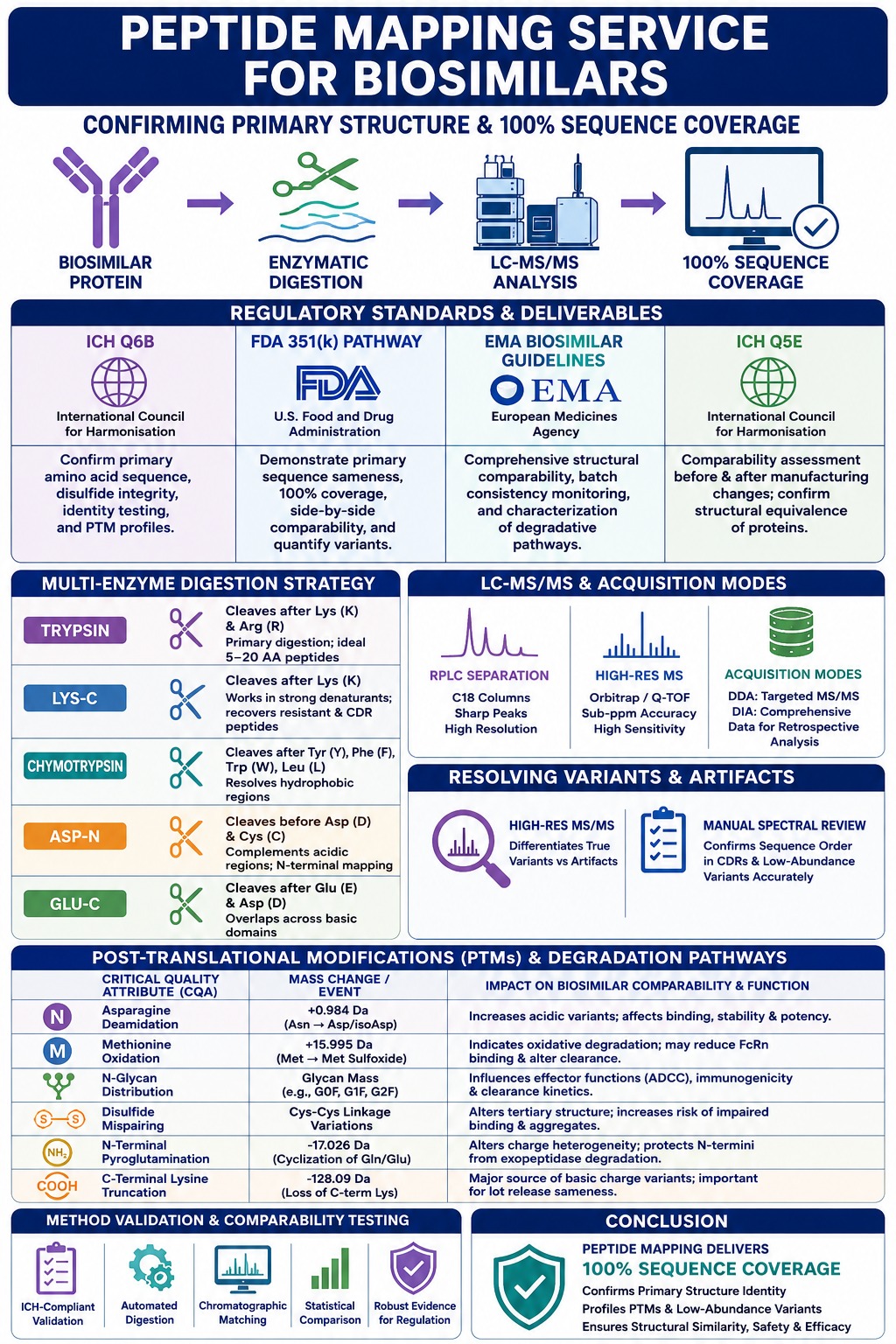
Regulatory Standards for a Peptide Mapping Service for Biosimilars
Regulatory requirements established by the FDA, EMA, and ICH call for comprehensive head-to-head analytical characterization to demonstrate that a proposed biosimilar has an identical primary amino acid sequence to the innovator reference product. Within ICH Q6B specifications, high-resolution LC-MS/MS peptide mapping is recognized as a critical analytical approach for identity testing, structural characterization, and lot release assessment.
Historically, mass spectrometry has supported primary structure confirmation in virtually all biological license applications, making LC-MS/MS peptide mapping a well-established industry standard. Regulatory authorities expect biosimilar developers to demonstrate complete sequence coverage, including all heavy and light chain domains as well as hypervariable CDR regions, to establish that there are no unexplained structural differences. In addition, comparability strategies described in ICH Q5E require manufacturing process changes to preserve structural equivalence. Consequently, validated peptide mapping methods are important multi-attribute monitoring tools that can be applied throughout the product lifecycle.
| Regulatory Guideline | Regulatory Body / Context | Mandated Peptide Mapping Deliverables |
|---|---|---|
| ICH Q6B | International Council for Harmonisation | Confirmation of primary amino acid sequence, determination of disulfide bond integrity, identity testing, and evaluation of PTM profiles. |
| FDA 351(k) Pathway | U.S. Food and Drug Administration | Demonstration of primary sequence sameness, 100% sequence coverage, side-by-side comparability with reference products, and quantitation of sequence variants. |
| EMA Biosimilar Guidelines | European Medicines Agency | Comprehensive structural comparability packages, monitoring of batch-to-batch consistency, and characterization of degradative pathways. |
| ICH Q5E | International Council for Harmonisation | Comparability assessment before and after manufacturing changes, with confirmation of structural equivalence of expressed proteins. |
Ensure your regulatory submission is comprehensive—view our end-to-end biosimilar analytical packages here.
Multi-Enzyme Digestion Strategies in a Peptide Mapping Service for Biosimilars
Obtaining 100% sequence coverage across complex recombinant proteins requires carefully designed multi-enzyme digestion strategies rather than depending exclusively on a single protease. The use of complementary enzymes, including trypsin, Lys-C, Asp-N, Glu-C, and chymotrypsin, produces overlapping peptide maps that can capture small, highly charged, or hydrophobic sequence regions that may remain undetected when only one enzyme is used.
Multi-Enzyme Proteolytic Digestion Workflows
The selection of proteolytic enzymes directly influences peptide fragment size, chromatographic retention behavior, and ionization efficiency in the mass spectrometer. Although trypsin remains the conventional protease because of its high cleavage specificity at the C-terminal side of lysine and arginine residues, digestion with trypsin alone can result in incomplete sequence coverage. For instance, engineered monoclonal antibodies or single-domain antibodies can produce very short di- or tri-peptides within CDR loops during tryptic digestion. These small fragments may exhibit poor retention on reversed-phase columns and can consequently evade detection.
Understand the importance of these critical parameters by exploring our guide on Critical Quality Attributes (CQAs) in Biosimilars.
To address these analytical limitations, secondary digestion approaches using Lysyl Endopeptidase (Lys-C), Endoproteinase Asp-N, Glu-C, or Chymotrypsin can be incorporated. Lys-C cleaves specifically at lysine residues and retains activity under strong denaturing conditions, such as 6 M urea, allowing it to digest domains that are resistant to conventional proteolysis. Applying orthogonal proteases produces overlapping peptide fragments that extend across the complete polypeptide chain, helping confirm sequence continuity and reducing analytical blind spots. Contemporary sample preparation workflows can also use neutral pH digestion conditions and free methionine scavengers to minimize preparation-related artifacts, including artificial deamidation and oxidation.
| Proteolytic Enzyme | Primary Cleavage Specificity | Analytical Role in Biosimilar Characterization |
|---|---|---|
| Trypsin | C-terminal to Lys (K) and Arg (R) residues | Primary digestion standard; generates ideal 5–20 amino acid peptides for efficient MS/MS fragmentation. |
| Lys-C (Lysyl Endopeptidase) | C-terminal to Lys (K) residues | Performs digestion under strong denaturing conditions; helps recover tryptic-resistant domains and small CDR peptides. |
| Chymotrypsin | C-terminal to Tyr (Y), Phe (F), Trp (W), Leu (L) | Helps resolve highly hydrophobic regions and membrane-spanning antibody segments. |
| Asp-N | N-terminal to Asp (D) and Cys (C) residues | Generates complementary fragments for acidic regions and supports N-terminal sequence confirmation. |
| Glu-C | C-terminal to Glu (E) and Asp (D) residues | Produces overlapping peptides across heavily basic domains and supports confirmation of sequence overlap. |
LC-MS/MS Acquisition Modes and High-Resolution Separations
Reversed-phase liquid chromatography (RPLC) combined with high-resolution accurate-mass (HRAM) mass spectrometry delivers the separation capacity and mass accuracy required for detailed characterization of complex proteolytic digests. Liquid chromatography separation commonly employs superficially porous C18 column chemistries with optimized 120 Å pore sizes to achieve sharp peak profiles, high peak capacity, and limited band broadening for both hydrophilic and hydrophobic peptides. Mobile phases consisting of water/acetonitrile gradients modified with formic acid or trifluoroacetic acid can enhance chromatographic resolution and electrospray ionization efficiency.
Mass spectrometric analysis can be performed using advanced Orbitrap or Quadrupole Time-of-Flight (Q-TOF) instruments capable of achieving sub-ppm mass accuracy. Data-Dependent Acquisition (DDA) automatically selects the most abundant precursor ions for collision-induced dissociation (CID) or higher-energy collisional dissociation (HCD), producing diagnostic b- and y-ion series that support exact peptide sequence confirmation. Alternatively, Data-Independent Acquisition (DIA) fragments precursor ions continuously across sequential mass windows, generating comprehensive digital datasets of biosimilar peptide maps that can be retained for retrospective comparability assessments.
Discover how we leverage advanced technology in our native mass spectrometry for biosimilars services.
Resolving Sequence Variants and Artifacts in Peptide Mapping Service for Biosimilars
Reliable primary sequence confirmation requires accurate differentiation between genuine micro-heterogeneity and sequence variants and potential analytical complications associated with isobaric amino acids and software-generated artifacts. High-resolution tandem mass spectrometry, together with expert manual spectral assessment, helps confirm genuine amino acid substitutions while reducing false-positive assignments generated by automated algorithms.
Isobaric Peptides and Manual MS/MS Data Curation
Automated database-search algorithms can encounter challenges when differentiating between isobaric or near-isobaric dipeptide combinations. For example, dipeptide combinations such as Serine-Alanine (SA) and Glycine-Threonine (GT) have identical nominal masses, which may cause automated database search engines to incorrectly assign peptides or produce structural false positives. Automated scoring systems may also misinterpret isotopic distributions, resulting in incorrect software annotations, including artificial succinylation of aspartic acid residues or inaccurate deamidation assignments.
For regulatory-grade analytical accuracy, the workflow should combine automated software scoring, such as BioConfirm algorithms, with expert manual evaluation of MS/MS fragmentation spectra. Detailed inspection of key backbone fragment ions, including b- and y-ion series, can establish the precise sequence order within hypervariable complementarity-determining regions (CDRs). This approach helps confirm that sequence variants detected in candidate biosimilar lots are accurately assigned and quantified, including variants present at low-abundance levels.
Stay ahead of protein degradation; read our analysis on forced degradation of biosimilars here.
Profiling Post-Translational Modifications (PTMs) and Degradation Pathways
Site-specific characterization of post-translational modifications through LC-MS/MS peptide mapping enables comparative assessment of micro-heterogeneity between biosimilar candidates and reference biologics. This bottom-up mass spectrometric strategy identifies mass shifts relative to the theoretical amino acid sequence, allowing simultaneous monitoring of chemical and enzymatic modifications across individual amino acid residues.
The quantitative assessment of critical quality attributes (CQAs) includes several important modification pathways:
- Asparagine Deamidation: Detected through a +0.984 Da mass increase associated with conversion of asparagine to aspartic or isoaspartic acid. This modification occurs frequently at Asn-Gly motifs and may influence acidic charge profiles, stability, binding characteristics, and potency.
- Methionine and Tryptophan Oxidation: Identified through a +15.995 Da mass increase associated with oxidative modification, which can contribute to chemical degradation, impair neonatal Fc receptor (FcRn) binding, and potentially affect the half-life of biotherapeutics.
- N- and O-Glycosylation Profiling: Performed through glycopeptide mapping to characterize specific glycosylation sites, site occupancy, and relative levels of neutral, fucosylated, galactosylated, and sialylated structures.
- Disulfide Bridge Mapping: Performed by comparing non-reduced and reduced digestion profiles to identify canonical disulfide linkages and detect non-native disulfide scrambling.
- Terminal Processing Variants: Quantitated by assessing N-terminal glutamine cyclization to pyroglutamate (-17.026 Da) and C-terminal heavy chain lysine cleavage (-128.09 Da).
| Critical Quality Attribute (CQA) | Mass Difference / Structural Event | Impact on Biosimilar Comparability & Function |
|---|---|---|
| Asparagine Deamidation | +0.984 Da (Asn → Asp/isoAsp) | Increases acidic charge variants and may affect binding affinity, stability, and potency. |
| Methionine Oxidation | +15.995 Da (Met → Met Sulfoxide) | Indicates oxidative degradation; may reduce FcRn binding affinity and alter in vivo clearance. |
| N-Glycan Distribution | Glycan mass signatures (e.g., G0F, G1F, G2F) | Influences effector functions such as ADCC, as well as immunogenicity profiles and clearance kinetics. |
| Disulfide Mispairing | Cys-Cys covalent linkage variations | Can alter tertiary folding and increase the risk of impaired target binding and aggregate formation. |
| N-Terminal Pyroglutamination | -17.026 Da (Cyclization of N-terminal Gln/Glu) | Alters charge heterogeneity and protects N-termini against exopeptidase degradation. |
| C-Terminal Lysine Truncation | -128.09 Da (Loss of heavy chain C-term Lys) | Represents a major source of basic charge variant heterogeneity and is important for demonstrating lot release sameness. |
Need deeper insights into charge variants? Explore our specialized charge variant analysis services.
Method Validation and Comparability Testing in Biosimilar Development
Validation of peptide mapping assays in accordance with applicable ICH guidelines helps establish analytical specificity, precision, and robustness throughout biosimilar development programs. Comparative head-to-head testing strategies assess multiple batches of biosimilar candidates against batches of reference innovator products to demonstrate comparable peptide maps and establish statistically comparable PTM ranges.
Method validation demonstrates that the analytical platform can reproducibly identify primary sequence changes without generating artifacts during sample preparation. The implementation of automated digestion technologies, such as SMART Digest kits, can streamline sample preparation, reduce turnaround times, and limit operator-related variation in digestion. Automated chromatographic matching platforms, including OpenLAB CDS Match Compare, can evaluate retention times, peak areas, and mass spectra across biosimilar and reference product lots. When automated comparative matching is combined with statistical assessment of peak areas, the resulting analytical dataset provides robust empirical evidence of structural similarity to support global regulatory submissions.
Ready to start your comparability testing? Click here to learn about our biosimilar comparability study designs.
Conclusion
An advanced Peptide Mapping Service for Biosimilars establishes a critical analytical foundation for demonstrating 100% sequence coverage, confirming primary structure identity, and evaluating higher-order comparability for regulatory submissions. The integration of multi-enzyme digestion strategies, high-resolution LC-MS/MS platforms, and rigorous manual spectral assessment enables biopharmaceutical developers to address stringent ICH Q6B requirements while reducing analytical risks within biosimilar comparability programs.
Through comprehensive characterization of primary amino acid sequences, site-specific post-translational modifications, and low-abundance sequence variants, peptide mapping helps demonstrate that proposed biosimilars are comparable to their innovator reference products with respect to structure, safety, and efficacy.
To discuss your biosimilar analytical characterization strategy or request a consultation for peptide mapping services, contact the ResolveMass Laboratories Inc. team directly at:
Frequently Asked Questions
Complete sequence coverage demonstrates that the entire protein sequence has been experimentally evaluated without unexplained regions or unidentified sequence gaps. This assessment is particularly important for the heavy and light chains and the hypervariable complementarity-determining regions (CDRs). Confirming every amino acid provides strong evidence of primary structure consistency between the biosimilar and reference product.
Trypsin digestion alone may generate peptides that are too short, excessively hydrophobic, or otherwise difficult to retain and detect during LC-MS/MS analysis. Using complementary enzymes such as Lys-C, Asp-N, Glu-C, and chymotrypsin produces alternative and overlapping peptide fragments. These complementary digestion patterns help cover regions that may remain unresolved with a single protease.
Peptide mapping can characterize several important CQAs and PTMs at specific amino acid sites. These include asparagine deamidation, methionine oxidation, N- and O-glycosylation, disulfide bridge connectivity, N-terminal pyroglutamination, and C-terminal lysine truncation. Monitoring these attributes helps evaluate molecular consistency and identify differences between biosimilar and reference products.
ICH Q6B provides a framework for evaluating the identity, purity, and structural characteristics of biological products. Peptide mapping can be incorporated as an important analytical approach for confirming primary sequence identity and characterizing relevant structural modifications. Biosimilar developers use such analytical evidence to support comprehensive structural comparability with the reference product.
High-resolution accurate-mass (HRAM) instruments provide precise mass measurements that help distinguish closely related peptide assignments. However, mass accuracy alone may not resolve every ambiguity, particularly when peptides have similar or identical masses. Expert review of MS/MS fragmentation patterns, including b- and y-ion series, provides additional confirmation of peptide identity and helps eliminate incorrect software-generated assignments.
Carefully controlled sample preparation is essential for preventing modifications that could be mistakenly interpreted as product-related changes. Digestion conditions can be optimized around neutral pH, appropriate incubation periods, and controlled temperatures to limit artificial deamidation and oxidation. Free methionine scavengers and other suitable controls may also be incorporated to reduce oxidation-related artifacts during processing.
Intact mass analysis evaluates the molecular weight of the complete, undigested protein and provides an overall view of major molecular species. Peptide mapping takes a more detailed approach by enzymatically breaking the protein into defined peptides for residue-level sequence confirmation and PTM localization. Using both approaches provides complementary information for a more comprehensive structural comparability assessment.
Reversed-phase C18 chromatography is widely used for separating peptides generated during proteolytic digestion. Columns with superficially porous particles and suitable pore dimensions, such as 120 Å, can provide strong peak capacity and efficient separation across diverse peptide characteristics. Properly optimized C18 conditions can improve the resolution and detection of both hydrophilic and hydrophobic peptide fragments.
Side-by-side studies analyze multiple batches of the biosimilar candidate and innovator reference product using the same or appropriately comparable analytical workflows. LC-MS/MS datasets can then be evaluated using chromatographic profiles, peak areas, retention times, precursor masses, and MS/MS spectra. Statistical assessment of these results helps determine whether observed differences fall within scientifically and regulatorily justified comparability criteria.
Reference:
- Mouchahoir, T., & Schiel, J. E. (2018). Development of an LC-MS/MS peptide mapping protocol for the NISTmAb. Analytical and Bioanalytical Chemistry, 410(8), 2111–2126. https://doi.org/10.1007/s00216-018-0848-6
- Liu, Y. D., Beardsley, M. I., & Yang, F. (2023). Expanding the analytical toolbox: Developing new Lys-C peptide mapping methods with minimized assay-induced artifacts to fully characterize antibodies. Pharmaceuticals, 16(9), 1327. https://doi.org/10.3390/ph16091327
- Kirchhoff, C. F., Wang, X.-Z. M., Conlon, H. D., Anderson, S., Ryan, A. M., & Bose, A. (2017). Biosimilars: Key regulatory considerations and similarity assessment tools. Biotechnology and Bioengineering, 114(12), 2696–2705. https://doi.org/10.1002/bit.26438
- Li, L., & Xiao, X. (2018). Methods for identifying and analyzing amino acid sequences of proteins (Australian Patent Application No. AU2017214586A1). Google Patents. https://patents.google.com/patent/AU2017214586A1/en
- Li, C., Rossomando, A., Wu, S.-L., & Karger, B. L. (2013). Comparability analysis of anti-CD20 commercial (rituximab) and RNAi-mediated fucosylated antibodies by two LC-MS approaches. mAbs, 5(4), 565–575. https://doi.org/10.4161/mabs.24814
Get In Touch With Us
About The Author


