


Introduction
The use of Peptide-Oligonucleotide Conjugate (POCs) in CNS Drug Delivery represents an advanced bioconjugation strategy designed to transport therapeutic nucleic acids across the otherwise restrictive blood-brain barrier and into central nervous system parenchyma. By covalently attaching tissue-targeting or cell-penetrating peptides to synthetic oligonucleotides, this strategy is intended to overcome physiological delivery barriers and facilitate target gene silencing within central nervous system tissues.
The central nervous system (CNS) remains one of the most difficult targets for biopharmaceutical intervention because of its highly restrictive anatomical barriers. The blood-brain barrier (BBB), which is composed of brain microvascular endothelial cells (BMECs), pericytes, astrocyte end-feet, and dense intercellular tight junction complexes containing claudin-5, occludin, and junctional adhesion molecules, restricts 98% of small-molecule drugs and virtually 100% of macromolecular therapeutics from reaching the brain extracellular space. Although nucleic acid-based modalities—including antisense oligonucleotides (ASOs), small interfering RNAs (siRNAs), and phosphorodiamidate morpholino oligomers (PMOs)—provide high target specificity for neurodegenerative and neuroinflammatory disorders, their unfavorable physicochemical characteristics substantially restrict their use through systemic administration. Naked oligonucleotides carry a strong polyanionic charge because of their phosphodiester or phosphorothioate backbones, have relatively high molecular weights (6-14 kDa), and demonstrate limited membrane permeability, making passive diffusion across brain capillary endothelial membranes highly inefficient.
Historically, invasive local delivery routes, including intrathecal (IT) and intracerebroventricular (ICV) injections, have been used to bypass the BBB. Nevertheless, these procedures are associated with considerable clinical challenges, including infection risk, spinal headaches, inadequate rostral parenchymal distribution, and limited patient compliance during chronic treatment regimens. Other carrier platforms, including lipid nanoparticles (LNPs) and viral vectors, can present additional limitations such as hepatic accumulation, substantial immunogenicity, and limited penetration into deeper tissues because of their comparatively large steric profiles (>50 nm).
Peptide-Oligonucleotide Conjugates (POCs) address several of these limitations by functioning as compact, unimolecular delivery systems (<10 nm) that can utilize endogenous receptor-mediated transcytosis (RMT) pathways. Through deliberate peptide engineering, these constructs can interact with receptors located on the luminal surface of the BBB, undergo endosomal trafficking across endothelial cells while preserving barrier integrity, and facilitate delivery of functional genetic payloads to target neurons, astrocytes, and microglia.
Explore different structural formats and designs: Types of Peptide Oligonucleotide Conjugates
Share via:
Article Summary:
- POCs (Peptide-Oligonucleotide Conjugates) combine targeting peptides with ASOs/siRNAs to improve systemic delivery of genetic medicines across the blood-brain barrier (BBB).
- Receptor-mediated transcytosis (RMT) enables POCs to cross brain endothelial cells without disrupting BBB integrity, using targets such as LRP-1, TfR1, LDL receptors, and integrin αvβ3.
- Linker engineering controls payload release and stability. Cleavable options include Val-Cit, disulfide, and hydrazone/acetal linkers, while non-cleavable systems include thioether, amide, and triazole linkages.
- Endosomal escape is a major bottleneck, with most internalized oligonucleotides remaining trapped in endosomes. Histidine switches, amphipathic peptides, and polycationic R8/R9 motifs can improve intracellular release.
- Preclinical studies show promising 60–80%+ target transcript knockdown in models of ischemic stroke, Alzheimer’s disease, Parkinson’s disease, and glioblastoma.
- HRMS and orthogonal chromatography are essential for POC quality control, enabling confirmation of molecular mass, conjugation stoichiometry, sequence purity, and impurities.
- Overall, POCs offer potential for non-invasive IV CNS delivery, targeted gene silencing, and disease-modifying therapy, with future development focused on linker optimization, endosomal escape, peptide discovery, and advanced analytical characterization.
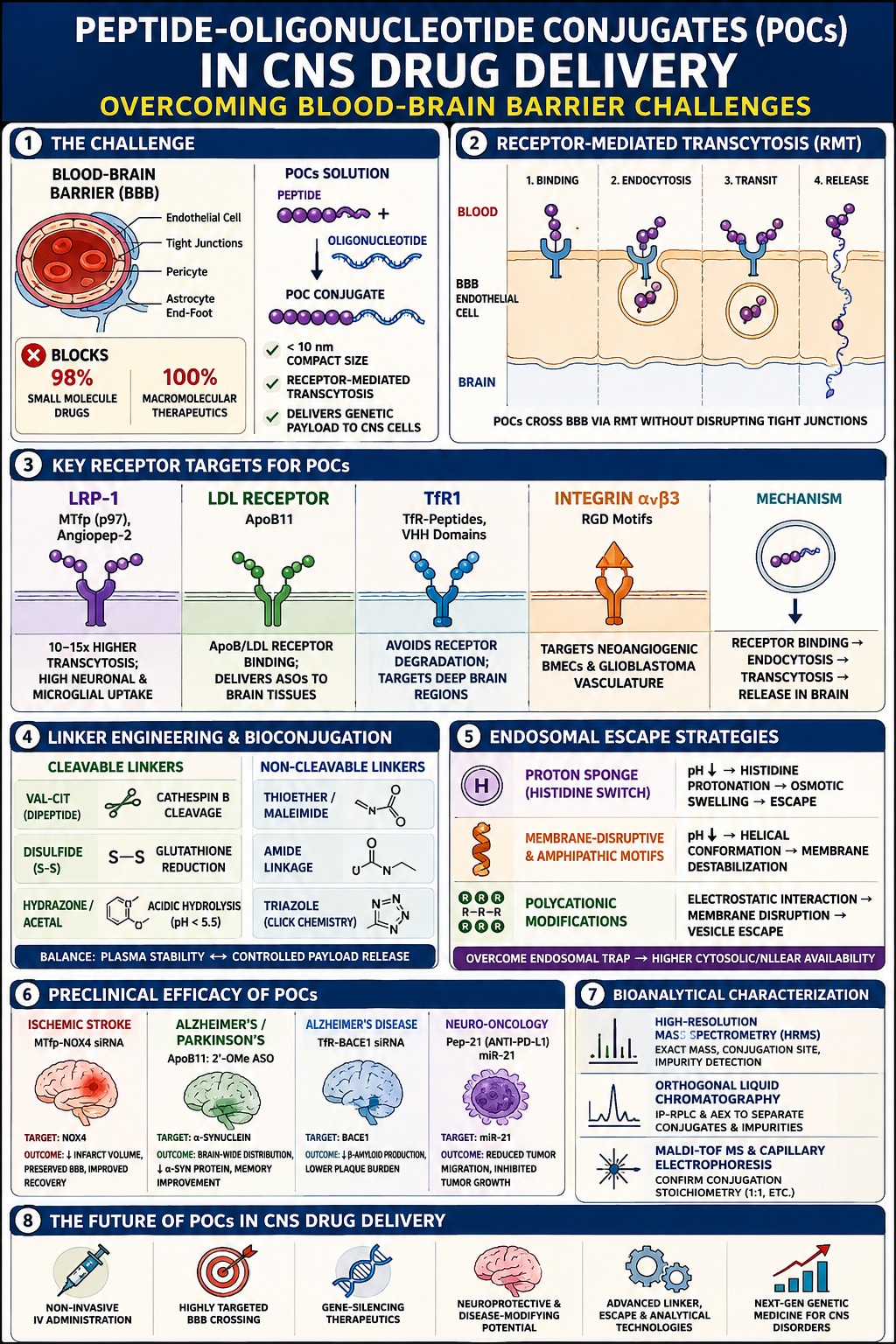
Receptor-Mediated Transcytosis Mechanisms for Peptide-Oligonucleotide Conjugate (POCs) in CNS Drug Delivery
Receptor-mediated transcytosis (RMT) enables Peptide-Oligonucleotide Conjugate (POCs) in CNS Drug Delivery to traverse the blood-brain barrier by employing peptide domains that selectively recognize receptors present on the luminal surface of capillary endothelial cells. Receptor binding initiates endocytosis, followed by vesicular transport and subsequent abluminal release into the brain extracellular space.
The physiological performance of RMT is strongly dependent on the selection of peptide ligands capable of targeting receptors that are consistently expressed on the luminal surface of BMECs. In contrast to full-length monoclonal antibodies, which may contribute to receptor downregulation, degradation, or unfavorable clearance behavior, functionalized short peptide motifs (5-25 amino acids) offer lower steric mass, generally lower immunogenicity, and adjustable binding affinity. These characteristics can support receptor engagement while allowing appropriate dissociation on the abluminal side.
Learn more about cellular uptake mechanisms: How Do Peptide Oligonucleotide Conjugates Enter Cells?
Low-Density Lipoprotein Receptor-Related Protein 1 (LRP-1) Targeting
LRP-1 targeting employs peptide ligands, including melanotransferrin-derived MTfp or Angiopep-2, to promote rapid endocytosis and brain parenchymal uptake of conjugated nucleic acids through receptor-mediated interactions.
LRP-1 is highly expressed on brain microvascular endothelial cells as well as within neural tissues. Melanotransferrin-derived peptide (MTfp, or p97 domain) is a 12-amino acid sequence derived from human melanotransferrin that exhibits specific binding to LRP-1. Transcytosis rates of MTfp across bovine and murine brain capillary monolayers have been reported to be 10 to 15 times higher than those observed for holo-transferrin or lactoferrin. When conjugated to siRNAs, MTfp functions as a molecular delivery vehicle that promotes systemic brain accumulation while maintaining tight junction integrity and avoiding local tissue toxicity. Likewise, Angiopep-2 is a 19-amino acid peptide derived from the LRP-binding domain of aprotinin and utilizes LRP-1 to facilitate rapid transendothelial movement into brain parenchyma.
Transferrin Receptor Modalities for Peptide-Oligonucleotide Conjugate (POCs) in CNS Drug Delivery
Transferrin receptor (TfR1) modalities use short, non-blocking peptide motifs or single-domain antibody fragments to promote transendothelial transport of Peptide-Oligonucleotide Conjugate (POCs) in CNS Drug Delivery while reducing the likelihood of lysosomal sequestration or receptor degradation.
The transferrin receptor system (TfR1) remains an important target for central nervous system delivery because of its high expression on BMECs. High-affinity bivalent antibodies can become preferentially retained within lysosomes or undergo recycling back into circulation. In contrast, truncated peptide ligands and single-domain antibody fragments (VHH) engineered to recognize non-ligand-blocking TfR epitopes can support more favorable transcytosis. Conjugating antisense sequences to TfR-binding peptides can facilitate uptake across the neurovascular unit and increase tissue concentrations within deep brain regions, including the striatum, hippocampus, and cortex.
Compare targeting approaches: Peptide vs. Antibody Oligonucleotide Conjugates
Apolipoprotein B (ApoB) Derivatives and LDL Receptors
Apolipoprotein B derivatives, including ApoB11, utilize low-density lipoprotein (LDL) receptors on brain endothelial cells to transport attached antisense payloads across the blood-brain barrier and into cerebral cortical and hippocampal tissues.
Apolipoprotein B derivatives, particularly ApoB11, which is derived from the ApoB38 peptide containing the LDL-receptor binding domain, provide a dual-function delivery approach. ApoB11 incorporates an internal receptor-binding motif connected to a positively charged oligo-arginine (e.g., 9-Arg) tail through a flexible poly-glycine (5-Gly) spacer. The polycationic tail can electrostatically complex with or covalently anchor negatively charged 2′-O-methyl (2′-OMe) modified antisense oligonucleotides, while the ApoB segment interacts with low-density lipoprotein (LDL) receptors on brain endothelial cells to support brain delivery.
| Receptor Target | Primary Peptide Ligands | Key Sequence Features / Chemistry | Transcytosis Efficiency / Target CNS Mechanism |
|---|---|---|---|
| LRP-1 | MTfp (p97 domain), Angiopep-2 | 12-mer peptide (MTfp); aprotinin-derived 19-mer | Transcytosis rate 10-15x higher than serum transferrin; high neuronal and microglial uptake |
| LDL Receptor | ApoB11 | ApoB38-derived, 5-Gly spacer, 9-Arg polycationic tail | Binds ApoB/LDL receptors on BMECs; electrostatically or covalently packages ASOs |
| TfR1 | TfR-peptides, VHH domains | Truncated peptide motifs, monomeric VHH fusions | Avoids receptor degradation; targets deep cortical, striatal, and hippocampal structures |
| Integrin αvβ3 | RGD motifs | Cyclic or linear Arg-Gly-Asp domain | Targets neoangiogenic BMECs and glioblastoma vasculature for tumor site delivery |
Linker Engineering and Bioconjugation Strategies for Peptide-Oligonucleotide Conjugate (POCs) in CNS Drug Delivery
Linker engineering in Peptide-Oligonucleotide Conjugate (POCs) in CNS Drug Delivery is designed to balance plasma stability during systemic circulation with controlled intracellular release of the active nucleic acid payload within CNS target cells.
The stability of the covalent linkage helps maintain the structural integrity of the conjugate during passage across the blood-brain barrier before the therapeutic payload is released within target neural cells. The selected bioconjugation chemistry can directly affect the pharmacokinetics (PK), pharmacodynamics (PD), organ biodistribution, and safety profile of POC therapeutics. Chemical linkers are generally classified as either non-cleavable or cleavable according to their behavior in extracellular and intracellular environments.
Examine chemical conjugation chemistry: Peptide Oligonucleotide Conjugate Linker Chemistry
Cleavable Linker Technologies
Cleavable linkers incorporate chemically labile bonds, including cathepsin-sensitive dipeptides, reduction-sensitive disulfides, and acid-labile hydrazones, that can facilitate liberation of unmodified oligonucleotides within intracellular endosomes or lysosomes.
Cleavable linkers are engineered to remain sufficiently stable during plasma circulation while enabling rapid release of the unmodified oligonucleotide payload when the conjugate encounters specific intracellular triggers within neurons or glia:
- Enzyme-Cleavable Dipeptides: Sequences such as Valine-Citrulline (Val-Cit) or Lysine-Phenylalanine (Lys-Phe) can resist luminal plasma proteases while undergoing cleavage by lysosomal cathepsins, including Cathepsin B, following cellular internalization.
- Disulfide Linkers: Reducible bonds, such as pyridyldiopropionate linkages, take advantage of the substantial concentration gradient between extracellular plasma glutathione (approximately 2-20 μM) and intracellular cytosolic glutathione (approximately 1-10 mM), thereby promoting cytosolic release following endosomal escape.
- Acid-Sensitive Linkers: Hydrazone, acetal, and cis-aconityl groups can remain stable under systemic conditions at pH 7.4 but undergo hydrolysis within the acidic microenvironment of early and late endosomes (pH 5.0-6.0).
Non-Cleavable Linker Technologies
Non-cleavable linkers connect peptides and oligonucleotides through metabolically stable covalent bonds, including thioethers and triazoles, and therefore depend on intracellular proteolytic degradation of the peptide backbone within target cells.
Non-cleavable linkers establish permanent, metabolically stable covalent connections between the peptide delivery vehicle and nucleic acid payload:
- Thioether and Maleimide Linkages: These are generated through a reaction between C-terminal cysteine thiols on the peptide and maleimide-functionalized oligonucleotides.
- Amide Linkages: These are produced by coupling amino-modified oligonucleotides with activated carboxylic esters, such as NHS esters, present on peptide side chains and provide high plasma stability.
- Click Chemistry (Triazoles): Copper-free strain-promoted azide-alkyne cycloaddition (SPAAC) between dibenzocyclooctyne (DBCO) and azide functional groups generates stable triazole linkages under mild physiological conditions without introducing heavy-metal toxicity.
With non-cleavable linker systems, the peptide component undergoes progressive proteolytic degradation within target cell lysosomes. This process leaves a short amino acid residue attached to the oligonucleotide, and that residual modification must not interfere with the oligonucleotide’s ability to bind target RNA transcripts.
| Linker Class | Specific Chemistry | Cleavage Trigger | Plasma Stability | Primary Applications in CNS Delivery |
|---|---|---|---|---|
| Cleavable | Valine-Citrulline (Val-Cit) | Cathepsin B cleavage in lysosomes | High in systemic plasma | Native ASO/siRNA payload release in cortical neurons |
| Cleavable | Disulfide (S-S) | Glutathione reduction in cytosol | Moderate (tunable via steric hindrance) | Cytosolic siRNA release post-endosomal escape |
| Cleavable | Hydrazone / Acetal | Acidic hydrolysis (pH < 5.5) | High at pH 7.4; releases in endosomes | Endosomal payload liberation prior to lysosomal degradation |
| Non-Cleavable | Thioether / Triazole | Proteolytic degradation of peptide backbone | Exceptional in plasma and CSF | Long-circulating ASOs targeting nuclear transcripts |
Endosomal Escape Dynamics and Subcellular Bioavailability
Endosomal escape dynamics are critical determinants of the cytosolic and nuclear bioavailability of internalized conjugates because more than 98% of internalized nucleic acids can remain trapped within endolysosomal vesicles in the absence of specialized release mechanisms.
Analysis of intracellular trafficking demonstrates that although receptor-mediated endocytosis can transport substantial quantities of POCs across the luminal membrane of brain microvascular endothelial cells, most internalized cargo becomes sequestered within early endosomes, progresses to late endosomes or lysosomes for degradation, or is recycled back into the bloodstream through exocytosis. Quantitative studies have indicated that less than 1-2% of endocytosed oligonucleotides naturally escape endosomal compartments and gain access to cytosolic or nuclear targets.
To address this major intracellular delivery bottleneck, specific architectural modifications can be incorporated into the peptide component of the conjugate:
Understand key intracellular release barriers: Endosomal Escape in Peptide Oligonucleotide Conjugates
Proton Sponge Mechanism and Histidine Switches
Histidine switches incorporate amino acid residues with a pKa of approximately 6.0 that become protonated within acidic endosomes, promoting an influx of ions and water that can cause osmotic swelling and membrane disruption.
Incorporating histidine residues into the peptide backbone provides a buffering mechanism during endosomal acidification. As ATP-driven proton pumps reduce the endosomal pH from 7.4 toward 5.0, the imidazole rings of histidine undergo progressive protonation. This process promotes the influx of chloride ions and water molecules into the endosome, resulting in osmotic swelling and membrane destabilization that can release POC cargo into the cytoplasm.
Membrane-Disruptive and Amphipathic Motifs
Amphipathic motifs can undergo pH-dependent conformational transitions from random-coil structures under neutral conditions to helical structures in acidic endosomes, allowing direct interaction with and destabilization of vesicular lipid bilayers.
Synthetic amphipathic sequences, including the GALA peptide and influenza virus HA2 subunit fusion domains, exhibit pH-dependent structural changes. At neutral systemic pH, these peptides generally adopt random-coil conformations; after entering the acidic endosomal environment, they transition into amphipathic α-helices that interact with endosomal lipid bilayers and can generate transient lipid pores.
Polycationic Modifications
Polycationic modifications, including oligo-arginine (R8/R9) or octa-guanidine tails, facilitate electrostatic interactions with anionic phospholipid headgroups, promoting localized membrane micro-disruptions or budding-and-collapse escape mechanisms.
Adding oligo-arginine or octa-guanidine tails to the conjugate promotes interactions with negatively charged phospholipid headgroups within endosomal membranes. This interaction can destabilize the membrane through localized micro-domain formation and facilitate vesicular escape through transient membrane disruptions or vesicle budding-and-collapse mechanisms without causing cellular necrosis.
Preclinical Efficacy of Peptide-Oligonucleotide Conjugate (POCs) in CNS Drug Delivery Pathologies
Preclinical evaluations indicate that Peptide-Oligonucleotide Conjugate (POCs) in CNS Drug Delivery can achieve target transcript knockdowns exceeding 60-80% across acute and chronic neurological disease models.
Therapeutic applications include ischemic stroke, Alzheimer’s disease, Parkinson’s disease, and Huntington’s disease, where selective silencing of pathological transcripts within brain parenchyma may provide a disease-modifying strategy.
Discover broader therapeutic applications: Peptide Oligonucleotide Conjugates Drug Delivery
Ischemic Stroke and Oxidative Stress Mitigation
Ischemic stroke intervention uses MTfp-siRNA conjugates targeting NOX4 to suppress reactive oxygen species generation, preserve blood-brain barrier tight junctions, and substantially reduce infarct volume.
Ischemic stroke causes extensive brain tissue injury through mechanisms involving oxidative stress and neuroinflammation, with Nicotinamide Adenine Dinucleotide Phosphate Oxidase 4 (NOX4) upregulation occurring in cerebral endothelial cells and neurons. Conventional therapeutics may have limited ability to suppress this neurotoxic cascade because intact BBB restrictions can prevent adequate drug exposure during the early stages of ischemia.
To address this challenge, an MTfp-siRNA peptide-oligonucleotide conjugate was developed to target NOX4. Preclinical studies involving the MTfp-NOX4 POC demonstrated:
- Intact BBB Transcytosis: Systemically administered MTfp-NOX4 POC crossed intact vascular barriers and distributed into parenchymal neurons and glia.
- Gene Knockdown: A substantial reduction in NOX4 mRNA and protein expression was observed across ischemic brain tissues.
- Neuroprotective Outcomes: Animals receiving pretreatment or acute treatment following ischemia demonstrated significantly smaller brain infarct volumes, decreased reactive oxygen species (ROS) levels, reduced neuroinflammation, and improved neurological functional recovery.
Neurodegenerative Proteinopathies: Alzheimer’s and Parkinson’s Diseases
Neurodegenerative interventions utilize ApoB11 or TfR-targeted antisense conjugates to reduce expression of misfolded protein-associated transcripts, including α-synuclein and BACE1, across cortical and hippocampal tissues.
Neurodegenerative disorders such as Alzheimer’s Disease (AD), Parkinson’s Disease (PD), and Dementia with Lewy Bodies (DLB) are associated with the pathological accumulation of misfolded proteins, particularly α-synuclein (α-syn) and amyloid-beta (Aβ) aggregates. Systemic administration of an ApoB11-conjugated 2′-O-methylated antisense oligonucleotide (ApoB11:2′-OMe ASO) targeting the α-syn transcript demonstrated significant therapeutic effects in PSAPP double-transgenic mice:
- Parenchymal Distribution: Fluorescent labeling demonstrated broad parenchymal distribution of the ASO throughout the cerebral cortex and pyramidal cells of the hippocampus within 24 hours following IV administration.
- Protein Downregulation: Long-term systemic administration reduced α-synuclein expression, limiting subsequent neurotoxic accumulation, preserving neuronal density as indicated by NeuN markers, and improving spatial memory deficits in behavioral models.
| Disease Indication | POC Construct | Target Transcript / Mechanism | Preclinical Model | Key Therapeutic Outcome |
|---|---|---|---|---|
| Ischemic Stroke | MTfp-NOX4 siRNA | NOX4 gene / Inhibition of ROS generation & oxidative stress | Mouse MCAO model | Decreased infarct volume; preserved BBB integrity; accelerated functional recovery |
| Alzheimer’s / Parkinson’s | ApoB11:2′-OMe ASO | α-Synuclein mRNA / Suppression of toxic aggregation | PSAPP transgenic mouse model | Brain-wide ASO distribution; reduced α-syn protein levels; memory rescue |
| Alzheimer’s Disease | TfR-BACE1 siRNA | BACE1 transcript / Reduction of amyloid precursor cleavage | Mouse AD models | Reduced brain β-amyloid production; lowered neuronal plaque burden |
| Neuro-Oncology (Glioblastoma) | Pep-21 (Anti-PD-L1 peptide) | miR-21 / Downregulation of oncogenic microRNA | Tumor-bearing mouse models | Reduced macrophage-mediated tumor migration; inhibited tumor expansion |
Bioanalytical Characterization and Quality Control Frameworks
Bioanalytical characterization of peptide-oligonucleotide hybrid molecules requires high-resolution mass spectrometry and orthogonal liquid chromatography to establish exact molecular mass, conjugation stoichiometry, and sequence purity.
The structural complexity and heterogeneity of POCs, which combine hydrophilic, polyanionic oligonucleotide backbones with hydrophobic or polycationic peptide sequences, create distinct analytical challenges during process development and quality control. Comprehensive characterization therefore requires multi-tiered chromatographic and mass spectrometric approaches:
Read detailed analytical characterization strategies: Structural Characterization of Peptide Oligonucleotide Conjugates
High-Resolution Mass Spectrometry (HRMS)
HRMS platforms, including Orbitrap analyzers, provide the mass accuracy necessary to resolve minor sequence impurities, including truncated (n-1) oligonucleotides and incompletely removed protecting groups.
The use of Orbitrap HRMS platforms enables accurate determination of exact molecular weight (m/z), charge-state distributions, and bioconjugation sites. High-resolution mass spectrometry can distinguish minor sequence-related impurities, including truncated oligonucleotide failure sequences (n-1, n-2), amino acid deletions, and incompletely removed protecting groups generated during solid-phase assembly.
Explore primary sequence verification methods: Peptide Oligonucleotide Conjugate Sequence Confirmation Strategies
Orthogonal Liquid Chromatography
Orthogonal liquid chromatography combines ion-pair reversed-phase and anion-exchange separation modes to distinguish functional conjugates from unreacted starting materials and degradation products.
A combination of Ion-Pair Reversed-Phase Liquid Chromatography (IP-RPLC) and Anion-Exchange Chromatography (AEX) is used to resolve unreacted peptide starting materials, free oligonucleotides, and target POC conjugates. IP-RPLC employs alkylammonium ion-pairing agents, such as triethylammonium acetate, to partially neutralize the negatively charged phosphate backbone and facilitate separation according to hydrophobic interactions associated with the peptide motif. Matrix-Assisted Laser Desorption/Ionization Time-of-Flight Mass Spectrometry (MALDI-TOF MS) and capillary electrophoresis provide additional confirmation of 1:1 or discrete multivalent conjugation stoichiometry.
Review quality control and specification guidelines: Peptide Oligonucleotide Conjugates Specification Setting
Conclusion: The Future of Peptide-Oligonucleotide Conjugate (POCs) in CNS Drug Delivery
Peptide-Oligonucleotide Conjugate (POCs) in CNS Drug Delivery represent a targeted, non-invasive therapeutic modality designed to transport therapeutic nucleic acids across the blood-brain barrier for the treatment of neurological disorders that have historically been difficult to address.
By combining the cell-targeting specificity of short receptor-binding peptides with the gene-silencing capabilities of modified nucleic acids, POCs offer a strategy for addressing the longstanding challenge of achieving central tissue exposure while maintaining appropriate peripheral pharmacokinetic characteristics. Preclinical findings in ischemic stroke models using MTfp-NOX4 siRNA and neurodegenerative Alzheimer’s/Parkinson’s models using ApoB11:ASO constructs demonstrate the potential of systemically administered conjugates to produce neuroprotective and disease-modifying effects without compromising blood-brain barrier integrity.
As synthetic methodologies continue to evolve through orthogonal protection strategies and AI-driven peptide discovery, POC platforms have the potential to reduce reliance on invasive intrathecal procedures by enabling convenient and highly targeted intravenous administration. Continued optimization of linker chemistry, endosomal escape kinetics, and high-resolution mass spectrometry-based quality control will be essential for advancing Peptide-Oligonucleotide Conjugate (POCs) in CNS Drug Delivery as a leading approach in genetic medicine for central nervous system disorders.
For technical inquiries, custom bioconjugation services, and advanced analytical characterization of peptide-oligonucleotide constructs, visit the ResolveMass Laboratories Contact Page.
Frequently Asked Questions
POCs have a compact molecular architecture, generally measuring less than 10 nm, whereas LNPs commonly have substantially larger particle dimensions. Their smaller size can support improved access to brain tissue and more controlled molecular composition. POCs can also be engineered with defined peptide and oligonucleotide components, potentially reducing nonspecific hepatic accumulation and improving delivery specificity.
MTfp is a 12-amino acid peptide derived from human melanotransferrin that interacts with LRP-1 expressed on brain microvascular endothelial cells. This receptor interaction promotes cellular internalization and transendothelial trafficking of the attached oligonucleotide cargo. MTfp has demonstrated substantially enhanced transcytosis compared with holo-transferrin while maintaining the integrity of BBB tight junctions.
Cleavable linkers are engineered to respond to intracellular conditions, including acidic pH, elevated glutathione concentrations, or proteolytic enzymes such as cathepsins. Their cleavage releases the nucleic acid payload from the peptide carrier within the target cell. Non-cleavable linkers remain covalently attached and depend on intracellular degradation of the peptide portion, leaving a residual amino acid-containing structure on the oligonucleotide.
Endosomal escape domains are incorporated to prevent internalized POCs from remaining trapped within endosomal or lysosomal compartments. Histidine-rich sequences, amphipathic peptides, and other membrane-active motifs can respond to the acidic endosomal environment and destabilize vesicular membranes. This may promote transient membrane permeabilization and improve access of the nucleic acid payload to cytoplasmic or nuclear targets.
Chemical modifications such as 2′-O-methyl (2′-OMe), 2′-Fluoro (2′-F), and phosphorothioate (PS) substitutions can improve oligonucleotide stability in biological environments. These modifications can reduce degradation by serum nucleases and enhance resistance to enzymatic cleavage. As a result, appropriately modified oligonucleotides may demonstrate improved systemic persistence and an extended plasma circulation half-life (t₁/₂).
ApoB11 incorporates an Apolipoprotein B-derived receptor-binding sequence together with a poly-arginine segment connected through a flexible glycine spacer. The poly-arginine component facilitates interaction with the negatively charged antisense oligonucleotide, while the ApoB-derived region recognizes LDL receptors on brain endothelial cells. This receptor interaction supports transport of the conjugate across the BBB and enables distribution toward cortical and hippocampal tissues for target gene modulation.
Producing peptide-oligonucleotide conjugates requires careful coordination of solid-phase peptide synthesis (SPPS) with phosphoramidite-based oligonucleotide chemistry. The protecting groups and reaction conditions must remain compatible throughout peptide assembly, oligonucleotide synthesis, conjugation, and final deprotection. Poorly matched chemistries can result in side reactions, incomplete coupling, sequence truncation, or degradation of the final conjugate.
High-resolution Orbitrap mass spectrometry (HRMS) and Ion-Pair Reversed-Phase Liquid Chromatography (IP-RPLC) are important analytical techniques for characterizing POCs. HRMS can establish molecular mass, charge-state distribution, conjugation identity, and sequence-related impurities, while IP-RPLC helps separate the desired conjugate from free peptides, oligonucleotides, and degradation products. Additional orthogonal techniques can further confirm purity and conjugation stoichiometry.
Yes, intranasal administration can potentially be integrated with POC technology as an alternative approach for CNS delivery. The intranasal route can provide access to the brain through olfactory and trigeminal pathways while reducing dependence on systemic circulation. Combining this route with peptide-mediated targeting may increase local CNS exposure and potentially limit distribution to peripheral tissues, although formulation and delivery efficiency must be carefully optimized.
Reference:
- Bagchi, S., & Nair, A. (2022). Biodistribution and delivery of oligonucleotide therapeutics to the central nervous system: Advances, challenges, and future perspectives. Journal of Controlled Release, 351, 282–297. https://doi.org/10.1016/j.jconrel.2022.09.039
- Eyford, B. A., Singh, C. S. B., Abraham, T., Munro, L., Choi, K. B., Hill, T., Hildebrandt, R., Welch, I., Vitalis, T. Z., Gabathuler, R., Gordon, J. A., Adomat, H., Guns, E. S. T., Lu, C.-J., Pfeifer, C. G., Tian, M. M., & Jefferies, W. A. (2021). A nanomule peptide carrier delivers siRNA across the intact blood-brain barrier to attenuate ischemic stroke. Frontiers in Molecular Biosciences, 8, 611367. https://doi.org/10.3389/fmolb.2021.611367
- Malinowska, A. L., Huynh, H. L., & Bose, S. (2024). Peptide–oligonucleotide conjugation: Chemistry and therapeutic applications. Current Issues in Molecular Biology, 46(10), 11031–11047. https://doi.org/10.3390/cimb46100655
- Järver, P., Coursindel, T., El Andaloussi, S., Godfrey, C., Wood, M. J. A., & Gait, M. J. (2012). Peptide-mediated cell and in vivo delivery of antisense oligonucleotides and siRNA. Molecular Therapy—Nucleic Acids, 1(6), e27. https://doi.org/10.1038/mtna.2012.18
- Demeule, M., Poirier, J., Jodoin, J., Bertrand, Y., Desrosiers, R. R., Dagenais, C., Nguyen, T., Lanthier, J., Gabathuler, R., Kennard, M., Jefferies, W. A., Karkan, D., Tsai, S., Fenart, L., Cecchelli, R., & Béliveau, R. (2002). High transcytosis of melanotransferrin (P97) across the blood-brain barrier. Journal of Neurochemistry, 83(4), 924–933. https://doi.org/10.1046/j.1471-4159.2002.01201.x
- Demeule, M., Poirier, J., Jodoin, J., Bertrand, Y., Desrosiers, R. R., Dagenais, C., Nguyen, T., Lanthier, J., Gabathuler, R., Kennard, M., Jefferies, W. A., Karkan, D., Tsai, S., Fenart, L., Cecchelli, R., & Béliveau, R. (2002). High transcytosis of melanotransferrin (P97) across the blood-brain barrier. Journal of Neurochemistry, 83(4), 924–933. https://doi.org/10.1046/j.1471-4159.2002.01201.x
- Li, G., Ye, C., Zhu, Y., Zhang, T., Gu, J., Pan, J., Wang, F., Wu, F., Huang, K., Xu, K., Wu, X., & Shen, J. (2022). Oxidative injury in ischemic stroke: A focus on NADPH oxidase 4. Oxidative Medicine and Cellular Longevity, 2022, 1148874. https://doi.org/10.1155/2022/1148874
Get In Touch With Us
About The Author


