


Introduction
Comprehensive Peptide Stability Testing Services establish the chemical, physical, and microbiological quality characteristics of therapeutic peptides when stored under controlled environmental conditions, supporting compliance with global regulatory registration requirements. These specialized testing programs integrate International Council for Harmonisation (ICH) Q1A(R2) long-term, intermediate, and accelerated stability protocols with ICH Q1B photostability studies, stress-induced forced degradation investigations, and statistical extrapolation approaches for determining product shelf life.
Peptides occupy a distinctive structural position between small-molecule synthetic pharmaceuticals and large recombinant proteins. Although they do not possess the highly robust tertiary folding characteristic of large globular proteins, their complex primary amino acid sequences create specific chemical and physical stability vulnerabilities. Chemical liabilities, including asparagine deamidation, methionine oxidation, N-terminal truncation, and cyclic succinimide formation, can occur together with physical changes such as oligomerization, fibrillization, and precipitation. As a result, biopharmaceutical sponsors depend on specialized peptide stability testing services to validate stability-indicating analytical methodologies, establish appropriate storage conditions, determine precise retest periods for active pharmaceutical ingredients (APIs), and define shelf-life specifications for commercial drug products.
To explore the core structural and analytical differences between traditional synthetic drugs and peptide therapeutics, read our detailed comparison on the difference between a peptide and a small molecule drug.
Share via:
Quick Summary:
- Peptide stability testing evaluates chemical, physical, and microbiological stability to support product quality, safety, efficacy, and regulatory approval.
- ICH Q1A(R2), Q1B, Q1E, Q1D, and Q5C provide key frameworks for environmental stability, photostability, shelf-life, study design, and biologic peptide considerations.
- Common degradation pathways include deamidation, oxidation, truncation, hydrolysis, aggregation, fibrillization, and precipitation.
- Forced degradation studies use acid/base, oxidative, thermal, and photolytic stress to identify degradation pathways and establish stability-indicating methods.
- Advanced analytical tools such as RP-HPLC, SEC/SEC-MALS, LC-MS/MS, and iCEF/cIEF monitor purity, degradation products, aggregation, molecular mass, and charge variants.
- Shelf-life and retest periods are determined through regression analysis, batch pooling/ANCOVA, extrapolation, and significant-change assessment under ICH Q1E.
- High-throughput predictive stability and cGMP programs combine accelerated stress modeling, validated stability chambers, environmental monitoring, and analytical testing to support formulation development and commercial shelf-life determination.
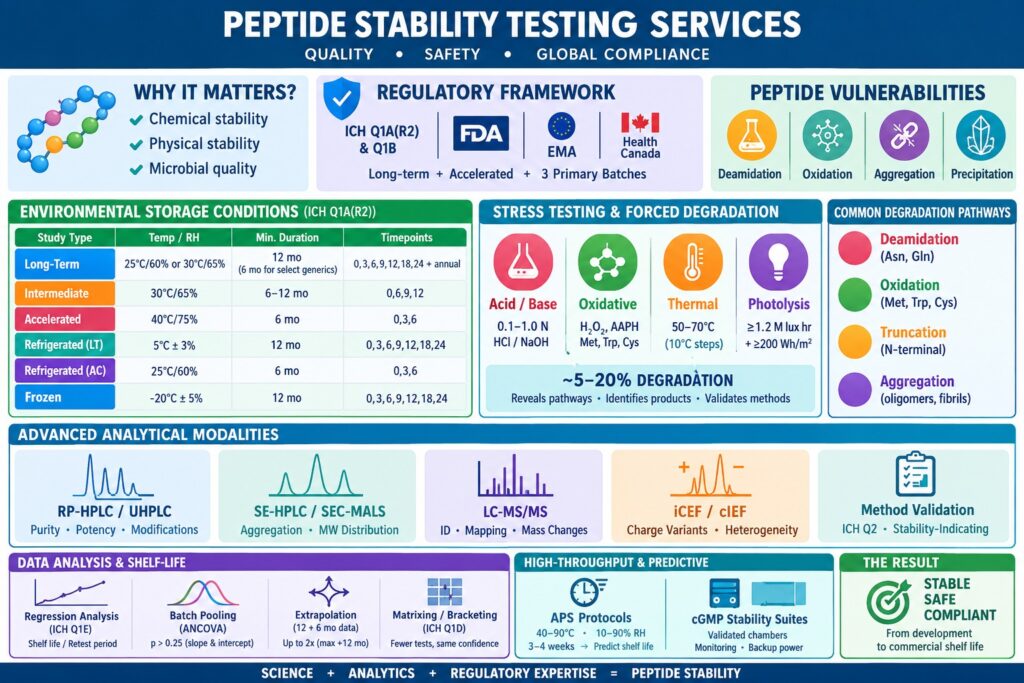
Regulatory Framework for Peptide Stability Testing Services
The regulatory framework governing Peptide Stability Testing Services requires multi-batch environmental chamber studies performed according to ICH Q1A(R2) and ICH Q5C guidelines to demonstrate the maintenance of quality, safety, and efficacy under defined climatic conditions. Regulatory submissions to the U.S. Food and Drug Administration (FDA), European Medicines Agency (EMA), and Health Canada generally require real-time long-term stability data together with accelerated stability data from at least three primary registration batches.
Developing a compliant stability dossier involves placing drug substance or drug product samples under standardized environmental conditions designed to represent global storage, transportation, distribution, and handling environments. Primary registration batches should be manufactured under cGMP conditions using manufacturing processes and container-closure systems that are representative of the intended commercial product.
Partnering with the right development team is essential for smooth regulatory submissions. Learn how to select the optimal manufacturing partner with our guide on how to choose a peptide CDMO in the US.
| Study Type | Environmental Storage Condition | Minimum Required Duration at Submission | Standard Testing Frequencies / Timepoints |
|---|---|---|---|
| Long-Term (Ambient) | 25°C ± 2°C / 60% ± 5% RH or 30°C ± 2°C / 65% ± 5% RH | 12 Months (6 months for select generic filings under strict commitments) | Months 0, 3, 6, 9, 12, 18, 24, and annually through the proposed shelf life |
| Intermediate | 30°C ± 2°C / 65% ± 5% RH | 6 to 12 Months (Triggered by significant change at accelerated conditions) | Months 0, 6, 9, and 12 |
| Accelerated (Ambient) | 40°C ± 2°C / 75% ± 5% RH | 6 Months | Months 0, 3, and 6 |
| Refrigerated (Long-Term) | 5°C ± 3°C | 12 Months | Months 0, 3, 6, 9, 12, 18, and 24 |
| Refrigerated (Accelerated) | 25°C ± 2°C / 60% ± 5% RH | 6 Months | Months 0, 3, and 6 |
| Frozen Storage | -20°C ± 5°C | 12 Months | Months 0, 3, 6, 9, 12, 18, and 24 |
For synthetic peptides classified as chemical entities, compliance with ICH Q1A(R2) remains the principal stability framework. However, when peptide active ingredients are manufactured through recombinant expression systems or exhibit complex higher-order folding, ICH Q5C considerations are also applicable for monitoring biological potency, micro-heterogeneity, and aggregation characteristics over time.
Looking to bridge regulatory standards between North American jurisdictions? Explore our specialized solutions for peptide CDMO services in Canada.
Stress Testing and Forced Degradation Methodology for Peptides
Forced degradation stress testing deliberately exposes peptide molecules to extreme environmental and chemical conditions to generate approximately 5% to 20% degradation of the parent compound. This controlled degradation process helps reveal intrinsic degradation pathways, identify degradation products that may develop during long-term storage, and generate stressed sample matrices for the validation of stability-indicating analytical procedures.
Acid and Base Hydrolysis
Hydrolytic forced degradation evaluates the susceptibility of peptides to acid- and base-catalyzed cleavage and chemical modification by exposing samples to acidic or alkaline solutions under different temperatures and exposure periods. Acidic stress, typically performed using 0.1 N to 1.0 N Hydrochloric Acid, preferentially promotes hydrolytic cleavage at susceptible peptide bonds, particularly Aspartyl motifs such as Asp-Pro or Asp-Gly. This behavior is associated with intramolecular catalysis involving the free side-chain carboxylate. Alkaline stress, commonly performed with 0.1 N to 1.0 N Sodium Hydroxide, accelerates nucleophilic attack by the peptide backbone nitrogen on neighboring side-chain carbonyl groups. In Asparagine (Asn) residues, this base-mediated pathway produces a cyclic succinimide intermediate, which subsequently hydrolyzes to generate a mixture of L-aspartyl and L-isoaspartyl derivatives. These modifications introduce a net negative charge and alter the geometry of the peptide backbone. Glutamine (Gln) residues can undergo a comparable deamidation pathway, although the reaction generally proceeds at a slower kinetic rate.
Oxidative Degradation Pathways
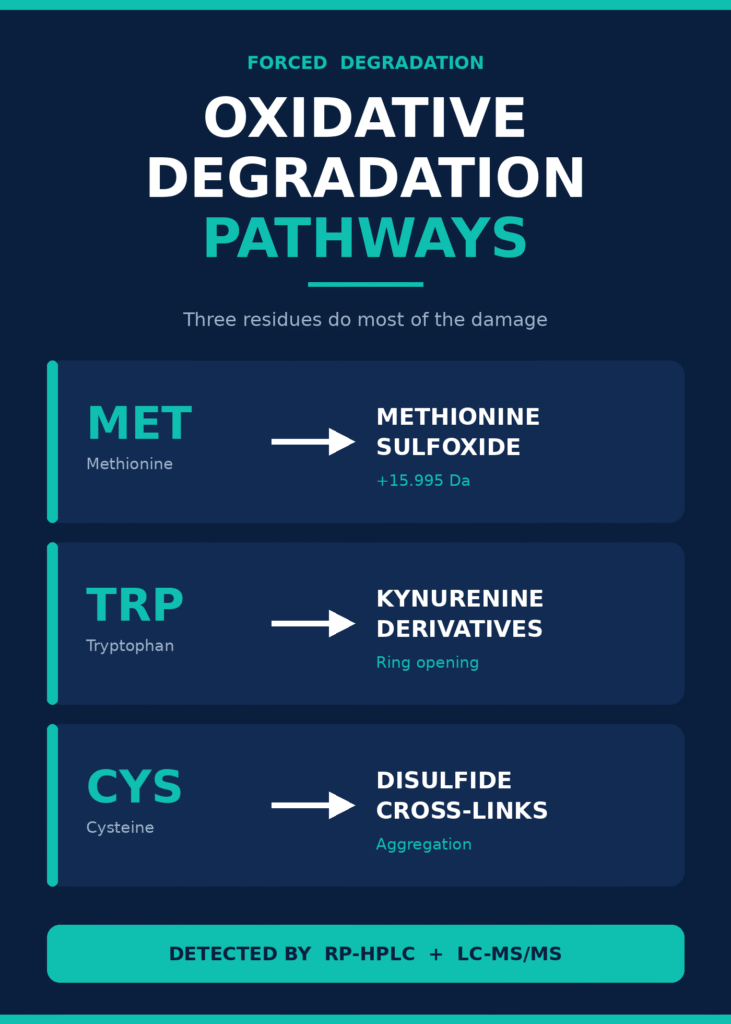
Oxidative stress testing assesses peptide susceptibility to electron-transfer reactions, radical formation, and nucleophilic oxidation by incubating the active molecule with oxidizing agents such as Hydrogen Peroxide (0.1% to 3.0% v/v H2O2), 2,2′-Azobis(2-amidinopropane) dihydrochloride (AAPH), or trace metal ions (Fe2+/Cu2+). Methionine (Met) residues are among the principal oxidative targets and undergo oxygen insertion into the thioether side chain to form Methionine Sulfoxide. Under more severe oxidative conditions, Methionine Sulfoxide may undergo additional oxidation to form Methionine Sulfone. Tryptophan (Trp) residues can experience oxidative indole ring opening, producing N-formylkynurenine, kynurenine, and hydroxytryptophan derivatives. Unpaired Cysteine (Cys) residues can oxidize rapidly, resulting in intermolecular or intramolecular disulfide cross-links or conversion into sulfenic, sulfinic, and cysteic acid variants.
For a real-world evaluation of degradation pathways in complex GLP-1 analogs, see our semaglutide peptide characterization case study.
Thermal Stress and Physical Aggregation
Thermal forced degradation assesses the thermal threshold and conformational stability of peptides by exposing lyophilized powders or liquid formulations to temperatures above conventional accelerated storage conditions, commonly using 10°C increments such as 50°C, 60°C, and 70°C. Increased thermal energy disrupts weak hydrogen-bonding interactions and hydrophobic forces that contribute to maintaining peptide solution conformation. This disruption can expose hydrophobic regions and promote self-association into soluble oligomers, high-molecular-weight species (HMWS), and insoluble fibrillar precipitates. In the solid state, elevated temperature can additionally accelerate moisture-mediated transamidation, racemization at alpha-carbon centers, and beta-elimination reactions.
Mitigate thermal and moisture liabilities during drug design by reviewing best practices for formulating a lyophilized peptide injectable.
Photostability Testing under ICH Q1B
Photostability stress testing evaluates the susceptibility of peptide drug substances and drug products to visible and ultraviolet light exposure. Under ICH Q1B, testing involves exposure to a minimum integrated visible-light dose of 1.2 million lux hours together with a minimum near-ultraviolet energy exposure of 200 Watt-hours per square meter (Wh/m²). Photolytic reactions can be particularly relevant for peptides containing aromatic residues, including Tryptophan, Tyrosine, and Phenylalanine, because these residues absorb UV radiation and can participate in reactive oxygen species generation. Direct photon absorption and photosensitized mechanisms may cause tryptophan destruction, dityrosine cross-linking, side-chain oxidation, and covalent aggregation. The study should evaluate the unformulated drug substance, the exposed product in its immediate container, and the fully packaged commercial product, together with appropriate dark controls. This approach helps distinguish light-induced degradation from degradation associated with other environmental factors.
| Forced Degradation Condition | Typical Experimental Parameters | Primary Targeted Residues / Structural Features | Major Degradation Products / Mechanisms | Primary Analytical Validation Focus |
|---|---|---|---|---|
| Acid Hydrolysis | 0.1–1.0 N HCl, 25°C–60°C | Asp-Pro, Asp-Gly, labile amide bonds | Truncated fragments, C-terminal ester hydrolysates | RP-HPLC, LC-MS/MS fragment mapping |
| Base Hydrolysis | 0.1–1.0 N NaOH, 25°C–50°C | Asn, Gln, C-terminal amides | Cyclic succinimides, Iso-Asp variants, racemization | RP-HPLC, iCEF / cIEF |
| Oxidative Stress | 0.1%–3.0% H2O2, AAPH, 25°C | Met, Trp, Cys residues | Methionine sulfoxide, Kynurenine, disulfide cross-links | RP-HPLC, LC-MS/MS peptide mapping |
| Thermal Stress | 50°C, 60°C, 70°C | Hydrophobic cores, amide backbone | High-molecular-weight aggregates (HMWS), dimers | SE-HPLC / SEC-MALS, RP-HPLC |
| Photolysis (ICH Q1B) | ≥ 1.2 M lux hr + ≥ 200 Wh/m² UV | Trp, Tyr, Phe aromatic rings | Photo-oxidation, dityrosine dimers, photo-induced HMWS | RP-HPLC, SE-HPLC, LC-MS/MS |
Advanced Analytical Modalities for Peptide Stability Testing Services
Advanced analytical techniques applied within Peptide Stability Testing Services should be demonstrated to function as stability-indicating methods in accordance with applicable ICH Q2 requirements, providing adequate discrimination between intact active peptide peaks and degradation products. Using an orthogonal analytical strategy that combines chromatographic, electrophoretic, and mass spectrometric techniques supports reliable characterization of chemical modifications as well as physical changes occurring during storage.
Reversed-Phase High-Performance Liquid Chromatography (RP-HPLC/UHPLC)
Reversed-phase liquid chromatography is a principal analytical technique for evaluating chemical purity, assay potency, and hydrophobic degradation profiles in peptides. RP-HPLC methods commonly use wide-pore (300 Å) silica or polymeric C18 or C4 stationary phases operated with binary gradient elution systems containing water and acetonitrile. Volatile ion-pairing additives, including 0.05% to 0.1% v/v Trifluoroacetic Acid (TFA) or Formic Acid (FA), can be incorporated to mask silanol groups, reduce secondary ionic interactions, and improve chromatographic peak symmetry. RP-HPLC can resolve multiple chemical modifications, including methionine oxidation, tryptophan degradation, N-terminal truncation, and deamidation-associated iso-aspartyl variants.
Size-Exclusion HPLC (SE-HPLC/SEC-MALS)
Size-exclusion chromatography evaluates physical aggregation and molecular-size distribution by separating peptide species according to their hydrodynamic volume. SE-HPLC can distinguish monomeric peptide entities from soluble dimers, higher-order oligomers, high-molecular-weight species (HMWS), and low-molecular-weight cleavage fragments. When size-exclusion chromatography is coupled with Multi-Angle Light Scattering (SEC-MALS), absolute molar mass can be determined without depending exclusively on column calibration curves. This combination can help establish whether observed aggregation is associated primarily with non-covalent hydrophobic association or covalent cross-linking.
High-Resolution Mass Spectrometry and LC-MS/MS Peptide Mapping
Liquid Chromatography coupled with Tandem Mass Spectrometry (LC-MS/MS) enables high-resolution mass measurement and site-specific structural characterization of peptide degradation products. High-Resolution Accurate Mass (HRAM) spectrometers can be used for intact mass analysis to monitor subtle mass changes associated with modifications such as deamidation (+0.984 Da) and oxidation (+15.995 Da). Targeted LC-MS/MS peptide mapping, performed after enzymatic digestion with specific proteases such as Trypsin, Chymotrypsin, or Lys-C, enables precise localization of amino acid modification sites through interpretation of tandem mass fragment ions, including b and y series.
Discover how advanced liquid chromatography and mass spectrometry are specifically applied to complex metabolic therapeutics in our guide to GLP-1 peptide analytical characterization.
Imaged Capillary Isoelectric Focusing (iCEF/cIEF)
Imaged Capillary Isoelectric Focusing quantifies peptide charge heterogeneity by separating molecular variants along an ampholyte-generated pH gradient under a high-voltage capillary electric field. iCEF can identify chemical degradation pathways that modify the overall molecular charge of a peptide. Examples include deamidation, which produces acidic variants with lower isoelectric points, and loss of C-terminal amidation, which can produce more basic variants.
Statistical Shelf-Life Assignment and Retest Period Determination via ICH Q1E
Determination of a product shelf life or drug substance retest period under ICH Q1E involves statistical linear regression analysis of real-time long-term stability data. The assigned shelf life is generally associated with the timepoint at which the 95% one-sided confidence limit for the mean degradation trend intersects the applicable lower specification limit for active potency or the upper specification limit for degradation impurities.
Defining Significant Change Under Accelerated Testing
During accelerated stability studies conducted at 40°C / 75% RH, detection of a “significant change” at any point during the 6-month study period triggers evaluation under intermediate storage conditions, typically 30°C / 65% RH. This additional assessment helps characterize degradation kinetics and supports determination of appropriate storage and labeling conditions.
For peptide formulations, significant change can include the following:
- A 5% shift or decrease in active assay potency relative to the initial baseline value.
- Any individual degradation product or total related substances exceeding established regulatory acceptance criteria.
- Failure to meet acceptance criteria for physical appearance, clarity, color, or functionality, including precipitation or irreversible caking.
- Failure to comply with the established pH acceptance criteria.
- Failure to meet predefined acceptance thresholds for functional biological activity or potency assays.
Statistical Regression Analysis and Batch Pooling Logic
Developing a scientifically defensible shelf-life estimate requires plotting quantitative stability parameters, such as the percentage of active ingredient remaining or the rate of aggregate formation, against time. Linear regression models are then used to characterize degradation kinetics and assess consistency across primary registration batches. An Analysis of Covariance (ANCOVA) can be used to determine whether stability data obtained from three separate manufacturing batches are suitable for pooling. Statistical evaluations assess equality of slope (p > 0.25) and intercept (p > 0.25) among the individual batch regression lines. When statistical testing supports batch uniformity, the data can be pooled into a single regression model, potentially reducing the width of the 95% confidence interval and supporting an extended extrapolated shelf life. When batch equality is not established, the shelf life is governed by the earliest expiration date determined for the individual batches.
ICH Q1E allows extrapolation of expiration dates beyond the period covered by available real-time long-term stability data under appropriate circumstances. When 12 months of long-term stability data and 6 months of accelerated stability data demonstrate no significant change, the proposed shelf life may be extrapolated to as much as twice the duration of the available real-time testing period, provided that the extrapolated period does not exceed the available real-time data by more than 12 months.
For complex generics transitioning through registration, read how stability and characterization tie into bioequivalence study design for complex generic drug products.
Matrixing and Bracketing Study Designs under ICH Q1D
For complex peptide product portfolios manufactured at multiple strengths, fill volumes, or container sizes, ICH Q1D provides matrixing and bracketing approaches that can streamline the overall stability testing schedule while maintaining an appropriate scientific rationale.
- Bracketing Designs: Testing is limited to the extreme levels of selected design factors, such as the highest and lowest dosage strengths or the smallest and largest container dimensions, at each designated testing interval. Under an appropriately justified bracketing design, the stability behavior of intermediate strengths or container sizes is represented by the selected extremes.
- Matrixing Designs: Only a defined subset of the complete sample combinations is evaluated at a particular timepoint, while a different subset is tested at the following interval. Matrixing is based on the assumption that the stability characteristics of the tested subsets can adequately represent the broader sample population at the corresponding timepoint. Appropriate statistical justification is required to maintain sufficient predictive capability for ICH Q1E analysis.
Execution of High-Throughput and Predictive Peptide Stability Protocols
High-throughput predictive stability testing combines short-duration stress studies with kinetic mathematical modeling to forecast real-time peptide shelf life during the early stages of product development. Contract Research Organizations (CROs) can use Accelerated Predictive Stability (APS) protocols to assess formulation stability before initiating multi-year formal ICH registration stability programs.
APS protocols expose peptide formulations to combined thermal and relative-humidity stress, typically ranging from 40°C to 90°C and 10% to 90% RH, over a period of approximately 3 to 4 weeks. Experimentally determined degradation rate constants are fitted to modified Arrhenius and humidity-sensitivity equations to characterize chemical reaction kinetics. These mathematical models can provide early predictions of room-temperature or refrigerated stability within approximately one month, enabling developers to optimize lyophilization cycles, evaluate excipient systems, and screen primary packaging configurations.
Execution of cGMP stability programs requires specialized stability suites equipped with validated climatic chambers, continuous temperature and humidity monitoring systems, redundant refrigeration capabilities, emergency backup power, and stability-indicating analytical instrumentation. These integrated capabilities support continuous environmental control, regulatory dossier acceptance, and scientifically defensible shelf-life determination for peptide drug substances and drug products.
As your peptide formulation demonstrates stable profiles and moves toward larger batch sizes, learn how to manage technical transitions with our overview of peptide API scale-up and comprehensive peptide CDMO scale-up services.
Conclusion
Executing comprehensive Peptide Stability Testing Services requires the integration of ICH Q1A(R2) environmental storage protocols, stress-induced forced degradation studies, validated stability-indicating analytical methodologies, and statistical regression modeling under ICH Q1E. Detailed characterization of chemical liabilities and physical aggregation pathways supports the assessment of product quality, active potency, and stability throughout the intended commercial shelf life of a peptide product.
Deciding on the ideal outsourcing partner for your supply chain and regulatory testing? Compare options with our analyses on peptide CDMO vs CMO
and United States vs overseas peptide CDMOs.
For expert assistance with designing and executing cGMP-compliant stability programs for therapeutic peptides, contact the analytical team at ResolveMass Laboratories Inc..
Frequently Asked Questions
Forced degradation deliberately exposes peptides to aggressive chemical and physical stresses, such as acid or base, oxidizing agents, elevated temperatures, and intense light, to generate controlled degradation. Accelerated stability testing uses defined storage conditions of 40°C / 75% RH over an extended period to characterize degradation under more representative stress. Forced degradation primarily identifies degradation mechanisms and supports validation of stability-indicating methods.
Synthetic peptide drug substances can undergo several degradation reactions, including Asn/Gln deamidation, Met/Trp/Cys oxidation, cleavage at susceptible peptide bonds, racemization, and terminal modifications. Deamidation may proceed through cyclic succinimide intermediates and generate aspartyl or iso-aspartyl products. Oxidative pathways can produce methionine sulfoxide, kynurenine-related products, and disulfide-linked species.
ICH Q1B photostability studies generally use at least 1.2 million lux hours of visible light and 200 Wh/m² of near-UV exposure. Liquid peptide formulations may show greater photosensitivity because molecular mobility can facilitate photochemical reactions and aggregation. Lyophilized products can exhibit different degradation behavior because the restricted molecular mobility of the solid matrix can alter reaction rates.
Intermediate-condition testing is generally initiated when significant change is observed during accelerated stability testing at 40°C / 75% RH for a product intended for room-temperature storage. The intermediate study helps characterize degradation under less severe conditions. Sponsors may also incorporate intermediate testing proactively when the stability strategy or product characteristics justify it.
Size-Exclusion HPLC (SE-HPLC) is widely used to separate peptide monomers from soluble aggregates and high-molecular-weight species (HMWS). SEC-MALS can provide additional molecular-mass information and help characterize aggregation behavior. For particulate matter outside the soluble size range, techniques such as Micro-Flow Imaging (MFI) or dynamic light scattering may provide complementary information.
ICH Q1E provides a statistical framework for evaluating whether stability data support extrapolation beyond the period covered by available real-time studies. When sufficient long-term and accelerated data demonstrate appropriate stability, statistical analysis can support a proposed extension. Any extrapolation remains subject to the applicable regulatory framework, available data, and demonstrated degradation behavior.
A retest period applies to a peptide drug substance or API and identifies the period after which the material should be re-evaluated against established specifications before further use. Shelf life applies to the finished drug product in its approved container-closure system. The shelf life establishes the period during which the packaged product is expected to remain within its approved quality specifications.
Bracketing evaluates selected extremes of variables such as dosage strength, fill volume, or container size at the designated stability timepoints. Matrixing evaluates different subsets of samples at different intervals rather than testing every combination at every timepoint. Both approaches can reduce the overall testing burden when scientifically justified and appropriately designed.
No. Accelerated Predictive Stability (APS) is intended as a development-stage tool for rapidly assessing formulation behavior, degradation kinetics, excipient selection, and packaging options. It does not substitute for formal ICH stability studies required to support regulatory submissions. Conventional accelerated and real-time stability data remain essential for establishing the regulatory stability profile.
Reference:
- González-González, O., Ramirez, I. O., Ramirez, B. I., O’Connell, P., Ballesteros, M. P., Torrado, J. J., & Serrano, D. R. (2022). Drug stability: ICH versus accelerated predictive stability studies. Pharmaceutics, 14(11), 2324. https://doi.org/10.3390/pharmaceutics14112324
- Welankiwar, A., & Jambhe, A. (2025). Evaluation of stability study of drug substance and drug product as per regulatory guidelines. International Journal of Pharmaceutical Sciences, 3(11), 607–638. https://doi.org/10.5281/zenodo.17531392
- Pritts, J. D., Ortega-Rodriguez, U., & Rao, V. A. (2026). Physicochemical differences observed in photostability studies of lyophilized, reconstituted, and diluted somatropin. Pharmaceutical Research, 43(1), 185–193. https://doi.org/10.1007/s11095-025-03986-1
- Deshmukh, O., & Shinde, K. (2026). Forced degradation studies of pharmaceutical drug substances: Stress-testing strategies, degradation pathway elucidation, and the evolving regulatory landscape. International Journal of Pharmaceutical Sciences, 4(7), Article IJPS/260406721. https://www.ijpsjournal.com/article/forced-degradation-studies-of-pharmaceutical-drug-substances-stress-testing-strategies-degradation-pathway-elucidation-and-the-evolving-regulatory-landscape
- Baertschi, S. W., Alsante, K. M., & Tønnesen, H. H. (2010). A critical assessment of the ICH guideline on photostability testing of new drug substances and products (Q1B): Recommendation for revision. Journal of Pharmaceutical Sciences, 99(7), 2934–2940. https://doi.org/10.1002/jps.22076
Get In Touch With Us
About The Author


