

Introduction:
Peptide technology transfer to a CDMO is more than transferring a manufacturing recipe — it requires transfer of product, process, analytical, and quality knowledge, not just a batch record.
Peptide technology transfer to a CDMO is the controlled transfer of product, manufacturing, analytical, and quality knowledge from an existing manufacturing site — typically the original innovator — to a contract development and manufacturing organization. The objective is not just to relocate a process but to enable the receiving peptide CDMO to reproduce the product’s identity, purity, potency, and stability profile consistently, without introducing any unintended change to its critical quality attributes.
For legacy products, this is rarely a simple copy-paste exercise. Many peptide products approved a decade or more ago were developed and validated using analytical methods, reference standards, and manufacturing platforms that have since evolved. A technology transfer therefore becomes as much a knowledge-reconstruction exercise as a relocation exercise — the receiving CDMO must understand not only what is manufactured, but why specific process and analytical decisions were historically made.
Summary:
- Peptide technology transfer to a CDMO is more than transferring a manufacturing recipe — it requires transfer of product, process, analytical, and quality knowledge, not just a batch record.
- Legacy peptide products often contain undocumented process knowledge, historical analytical methods, and site-specific practices that can complicate transfer.
- A successful transfer establishes equivalence between the innovator site’s process and the receiving peptide CDMO’s equipment, materials, analytical methods, and manufacturing environment.
- Orthogonal peptide characterization — HPLC, LC-MS/MS, high-resolution MS, peptide mapping, impurity profiling, and NMR — provides critical analytical evidence during transfer.
- A structured risk assessment identifies critical process parameters (CPPs), critical material attributes (CMAs), and critical quality attributes (CQAs) before engineering or GMP batches begin.
- Analytical method transfer should be demonstrated rather than assumed, particularly for methods developed years earlier on now-obsolete instrumentation.
- ICH Q10 places technology transfer within the pharmaceutical product lifecycle and emphasizes knowledge management, quality risk management, and continual improvement.
1: What Is Peptide Technology Transfer to a CDMO?
Peptide technology transfer to a CDMO is the controlled transfer of product, manufacturing, analytical, and quality knowledge from an existing manufacturing site — typically the original innovator — to a contract development and manufacturing organization. The objective is not just to relocate a process but to enable the receiving peptide CDMO to reproduce the product’s identity, purity, potency, and stability profile consistently, without introducing any unintended change to its critical quality attributes.
For legacy products, this is rarely a simple copy-paste exercise. Many peptide products approved a decade or more ago were developed and validated using analytical methods, reference standards, and manufacturing platforms that have since evolved. A technology transfer therefore becomes as much a knowledge-reconstruction exercise as a relocation exercise — the receiving CDMO must understand not only what is manufactured, but why specific process and analytical decisions were historically made.
2: Why Is Peptide Technology Transfer to a CDMO Challenging?
Peptide technology transfer to a CDMO is challenging because legacy products frequently contain years of accumulated process knowledge, analytical history, and site-specific experience that may not be completely captured in current manufacturing documents. A successful transfer therefore requires systematic reconstruction, verification, and controlled transfer of product and process knowledge rather than simply handing over a batch record.
Peptide therapeutics present additional analytical challenges because relatively small structural differences can affect purity, potency, stability, and biological performance. Depending on the molecule, manufacturing and characterization may need to account for:
- Sequence variants and deletion sequences
- Oxidation and deamidation
- Epimerization
- Aggregation
- Residual reagents and other process-related impurities
ICH Q10 identifies technology transfer as a distinct stage within the pharmaceutical product lifecycle and describes knowledge management and quality risk management as important enablers of an effective pharmaceutical quality system.
3: Why Legacy Peptide Products Are Uniquely Difficult to Transfer
Legacy peptide transfers are harder than transfers of newer products because the original data package often does not meet current expectations for detail, traceability, or method robustness. Common issues include:
- Incomplete or outdated method validation packages — original HPLC or mass spectrometry methods validated under older USP/ICH guidance versions
- Reference standard gaps — the original reference standard may be depleted, poorly characterized by today’s standards, or missing full impurity assignment
- Legacy equipment dependencies — process steps written around specific, sometimes discontinued, equipment models
- Undocumented “tribal knowledge” — operational nuances known only to long-tenured staff at the innovator site
- Impurity profile drift — synthetic route or resin/reagent lot changes over the product’s lifecycle that were never fully reconciled in the CMC file
Recognizing these gaps early, before the transfer protocol is finalized, is the single biggest factor separating a smooth technology transfer from one that stalls in deviations.
4: Case Study Background: Transfer of a Legacy Peptide Product
The product in this case study was a synthetic therapeutic peptide, manufactured for several years at an innovator facility, being moved to a specialized peptide CDMO to increase manufacturing capacity and establish a more flexible supply chain. The peptide contained several amino acids and required multiple purification and analytical controls.
The innovator provided a substantial documentation package: historical batch records, current manufacturing procedures, raw-material specifications, in-process controls, finished-product specifications, analytical methods, historical CoAs, stability data, deviation and investigation history, process development reports, cleaning information, reference standards, and regulatory documentation.
However, the technology-transfer team discovered that some historical information was incomplete:
| Legacy Information | Transfer Challenge |
|---|---|
| Old HPLC method | Original column no longer commercially available |
| Historical impurity limits | Rationale not documented |
| Manufacturing parameters | Some operating ranges based on operator experience |
| Raw materials | Original suppliers had changed |
| Equipment | CDMO equipment differed in scale and design |
| Reference standard | Limited quantity remaining |
| Historical impurity profile | Some impurities never structurally identified |
| Process knowledge | Critical tacit knowledge existed only with experienced operators |
This is a common reason why peptide technology transfer to a CDMO should begin with a knowledge-gap assessment rather than immediate manufacturing.
5: The Technology Transfer Framework: A Phased Approach
A structured, phased framework keeps a legacy peptide transfer on schedule and audit-ready. The table below summarizes the stages typically used in a peptide technology transfer to a CDMO.
| Phase | Primary Activities | Typical Duration |
|---|---|---|
| Due Diligence & Gap Assessment | Document review, site technical assessment, CQA/CPP mapping | 4–8 weeks |
| Analytical Method Transfer | Method verification, co-validation or revalidation, reference standard qualification | 6–12 weeks |
| Process Transfer & Engineering Runs | Equipment fit assessment, scale-up trials, engineering batches | 8–16 weeks |
| Process Validation | Three (or more) consecutive validation batches against pre-approved protocol | 8–12 weeks |
| Regulatory Alignment | CMC amendment or supplement preparation, stability program initiation | Parallel to above |
6: What Should Be Transferred During Peptide Technology Transfer to a CDMO?
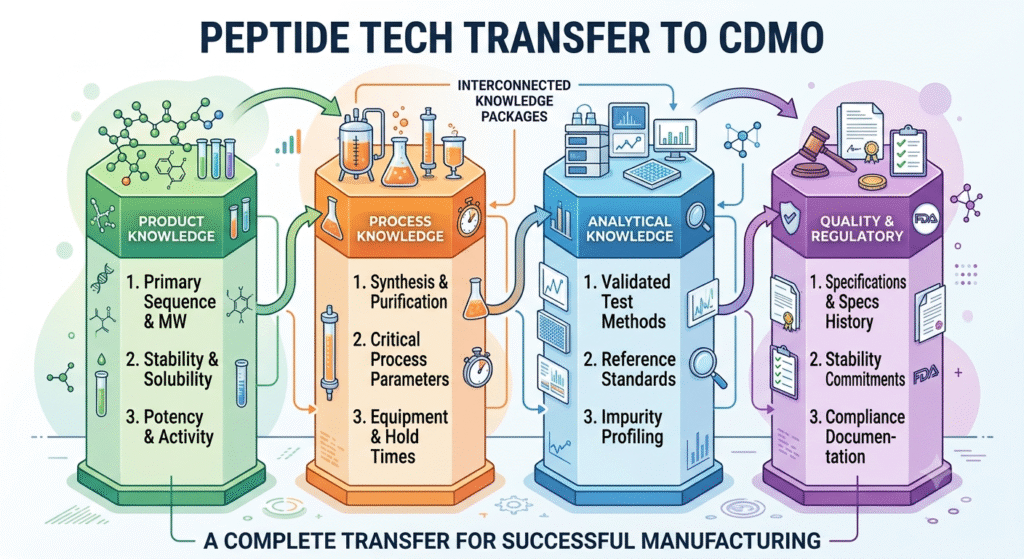
A complete peptide technology transfer should transfer four interconnected knowledge packages: product knowledge, process knowledge, analytical knowledge, and quality/regulatory knowledge.
1. Product Knowledge
The receiving organization should understand the peptide’s:
- Primary amino acid sequence and molecular weight
- Chemical modifications and stereochemistry where relevant
- Purity profile and known impurities
- Degradation pathways and aggregation behavior
- Solubility and stability characteristics
- Potency or biological activity requirements
Where historical structural information is insufficient, analytical characterization helps establish a defensible baseline. ResolveMass Laboratories supports peptide characterization using analytical platforms including LC-MS/MS, HPLC, high-resolution MS, and NMR.
2. Process Knowledge
Process transfer should capture the actual manufacturing strategy, including starting materials, reagents and solvents, reaction conditions, coupling and deprotection steps, cleavage conditions, purification strategy, intermediate controls, concentration and drying conditions, storage requirements, hold times, and equipment requirements.
Importantly, a process parameter should not be considered critical simply because it appears in a historical batch record — its criticality should be evaluated using scientific and risk-based reasoning, a principle that applies equally whether the work happens under a CDMO or CMO model.
3. Analytical Knowledge
The CDMO should receive complete analytical information, including test methods, system suitability criteria, reference standards, sample preparation procedures, chromatographic conditions, detection parameters, integration rules, impurity identification information, historical trends, and method validation and transfer reports.
ICH Q2(R2) describes analytical procedure validation as demonstrating that an analytical procedure is fit for its intended purpose, covering considerations such as specificity/selectivity, accuracy, precision, and reportable range.
4. Quality and Regulatory Knowledge
Quality and regulatory knowledge includes the specification history, deviation and CAPA trends, stability commitments, and the rationale behind existing acceptance criteria — information that determines how the transfer will ultimately be documented for health authorities.
7: How Was the Analytical Gap Assessed?
The first analytical objective was to determine whether the legacy methods were sufficiently robust for use at the receiving CDMO. The transfer team compared historical methods with current instrumentation and laboratory capabilities.
| Analytical Area | Assessment |
|---|---|
| Identity | Molecular mass and structural confirmation |
| Assay | Quantitative determination of peptide content |
| Purity | Main peak and related-substance assessment |
| Impurities | Identification and characterization of major unknowns |
| Sequence | LC-MS/MS-based peptide sequencing |
| Molecular mass | HRMS confirmation where appropriate |
| Degradation | Forced-degradation and degradation-product assessment |
| Structure | NMR/orthogonal characterization where required |
| Stability | Comparison of historical and current degradation behavior |
This type of analytical bridge is particularly valuable when the original method has been transferred multiple times or when historical analytical data are insufficient to explain observed product variability.
8: Why Is Orthogonal Peptide Characterization Important During Technology Transfer?
Orthogonal characterization reduces the risk of relying on a single analytical technique to establish peptide identity and quality, because different techniques interrogate different molecular characteristics and provide complementary evidence.
- HPLC — separates the peptide from related substances and degradation products
- LC-MS/MS — supports molecular identity, sequence confirmation, and impurity characterization
- HRMS — provides accurate-mass information for molecular and impurity assignments
- Peptide mapping — compares fragment-level structural characteristics
- NMR — provides complementary structural and conformational information
- qNMR — may support quantitative characterization when appropriately developed and validated
ResolveMass describes integrated peptide characterization workflows using LC-MS/MS, HPLC, NMR, peptide mapping, and impurity profiling for complex peptide programs. This is especially important when the legacy product has an extensive manufacturing history but incomplete structural characterization of minor impurities.
9: Risk Assessment: What Can Go Wrong During Peptide Technology Transfer to a CDMO?
A risk-based assessment identifies process and analytical variables that could affect critical quality attributes before commercial-scale manufacturing begins. Potential risks include:
- Different reaction-vessel geometry and mixing efficiency
- Different temperature-control performance
- Changes in raw-material suppliers
- Differences in resin or purification media
- Column-scale differences and changes in chromatography loading
- Different drying equipment
- Longer or shorter intermediate hold times
- Analytical method differences
- Reference-standard degradation
- Previously unidentified impurities
A risk-ranking exercise can categorize these variables according to severity, probability, and detectability. The objective is not to eliminate every difference between the innovator and CDMO sites — it is to understand which differences matter to product quality and which do not. ICH Q10 emphasizes quality risk management as part of the pharmaceutical quality system and describes technology transfer as an activity in which process and product knowledge should support manufacturing control.
10: Process Scale-Up and Equipment Bridging
Successful scale-up requires demonstrating that the receiving equipment can reproduce the critical process conditions — not necessarily that it is identical to the innovator’s equipment.
For example, a peptide purification process may have been developed on a small chromatography column at the innovator site but transferred to a larger column at the CDMO. The transfer team should evaluate column dimensions, resin characteristics, dynamic binding capacity, linear velocity, loading density, gradient profile, flow rate, pressure, fraction collection strategy, and pooling criteria. Similarly, reaction transfer should consider mixing, heat transfer, addition rates, agitation, concentration, and hold times.
The receiving CDMO should establish an appropriate engineering or demonstration batch strategy — carried out under cGMP peptide manufacturing conditions — before committing to routine commercial manufacturing.
11: Analytical Method Transfer: A Critical Step Often Underestimated
Analytical method transfer should establish that the receiving laboratory can generate reliable results using the transferred procedure under its own equipment, analysts, and laboratory conditions. A legacy peptide method may appear straightforward but still produce different results because of different HPLC systems, detector response differences, column lot differences, software and integration settings, reference-standard preparation, mobile-phase preparation, analyst technique, instrument dwell volume, or temperature control.
The transfer protocol should define acceptance criteria in advance. For critical methods, the team may need to perform comparative testing using common samples analyzed at both sites, creating an analytical bridge:
Innovator method → Receiving laboratory method → Comparable analytical result
ICH Q2(R2) provides the framework for demonstrating that analytical procedures are fit for purpose and describes validation characteristics relevant to quantitative and qualitative pharmaceutical testing.
12: How Were Unknown Peptide Impurities Addressed?
Unknown impurities identified during transfer should be scientifically investigated rather than simply assigned a generic label. A representative workflow is:
Chromatographic separation → Accurate mass → MS/MS fragmentation → Structural hypothesis → Orthogonal confirmation → Impurity classification → Specification/risk assessment
Potential peptide-related impurities may include deletion sequences, truncated peptides, oxidized species, deamidated species, epimerized products, modified side-chain products, process-related impurities, aggregates, and degradation products.
ResolveMass’s peptide impurity characterization work highlights the importance of identifying and characterizing impurity populations associated with peptide synthesis and degradation. The result is not simply an impurity list — it is a stronger understanding of how the manufacturing process generates the impurity profile.
13: Transfer Verification and Manufacturing Readiness
The final stage of the transfer is demonstrating that the CDMO can consistently manufacture and test the peptide against predefined requirements, using a staged approach:
- Stage 1 — Knowledge Transfer: review of product history, process history, analytical history, deviations, stability trends, and regulatory commitments
- Stage 2 — Laboratory Feasibility: confirm analytical method suitability, instrument compatibility, reference-standard availability, and impurity detection capability
- Stage 3 — Engineering/Development Batch: evaluate process equipment, operating ranges, sampling strategy, yield, impurity profile, and intermediate quality
- Stage 4 — Demonstration/Qualification: confirm reproducibility, process capability, analytical consistency, quality attributes, and documentation
- Stage 5 — Routine Manufacturing: transition to continued process monitoring, deviation management, change control, CAPA, trending, and stability monitoring
FDA’s process-validation framework emphasizes establishing process understanding and demonstrating that manufacturing processes are capable of consistently producing product meeting quality requirements.
14: Results of the Representative Case Study
The technology-transfer strategy produced several important outcomes:
| Transfer Objective | Outcome |
|---|---|
| Product identity | Confirmed using complementary analytical techniques |
| Analytical method suitability | Demonstrated at receiving laboratory |
| Impurity understanding | Historical and newly observed impurities evaluated |
| Process knowledge | Critical operating parameters documented |
| Equipment differences | Evaluated through engineering studies |
| Raw-material risks | Assessed using risk-based approach |
| Manufacturing readiness | Established through staged transfer activities |
| Regulatory readiness | Supporting analytical and process documentation organized |
The most important result was not simply successful production of a batch. It was the creation of a documented and scientifically justified knowledge base connecting the legacy process to the receiving CDMO’s manufacturing and analytical systems.
15: What Makes a Successful Peptide Technology Transfer to a CDMO?
The strongest technology-transfer programs combine scientific understanding, analytical evidence, risk management, controlled documentation, and effective communication between the sending and receiving organizations. Key success factors include:
- Complete transfer documentation and early identification of knowledge gaps
- Defined CQAs, CPPs, and CMAs
- Risk-based transfer planning
- Analytical method assessment and orthogonal peptide characterization
- Reference-standard control
- Equipment comparability assessment
- Impurity characterization and engineering-batch evaluation
- Clear acceptance criteria, formal change control, and deviation/CAPA management
- Strong communication between technical teams
Research on pharmaceutical knowledge management has also highlighted that ineffective knowledge transfer can create challenges across the product lifecycle, reinforcing the importance of systematic knowledge capture during technology-transfer projects.
16: Key Lessons for Peptide Technology Transfer to a CDMO
- Start the analytical gap assessment before finalizing the transfer timeline. Method and reference standard issues, not manufacturing issues, are the most common source of delay in legacy peptide transfers.
- Budget time for forced degradation and stability-indicating method work. Older approvals frequently lack the level of method validation now expected under ICH Q2(R2).
- Treat impurity characterization as a transfer deliverable, not an afterthought. Unassigned impurities discovered mid-transfer can trigger regulatory queries later.
- Use comparability protocols, not just transfer protocols. Demonstrating equivalence to historical data protects the product’s approved specification and shortens regulatory review.
- Evaluate specialized capability, not just general manufacturing capacity. Specialized peptide CDMO services with in-house mass spectrometry and peptide characterization reduce the time and communication risk of outsourcing structural elucidation work mid-transfer.
- Understand how to choose a peptide CDMO before committing. A structured evaluation — see how to choose a peptide CDMO in the US — should weigh analytical depth, regulatory track record, and capacity alongside cost.
- Know whether you need a CDMO or a CRO. The distinction between a peptide CDMO and a CRO matters when scoping which activities (development, testing, manufacturing) the receiving partner will actually own.
17: How ResolveMass Laboratories Can Support Peptide Technology Transfer
ResolveMass Laboratories Inc. supports peptide development and technology-transfer programs through specialized analytical characterization, impurity profiling, mass spectrometry, chromatography, and structural analysis. Its peptide analytical capabilities include peptide sequencing, LC-MS/MS characterization, high-resolution mass spectrometry, HPLC purity and impurity profiling, peptide mapping, unknown impurity characterization, NMR-based structural characterization, stability and degradation assessment, reference-standard characterization, and analytical method development and support, alongside cGMP peptide manufacturing services.
For organizations transferring a legacy peptide, this analytical support can be particularly valuable where historical documentation is incomplete or where the receiving peptide CDMO in the United States needs an independent analytical bridge between the innovator product and transferred process.
Conclusion:
Peptide technology transfer to a CDMO should be treated as a knowledge-transfer and process-understanding exercise, not simply a manufacturing handoff. Legacy peptide products require particular attention because historical process knowledge, analytical methods, impurity profiles, and equipment-specific practices may not be completely documented.
A robust strategy combines risk assessment, analytical method transfer, peptide sequencing, impurity characterization, LC-MS/MS, HPLC, orthogonal structural characterization, process-scale evaluation, and controlled documentation. For pharmaceutical companies moving an established peptide product from an innovator site to a CDMO, the goal is ultimately straightforward: preserve the product’s established quality profile while creating a scientifically justified, reproducible, and controlled manufacturing process at the receiving site.
Frequently Asked Questions:
A comprehensive technology-transfer package should generally include manufacturing procedures, batch records, raw-material specifications, process parameters, in-process controls, finished-product specifications, analytical methods, validation reports, reference standards, stability data, historical batch data, impurity profiles, deviations, investigations, cleaning information, and process-development reports.
LC-MS/MS can provide valuable information about peptide molecular identity, sequence, molecular mass, and related impurities. It can also help investigate unexpected peaks observed during chromatographic analysis and support comparison between innovator and CDMO batches.
Impurity profiling helps establish the historical impurity fingerprint of the peptide and determine whether the transferred manufacturing process produces a comparable profile. It can also help identify previously unknown or insufficiently characterized peptide-related impurities.
No. Equipment does not necessarily need to be identical. The important consideration is whether the CDMO equipment can reproduce the critical process conditions and consistently achieve the required product quality attributes.
Critical quality attributes are physical, chemical, biological, or microbiological characteristics that should be controlled within appropriate limits to ensure product quality. For peptides, these may include identity, assay, purity, related substances, molecular mass, sequence integrity, aggregation, residual solvents, water content, and potency where applicable.
Reference
- Morales M. Launching a CDMO in Brazil aiming to develop biopharmaceuticals for clinical trials. Journal of Venomous Animals and Toxins including Tropical Diseases.https://www.academia.edu/download/117280650/scielo.pdf
- Seshire A, Duan Y, Lang K. Reaching outer space and enabling the mRNA revolution: a critical role of partnerships for successful drug and vaccine development. Public-Private-Partnerships in Drug Research and Development. 2024 Sep 11:51-81.https://link.springer.com/chapter/10.1007/164_2024_723
- Creta A. A Strategic Framework for Evaluating Next-Generation Technologies in Biocatalysis (Doctoral dissertation, Massachusetts Institute of Technology).https://dspace.mit.edu/entities/publication/35ad53a0-2b8a-4b4e-9c74-2c9aa2125b1f
- Hotha K. Transforming Molecules into Medicines: Role of CDMOS in Phase-Appropriate Technology Transfers in Advancing Pharmaceutical Innovation. Advances in Chemical Engineering and Science. 2023;13:203-23.https://drhothas.com/wp-content/uploads/2024/09/Transforming-Molecules-into-Medicines-Role-of-CDMOS-in-Phase-Appropriate-Technology-Transfers-in-Advancing-Pharmaceutical-Innovation.pdf
- Srai JS, Bauer P, Badman C, Bresciani M, Cooney CL, Florence A, Hausner D, Konstantinov K, Lee SL, Mascia S, Nasr M. Emerging applications and regulatory strategies for Advanced Medicines Manufacturing–Towards the development of a platform approach. Journal of Pharmaceutical Sciences. 2024 Jul 1;113(7):1701-10.https://www.sciencedirect.com/science/article/pii/S0022354924001436
About the Author


