

Introduction:
PLA nanoparticle formulation for targeted oncology delivery is one of the more demanding areas of parenteral drug development, because a formulation has to survive systemic circulation, accumulate preferentially at the tumour site, and release its payload in a controlled, reproducible way — all while meeting the same rigorous quality and safety bar as any other injectable. Solid tumours present a particular challenge: dense, heterogeneous tissue, variable vascular permeability, and a tumour microenvironment that can inactivate poorly designed carriers before they ever reach their target.
PLA is one member of a broader family of biodegradable polyester carriers that also includes PLGA (poly lactic-co-glycolic acid) and PCL (polycaprolactone), and much of what the field has learned from PLGA depot and implant development directly informs PLA nanoparticle design. This case study walks through how a PLA-based nanoparticle system is formulated, characterized, and moved toward regulatory readiness for a solid tumour oncology application, drawing on the kind of formulation and analytical work ResolveMass Laboratories performs for sponsors developing nanoparticulate and long-acting oncology therapeutics.
Summary:
- PLA nanoparticle formulation for targeted oncology delivery relies on precise control of particle size, surface chemistry, and drug loading to concentrate cytotoxic payloads inside solid tumours while sparing healthy tissue.
- Poly(lactic acid), or PLA, and its co-polymer cousin PLGA are the two most widely used biodegradable carriers in oncology drug delivery, each offering a different degradation and release profile.
- Surface functionalization — PEGylation and ligand conjugation — extends circulation time and enables active targeting of tumour-associated receptors, on top of the passive Enhanced Permeability and Retention (EPR) effect.
- A rigorous, orthogonal analytical package (DLS, TEM, HPLC, mass spectrometry) is what separates a promising bench formulation from a clinically viable, regulator-ready candidate.
- Lessons from PLGA depot and implant programmes — including microsphere and implant systems developed for other indications — inform many of the formulation and characterization decisions made for PLA oncology nanoparticles.
- ResolveMass’s case study below outlines a representative PLA nanoparticle development and characterization workflow for a solid tumour indication, from formulation screening through release-testing and regulatory readiness.
1: PLA vs. PLGA: Choosing the Right Polymer Family for Oncology Delivery
PLA is generally chosen over PLGA when a formulation calls for slower, more sustained payload release, since PLA lacks the glycolic acid units that make PLGA more hydrophilic and faster-degrading.
The choice between these two polyesters is rarely arbitrary — it follows directly from the target release profile, the payload’s stability, and the intended dosing interval:
- A side-by-side comparison of degradation rates across PLGA, PLA, and PCL shows how monomer ratio and polymer backbone chemistry translate into weeks-to-months differences in payload release duration.
- Shelf-life expectations also diverge meaningfully across the three polymers; sponsors evaluating long-term storage stability often reference comparative shelf-life data for PLGA, PLA, and PCL formulations during polymer selection.
- The mechanism of polymer breakdown — bulk erosion versus surface erosion — determines whether a nanoparticle degrades uniformly throughout its volume or from the outside in, which has direct implications for burst release and dose-dumping risk.
- Polymer grade selection is not a minor detail: the role of PLGA polymer grade in long-acting release formulation illustrates how molecular weight, end-group chemistry, and lactide:glycolide ratio each independently shift release kinetics — the same principle applies when selecting PLA grades for nanoparticle work.
- For sponsors newer to these carriers, background on PLGA for parenteral use provides useful context on why this polymer family dominates injectable long-acting and nanoparticulate delivery.
2: Why PLA for Oncology Nanoparticles?
PLA is chosen for oncology nanocarriers because its degradation rate, mechanical properties, and drug-release profile can all be tuned through polymer molecular weight, stereochemistry (L-PLA vs. D,L-PLA), and blending with PLGA or PEG.
| Property | Why It Matters for Oncology Delivery |
|---|---|
| Biodegradability | Hydrolyzes to lactic acid, cleared via normal metabolic pathways — no long-term tissue accumulation |
| Tunable degradation rate | Molecular weight and crystallinity control payload release over days to weeks |
| Biocompatibility | Long clinical history (sutures, implants) supports a favourable safety profile |
| Mechanical stability | Withstands formulation processing (homogenization, lyophilization) without particle collapse |
| Surface modifiability | Free carboxyl/hydroxyl end groups allow PEGylation and ligand conjugation |
| Glass transition behaviour | Polymer chain mobility above/below Tg affects both processing and long-term storage stability |
Polymer thermal behaviour deserves particular attention during formulation screening. The glass transition temperature of PLGA — and the analogous behaviour in PLA — governs whether a nanoparticle remains rigid or becomes rubbery at storage or physiological temperature, which in turn affects both drug diffusion rate and particle morphology stability over shelf life.
For nanoparticle-specific design decisions, understanding how PLGA nanoparticles compare with microspheres is directly relevant: nanoparticles in the 80–200 nm range behave very differently from micron-scale microspheres in terms of tumour penetration, cellular uptake, and clearance mechanism, even when built from chemically similar polymers.
3: Formulation Approach: Building the Nanoparticle
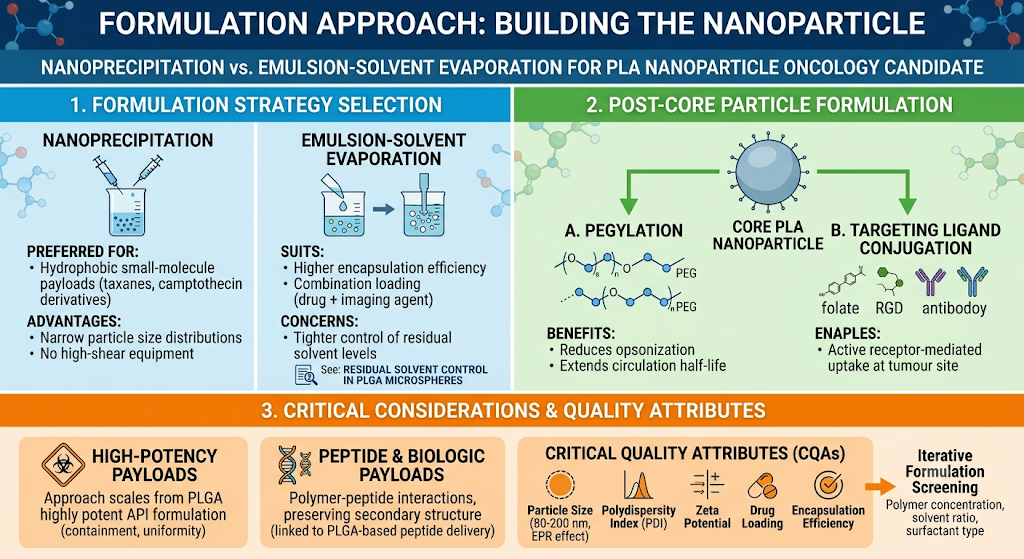
The formulation strategy for a PLA nanoparticle oncology candidate centers on nanoprecipitation or emulsion-solvent evaporation, selected based on the physicochemical properties of the cytotoxic payload.
- Nanoprecipitation is typically preferred for hydrophobic small-molecule payloads (e.g., taxanes, camptothecin derivatives), producing narrow particle-size distributions without high-shear equipment.
- Emulsion-solvent evaporation suits payloads requiring higher encapsulation efficiency or combination loading (drug + imaging agent), though it demands tighter control of residual solvent levels — a concern covered in detail in residual solvent control in PLGA microsphere manufacturing, where the same process chemistry and ICH Q3C considerations apply to PLA-based nanoparticle manufacturing.
- Surface engineering follows core particle formation: PEGylation reduces opsonization and extends circulation half-life, while conjugation of tumour-targeting ligands (e.g., folate, RGD peptides, or antibody fragments) enables active receptor-mediated uptake at the tumour site.
- High-potency payload handling is a common feature of oncology nanoparticle programmes; the approach to formulating highly potent APIs using PLGA microspheres — including containment, uniformity, and content verification strategies — translates directly to cytotoxic oncology payloads formulated into PLA nanoparticles.
- Peptide and biologic payloads introduce additional formulation complexity; considerations around PLGA-based peptide delivery — including polymer-peptide interactions and preservation of secondary structure — are increasingly relevant as oncology nanoparticle programmes move beyond small-molecule payloads toward peptide-drug conjugates.
- Broader formulation development support, from polymer selection through process scale-up, follows the same general framework outlined in PLGA formulation development services and, more specifically for microsphere-based systems, PLGA microsphere formulation development.
Critical quality attributes (CQAs) tracked throughout formulation development include particle size (typically 80–200 nm for optimal EPR-driven accumulation), polydispersity index (PDI), zeta potential, drug loading, and encapsulation efficiency. Formulation screening is iterative: small changes in polymer concentration, solvent ratio, or surfactant type can shift particle size by tens of nanometres, which in turn affects both tumour penetration and clearance by the reticuloendothelial system.
4: Analytical Characterization: Confirming What Was Built
Characterization answers whether the formulated nanoparticles actually meet the target CQAs, and it is where formulation claims are either substantiated or disproven with data.
| Technique | What It Confirms |
|---|---|
| Dynamic Light Scattering (DLS) | Particle size, size distribution (PDI) |
| Transmission Electron Microscopy (TEM) | Particle morphology, structural integrity |
| Zeta Potential Analysis | Surface charge, colloidal stability prediction |
| HPLC/UPLC | Drug loading, encapsulation efficiency, degradation products |
| Mass Spectrometry (LC-MS/MS) | Payload identity confirmation, impurity profiling, ligand conjugation verification |
| In Vitro Release Testing | Release kinetics under simulated physiological conditions |
Mass spectrometry plays a particularly important role beyond simple potency assay: it can confirm that surface-conjugated targeting ligands are attached at the expected stoichiometry and location, and it can detect low-level degradation products that UV-based HPLC methods might miss. A broader overview of the analytical toolkit is available in PLGA characterization methods and the complementary characterization methods for PLGA microspheres, both of which describe the orthogonal method combinations regulators increasingly expect for nanoparticulate and microparticulate polymer-based products.
For generic and follow-on nanoparticle programmes, characterization also has to support demonstration of polymer sameness against a reference product. This is where PLGA polymer characterization for generics and the broader question of PLGA polymer sameness for ANDA submissions become directly relevant, alongside dedicated PLGA reverse engineering for ANDA support and general PLGA reverse engineering CRO services, which apply equally to PLA-based generic nanoparticle development programmes.
5: In Vitro Release Testing: Predicting In Vivo Behaviour
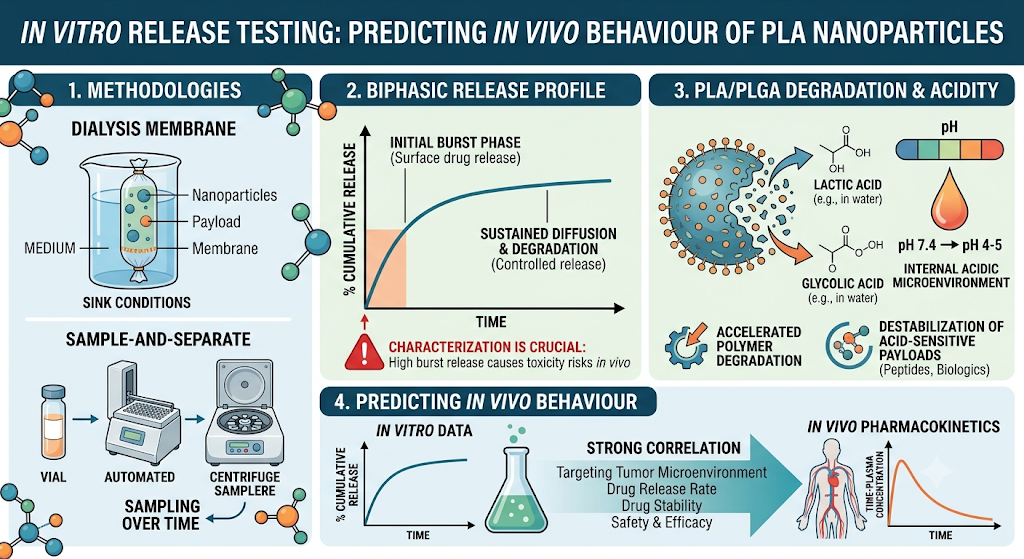
In vitro release testing for PLA nanoparticles predicts how the payload will be released once inside the tumour microenvironment, and a well-designed release method should correlate with observed in vivo pharmacokinetics.
- Release studies are typically run under sink conditions using dialysis membrane or sample-and-separate methods, sampled over a timeframe reflecting the intended dosing interval.
- A biphasic release profile — an initial burst phase followed by sustained diffusion-controlled release — is common for PLA nanoparticles and must be characterized quantitatively. The mechanisms behind this phenomenon are described in detail in burst release in PLGA formulations, which remains one of the most common root causes of unexpected in vivo toxicity signals in early nanoparticle development.
- As PLA and PLGA polymers degrade, localized acid byproducts can build up within the particle matrix; this is explored in the acidic microenvironment created by PLGA degradation, a phenomenon that can destabilize acid-sensitive payloads (including many peptide and biologic drugs) and accelerate polymer autocatalytic degradation if not accounted for during formulation design.
6: Lessons from PLGA Depot and Implant Case Studies
Much of the current understanding of how polyester-based carriers behave in vivo comes from PLGA depot and implant programmes developed for other indications, and these case studies offer directly transferable insight for PLA nanoparticle oncology development.
- The dexamethasone implant PLGA characterization case study demonstrates how implant-based sustained release is characterized end-to-end, from polymer degradation tracking to drug release correlation.
- Depot formulation challenges are well documented in leuprolide depot formulation challenges and the corresponding PLGA characterization for Lupron Depot, including a dedicated case study on reverse engineering PLGA polymer in Lupron Depot for long-acting injectables.
- Peptide-loaded microsphere systems bring their own set of interaction challenges, as shown in the exenatide PLGA microsphere characterization case study, which addresses peptide-polymer interactions that can also arise with peptide-conjugated PLA nanoparticles.
- High drug-load systems present unique formulation trade-offs, covered in the buprenorphine depot PLGA characterization case study, and implant-specific considerations are detailed in the goserelin PLGA implant characterization case study.
- For generic development programmes, the reverse engineering of risperidone PLGA microspheres illustrates the depth of analytical work required to establish polymer and formulation sameness against an approved reference product — a workflow directly applicable to generic PLA nanoparticle oncology products.
7: Beyond Oncology: Related Applications of PLA/PLGA Nanocarrier Technology
The formulation and analytical principles developed for PLA oncology nanoparticles extend across a much broader set of delivery applications, and cross-indication learning frequently accelerates development timelines.
- Long-acting injectable technology as a category is summarized in long-acting injectable drug delivery technologies, covering the full range of depot, implant, and nanoparticle approaches built on biodegradable polyesters.
- PLGA-based implants are also used directly in oncology outside the nanoparticle format, as described in PLGA for oncology implants, an approach that complements nanoparticle-based tumour targeting for certain solid tumour indications.
- Ocular applications share many of the same particle-size and release-control challenges; see PLGA-based ocular drug delivery for a comparison of considerations relevant to small-particle, localized delivery systems.
- Central nervous system delivery introduces the added complexity of the blood-brain barrier, discussed in PLGA in CNS drug delivery and the blood-brain barrier, where nanoparticle size and surface chemistry requirements can be even more stringent than for solid tumour targeting.
- Pulmonary delivery represents another growing application area, covered in PLGA for pulmonary drug delivery, which shares particle engineering principles with inhalable oncology nanoparticle concepts under early-stage investigation.
- Large-molecule and biologic payloads bring their own characterization demands, addressed in characterization of long-acting biologics, relevant as more oncology nanoparticle programmes move toward antibody fragment or biologic payload conjugation.
8: Regulatory, Quality, and Supply Chain Considerations
Nanoparticle oncology formulations face additional scrutiny compared with conventional small-molecule injectables, because regulators evaluate not just the drug substance but the nanocarrier’s physicochemical consistency, batch-to-batch reproducibility, and long-term stability.
- FDA and EMA guidance on nanomedicine products both emphasize the need for orthogonal characterization methods rather than relying on a single analytical technique to confirm particle size and morphology.
- Manufacturing must be conducted under appropriate quality systems; the applicable GMP requirements for PLGA-based products outline expectations that extend directly to PLA nanoparticle manufacturing.
- Biocompatibility and toxicology data form a core part of any regulatory submission; PLGA biocompatibility, safety, toxicology, and regulatory considerations provides a framework that applies equally to PLA-based nanocarriers given their shared chemical lineage.
- Polymer sourcing is not a minor supply chain decision — variability between polymer lots and suppliers can materially affect CQAs, a topic explored in PLGA supplier benefits.
- Comparability protocols become critical when scaling from bench to pilot to GMP manufacturing; PLGA microsphere scale-up services describes how particle size and drug loading are monitored and controlled as batch volumes increase, a process equally applicable to PLA nanoparticle scale-up.
- Sterility and endotoxin control add complexity, since many PLA nanoparticle processes cannot tolerate terminal sterilization without altering particle morphology, often necessitating aseptic processing validation.
9: Key Takeaways for Formulation Teams
- PLA nanoparticle formulation for targeted oncology delivery depends on tightly controlled particle size, surface chemistry, and drug loading — verified through orthogonal analytical methods, not a single assay.
- Surface engineering (PEGylation, ligand conjugation) is what converts passive EPR-based accumulation into active, receptor-mediated tumour targeting.
- Mass spectrometry and HPLC-based characterization provide the structural and purity confirmation that regulators increasingly expect for nanomedicine submissions.
- Decades of PLGA depot, implant, and microsphere case studies across multiple indications provide a directly transferable evidence base for PLA nanoparticle formulation and characterization decisions.
- Comparability and batch consistency should be built into the analytical plan early, since scale-up is where many nanoparticle programmes encounter unexpected CQA shifts.
Conclusion:
Developing a clinically viable PLA nanoparticle formulation for targeted oncology delivery is as much an analytical challenge as it is a formulation one. Getting particle size, surface functionalization, and drug release right at the bench is only half the work — demonstrating that those attributes hold up consistently across batches, under real physiological conditions, and to the standard regulators expect, is what determines whether a promising nanocarrier makes it into the clinic. Drawing on established PLGA depot, implant, and microsphere case studies alongside nanoparticle-specific analytical methods gives formulation teams a well-grounded path from bench-scale screening to a regulator-ready candidate. ResolveMass Laboratories supports sponsors through this full arc, from formulation-stage characterization through method development and comparability testing for nanoparticulate oncology candidates.
Frequently Asked Questions:
PLA nanoparticles can encapsulate a wide range of anticancer agents, including hydrophobic small-molecule drugs, targeted therapies, natural compounds, peptides, and combination drug formulations. They are especially useful for drugs with poor water solubility or short plasma half-lives. The polymer matrix protects the drug from premature degradation and enables sustained release, improving therapeutic efficacy and reducing systemic toxicity.
Controlled drug release is achieved through the gradual biodegradation of the PLA polymer matrix and the diffusion of the drug from the nanoparticles. Factors such as polymer molecular weight, particle size, crystallinity, and drug-polymer interactions influence the release profile. Optimizing these parameters allows researchers to tailor drug release over days or even weeks, depending on the therapeutic requirements.
The Enhanced Permeability and Retention (EPR) effect allows nanoparticles to preferentially accumulate in tumour tissues because tumour blood vessels are more permeable than healthy vessels. Additionally, poor lymphatic drainage in tumours helps retain nanoparticles for longer periods. This passive targeting mechanism enhances local drug concentration while minimizing exposure to healthy tissues.
Stability studies evaluate changes in particle size, polydispersity index (PDI), zeta potential, drug content, release profile, polymer integrity, and appearance over time. Studies are typically conducted under long-term, intermediate, and accelerated storage conditions following ICH stability guidelines. These assessments help establish shelf life and ensure the formulation maintains its quality throughout storage.
Zeta potential measures the surface charge of nanoparticles and is an important indicator of colloidal stability. Nanoparticles with sufficient positive or negative surface charge repel each other, reducing aggregation during storage. Maintaining an appropriate zeta potential contributes to better suspension stability, reproducible particle size, and consistent therapeutic performance.
Reference
- Zhu D, Tao W, Zhang H, Liu G, Wang T, Zhang L, Zeng X, Mei L. Docetaxel (DTX)-loaded polydopamine-modified TPGS-PLA nanoparticles as a targeted drug delivery system for the treatment of liver cancer. Acta biomaterialia. 2016 Jan 15;30:144-54.https://www.sciencedirect.com/science/article/pii/S1742706115302063
- Hu Q, Gao X, Gu G, Kang T, Tu Y, Liu Z, Song Q, Yao L, Pang Z, Jiang X, Chen H. Glioma therapy using tumor homing and penetrating peptide-functionalized PEG–PLA nanoparticles loaded with paclitaxel. Biomaterials. 2013 Jul 1;34(22):5640-50.https://www.sciencedirect.com/science/article/pii/S0142961213004699
- Pulkkinen M, Pikkarainen J, Wirth T, Tarvainen T, Haapa-Aho V, Korhonen H, Seppälä J, Järvinen K. Three-step tumor targeting of paclitaxel using biotinylated PLA-PEG nanoparticles and avidin–biotin technology: formulation development and in vitro anticancer activity. European journal of pharmaceutics and biopharmaceutics. 2008 Sep 1;70(1):66-74.https://www.sciencedirect.com/science/article/pii/S0939641108001574
- Chen J, Ning E, Wang Z, Jing Z, Wei G, Wang X, Ma P. Docetaxel loaded mPEG-PLA nanoparticles for sarcoma therapy: preparation, characterization, pharmacokinetics, and anti-tumor efficacy. Drug Delivery. 2021 Jan 1;28(1):1389-96.https://www.tandfonline.com/doi/abs/10.1080/10717544.2021.1945167
- Schadlich A, Caysa H, Mueller T, Tenambergen F, Rose C, Gopferich A, Kuntsche J, Mader K. Tumor accumulation of NIR fluorescent PEG–PLA nanoparticles: Impact of particle size and human xenograft tumor model. ACS nano. 2011 Nov 22;5(11):8710-20.https://pubs.acs.org/doi/abs/10.1021/nn2026353
About the Author


