
Introduction
Justifying Regulatory Starting Materials for Synthetic Peptides under the International Council for Harmonisation (ICH) Q11 guideline requires a robust scientific rationale that directly connects raw material quality, structural integrity, and impurity profiles with the critical quality attributes (CQAs) of the final drug substance. The selection and designation of starting materials establish the regulatory boundary at which Good Manufacturing Practice (GMP) compliance begins. This boundary determines when comprehensive regulatory oversight, change control, and process validation requirements become applicable. In Chemistry, Manufacturing, and Controls (CMC) filings submitted under Module 3.2.S.2.3 of the Common Technical Document (CTD), the justification of starting materials is among the most extensively scrutinized elements by global regulatory agencies, including the U.S. Food and Drug Administration (FDA) and the European Medicines Agency (EMA).
Synthetic peptides occupy a distinctive position in regulatory science. Although they are assembled through chemical reactions rather than biological expression, their structural complexity, potential for sequence-specific side reactions, and intricate impurity profiles place them at the intersection of conventional small-molecule chemistry and complex biopharmaceutical standards. Establishing the cGMP boundary too late in the synthetic process can lead to regulatory rejection because of insufficient oversight of upstream chemical transformations. Conversely, placing this boundary unnecessarily early can increase commercial manufacturing costs and limit supply chain flexibility. Achieving regulatory compliance therefore requires a structured justification framework based on Quality by Design (QbD) principles, comprehensive analytical characterization, and risk assessments aligned with international standards.
To strengthen your understanding of the analytical evidence needed for regulatory submissions, review the requirements for GLP-1 peptide characterization and regulatory compliance.
Share via:
Quick Summary:
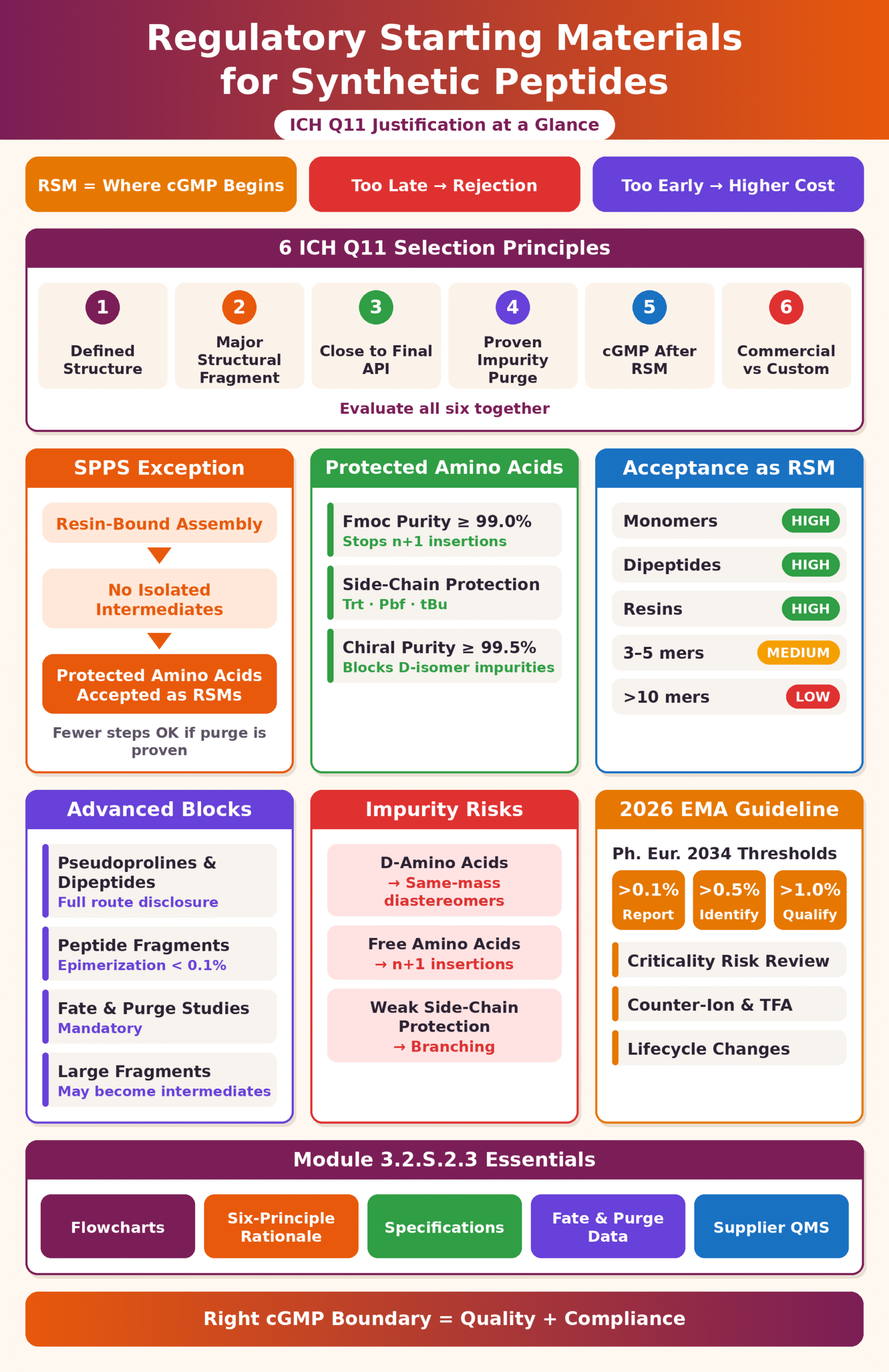
- Starting materials mark where cGMP begins. Under ICH Q11, the regulatory starting material sets the boundary for GMP oversight, change control and validation. Placing it too late risks rejection, and placing it too early raises cost and limits supply flexibility.
- All six ICH Q11 principles must be met together. A starting material must have a defined structure and contribute a significant structural fragment. It must also sit at a suitable distance from the API, with proven impurity purge and cGMP steps after it, and its commercial versus custom-synthesis status must be considered. Regulators reject justifications that rely only on the favorable criteria.
- Solid-phase synthesis has an exception. Because SPPS doesn’t isolate intermediates, regulators accept protected amino acids as starting materials. This depends on their quality being controlled and downstream purification being shown to clear impurities.
- Protected amino acids need three key controls. These are high Fmoc purity (≥99.0%) to prevent n+1 insertions, stable side-chain protection (Trt, Pbf, tBu), and chiral purity (≥99.5%) to avoid D-isomer diastereomers that are hard to separate.
- Advanced building blocks face more scrutiny. Pseudoprolines and dipeptides need full route disclosure. Peptide fragments need process disclosure, epimerization control (<0.1%) and purge studies, and large fragments may be reclassified as intermediates that move the cGMP boundary upstream.
- The 2026 EMA peptide guideline adds European expectations. These include alignment with Ph. Eur. 2034 impurity thresholds (0.1% to report, 0.5% to identify, 1.0% to qualify), criticality risk assessments, counter-ion and TFA control, and comparability data when suppliers or routes change.
- Module 3.2.S.2.3 should present a complete QbD package. It needs manufacturing flowcharts, a rationale covering all six principles, justified specifications, impurity fate-and-purge data, and supplier QMS documentation. Together these support a defensible cGMP boundary and easier lifecycle management.
General Regulatory Principles Under ICH Q11 for Regulatory Starting Materials for Synthetic Peptides
ICH Q11 establishes six interconnected scientific principles that must be evaluated collectively, rather than independently, when justifying starting material selection for synthetic drug substances. These principles establish that a starting material should be an isolated, well-defined chemical entity that contributes a significant structural fragment to the active pharmaceutical ingredient (API). All subsequent chemical transformation steps must be conducted under cGMP conditions, supported by an appropriate and validated analytical control strategy.
Section 5.1.1 of ICH Q11 and its associated Questions and Answers (Q&A) document emphasize that regulatory proposals must consider all applicable selection principles together. Regulatory authorities do not accept justifications that rely exclusively on favorable criteria while overlooking potential quality risks associated with the proposed starting material.
The core principles governing the selection of synthetic peptide building blocks encompass six essential regulatory criteria:
Defined Chemical Structure and Properties: Proposed starting materials must be isolated and fully characterized as solids or solutions with clearly established molecular structures and physical properties. Non-isolated intermediates are generally unsuitable for designation as regulatory starting materials.
Significant Structural Fragment Contribution: The proposed building block must contribute a distinct structural portion to the final peptide backbone. This distinguishes genuine starting materials from solvents, catalysts, and coupling reagents that do not become incorporated into the peptide structure.
Proximity to the Drug Substance: The number and nature of chemical transformation steps between the proposed starting material and the final API must provide sufficient opportunities for downstream process controls to remove potential impurities. The justification must consider the effectiveness of these operations rather than relying exclusively on the number of steps.
Impurity Formation, Fate, and Purge Dynamics: The manufacturing process performed after the introduction of the starting material must demonstrate a reliable and validated capacity to remove impurities originating from the starting material, reagents, and reaction byproducts.
Manufacturing under cGMP Controls: All chemical transformation steps conducted after the designated starting material must be performed under cGMP conditions in accordance with applicable requirements, including ICH Q7.
Commercial Availability versus Custom Synthesis: Chemicals available through established commercial markets may present a different regulatory risk profile from custom-synthesized building blocks manufactured exclusively for a particular peptide candidate. The manufacturing history, supplier controls, and intended use must be considered when evaluating their suitability.
For a practical perspective on documenting peptide identity and structural attributes, consider the analytical requirements involved in sequence confirmation of synthetic therapeutic peptides.
The Solid-Phase Synthesis Distance Rule Exception
The conventional regulatory expectation for small-molecule synthesis, which generally emphasizes multiple cGMP reaction steps between the designated starting material and the final active pharmaceutical ingredient (API), is modified for solid-phase peptide synthesis (SPPS). Because SPPS involves repeated coupling and deprotection cycles on a solid support without isolating intermediate peptide chains, regulators may accept protected amino acid monomers as starting materials when their quality attributes and downstream impurity purge capabilities are adequately established.
In traditional liquid-phase small-molecule organic synthesis, regulators often expect several isolated synthetic steps, commonly three to four, between the starting material and the final isolated drug substance. However, solid-phase peptide synthesis follows a fundamentally different process architecture. In SPPS, sequential amino acid coupling and deprotection reactions take place on an insoluble resin matrix, and intermediate peptide chains are not routinely isolated between successive reaction cycles.
Recognizing this operational distinction, the ICH Q11 Q&A document explains that, for synthetic peptides and oligonucleotides manufactured on solid supports, the conventional relationship between impurity risk and the physical number of steps remaining in the process must be interpreted differently. Consequently, individual protected amino acids are widely accepted as starting materials when their quality is appropriately controlled, their relevant impurities are characterized, and downstream purification processes are demonstrated to provide adequate impurity clearance.
Technical Justification Framework for Protected Amino Acids as Regulatory Starting Materials for Synthetic Peptides
Protected amino acids are established regulatory starting materials for solid-phase peptide synthesis because they are isolated, fully characterized chemical building blocks that contribute individual amino acid residues directly to the target sequence. Justifying their selection requires evidence that variations in chemical purity, side-chain protection, and stereochemical composition are adequately controlled before peptide assembly. These controls help prevent the introduction of impurities that could persist in the final API or compromise its quality.
Industrial peptide manufacturing predominantly relies on 9-fluorenylmethyloxycarbonyl (Fmoc) or tert-butyloxycarbonyl (Boc) protection strategies. Fmoc chemistry is widely used in commercial manufacturing because its base-labile deprotection conditions avoid the hydrofluoric acid handling associated with Boc cleavage.
Justifying protected amino acid building blocks in CTD filings requires detailed criticality assessments covering three principal chemical domains:
N-Alpha Protecting Group Integrity: Complete N-terminal protection must be demonstrated, with specifications such as Fmoc purity of at least 99.0%, where scientifically justified. Incomplete protection can allow unprotected free amino acids to participate in unintended coupling reactions, potentially generating insertion peptides (n+1).
Side-Chain Protecting Group Stability: Reliable side-chain protection must be established for functionalized amino acids. Examples include trityl (Trt) for Cys, His, Asn, and Gln; 2,2,4,6,7-pentamethyldihydrobenzofuran-5-sulfonyl (Pbf) for Arg; and tert-butyl (tBu) for Asp, Glu, Ser, Thr, and Tyr. These protecting groups help prevent branching, cross-linking, and unintended side-chain modifications during repeated coupling cycles.
Stereochemical Purity and Racemization Control: D-enantiomer impurities in L-amino acid building blocks must be monitored using suitable chiral chromatography methods. Such impurities can produce diastereomeric peptide impurities that may co-elute with the target peptide during final preparative purification, making their control particularly important.
Because stereochemical impurities may escape detection through mass measurements alone, explore the analytical approaches used in chiral analysis of therapeutic peptide APIs.
Pseudoprolines, Isoacyl Building Blocks, and Protected Dipeptides
Protected dipeptides and pseudoproline building blocks can be justified as regulatory starting materials by demonstrating that their incorporation helps prevent sequence aggregation during synthesis and that their manufacturing processes do not introduce impurities that cannot be adequately removed. Regulatory authorities expect complete disclosure of the upstream synthetic route for these materials, together with stringent specifications for diastereomeric purity and chemical purity.
During the assembly of long or hydrophobic peptide sequences, chain aggregation on the solid support can reduce coupling efficiency and increase the formation of deletion impurities. To disrupt secondary structure formation, process chemists may incorporate pseudoproline dipeptides, such as Fmoc-X-Pro-OH or Fmoc-X-Ser/Thr(ψMe,Mepro)-OH, or isoacyl dipeptides into the assembly sequence.
When these advanced building blocks are proposed as regulatory starting materials, authorities require comprehensive disclosure of the supplier’s synthetic route, detailed impurity specifications, and experimental evidence demonstrating that dipeptide-derived impurities are adequately controlled or removed during downstream processing. The justification should also establish that the building blocks perform their intended function without introducing additional quality risks into the final drug substance.
Since aggregation can influence synthesis performance and the resulting impurity profile, learn more about peptide aggregation analysis and its role in characterization.
Regulatory Justification for Advanced Peptide Fragments and Segment Condensation
Multi-amino acid peptide fragments may be justified as regulatory starting materials in convergent peptide synthesis when their complete manufacturing processes are disclosed and downstream impurity clearance is adequately demonstrated. However, proposals involving larger fragments are subject to substantial regulatory scrutiny because authorities must ensure that complex, risk-bearing chemical operations are not improperly excluded from the cGMP manufacturing boundary.
Convergent segment condensation involves combining short, protected oligomers, such as fragments containing 5 to 15 amino acid residues, in solution or on a solid support. This approach is frequently used in the manufacture of larger peptide drugs, including glucagon-like peptide-1 (GLP-1) receptor agonists. Compared with linear synthesis, convergent approaches can improve overall yield and manufacturing throughput when the selected fragments and condensation reactions are appropriately designed.
When multi-amino acid fragments are proposed as starting materials, regulatory authorities evaluate four critical parameters:
Synthetic Process Disclosure: The complete chemical manufacturing route for each fragment must be documented in CTD Section 3.2.S.2.3. This information should include the starting monomers, coupling reagents, solvents, reaction conditions, and isolation parameters necessary to understand the fragment’s manufacturing history and impurity profile.
Epimerization Risk Management: Activation of the C-terminal residue of an oligomeric fragment can increase the risk of racemization or epimerization. The justification must demonstrate that the selected activation and coupling conditions adequately control this risk and maintain stereochemical purity within acceptable limits, with a target such as less than 0.1% where scientifically justified.
Purge Efficiency Validation: Formal impurity fate-and-purge studies must establish that preparative reversed-phase high-performance liquid chromatography (RP-HPLC), liquid-phase crystallization, or other suitable purification operations reliably remove truncated fragments, deletion sequences, and other impurities generated during segment synthesis.
cGMP Boundary Placement: Regulatory agencies may reject proposals to designate large, multiresidue fragments manufactured under non-GMP conditions as starting materials when the proposal inadequately addresses manufacturing complexity or impurity risks. If a fragment incorporates multiple amino acid residues through complex, multistep operations, authorities may classify it as an advanced intermediate rather than a starting material, potentially requiring the cGMP boundary to be moved upstream to the monomeric amino acids.
For GLP-1-related development programs, examine the analytical considerations involved in peptide sequencing and structural confirmation.
Analytical Characterization and Impurity Purge Qualification for Regulatory Starting Materials for Synthetic Peptides
Qualifying starting materials for synthetic peptides requires the application of orthogonal analytical methods to evaluate chemical purity, stereochemical integrity, and trace impurities before raw materials enter the peptide assembly process. Because contaminants in starting materials may undergo chemical reactions similar to those of the intended building blocks, comprehensive incoming material specifications are essential to prevent the formation of drug substance impurities that may co-elute with the target peptide.
The selection of analytical methods and release specifications depends on the material class, structural complexity, intended application, and potential for impurity propagation into the final API. Specifications should be supported by scientific evidence and an assessment of the risks associated with each material.
| Material Class | Primary Impurity Types | Critical Quality Attributes (CQAs) | Primary Analytical Release Methods | Regulatory Acceptability Status |
|---|---|---|---|---|
| Protected Monomeric Amino Acids (e.g., Fmoc-Leu-OH) | D-enantiomers, free amino acids, N-protected dipeptides, β-alanine, residual solvents | Chemical purity of at least 99.0%, chiral purity of at least 99.5%, identity, moisture content | RP-HPLC/UHPLC, Chiral HPLC/GC-MS, HRMS, Karl Fischer | High; accepted global benchmark for linear SPPS |
| Protected Dipeptides and Pseudoprolines | Unreacted monomers, regioisomers, epimerized dipeptides | Chemical purity of at least 98.5%, diastereomeric purity, residual solvents | RP-HPLC, LC-MS/MS, Chiral HPLC, ¹H/¹³C NMR | High; acceptable with full route disclosure and specifications |
| Short Oligomer Fragments (3–5 mer units) | Deletion sequences, truncated peptides, C-terminal epimers | Sequence fidelity, stereochemical purity, peptide content | RP-HPLC, Orthogonal HRMS, Amino Acid Analysis (AAA) | Moderate; requires formal impurity fate-and-purge studies |
| Large Segment Fragments (more than 10 mer units) | Accumulated deletion peptides, side-chain adducts, aggregation | Chromatographic purity, mass accuracy, secondary structure | UHPLC-MS/MS, Peptide Mapping, Circular Dichroism | Low; may be reclassified as surrogate APIs requiring full cGMP controls |
| Functionalized Resins and Supports | Loading variability, unfunctionalized beads, labile linkers | Substrate substitution level (mmol/g), particle size | Titration (Fmoc UV assay), Elemental Analysis | High; standard functional support for SPPS |
A defensible analytical strategy should connect each material’s critical quality attributes with the final drug substance specifications. Review the analytical components typically expected in a complete characterization data package for a GLP-1 receptor agonist ANDA.
Mechanism of Impurity Propagation and Fate
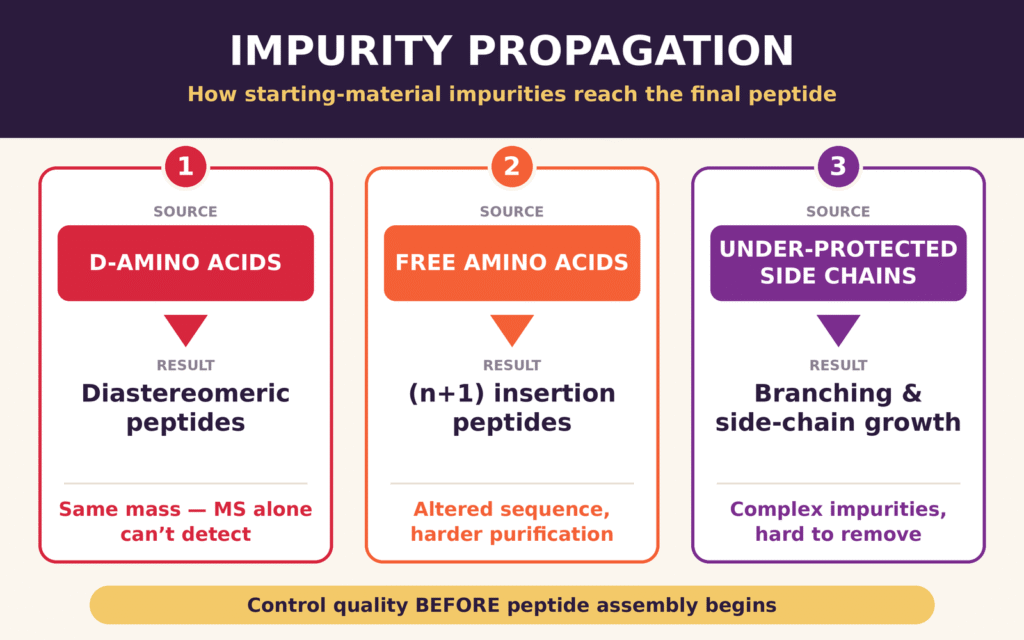
Trace impurities present in starting materials can propagate through peptide synthesis through several predictable chemical mechanisms:
Enantiomeric Impurities (D-Amino Acids): Chiral impurities in L-amino acid building blocks can participate in coupling reactions at rates comparable to those of the intended enantiomers. Their incorporation generates diastereomeric peptide impurities that have the same molecular weight as the target API. Consequently, mass spectrometry alone may not distinguish these impurities from the intended peptide, making high-resolution, orthogonal RP-HPLC separation and appropriate stereochemical analysis essential.
Free Amino Acid Impurities: Unprotected amino acids present in N-protected building blocks can participate in unintended coupling reactions during peptide assembly. Depending on the reaction sequence, these impurities may generate (n+1) insertion peptides that alter the intended amino acid sequence and complicate final purification.
Under-Protected Side Chains: Incomplete side-chain protection of trifunctional residues, such as Lys, Cys, Asp, or Glu, can permit unintended reactions during coupling. These reactions may result in side-chain elongation, branching, or other structurally complex peptide impurities that are difficult to remove from the final API.
To evaluate how multiple quality attributes and process-related modifications can be monitored together, explore multi-attribute monitoring (MAM) for peptide characterization.
Impact of European Regulatory Standards and the 2026 EMA Peptide Guideline
The European Medicines Agency (EMA) Guideline on the Development and Manufacture of Synthetic Peptides establishes regulatory expectations for synthetic peptide development and manufacturing, including the assessment of impurity limits in relation to European Pharmacopoeia Monograph 2034. It also emphasizes the importance of formal raw material criticality assessments, counter-ion control, residual solvent monitoring, and lifecycle comparability when starting material sources change.
The 2026 EMA guideline (EMA/CHMP/CVMP/QWP/367182/2025) provides specific Chemistry, Manufacturing, and Controls (CMC) expectations for synthetic peptides and establishes a harmonized framework for European regulatory submissions. Its principal considerations include the following:
Ph. Eur. Monograph 2034 Threshold Alignment: Impurity reporting, identification, and qualification thresholds must be evaluated in relation to European Pharmacopoeia Monograph 2034, titled Substances for Pharmaceutical Use. The thresholds cited in this context are greater than 0.1% for reporting, greater than 0.5% for identification, and greater than 1.0% for toxicological qualification. Their applicability must be confirmed against the relevant substance, current pharmacopoeial requirements, and applicable regulatory guidance rather than treated as universal limits for every impurity.
Criticality Risk Assessments: Regulatory dossiers should include structured risk assessments evaluating how trace impurities in protected amino acids, coupling agents, and solid supports may affect the quality profile of the final API. These assessments should consider impurity formation, propagation, potential accumulation, and removal during downstream processing.
Counter-Ion and Solvent Control: The guideline emphasizes the need to justify counter-ion selection, including acetate, trifluoroacetate (TFA), and hydrochloride, as applicable to the peptide drug substance. Because residual TFA may present toxicological and stability concerns, applicants should justify the proposed residual TFA levels and demonstrate counter-ion exchange efficiency using validated analytical methods, such as ion chromatography, where appropriate.
Lifecycle Change Control: Post-approval changes to starting material suppliers, synthetic routes, or raw material specifications require a scientifically justified assessment of their potential effects on drug substance quality. Comparability testing using validated, orthogonal analytical procedures may be necessary to demonstrate that the changes do not adversely affect the product’s critical quality attributes.
For development teams assessing peptide degradation and shelf-life risks, consult the analytical approaches described in GLP-1 peptide stability testing and analytical methods.
Structuring Module 3.2.S.2.3 and Risk Assessment in Regulatory Submissions
Module 3.2.S.2.3 of the Common Technical Document (CTD) should present a scientifically justified Quality by Design (QbD) framework that connects starting material critical quality attributes (CQAs) to the final API specifications through demonstrated process understanding and risk assessment. Regulatory submissions should include detailed chemical flowcharts, material specification tables, impurity fate-and-purge matrices, and comprehensive supplier quality management documentation.
A complete regulatory submission package in Section 3.2.S.2.3 should incorporate five core components:
Manufacturing Flowcharts: Clear reaction schemes should describe the chemical synthesis of custom protected amino acids, dipeptides, or peptide fragments. These schemes should identify solvents, catalysts, reagents, reaction conditions, and isolated intermediates to provide a transparent overview of the manufacturing process.
Selection Rationale Narrative: A comprehensive narrative should evaluate the proposed starting material against all six ICH Q11 selection principles. The justification should address the material’s chemical definition, structural contribution, position in the manufacturing process, impurity profile, downstream control strategy, and manufacturing conditions.
Analytical Specifications: Appropriate release-testing parameters should establish justified limits for chemical purity, such as at least 99.0%; chiral purity, such as at least 99.5%; free amino acids, such as less than 0.2%; heavy metals or elemental impurities; residual solvents in accordance with ICH Q3C; and moisture content. These values should be treated as proposed specifications requiring scientific justification and should be tailored to the specific starting material, process, and regulatory expectations.
Impurity Fate-and-Purge Studies: Experimental batch data should demonstrate that process-related impurities originating from starting materials are adequately removed or controlled during preparative RP-HPLC, counter-ion exchange, lyophilization, or other relevant downstream operations. The studies should establish the effectiveness and consistency of the proposed impurity control strategy.
Supplier Audit and Quality Management Systems: Documentation should demonstrate that starting material suppliers operate under appropriate Quality Management Systems (QMS). Supplier qualification should address material traceability, change-notification agreements, specification compliance, and the controls necessary to maintain consistent starting material quality throughout the product lifecycle.
For a structured approach to reviewing analytical documentation before submission, use this peptide characterization CRO deliverables checklist.
Conclusion
Successfully defining and justifying Regulatory Starting Materials for Synthetic Peptides under ICH Q11 requires a comprehensive, risk-based framework that integrates raw material specifications, process understanding, impurity control, and advanced analytical characterization. By aligning starting material selection with ICH Q11 principles, demonstrating impurity fate-and-purge capabilities, and addressing the applicable expectations of the 2026 EMA peptide guideline, biopharmaceutical developers can prepare scientifically defensible regulatory submissions that are better positioned to withstand scrutiny by global regulatory agencies.
Establishing a well-supported cGMP boundary early in process development helps maintain consistent drug substance quality, strengthens regulatory compliance, and facilitates effective post-approval lifecycle management. A robust justification should extend beyond the formal selection of starting materials to demonstrate how their quality attributes, manufacturing histories, and associated impurities are controlled throughout the synthesis process.
To obtain expert support for analytical characterization, impurity identification, process validation, peptide API scale-up, and regulatory filings, contact the technical team through the ResolveMass Contact Page.
Frequently Asked Questions
Fmoc- and Boc-protected amino acids are widely recognized as suitable regulatory starting materials for synthetic peptides when their selection is scientifically justified. Applicants must establish appropriate quality specifications, control enantiomeric impurities, and assess potential risks associated with raw material contaminants. Regulatory acceptability depends on the overall justification and the effectiveness of the proposed impurity control strategy.
The conventional ICH Q11 approach to evaluating the number of synthetic steps remaining before the final API requires a different interpretation for SPPS. Because peptide chains undergo repeated coupling and deprotection reactions on an insoluble resin without intermediate isolation, protected amino acid monomers may be accepted as regulatory starting materials. Their suitability depends on adequate raw material controls and demonstrated downstream impurity removal.
Common impurities include D-amino acid enantiomers, unprotected free amino acids, beta-alanine-related impurities, incompletely protected side-chain derivatives, and residual N-protected dipeptides. Depending on their chemical properties and the synthesis conditions, these contaminants can generate diastereomeric peptides, (n+1) insertion sequences, and other unintended peptide species. Appropriate incoming material testing helps minimize their introduction into the final drug substance.
A multi-amino acid peptide fragment may qualify as a regulatory starting material when its designation is supported by comprehensive scientific evidence. Applicants should disclose the fragment’s manufacturing route, demonstrate control of C-terminal epimerization, and establish that segment-related impurities can be effectively removed during downstream purification. The justification must also explain why the proposed manufacturing boundary provides adequate control of potential quality risks.
Testing commonly includes Reversed-Phase HPLC or UHPLC for chemical purity, Chiral HPLC or GC-MS for enantiomeric purity, and High-Resolution Mass Spectrometry for identity confirmation. Karl Fischer titration can determine moisture content, while Headspace GC can measure residual organic solvents against applicable ICH Q3C requirements. Acceptance limits, including proposed chemical purity of at least 99.0% and chiral purity of at least 99.5%, should be justified according to the material’s intended use and impurity risks.
The 2026 EMA guideline emphasizes risk-based impurity control and alignment with applicable European Pharmacopoeia requirements, including Monograph 2034 where relevant. The reporting, identification, and qualification thresholds cited in this context are greater than 0.1%, 0.5%, and 1.0%, respectively, subject to the applicable requirements and impurity-specific considerations. Applicants should also assess how starting material impurities may propagate into the final API and affect its critical quality attributes.
Enantiomeric impurities, such as D-amino acids in L-amino acid starting materials, can participate in peptide coupling and become incorporated into the growing peptide chain. The resulting diastereomeric impurities have the same molecular weight as the intended peptide, so mass spectrometry alone may not distinguish them. Chiral analysis and suitable chromatographic separation techniques are therefore essential for detecting and controlling these impurities.
CTD Section 3.2.S.2.3 should contain a detailed justification for selecting each proposed regulatory starting material under the applicable ICH Q11 principles. Supporting documentation typically includes manufacturing flowcharts, material specifications, analytical procedures, batch data, impurity fate-and-purge assessments, and supplier qualification records. Together, these elements demonstrate that the starting material’s quality and potential impurities are adequately understood and controlled.
Changes to starting material suppliers should be evaluated through formal change control and a scientifically justified comparability assessment. The evaluation may include testing the new supplier’s materials, comparing impurity profiles, manufacturing representative API batches, and assessing relevant stability data. The extent of testing should reflect the potential impact of the change on drug substance quality and applicable regulatory reporting requirements.
Reference:
- European Medicines Agency. (2025). Guideline on the development and manufacture of synthetic peptides (EMA/CHMP/CVMP/QWP/367182/2025). https://www.ema.europa.eu/en/documents/scientific-guideline/guideline-development-manufacture-synthetic-peptides_en.pdf
- Thürmer, R. (2024, April 9). European quality guidelines for synthetic peptides and oligonucleotides [Presentation]. USP Workshop on Peptide and Oligonucleotide Therapeutics: Regulations and Quality Standards. https://www.usp.org/sites/default/files/usp/document/our-work/biologics/documents/Rene%20Thurmer_European%20quality%20guidelines.pdf
- Tymonko, S., Burke, B. J., Crochard, J.-P., Dirat, O., Fraunhoffer, K. J., Harrison, C., Kramer, T., Lee, H., Liberman, V., Sidhu, K. P. S., Smith, R., Strotman, N. A., Tandogan, N., Triman, A., & Zhang, H. (2024). Impact of ICH Q11 questions and answers on the outcome of active pharmaceutical ingredient starting material proposal acceptance by ICH regulatory members. Organic Process Research & Development, 28(7), 2590–2607. https://doi.org/10.1021/acs.oprd.4c00033
- D’Hondt, M., Bracke, N., Taevernier, L., Gevaert, B., Verbeke, F., De Spiegeleer, B., & Wynendaele, E. (2014). Related impurities in peptide medicines. Journal of Pharmaceutical and Biomedical Analysis, 101, 2–30. https://doi.org/10.1016/j.jpba.2014.06.012
Get In Touch With Us
About The Author