
Introduction
Evaluating Synthetic vs Recombinant Manufacturing for long peptides and small proteins requires balancing sequence length, non-canonical modifications, scale-up economics, and regulatory impurity thresholds. Although synthetic chemical routes offer rapid development iterations and extensive flexibility for custom structural modifications, recombinant biological expression systems provide superior cost efficiency and production yields for unmodified sequences exceeding 50 amino acids at commercial scale.
The rapid expansion of the global peptide therapeutics market, driven by blockbuster metabolic therapies such as GLP-1 and GIP receptor agonists, has made biomanufacturing decisions increasingly important strategic considerations. Therapeutic molecules that occupy the structural space between short peptides and complex globular proteins, typically comprising 30 to 150 amino acid residues, present distinctive synthesis and isolation challenges. As development pipelines progress, biopharmaceutical developers must select manufacturing routes that support scalable production, high batch-to-batch purity, stringent regulatory compliance, and long-term commercial viability.
Managing these competing requirements involves evaluating step-wise coupling efficiencies, downstream purification complexities, host cell contamination risks, and environmental Process Mass Intensity (PMI). Advanced analytical characterization platforms, including those offered by ResolveMass Laboratories Inc., play an essential role in establishing active ingredient sameness, identifying trace impurities, and reducing regulatory risks for both synthetic and recombinantly derived biomolecules.
Explore the analytical approaches used to investigate GLP-1-related impurities and confirm peptide quality.
Learn about GLP-1 peptide impurity characterization
Share via:
Quick Summary:
- Core choice: Synthetic manufacturing (SPPS and Native Chemical Ligation) builds peptides chemically without cells. Recombinant manufacturing uses host organisms such as E. coli, yeast or mammalian cells to express them from DNA.
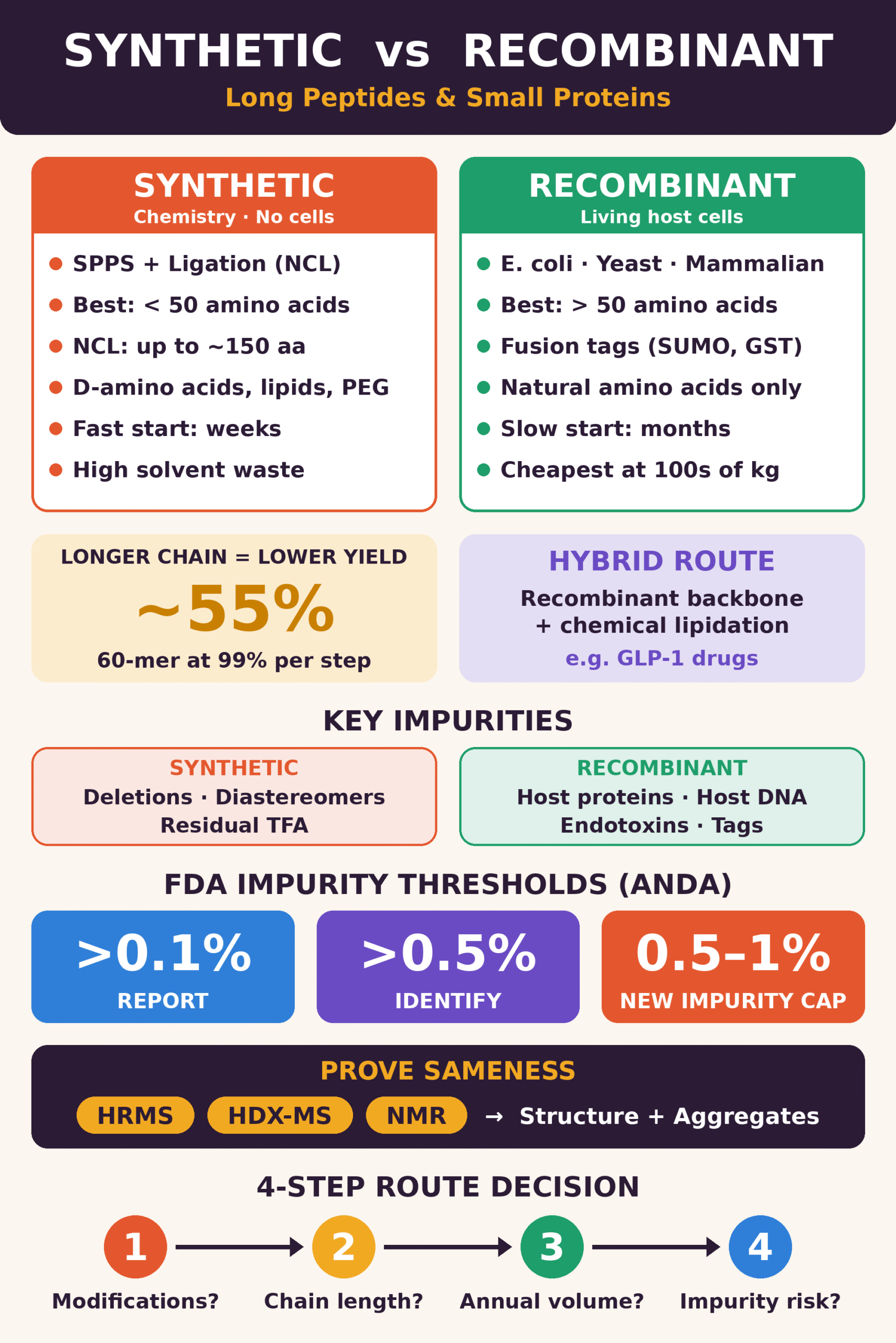
- Sequence length matters: Synthesis suits peptides under about 50 amino acids, and ligation can extend it to roughly 150. Above 50 residues, small losses at each coupling step add up; a 60-mer at 99% per step gives only about 55% crude yield, so recombinant expression often becomes more attractive.
- Modifications favor synthesis: D-amino acids, non-canonical residues, lipidation and PEGylation are easy to add chemically but hard to make in host cells. A hybrid route pairs a recombinant backbone with chemical conjugation and is relevant for GLP-1-type drugs.
- Economics and scale: Synthesis needs less upfront investment and reaches clinical batches in weeks, but its per-gram cost stays high. Recombinant production needs months of strain and process development but becomes cheaper at hundreds of kilograms per year. It also generates less solvent waste (lower PMI).
- Different impurity profiles: Synthesis can produce deletion sequences, diastereomers and residual TFA. Recombinant products carry host cell proteins, host DNA, endotoxins and fusion-tag residues.
- Regulatory expectations: FDA product-specific guidances for peptides like semaglutide and liraglutide set impurity thresholds for ANDAs: report above 0.1%, identify above 0.5%, and justify any new impurities at roughly 0.5–1.0%. Applicants must also show higher-order structure sameness and assess immunogenic aggregates using HRMS, HDX-MS and NMR.
- Decision framework: Choose the route by assessing required modifications, sequence length and expected yield, commercial volume and cost of goods, and impurity and regulatory risk early in development.
Technical Mechanics of Synthetic vs Recombinant Manufacturing
The fundamental distinction between Synthetic vs Recombinant Manufacturing lies in the use of sequential chemical coupling on solid supports versus ribosomal translation within biological host organisms. Solid-Phase Peptide Synthesis (SPPS) and Native Chemical Ligation (NCL) assemble amino acids through chemical processes without living cells. In contrast, recombinant systems use genetically engineered microorganisms or eukaryotic cell cultures to produce proteins from encoded genetic sequences.
Chemical Assembly via Solid-Phase Synthesis and Native Chemical Ligation
Chemical peptide synthesis constructs polypeptide chains sequentially on solid resin supports using Fmoc or Boc protection chemistry. Native Chemical Ligation (NCL) can subsequently be used to join shorter synthetic fragments to produce full-length small proteins.
During Solid-Phase Peptide Synthesis (SPPS), chain elongation involves repeated cycles of N-terminal deprotection followed by activated amino acid coupling on an insoluble polymeric resin. Although modern automated synthesizers can achieve individual coupling efficiencies exceeding 99%, incomplete reactions accumulate across longer sequences, resulting in exponential reductions in overall yield. For example, synthesizing a 60-mer peptide at an average step yield of 99% produces a theoretical crude yield of approximately 54.7%. The remaining material consists of closely related impurities, including deletion sequences, insertions, and truncated side products.
Native Chemical Ligation (NCL) helps overcome the chain-length limitations associated with single-run SPPS by enabling the chemoselective joining of unprotected synthetic peptide fragments in an aqueous solution. This technique relies on a specific reaction between an N-terminal cysteine residue on one fragment and a C-terminal thioester on another. The reaction initially forms a thioester-linked intermediate, which then undergoes a spontaneous S-to-N acyl shift to establish a native peptide bond. Through this hybrid chemical strategy, functional small proteins containing approximately 100 to 150 residues can be synthesized without requiring host cell expression.
For a deeper understanding of sequence confirmation in synthetic peptides, explore the analytical methods used to establish amino acid order and identify sequence-related variations.
Explore peptide sequencing methods for GLP-1 peptides
Biological Expression Systems in Recombinant Polypeptide Production
Recombinant polypeptide production uses biological host systems, including Escherichia coli, Pichia pastoris, and mammalian cell lines, to translate target gene sequences into proteins through ribosomal machinery. This biological process supports high translational fidelity across long amino acid sequences, although production remains dependent on cellular viability, host metabolism, and the characteristics of the expression system.
During recombinant expression, optimized synthetic DNA encoding the target peptide is inserted into an expression vector controlled by a strong promoter. In microbial hosts such as E. coli, short or highly hydrophobic peptides may undergo rapid intracellular proteolytic degradation or produce toxic effects that interfere with host cell growth. To address these challenges, biomanufacturers frequently express the target peptide as a fusion construct linked to a stable carrier protein, such as SUMO, GST, or thioredoxin. These carrier proteins can improve peptide stability and facilitate accumulation in soluble fractions or dense inclusion bodies.
Post-fermentation processing involves several downstream operations, including cell disruption, inclusion body isolation, chemical solubilization, oxidative refolding to establish native disulfide bonds, and targeted enzymatic or chemical cleavage to release the final active peptide. Although biological translation avoids the chemical step-wise deletion impurities commonly associated with SPPS, downstream purification must effectively remove host cell proteins, nucleic acids, endotoxins, and other process-related contaminants.
Review the analytical considerations involved in confirming the sequence of GLP-1 analogues and evaluating their structural characteristics.
Discover the GLP-1 analog peptide sequencing workflow
Key Factors in Synthetic vs Recombinant Manufacturing Decisions
Selecting the most appropriate manufacturing pathway requires careful consideration of sequence length, non-canonical amino acid requirements, structural folding, and production scale. Peptides containing fewer than 50 amino acids and molecules requiring non-natural modifications generally favor synthetic manufacturing. Conversely, longer sequences composed of naturally occurring amino acids are often better suited to recombinant expression platforms.
| Evaluation Parameter | Synthetic Manufacturing (SPPS / NCL) | Recombinant Manufacturing (Microbial / Yeast) |
|---|---|---|
| Optimal Sequence Length | 1 to 50 residues; up to approximately 150 through NCL | More than 50 to 200+ residues |
| Non-Canonical Amino Acids | Broad flexibility, including D-amino acids and artificial side chains | Extremely limited; may require amber codon suppression |
| Backbone & Side-Chain Modifications | Highly flexible, including lipidation, PEGylation, and phosphorylation | Restricted by host cellular post-translational capabilities |
| Disulfide Bond Formation | Chemically directed orthogonal protection schemes | In vivo or in vitro oxidative refolding processes |
| Characteristic Impurities | Deletion sequences, diastereomers, and residual TFA | Host Cell Proteins (HCP), Host Cell DNA, and fusion tags |
| Initial Lead Time | Short; often weeks for direct chemical synthesis | Longer; potentially months for cell line and strain engineering |
| Environmental Footprint (PMI) | High due to substantial organic solvent consumption | Generally lower due to predominantly aqueous fermentation streams |
Chemical peptide synthesis provides extensive structural flexibility, allowing the precise incorporation of D-enantiomers, non-canonical amino acids, backbone N-methylations, and specialized chemical conjugates. These conjugates may include fatty acid chains introduced through modifications such as palmitoylation. In comparison, conventional recombinant expression systems are generally limited to the 20 natural L-amino acids processed through standard ribosomal translation, although specialized engineering approaches can expand this capability.
When therapeutic molecules require complex structural modifications, such as the lipophilic side chains responsible for extending the circulation half-life of GLP-1 receptor agonists, recombinant expression alone may not produce the final active drug substance. In such cases, developers must consider either complete chemical synthesis or a semi-synthetic hybrid approach. The hybrid strategy involves producing a peptide backbone through recombinant expression and subsequently introducing the required modifications through chemical conjugation.
Explore how peptide stereochemistry can influence identity, purity, and the analytical assessment of therapeutic candidates.
Learn about chiral analysis of therapeutic peptide APIs
Economic and Scalability Thresholds in Process Selection
Recombinant manufacturing generally provides better long-term cost efficiency at production volumes reaching several hundred kilograms or metric tonnes because of its relatively low marginal media costs. Synthetic peptide synthesis, however, typically requires less initial capital investment and supports faster development timelines for clinical trial batches.
The economics of Solid-Phase Peptide Synthesis are largely determined by raw material expenses and operational expenditure (OpEx). Protected amino acid monomers, advanced coupling reagents such as HATU, DIC, and Oxyma, specialized resins, and high-purity organic solvents such as dimethylformamide (DMF) represent recurring costs that increase with production volume. Consequently, although establishing a pilot SPPS facility generally requires relatively limited initial capital expenditure (CapEx), the manufacturing cost per gram may remain comparatively high as production increases.
Recombinant manufacturing requires substantial upfront capital investment and longer development timelines for strain engineering, master cell bank registration, fermentation optimization, and downstream isolation facilities. Nevertheless, once a high-yielding microbial strain capable of producing multi-gram-per-liter titers has been validated, the marginal costs associated with nutrient media and fermentation inputs can decrease significantly. For unmodified long peptides and small proteins required in annual quantities of several hundred kilograms, recombinant expression may therefore deliver substantially lower unit production costs.
Environmental sustainability and Process Mass Intensity (PMI) also influence manufacturing decisions. SPPS can generate substantial chemical waste per kilogram of final product because repeated resin-washing cycles require considerable quantities of solvents. Increasing regulatory and industry attention to environmental sustainability is encouraging manufacturers to adopt greener solvent alternatives and evaluate aqueous-based recombinant fermentation processes. These considerations make environmental performance an important component of long-term manufacturing strategy alongside yield, cost, and product quality.
Regulatory Impurity Control and Analytical Characterization Frameworks
Regulatory approval for generic and novel long peptides requires comprehensive characterization of route-specific impurities and confirmation of higher-order structural sameness. The Food and Drug Administration (FDA) and international regulatory agencies establish analytical expectations according to the characteristics of the drug substance and its manufacturing process, including whether it is produced chemically or biologically.
Updated FDA draft product-specific guidances (PSGs) for complex peptide therapeutics, including semaglutide, tirzepatide, liraglutide, and teriparatide, outline specific expectations for generic Abbreviated New Drug Application (ANDA) submissions. For synthetic peptides referencing a listed drug (RLD) of recombinant origin, applicants may need to address defined impurity thresholds and demonstrate adequate analytical characterization.
– Reporting Threshold: Active ingredient-related impurities present above 0.1% of the drug substance may require formal reporting, depending on the applicable product-specific guidance and regulatory requirements.
– Identification Threshold: Peptide-related impurities exceeding 0.5% may require isolation, structural characterization, and identification, as specified by the relevant regulatory guidance.
– New Specified Impurity Limits: Proposed synthetic generic products containing new specified impurities that are absent from the recombinant RLD may require evidence demonstrating that these impurities remain within applicable limits, potentially in the range of 0.5% to 1.0%. Appropriate supporting evidence may include detailed safety and immunogenicity risk assessments.
Synthetic manufacturing can generate closely related peptide variants, including single amino acid deletion species (des-amino acid species), insertions, and racemized diastereomers. These impurities may exhibit physicochemical properties that closely resemble those of the target molecule, making their separation and identification challenging. Recombinant manufacturing avoids certain chemical deletion sequences but may introduce host-derived contaminants, including Host Cell Proteins (HCP), host cell DNA (hcDNA), residual cleavage enzymes, and bacterial endotoxins.
Demonstrating Higher-Order Structure (HOS) sameness and evaluating the presence of potentially immunogenic aggregates are essential components of regulatory characterization. Unintended aggregation or subtle alterations in secondary structure may expose cryptic epitopes, potentially triggering anti-drug antibodies (ADAs) in treated patients. Addressing these analytical challenges requires advanced orthogonal characterization techniques, including high-resolution mass spectrometry (HRMS), Hydrogen-Deuterium Exchange Mass Spectrometry (HDX-MS), and multidimensional NMR. Specialized analytical organizations such as ResolveMass Laboratories Inc. can support these investigations through structural characterization and impurity profiling services.
Explore the regulatory considerations for characterizing GLP-1 peptides and preparing supporting analytical evidence.
Review regulatory requirements for GLP-1 peptide characterization
Strategic Decision Framework for Biomanufacturing Route Selection
A comprehensive manufacturing selection framework evaluates chemical modification requirements, sequence length, annual commercial production volumes, and downstream purification feasibility. Aligning molecular design with manufacturing capabilities early in development can help prevent expensive process changes during later clinical stages.
Biopharmaceutical decision-makers can apply the following structured evaluation process to identify the most suitable manufacturing strategy.
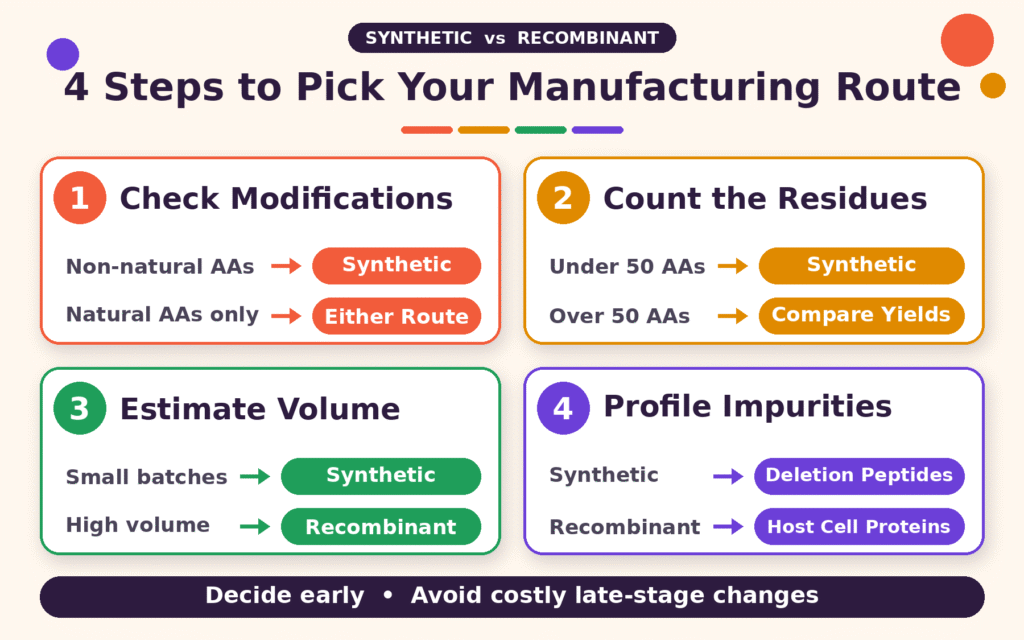
1. Assess Structural Modifications: Determine whether the molecule requires D-amino acids, artificial side chains, or specialized backbone alterations. If these modifications are essential, consider Solid-Phase Peptide Synthesis or a semi-synthetic hybrid approach because standard host cells cannot incorporate non-canonical residues through conventional ribosomal translation without specialized engineering.
2. Evaluate Sequence Length and Coupling Yields: For targets containing fewer than approximately 40 to 50 amino acids, prioritize SPPS when its rapid development timelines and relatively low initial capital requirements align with project objectives. For sequences exceeding 50 residues, calculate theoretical chemical synthesis yields and compare them with anticipated biological expression yields to determine whether cumulative coupling losses make chemical synthesis less attractive.
3. Model Commercial Scale and Cost of Goods (CoGS): Estimate long-term annual demand and evaluate the anticipated cost of goods. Orphan drugs and specialized research candidates may favor SPPS because of their relatively limited production requirements. In contrast, high-volume primary care therapeutics may benefit from recombinant fermentation when their sequences can be expressed efficiently and purified economically.
4. Profile Impurity and Regulatory Risk: Conduct comparative analytical testing early in development to characterize potential deletion peptides associated with synthetic manufacturing and host cell contaminants associated with recombinant production. Establish an analytical control strategy that addresses the relevant impurity profile, product quality requirements, and applicable FDA guidance thresholds.
For GLP-1 receptor agonist development, a well-organized characterization package can help bring together structural identity, impurity profiling, and supporting evidence for generic drug development.
Explore a full characterization data package for a GLP-1 receptor agonist ANDA
Conclusion
Choosing between Synthetic vs Recombinant Manufacturing for long peptides and small proteins requires balancing chemical flexibility, biological production efficiency, scalability, and regulatory compliance. Solid-phase chemical synthesis remains particularly suitable for shorter sequences and molecules requiring non-canonical amino acids or specialized structural modifications. Recombinant production, meanwhile, is generally advantageous for high-volume manufacturing of unmodified protein targets that can be expressed efficiently in suitable host systems.
Advanced analytical characterization is essential for establishing product quality, demonstrating active ingredient sameness, identifying trace impurities, and supporting regulatory submissions across global markets. ResolveMass Laboratories Inc. supports biopharmaceutical innovators through comprehensive structural elucidation, trace impurity profiling, and biomanufacturing process validation, helping developers address analytical challenges associated with synthetic and recombinant production pathways.
For additional support in assessing peptide stability and selecting appropriate analytical methods throughout development, explore the available characterization approaches.
Learn about analytical methods for GLP-1 peptide stability
To consult with analytical biomanufacturing experts about structural characterization or regulatory impurity profiling for long peptides and small proteins, visit the ResolveMass Laboratories Inc. Contact Page.
Frequently Asked Questions
Conventional recombinant expression primarily incorporates the 20 naturally occurring L-amino acids through standard ribosomal translation. Specialized genetic code expansion techniques can enable the incorporation of certain non-canonical amino acids, although these approaches require additional development. Alternatively, chemical modification after recombinant expression can introduce specific structural features that biological production alone cannot readily provide.
As peptide length increases, incomplete amino acid coupling reactions accumulate, reducing the overall yield of the desired full-length product. At an average coupling efficiency of 99% per step, a 60-residue peptide has a theoretical full-length yield of approximately 54.7%, assuming 59 coupling steps. The resulting crude material may contain deletion sequences and truncated peptides that require additional purification.
FDA requirements for peptide impurities depend on the applicable product-specific guidance, the drug substance, and the nature of the impurity. The thresholds described in certain draft guidances include reporting impurities above 0.1% and identifying or characterizing specified impurities above 0.5%. Applicants must verify the current guidance and establish appropriate safety assessments for new impurities.
Native Chemical Ligation (NCL) joins unprotected peptide fragments through a chemoselective reaction involving an N-terminal cysteine and a C-terminal thioester. The resulting intermediate undergoes an S-to-N acyl shift, creating a native peptide bond at the junction. This technique enables the assembly of longer peptide chains and small proteins that are difficult to produce efficiently through a single SPPS synthesis.
Short peptides may be rapidly degraded by intracellular proteases or interfere with host cell growth during recombinant production. Fusion tags, such as SUMO and GST, can improve peptide stability, facilitate expression, and support recovery during downstream processing. Following expression and purification, the carrier protein is removed through an appropriate enzymatic or chemical cleavage process.
Synthetic peptide manufacturing commonly produces deletion sequences, insertions, racemized diastereomers, and residual reagents associated with chemical synthesis and cleavage. Recombinant production may introduce Host Cell Proteins (HCP), host cell DNA, residual processing enzymes, endotoxins, and incorrectly folded or disulfide-bonded species. Each manufacturing route therefore requires a tailored analytical strategy to identify, quantify, and control its characteristic impurities.
Process Mass Intensity (PMI) measures the total mass of materials consumed during manufacturing relative to the mass of the final product. In SPPS, repeated washing and deprotection steps can generate substantial solvent and reagent waste, increasing PMI. Evaluating this metric helps manufacturers identify opportunities to reduce material consumption, adopt greener solvents, and improve the environmental efficiency of peptide production.
Demonstrating active ingredient sameness requires comprehensive analytical evidence comparing the proposed synthetic product with the recombinant reference listed drug (RLD). Relevant assessments may include primary sequence, physicochemical properties, higher-order structure (HOS), biological activity, and impurity profiles. Applicants must also evaluate differences in impurities and address any associated safety or immunogenicity concerns in accordance with applicable FDA requirements.
A hybrid approach is appropriate when recombinant expression can efficiently produce a long peptide backbone but cannot readily introduce all the modifications required for therapeutic activity. The core polypeptide is first expressed in a suitable biological host, recovered, and purified before undergoing chemical modification. This strategy can support the introduction of features such as lipidation or PEGylation while retaining the production advantages of recombinant manufacturing.
Reference:
- Thapa, P., Zhang, R.-Y., Menon, V., & Bingham, J.-P. (2014). Native chemical ligation: A boon to peptide chemistry. Molecules, 19(9), 14461–14483. https://doi.org/10.3390/molecules190914461
- Clement, H., Flores, V., Diego-Garcia, E., Corrales-Garcia, L., Villegas, E., & Corzo, G. (2015). A comparison between the recombinant expression and chemical synthesis of a short cysteine-rich insecticidal spider peptide. The Journal of Venomous Animals and Toxins Including Tropical Diseases, 21, Article 19. https://doi.org/10.1186/s40409-015-0018-7
- U.S. Food and Drug Administration. (2026, July). Draft guidance on semaglutide: Product-specific guidance for generic drug development (Recommended November 2023; revised December 2025 and July 2026). https://www.accessdata.fda.gov/drugsatfda_docs/psg/PSG_215256.pdf
- U.S. Food and Drug Administration. (n.d.). FDA guidance document. https://www.fda.gov/media/187979/download
Get In Touch With Us
About The Author