
Introduction:
Thermogravimetric Analysis Testing is an advanced analytical technique used to measure mass changes in materials as they are heated, cooled, or held at constant temperature in a controlled atmosphere.
By analyzing how a material’s weight changes with temperature, TGA Testing helps scientists determine composition, thermal stability, moisture content, oxidation behavior, and decomposition temperatures. This information is essential for industries such as pharmaceuticals, polymers, energy materials, chemicals, and environmental science.
At ResolveMass Laboratories Inc., TGA Testing is performed using state-of-the-art thermal analysis instruments and validated methodologies to ensure accurate and reproducible results for research, quality control, and regulatory applications.
Share via:
Summary:
- TGA Testing (Thermogravimetric Analysis) is a thermal analysis technique used to measure changes in a material’s mass as temperature changes.
- It helps identify thermal stability, composition, moisture content, and decomposition behavior of materials.
- TGA Testing is widely used in pharmaceuticals, polymers, chemicals, food, environmental science, and advanced materials research.
- Industries rely on TGA Testing for quality control, product development, failure analysis, and regulatory compliance.
- ResolveMass Laboratories Inc. provides expert analytical services using advanced thermal analysis equipment to deliver reliable and precise results.
1: What is Thermogravimetric Analysis Testing?
Thermogravimetric Analysis is a thermal analysis technique that measures the mass of a sample as a function of temperature or time under controlled heating conditions.
During TGA Testing:
- A small sample is placed on a sensitive microbalance.
- The sample is heated at a controlled rate.
- The instrument records weight changes continuously.
- A TGA curve (mass vs temperature) is generated.
These weight changes provide valuable information about:
- Moisture loss
- Decomposition
- Oxidation
- Thermal stability
- Composition of multi-component materials
2: Why Thermogravimetric Analysis Testing is Important in Material Analysis
TGA Testing is essential because it provides direct insight into how materials behave under heat.
This data is critical for ensuring product performance, safety, and regulatory compliance.
Key reasons industries use TGA Testing
- Determine thermal stability of materials
- Identify moisture or volatile content
- Evaluate material composition
- Study oxidation and degradation behavior
- Perform quality control and product validation
For example:
| Industry | Use of TGA Testing |
|---|---|
| Pharmaceuticals | Drug stability and excipient analysis |
| Polymers | Polymer degradation and filler content |
| Chemicals | Purity and composition verification |
| Energy | Battery material characterization |
| Food | Moisture and organic content analysis |
At ResolveMass Laboratories Inc., TGA Testing supports companies in making data-driven decisions during product development and regulatory submissions.
3: How Thermogravimetric Analysis TestingWorks
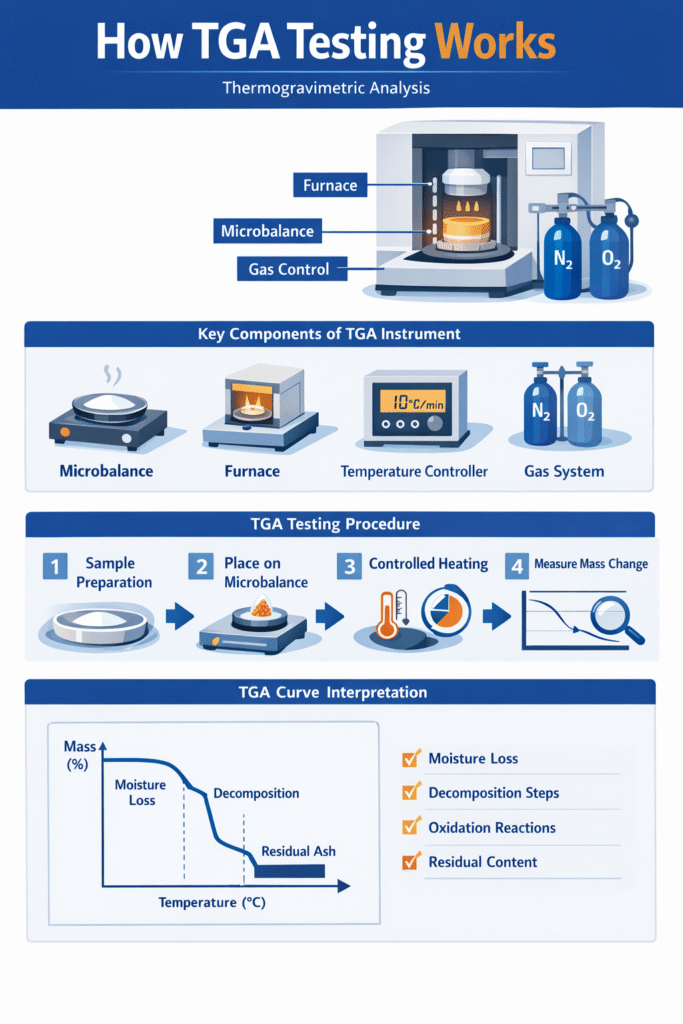
TGA Testing works by measuring the change in mass of a material as the temperature increases under a controlled atmosphere. This process allows scientists to determine how a material behaves when exposed to heat, including moisture loss, decomposition, oxidation, and thermal stability.
During TGA Testing (Thermogravimetric Analysis), a small sample is placed in a highly sensitive instrument that records even the smallest weight changes as the temperature rises at a controlled rate. The data generated helps researchers understand the composition, stability, and degradation behavior of materials.
Key Components of a TGA Instrument
A TGA instrument consists of several critical components that ensure precise and reliable measurements during TGA Testing:
- Microbalance – A highly sensitive balance capable of detecting extremely small mass changes, often in micrograms.
- Furnace – Heats the sample according to a controlled temperature program.
- Temperature Controller – Maintains accurate heating rates and temperature stability throughout the experiment.
- Gas System – Regulates the testing atmosphere, typically using gases such as nitrogen, air, or oxygen.
- Data Acquisition System – Records and analyzes weight changes and generates the TGA curve.
These components work together to ensure accurate monitoring of thermal reactions and weight variations during TGA Testing.
Typical TGA Testing Procedure
The TGA Testing procedure follows a structured process to ensure accurate and reproducible results:
- Sample Preparation
A small amount of material (usually a few milligrams) is prepared and placed in a specialized sample pan. - Sample Placement on Microbalance
The sample pan is positioned on a highly sensitive microbalance inside the instrument. - Controlled Heating
The furnace gradually increases the temperature at a programmed rate (for example, 10°C per minute). - Continuous Mass Measurement
As the temperature increases, the instrument continuously records any change in the sample’s mass. - Data Analysis and Interpretation
The collected data is analyzed to determine key material properties such as moisture content, decomposition temperatures, and residual mass.
TGA Curve and Data Interpretation
The final output of TGA Testing is a TGA curve, which plots mass change versus temperature or time.
This curve helps scientists identify:
- Moisture or solvent loss
- Thermal decomposition stages
- Oxidation or combustion reactions
- Residual inorganic content
- Material stability at high temperatures
By analyzing these patterns, researchers can gain valuable insights into the composition and thermal performance of materials, which is critical for product development, quality control, and material characterization.
4: What Information Can TGA Testing Provide?
TGA Testing can provide detailed information about the composition and thermal behavior of materials.
Common data obtained from TGA Testing
- Moisture content
- Thermal degradation temperatures
- Ash content
- Volatile compounds
- Oxidation resistance
- Material composition
Example of TGA data interpretation
| Temperature Range | Observation | Interpretation |
|---|---|---|
| 25–150°C | Weight loss | Moisture evaporation |
| 200–400°C | Mass decrease | Organic decomposition |
| 500°C+ | Stable mass | Inorganic residue or ash |
This information helps researchers understand how materials behave during manufacturing, storage, and use.
5: Applications of TGA Testing Across Industries
TGA Testing is widely used across industries to analyze material composition and thermal stability.
- Material Characterization TGA is extensively used for characterizing materials such as polymers, composites, and pharmaceuticals. By analyzing the thermogram, scientists can determine the composition of the material, including the presence of fillers, additives, and moisture content. This is particularly useful in quality control and research and development, where the consistency and performance of materials are critical.
- Thermal Stability Assessment The thermal stability of a material is a key parameter in many applications, especially in industries where materials are exposed to high temperatures. TGA testing helps in identifying the temperature at which a material starts to decompose or degrade, providing essential data for material selection and design. For instance, in the pharmaceutical industry, TGA can be used to assess the stability of active pharmaceutical ingredients (APIs) and excipients under different storage conditions.
- Decomposition Kinetics TGA can also be employed to study the decomposition kinetics of materials. By analyzing the rate of weight loss at different temperatures, it is possible to determine the activation energy and other kinetic parameters of the decomposition process. This information is vital for understanding the reaction mechanisms and for optimizing processing conditions in various industrial applications.
- Oxidative Stability TGA can be used to evaluate the oxidative stability of materials, particularly polymers and oils. By conducting tests in an oxidative environment, such as in the presence of air or oxygen, TGA can reveal the temperatures at which oxidation reactions occur, leading to material degradation. This is crucial for predicting the shelf life and performance of materials in real-world applications.
- Moisture and Volatile Content Analysis TGA is an effective method for determining the moisture and volatile content in materials. By heating the sample at a controlled rate, the weight loss corresponding to the evaporation of water or other volatile components can be quantified. This is particularly important in industries such as food, pharmaceuticals, and building materials, where moisture content affects the quality and stability of the products.
- Pharmaceutical Industry:In pharmaceuticals, TGA Testing helps evaluate drug stability and excipient compatibility.Applications include: Moisture content analysis, Drug degradation studies, Excipient compatibility testing, Stability evaluation
6: Advantages of TGA Testing
TGA Testing offers several advantages compared with other material characterization techniques.
Key benefits
- High sensitivity for detecting small mass changes
- Accurate composition analysis
- Wide temperature range testing
- Minimal sample preparation
- Applicable to solids, powders, and polymers
These advantages make TGA Testing an essential tool in modern analytical laboratories.
7: Limitations of TGA Testing
While TGA Testing (Thermogravimetric Analysis) is a powerful analytical technique for studying material stability and composition, it also has certain limitations that researchers must consider during interpretation. Understanding these limitations ensures that TGA data is used correctly and complemented with other analytical methods when necessary.
1. Cannot Directly Identify Chemical Species
One of the primary limitations of TGA Testing is that it measures mass changes only, not the specific chemical compounds causing those changes.
For example, if a material loses weight during heating, TGA can detect the amount and temperature of the loss, but it cannot directly determine whether the lost mass is due to:
- Water or moisture
- Organic solvents
- Polymer decomposition
- Gas release from chemical reactions
Because of this, additional analytical techniques are often required to identify the exact chemical components involved.
2. Requires Complementary Analytical Techniques
To obtain a more complete understanding of material composition, TGA Testing is often combined with other advanced analytical methods.
Common complementary techniques include:
| Technique | Purpose |
|---|---|
| FTIR (Fourier Transform Infrared Spectroscopy) | Identifies gases or compounds released during heating |
| MS (Mass Spectrometry) | Determines molecular composition of evolved gases |
| DSC (Differential Scanning Calorimetry) | Measures heat flow associated with thermal transitions |
| GC-MS | Provides detailed chemical analysis of volatile compounds |
By combining TGA Testing with these techniques, scientists can identify both mass changes and the chemical processes responsible for them.
3. Complex Data Interpretation
Interpreting TGA curves and thermal decomposition patterns often requires significant expertise.
Several factors can affect the results, including:
- Heating rate
- Sample size
- Atmosphere (air, nitrogen, oxygen)
- Material composition
- Instrument calibration
Because multiple processes may occur simultaneously during heating, accurate interpretation of TGA data typically requires experienced thermal analysis specialists.
4. Limited Information on Structural Changes
Another limitation is that TGA Testing focuses only on mass changes and does not directly reveal structural transformations within the material.
For instance, TGA may show that a sample remains stable in weight, but it cannot determine structural changes such as phase transitions or crystallinity changes.
Techniques such as XRD, DSC, or microscopy are often required to study these structural properties.
Expert Thermal Analysis at ResolveMass Laboratories
At ResolveMass Laboratories Inc., experienced scientists address these limitations by integrating TGA Testing with multiple complementary analytical techniques. This comprehensive approach allows researchers to gain deeper insights into material composition, degradation mechanisms, and thermal stability.
By combining advanced instrumentation with expert interpretation, ResolveMass Laboratories ensures reliable and meaningful results for complex material characterization projects.

8: Why Choose ResolveMass Laboratories for TGA Testing
ResolveMass Laboratories Inc. provides high-quality TGA Testing services using advanced analytical instrumentation and experienced scientists.
Key advantages of working with ResolveMass
- Advanced thermal analysis instrumentation
- Highly trained analytical chemistry experts
- Accurate and reproducible results
- Fast turnaround times
- Customized testing solutions for complex materials
Our team supports clients in pharmaceuticals, polymers, advanced materials, and chemical research, ensuring that all analytical work meets strict quality standards.
Conclusion:
Thermogravimetric Analysis Testing is a powerful analytical technique used to measure how materials change in mass as temperature increases. It provides critical insights into thermal stability, composition, moisture content, and decomposition behavior.
Across industries such as pharmaceuticals, polymers, chemicals, and energy materials, TGA Testing plays a crucial role in product development, quality control, and research innovation.
At ResolveMass Laboratories Inc., expert scientists combine advanced instrumentation with deep analytical expertise to deliver high-quality TGA Testing services that help organizations understand their materials with confidence.
Frequently Asked Questions:
TGA Testing measures the change in mass of a sample as it is heated over time. These mass changes help identify processes such as:
-Moisture evaporation
-Thermal decomposition
-Oxidation reactions
-Volatile compound release
-Residual inorganic content
This information helps researchers understand material composition and stability under heat.
TGA Testing is widely used across multiple industries for material characterization and quality control.
Common industries include:
-Pharmaceuticals
-Polymer and plastics manufacturing
-Chemical industry
-Energy and battery materials
-Environmental research
-Food and agricultural analysis
These industries rely on TGA Testing to evaluate thermal behavior and ensure product reliability.
TGA Testing is important because it helps scientists understand how materials behave when exposed to heat.
It helps researchers determine:
-Thermal stability
-Decomposition temperatures
-Moisture or volatile content
-Composition of complex materials
These insights are essential for product development, safety testing, and quality assurance.
Difference Between TGA and DSC
-TGA (Thermogravimetric Analysis) measures the change in mass of a material as temperature increases.
-DSC (Differential Scanning Calorimetry) measures the heat flow into or out of a material during heating or cooling.
TGA is mainly used to study thermal stability, decomposition, and moisture content.
DSC is used to analyze phase transitions such as melting, crystallization, and glass transition.
TGA results are presented as a mass vs. temperature curve, while DSC results show heat flow vs. temperature.
TGA Testing can analyze a wide variety of solid and powdered materials.
Common examples include:
-Polymers and plastics
-Pharmaceuticals and drug compounds
-Metals and ceramics
-Composite materials
-Biomaterials and environmental samples
This versatility makes TGA Testing useful across many scientific and industrial applications.
Reference
- Experimental methods in chemical engineering: Thermogravimetric analysis—TGA.https://onlinelibrary.wiley.com/doi/abs/10.1002/cjce.23673
- Unlocking thermogravimetric analysis (TGA) in the fight against “Fake graphene” materials.https://www.sciencedirect.com/science/article/abs/pii/S0008622321004474
- Evaluating the thermal stability of high performance fibers by TGA.https://onlinelibrary.wiley.com/doi/abs/10.1002/app.22305
- Reaction schemes and characteristics in crude oil oxidation process using a TGA testing method.https://www.sciencedirect.com/science/article/abs/pii/S0016236118311256
- TGA and macro-TGA characterisation of biomass fuels and fuel mixtures.https://www.sciencedirect.com/science/article/abs/pii/S0016236111000706