

Introduction
Developing a compliant Biosimilar Regulatory Dossier Structure demands an in-depth understanding of the sophisticated analytical expectations established by global regulatory authorities. Unlike generic small-molecule drugs, biosimilars are large, structurally complex proteins manufactured using living expression systems. As a result, producing an identical copy of the reference product is not feasible, and even minor manufacturing variations can influence the final product. To obtain regulatory approval through the 351(k) pathway in the United States or comparable centralized approval pathways administered by the European Medicines Agency (EMA) and Health Canada, sponsors must provide a comprehensive “totality of the evidence” package.
At the core of this submission is Common Technical Document (CTD) Module 3, which contains detailed Chemistry, Manufacturing, and Controls (CMC) information together with an extensive analytical comparability assessment. Preparing this module requires advanced laboratory capabilities that can accurately detect subtle molecular differences and product heterogeneity. Contract Research Organizations (CROs), such as ResolveMass Laboratories Inc., operating under a fully implemented ISO 9001:2015 Quality Management System, FDA registration, and Health Canada Drug Establishment Licence (DEL 3-002945-A), deliver the advanced analytical characterization and GMP-compliant testing necessary to produce a scientifically rigorous and regulatory-ready Module 3 dossier.
Discover our comprehensive Biosimilar Characterization Services to ensure your Module 3 dossier meets rigorous global expectations.
Article Summary:
- CTD Module 3 is the foundation of a biosimilar regulatory submission, providing detailed Chemistry, Manufacturing, and Controls (CMC) information along with comprehensive analytical evidence demonstrating biosimilarity to the reference biologic.
- The module is organized into four major sections—Drug Substance (3.2.S), Drug Product (3.2.P), Appendices (3.2.A), and Regional Information (3.2.R), each contributing essential manufacturing, quality, validation, and analytical documentation required by global regulatory authorities.
- Analytical similarity follows a risk-based, three-tier evaluation strategy, where critical quality attributes are assessed using statistical equivalence testing, predefined quality ranges, or qualitative graphical comparisons based on their potential clinical impact.
- Establishing the Quality Target Product Profile (QTPP) and identifying Critical Quality Attributes (CQAs) requires extensive structural, physicochemical, and functional characterization of the reference product using multiple complementary analytical techniques.
- Comprehensive characterization includes molecular structure analysis, post-translational modification profiling, and functional bioassays, ensuring the biosimilar closely matches the reference product in quality, biological activity, and overall performance.
- Common regulatory deficiencies often involve manufacturing documentation, analytical method validation, process controls, and incomplete comparability data, making robust quality systems and well-documented analytical evidence essential for efficient regulatory review.
- A scientifically robust and well-organized CTD Module 3 reduces regulatory uncertainty, supports smoother approval pathways, and helps accelerate the development and commercialization of safe, effective, and high-quality biosimilar medicines.
What is the CTD Module 3 in Biosimilar Development?
CTD Module 3 serves as the comprehensive quality component of a regulatory submission. It provides detailed information regarding the manufacturing processes, quality controls, specifications, and analytical comparability studies for both the drug substance and the drug product when compared with the reference biologic.
Developed under the ICH M4Q guidelines, Module 3 establishes a standardized format for presenting CMC data across multiple international regulatory agencies. In biosimilar development, this module carries significantly greater complexity because it must demonstrate not only that the manufacturing process is consistently controlled but also that the final product is highly similar to the reference biologic. Since the manufacturing process itself largely defines a biological product, any differences in expression systems, purification methods, or production conditions must be comprehensively characterized and scientifically justified to demonstrate that they do not result in clinically meaningful differences in safety, purity, or efficacy. A carefully prepared Module 3 helps minimize regulatory uncertainty and can substantially reduce the extent, duration, and overall cost of comparative clinical efficacy studies conducted later in development.
Read our deep-dive analysis on executing a robust Biosimilar Comparability Studies framework to de-risk clinical phases.
Key Sections of the Biosimilar CTD Module 3
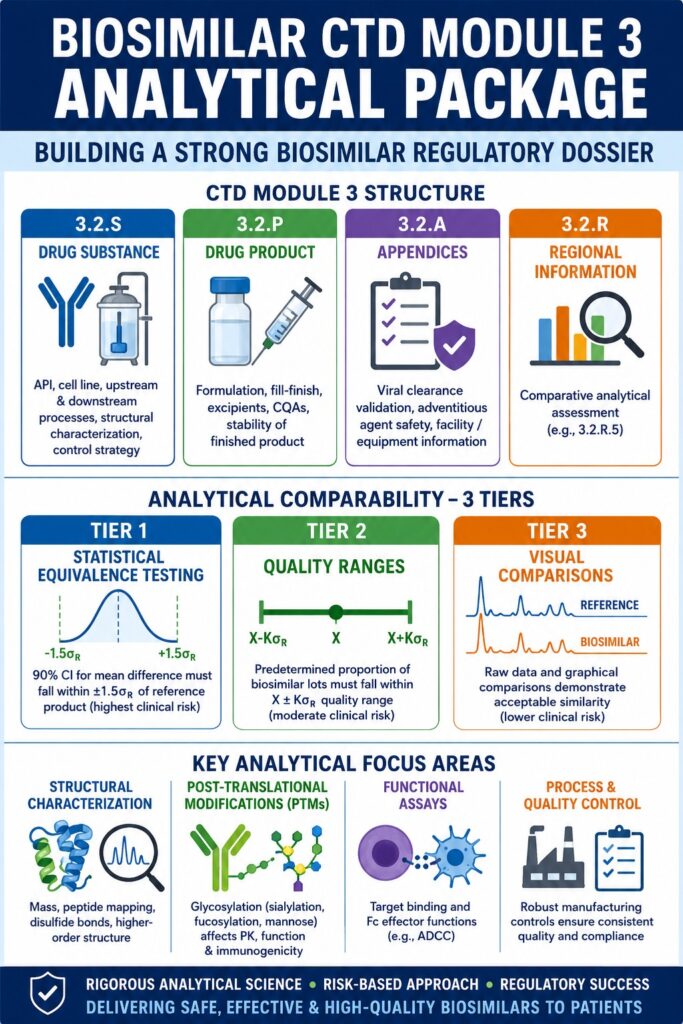
The biosimilar CTD Module 3 is organized into four principal sections: Drug Substance (3.2.S), Drug Product (3.2.P), Appendices (3.2.A), and Regional Information (3.2.R). These sections collectively present the complete quality package, with the critical analytical similarity assessment traditionally documented within the regional information section.
Each section must be organized with exceptional detail and data integrity to facilitate efficient regulatory review while creating a clear connection between independent quality information and comparative analytical evidence.
| CTD Section | Title | Biosimilar-Specific Focus |
|---|---|---|
| 3.2.S | Drug Substance | Contains comprehensive information regarding the active pharmaceutical ingredient (API), including cell line development, upstream and downstream manufacturing processes, structural characterization, and overall control strategy. |
| 3.2.P | Drug Product | Describes formulation development, fill-finish manufacturing operations, excipient controls, identification of critical quality attributes (CQAs), and stability data for the finished dosage form. |
| 3.2.A | Appendices | Includes supporting documentation such as viral clearance validation studies, adventitious agent safety assessments, and facility- or equipment-specific information. |
| 3.2.R | Regional Information | Functions as the repository for the comparative analytical assessment. For example, Health Canada expects the biosimilarity assessment to be presented as a dedicated collection of information under Section 3.2.R.5. |
Regulatory agencies consistently evaluate these sections in great detail. Consequently, robust process validation, comprehensive documentation, and strong data integrity practices are essential for demonstrating that the biosimilar manufacturing process remains consistently controlled throughout its lifecycle.
Learn how advanced analytical validation begins early during Cell Line Development for Biosimilars.
How is Analytical Comparability Structured in Module 3?
Analytical comparability within Module 3 is organized using a tiered, risk-based statistical framework that evaluates Critical Quality Attributes (CQAs) according to their potential impact on clinical performance. Depending on the significance of each attribute, similarity is established through statistical equivalence testing, predefined quality ranges, or qualitative visual comparisons.
Regulatory authorities, including the FDA, recommend classifying analytical similarity into three statistical tiers.
Tier 1 (Statistical Equivalence Testing)
Tier 1 is reserved for the highest-risk CQAs that directly influence the primary mechanism of action, including attributes such as target binding or apoptosis inhibition. Analytical similarity is established when the two-sided 90% confidence interval for the mean difference between the biosimilar and the reference product remains completely within an equivalence margin of ±1.5σR, where σR represents the standard deviation of the reference product. When substantially more biosimilar lots are evaluated than reference lots, for example, when the biosimilar lot count exceeds the reference lot count by more than 50%, statistical methods such as the Satterthwaite approximation are applied to ensure accurate confidence interval calculations.
Tier 2 (Quality Ranges)
Tier 2 is applied to quality attributes considered to present a moderate level of clinical risk. In this approach, an acceptable quality range is established using the reference product mean together with a predefined multiplier of the reference product standard deviation (X ± KσR). Analytical similarity is demonstrated when a predetermined proportion of biosimilar lots falls within this established quality range.
Tier 3 (Visual Comparisons)
Tier 3 is used for lower-risk quality attributes or qualitative datasets, including specific impurity profiles, where formal statistical analysis is not considered appropriate. Instead, raw analytical data together with graphical comparisons are reviewed to verify that the biosimilar demonstrates an acceptable level of alignment with the reference product.
Establishing the Quality Target Product Profile (QTPP) and CQAs
Developing the Quality Target Product Profile (QTPP) begins with extensive physicochemical and functional characterization of the reference product. This comprehensive assessment establishes the statistical acceptance criteria and identifies the Critical Quality Attributes (CQAs) that the biosimilar must successfully match throughout development.
A high-quality Comparative Quality Exercise (CQE) relies on advanced orthogonal analytical technologies capable of thoroughly evaluating multiple molecular characteristics. Because biological products naturally exhibit inherent micro-heterogeneity, analytical characterization focuses on understanding and comparing the distribution of molecular variants in accordance with ICH Q6B and ICH Q5E guidelines.
See how our quality testing workflows align directly with ICH Q6B Guidelines for Biological Characterisation.
Key characterization parameters include the following:
Physicochemical and Structural Characterization
Comprehensive structural characterization involves accurate molecular mass determination, peptide mapping, and disulfide bond analysis using ultra-high-resolution mass spectrometry platforms such as LC-MS/MS. These technologies are capable of identifying mistranslation events while also supporting higher-order structure (HOS) evaluation through analytical techniques including circular dichroism and Fourier-transform infrared spectroscopy.
Explore how we leverage Native Mass Spectrometry for Biosimilars to resolve native intact mass structures and structural variations.
Post-Translational Modifications (PTMs)
Detailed, site-specific characterization of glycosylation profiles, including sialylation, fucosylation, and high-mannose content, is an essential component of biosimilar assessment. These post-translational modifications significantly influence pharmacokinetic behavior, receptor interactions, immunogenicity, and overall biological function.
Explore our specialized approaches for high-resolution Glycosylation Analysis of Biosimilars to map carbohydrate structures accurately.
Functional Assays
Functional characterization must quantitatively evaluate both target binding activity and Fc-associated effector functions. For example, the European Medicines Agency (EMA) specifically recommends assessing Antibody-Dependent Cellular Cytotoxicity (ADCC) using the classical two-cell assay format involving target cells together with effector cells, such as Natural Killer (NK) cells or Peripheral Blood Mononuclear Cells (PBMCs), rather than relying exclusively on reporter gene assay systems.
Review our expert approaches to Charge Variant Analysis in Biosimilars to fully characterize critical charge heterogeneities.
Successfully performing these sophisticated analytical evaluations requires highly specialized scientific infrastructure. ResolveMass Laboratories Inc. combines extensive expertise in advanced mass spectrometry, nuclear magnetic resonance (NMR), and chromatographic sciences to generate regulatory-ready analytical documentation that addresses these demanding CQA requirements efficiently and comprehensively.
Find out how we map molecular variants using a comprehensive Proteomics Approach for Biosimilars.
Navigating Regulatory Challenges and Common Deficiencies
The most frequently observed deficiencies in Module 3 biosimilar submissions arise from insufficient analytical method validation, inadequately documented manufacturing deviations, and incomplete analytical comparability data addressing process-related impurities.
Reviews of regulatory agency questions reveal recurring challenges across multiple jurisdictions. Detailed assessments of FDA and EMA biosimilar submissions show that Drug Substance Manufacture (3.2.S.2) accounts for approximately 21–35% of FDA questions and 13–50% of EMA questions. Likewise, Drug Product Manufacture (3.2.P.3) represents approximately 17–41% of FDA regulatory queries. In addition, deficiencies associated with Analytical Similarity (3.2.R) and Control of Drug Substance (3.2.S.4) frequently contribute to prolonged review timelines and may ultimately result in Complete Response Letters (CRLs).
Learn how to screen and quantify process-related contaminants using our Impurity Profiling of Biosimilars workflow.
To reduce the likelihood of these regulatory setbacks, sponsors should ensure that stability-indicating analytical methods are fully validated, reference standards are comprehensively qualified under Section 3.2.S.5, and any geographic bridging strategy, such as using an EU-approved reference product to support a US FDA submission, is backed by robust three-way analytical and pharmacokinetic comparability data.
Ensure your validation methods withstand stress testing protocols by mastering the Forced Degradation of Biosimilars.
Conclusion
A well-developed Biosimilar Regulatory Dossier Structure ultimately depends on the scientific quality, completeness, and precision of the CTD Module 3 Analytical Package. Through the use of orthogonal analytical platforms, rigorous risk-based statistical equivalence methodologies spanning Tiers 1 through 3, and proactive management of commonly observed regulatory deficiencies involving manufacturing controls and analytical similarity, developers can substantially reduce residual regulatory uncertainty. As the global biopharmaceutical industry continues to evolve, collaborating with specialized analytical experts possessing state-of-the-art scientific capabilities has become increasingly important for successfully navigating complex regulatory pathways, achieving timely licensure, and expanding patient access to high-quality biosimilar therapies.
For advanced analytical support and comprehensive GMP-compliant characterization services tailored to your biosimilar development program, visit https://resolvemass.ca/contact/.
Frequently Asked Questions (FAQs)
Analytical similarity data is typically presented within CTD Module 3 under the Regional Information (Section 3.2.R). This section contains the detailed comparative assessment demonstrating that the proposed biosimilar closely matches the reference biologic in terms of quality attributes. Certain regulatory agencies, including Health Canada, specifically expect this information to be organized under Section 3.2.R.5 as part of the overall biosimilarity evaluation.
For high-risk Tier 1 Critical Quality Attributes (CQAs), the FDA recommends a statistical equivalence approach using an acceptance margin of ±1.5σR. In this calculation, σR represents the standard deviation derived from the variability observed across reference product lots. This statistical framework helps determine whether the biosimilar demonstrates sufficient similarity for attributes that directly influence clinical performance.
A scientifically reliable comparability assessment generally involves testing multiple lots of both the biosimilar and the reference product. In most cases, evaluating 6 to 10 independent lots from each product provides enough data to capture natural manufacturing variability and establish meaningful statistical comparisons. The exact number may vary depending on product complexity and regulatory expectations.
In specific situations, Fc functionality testing may not be necessary for certain monoclonal antibodies. If the sponsor can scientifically demonstrate that the antibody interacts only with a soluble target and has no involvement with transmembrane variants or cell-associated mechanisms, assays such as ADCC or CDC may be omitted. Any such decision must be supported by strong scientific justification and accepted by regulatory authorities.
The European Medicines Agency (EMA) does not require every analytical test to be performed in a side-by-side format. However, assays that are known to exhibit significant between-run variability should be conducted simultaneously to minimize analytical bias. This approach helps ensure that observed differences reflect the products themselves rather than variability introduced by the testing process.
Although ICH Q5E was originally developed to address comparability following manufacturing changes for approved biological products, its scientific concepts are highly relevant to biosimilar development. The guideline provides a framework for assessing whether structural or manufacturing differences could affect product safety, quality, or efficacy. These principles continue to guide regulatory evaluations of biosimilarity worldwide.
Process-related impurities, including host cell proteins and host cell DNA, are expected to differ from those found in the reference biologic because biosimilars are produced using different manufacturing processes. Rather than matching the originator impurity profile, manufacturers must thoroughly characterize these impurities, establish effective control strategies, and demonstrate that impurity levels remain within acceptable safety limits defined by applicable ICH guidelines.
Most FDA Complete Response Letters (CRLs) for biosimilars are associated with deficiencies in Chemistry, Manufacturing, and Controls (CMC) documentation. Common issues include inadequate manufacturing process validation, incomplete analytical similarity evidence, insufficient immunogenicity assay validation, and observations made during pre-approval facility inspections. Addressing these areas early can significantly improve the likelihood of successful regulatory review.
Yes, developers may use a reference product licensed outside the United States during biosimilar development. However, the FDA requires a scientifically justified bridging strategy that establishes a clear relationship between the non-U.S. comparator and the U.S.-licensed reference product. This bridge typically includes comprehensive analytical comparisons along with pharmacokinetic data to confirm that both reference products are appropriate for biosimilarity evaluation.
For monoclonal antibodies with ADCC as a relevant mechanism of action, the EMA recommends using a traditional two-cell ADCC assay instead of relying exclusively on reporter gene assays. This classical format incorporates target cells together with effector cells, such as Natural Killer (NK) cells or Peripheral Blood Mononuclear Cells (PBMCs), providing a more representative assessment of Fc-mediated biological activity during biosimilarity evaluation.
Reference:
- U.S. Food and Drug Administration. (2024). Biosimilars info sheet: Level 2: Regulatory and scientific concepts [Fact sheet]. https://www.fda.gov/media/182186/download
- European Medicines Agency. (n.d.). Biosimilar medicines: Marketing authorisation. https://www.ema.europa.eu/en/human-regulatory-overview/marketing-authorisation/biosimilar-medicines-marketing-authorisation
- Health Canada. (2024). Quality Overall Summary – Biologic Products (QOS-B). Government of Canada. https://www.canada.ca/en/health-canada/services/drugs-health-products/biologics-radiopharmaceuticals-genetic-therapies/applications-submissions/guidance-documents/preparation-quality-information-drug-submissions-ctd-format-biotherapeutic-blood-products/quality-overall-summary-biologic-products.html
- Health Canada. (2026, May 19). Information requirements for new drug submissions. In Guidance on information and submission requirements for biosimilar biologic drugs. Government of Canada. https://www.canada.ca/en/health-canada/services/drugs-health-products/biologics-radiopharmaceuticals-genetic-therapies/applications-submissions/guidance-documents/information-submission-requirements-biosimilar-biologic-drugs/new-drug-submissions.html
- U.S. Food and Drug Administration. (2016). Clinical pharmacology data to support a demonstration of biosimilarity to a reference product: Guidance for industry. https://www.fda.gov/media/101924/download
- Chow, S.-C., Song, F., & Bai, H. (2016). Analytical similarity assessment in biosimilar studies. The AAPS Journal, 18(3), 670–677. https://doi.org/10.1208/s12248-016-9882-5
- European Medicines Agency. (n.d.). Questions and answers for biological medicinal products. https://www.ema.europa.eu/en/human-regulatory-overview/research-and-development/scientific-guidelines/biological-guidelines/questions-answers-biological-medicinal-products
Get In Touch With Us
About The Author


