


Introduction
A comprehensive Biosimilar Analytical Characterisation Service package delivers a rigorous, multi-tiered, head-to-head comparison of the structural, biophysical, and functional characteristics of a proposed biosimilar candidate and its innovator reference product to meet global regulatory expectations. This analytical framework generates the totality of evidence required to demonstrate a high degree of analytical similarity and support an abbreviated clinical development pathway in accordance with International Council for Harmonisation (ICH) Q6B and ICH Q5E guidelines.
Therapeutic recombinant proteins, particularly monoclonal antibodies (mAbs), Fc-fusion proteins, and complex cytokines, naturally exhibit molecular heterogeneity because of expression in living host cells, post-translational processing, and downstream purification processes. Even minor changes in cell culture conditions or isolation procedures can affect critical quality attributes (CQAs), including glycosylation patterns, charge states, and aggregation levels. Therefore, demonstrating analytical similarity represents a fundamental component of biosimilar development.
Learn more about building a robust testing strategy through our detailed guide on Biosimilar Comparability Studies.
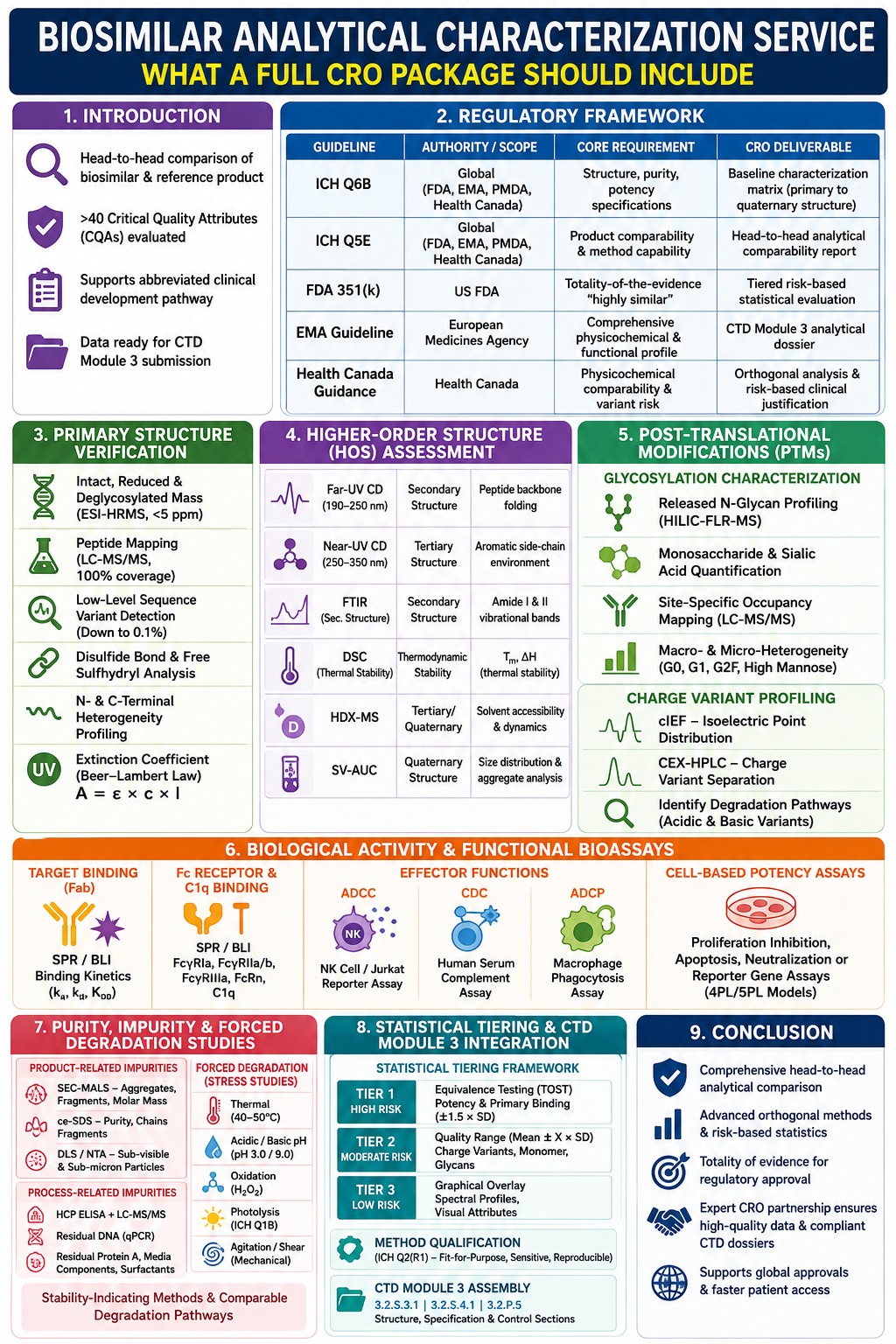
A regulatory-grade analytical package provided by a specialized contract research organization (CRO) reduces reliance on extensive clinical studies by evaluating more than 40 distinct CQAs across multiple reference product batches and biosimilar lots. The complete analytical service suite should include comprehensive primary sequence verification, higher-order structure (HOS) assessment, post-translational modification (PTM) profiling, biological potency testing, and forced degradation profiling. These analytical activities are organized to generate scientifically robust data suitable for Common Technical Document (CTD) Module 3 regulatory submissions.
Share via:
Article Summary:
- A complete Biosimilar Analytical Characterization Service provides a head-to-head comparison of the biosimilar and reference product across structural, physicochemical, and functional attributes.
- The package follows key regulatory frameworks including ICH Q6B, ICH Q5E, FDA 351(k), EMA guidelines, and Health Canada requirements, supporting a totality-of-evidence approach.
- Primary structure characterization verifies amino acid sequence, intact mass, peptide mapping, disulfide bonds, terminal variants, and low-level sequence changes using advanced LC-MS/MS and HRMS techniques.
- Higher-order structure (HOS) testing uses orthogonal methods such as CD, FTIR, DSC, HDX-MS, and SV-AUC to assess protein folding, conformation, thermal stability, and aggregation.
- PTM and heterogeneity profiling evaluates glycosylation, charge variants, oxidation, deamidation, and other modifications that may influence potency, stability, and immunogenicity.
- Functional and purity assessment includes target/Fc receptor binding, ADCC, CDC, ADCP, cell-based potency, SEC-MALS, ce-SDS, impurity testing, and forced degradation studies.
- Finally, risk-based statistical tiering and CTD Module 3 integration convert analytical results into regulatory-ready evidence, helping demonstrate biosimilarity and support efficient global approval.
Regulatory Frameworks Governing a Biosimilar Analytical Characterisation Service
Regulatory approval of a biosimilar depends on establishing analytical comparability with the reference product according to international standards, including ICH Q6B, ICH Q5E, FDA 351(k), and European Medicines Agency (EMA) guidelines. A regulatory-grade Biosimilar Analytical Characterisation Service establishes defined specification criteria and head-to-head lot comparison strategies to determine whether observed structural variations could affect clinical safety, quality, or efficacy.
The International Council for Harmonisation (ICH) Q6B guideline establishes expectations for test procedures and acceptance criteria applicable to biotechnological and biological products, including structural, physicochemical, and biological characterization. In parallel, ICH Q5E provides the scientific basis for comparability assessments and supports the evaluation of analytical methods capable of identifying subtle differences between manufacturing lots and between biosimilar candidates and originator reference products.
Regulatory authorities require a stepwise biosimilarity assessment that begins with extensive analytical characterization. Establishing a high degree of analytical similarity provides the scientific basis for potentially reducing the extent of non-clinical and clinical studies required during subsequent stages of biosimilar development.
Discover how to streamline your regulatory journey with an End-to-End Biosimilar Analytical Package for a Regulatory Submission.
| Regulatory Guideline | Regulatory Authority / Scope | Core Analytical Requirement | Key Deliverable in CRO Package |
|---|---|---|---|
| ICH Q6B | Global (FDA, EMA, PMDA, Health Canada) | Physicochemical, structural, purity, and potency specifications for biologics. | Baseline characterization matrix covering primary to quaternary structure. |
| ICH Q5E | Global (FDA, EMA, PMDA, Health Canada) | Assessment of product comparability following process changes or biosimilar comparison. | Head-to-head analytical comparability report demonstrating matching CQA profiles. |
| FDA 351(k) Pathway | US Food and Drug Administration (FDA) | Totality-of-the-evidence approach to demonstrate “highly similar” status. | Tiered risk-based statistical evaluation (Tier 1 equivalence, Tier 2 quality ranges). |
| EMA Biosimilar Guideline | European Medicines Agency (EMA) | Comprehensive state-of-the-art physicochemical and functional comparative profile. | CTD Module 3 analytical dossier with qualified orthogonal data. |
| Health Canada Guidance | Health Canada | Physicochemical comparability and risk assessment of low-level variants. | Orthogonal analysis of heterogeneity and variant risk-based clinical justification. |
Primary Structure and Amino Acid Sequence Verification
Primary structure verification establishes whether the amino acid sequence of the biosimilar candidate matches that of the reference product through high-resolution intact mass analysis, peptide mapping, and terminal sequencing. Advanced mass spectrometry platforms provide extensive sequence coverage and can identify low-level misincorporations or point mutations at sub-percentage abundance levels.
Primary sequence verification requires a multi-layered analytical workflow:
- Intact, Reduced, and Deglycosylated Mass Analysis: Electrospray Ionization Ultra-High Resolution Mass Spectrometry (ESI-HRMS), using Orbitrap instrumentation, determines the molecular weight of the uncleaved protein, isolated heavy and light chains, and deglycosylated backbones with a mass accuracy threshold of < 5 ppm.
- Enzymatic Peptide Mapping via LC-MS/MS: Multi-enzyme proteolytic digestion using enzymes such as Trypsin, Lys-C, Glu-C, and Chymotrypsin produces overlapping peptide fragments. Automated MS/MS fragmentation profiling enables 100% sequence coverage across both heavy and light chains.
- Low-Level Sequence Variant Analysis: Advanced LC-MS algorithms identify misincorporation events and point mutations that may arise during high-density cell culture expression, with the ability to detect sequence variants present at abundance levels as low as 0.1%.
- Disulfide Bond Assignment and Free Sulfhydryl Quantification: Non-reduced LC-MS/MS mapping, combined with chemical derivatization assays, verifies native disulfide pairings and quantifies free cysteine residues and mismatched disulfide linkages.
- N- and C-Terminal Heterogeneity Profiling: Edman degradation and C-terminal peptide mapping characterize terminal modifications, including N-terminal pyroglutamate formation, C-terminal lysine clipping, and truncation variants.
- Extinction Coefficient Determination: Molar extinction coefficient (ε) determination through Amino Acid Analysis (AAA), coupled with UV-Vis spectrophotometry, ensures that protein concentration measurements comply with the Beer-Lambert Law:
A = ε · c · l
where A is absorbance, c is protein concentration, and l is optical path length.
Enhance your sequence analysis framework by exploring specialized Proteomics Approach for Biosimilars.
Higher-Order Structure (HOS) and Conformational Integrity in Biosimilar Analytical Characterisation Service Packages
Higher-order structure (HOS) analysis assesses secondary, tertiary, and quaternary folding characteristics to determine whether the three-dimensional conformation of the biosimilar is comparable to that of the reference biologic. A comprehensive CRO Biosimilar Analytical Characterisation Service uses complementary biophysical techniques, including circular dichroism, differential scanning calorimetry, and analytical ultracentrifugation, to investigate protein folding and thermodynamic stability.
Because biological activity is closely associated with appropriate protein folding, contract laboratories apply spectroscopic, calorimetric, and hydrodynamic techniques to evaluate conformational equivalence between biosimilar and reference product lots.
ead more about evaluating structural integrity using Native Mass Spectrometry for Biosimilars.
| HOS Method | Structural Domain Evaluated | Measured Attribute | Sensitivity / Analytical Utility |
|---|---|---|---|
| Far-UV CD | Secondary Structure (190–250 nm) | Peptide backbone folding (α-helix, β-sheet). | Detects global secondary structural perturbations. |
| Near-UV CD | Tertiary Structure (250–350 nm) | Aromatic side-chain environments (Trp, Tyr, Phe). | Probes local tertiary folding environments. |
| FTIR Spectroscopy | Secondary Structure (Amide I & II) | Amide I (1600–1700 cm⁻¹) vibrational bands. | High-throughput confirmation of secondary structure. |
| Differential Scanning Calorimetry (DSC) | Thermodynamic Stability | Thermal transition/melting temperatures (Tₘ, ΔH). | Identifies domain-specific thermal stability differences. |
| Hydrogen-Deuterium Exchange Mass Spectrometry (HDX-MS) | Tertiary/Quaternary Conformational State | Solvent accessibility and hydrogen bonding exchange. | Provides regional structural resolution at the peptide level. |
| Sedimentation Velocity Analytical Ultracentrifugation (SV-AUC) | Quaternary Structure / Size Distribution | Sedimentation coefficient (s), monomer/aggregate ratios. | Orthogonal matrix-free aggregate quantification. |
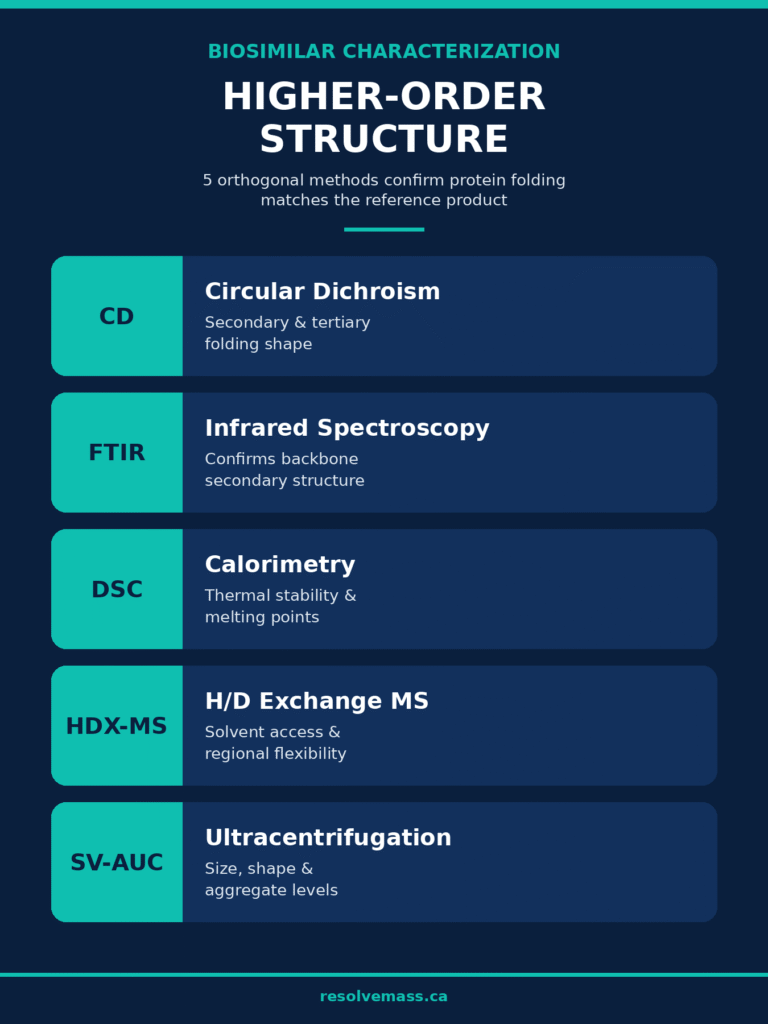
Far-UV Circular Dichroism (CD) spectroscopy (190–250 nm) and Fourier-Transform Infrared Spectroscopy (FTIR) evaluate secondary structural elements and verify comparable proportions of β-sheets, α-helices, and random coils. Near-UV CD (250–350 nm) assesses the tertiary environment surrounding aromatic residues, while intrinsic Tryptophan fluorescence detects localized changes in tertiary conformation. Differential Scanning Calorimetry (DSC) evaluates thermal unfolding profiles and establishes precise melting transitions (Tₘ1, Tₘ2, Tₘ3) and unfolding enthalpy (ΔH), supporting the assessment of domain-specific thermodynamic stability. In addition, Hydrogen-Deuterium Exchange Mass Spectrometry (HDX-MS) measures backbone amide hydrogen exchange rates and identifies subtle differences in solvent accessibility, regional flexibility, and tertiary dynamics. Finally, Sedimentation Velocity Analytical Ultracentrifugation (SV-AUC) provides matrix-free hydrodynamic separation for quantifying native quaternary assemblies and low-abundance soluble aggregates without introducing sample dilution artifacts.
Post-Translational Modifications: Glycosylation and Charge Variant Profiling
Post-translational modification (PTM) profiling characterizes enzymatic and non-enzymatic modifications, including N- and O-linked glycosylation, deamidation, and oxidation, that can arise during cell culture expression and purification. These molecular variants can influence therapeutic half-life, biological potency, and immunogenicity risk, making detailed micro-heterogeneity characterization an essential component of biosimilar analytical assessment.
Glycosylation Characterization
For glycosylated therapeutics such as IgG1 monoclonal antibodies, core glycan structures attached to Asn297 contribute significantly to effector functions such as Antibody-Dependent Cellular Cytotoxicity (ADCC). A comprehensive glycosylation analysis module includes:
- Released N-Glycan Profiling: PNGase F enzymatic release followed by fluorophore labeling, such as 2-AB or Procainamide, and high-performance Hydrophilic Interaction Liquid Chromatography with Fluorescence and Mass Spectrometry detection (HILIC-FLR-MS).
- Monosaccharide and Sialic Acid Quantification: Reversed-phase HPLC analysis of core monosaccharides and quantification of N-acetylneuraminic acid (Neu5Ac) relative to the immunogenic N-glycolylneuraminic acid (Neu5Gc).
- Site-Specific Occupancy Mapping: LC-MS/MS peptide mapping with Electron Transfer Dissociation (ETD) to determine glycosylation occupancy across identified consensus sites.
- Macro- and Micro-Heterogeneity Assessment: Accurate quantification of afucosylated glycans (G0, G1), galactosylated forms (G0F, G1F, G2F), high-mannose structures (Man5, Man6), and bisecting species.
Charge Variant Profiling
Charge variants modify the surface charge distribution of proteins as a result of chemical or enzymatic degradation pathways. Analytical characterization of these variants relies on:
- Capillary Isoelectric Focusing (cIEF): High-resolution separation based on measurable isoelectric point (pI) values, enabling precise quantification of acidic, main, and basic species.
- Cation Exchange Chromatography (CEX-HPLC): Salt- or pH-gradient CEX chromatography separates charge variants and can be coupled with fraction collection and offline mass spectrometry characterization.
- Identification of Degradation Pathways: Structural characterization of acidic variants resulting from deamidation, sialylation, glycation, or fragmentation, and basic variants associated with C-terminal lysine retention, succinimide formation, or oxidation.
Learn more about resolving micro-heterogeneity through advanced Charge Variant Analysis in Biosimilars.
Biological Activity, Potency, and Functional Bioassay Suites
Functional characterization measures the biological mechanism of action (MoA) of a therapeutic protein through target-binding kinetic assays and cell-based bioassays. A contract laboratory package evaluates Fab-mediated target binding and Fc-mediated effector functions to establish comparable physiological activity between the biosimilar and reference product.
The functional bioassay suite evaluates multiple biological dimensions:
- Fab-Mediated Target Antigen Binding: Surface Plasmon Resonance (SPR) or Biolayer Interferometry (BLI) biosensors determine target-binding kinetics and derive association constants (kₐ), dissociation constants (k𝑑), and affinity constants (Kᴅ).
- Fc Receptor Binding Kinetics: SPR/BLI determines binding affinities to Fc gamma receptors (FcγRIa, FcγRIIa/b, FcγRIIIa V/F 158 variants), neonatal Fc receptor (FcRn, which governs serum half-life), and Complement 1q (C1q).
- Effector Function Assays:
- Antibody-Dependent Cellular Cytotoxicity (ADCC): Cell-based assays using isolated NK cells or engineered Jurkat reporter cell lines to quantify cytotoxic activity.
- Complement-Dependent Cytotoxicity (CDC): Human serum complement assays that measure target cell lysis.
- Antibody-Dependent Cellular Phagocytosis (ADCP): Primary macrophage-mediated phagocytosis assays.
- Cell-Based Potency Assays: Mechanistic bioassays, including cell proliferation inhibition, apoptosis induction, neutralization assays, or reporter gene expression, are validated to demonstrate parallelism and calculate relative potency against reference standards using 4-parameter or 5-parameter logistic models.
Explore key factors driving successful characterization with Critical Quality Attributes (CQAs) in Biosimilars.
Purity, Impurity Profiling, and Forced Degradation Studies in a Biosimilar Analytical Characterisation Service
Impurity profiling and forced degradation studies establish product purity while assessing candidate behavior under physical and chemical stress conditions. By characterizing product-related aggregates, fragments, and process-related contaminants, contract testing laboratories demonstrate whether the candidate exhibits degradation pathways comparable to those of the reference biologic within a Biosimilar Analytical Characterisation Service.
Check out our case study on Forced Degradation of Biosimilars to understand accelerated stress workflows.
| Stressor | Target Degradation Pathway | Primary Analytical Method | Regulatory Purpose |
|---|---|---|---|
| Thermal (40°C–50°C) | Aggregation, conformational unfolding. | SEC-MALS, SV-AUC, DSC. | Evaluates thermal stability equivalence. |
| Acidic / Basic pH | Peptide cleavage, Asp-isomerization, Asn-deamidation. | cIEF, CEX-HPLC, LC-MS/MS. | Assesses primary stability-indicating capability. |
| Oxidation (H₂O₂) | Met/Trp oxidation, loss of FcRn binding. | RP-HPLC, Peptide Mapping, SPR. | Compares degradation susceptibility. |
| Photolysis (ICH Q1B) | Photo-oxidation, dityrosine cross-linking. | SEC-MALS, Fluorimetry, ce-SDS. | Validates protective packaging requirements. |
| Agitation / Shear | Sub-visible particle generation, aggregation. | NTA, Micro-Flow Imaging (MFI). | Confirms physical formulation robustness. |
Product-Related Impurities and Purity Profiling
Size Exclusion Chromatography with Multi-Angle Light Scattering (SEC-MALS) quantifies soluble high-molecular-weight aggregates, dimers, and low-molecular-weight fragments while providing absolute molar mass distributions. Capillary Electrophoresis-Sodium Dodecyl Sulfate (ce-SDS) under reduced and non-reduced conditions determines molecular purity, intact protein percentage, free heavy/light chains, and non-covalent fragments. Orthogonal techniques, including Dynamic Light Scattering (DLS) and Nanoparticle Tracking Analysis (NTA), are used to evaluate sub-visible (1–10 μm) and sub-micron particles.
Read more about controlling aggregation variants via Aggregation Analysis in Biosimilars.
Process-Related Impurities
Because manufacturing processes may differ between biosimilar candidates and originator products, process-related impurities are assessed to confirm clearance efficiency and safety rather than to establish direct identity matching. Testing includes ultra-sensitive total Host Cell Protein (HCP) ELISA combined with LC-MS/MS identification, quantitative PCR (qPCR) for residual host cell DNA, and assays for residual Protein A, cell culture media components, and surfactants.
Forced Degradation (Stress Stability) Profiling
Forced degradation studies expose biosimilar and reference product lots to controlled stress conditions to confirm that analytical methods are stability-indicating and to evaluate whether degradation pathways are comparable. Stress protocols include thermal incubation (40°C–50°C), exposure to pH extremes (pH 3.0 and pH 9.0), oxidative stress (H₂O₂), photolytic exposure in accordance with ICH Q1B guidelines (> 1.2 million lux hours), and mechanical agitation.
Discover comprehensive testing strategies with Impurity Profiling of Biosimilars.
Statistical Tiering, CTD Module 3 Integration, and CRO Partnership Strategy
A complete contract research organization package integrates complex analytical datasets into risk-based statistical tiering models formatted for Common Technical Document (CTD) Module 3 submissions. Partnering with a specialized analytical CRO can streamline dossier preparation and help mitigate regulatory risk across multiple global jurisdictions.
A regulatory-ready CRO integration framework is based on three primary pillars:
- Statistical Similarity Tiering Framework:
- Tier 1 (High Risk / Critical Potency Attributes): Statistical equivalence testing, such as Two One-Sided Tests (TOST), with defined equivalence bounds (e.g., ± 1.5 × SD of the reference product) applied to biological potency and primary binding attributes.
- Tier 2 (Moderate Risk / Quality Attributes): Quality Range assessments (Mean ± X × SD) applied to charge variants, monomer purity, and principal glycan structures.
- Tier 3 (Low Risk / Basic Attributes): Direct graphical overlays and visual comparisons for attributes such as raw spectral profiles or visual clarity.
- Method Qualification vs. Validation: ICH Q2(R1) principles are applied to qualify characterization assays as fit-for-purpose, reproducible, and sufficiently sensitive to resolve subtle batch-to-batch variations.
- CTD Module 3 Dossier Assembly: Analytical data are structured directly into Sections 3.2.S.3.1 (Elucidation of Structure and Characterisation), 3.2.S.4.1 (Specification), and 3.2.P.5 (Control of Drug Product) to facilitate efficient agency review.
Explore specialized support services through Biosimilar Characterization Services.
Conclusion
A complete Biosimilar Analytical Characterisation Service package provides the scientific foundation for biosimilar development and approval by delivering a robust, head-to-head assessment of structural, physicochemical, and functional comparability. By applying advanced orthogonal analytical platforms and risk-based statistical evaluation, biopharmaceutical sponsors can establish the totality of evidence necessary to support successful regulatory approval. Partnering with an experienced testing laboratory provides access to method qualification expertise, comprehensive product knowledge, and fully compliant CTD Module 3 dossiers.
To learn more about tailored analytical packages, explore complete characterization solutions, or connect directly with the team, visit the ResolveMass Contact Us Page.
Frequently Asked Questions (FAQs)
A CRO determines analytical similarity through comprehensive head-to-head testing of multiple biosimilar lots and reference product batches. Orthogonal analytical techniques are used to examine critical quality attributes (CQAs), including structure, purity, heterogeneity, and biological activity. The resulting datasets can then be evaluated using appropriate statistical approaches to identify meaningful differences and demonstrate a high degree of similarity.
Liquid chromatography-mass spectrometry (LC-MS) provides high sensitivity, selectivity, and mass accuracy for evaluating complex biological molecules. It supports applications such as intact mass analysis, amino acid sequence verification, peptide mapping, and post-translational modification characterization. High-resolution LC-MS/MS platforms can also help identify low-abundance molecular variants that may not be detected using conventional analytical techniques.
Method qualification determines whether a characterization method is suitable for its intended scientific purpose and can generate reliable, reproducible data. Unlike routine Quality Control (QC) release assays, many characterization methods are designed to investigate complex molecular attributes rather than routine product specifications. Qualification therefore focuses on factors such as reproducibility, analytical sensitivity, and fitness-for-purpose, while full validation is generally associated with methods used for defined regulatory or Quality Control applications.
Higher-order structures (HOS) are investigated using complementary analytical techniques that examine different levels of protein conformation. Far-UV CD and FTIR are used to assess secondary structure, while Near-UV CD and Intrinsic Fluorescence provide information about tertiary conformation. DSC evaluates thermal stability, whereas SV-AUC and HDX-MS provide additional information regarding molecular assemblies, conformational behavior, solvent accessibility, and structural dynamics.
Glycan structures can influence important properties of therapeutic monoclonal antibodies, including effector functions such as ADCC, serum half-life, stability, and potential immunogenicity. Comprehensive glycan profiling therefore helps identify differences in glycosylation between a biosimilar and its reference product. Analytical evaluation may include released N-glycan profiling, sialic acid characterization, fucosylation assessment, and site-specific glycosylation analysis.
Product-related impurities originate from the biological molecule itself and can include aggregates, fragments, oxidized species, and other molecular variants. These impurities are typically characterized through direct comparative analysis of the biosimilar and reference product. Process-related impurities, such as Host Cell Proteins (HCP), residual host cell DNA, Protein A, and cell culture components, are associated with manufacturing and purification and are primarily assessed according to appropriate safety and clearance requirements.
Forced degradation studies subject biosimilar and reference products to controlled stress conditions, including elevated temperature, pH changes, oxidation, light exposure, and mechanical agitation. The resulting degradation profiles help determine whether analytical methods can reliably detect relevant product changes and confirm their stability-indicating capability. Comparing the degradation behavior of both products can also provide valuable evidence regarding whether they exhibit comparable degradation pathways.
Functional characterization combines binding assays with biological activity studies to assess whether the biosimilar produces comparable biological effects to the reference product. Surface Plasmon Resonance (SPR) and Biolayer Interferometry (BLI) can determine binding kinetics and affinity for target antigens, Fc receptors, FcγRIIIa, FcRn, and C1q. Cell-based bioassays further evaluate biological activity and relative potency using validated models and appropriate statistical approaches, including 4-parameter logistic analysis where applicable.
Analytical characterization generates the structural, physicochemical, purity, and functional evidence needed to support the quality section of a biosimilar regulatory dossier. These data can be organized within CTD Module 3, including relevant Sections 3.2.S and 3.2.P, to provide regulators with a comprehensive assessment of product quality and comparability. A strong analytical package can reduce uncertainty during regulatory review and support scientifically justified decisions regarding the extent of additional non-clinical and clinical studies.
Reference:
- Chow, S.-C., Song, F., & Bai, H. (2016). Analytical similarity assessment in biosimilar studies. The AAPS Journal, 18(3), 670–677. https://doi.org/10.1208/s12248-016-9882-5
- European Medicines Agency. (2005). ICH Q5E: Comparability of biotechnological/biological products—Scientific guideline. https://www.ema.europa.eu/en/ich-q5e-biotechnological-biological-products-subject-changes-their-manufacturing-process-comparability-biotechnological-biological-products-scientific-guideline (ema.europa.eu)
- U.S. Food and Drug Administration. (2015). Quality considerations in demonstrating biosimilarity of a therapeutic protein product to a reference product: Guidance for industry. Center for Drug Evaluation and Research & Center for Biologics Evaluation and Research. FDA guidance document (fda.gov)
- European Medicines Agency. (1999). ICH Q6B: Specifications: Test procedures and acceptance criteria for biotechnological/biological products—Scientific guideline. EMA guideline
- International Council for Harmonisation of Technical Requirements for Pharmaceuticals for Human Use. (n.d.). Quality guidelines. ICH Quality Guidelines
- Health Canada. (2026). Guidance on information and submission requirements for biosimilar biologic drugs: Quality information requirements. Government of Canada. Health Canada guidance
Get In Touch With Us
About The Author


