

Introduction:
Understanding which analytical tests for biosimilar regulatory submission are mandatory is one of the most complex challenges in biologic drug development. Unlike small-molecule generic approval — which relies on simple bioequivalence — biosimilar programs require a multidimensional analytical comparability package demonstrating structural, physicochemical, and functional similarity to the reference biological product. Regulatory agencies including the FDA under the 351(k) pathway (BPCIA, 2010), the EMA under CHMP/437/04, and Health Canada under its 2019 Biosimilar Guidance Document all expect a data package grounded in ICH Q5E (comparability of biotechnological products) and ICH Q6B (specifications and test procedures) that spans from primary sequence through biological potency.
The complexity is justified. Unlike a chemical drug, a biologic’s identity cannot be fully defined by its amino acid sequence alone. Glycosylation patterns, aggregation state, charge heterogeneity, and higher-order conformation all influence clinical behaviour, pharmacokinetics, safety, and immunogenicity. Getting the analytical strategy right at the outset is therefore critical — both for regulatory success and for patient safety.
Need help defining your regulatory strategy? Explore our expert biosimilar characterization services to ensure your data package meets global standards.
Share via:
Article Summary:
- Biosimilar regulatory submissions require comprehensive analytical characterization across four core domains: structural, physicochemical, biological activity, and immunogenicity.
- The FDA (351(k) pathway), EMA (CHMP/437/04), and Health Canada all mandate head-to-head comparability data against the reference product using multiple lots (typically 3–6).
- ICH Q6B and ICH Q5E are the foundational guidelines governing specifications and comparability study design across all jurisdictions.
- Higher-order structure tools — including circular dichroism, differential scanning calorimetry, and HDX-MS — are increasingly expected for rigorous biosimilar characterization.
- Glycan profiling is mandatory for glycoprotein biosimilars; N-glycan distribution, fucosylation, and sialylation must be shown comparable to the reference product.
- Aggregation and charge variant analysis are critical inputs for immunogenicity risk assessment.
- The “totality of evidence” principle means the integrated analytical package determines how much clinical data is required.
The Regulatory Framework: FDA, EMA, and Health Canada
All three major regulatory jurisdictions share a risk-based, tiered approach: the more thoroughly the analytical data demonstrates similarity, the less clinical evidence regulators require. The FDA’s “totality of evidence” standard, the EMA’s “fingerprinting” approach, and Health Canada’s comparability strategy all converge on this principle.
- FDA (351(k) pathway): Guided by “Scientific Considerations in Demonstrating Biosimilarity of a Therapeutic Protein Product” (2015, with product-class updates), the FDA requires comprehensive CMC data in CTD Module 3, organized around drug substance (3.2.S) and drug product (3.2.P) characterization.
- EMA (CHMP/437/04 and EMEA/CHMP/BWP/49348/2005): The overarching guideline and its companion quality guideline specify structural, physicochemical, and biological comparability, with tiered clinical requirements dependent on the analytical outcome.
- Health Canada (2019 Biosimilar Guidance Document): Mirrors the FDA/EMA framework, emphasizing risk-based study design and mandatory immunogenicity assessment in patient populations.
Across all jurisdictions, ICH Q2(R1) mandates full validation of every analytical method used in the submission — specificity, accuracy, precision, linearity, range, and robustness must all be documented before data generated by those methods can be used as regulatory evidence.
Understand what matters most: Learn how to identify and manage Critical Quality Attributes (CQAs) in biosimilars to streamline your regulatory path.
Structural Characterization: Foundation of Analytical Tests for Biosimilar Regulatory Submission
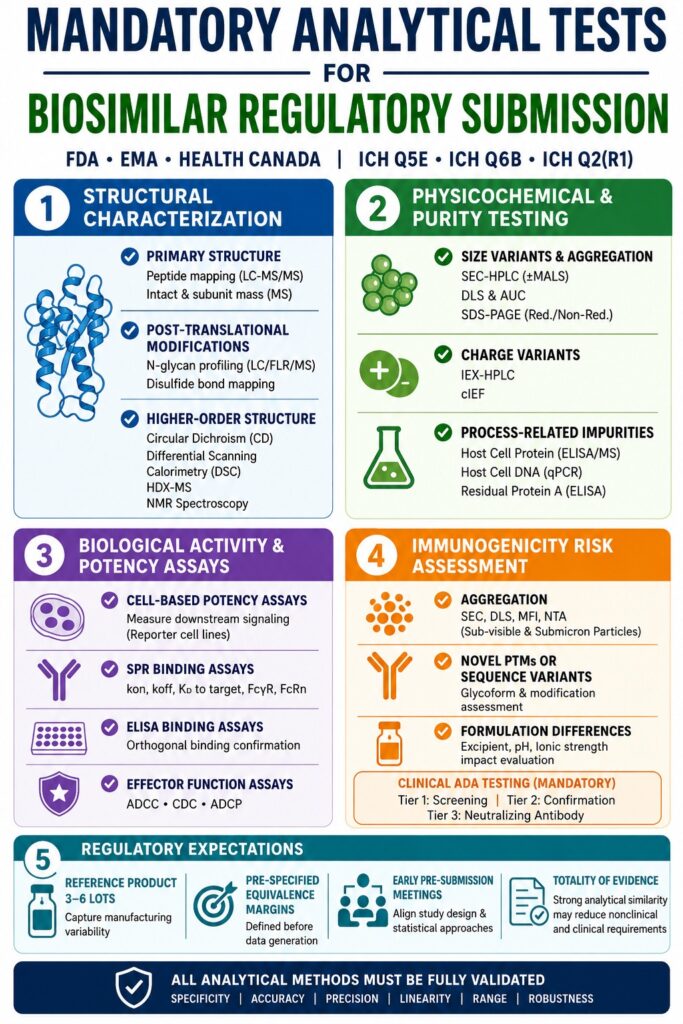
Structural characterization is the cornerstone of the analytical package and must provide a complete, molecule-level description of both the biosimilar and the reference product. Regulators expect orthogonal methods that interrogate primary sequence, post-translational modifications (PTMs), and higher-order conformation — no single technique is sufficient alone.
Primary Structure
- Peptide mapping with LC-MS/MS — identifies peptide fragments after enzymatic digestion, confirms the complete amino acid sequence, and localizes oxidation, deamidation, and disulfide bond positions. Discover how our precise peptide mapping supports your biosimilar submission.
- Intact and subunit mass measurement (ESI-MS, MALDI-TOF) — confirms molecular weight and detects N/C-terminal variants and heterogeneity.
Click here to see our capabilities in intact mass analysis for biosimilars.
Post-Translational Modifications (PTMs)
- N-glycan profiling (HILIC-UPLC-FLR or LC-MS) — mandatory for all glycoprotein biosimilars; must characterize glycoform distribution, fucosylation, sialylation, high-mannose content, and galactosylation patterns.
- Disulfide bond mapping — detects incorrect pairing that could alter tertiary structure or trigger immunogenicity responses in patients.
Delve deeper into modifications: Explore our guide on analyzing Post-Translational Modifications (PTMs) in biosimilars.
Higher-Order Structure (HOS)
- Circular dichroism (CD) — quantifies secondary structure content (α-helix, β-sheet); far-UV CD is standard, near-UV CD probes tertiary structure environment.
- Differential scanning calorimetry (DSC) — measures thermal unfolding transitions, providing a thermodynamic fingerprint of conformational stability for direct comparison.
- Hydrogen-deuterium exchange mass spectrometry (HDX-MS) — increasingly expected by regulators for domain-level conformational fingerprinting at peptide resolution, making it one of the most informative HOS tools available.
- NMR spectroscopy — applied as an orthogonal HOS technique, particularly for smaller biosimilar proteins where sufficient resolution is achievable.
Physicochemical and Purity Testing: Detecting Critical Quality Differences
Regulators require a complete purity and heterogeneity profile because size variants, charge isoforms, and process-related impurities are directly linked to clinical risk — particularly immunogenicity and altered pharmacokinetics. These tests must all be performed head-to-head against the reference product.
Size Variants and Aggregation
- SEC-HPLC (optionally with MALS detection) — quantifies monomer purity and resolves high-molecular-weight aggregates and low-molecular-weight fragments.
- DLS (Dynamic Light Scattering) and AUC (Analytical Ultracentrifugation) — orthogonal aggregate characterization across a wider hydrodynamic size range than SEC alone.
- SDS-PAGE (reducing and non-reducing) — visual gross purity assessment and detection of disulfide-linked aggregate species.
Read about our advanced approaches to aggregation analysis in biosimilars.
Charge Variants
- IEX-HPLC (Ion Exchange Chromatography) and cIEF (Capillary Isoelectric Focusing) — resolve charge isoforms arising from deamidation, sialylation differences, or C-terminal lysine clipping. Charge variant profiles are highly sensitive indicators of process-related variability.
Explore our mass spectrometry approaches for charge variant analysis in biosimilars.
Process-Related Impurities
- Host cell protein (HCP) assay (ELISA, orthogonally supported by mass spectrometry) — residual expression-system proteins must be quantified and shown comparable to reference product levels.
- Host cell DNA (qPCR) and residual Protein A (ELISA for mAbs) — both mandatory safety-critical impurity tests.
Learn how comprehensive impurity profiling ensures your product’s safety.
Biological Activity and Potency Assays: Proving Functional Similarity
Potency assays confirm that the biosimilar’s structural similarity translates into equivalent biological activity — a requirement no purely structural test can satisfy. Regulators require mechanism-of-action-relevant functional data, not binding data alone.
- Cell-based potency assays — the regulatory gold standard; use engineered reporter cell lines measuring downstream signalling responses (e.g., proliferation inhibition, cytokine release, apoptosis induction). Equivalence margins must be pre-specified and statistically justified.
- SPR (Surface Plasmon Resonance) — quantifies binding kinetics (kon, koff, KD) to target receptor, Fcγ receptors, and FcRn. Especially critical for mAbs and Fc-fusion proteins, where FcRn binding governs serum half-life.
- ELISA-based binding assays — orthogonal or complementary binding confirmation across multiple reference lots; supports statistical equivalence demonstration.
- Effector function assays (IgG mAbs) — ADCC (antibody-dependent cell-mediated cytotoxicity), CDC (complement-dependent cytotoxicity), and ADCP assays are required when mechanistically relevant. ADCC is particularly sensitive to core fucosylation level and must be carefully assessed when glycan profiles differ.
Immunogenicity: Mandatory Risk Assessment in the Analytical Package
Although full immunogenicity assessment occurs in clinical trials, the analytical submission package must include a pre-clinical immunogenicity risk evaluation based on structural characterization data. Regulators examine three key analytical risk drivers:
- Aggregation — sub-visible and submicron protein particles are potent immunogenicity triggers. SEC, DLS, MFI (Micro-Flow Imaging), and NTA (Nanoparticle Tracking Analysis) data collectively inform the risk narrative.
- Novel PTMs or sequence variants — glycoforms or modification patterns not present in the reference product require a specific immunogenicity justification in the submission.
- Formulation differences — excipient composition, pH, and ionic strength can affect protein conformational stability and aggregation propensity, and must be evaluated.
The clinical immunogenicity program then applies a tiered ADA (anti-drug antibody) testing strategy: Tier 1 screening, Tier 2 confirmation of specificity, and Tier 3 neutralizing antibody assessment. All three regulatory jurisdictions require ADA testing in patients using the therapeutic route of administration.
The “Totality of Evidence”: How Your Analytical Package Shapes the Whole Submission
The totality of evidence principle means that the analytical package does not stand alone — it determines the scope of every downstream nonclinical and clinical study. A highly similar analytical profile with no unexplained differences may support a waiver of certain animal studies and reduction in clinical data requirements. Conversely, differences in glycosylation or aggregation that are not fully characterized demand additional scientific justification and potentially expanded clinical investigation.
Reference product lot selection is therefore critical: FDA and EMA both expect 3–6 lots of the reference biologic, sourced to capture manufacturing variability across different production batches and time periods. Statistical equivalence margins for all analytical comparisons must be pre-specified before data generation — post-hoc selection of acceptance criteria is not acceptable to regulators. Early pre-submission meetings (Type B or C meetings for the FDA) are strongly recommended to align on study design and statistical approaches.
Ensure success with robust data: Read about best practices for conducting effective biosimilar comparability studies.
Conclusion
The analytical tests for biosimilar regulatory submission span structural, physicochemical, biological activity, and immunogenicity domains — all governed by ICH Q5E, ICH Q6B, and region-specific guidance from the FDA, EMA, and Health Canada. A well-constructed analytical package is not just a regulatory formality: it is the scientific foundation that determines how much clinical development is required and whether patients can ultimately access a safe, effective, and more affordable biologic therapy. Investing in high-resolution, orthogonal analytical characterization at the outset significantly reduces risk across the entire development programme.
If your team is building, auditing, or gap-assessing a biosimilar analytical strategy, ResolveMass Laboratories offers expert analytical testing services tailored to regulatory submission requirements.
Ready to build a regulatory-grade biosimilar analytical package? Contact ResolveMass Laboratories — our scientists can help design and execute your comparability testing program.
Need expert guidance on your biosimilar submission strategy? Contact us today.
Frequently Asked Questions:
Regulatory agencies require a biosimilar to demonstrate high similarity to an approved reference biologic, with no clinically meaningful differences in safety, purity, and potency. The submission typically includes extensive analytical characterization, manufacturing and quality data, nonclinical studies when needed, pharmacokinetic/pharmacodynamic (PK/PD) evidence, immunogenicity assessment, and selected clinical data. Regulators apply a “totality of evidence” approach, meaning all data are evaluated collectively rather than relying on a single study. Requirements may vary slightly among regions, but the scientific principles remain largely consistent.
Analytical similarity assessment is the foundation of biosimilar development and involves a detailed comparison of the proposed biosimilar with its reference product. Advanced physicochemical and functional assays are used to evaluate critical quality attributes such as structure, purity, biological activity, and stability. The goal is to demonstrate that any observed differences are not clinically meaningful. Regulatory agencies consider analytical studies highly sensitive and often more capable of detecting product differences than clinical efficacy trials.
In the United States, biosimilars are approved through the abbreviated 351(k) pathway established under the Public Health Service Act. This pathway allows sponsors to rely partly on existing knowledge about the reference product while demonstrating biosimilarity through comparative studies. The development program generally includes analytical comparisons, PK/PD evaluations, immunogenicity assessments, and additional studies when scientifically justified. Similar abbreviated pathways exist in Canada, Europe, and other jurisdictions to avoid unnecessary duplication of studies while maintaining rigorous standards.
Regulatory affairs for biosimilars encompasses the planning, preparation, submission, and maintenance of regulatory applications throughout the product lifecycle. Professionals in this field ensure compliance with regional guidelines, coordinate interactions with health authorities, manage scientific documentation, and support post-marketing commitments. They also monitor evolving regulations and guidance documents to facilitate efficient product development and approval. Effective regulatory affairs strategies are essential for demonstrating biosimilarity and maintaining market authorization.
Recent FDA guidance reflects the agency’s growing confidence in modern analytical and scientific methods for biosimilar evaluation. The FDA has updated recommendations for comparative analytical assessments and has proposed reducing certain clinical study requirements when robust analytical evidence is available. For interchangeability, the agency has also indicated that routine switching studies may no longer be necessary in many cases. These changes are intended to streamline development while preserving standards for safety, efficacy, and quality.
No, the FDA does not universally require cell-based potency assays for every biosimilar submission. The choice of potency assay depends on the mechanism of action and critical quality attributes of the specific biologic. Sponsors must employ scientifically justified methods that adequately evaluate biological activity and functional similarity. In some cases, cell-based assays are highly relevant and expected, whereas in others, alternative functional assays may provide sufficient evidence.
A biosimilar is a biologic product that is highly similar to a reference product and has no clinically meaningful differences in safety, purity, or potency. An interchangeable biologic meets the same biosimilarity standard but also satisfies additional legal requirements that allow pharmacy-level substitution, subject to applicable laws. Importantly, an interchangeable product is not considered safer or more effective than a non-interchangeable biosimilar. The distinction primarily relates to substitution practices rather than clinical performance.
Higher-order structure (HOS) characterization evaluates the three-dimensional conformation of a protein and is critical for demonstrating biosimilarity. Common analytical techniques include circular dichroism spectroscopy, Fourier-transform infrared spectroscopy, nuclear magnetic resonance spectroscopy, differential scanning calorimetry, hydrogen-deuterium exchange mass spectrometry, and fluorescence spectroscopy. These methods help assess secondary, tertiary, and quaternary structural features that may influence biological function. Multiple complementary techniques are generally used to provide a comprehensive assessment of structural similarity.
Health Canada and the FDA follow similar scientific principles for biosimilar evaluation, emphasizing comprehensive analytical comparisons and the totality-of-evidence approach. However, neither agency mandates an identical list of analytical tests for every product. The specific testing strategy is determined by the characteristics of the biologic, its mechanism of action, and identified critical quality attributes. Consequently, while the overall expectations are highly aligned, the exact analytical package may differ depending on the product and regulatory discussions.
Reference:
- Cordeiro, M. A., Vitorino, C., Sinogas, C., & Sousa, J. J. (2024). A regulatory perspective on biosimilar medicines. Pharmaceutics, 16(3), 321. https://doi.org/10.3390/pharmaceutics16030321
- Chauhan, M. K., & Malik, S. (2016). Regulatory guidelines for approval of biosimilars in India, Europe, Brazil and China: A comprehensive overview. International Journal of Pharmacy and Pharmaceutical Sciences, 8(10), 7–11. https://doi.org/10.22159/ijpps.2016v8i10.11753
- U.S. Food and Drug Administration. (2018). Biosimilar product regulatory review and approval. U.S. Department of Health and Human Services. https://www.fda.gov/files/drugs/published/Biosimilar-Product-Regulatory-Review-and-Approval.pdf
- Kasana, H., Chander, H., & Mathur, A. (2024). A systematic review of regulatory requirements of biosimilar products: WHO, India, European Union and USFDA. Research Journal of Pharmacy and Technology, 17(5), 2413–2420. https://doi.org/10.52711/0974-360X.2024.00378
- Bansal, A., Shukla, V. K., & Chauhan, S. (2019). A comprehensive study of regulatory compliance for biosimilars in US, EU and India. International Journal of Drug Regulatory Affairs, 7(2), 17–34. https://doi.org/10.22270/ijdra.v7i2.313
- European Medicines Agency. (n.d.). Biosimilar medicines: Marketing authorisation. https://www.ema.europa.eu/en/human-regulatory-overview/marketing-authorisation/biosimilar-medicines-marketing-authorisation
Get In Touch With Us
About The Author


