

Introduction
Biomarker bioanalytical services are the cornerstone of modern pharmaceutical development, enabling data-driven decisions from early discovery through regulatory approval and post-market surveillance. At ResolveMass Laboratories Inc., these services are delivered as part of a broader, integrated bioanalytical services ecosystem supporting small molecules, biologics, biosimilars, and advanced therapies.
Successful drug development requires more than biomarker measurement—it demands strategic integration of PK/PD bioanalysis, robust bioanalytical method development, and regulatory-ready execution across all phases of development.
As the industry shifts toward precision medicine, biomarker bioanalytical services play a critical role in target identification, patient stratification, dose optimization, and efficacy evaluation—particularly in complex programs involving large molecule bioanalysis and cell and gene therapy bioanalysis.
Summary
This comprehensive guide explains how biomarker bioanalytical services integrate with end-to-end bioanalytical services in drug development:
- Discovery Phase: Biomarkers identify therapeutic targets and validate proof-of-concept with sensitive LC-MS/MS bioanalysis of xenobiotics
- Preclinical Development: PK/PD biomarker analysis establishes dose-response relationships and predicts clinical outcomes
- Phase I Clinical Trials: Safety biomarkers monitor drug toxicity while PK biomarkers optimize first-in-human dosing
- Phase II Clinical Trials: Efficacy biomarkers demonstrate mechanism of action and guide patient stratification strategies
- Phase III & Late-Phase Trials: Validated biomarker assays support regulatory submissions and companion diagnostics development. Fully validated biomarker assays supporting IND & NDA submissions
- Method Development: Fit-for-purpose and fully validated approaches aligned with bioanalytical method validation
- Regulatory Compliance: GLP and GCP-compliant biomarker services meet FDA, EMA, and ICH guidelines. GLP/GCP-compliant regulated bioanalytical services
1: Understanding Biomarker Bioanalytical Services in Drug Development
Biomarker bioanalytical services encompass the development, validation, and execution of analytical methods to measure biological markers that indicate normal processes, disease states, or pharmacological responses to therapeutic interventions. These services integrate multiple analytical platforms including liquid chromatography-mass spectrometry (LC-MS/MS), immunoassays (ELISA, MSD), flow cytometry, and genomic/proteomic technologies.
These services operate within a broader bioanalytical CRO framework that ensures scientific rigor, scalability, and compliance. Advanced analytical platforms—including small vs large molecule bioanalysis workflows—enable precise biomarker quantification across diverse biological matrices.
Types of Biomarkers in Drug Development
Different biomarker categories serve distinct purposes throughout drug development:
| Biomarker Type | Primary Purpose | Development Phase | Examples |
|---|---|---|---|
| Target Engagement | Confirms drug reaches intended target | Discovery to Phase II | Receptor occupancy, enzyme inhibition |
| Pharmacodynamic (PD) | Measures biological response to drug | Preclinical to Phase III | Pathway activation markers, cytokines |
| Safety/Toxicity | Monitors adverse effects | All phases | Liver enzymes, cardiac troponins, renal markers |
| Efficacy/Clinical Outcome | Predicts or measures therapeutic benefit | Phase II to Phase III | Disease-specific proteins, metabolites |
| Predictive/Diagnostic | Identifies responsive patient populations | Phase II to Phase III | Genetic variants, protein expression levels |
| Prognostic | Indicates disease progression independent of treatment | All phases | Tumor markers, inflammatory markers |
Why Specialized Bioanalytical Services Matter
Successful biomarker strategies require:
- Analytical Sensitivity: Detecting low-abundance biomarkers in complex biological matrices
- Deep understanding of bioanalytical matrix effects
- Specificity: Distinguishing target analytes from structurally similar compounds
- Throughput: Processing large sample volumes within clinical trial timelines
- Proven bioanalytical quantification strategies
- Regulatory Compliance: Meeting evolving FDA and EMA bioanalytical guidelines
- Scientific Expertise: Interpreting biomarker data within biological and clinical contexts
2: Biomarker Bioanalytical Services in Drug Discovery
During discovery, biomarker bioanalytical services support mechanism-of-action studies and early target validation. These programs often leverage high-throughput bioanalysis to rapidly screen biomarker responses across multiple candidates.
Exploratory biomarker assays are developed using flexible approaches informed by prior challenges in bioanalytical method development, ensuring early scientific insight without unnecessary regulatory burden.
In the discovery phase, biomarker bioanalytical services identify and validate therapeutic targets while establishing proof-of-concept for novel mechanisms of action. Early biomarker work focuses on understanding disease biology and confirming that drug candidates engage intended targets with appropriate pharmacological activity.
Target Identification and Validation
Discovery-stage biomarker services support:
- Pathway Analysis: Measuring multiple pathway components to understand disease mechanisms
- Target Expression Profiling: Quantifying target proteins or genes across disease states
- Phenotypic Screening: Identifying biomarker changes associated with desired cellular responses
- Mechanism-of-Action Studies: Demonstrating how compounds modulate biological pathways
Proof-of-Concept Biomarker Development
Establishing proof-of-concept requires:
- Fit-for-Purpose Method Development: Creating reliable assays without full validation requirements
- In Vitro Biomarker Assessment: Testing biomarker responses in cell-based systems
- Exploratory In Vivo Studies: Measuring biomarkers in animal models to predict human relevance
- Biomarker-Exposure Relationships: Correlating drug concentrations with pharmacodynamic effects
At this stage, biomarker bioanalytical services prioritize scientific insight over regulatory compliance, using flexible approaches that accelerate learning while conserving resources.
3: Preclinical Development: Biomarker Bioanalytical Services for IND Enablement
Preclinical biomarker bioanalytical services establish the scientific rationale for first-in-human studies by demonstrating target engagement, optimal dose ranges, and acceptable safety profiles in animal models. This phase bridges discovery research and clinical development, requiring more rigorous analytical standards.
Preclinical biomarker bioanalysis integrates seamlessly with toxicokinetic bioanalysis and PK studies to support IND submissions.
GLP-compliant biomarker programs are executed within certified bioanalytical laboratory services environments, ensuring data integrity and regulatory readiness.
PK/PD Biomarker Integration
Successful IND applications require integrated PK/PD analysis:
- Pharmacokinetic Assessment: Measuring drug exposure across multiple species
- Pharmacodynamic Biomarkers: Demonstrating dose-dependent biological responses
- PK/PD Modeling: Predicting human efficacious doses from animal data
- Time-Course Analysis: Understanding onset, duration, and reversibility of pharmacological effects
Safety Biomarker Programs
Comprehensive safety assessment includes:
| Organ System | Key Safety Biomarkers | Analytical Methods |
|---|---|---|
| Hepatic | ALT, AST, bilirubin, bile acids | Clinical chemistry, LC-MS/MS |
| Renal | Creatinine, BUN, KIM-1, NGAL | Immunoassays, LC-MS/MS |
| Cardiac | Troponins, NT-proBNP, CK-MB | High-sensitivity immunoassays |
| Inflammatory | Cytokines (IL-6, TNF-α, CRP) | Multiplex immunoassays |
GLP-Compliant Biomarker Analysis
Regulatory-acceptable preclinical studies require:
- GLP Method Validation: Meeting regulatory expectations for accuracy, precision, and reproducibility
- Quality Systems: Implementing SOPs, training documentation, and audit trails
- Sample Chain of Custody: Ensuring sample integrity from collection through analysis
- Data Integrity: Electronic record systems compliant with 21 CFR Part 11
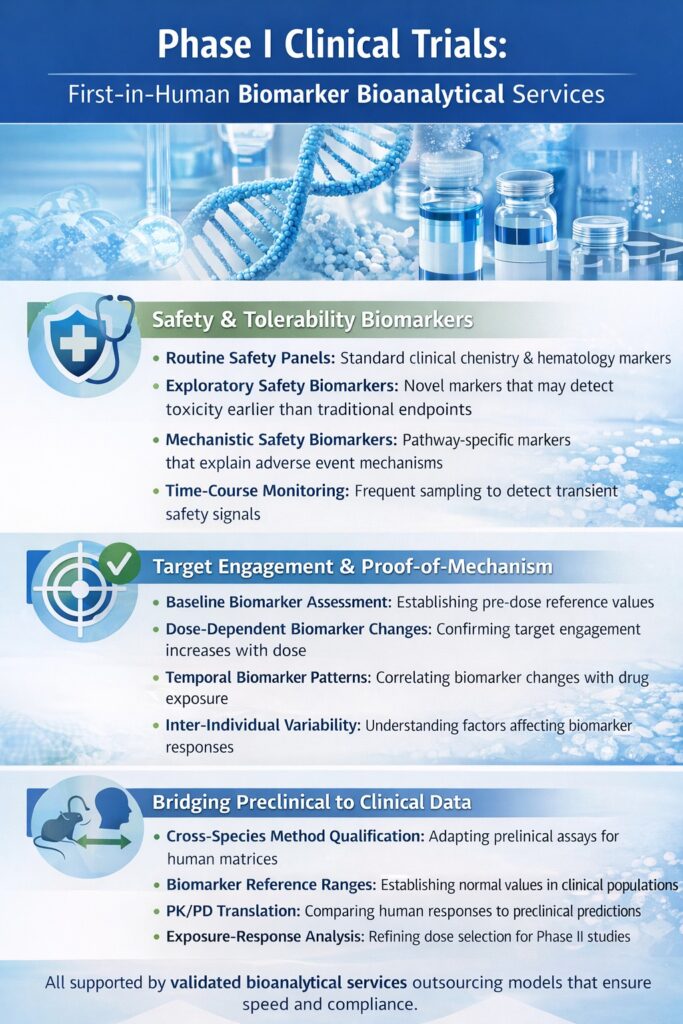
4: Phase I Clinical Trials: First-in-Human Biomarker Bioanalytical Services
Phase I biomarker bioanalytical services focus on safety monitoring and establishing pharmacokinetic-pharmacodynamic relationships in healthy volunteers or patients. These first-in-human studies determine optimal dose ranges and dosing schedules for subsequent efficacy trials.
Phase I biomarker programs rely on clinical bioanalytical services to monitor safety, tolerability, and pharmacodynamic effects in real time.
Safety and Tolerability Biomarkers
Phase I biomarker programs typically include:
- Routine Safety Panels: Standard clinical chemistry and hematology markers
- Exploratory Safety Biomarkers: Novel markers that may detect toxicity earlier than traditional endpoints
- Mechanistic Safety Biomarkers: Pathway-specific markers that explain adverse event mechanisms
- Time-Course Monitoring: Frequent sampling to detect transient safety signals
Target Engagement and Proof-of-Mechanism
Demonstrating pharmacological activity requires:
- Baseline Biomarker Assessment: Establishing pre-dose reference values
- Dose-Dependent Biomarker Changes: Confirming target engagement increases with dose
- Temporal Biomarker Patterns: Correlating biomarker changes with drug exposure
- Inter-Individual Variability: Understanding factors affecting biomarker responses
Bridging Preclinical to Clinical Data
Biomarker bioanalytical services enable translational comparisons:
- Cross-Species Method Qualification: Adapting preclinical assays for human matrices
- Biomarker Reference Ranges: Establishing normal values in clinical populations
- PK/PD Translation: Comparing human responses to preclinical predictions
- Exposure-Response Analysis: Refining dose selection for Phase II studies
All supported by validated bioanalytical services outsourcing models that ensure speed and compliance.
5: Phase II Clinical Trials: Efficacy-Focused Biomarker Bioanalytical Services
In Phase II trials, biomarker bioanalytical services shift toward demonstrating therapeutic efficacy and supporting patient stratification strategies. This proof-of-concept phase determines whether compounds have sufficient activity to warrant late-phase development investment.
In Phase II trials, biomarker bioanalytical services directly influence go/no-go decisions. Advanced statistical and analytical approaches are integrated with bioanalytical services small & large molecule quantification to support dose optimization and patient enrichment.
For biotech sponsors, cost-effective execution is enabled through affordable bioanalytical services for biotech startups without compromising data quality.
Efficacy Biomarker Development
Phase II biomarker strategies include:
- Primary Pharmacodynamic Markers: Measuring direct downstream effects of target modulation
- Disease Activity Markers: Quantifying changes in disease-specific pathways
- Composite Biomarker Scores: Combining multiple markers for enhanced predictive value
- Biomarker-Clinical Endpoint Correlations: Linking biomarker changes to clinical outcomes
Patient Stratification and Enrichment
Precision medicine approaches require:
| Strategy | Biomarker Application | Impact on Trial Design |
|---|---|---|
| Predictive Enrichment | Select patients most likely to respond | Reduced sample size, increased success probability |
| Prognostic Enrichment | Identify patients with specific disease trajectories | Improved endpoint sensitivity, shorter trials |
| Pharmacodynamic Enrichment | Choose patients showing target engagement | Enhanced proof-of-mechanism, clearer dose-response |
Adaptive Trial Designs with Biomarkers
Modern Phase II trials leverage biomarker bioanalytical services for:
- Interim Biomarker Analysis: Supporting go/no-go decisions based on early efficacy signals
- Dose Optimization: Using biomarker data to refine dose selection for Phase III
- Population Refinement: Adapting inclusion criteria based on emerging biomarker relationships
- Futility Analysis: Identifying lack of biomarker response to terminate ineffective arms
Method Validation Requirements
Phase II biomarker assays require:
- Fit-for-Purpose Validation: Appropriate rigor for exploratory vs. primary endpoints
- Assay Performance Qualification: Demonstrating reliability in clinical sample matrices
- Stability Studies: Confirming biomarker integrity during collection, storage, and shipping
- Quality Control Programs: Implementing sample-level QCs for ongoing validation
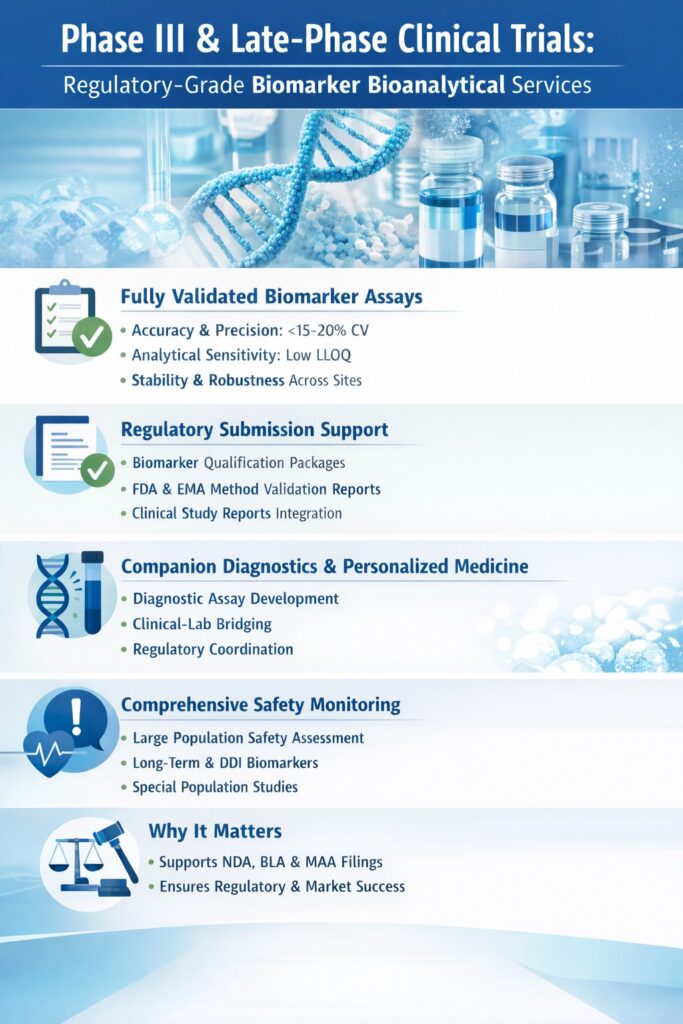
6: Phase III and Late-Phase Clinical Trials: Regulatory-Grade Biomarker Bioanalytical Services
Phase III biomarker bioanalytical services require fully validated methods that meet regulatory standards for supporting efficacy claims and safety monitoring in large, confirmatory trials. These pivotal studies generate data for marketing authorization applications and may include biomarkers as co-primary endpoints or companion diagnostics.
Fully Validated Biomarker Assays
Late-phase biomarker methods must meet stringent criteria:
- Accuracy and Precision: Within-run and between-run variability <15-20% CV
- Analytical Sensitivity: Lower limit of quantification (LLOQ) sufficient for clinical decisions
- Selectivity: Demonstrated absence of matrix interference from endogenous compounds
- Stability: Long-term, freeze-thaw, and bench-top stability established
- Robustness: Consistent performance across laboratories and operators
Regulatory Submissions and Biomarkers
Biomarker bioanalytical services support regulatory filings through:
- Biomarker Qualification Packages: Documentation supporting biomarker use for regulatory decisions
- Method Validation Reports: Comprehensive validation data per FDA/EMA guidelines
- Study Reports: Integration of biomarker data with clinical efficacy and safety outcomes
- Companion Diagnostic Development: Coordinating biomarker assays with diagnostic device approvals
Companion Diagnostics and Personalized Medicine
When biomarkers identify patient populations:
- Diagnostic Assay Development: Creating clinically viable tests for patient selection
- Clinical-Laboratory Bridging: Ensuring consistency between trial biomarkers and diagnostic assays
- Regulatory Coordination: Aligning drug approval with companion diagnostic clearance/approval
- Post-Market Surveillance: Continuing biomarker monitoring for long-term safety and efficacy
Late-Phase Safety Biomarkers
Late-phase trials demand fully validated biomarker assays executed within globally compliant bioanalytical services in North America.
Comprehensive safety monitoring includes:
- Large Population Safety Assessment: Detecting rare adverse events through biomarker monitoring
- Long-Term Safety Biomarkers: Evaluating cumulative exposure effects
- Drug-Drug Interaction Biomarkers: Assessing pharmacological interactions
- Special Population Studies: Biomarker behavior in pediatric, geriatric, or renally/hepatically impaired patients
7: Method Development and Validation Strategies Across Development Phases
Successful biomarker bioanalytical services require phase-appropriate method validation strategies that balance analytical rigor with development timelines. Understanding when to apply exploratory, fit-for-purpose, or fully validated approaches optimizes resource allocation and accelerates development.
Robust biomarker programs depend on scientifically sound bioanalytical method validation strategies that evolve with development stage.
From exploratory assays to full regulatory validation, ResolveMass applies phase-appropriate rigor supported by deep experience in bioanalytical services overview programs.
Fit-for-Purpose Validation Framework
The FDA’s “fit-for-purpose” concept recognizes different validation requirements:
| Development Stage | Validation Level | Key Characteristics |
|---|---|---|
| Discovery/Early Preclinical | Exploratory | Basic accuracy and precision, rapid turnaround |
| IND-Enabling Preclinical | GLP-Compliant | Formal validation, regulatory acceptance |
| Phase I/II | Fit-for-Purpose | Appropriate rigor for endpoint criticality |
| Phase III/Registration | Fully Validated | Complete validation per regulatory guidelines |
Critical Bioanalytical Considerations
Effective biomarker bioanalytical services address:
- Matrix Effects: Biological sample complexity affects measurement accuracy
- Sample Collection Protocols: Pre-analytical variables significantly impact biomarker stability
- Reference Standards: Availability and quality of calibrators and controls
- Multiplexing Opportunities: Measuring multiple biomarkers simultaneously for efficiency
- Cross-Validation: Confirming consistency across analytical platforms
Technology Platforms for Biomarker Analysis
Modern bioanalytical laboratories employ diverse technologies:
- LC-MS/MS: Gold standard for small molecule and peptide biomarkers, offering superior sensitivity and specificity
- Immunoassays (ELISA, MSD, Luminex): High-throughput protein quantification with established regulatory acceptance
- Flow Cytometry: Cell-based biomarkers including immune cell populations and activation markers
- Genomic/Transcriptomic Methods: Gene expression biomarkers using qPCR, RNA-seq, or microarrays
- Emerging Technologies: Digital PCR, single-cell analysis, and mass cytometry for specialized applications
8: Regulatory Compliance and Quality Standards for Biomarker Bioanalytical Services
Regulatory-compliant biomarker bioanalytical services adhere to Good Laboratory Practice (GLP), Good Clinical Practice (GCP), and bioanalytical method validation guidelines from FDA, EMA, and ICH. Maintaining compliance ensures biomarker data supports regulatory submissions and withstands agency scrutiny.
All biomarker bioanalytical services are delivered under established quality systems aligned with GLP, GCP, and FDA/EMA expectations. This regulatory focus underpins successful IND, NDA, and BLA submissions and long-term sponsor confidence
Regulatory Guidelines for Biomarkers
Key guidance documents include:
- FDA Bioanalytical Method Validation Guidance (2018): Comprehensive requirements for bioanalytical method validation
- EMA Guideline on Bioanalytical Method Validation (2011): European standards for bioanalytical methods
- ICH M10 Guideline: Harmonized bioanalytical method validation principles
- FDA Biomarker Qualification Program: Framework for qualifying novel biomarkers for regulatory use
- 21 CFR Part 58 (GLP): Requirements for preclinical laboratory studies
Quality Management Systems
Robust biomarker bioanalytical services implement:
- Standard Operating Procedures: Documented processes for all laboratory activities
- Personnel Training and Qualification: Ensuring technical competency and GLP/GCP knowledge
- Equipment Qualification: IQ/OQ/PQ protocols for critical analytical instruments
- Deviation Management: Systems for identifying, investigating, and resolving deviations
- CAPA Programs: Corrective and preventive action processes for continuous improvement
Data Integrity and Electronic Systems
Modern laboratories ensure data integrity through:
- 21 CFR Part 11 Compliance: Electronic signatures and records meeting regulatory requirements
- Audit Trails: Complete documentation of data creation, modification, and deletion
- Data Security: Protection against unauthorized access or manipulation
- Archiving Systems: Long-term storage ensuring data retrievability for regulatory inspections
9: Selecting the Right Partner for Biomarker Bioanalytical Services
Choosing an experienced bioanalytical partner with proven expertise in biomarker assay development and regulatory compliance is critical for drug development success. The right partnership provides not just analytical services, but strategic guidance throughout the development lifecycle.
Choosing the right partner means selecting a team with proven experience across bioanalytical services outsourcing for pharma, complex modalities, and regulatory milestones.
ResolveMass provides scalable, transparent, and scientifically driven biomarker bioanalytical services supported by advanced infrastructure, expert scientists, and a strong regulatory track record.
Essential Capabilities to Evaluate
When selecting a bioanalytical partner, consider:
- Technology Platform Breadth: Access to LC-MS/MS, immunoassays, flow cytometry, and emerging technologies
- Regulatory Track Record: Demonstrated success supporting IND, NDA, and BLA submissions
- Scientific Expertise: Ph.D.-level scientists with deep biomarker knowledge
- Quality Systems: GLP/GCP compliance and successful regulatory inspections
- Flexibility and Responsiveness: Ability to adapt to changing project needs and timelines
Strategic Partnership Benefits
Beyond analytical execution, experienced partners provide:
- Biomarker Strategy Consultation: Helping design biomarker programs aligned with regulatory expectations
- Method Development Optimization: Leveraging previous experience to accelerate assay development
- Regulatory Intelligence: Staying current with evolving bioanalytical guidelines
- Technology Transfer: Seamless transitions between development phases or to clinical laboratories
- Integrated Services: Coordinating biomarker analysis with PK, immunogenicity, and other bioanalytical needs
Phase-Specific Partnership Considerations
Different development phases require different partnership approaches:
| Phase | Key Partnership Needs | Questions to Ask |
|---|---|---|
| Discovery | Scientific creativity, rapid turnaround | Can they adapt quickly to changing hypotheses? |
| Preclinical | GLP compliance, IND experience | What is their regulatory inspection history? |
| Phase I/II | Clinical sample handling, flexible validation | How do they handle protocol amendments? |
| Phase III | Large-scale capacity, global reach | Can they support multi-site international trials? |
Conclusion
Biomarker bioanalytical services represent the scientific backbone of modern drug development, enabling evidence-based decisions from target identification through regulatory approval and beyond. As pharmaceutical development increasingly embraces precision medicine and biomarker-driven strategies, the demand for sophisticated, compliant, and scientifically rigorous bioanalytical support continues to grow.
At ResolveMass Laboratories Inc., we deliver comprehensive biomarker bioanalytical services that combine cutting-edge analytical technology with deep scientific expertise and regulatory knowledge. Our team understands that successful drug development requires more than accurate measurements—it demands strategic partnerships built on scientific excellence, quality commitment, and shared development goals.
Whether you’re initiating discovery-stage target validation, preparing for IND submission, executing pivotal clinical trials, or developing companion diagnostics, our biomarker expertise supports your development objectives at every phase. From exploratory method development to fully validated GLP/GCP-compliant analysis, we provide the analytical foundation for confident development decisions and regulatory success.
Frequently Asked Questions:
There is no single “most important” biomarker; the most important biomarker is the one that directly supports the specific drug development or clinical objective.
In pharmaceutical development, target engagement and pharmacodynamic biomarkers are often the most critical because they confirm that a drug interacts with its intended target and produces a biological effect.
Biomarker services are specialized bioanalytical services that involve the development, validation, and measurement of biological markers to support drug discovery, clinical trials, and regulatory submissions.
These services include biomarker assay development, quantitative analysis in biological matrices, data interpretation, and regulatory-compliant reporting across preclinical and clinical phases.
The main purpose of a biomarker is to objectively measure biological processes, disease progression, or responses to a therapeutic intervention.
In drug development, biomarkers are used to guide dose selection, assess safety and efficacy, monitor treatment response, and support regulatory decision-making.
Biomarker testing should be performed for patients, clinical trial participants, or study subjects when biological information is needed to guide diagnosis, treatment selection, or drug development decisions.
In pharmaceutical research, biomarker testing is essential for sponsors developing small molecules, biologics, biosimilars, or advanced therapies that require evidence of target engagement or therapeutic response.
In pharma, a biomarker is a measurable biological indicator used to evaluate drug exposure, pharmacological response, safety, or clinical efficacy.
Pharmaceutical biomarkers are critical tools in drug discovery and clinical development, supporting mechanism-of-action studies, patient stratification, regulatory submissions, and precision medicine strategies.
Reference
- Jean W. Lee , Daniel Figeys ,Julian Vasilescu.Biomarker Assay Translation from Discovery to Clinical Studies in Cancer Drug Development: Quantification of Emerging Protein Biomarkers.https://www.sciencedirect.com/science/chapter/bookseries/abs/pii/S0065230X06960102
- Jochen Kuhlmann and Georg Wensing.The Applications of Biomarkers in Early Clinical Drug Development to Improve Decision-Making Processes.https://www.benthamdirect.com/content/journals/ccp/10.2174/157488406776872578
- Laura M Yee,Tracy G Lively &Lisa M McShane.Biomarkers in Early-Phase Trials: Fundamental Issues.https://www.tandfonline.com/doi/abs/10.4155/bio-2018-0006
- The Applications of Biomarkers in Early Clinical Drug Development to Improve Decision-Making Processes.https://link.springer.com/chapter/10.1007/978-3-540-49529-1_3
About the Author


