

Introduction:
Why is bioanalysis important in pharmaceutical development? Bioanalysis serves as the cornerstone of drug development by providing quantitative measurements of drugs, metabolites, and biomarkers in biological matrices such as blood, plasma, urine, and tissues. Without accurate bioanalytical data, regulatory agencies cannot assess whether a drug candidate is safe and effective for human use.
The pharmaceutical industry relies on bioanalysis to answer critical questions throughout the drug development lifecycle: How much drug reaches systemic circulation? How long does it remain in the body? What metabolites are formed? Are there any safety concerns related to drug accumulation? These questions directly impact regulatory approval decisions made by authorities like the U.S. Food and Drug Administration (FDA), European Medicines Agency (EMA), and Health Canada.
At ResolveMass Laboratories Inc., we understand that bioanalytical testing is not merely a regulatory checkbox—it’s the scientific foundation that transforms promising drug candidates into approved therapeutics that improve patient lives. Our commitment to precision, accuracy, and regulatory compliance ensures that every data point we generate supports confident decision-making throughout the drug approval process. Learn more about our bioanalytical services and laboratory capabilities.
Summary
Why is bioanalysis important? Bioanalysis is crucial for ensuring drug safety, efficacy, and regulatory compliance throughout pharmaceutical development. This comprehensive guide covers:
- The fundamental role of bioanalysis in measuring drug concentrations and metabolites in biological samples
- Critical applications in pharmacokinetic and pharmacodynamic studies for regulatory submissions
- How bioanalytical validation ensures data reliability for FDA, EMA, and Health Canada approvals
- The impact of bioanalysis on patient safety and therapeutic monitoring
- Key regulatory guidelines governing bioanalytical method validation
- Advanced technologies transforming modern bioanalytical testing
- Real-world applications across clinical trials, generic drug development, and biosimilar characterization
Do you know whether your biomarker strategy is optimized for target engagement, dose selection, or regulatory submission? Our team provides biomarker bioanalytical services that help sponsors design, validate, and execute biomarker assays aligned with global expectations.
1: What is Bioanalysis and Why is Bioanalysis Important for Drug Development?
Bioanalysis is the quantitative measurement of drugs and their metabolites in biological systems using validated analytical methods. It encompasses the entire process from sample collection and preparation to instrumental analysis and data interpretation.
Why is bioanalysis important at this foundational level? Because it provides the objective, measurable evidence that regulatory agencies require to evaluate drug performance. Without validated bioanalytical methods, there would be no reliable way to determine drug concentrations, assess exposure-response relationships, or monitor safety parameters. Learn about small-molecule vs large-molecule bioanalysis.
Core Components of Bioanalytical Testing
- Sample Matrix Selection: Blood, plasma, serum, urine, cerebrospinal fluid, or tissue
- Analytical Method Development: Creating sensitive and specific assays to detect target analytes
- Method Validation: Demonstrating that methods are accurate, precise, and reproducible
- Sample Analysis: Processing clinical trial samples under GLP conditions
- Data Quality Assurance: Ensuring all results meet regulatory acceptance criteria
2: The Role of Bioanalysis in Pharmacokinetic (PK) Studies
Pharmacokinetic studies examine how the body absorbs, distributes, metabolizes, and eliminates drugs. Why is bioanalysis important in PK studies? It provides the concentration-time data that defines a drug’s ADME (Absorption, Distribution, Metabolism, and Excretion) profile, which regulatory agencies scrutinize to determine appropriate dosing regimens and identify potential safety concerns.
Learn more about PK/PD bioanalysis: https://resolvemass.ca/pk-pd-bioanalysis/.
Key PK Parameters Derived from Bioanalytical Data
| PK Parameter | Description | Regulatory Significance |
|---|---|---|
| Cmax | Maximum drug concentration | Assesses potential toxicity and efficacy |
| Tmax | Time to reach Cmax | Determines onset of action |
| AUC | Area under concentration-time curve | Measures total drug exposure |
| t½ | Elimination half-life | Guides dosing frequency |
| Clearance | Rate of drug elimination | Identifies need for dose adjustments |
| Bioavailability | Fraction of drug reaching systemic circulation | Critical for oral formulations |
ResolveMass Laboratories employs state-of-the-art LC-MS/MS technology to generate PK data that meets the stringent requirements of regulatory submissions. Our bioanalytical scientists understand that even minor variations in method performance can significantly impact PK parameter calculations and subsequent regulatory decisions.
3: Why is Bioanalysis Important for Pharmacodynamic (PD) Assessments?
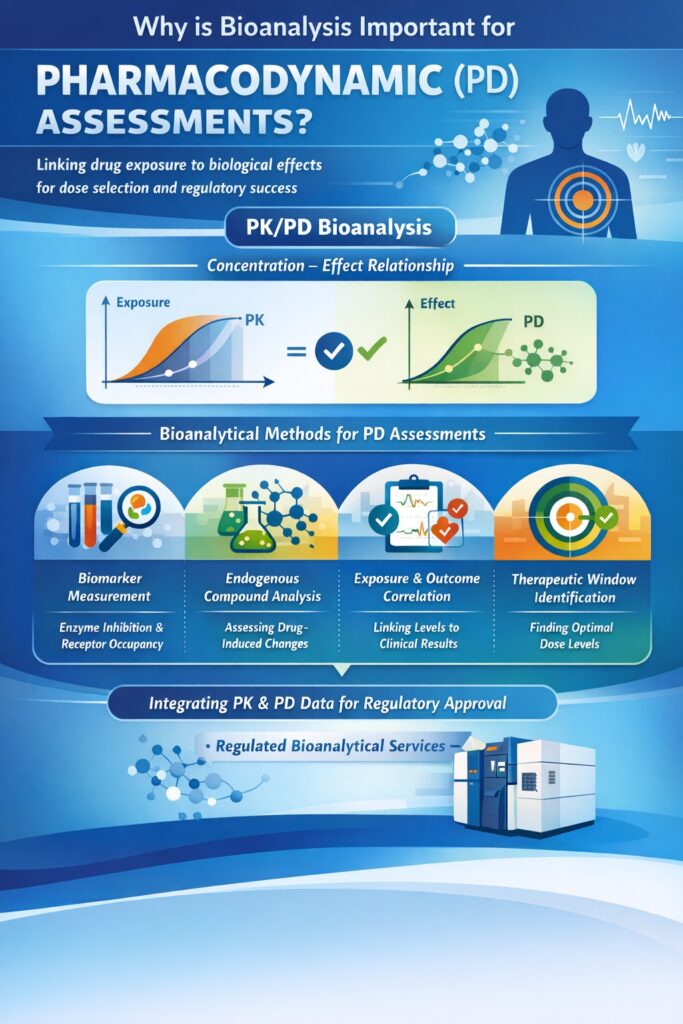
While PK studies track drug concentrations, pharmacodynamic assessments measure the biological effects of those drugs. Why is bioanalysis important in PD studies? It establishes the concentration-effect relationship that demonstrates a drug actually produces its intended therapeutic action at the doses being proposed.
Our biomarker bioanalytical services are designed to support PD measurements that inform dose selection and regulatory filing decisions.
Bioanalytical methods support PD assessments by:
- Measuring biomarkers that indicate drug activity (e.g., enzyme inhibition, receptor occupancy)
- Quantifying endogenous compounds affected by drug treatment
- Correlating drug exposure with clinical outcomes
- Identifying optimal therapeutic windows
This integration of PK and PD data, often termed PK/PD modeling, has become essential for modern drug development and regulatory approval. Agencies now expect sponsors to demonstrate not just that a drug reaches target tissues, but that it produces measurable pharmacological effects at clinically relevant concentrations.
4: Bioanalytical Method Validation: The Regulatory Foundation
Why is bioanalysis important in the context of regulatory compliance? Because regulatory agencies will only accept data generated using thoroughly validated bioanalytical methods that demonstrate fitness for purpose.
To understand expectations, read our detailed discussion on bioanalytical method validation.
FDA and EMA Bioanalytical Method Validation Guidelines
Both the FDA and EMA have published comprehensive guidance documents outlining expectations for bioanalytical method validation:
Key Validation Parameters:
- Selectivity: Ability to differentiate and quantify the analyte in the presence of other components
- Accuracy: Closeness of measured values to true values (typically within ±15%, ±20% at LLOQ)
- Precision: Reproducibility of measurements (CV ≤15%, ≤20% at LLOQ)
- Sensitivity: Lowest concentration that can be reliably quantified (LLOQ)
- Calibration Curve: Relationship between instrument response and analyte concentration
- Stability: Demonstration that analytes remain stable during collection, processing, and storage
At ResolveMass Laboratories, we adhere strictly to current FDA, EMA, and ICH guidelines for bioanalytical method validation. Our quality systems ensure that every validation parameter is thoroughly documented and that all methods undergo rigorous testing before being applied to regulatory study samples.
5: Clinical Trial Support: Why is Bioanalysis Important for Phase I-III Studies
Clinical trials represent the most critical stage of drug development where bioanalytical data directly influences regulatory approval decisions. Why is bioanalysis important across different clinical phases? Each phase addresses specific regulatory questions that require precise bioanalytical measurements.
Phase I: Safety and Tolerability
- First-in-human dose escalation studies
- Assessment of maximum tolerated dose
- Initial PK/PD characterization
- Food effect and drug-drug interaction studies
Phase II: Dose Finding and Proof of Concept
- Dose-response relationship establishment
- Biomarker validation
- Population PK modeling
- Special population studies (renal/hepatic impairment)
Phase III: Efficacy Confirmation
- Large-scale PK sampling to confirm predicted exposures
- Therapeutic drug monitoring to ensure protocol compliance
- Immunogenicity assessment for biologics
- Long-term safety monitoring
ResolveMass Laboratories has supported clinical trials across all phases, providing rapid turnaround times and regulatory-compliant data packages that enable sponsors to make confident go/no-go decisions.
ResolveMass offers robust clinical bioanalytical services and supports everything from Phase I safety profiling to Phase III efficacy confirmation
6: Generic Drug Development and Bioequivalence Studies
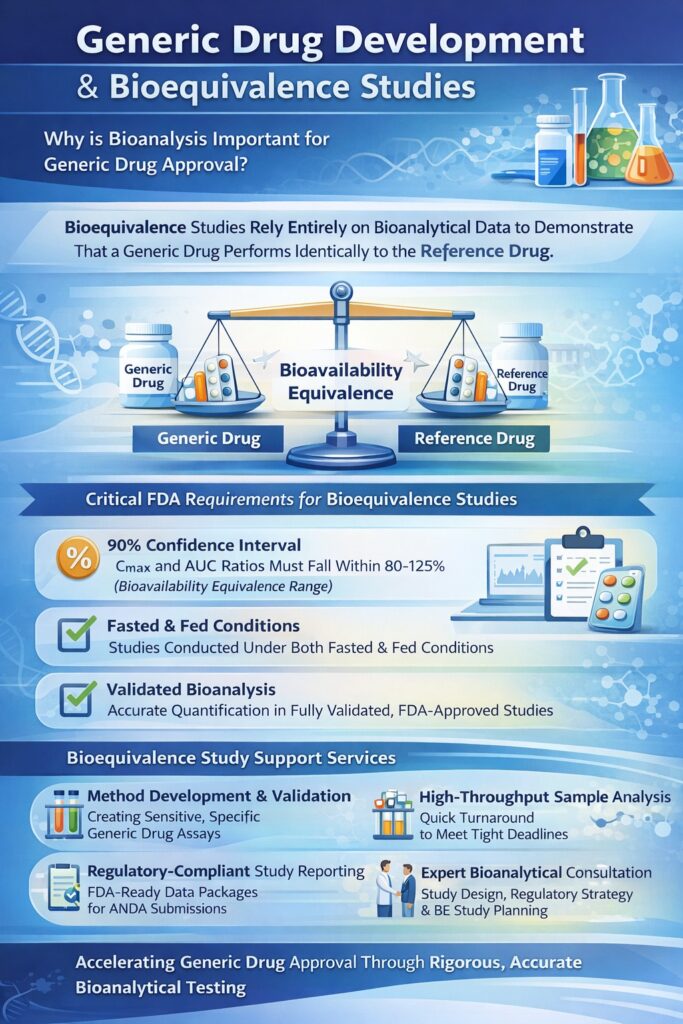
Why is bioanalysis important for generic drug approval? Bioequivalence studies, which rely entirely on bioanalytical data, are the primary mechanism by which generic drugs gain regulatory approval without repeating extensive clinical trials.
A bioequivalence study demonstrates that a generic formulation produces the same bioavailability as the reference listed drug. The FDA requires that:
- 90% confidence intervals for Cmax and AUC ratios fall within 80-125%
- Studies are conducted under fasting and fed conditions
- Bioanalytical methods are fully validated and capable of accurate quantification
Our laboratory specializes in bioequivalence study support, offering:
- Method development and validation for generic formulations
- High-throughput sample analysis to meet tight BE study timelines
- Regulatory-compliant study reports for ANDA submissions
- Expert consultation on study design and regulatory requirements
Learn more about how bioanalytical services for IND/ANDA submissions accelerate regulatory pathways.
7: Biosimilar Development: Advanced Bioanalytical Challenges
The growing biosimilar market presents unique bioanalytical challenges. Why is bioanalysis important for biosimilar approval? Unlike small molecules, biologics require extensive analytical characterization to demonstrate similarity to reference products.
For detailed insights, see our article on biosimilar bioanalysis.
Bioanalytical testing for biosimilars includes:
- PK comparability studies in healthy subjects and patient populations
- Immunogenicity assessment (anti-drug antibody development)
- Biomarker analysis to confirm comparable pharmacodynamic effects
- Neutralizing antibody detection
ResolveMass Laboratories employs advanced bioanalytical platforms specifically designed for large molecule characterization, ensuring that our clients can navigate the complex regulatory pathway for biosimilar approval.
8: The Impact of Bioanalysis on Patient Safety
Beyond regulatory compliance, why is bioanalysis important for patient safety? Accurate bioanalytical data protects patients by identifying potential safety risks before drugs reach the market and by enabling therapeutic drug monitoring for marketed medications.
Pre-Approval Safety Assessment
- Detection of toxic metabolites
- Identification of drugs with narrow therapeutic windows
- Assessment of accumulation potential with chronic dosing
- Evaluation of exposure in vulnerable populations (pediatrics, elderly)
Post-Approval Therapeutic Drug Monitoring
For drugs with narrow therapeutic indices or significant inter-patient variability, bioanalytical testing enables:
- Dose individualization based on measured concentrations
- Early detection of non-compliance
- Identification of drug-drug interactions in real-world settings
- Monitoring of immunosuppressants, anticoagulants, and oncology agents
Explore how our services support patient safety through high-quality testing:
9: Emerging Technologies in Regulatory Bioanalysis
The bioanalytical field continues to evolve with technological advances that improve sensitivity, throughput, and data quality. Why is bioanalysis important to stay current with these technologies? Because regulatory agencies increasingly expect sponsors to employ the most appropriate and scientifically advanced methods available.
The bioanalytical field continues to evolve with technological advances that improve sensitivity, throughput, and data quality.
For insights on modern techniques, see:
Current Technology Trends
- High-Resolution Mass Spectrometry: Improved selectivity and metabolite identification
- Microsampling: Reduced sample volumes, particularly beneficial for pediatric studies
- Automated Sample Preparation: Increased throughput and reduced variability
- Dried Blood Spot Analysis: Simplified sample collection and shipping
- Multi-Attribute Method (MAM): Comprehensive biologic characterization
ResolveMass Laboratories invests continuously in cutting-edge analytical instrumentation and method development capabilities, ensuring our clients benefit from the latest advances in bioanalytical science.
10: Regulatory Submission and Documentation
The ultimate goal of bioanalytical testing is to support regulatory submissions. Why is bioanalysis important in the submission process? Because comprehensive bioanalytical documentation is a required component of every IND, NDA, ANDA, and BLA submitted to regulatory agencies.
Key Documentation Requirements
- Bioanalytical method validation reports
- Study sample analysis reports
- Chain of custody documentation
- Stability data for drugs and metabolites
- Quality control data demonstrating assay performance
- Chromatograms and mass spectra for method validation and incurred sample analysis
Our quality assurance team ensures that all bioanalytical documentation meets regulatory expectations and is submission-ready, reducing the risk of information requests or application delays.
ResolveMass offers end-to-end bioanalytical outsourcing for pharma and bioanalytical services in North America.
Conclusion:
Throughout this comprehensive exploration, we’ve examined why bioanalysis is important from multiple regulatory and scientific perspectives. From pharmacokinetic characterization and bioequivalence demonstrations to biosimilar comparability and patient safety, bioanalytical testing provides the quantitative foundation upon which all regulatory decisions rest. Learn more about how our services can support your development program here: https://resolvemass.ca/bioanalytical-services/.
Why is bioanalysis important? Simply put, without validated bioanalytical methods and high-quality data, no drug can progress through the regulatory approval process. Bioanalysis transforms biological samples into actionable intelligence that guides drug development, informs regulatory agencies, and ultimately protects patient health.
As pharmaceutical development becomes increasingly complex with novel modalities like cell and gene therapies, the importance of rigorous bioanalytical science will only grow. ResolveMass Laboratories stands ready to support sponsors at every stage of development with the technical expertise, regulatory knowledge, and analytical capabilities needed to navigate the approval process successfully.
Frequently Asked Questions:
Bioanalysis is important because it generates quantitative data on drugs, metabolites, and biomarkers in biological matrices such as plasma, serum, urine, and tissues. These data are critical for:
-Determining pharmacokinetics (PK) and pharmacodynamics (PD)
-Supporting dose selection and exposure–response relationships
-Demonstrating safety, efficacy, and bioequivalence
-Enabling regulatory approval of drugs, biosimilars, and generics
Without reliable bioanalysis, clinical trial results cannot be interpreted accurately, making regulatory submission and approval impossible.
Regulated bioanalysis refers to bioanalytical studies conducted under regulatory compliance frameworks established by agencies such as the FDA, EMA, and ICH. These studies must follow:
-Good Laboratory Practice (GLP) principles
-Validated bioanalytical methods
-Documented data integrity, traceability, and reproducibility
Regulated bioanalysis ensures that bioanalytical data submitted in IND, NDA, ANDA, or BLA applications are accurate, reproducible, and acceptable to regulatory authorities.
The two most important functions of the regulatory affairs department are:
1. Regulatory Strategy and Compliance
-Interpreting global regulatory guidelines
-Ensuring study designs, bioanalytical methods, and documentation meet regulatory expectations
-Advising development teams on regulatory risks and requirements
2. Regulatory Submissions and Agency Communication
-Preparing and submitting dossiers (IND, CTA, NDA, ANDA, BLA)
-Managing interactions with regulatory agencies
-Addressing agency questions, deficiencies, and audits
These functions ensure timely approvals and reduce regulatory risk.
Bioanalytical techniques are applied across the drug development lifecycle, including:
-Pharmacokinetic (PK) and toxicokinetic (TK) studies
-Pharmacodynamic (PD) and biomarker analysis
-Bioavailability and bioequivalence studies
-Clinical trial sample analysis
-Therapeutic drug monitoring
-Biosimilar and biologics characterization
-Metabolite identification and quantification
These applications support both preclinical and clinical decision-making.
Methods of biological analysis include:
1. Chromatographic methods
-Liquid chromatography (LC)
-Gas chromatography (GC)
2. Mass spectrometry–based methods
-LC–MS/MS
-HRMS
3. Immunoassay techniques
-ELISA
-Ligand-binding assays (LBA)
4. Spectroscopic methods
-UV–Visible spectroscopy
-Fluorescence spectroscopy
5. Molecular biology techniques
-PCR
-qPCR
Next-generation sequencing (NGS)
Each method is selected based on analyte type, sensitivity requirements, and regulatory expectations.
The four main types of laboratory analytical methods are:
1. Qualitative Methods
Identify the presence of a substance
2. Quantitative Methods
Measure the amount or concentration of a substance
3. Semi-Quantitative Methods
Provide approximate concentration ranges
4. Structural (Confirmatory) Methods
Determine molecular structure or identity (e.g., MS, NMR)
These categories form the foundation of regulated laboratory and bioanalytical testing.
Reference
- Chongwoo Yu &E Dennis Bashaw.Regulatory Perspective of Biomarker Bioanalysis During Drug Development.https://www.tandfonline.com/doi/full/10.4155/bio-2019-0029
- Bioanalytical Method Development and Validation: from the USFDA 2001 to the USFDA 2018 Guidance for Industry.https://www.researchgate.net/publication/326495876_Bioanalytical_Method_Development_and_Validation_from_the_USFDA_2001_to_the_USFDA_2018_Guidance_for_Industry
- The International Open Access Journal of Analytical & Bioanalytical Techniques.https://www.researchgate.net/profile/Monica-Whitmire/publication/269541852_LC-MSMS_Bioanalysis_Method_Development_Validation_and_Sample_Analysis_Points_to_Consider_When_Conducting_Nonclinical_and_Clinical_Studies_in_Accordance_with_Current_Regulatory_Guidances/links/579a142b08ae024e100e38b6/LC-MS-MS-Bioanalysis-Method-Development-Validation-and-Sample-Analysis-Points-to-Consider-When-Conducting-Nonclinical-and-Clinical-Studies-in-Accordance-with-Current-Regulatory-Guidances.pdf?_sg%5B0%5D=started_experiment_milestone&origin=journalDetail
- Philip Timmerman,Neil Henderson,John Smeraglia,Hans Mulder,Benno Ingelse.Managing Scientific, Technical and Regulatory Innovation in Regulated Bioanalysis: A Discussion Paper from The European Bioanalysis Forum.https://www.tandfonline.com/doi/abs/10.4155/BIO.12.267
About the Author


