


Introduction
Establishing analytical similarity is a fundamental requirement for obtaining regulatory approval of biosimilar therapeutic proteins. A comprehensive Biosimilar Comparability Study Design and CRO Support Service delivers the structural, functional, and statistical framework necessary to demonstrate that a biosimilar candidate is highly similar to its reference listed drug (RLD) in accordance with US Food and Drug Administration (FDA) 351(k) and European Medicines Agency (EMA) regulatory pathways. Regulatory agencies across the globe advocate a stepwise development approach centered on comparative analytical assessments (CAA) that support the overall “totality-of-the-evidence” framework. Advancements in analytical characterization technologies have significantly improved the ability to detect subtle molecular differences through high-resolution mass spectrometry, biofunctional assays, and tiered statistical evaluations with greater sensitivity than traditional large-scale clinical efficacy studies. As a result, regulatory authorities increasingly support reducing or eliminating comparative clinical efficacy studies (CES) when a robust analytical comparability package is available. Successful execution of these programs requires carefully designed study protocols, strategic multi-lot reference product sourcing, three-way analytical bridging studies, and appropriately validated analytical methods to facilitate efficient regulatory submissions.
Learn more about end-to-end analytical testing and regulatory strategy through ResolveMass Biosimilar Characterization Services.
Share via:
Article Summary:
- Analytical similarity is the foundation of biosimilar approval, using FDA 351(k), EMA, ICH Q5E, and ICH Q6B principles to demonstrate structural, functional, and quality similarity to the reference product.
- Three-way analytical bridging compares the biosimilar with both US-licensed and EU-authorized reference products, supporting global regulatory submissions and reducing the need for duplicate clinical programs.
- FDA’s three-tier statistical framework evaluates CQAs according to risk: Tier 1 uses equivalence testing, Tier 2 uses quality ranges, and Tier 3 uses graphical/descriptive comparisons.
- Advanced orthogonal characterization assesses four major areas: primary structure/PTMs, glycosylation, charge & size heterogeneity, and biological function/potency.
- High-resolution analytical techniques such as LC-MS/MS, HILIC-UPLC, iCIEF, SEC-MALS, SPR/BLI, and cell-based assays provide sensitive detection of molecular and functional differences.
- Regulatory filing integrates the analytical evidence into CTD Module 3, including analytical similarity plans, head-to-head reports, method validation, statistical assessments, and scientific justification of observed differences.
- Experienced CRO support strengthens biosimilar programs through reference-lot sourcing, method development and validation, statistical analysis, advanced characterization, and audit-ready regulatory documentation—helping reduce risk and accelerate approval.
Comparative Analytical Assessment and the ICH Q5E Paradigm
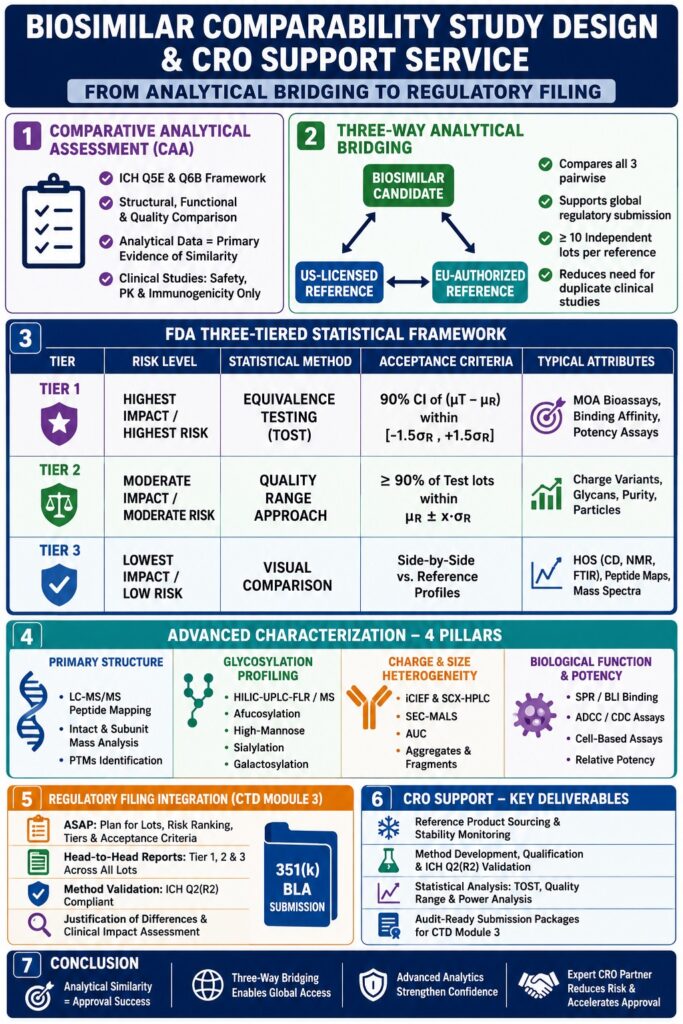
A Comparative Analytical Assessment (CAA) conducted in alignment with ICH Q5E principles determines whether molecular differences observed between a biosimilar candidate and its reference product have the potential to affect clinical performance. Through systematic evaluation of physicochemical characteristics, purity attributes, and biological activity across multiple manufacturing lots, sponsors can demonstrate that minor structural variations do not negatively influence safety, purity, or efficacy.
Although the ICH Q5E framework was originally established to assess manufacturing process changes implemented by a single innovator manufacturer, it now serves as the scientific basis for biosimilarity assessments. Demonstrating biosimilarity between products produced by different manufacturers using unique expression systems, purification processes, and formulation compositions introduces substantially greater analytical complexity. Biological therapeutics are intrinsically heterogeneous and can exhibit variability arising from post-translational modifications (PTMs), charge heterogeneity, and aggregation-related pathways.
To construct a regulatory-compliant comparability package, analytical strategies integrate ICH Q5E principles with ICH Q6B recommendations for specification development and quality assessment. The comparability program must thoroughly characterize the primary structure and higher-order structures (HOS), evaluate degradation pathways through forced degradation studies, and measure functional biological activities relevant to all proposed clinical indications. Within this framework, clinical studies are not intended to establish similarity. Instead, analytical characterization serves as the primary evidence of structural and functional similarity, while clinical investigations are generally used to confirm the absence of unexpected immunogenicity, altered pharmacokinetics (PK), or other clinically meaningful differences.
Discover how regulatory frameworks apply to biologicals via ICH Q6B Guidelines for Biological Characterisation.
Three-Way Analytical Bridging Strategies
Three-way analytical bridging studies compare the biosimilar candidate with both US-licensed and EU-authorized reference products to establish scientific equivalence across all three comparison pairs. This direct comparative strategy enables sponsors to leverage clinical data generated using an EU reference product in support of a US regulatory submission, or vice versa.
Global biosimilar development frequently requires bridging studies because regulatory requirements specify that the comparator used in a marketing application must be the locally authorized reference product. Conducting separate regional clinical programs can create significant financial burdens and operational inefficiencies. To establish a scientifically justified bridge, a three-way comparative analytical assessment is performed using:
- Biosimilar Candidate (Test Product): Manufacturing batches representative of the intended commercial process.
- US-Licensed Reference Product: Multiple independently sourced lots obtained directly from the US market to represent historical manufacturing variability.
- EU-Authorized Reference Product: Multiple independently sourced lots obtained from the European market covering comparable manufacturing and expiry periods.
The analytical study design requires simultaneous head-to-head testing across all three pairwise comparisons: Test vs. US-RLD, Test vs. EU-RLD, and US-RLD vs. EU-RLD. Demonstrating that the US and EU reference products are analytically comparable provides the scientific rationale for utilizing non-US clinical safety and PK/PD data within a US 351(k) Biologics License Application (BLA). A robust reference product sourcing strategy generally includes testing at least 10 or more independent originator lots spanning multiple manufacturing periods and shelf-life stages to accurately define target ranges and lot-to-lot variability represented by (σR).
Review best practices for bridging studies at Biosimilar Comparability Studies.
The FDA Three-Tiered Statistical Framework for Biosimilar Comparability Study Design and CRO Support Service
The FDA three-tiered statistical framework classifies critical quality attributes (CQAs) into three evaluation categories according to their clinical relevance and risk profile. Within a comprehensive Biosimilar Comparability Study Design and CRO Support Service, Tier 1 involves rigorous equivalence testing for high-risk attributes, Tier 2 applies quality range methodologies to moderate-risk attributes, and Tier 3 relies on graphical and descriptive comparisons for lower-risk attributes.
Before conducting statistical assessments, a detailed risk evaluation is performed using tools such as failure mode and effects analysis (FMEA) or risk-ranking methodologies. Quality attributes are categorized according to their potential impact on biological activity, pharmacokinetics, pharmacodynamics, toxicity, and immunogenicity.
Discover how attributes are categorized and defined at Critical Quality Attributes (CQAs) in Biosimilars.
| Assessment Tier | Criticality / Risk Level | Statistical Methodology | Acceptance Criteria Formula / Bound | Typical Quality Attributes Included |
|---|---|---|---|---|
| Tier 1 | Highest Impact / Highest Clinical Risk | Equivalence Testing (Two One-Sided Tests / TOST) | 90% CI of (μT − μR) must fall within [−1.5σR, +1.5σR] | Primary mechanism of action (MOA) bioassays, target binding affinity, potency assays |
| Tier 2 | Moderate Impact / Mild-to-Moderate Risk | Quality Range Approach | Predetermined percentage (e.g., ≥90%) of Test lots must fall within μR ± x·σR | Charge variants, glycan distribution, purity by SEC/CE-SDS, sub-visible particles |
| Tier 3 | Lowest Impact / Low Clinical Risk | Visual Comparison and Graphical Overlays | Side-by-side comparison against historical reference profiles | Spectroscopic HOS analyses (CD, NMR, FTIR), peptide mapping chromatograms, mass spectra |
Tier 1 Equivalence Testing and Similarity Margins
Tier 1 equivalence testing focuses on critical quality attributes that are directly associated with the biological mechanism of action. These assessments use two one-sided t-tests (TOST) to determine equivalence. Similarity limits are established at ±1.5 times the standard deviation of the reference product (±1.5σR), requiring the entire 90% confidence interval for the mean difference to remain within the predefined acceptance range.
The statistical framework evaluates the null hypothesis that the difference between the biosimilar mean (μT) and reference product mean (μR) exceeds the Equivalence Acceptance Criterion (EAC = 1.5σR), against the alternative hypothesis of equivalence:
Null Hypothesis (H0):
μT − μR ≤ −1.5σR or μT − μR ≥ 1.5σR
Alternative Hypothesis (H1):
−1.5σR < μT − μR < 1.5σR
For a Tier 1 attribute to meet equivalence requirements, the calculated two-sided 90% confidence interval for (μT − μR) must remain entirely within the interval [−1.5σR, +1.5σR]. Accurate estimation of σR requires analysis of independent reference product lots, ensuring that repeated testing of the same lot does not artificially reduce the observed variability.
Tier 2 Quality Range Approach
Tier 2 quality range assessments are used for attributes with moderate clinical significance. This approach establishes an acceptable interval derived from the variability observed in the reference product. The quality range is defined as the reference product mean plus or minus a selected multiplier of the reference standard deviation (μR ± x·σR), and a predefined proportion of biosimilar lots must fall within this interval.
The quality range can be represented as:
Quality Range = (μ̂R − x·σ̂R , μ̂R + x·σ̂R)
where μ̂R represents the reference product sample mean, σ̂R represents the reference product sample standard deviation, and x is an appropriately justified multiplier, commonly equal to 2 or 3 depending on the clinical significance of the attribute. Analytical similarity is demonstrated when the required percentage of biosimilar batches, such as 90% or 95%, falls within the established quality range.
Tier 3 Visual Comparisons and Raw Data Presentations
Tier 3 assessments are applied to low-risk or highly qualitative attributes where formal statistical analysis may not be appropriate. These evaluations rely on graphical overlays and descriptive comparisons of analytical data.
Typical Tier 3 assessments include higher-order structural analyses, chromatographic fingerprint comparisons, and evaluation of degradation pathways. Analytical reports commonly present overlaid UV, Circular Dichroism (CD), Nuclear Magnetic Resonance (NMR), or Differential Scanning Calorimetry (DSC) spectra. Subject matter experts assess the alignment of major structural characteristics, retention time profiles, and spectral features while confirming the absence of unexpected peaks or significant conformational differences.
Advanced Characterization Methodologies and Orthogonal Profiling
Advanced orthogonal characterization combines multiple high-resolution analytical techniques to evaluate critical biologic attributes including primary sequence integrity, glycosylation patterns, charge heterogeneity, and biological activity. Employing orthogonal methodologies enables comprehensive characterization of product heterogeneity and confirms that observed differences remain within scientifically justified limits.
A complete biosimilarity assessment is generally built upon four integrated analytical pillars:
- Primary Structure Verification: Utilizes LC-MS/MS peptide mapping, intact and subunit mass spectrometry, and Edman degradation to confirm complete primary sequence identity and quantify site-specific post-translational modifications.
- Glycosylation Profiling: Uses HILIC-UPLC-FLR and exoglycosidase digestion techniques to characterize and quantify N-glycan populations, including afucosylated glycans, high-mannose species, terminal sialylation, and galactosylation patterns.
- Charge State and Size Heterogeneity: Combines imaging Capillary Isoelectric Focusing (iCIEF), Strong Cation Exchange (SCX-HPLC), Size Exclusion Chromatography with Multi-Angle Light Scattering (SEC-MALS), and Analytical Ultracentrifugation (AUC) for comprehensive characterization of charge variants and aggregates.
- Biological and Functional Potency: Integrates Surface Plasmon Resonance (SPR) binding studies with cell-based bioassays such as ADCC, CDC, and signaling assays to evaluate biological activity relative to the reference product.
Learn more about proteomics strategies via Proteomics Approach for Biosimilars
and Native Mass Spectrometry for Biosimilars.
| Analytical Domain | Primary High-Resolution Technique | Orthogonal Characterization Technique | Target Quality Attribute Evaluated |
|---|---|---|---|
| Primary Structure | LC-MS/MS Peptide Mapping | MALDI-TOF MS / Edman Degradation | Amino acid sequence and site-specific PTMs |
| Intact / Subunit Mass | Orbitrap ESI-MS Intact Mass Analysis | Reduced / Deglycosylated Subunit MS | Molecular weight and glycoform distribution |
| Glycan Structure | HILIC-UPLC-FLR / MS N-Glycan Profiling | Capillary Gel Electrophoresis (CGE-LIF) | Fucosylation, galactosylation, and sialylation |
| Charge Variants | Imaging iCIEF | Strong Cation Exchange (SCX-HPLC) | Acidic, main, and basic charge isoforms |
| Higher-Order Structure | Far/Near-UV Circular Dichroism (CD) | 2D 1H-15N NMR / HDX-MS | Secondary and tertiary structural integrity |
| Size Heterogeneity | SEC-UPLC with MALS Detection | AUC-Sedimentation Velocity (AUC-SV) | Monomer content, aggregates, and fragments |
| Fc Receptor Binding | SPR Surface Plasmon Resonance Kinetics | Bio-Layer Interferometry (BLI) | Binding affinity (KD) to FcRn and FcγRs |
| Biological Potency | Target-Specific Cell Reporter Assays | Primary Cell Effector Assays (ADCC/CDC) | Relative functional potency and activity |
Primary Structure and Post-Translational Modifications
Verification of an identical amino acid sequence is a mandatory regulatory requirement for protein biosimilars. Ultra-high-performance liquid chromatography coupled with tandem mass spectrometry (LC-MS/MS) peptide mapping enables complete sequence coverage. Digestion using complementary proteolytic enzymes such as trypsin, Lys-C, and Asp-N generates peptide fragments that facilitate confirmation of the primary structure while simultaneously quantifying post-translational modifications (PTMs), including N-terminal pyroglutamate formation, C-terminal lysine clipping, methionine oxidation, and asparagine deamidation.
Glycosylation Profiling
Glycosylation plays a critical role in determining Fc-mediated effector functions, serum half-life, and immunogenicity characteristics of monoclonal antibodies (mAbs). Hydrophilic interaction liquid chromatography with fluorescence detection (HILIC-UPLC-FLR), combined with online mass spectrometry, is widely used to characterize fluorescently labeled N-glycans such as those labeled with 2-AB or Procainamide.
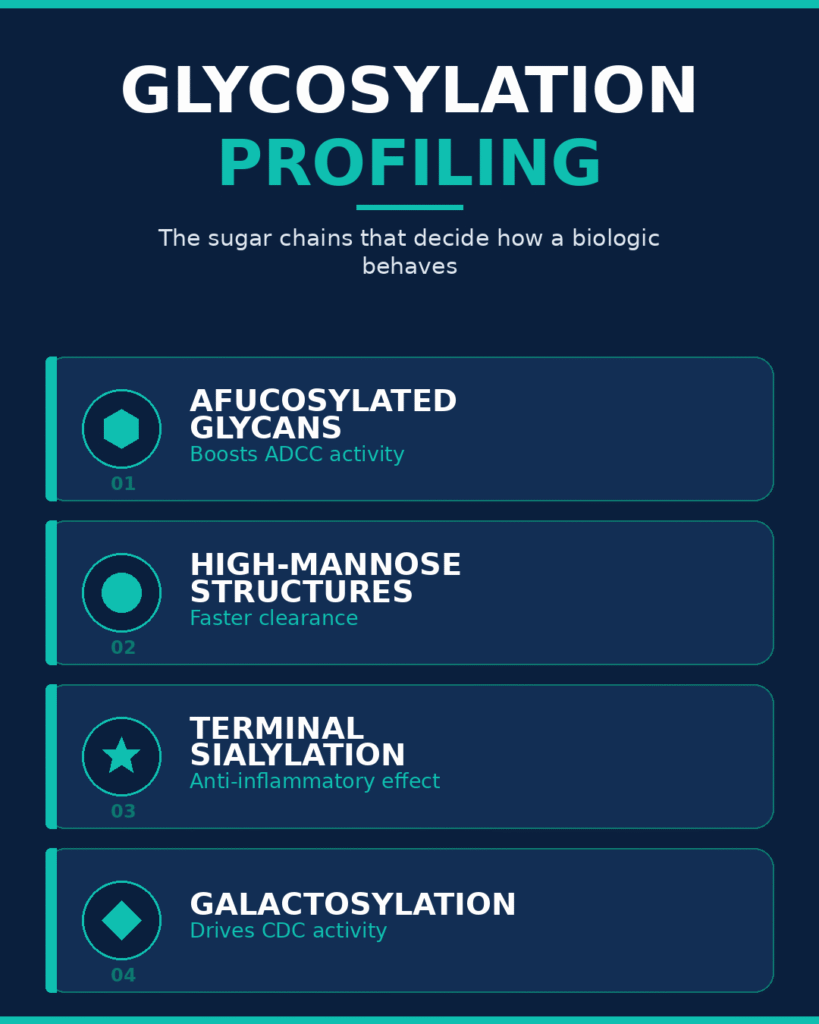
Quantitative analysis focuses on several critical glycan classes:
- Afucosylated Glycans (G0, G1): Strongly influence FcγRIIIa receptor binding and Antibody-Dependent Cellular Cytotoxicity (ADCC) activity.
- High-Mannose Structures (Man5, Man6): Contribute to increased serum clearance and altered FcγRIIIa receptor interactions.
- Terminal Sialylation (ST6Gal1): Affects anti-inflammatory functions and systemic pharmacokinetic behavior.
- Galactosylation (G1F, G2F): Influences Complement-Dependent Cytotoxicity (CDC) activity.
Detailed insights on PTM profiling are available at Glycosylation Analysis of Biosimilars.
Charge Variant Profiling and Size Heterogeneity
Charge heterogeneity resulting from deamidation, isomerization, glycation, and C-terminal processing is commonly evaluated using imaging Capillary Isoelectric Focusing (iCIEF) and cation exchange chromatography (CEX-HPLC). Size-related variants, including high-molecular-weight (HMW) aggregates and low-molecular-weight (LMW) fragments, are characterized using Size Exclusion Chromatography with Multi-Angle Light Scattering (SEC-MALS), supported by analytical ultracentrifugation sedimentation velocity (AUC-SV) as an orthogonal characterization method.
Explore specialized mass spec strategies in Charge Variant Analysis in Biosimilars: Mass Spectrometry Approaches for Heterogeneity
and aggregate testing at Aggregation Analysis in Biosimilars.
Biological Functionality and Potency Assays
Functional characterization directly evaluates the biological mechanism of action associated with all clinical indications proposed for extrapolation. Surface Plasmon Resonance (SPR) and Bio-Layer Interferometry (BLI) technologies are used to measure binding kinetics, including kon, koff, and KD values, against target antigens and Fc receptors such as FcRn, FcγRI, FcγRIIa, FcγRIIIa, and C1q.
Cell-based reporter assays and primary cell bioassays, including ADCC, CDC, proliferation inhibition assays, and apoptosis induction assays, are employed to determine relative biological potency. These methods require rigorous validation according to ICH Q2(R2) principles to ensure reliable and reproducible performance.
Regulatory Filing Integration: Module 3 CTD and BLA Submissions
The integration of analytical comparability data into Common Technical Document (CTD) Module 3 requires the consolidation of tiered statistical evaluations, historical lot analyses, and advanced structural characterization data into a comprehensive regulatory package. Contemporary 351(k) BLA submissions rely heavily on this analytical totality-of-the-evidence approach to establish biosimilarity and justify the reduction or elimination of unnecessary comparative clinical efficacy studies.
An effective regulatory submission typically presents comparative analytical data within CTD Module 3 (Quality), particularly sections 3.2.S.3.1 (Elucidation of Structure and Other Characteristics) and 3.2.R (Regional Information). Essential dossier elements include:
- Analytical Similarity Assessment Plan (ASAP): A predefined protocol outlining reference lot sourcing strategies, risk-ranking methodologies, statistical tier assignments, and acceptance criteria.
- Head-to-Head Comparative Analytical Reports: Comprehensive analytical packages summarizing Tier 1, Tier 2, and Tier 3 evaluations across biosimilar, US-reference, and EU-reference lots.
- Method Validation Reports: Documentation demonstrating compliance with ICH Q2(R2) requirements for accuracy, precision, specificity, linearity, and robustness.
- Justification of Differences and Clinical Impact Assessments: Scientific evaluations supporting any minor analytical differences and demonstrating a lack of clinically meaningful impact.
Recent FDA policy developments, including draft guidance documents addressing comparative clinical studies and interchangeability, continue to reinforce the importance of high-resolution analytical characterization as the most sensitive approach for identifying product differences. The removal of mandatory switching study requirements for interchangeability further underscores the growing regulatory reliance on comprehensive analytical similarity packages.
Learn how to compile complete regulatory dossiers with an End-to-End Biosimilar Analytical Package for a Regulatory Submission.
Strategic Execution via Biosimilar Comparability Study Design and CRO Support Service
Strategic implementation through a Biosimilar Comparability Study Design and CRO Support Service provides access to specialized instrumentation, validated analytical methodologies, reference product management expertise, and regulatory experience necessary for successful biosimilar development. Collaboration with an experienced analytical CRO can substantially reduce regulatory risk by delivering scientifically robust study designs and submission-ready analytical data packages.
Managing a biosimilar development program internally often requires significant capital investment and technical expertise. Utilizing specialized CRO services provides immediate access to advanced analytical infrastructure, including Orbitrap mass spectrometry platforms, SPR systems, automated iCIEF instrumentation, and dedicated cell-based bioassay laboratories.
An experienced analytical partner supports critical program milestones, including:
- Reference Product Sourcing and Stability Monitoring: Coordinated acquisition of multiple reference product lots, management of cold-chain logistics, and ongoing stability assessment throughout shelf-life.
- Method Development, Qualification, and ICH Q2(R2) Validation: Development of high-resolution analytical methods tailored to the molecule of interest and execution of validation studies consistent with regulatory expectations.
- Statistical Analysis Support: Performance of Tier 1 TOST equivalence testing, Tier 2 quality range calculations, and statistical power analyses to determine appropriate lot numbers.
- Audit-Ready Submission Packages: Preparation of compliant summaries, graphical presentations, and risk assessments suitable for direct incorporation into CTD Module 3 dossiers.
Conclusion
A comprehensive Biosimilar Comparability Study Design and CRO Support Service serves as the scientific backbone of successful biosimilar development, supporting progression from early-stage characterization through regulatory approval. Demonstrating analytical similarity through three-way bridging strategies, robust statistical assessment frameworks, and advanced orthogonal characterization techniques accelerates development timelines while strengthening regulatory confidence.
As regulatory agencies increasingly embrace the analytical totality-of-the-evidence approach and continue reducing dependence on comparative clinical efficacy studies, the depth, quality, and scientific rigor of analytical comparability packages become critical determinants of approval success. Partnering with an experienced analytical laboratory ensures that structural characterization, functional assessment, and statistical evaluation activities are conducted according to the highest scientific and regulatory standards established by the FDA and EMA.
To discuss your biosimilar comparability study design, reference product characterization, or regulatory filing strategy with expert analytical scientists, contact ResolveMass Laboratories Inc. directly at: https://resolvemass.ca/contact/
Frequently Asked Questions (FAQs)
Three-way analytical bridging involves direct comparison of a biosimilar candidate with both US-licensed and EU-authorized reference products. This approach establishes whether the reference products marketed in different regions are analytically comparable. Demonstrating this relationship allows sponsors to use clinical and nonclinical data generated with one regional comparator to support regulatory submissions in another region, reducing duplication of studies and development costs.
Critical Quality Attributes are classified according to their potential influence on product safety, efficacy, pharmacokinetics, and immunogenicity. Tier 1 includes attributes with the greatest clinical significance and requires the most rigorous statistical evaluation. Tier 2 covers attributes with moderate risk that are assessed using predefined quality ranges, while Tier 3 includes lower-risk structural or qualitative attributes that are primarily evaluated through graphical and visual comparisons.
FDA Tier 1 analytical similarity assessments typically use the Two One-Sided Tests (TOST) equivalence approach. This statistical method determines whether the difference between the biosimilar and reference product remains within predefined similarity limits derived from reference product variability. Successful completion of Tier 1 testing provides strong evidence that clinically important attributes are comparable between the two products.
ICH Q5E outlines scientific principles for evaluating comparability when changes occur during biologic manufacturing. Although originally developed for manufacturing changes within the same product, its concepts are widely applied in biosimilar development. The guideline emphasizes the use of sensitive analytical methods to demonstrate that any observed differences do not result in meaningful changes to product quality, safety, or efficacy.
A robust biosimilar comparability program generally includes testing multiple independent reference product lots to capture normal manufacturing variability. Regulatory expectations often support the use of at least 10 lots, although larger datasets may provide greater statistical confidence. Evaluating lots from different production periods and shelf-life stages helps establish reliable acceptance ranges for analytical similarity assessments.
In many cases, comprehensive comparative analytical assessments can significantly reduce the need for large comparative clinical efficacy studies. Modern analytical technologies are highly sensitive and can detect molecular differences that may not be observable through clinical endpoints. When analytical, functional, and pharmacokinetic data collectively demonstrate high similarity, regulatory agencies may determine that additional efficacy studies provide limited scientific value.
Higher-order structure is assessed using a combination of orthogonal analytical techniques that evaluate protein folding and conformational integrity. Common methods include Circular Dichroism (CD), Fourier-Transform Infrared Spectroscopy (FTIR), Differential Scanning Calorimetry (DSC), Hydrogen-Deuterium Exchange Mass Spectrometry (HDX-MS), and Nuclear Magnetic Resonance (NMR) spectroscopy. Together, these approaches provide detailed insight into secondary, tertiary, and quaternary structural characteristics.
Recent FDA guidance places greater emphasis on the overall totality of evidence rather than relying heavily on dedicated switching studies. Strong analytical similarity data, combined with supportive clinical and pharmacokinetic evidence, can strengthen the case for interchangeability. This evolving regulatory approach may streamline development programs while maintaining confidence in the safety and effectiveness of interchangeable biosimilars.
CTD Module 3 should contain a comprehensive collection of analytical and quality-related information supporting biosimilarity. Key elements include analytical similarity assessment plans, comparative characterization reports, method development and validation documentation, stability data, forced degradation studies, and statistical analyses. The dossier should also provide scientific justification for any observed differences and demonstrate that such variations do not affect clinical performance.
Reference:
- U.S. Food and Drug Administration. (2015, April). Scientific considerations in demonstrating biosimilarity to a reference product: Guidance for industry. U.S. Department of Health and Human Services. https://www.fda.gov/media/105779/download
- U.S. Food and Drug Administration. (2025, January). Considerations for the development of chimeric antigen receptor (CAR) T cell products: Guidance for industry. U.S. Department of Health and Human Services. FDA Guidance Document
- European Medicines Agency. (2026). Reflection paper on a tailored clinical approach in biosimilar development (EMA/CHMP/BMWP/60916/2025). European Medicines Agency. https://www.ema.europa.eu/en/documents/other/reflection-paper-tailored-clinical-approach-biosimilar-development_en.pdf
- European Medicines Agency. (2005, June 1). ICH Q5E: Comparability of biotechnological/biological products subject to changes in their manufacturing process (CPMP/ICH/5721/03). European Medicines Agency. https://www.ema.europa.eu/en/ich-q5e-biotechnological-biological-products-subject-changes-their-manufacturing-process-comparability-biotechnological-biological-products-scientific-guideline
- Chow, S.-C., Song, F., & Bai, H. (2016). Analytical similarity assessment in biosimilar studies. The AAPS Journal, 18(3), 670–677. https://doi.org/10.1208/s12248-016-9882-5
Get In Touch With Us
About The Author


