

Introduction:
The BPOG Guidelines for Single-Use Systems and ICH Q3E are increasingly important because biopharmaceutical manufacturing relies heavily on polymeric single-use systems (SUS), while regulators and manufacturers require stronger scientific justification for extractables and leachables (E&L) risks. Single-use bags, tubing, connectors, filters, sensors, and mixing assemblies can contain additives, processing aids, oligomers, degradation products, and other chemicals capable of migrating into process streams. The challenge is not simply detecting these compounds — it is determining which compounds are relevant, at what exposure level, and whether they present a quality or patient-safety risk, a distinction covered in depth under E&L requirements for single-use bioprocessing.
BioPhorum developed standardized extractables approaches to improve consistency across SUS suppliers and end users. Its updated protocol provides guidance on sample preparation, extraction conditions, analytical testing, and reporting. ICH Q3E takes the broader regulatory perspective by establishing a holistic framework for the assessment and control of E&L associated with pharmaceutical products; the current FDA draft states that Q3E builds upon ICH Q3A, Q3B, Q3C, Q3D, and M7 principles.
The key point: BPOG can provide high-quality extractables evidence, while Q3E provides the framework for translating E&L data into a scientifically justified safety and control strategy. This article walks through what BPOG’s single-use system guidance requires, what ICH Q3E adds, where the two frameworks align, the analytical and documentation work needed to bridge them, and what a practical, audit-ready testing strategy looks like in 2026.
Summary:
- The BPOG Guidelines for Single-Use Systems and ICH Q3E address the same core objective: understanding and controlling chemical substances that may migrate from manufacturing or packaging materials into pharmaceutical products.
- BioPhorum (BPOG) developed a standardized extractables approach specifically for polymeric single-use components used in biopharmaceutical manufacturing, covering testing, analytical characterization, reporting, and supplier data sharing.
- ICH Q3E provides a broader, risk-based framework for assessing and controlling extractables and leachables (E&L), with emphasis on patient safety and pharmaceutical product quality.
- BPOG extractables data can serve as an important input into an ICH Q3E-based E&L risk assessment, but BPOG testing alone does not constitute a complete Q3E safety assessment.
- A defensible E&L strategy connects: SUS materials → extractables → potential leachables → exposure → toxicological assessment → risk control.
- As of August 2026, ICH Q3E remains a draft, not-for-implementation framework in the US (Step 2 endorsed August 2025); companies should distinguish current regulatory requirements from forward-looking Q3E alignment.
- ResolveMass Laboratories supports sponsors with BPOG-aligned extractables studies and ICH Q3E-consistent risk assessments for single-use bioprocessing systems, biologics, and PLGA-based drug products.
1: What Are the BPOG Guidelines for Single-Use Systems?
The BPOG approach is an industry-standardized strategy for generating and communicating extractables information from single-use components used in biopharmaceutical manufacturing.
BioPhorum’s standardized extractables protocol was developed through collaboration between biopharmaceutical manufacturers and suppliers. The updated protocol is designed to reduce unnecessary testing while retaining scientifically meaningful information. BPOG-related extractables testing can cover components such as:
- Single-use bags and films
- Tubing
- Connectors and disconnectors
- Aseptic connectors
- Sterilizing-grade filters
- TFF cassettes
- Sensors
- Valves
- Chromatography components
- Impellers
- Filling needles
BioPhorum’s reporting framework calls for information about the tested component, extraction conditions, analytical methods, identified compounds, estimated quantities of unknowns, deviations, method qualifications, and supporting analytical data. This standardized reporting is particularly valuable because end users frequently need to compare supplier-generated E&L data before selecting or qualifying SUS components — a process covered further under GMP extractables and leachables testing.
2: What Is ICH Q3E and What Does It Add to E&L Assessment?
ICH Q3E is a proposed harmonized guideline for the assessment and control of extractables and leachables in pharmaceutical products. As of August 2026, it remains a draft framework not yet implemented in the US.
As of August 2026, the Q3E document available through FDA remains a draft Level 1 guidance and is explicitly identified as not for implementation. The ICH Step 2 draft was endorsed in August 2025 and subsequently entered regulatory consultation. The draft Q3E framework focuses on:
- Identifying potential extractables and leachables.
- Characterizing relevant chemical substances.
- Assessing patient exposure.
- Evaluating toxicological risk.
- Establishing appropriate controls.
- Applying a scientifically justified, risk-based approach.
This represents an important evolution from simply asking “What chemicals are present?” to asking “Which chemicals could reach the patient, at what exposure, and what does that exposure mean from a safety perspective?”
3: BPOG Guidelines for Single-Use Systems and ICH Q3E: How Do They Align?
The BPOG Guidelines for Single-Use Systems and ICH Q3E align strongly in their emphasis on scientific characterization, risk assessment, and appropriate control, but they operate at different levels — BPOG standardizes the testing input, while Q3E defines the risk-assessment framework that interprets it.
| Aspect | BPOG Approach | ICH Q3E Approach |
|---|---|---|
| Primary purpose | Standardize SUS extractables testing | Establish holistic E&L assessment and control |
| Main focus | Single-use components | Pharmaceutical products and associated materials |
| Testing | Defined extractables strategy | Risk-based E&L strategy |
| Analytical characterization | Strong emphasis | Required as appropriate to risk |
| Unknown compounds | Identification/estimation | Characterization and safety assessment |
| Exposure assessment | Provides supporting data | Central to risk assessment |
| Toxicology | Not the primary purpose of BPOG testing | Major component of safety assessment |
| Leachables | Supported through extractables knowledge | Directly incorporated into lifecycle risk assessment |
| Reporting | Standardized data presentation | Risk-based regulatory documentation |
| Regulatory status | Industry best practice | Draft harmonized guideline as of 2026 |
Therefore, BPOG should not be viewed as an alternative to Q3E. Instead, BPOG-generated data becomes one of the foundational evidence streams used within a Q3E-style E&L assessment, and understanding E&L testing vs. drug-device compatibility studies helps clarify where each type of study fits in the broader program.
4: How Does BPOG Extractables Testing Support an ICH Q3E Risk Assessment?
BPOG testing primarily answers “what substances could potentially be released from the SUS material under defined extraction conditions?” Q3E goes further, asking which of those substances could become relevant leachables, what exposure could result, and whether that exposure creates a patient or product-quality concern.
A practical workflow is:
SUS component selection → Material characterization → BPOG extractables testing → Chemical identification → Quantitation → Process/product exposure assessment → Leachables evaluation → Toxicological assessment → Risk classification → Control strategy
This distinction is critical. For example, detecting a compound in an aggressive extract does not automatically mean the same concentration will occur in the drug product. Actual leachable levels depend on factors such as:
- Contact time
- Temperature
- Process conditions
- Drug formulation
- Surface-area-to-volume ratio
- Material composition
- Manufacturing process
- Storage conditions
- Sterilization
- Repeated or prolonged contact
Consequently, extractables are potential leachables, not automatically confirmed leachables.
5: What Analytical Testing Is Needed for BPOG and Q3E Alignment?
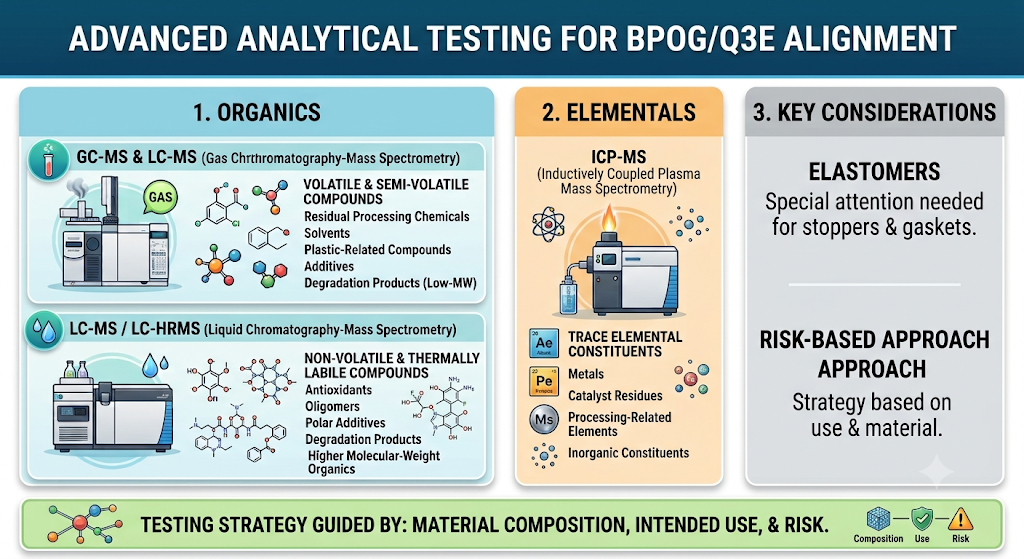
Analytical characterization should be sufficiently broad and sensitive to detect chemically diverse compounds, spanning organic, elemental, and material-specific extractables.
Organic extractables
- GC-MS / GC-HRMS — useful for volatile and semi-volatile compounds, including residual processing chemicals, solvents, plastic-related compounds, certain additives, and low-molecular-weight degradation products.
- LC-MS / LC-HRMS — useful for non-volatile and thermally labile compounds, including antioxidants, oligomers, degradation products, polar additives, and higher molecular-weight organic compounds.
Elemental extractables
- ICP-MS — used to characterize elemental constituents at trace concentrations, including metals, catalyst-related residues, processing-related elements, and other inorganic constituents.
Additional characterization
Depending on the SUS and study objectives, laboratories may also use FTIR, NMR, UV/Vis, headspace GC-MS, high-resolution mass spectrometry, targeted quantitative LC-MS/MS, and ion chromatography. Rubber and elastomer-based SUS components (e.g., stoppers, gaskets, tubing connectors) require particular attention, since rubber and elastomer leachables profiles often differ meaningfully from film and tubing polymers and can require dedicated extraction conditions.
The analytical strategy should be driven by material composition, extraction chemistry, intended use, and risk — rather than by a generic instrument checklist.
6: Why Is Chemical Identification Critical Under BPOG and ICH Q3E?
Chemical identification is one of the most important bridges between extractables testing and safety assessment. An extractables report should distinguish between confirmed identities, probable or tentative identities, unknown compounds, estimated concentrations, and compounds requiring additional characterization.
BioPhorum’s reporting guidance specifically emphasizes reporting the identity and amount of known compounds and estimated amounts of unknown compounds, along with analytical methods and study context. High-resolution mass spectrometry can be particularly useful when conventional library matching is insufficient. A defensible workflow can include:
Accurate mass → Molecular formula → Isotope pattern → Fragmentation → Database/library search → Reference-standard confirmation → Quantitative determination
This is particularly valuable when assessing unexpected compounds that may not be represented in standard supplier databases.
7: How Should SUS Extractables Be Converted Into Leachables Risk?
BPOG data should not be interpreted independently of the actual manufacturing process. A risk assessment should consider the actual patient exposure pathway: SUS component → Process contact → Drug substance/product → Administration → Patient exposure.
Important factors include:
- Contact duration
- Contact temperature
- Contact surface area
- Process volume
- Formulation composition
- Drug concentration
- Manufacturing stage
- Dilution or purification steps
- Clearance mechanisms
- Final drug-product concentration
- Maximum daily dose
- Route of administration
Route of administration meaningfully changes the conservatism required — for example, E&L compliance for a dry powder inhaler demands tighter thresholds than an oral product because of direct pulmonary tissue exposure. This is where Q3E-style thinking adds substantial value to standardized extractables testing.
8: What Are the Main Benefits of Combining BPOG and Q3E Principles?
- More consistent SUS qualification. Standardized supplier data make it easier to compare components and identify potential chemical risks.
- Reduced redundant testing. BioPhorum’s updated protocol was developed partly to reduce unnecessary testing; BioPhorum reports its revised approach reduced overall testing quantities by approximately 30–50% while retaining important information.
- Better supplier data utilization. BioPhorum’s risk-based testing work specifically addresses when end users can rely on supplier data and when additional testing may be appropriate — a decision many sponsors formalize through outsourcing E&L testing to an independent lab.
- Stronger regulatory justification. A documented connection between extractables data, process exposure, and toxicological risk provides a stronger scientific rationale than simply presenting large analytical datasets.
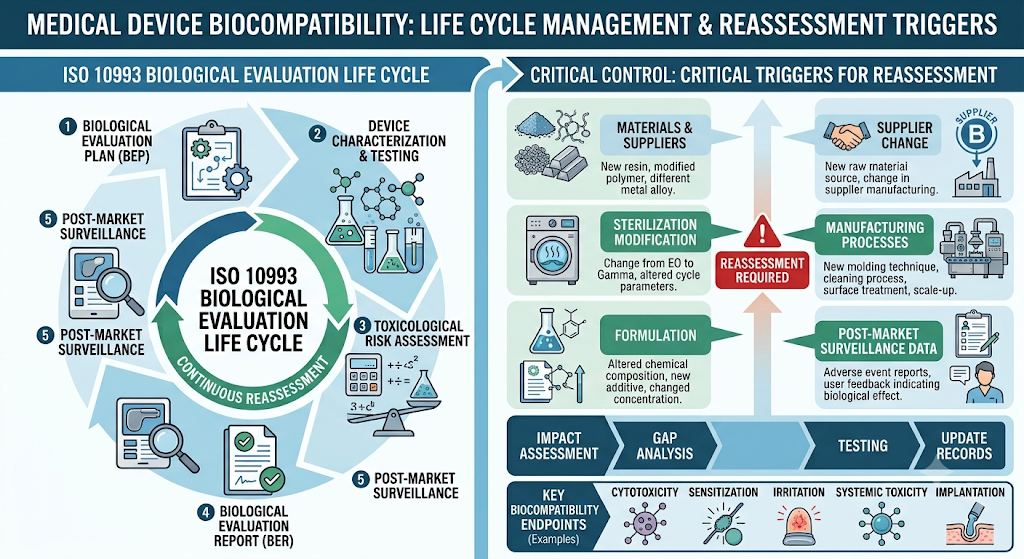
- Improved lifecycle management. Changes to materials, suppliers, sterilization, manufacturing processes, or formulation can trigger reassessment.
9: A Practical BPOG-to-Q3E E&L Workflow for Biopharmaceutical Manufacturers
| Stage | Key Question | Typical Output |
|---|---|---|
| 1. SUS inventory | Which components contact the process? | SUS component list |
| 2. Material assessment | What polymers/additives are present? | Material profile |
| 3. Supplier review | What existing data are available? | Supplier E&L package |
| 4. BPOG extractables | What compounds can be extracted? | Extractables dataset |
| 5. Analytical characterization | What are the compounds? | Identified/estimated compounds |
| 6. Process mapping | Which components contact product? | Contact matrix |
| 7. Leachables assessment | Which extractables could migrate? | Leachables risk assessment |
| 8. Exposure calculation | What patient exposure could result? | Exposure estimate |
| 9. Safety assessment | Is exposure acceptable? | Toxicological assessment |
| 10. Risk control | What controls are required? | E&L control strategy |
| 11. Documentation | Can the rationale be defended? | Regulatory-ready report |
10: What Documentation Should a Q3E-Aligned SUS E&L Package Contain?
A strong technical package should allow an independent reviewer to understand what was tested, why it was tested, what was found, and how the findings affect product safety.
Recommended documentation includes:
- SUS component description, manufacturer, and supplier information
- Material of construction and product-contact surface
- Intended process application
- Extraction study design, solvents, and conditions
- Analytical methods and method qualification/validation information
- Identified extractables and unknown/unknown-estimate data
- Quantitative results
- Toxicological assessment and exposure calculations
- Leachables strategy and risk assessment
- Scientific justification for omissions or deviations
- Change-control considerations
- Final E&L control strategy
BioPhorum’s standardized reporting framework already emphasizes study design, deviations, analytical methods, method qualifications, and summarized analytical results. Sponsors preparing for inspection should ensure this package qualifies as audit-ready E&L data, with full traceability supported by GMP data integrity for E&L testing practices throughout the analytical workflow.
11: What Are Common Mistakes in Single-Use E&L Programs?
Several approaches can weaken an E&L assessment:
- Treating BPOG as a complete regulatory assessment. BPOG testing generates valuable extractables information, but it does not replace exposure assessment and toxicological evaluation.
- Testing without considering the actual process. Extraction conditions should be interpreted in the context of real manufacturing conditions.
- Reporting only identified compounds. Unknowns should not simply disappear from the risk assessment — their presence, estimated levels, and characterization limitations should be documented.
- Ignoring component changes. Changes in resin, additives, manufacturing site, sterilization method, or supplier can alter the extractables profile.
- Assuming supplier data are automatically sufficient. Supplier data can be highly valuable, but the end user should establish whether those data adequately represent the intended use and risk profile. BioPhorum’s TVR (Test-Vendor-Risk) framework specifically emphasizes a risk-based decision on when vendor data can be leveraged and when additional end-user testing is appropriate.
12: How Can ResolveMass Laboratories Support BPOG and ICH Q3E-Aligned E&L Programs?
For organizations developing or qualifying biopharmaceutical manufacturing processes, an effective E&L program requires more than instrument availability — it requires analytical strategy, chemical identification, quantitative interpretation, risk assessment, and clear technical documentation.
ResolveMass Laboratories supports E&L programs through analytical characterization strategies involving GC-MS/GC-HRMS, LC-MS/MS, LC-HRMS, ICP-MS, FTIR, NMR, targeted quantitative analysis, unknown identification, analytical method development and validation/qualification, and scientific data interpretation, delivered as GMP-compliant extractables and leachables studies. Our team also supports E&L testing for biosimilar drug development, where single-use bioprocessing equipment is central to manufacturing.
The laboratory strategy should be tailored to the SUS material, process conditions, pharmaceutical dosage form, and intended route of administration. For regulatory-facing projects, the objective is to produce a traceable scientific story from raw analytical data through chemical identification and exposure assessment to the final risk conclusion.
13: What Should Companies Do Now as ICH Q3E Evolves?
Because the current Q3E framework remains a draft, companies should avoid treating it as an already implemented mandatory requirement — FDA explicitly describes the current document as a non-binding draft that is not for implementation. However, organizations can proactively prepare by:
- Reviewing existing SUS extractables datasets.
- Mapping SUS components to actual process contact.
- Identifying gaps in supplier data.
- Standardizing extractables reporting.
- Improving unknown-compound characterization.
- Establishing exposure calculations.
- Developing toxicological assessment workflows.
- Defining leachables monitoring strategies.
- Incorporating change-control triggers.
- Building regulatory-ready E&L documentation.
This approach allows companies to improve current E&L programs while remaining prepared for future harmonized expectations.
Conclusion:
The BPOG Guidelines for Single-Use Systems and ICH Q3E are complementary rather than competing approaches. BPOG provides a standardized and practical foundation for generating high-quality extractables information from polymeric SUS components, while ICH Q3E provides a broader framework for translating E&L data into scientifically justified safety and control decisions.
The most effective strategy is therefore not simply to “perform BPOG testing.” Instead, manufacturers should establish a complete evidence chain: Material → Extractables → Chemical Identification → Leachables Potential → Exposure → Toxicological Assessment → Risk → Control.
BioPhorum’s continuing work on standardized single-use technologies, supplier data, and risk-based testing demonstrates the industry’s movement toward more consistent and efficient SUS qualification. Meanwhile, the emerging ICH Q3E framework signals increasing international emphasis on systematic, science- and risk-based E&L control. For biopharmaceutical manufacturers, CDMOs, and pharmaceutical development teams, building a BPOG-supported, Q3E-ready BPOG Guidelines for Single-Use Systems and ICH Q3E strategy can improve chemical risk visibility, strengthen supplier qualification, and create a more defensible technical package for regulatory interactions.
Frequently Asked Questions:
BPOG is an industry-developed standardized approach rather than a universally mandatory regulatory test.
Its suitability depends on the specific pharmaceutical application and E&L risk profile.
Manufacturers should consider material composition, product contact and manufacturing conditions.
Regulatory expectations may also vary according to product type and jurisdiction.
Therefore, BPOG testing should be incorporated into a scientifically justified overall E&L strategy.
Supplier-generated BPOG data can be highly valuable for single-use system qualification.
However, the data should be evaluated against the manufacturer’s actual intended use.
Factors such as contact time, temperature, formulation and surface-area-to-volume ratio are important.
Differences between supplier test conditions and manufacturing conditions may create data gaps.
Additional testing may therefore be appropriate when existing information is insufficient.
No, BPOG testing does not by itself establish complete safety of a single-use component.
It primarily provides standardized information about substances that can be extracted from the material.
Safety assessment requires consideration of exposure, toxicological information and intended use.
Potential leachables and their concentration in the pharmaceutical product may also require evaluation.
Therefore, BPOG results should be integrated into a broader risk-based E&L assessment.
BPOG results help identify substances that could potentially migrate into pharmaceutical products.
These compounds can then be prioritized based on their chemical identity and estimated concentration.
The assessment should consider actual process conditions and potential patient exposure.
High-priority substances may require targeted leachables testing or additional toxicological evaluation.
This creates a logical connection between extractables characterization and product safety assessment.
Leachables formation depends on several material, process and formulation-related factors.
Important variables include temperature, contact time, solvent characteristics and surface-area-to-volume ratio.
Sterilization conditions, storage conditions and material composition can also influence migration.
The manufacturing process and final product formulation may change the chemical release profile.
These factors should be considered when designing an appropriate E&L risk assessment.
ICH Q3E emphasizes evaluating E&L substances according to their potential risk rather than detection alone.
The approach connects chemical identification with exposure and toxicological considerations.
This allows companies to prioritize substances that could have meaningful patient or product impact.
It also supports scientifically justified controls and additional testing where necessary.
The result is a more structured and efficient E&L management strategy.
Reference
- Markarian J. Analyzing Extractables and Leachables in Single-Use Systems. Pharmaceutical Technology. 2022 Oct;46(10):48-51.https://www.pharmtech.com/view/analyzing-extractables-and-leachables-in-single-use-systems
- Markarian J. Considerations for E&L Analysis in Single-Use Systems.https://www.pharmtech.com/view/considerations-for-e-l-analysis-in-single-use-systems
- Biel S, Bell S. How to Assure Robustness, Sterility, and Performance of Single‐Use Systems: A Quality Approach from the Manufacturer’s Perspective. Single‐Use Technology in Biopharmaceutical Manufacture. 2019 Aug 5:219-27.https://onlinelibrary.wiley.com/doi/abs/10.1002/9781119477891.ch18
- Pollard DJ, Pralong A. Single-use technology implementation for biologics and vaccines production. InBiopharmaceutical Processing 2018 Jan 1 (pp. 721-740). Elsevier.https://www.sciencedirect.com/science/article/pii/B9780081006238000359
About the Author


