

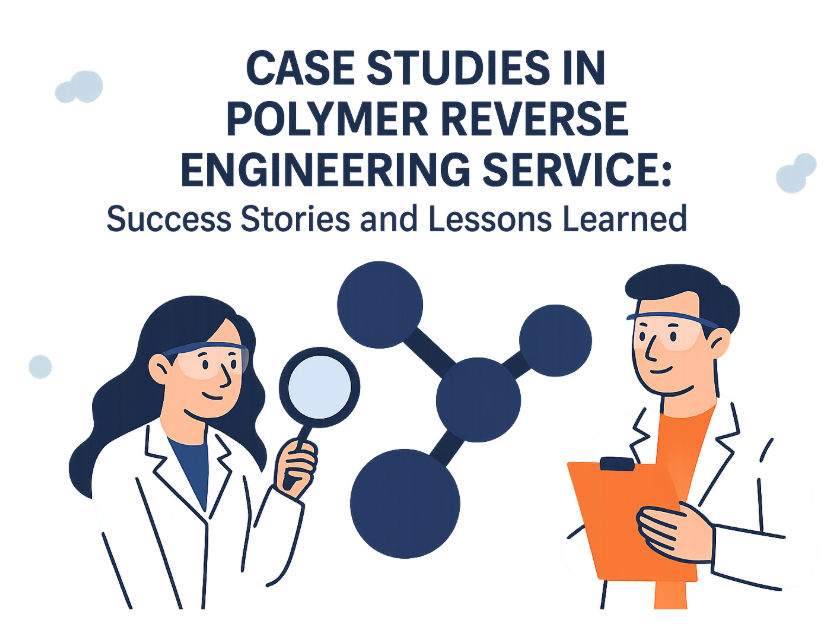
What is Polymer Reverse Engineering?
Polymer reverse engineering is a process where scientists break down and analyze plastic or rubber materials to understand how they’re made. This includes identifying:
- The base polymer
- Additives like stabilizers, colorants, or plasticizers
- How the material behaves with heat or chemicals
- Molecular weight and how it’s distributed
It’s often used to:
- Recreate competitor products
- Investigate product failures
- Improve existing formulations
- Ensure regulatory compliance
Learn more: Reverse Engineering Service for Polymers in Medical Devices: Innovations and Challenges
🧪 Case Study 1: Understanding a Medical Catheter Material
Client Problem:
A medical device company wanted to copy a flexible and solvent-resistant catheter but didn’t know what materials were used.
Our Solution:
- We used FTIR and DSC to find the polymer blend.
- TGA revealed heat stability and additive loss.
- GC-MS detected plasticizers and stabilizers.
- GPC helped find the molecular weight.
Result:
We helped them replicate the material successfully for FDA submission after doing extractables/leachables testing.
👉 Learn more about Impurity Profiling for Generic USFDA Submissions
🔧 Case Study 2: Cracking in an Automotive Gasket
Client Problem:
An automotive supplier reported cracks in rubber gaskets under heat.
Our Solution:
- DSC & TGA showed poor heat resistance.
- FTIR identified degraded NBR rubber.
- SEM-EDX detected contamination by chlorine.
- The root cause was traced to PVC contamination.
Result:
The client changed their process and materials, fixing the issue.
✅ Related: Crosslinked Polymer Analysis: Challenges in Structural Elucidation
🎥 Case Study 3: Recreating a Barrier Film for Packaging
Client Problem:
A startup wanted to replicate a competitor’s 5-layer plastic film that blocked oxygen well.
Our Solution:
- Microscopy mapped film structure.
- DSC & FTIR identified materials (like EVOH).
- GC-MS revealed additives.
- We studied the surface treatment (like corona discharge).
Result:
We provided a full report to help their manufacturer recreate the film.
🎯 Read: How Polymer Nanoparticles are Made: A Step-by-Step Guide
🧰 Techniques Used in Reverse Engineering
Here’s a list of methods we use to study unknown polymers:
| Technique | Purpose |
|---|---|
| FTIR | Find polymer type by functional groups |
| DSC | Check melting point and glass transition |
| TGA | See how material behaves when heated |
| GC-MS | Detect additives like plasticizers or antioxidants |
| GPC | Measure molecular weight |
| SEM-EDX | Analyze fillers and surface composition |
Each case may need a different set of tools depending on the complexity.
🏆 Why Choose Resolvemass?
At Resolvemass Laboratories Inc., our Polymer Reverse Engineering service helps clients:
- Improve or replicate materials
- Investigate failures
- Understand their competitors
- Get through regulatory hurdles
With our advanced labs, qualified scientists, and deep industry experience, we provide detailed, actionable reports — not just raw data.
Want to dive deeper into advanced analytical techniques?
📖 Explore: Molecular Weight and Polydispersity Estimation of Polymers
📘 References
- Lewis PR. Forensic Polymer Engineering: Why polymer products fail in service. Woodhead Publishing; 2016 Jun 9.
- De Brito MP, Dekker R, Flapper SD. Reverse logistics: a review of case studies. Springer Berlin Heidelberg; 2005.
- Gupta SD, Mukhopadhyay R, Baranwal KC, Bhowmick AK. Reverse engineering of rubber products: Concepts, tools, and techniques. CRC press; 2013 Sep 19.

Case Study: Immunogenicity Risk Assessment of a New Impurity in a Generic Peptide ANDA
Introduction: Immunogenicity Risk Assessment of Peptide Impurities is a key part of pharmaceutical development whenever…
Is Peptide Synthesis the Same as Protein Manufacturing?
Introduction: Peptide Synthesis vs Protein Manufacturing is an important distinction in pharmaceutical development, biotechnology, and…
Is It Better to Use One Integrated CDMO or Multiple Specialized Vendors?
Introduction Selecting between an integrated contract development and manufacturing organization (CDMO) and multiple specialized vendors…

Afucosylation, Sialylation, and High Mannose: What Glycan Profiling Analysis for Biosimilar Characterization Reveals About Efficacy and Safety
Introduction Glycan profiling analysis for biosimilar characterization provides valuable insights into how critical N-glycoforms, particularly…

Same Sequence, Different Shape: Why Higher Order Structure Analysis for Biosimilar Characterization Can’t Be Skipped
Introduction Higher Order Structure Analysis for Biosimilar Characterization is essential because proteins with identical primary…
Clinical Trial Material Manufacturing at a CDMO: Phase I and II Supply Planning
Introduction: Clinical Trial Material Manufacturing for Phase I and II is a critical part of…


