
Introduction
CMC Due Diligence Support involves a comprehensive assessment of the technical, regulatory, and quality aspects of drug substance and drug product assets to minimize risks associated with biopharmaceutical licensing transactions and investment decisions. Evaluating Chemistry, Manufacturing, and Controls (CMC) documentation ensures that an asset’s clinical trial efficacy and safety findings are supported by a scalable manufacturing process capable of meeting commercial production requirements. In today’s biopharmaceutical transaction landscape, CMC Due Diligence Support serves as a critical technical link between scientific proof-of-concept, manufacturing feasibility, and successful commercial market entry. While legal teams assess patent claims and financial analysts develop risk-adjusted Net Present Value (rNPV) models, technical due diligence determines whether a compound can be consistently manufactured in compliance with current Good Manufacturing Practice (cGMP) standards without unforeseen cost increases or regulatory enforcement actions.
A thorough evaluation of manufacturing processes and regulatory documentation requires specialized expertise in comprehensive CMC services to identify potential technical and compliance risks before a transaction is finalized.
Identifying manufacturing deficiencies during transaction assessments helps acquiring organizations and private equity firms avoid inheriting undisclosed technical and financial liabilities. Such liabilities may include inadequately characterized degradants, inconsistent batch genealogies, analytical assays without proper validation, or substantial manufacturing yield losses during scale-up. A comprehensive technical assessment examines every component of Common Technical Document (CTD) Module 3, comparing the claims presented in investment presentations and pitch decks with supporting primary evidence, including laboratory notebooks, Master Batch Records (MBRs), certificate of analysis (CoA) registries, and official regulatory correspondence.
Share via:
Quick Summary:
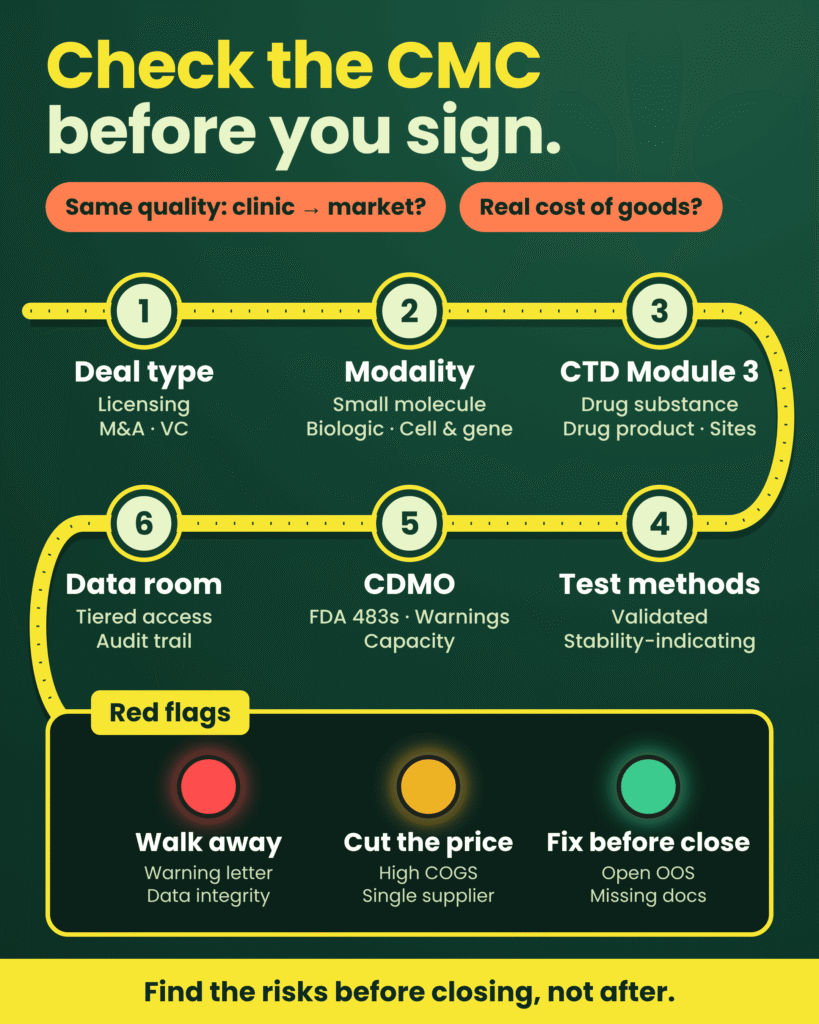
- Purpose: CMC due diligence checks whether a drug asset can be made consistently, at commercial scale, under cGMP, and at a viable cost before a licensing deal, acquisition or investment closes. It works alongside legal (patent) and financial (rNPV) reviews.
- Core objectives: The review confirms that batches stay comparable from preclinical and clinical lots through to commercial production. It also builds realistic cost-of-goods (COGS) models from yields, raw materials, cycle times and CDMO fees.
- Deal-specific focus: Licensing deals focus on tech transfer and reproducibility. M&A focuses on cGMP history, facility readiness and supply chain. VC audits focus on stage-appropriate CMC, scale-up limits and future capital needs.
- Modality-specific review:
- Small molecules are judged on synthetic route, starting materials, polymorphs and impurities.
- Biologics are judged on cell banks, glycosylation, aggregation and viral clearance.
- Cell and gene therapies are judged on vectors, potency assays, donor variability and cold chain.
- CTD Module 3 and analytical methods: Drug substance, drug product, stability and facility sections are checked against primary records such as batch records, CoAs and lab notebooks. Analytical methods must be validated (ICH Q2(R2)) and stability-indicating, as shown by forced degradation studies.
- CDMO oversight: This covers inspection history (FDA 483s, EIRs, warning letters), the strength of the quality system (OOS backlog, CAPA effectiveness), and whether the site has the capacity and technical fit for tech transfer.
- Red flags and data room: Issues are sorted into three groups:
- Deal breakers, such as an active warning letter or data integrity problems, can stop the deal.
- Valuation discounts, such as high COGS or a single supplier, reduce the price.
- Pre-closing fixes, such as open OOS investigations or missing documents, must be resolved before closing.
Strategic Objectives of CMC Due Diligence Support in Technical Valuation
Technical due diligence examines manufacturing reproducibility, regulatory compliance history, production economics, and batch comparability to develop reliable risk-adjusted Net Present Value (rNPV) models. This systematic auditing approach helps acquirers and institutional investors identify potential manufacturing liabilities before completing a transaction, preventing unexpected technical issues from compromising commercialization.
Cross-Phase Batch Comparability and Data Integrity
One of the primary objectives of technical due diligence is to establish whether manufacturing processes remain comparable across materials used in preclinical toxicology studies, early clinical trial phases, and proposed commercial-scale production. Changes in synthetic routes, cell lines, manufacturing scales, or contract manufacturing facilities may introduce subtle variations in impurity profiles and physicochemical characteristics. Due diligence specialists examine batch genealogy matrices to establish whether the clinical safety and efficacy findings generated using earlier development batches remain applicable to materials manufactured through the proposed commercial production process.
Cost of Goods Sold (COGS) Modeling and Scale-Up Economics
A detailed technical audit examines raw material consumption, stoichiometric yields, manufacturing cycle times, and CDMO tolling charges to develop realistic Cost of Goods Sold (COGS) estimates. For complex therapeutic modalities, including antibody-drug conjugates (ADCs), autologous cell therapies, and mRNA-LNP constructs, inefficient manufacturing processes and suboptimal yields can substantially increase production costs. In some cases, these expenses may exceed the commercial reimbursement limits associated with the intended therapeutic indication. Evaluating COGS under practical manufacturing conditions helps ensure that transaction valuations and financial agreements accurately reflect the asset’s achievable production economics and gross margin potential.
| Transaction Archetype | Core Diligence Objective | Primary Technical Documents Audited | Primary Risk Exposure Identified |
|---|---|---|---|
| Out-Licensing / In-Licensing Deals | Establish technical transferability, manufacturing reproducibility, and freedom-to-operate across intended geographical markets. | Development reports, analytical validation protocols, CDMO quality agreements, and CTD Module 3 filings. | Process comparability deficiencies, analytical method transfer failures, and inadequately characterized impurities. |
| Corporate M&A / Asset Acquisitions | Evaluate historical cGMP compliance, manufacturing facility readiness, and overall supply chain security. | Site inspection records (FDA Form 483s/EIRs), MBRs, deviation/CAPA documentation, and regulatory agency meeting minutes. | Regulatory warning letters, compulsory facility remediation expenses, and recurring batch release OOS issues. |
| Venture Capital / Equity Investment Audits | Determine whether the CMC package is appropriate for the development stage, identify scale-up limitations, and evaluate projected capital requirements. | Preclinical safety batch assessments, initial stability packages, preliminary COGS models, and IP claims. | Insufficient funding for scale-up milestones, dependence on unvalidated non-GMP processes, and single-source vendor dependencies. |
Implementing CMC Due Diligence Support Across Modalities
Assessing different therapeutic modalities requires specialized due diligence frameworks that address their individual manufacturing requirements and technical challenges. Small molecule evaluations primarily concentrate on synthetic pathways and polymorphic stability, whereas biologics and cell therapies require greater attention to bioprocess reproducibility, vector integrity, and cold-chain management.
Small Molecule Modalities
Technical audit procedures for small molecules primarily examine synthetic route optimization, starting material selection under ICH Q11, polymorph screening, salt selection, enantiomeric control, residual solvent profiles (ICH Q3C), and elemental impurity controls (ICH Q3D). Auditors evaluate critical process parameters (CPPs) throughout individual reaction stages to determine whether established operating ranges are appropriate and whether the manufacturing process consistently achieves effective impurity rejection.
A detailed review of API manufacturing documentation and drug substance CMC requirements helps identify gaps in synthetic route control, material characterization, and manufacturing reproducibility.
Biologic Modalities (Monoclonal Antibodies, Recombinant Proteins, ADCs)
For biologics, due diligence activities emphasize cell line stability, master/working cell bank (MCB/WCB) characterization, post-translational modifications (e.g., glycosylation profiles), charge variant distribution, and aggregation kinetics. Technical evaluators assess bioreactor harvest yields, downstream chromatography purification performance, virus clearance validation studies, and conjugation efficiency in antibody-drug conjugates (ADCs). These assessments help establish whether the manufacturing process can consistently produce biologics with the required quality attributes and acceptable batch-to-batch consistency.
Advanced Therapy Medicinal Products (Cell and Gene Therapies)
Evaluations of Advanced Therapy Medicinal Products prioritize autologous or allogeneic cell sourcing, vector design, transfection efficiency, potency assay validation, donor variability management, aseptic fill-finish integrity, and cryogenic supply chain requirements. Since the manufacturing process directly determines the characteristics of the final therapeutic product in cell and gene therapies, technical auditors carefully examine analytical comparability documentation whenever manufacturing process modifications are introduced.
Comprehensive Audit Framework for CTD Module 3 in CMC Due Diligence Support
Reviewing Common Technical Document (CTD) Module 3 documentation establishes whether drug substance and drug product characterization activities satisfy applicable regulatory expectations at each development milestone. A comprehensive technical assessment compares primary laboratory records, stability study reports, and analytical validation documentation against the manufacturing and quality claims presented during transaction negotiations.
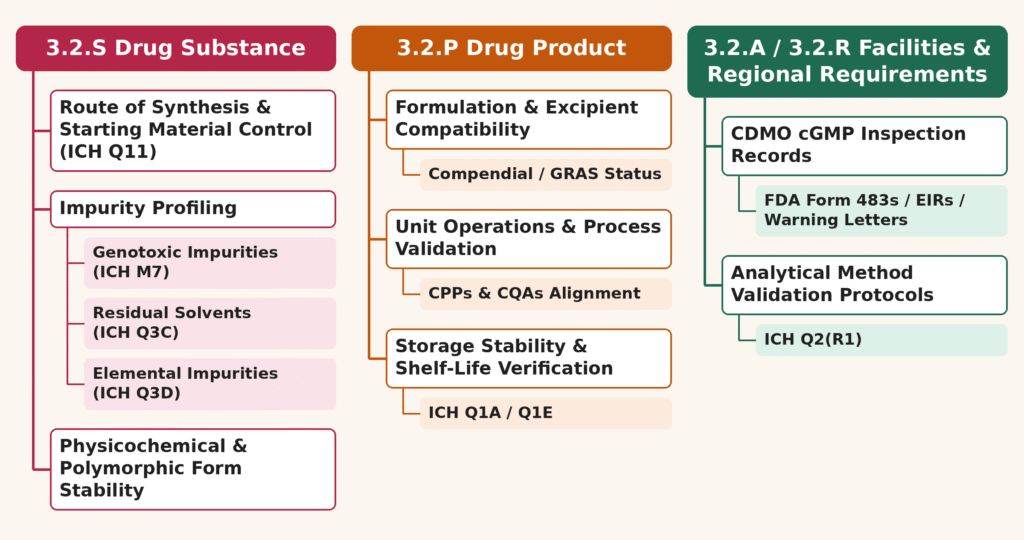
Module 3 Technical Evaluation Architecture
Drug Substance Evaluation (Section 3.2.S)
Assessing drug substance development requires a detailed examination of raw material specifications, intermediate isolation procedures, synthetic or biosynthetic control strategies, and impurity profiles. These elements help establish whether the active pharmaceutical ingredient (API) can be manufactured consistently while maintaining the required quality attributes.
- Regulatory Status of Starting Materials: Verify that designated starting materials meet the criteria established under ICH Q11. This assessment helps prevent regulatory authorities from reclassifying late-stage intermediates as starting materials during marketing authorization reviews, which could result in additional documentation requirements and manufacturing control expectations.
- Control of Mutagenic Impurities: Examine risk assessments conducted under ICH M7 guidelines to confirm that potential mutagenic impurities have been appropriately identified, quantified, and controlled below applicable acceptable threshold limits. This review establishes whether the impurity control strategy adequately addresses potential genotoxicity concerns.
- Polymorph and Particle Size Integrity: Confirm that the solid-state forms of the API have been adequately identified and characterized. Physical characteristics, particularly particle size distribution, should also be evaluated to determine whether they remain consistent with the formulation’s dissolution requirements and intended product performance.
A comprehensive impurity profiling strategy supports the identification and evaluation of potentially hazardous impurities throughout drug substance development.
Drug Product Evaluation (Section 3.2.P)
Assessing drug product manufacturing involves reviewing formulation composition, excipient safety characteristics, manufacturing process validation, and product stability data. These evaluations establish whether the finished dosage form can consistently meet its intended quality specifications throughout its proposed shelf life.
- Excipient Compliance and GRAS Status: Confirm that all inactive ingredients comply with relevant compendial requirements, including USP/NF and Ph. Eur., and possess Generally Recognized as Safe (GRAS) status, where applicable, under 21 CFR Part 170.3. The assessment should also establish whether excipient selection is supported by appropriate safety and compatibility documentation.
- Process Parameter Ranges and Validation: Review critical process parameters (CPPs) across individual manufacturing operations, including blending, wet granulation, compression, sterile filtration, and lyophilization. This assessment determines whether the established operating ranges are adequately controlled and supported by process validation evidence demonstrating manufacturing capability.
- Container-Closure System Integrity: Evaluate the compatibility of primary packaging materials with the drug product, including extractables and leachables profiles and moisture and oxygen barrier properties. These assessments help establish whether the container-closure system can protect product quality throughout manufacturing, storage, and distribution.
Specialized extractables and leachables assessments help evaluate potential packaging-related contamination and container-closure compatibility risks.
| CTD Module 3 Section | Key Technical Parameter | Mandatory Proving Documentation | High-Risk Red Flag Signal |
|---|---|---|---|
| 3.2.S.2 Synthesis & Controls | Synthetic route robustness and starting material designation. | Process development reports, ICH Q11 justification dossiers, and manufacturing yield records. | Late-stage synthetic route modifications without supporting process comparability data. |
| 3.2.S.3 Characterization | Impurity profiles and solid-state stability. | Forced degradation reports, ICH M7 mutagenic impurity evaluations, and NMR/XRPD spectra. | Unidentified degradation peaks exceeding applicable ICH identification thresholds. |
| 3.2.P.2 Formulation | Excipient compatibility and functional performance. | Pre-formulation studies, excipient CoA records, and dissolution profile datasets. | Use of novel, non-compendial excipients without adequate safety and toxicological documentation. |
| 3.2.P.8 Stability | Real-time and accelerated shelf-life verification. | ICH Q1A/Q1E stability study results and photostability reports (ICH Q1B). | Out-of-specification degradation trends emerging during long-term storage studies. |
Analytical Method Validation and Forced Degradation Profiling
Evaluating analytical procedures establishes whether the methods used for batch release testing and stability monitoring have been appropriately validated in accordance with ICH Q2(R1) guidelines and can reliably separate and quantify degradation products. Effective stability-indicating analytical methods are essential for preventing unidentified or inadequately characterized degradants from compromising shelf-life claims, product quality, or clinical safety assessments.
Technical due diligence specialists review analytical validation reports covering essential parameters such as specificity, linearity, range, precision (repeatability and intermediate precision), accuracy, limit of detection (LOD), limit of quantitation (LOQ), and method robustness. Forced degradation studies and associated stress-testing data are also examined to determine whether the analytical methods can adequately resolve degradation products generated under heat, light, humidity, acid/base hydrolysis, and oxidative stress conditions. If the available analytical procedures do not demonstrate sufficient stability-indicating capability, previously generated stability datasets may no longer provide reliable evidence for product quality assessment. Such deficiencies can necessitate complete analytical method re-validation and additional testing of development batches, increasing both development timelines and associated costs.
Independent analytical method development and validation helps establish reliable testing procedures and address analytical gaps identified during technical assessments.
Risk Mitigation and CDMO Oversight in CMC Due Diligence Support
Contract Development and Manufacturing Organization (CDMO) oversight involves evaluating manufacturing facility compliance, technical capabilities, quality management systems, and production capacity to minimize potential supply chain disruptions. Independent CDMO assessments help determine whether third-party manufacturing facilities maintain appropriate cGMP compliance and operate without unresolved regulatory sanctions or significant quality deficiencies. These evaluations also establish whether manufacturing partners can support the asset’s development requirements and future commercial supply obligations.
Quality Systems and Regulatory Inspection History Audits
Assessing third-party manufacturing partners requires a detailed review of their regulatory inspection history, including FDA Form 483 observations, Establishment Inspection Reports (EIRs), Warning Letters, and EMA EudraGMDP records. Technical evaluators also examine the organization’s internal Quality Management Systems (QMS), with particular attention to the outstanding backlog of Out-of-Specification (OOS) investigations, deviation closure timelines, and the effectiveness of Corrective and Preventive Action (CAPA) procedures.
These assessments help identify recurring compliance problems, inadequate investigation practices, and weaknesses in quality oversight that could affect manufacturing reliability. Reviewing the effectiveness of corrective actions is particularly important because unresolved quality system deficiencies may result in repeated deviations, batch rejection, regulatory scrutiny, or interruptions in commercial manufacturing operations.
Technical Transfer Feasibility and Capacity Constraints
Determining whether a CDMO is technically suitable requires confirmation that its facilities have compatible unit operations, appropriate cleanroom classifications, analytical instrumentation, and containment capabilities for handling high-potency active pharmaceutical ingredients (HPAPIs). Technical due diligence also examines manufacturing capacity commitments, facility utilization rates, personnel continuity, and the governance provisions outlined in Quality Agreements.
Evaluating these operational factors helps establish whether the selected CDMO can accommodate anticipated production volumes, support technology transfer activities, and maintain consistent manufacturing performance as the product advances toward commercialization. Identifying capacity limitations or technical incompatibilities before completing a transaction reduces the likelihood of unexpected technology transfer expenses and future supply interruptions.
Reviewing CDMO chemistry and manufacturing capabilities helps assess external manufacturing readiness, technical resources, and potential capacity constraints.
Identifying Critical Technical Red Flags in Licensing Transactions
Classifying technical red flags allows transaction teams to distinguish between critical liabilities that could prevent a deal from proceeding, deficiencies that require valuation adjustments, and correctable issues that can be addressed through pre-closing contractual commitments. A structured risk identification process helps prospective buyers identify unresolved manufacturing and regulatory problems before assuming responsibility for the acquired asset.
Technical Red Flag Categorization Matrix
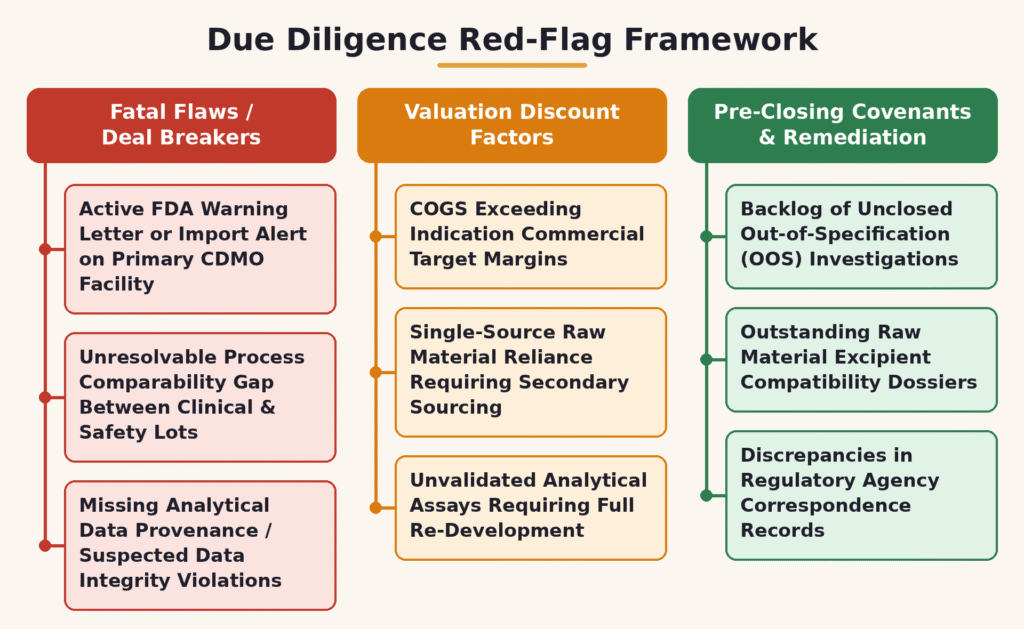
- Fatal Flaws (Deal Breakers): These involve serious regulatory compliance or technical failures that can fundamentally compromise the asset’s development and approval pathway. Examples include active regulatory import alerts affecting primary manufacturing facilities, irreproducible batch genealogies, and major process comparability gaps that cannot be adequately resolved. Such deficiencies may make the asset unsuitable for acquisition unless a credible remediation strategy can be established.
- Valuation Discount Factors: These include operational and manufacturing inefficiencies that may be correctable but require additional capital investment. Examples include inadequate reaction yields, dependence on single-source suppliers, and analytical methods that have not undergone appropriate validation. The financial implications of resolving these issues should be incorporated into the acquisition valuation because they can directly reduce the asset’s expected commercial profitability.
- Pre-Closing Covenants: These refer to technical and documentation deficiencies that can generally be corrected before transaction completion. Examples include unresolved OOS investigation records, incomplete photostability studies, and missing standard operating procedures. The seller may be required to address these deficiencies through specific remediation commitments established as conditions precedent to transaction closing.
| Red Flag Category | Identified Deficiency | Operational & Financial Impact | Deal Remediation Mechanism |
|---|---|---|---|
| Regulatory Enforcement | Active FDA Warning Letter or Import Alert affecting the primary CDMO facility. | Delayed PDUFA dates, mandatory facility re-inspection, and potential supply interruptions. | Require the seller to complete facility remediation before closing or mandate a CDMO technology transfer. |
| Process Comparability | Changes in impurity profiles following manufacturing scale-up or synthetic route modifications. | Potential requirement to repeat Phase 1 clinical trial safety studies. | Adjust the acquisition purchase price and defer closing until adequate process comparability has been demonstrated. |
| Analytical Validation | Release testing assays that have not been validated according to ICH Q2(R1) guidelines. | Batch release delays, potential invalidation of existing stability data packages, and additional testing expenses. | Establish a pre-closing contractual requirement for complete analytical method re-validation. |
| Supply Chain Security | Dependence on a single supplier for critical starting materials or manufacturing reagents. | Increased supply chain disruption exposure and reduced purchasing and pricing flexibility. | Incorporate secondary supplier qualification and associated costs into the transaction valuation model. |
Data Room Governance and Virtual Data Room Access Protocols
Data room governance establishes controlled access arrangements and clean-team procedures to protect proprietary trade secrets while allowing authorized transaction participants to conduct comprehensive technical assessments. A well-structured information management system helps organizations comply with non-disclosure obligations and minimize the risk of intellectual property leakage during domestic and cross-border licensing negotiations.
Tiered Access Architecture and Clean-Team Management
Because potential licensing partners may operate competing commercial development programs, virtual data rooms must separate confidential technical information from general corporate documentation. Information access protocols should restrict sensitive records to specifically authorized subject-matter experts who are bound by appropriate clean-team non-disclosure agreements.
For example, proprietary synthetic process details, specific cell culture media formulations, and third-party financial royalty arrangements may require additional access restrictions. Such information can be disclosed progressively as negotiations advance, with certain sensitive details remaining redacted until the final stages of the transaction. This tiered approach allows technical experts to review the information necessary for due diligence while protecting commercially sensitive intellectual property.
Reconstructable Evidence Audit Trails
An audit-ready virtual data room (VDR) should organize technical documentation according to the structure of CTD Module 3, making it easier for reviewers to trace individual claims back to their original supporting evidence. Every technical statement presented in an investor presentation or transaction summary should contain a direct hyperlink to the relevant primary laboratory reports, manufacturing batch records, and official regulatory correspondence.
VDR tracking systems should also maintain comprehensive records of reviewer access histories, document viewing durations, and download activities. These records establish an auditable history of information disclosure, improve document accountability, and help organizations demonstrate that confidential technical information has been accessed and shared in accordance with established transaction protocols.
Conclusion: Maximizing Asset Value Through CMC Due Diligence Support
Integrating specialized CMC Due Diligence Support into transaction evaluation workflows strengthens asset valuation, supports regulatory approval planning, and protects institutional investment capital. A comprehensive technical assessment establishes whether a therapeutic asset can progress from clinical development to consistent, commercially viable manufacturing. By verifying CTD Module 3 documentation completeness, cross-phase batch comparability, analytical method validation, and CDMO network reliability, transaction teams can identify manufacturing weaknesses and address potential technical liabilities before completing an acquisition or licensing agreement.
Implementing a structured CMC evaluation framework protects acquiring organizations and investors from unexpected technical and regulatory liabilities while enabling sellers to present well-documented, audit-ready technical packages that support stronger transaction valuations. To discuss specialized technical auditing requirements or obtain expert assistance with upcoming pharmaceutical licensing transactions and investor audits, visit the ResolveMass Contact Page.
Frequently Asked Questions
The duration of a technical CMC due diligence assessment depends on the complexity of the therapeutic asset, the volume of available documentation, and the number of manufacturing facilities involved. A focused review of a single clinical-stage asset generally takes approximately 2 to 4 weeks. More extensive corporate transactions involving multiple CDMO facilities, advanced therapy platforms, or regulatory submissions across different countries may require 6 to 12 weeks for comprehensive evaluation.
Common CMC deficiencies identified during technical audits include insufficiently characterized impurities, analytical methods that lack stability-indicating capabilities, incomplete batch genealogy records, and reduced manufacturing yields following scale-up. Other significant concerns include unresolved FDA Form 483 observations, dependence on single-source raw material suppliers, and unrealistic Cost of Goods Sold (COGS) projections. These issues can increase development expenses, delay regulatory approvals, and create unexpected manufacturing liabilities for acquiring organizations.
CMC due diligence for small molecule products primarily examines synthetic route consistency, polymorphic stability, residual solvent levels, and elemental impurity controls. In contrast, cell and gene therapy (CGT) assessments emphasize donor material traceability, vector transduction efficiency, potency assay validation, aseptic manufacturing controls, and cryogenic supply chain management. These modality-specific evaluations help determine whether the manufacturing process can consistently maintain the required product quality and therapeutic characteristics.
Batch genealogy verification establishes the manufacturing history of individual drug substance and drug product lots used throughout preclinical and clinical development. It confirms whether these batches were manufactured using documented processes and adequately controlled parameters that support cross-phase comparability. Incomplete or inconsistent genealogy records may raise regulatory concerns about the relevance of historical safety and efficacy findings, potentially resulting in additional investigations, regulatory delays, or requirements for further comparability studies.
CMC due diligence provides technical findings that can significantly influence risk-adjusted Net Present Value (rNPV) calculations by identifying manufacturing expenses and regulatory uncertainties that may not be reflected in initial financial projections. Additional costs associated with CDMO technology transfers, process re-validation, manufacturing optimization, and increased COGS can reduce projected profitability. Furthermore, unresolved technical and regulatory deficiencies may lower the estimated probability of technical and regulatory success (PTRS), directly affecting the asset’s overall investment valuation.
Analytical method validation establishes whether quality control procedures are scientifically reliable and suitable for their intended applications under ICH Q2(R1) guidelines. During due diligence, specialists examine validation parameters to determine whether analytical methods can accurately identify and quantify impurities, detect degradation products, and monitor changes in product quality over time. Inadequately validated methods can undermine existing stability datasets, compromise batch release decisions, and necessitate additional analytical development before regulatory submissions.
CDMO compliance assessments involve reviewing regulatory inspection records, including FDA Form 483 observations, Warning Letters, Establishment Inspection Reports (EIRs), and relevant internal Out-of-Specification (OOS) investigation records. Auditors also examine the effectiveness of Corrective and Preventive Action (CAPA) systems, deviation management procedures, and outstanding quality investigations. Identifying unresolved compliance deficiencies helps investors evaluate the possibility of manufacturing interruptions, regulatory enforcement, facility remediation expenses, or mandatory technology transfers.
Transaction teams implement controlled information-sharing procedures to prevent unauthorized disclosure of confidential manufacturing information during licensing negotiations and acquisition assessments. Common safeguards include tiered document permissions, selective redaction of proprietary manufacturing processes, restricted disclosure of secondary supplier information, and clean-team agreements for reviewers associated with competing organizations. These measures ensure that authorized technical experts can examine essential CMC documentation while maintaining confidentiality and protecting intellectual property under applicable non-disclosure obligations.
Asset licensing CMC due diligence concentrates on the technical suitability of a specific therapeutic asset, including manufacturing reproducibility, technology transfer requirements, process specifications, and freedom-to-operate within the intended geographical markets. Corporate M&A CMC due diligence involves a broader assessment of the acquiring company’s manufacturing infrastructure, historical cGMP compliance, environmental obligations, quality management systems, and regulatory liabilities across its entire product portfolio. This distinction helps transaction teams identify asset-specific development risks in licensing agreements and organization-wide operational exposures in corporate acquisitions.
Reference:
- United States Pharmacopeia. (n.d.). Model-informed due diligence and valuation: M&A asset valuation and reducing risk. https://www.usp.org/events-training/course/model-informed-due-diligence-and-valuation-ma-asset-valuation-and-reducing
- Popkin, M. E., Goese, M., Wilkinson, D., Finnie, S., Flanagan, T., Campa, C., Clinch, A., Teasdale, A., Lennard, A., Cook, G., Mohan, G., & Osborne, M. D. (2022). Chemistry manufacturing and controls development, industry reflections on manufacture, and supply of pandemic therapies and vaccines. The AAPS Journal, 24(6), Article 101. https://doi.org/10.1208/s12248-022-00751-9
- Moparthi, R. (2024). CMC and regulatory affairs professional: Ensuring effective compliance strategies. Journal of Electrical Systems, 20(8s), 567–574. https://doi.org/10.52783/jes.9003
- U.S. Food and Drug Administration. (n.d.). Chemistry, manufacturing, and controls (CMC) guidances for industry (GFIs) and questions and answers (Q&As). https://www.fda.gov/animal-veterinary/guidance-industry/chemistry-manufacturing-and-controls-cmc-guidances-industry-gfis-questions-and-answers
Get In Touch With Us
About The Author