

Introduction
Verifying the regulatory compliance of an analytical contract testing laboratory begins with confirming that the facility maintains an active and compliant status in Health Canada’s Drug and Health Products Inspections Database (DHPID), followed by a thorough review of its physical Drug Establishment Licence (DEL) information. This verification process ensures that analytical data generated for drug release testing, stability programs, impurity profiling, and other regulated activities fully comply with Good Manufacturing Practices (GMP) requirements.
The objective of this Drug Establishment Licence (DEL) Explained guide is to provide pharmaceutical sponsors, quality assurance professionals, and regulatory affairs teams with a practical framework for assessing the compliance status of contract analytical laboratories operating in Canada. Under Part C, Division 1A of the Food and Drug Regulations (FDR), every Canadian drug establishment performing licensable activities must possess a valid Drug Establishment Licence. These licensable activities include fabricating, packaging/labelling, testing, importing, distributing, and wholesaling drug products. Among these activities, analytical testing represents one of the most critical quality control functions because laboratories confirm the safety, identity, strength, and purity of pharmaceutical products before they are released to patients. Failure to verify that a contract testing laboratory is authorized to perform specific testing activities for designated dosage forms can expose pharmaceutical sponsors to substantial regulatory, legal, and operational consequences, including product recalls, licence suspensions, or enforcement actions.
Although routine research and development testing generally does not require a Drug Establishment Licence, analytical testing conducted in support of clinical studies involving marketed products or commercial product release must comply with GMP requirements and falls under Health Canada’s regulatory oversight. Established contract research organizations (CROs) and contract development and manufacturing organizations (CDMOs), including ResolveMass Laboratories Inc. in Laval, Québec, combine advanced analytical capabilities with active regulatory authorizations. ResolveMass holds Health Canada Drug Establishment Licence 3-002945-A along with United States FDA Registration 3042696771, enabling regulatory acceptance of analytical data across multiple international jurisdictions.
Share via:
Article Summary:
- A valid Drug Establishment Licence (DEL) is essential for Canadian laboratories performing regulated pharmaceutical activities such as analytical testing, product release testing, importing, and manufacturing under Health Canada requirements.
- Before selecting a contract testing laboratory, sponsors should verify its active “Compliant (C)” status in Health Canada’s Drug and Health Products Inspections Database (DHPID) and confirm that its DEL covers the specific testing activities and dosage forms required.
- Regulatory compliance extends beyond holding a licence. Laboratories should also demonstrate validated analytical methods, GMP-compliant quality systems, complete documentation, and robust data integrity controls to ensure reliable and defensible analytical results.
- Quality audits should assess critical GMP elements, including computerized system validation, audit trails, Out-of-Specification (OOS) investigations, equipment qualification, quality agreements, and documentation practices to reduce regulatory and operational risks.
- ISO/IEC 17025 accreditation and Health Canada GMP compliance serve different purposes. While ISO 17025 confirms technical competence, only an active DEL with GMP compliance authorizes laboratories to generate analytical data acceptable for commercial pharmaceutical release in Canada.
- Canadian importers using overseas analytical laboratories must ensure those facilities are listed on the Foreign Building (FB) Annex of their Drug Establishment Licence and maintain current GMP evidence to preserve import authorization.
- Conducting a comprehensive DEL verification before outsourcing analytical work helps pharmaceutical companies minimize compliance risks, avoid regulatory delays, strengthen submission readiness, and ensure the integrity of analytical data used in global regulatory filings.
Technical Compliance and Oversight: Drug Establishment Licence (DEL) Explained
Health Canada grants a Drug Establishment Licence only after confirming that a facility consistently complies with stringent Good Manufacturing Practices (GMP) requirements. The licence serves as formal authorization for designated buildings to perform defined pharmaceutical activities involving both human and veterinary drug products.
From a regulatory perspective, the DEL framework enables Health Canada to maintain direct GMP oversight throughout the pharmaceutical supply chain. Any establishment involved in handling prescription or regulated non-prescription drugs in a manner defined under the Food and Drugs Act must maintain a valid Drug Establishment Licence and an acceptable compliance status. Importantly, a DEL is not a universal authorization covering every pharmaceutical activity or dosage form. Instead, the licence clearly identifies the physical location of the authorized facility, specifies the licensable activities permitted, identifies the applicable drug categories, and indicates whether the establishment is approved to handle sterile or non-sterile dosage forms.
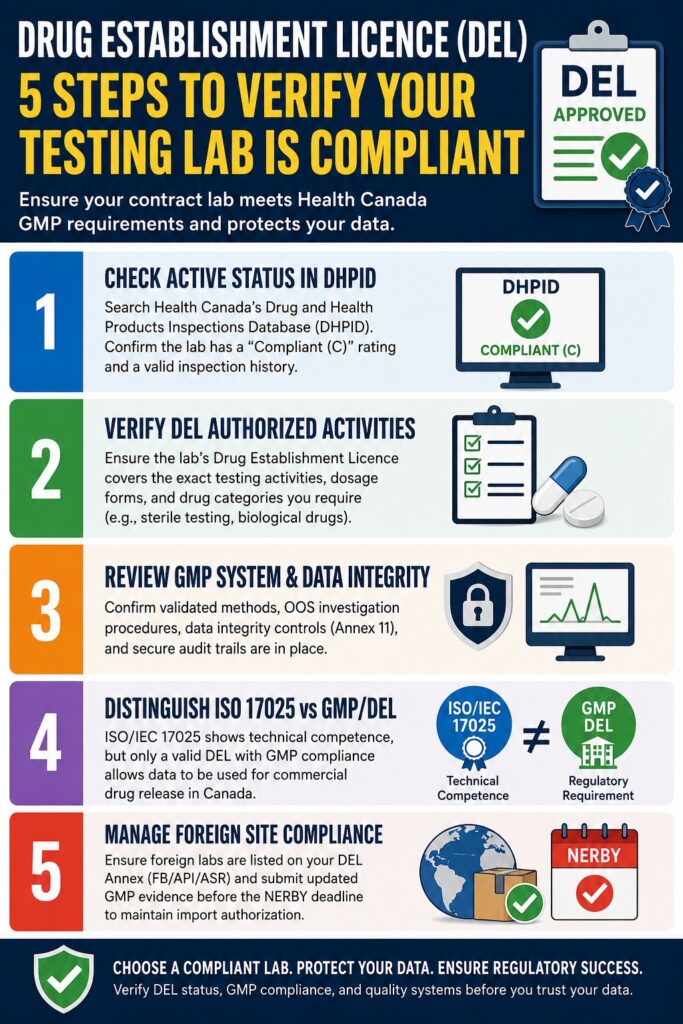
For contract analytical laboratories, compliance verification must demonstrate that the facility is licensed to perform the exact analytical services required by the sponsor. For example, a laboratory authorized solely for non-sterile chemical analyses cannot legally conduct sterility testing or bacterial endotoxin testing for sterile injectable products. Likewise, when analytical work involves biological drugs classified under Schedule D or radiopharmaceuticals regulated under Schedule C, the laboratory must possess the corresponding authorizations within its Drug Establishment Licence. Utilizing a laboratory that lacks the required DEL authorization presents significant regulatory risk because Health Canada does not recognize analytical data generated at a non-compliant facility. As a result, regulatory submissions, including New Drug Submissions (NDS) and Abbreviated New Drug Submissions (ANDS), may be delayed, rejected, or deemed unacceptable.
Verifying Analytical Methods Within the Drug Establishment Licence (DEL) Explained Structure
Verification of analytical testing compliance extends beyond confirming the existence of a valid Drug Establishment Licence. Sponsors must also verify that the laboratory performs validated analytical methods within a fully compliant GMP quality system. This evaluation ensures that quantitative and qualitative analytical procedures consistently produce accurate, precise, reliable, and scientifically defensible results.
Within the regulatory framework, analytical procedures used for finished product testing and active pharmaceutical ingredient (API) assays should be validated according to internationally recognized requirements, including the International Council for Harmonisation (ICH) Q2(R2) guideline. Compliance auditors should confirm that the laboratory’s Quality Management System (QMS) contains comprehensive procedures governing analytical method validation, method verification, and analytical method transfer. When contract laboratories perform technically sophisticated analyses—such as nitrosamine impurity quantification, extractables and leachables (E&L) studies, or peptide sequencing—the corresponding analytical methods must undergo complete GMP-compliant validation to minimize the risk of inaccurate or misleading results. Regulatory authorities also expect laboratories to maintain complete supporting documentation, including validation protocols, analytical raw data, chromatography records, validation reports, and all associated technical documentation.
Step-by-Step Protocol for Verification via Health Canada Databases
Verification of a domestic or foreign analytical testing laboratory begins by searching the Drug and Health Products Inspections Database (DHPID) to confirm that the establishment currently holds an active “Compliant” regulatory status. This publicly accessible database replaced previous inspection listings and provides comprehensive information regarding inspection history, compliance outcomes, and regulatory status.
Health Canada established the DHPID to promote regulatory transparency and improve public access to inspection information. The database contains records of inspections performed since 2012 for both Canadian establishments and authorized foreign facilities. To perform a comprehensive compliance assessment, quality assurance personnel should search the database using the establishment’s legal business name, geographic location, or specific Drug Establishment Licence number.
The database provides a detailed overview of the laboratory’s regulatory compliance history. During the review process, auditors should verify that the “Rating” column identifies the establishment as “Compliant (C),” confirming that the inspected activities satisfy the requirements of the Food and Drugs Act and the Food and Drug Regulations. If an establishment receives a “Non-compliant (NC)” rating, the facility is no longer authorized to perform regulated activities, and analytical testing conducted during the period of non-compliance may not be accepted by Health Canada. The DHPID also reports the dates of the most recent inspection together with detailed inspection observations categorized according to their assigned risk classifications.
One of the most frequent compliance mistakes within the pharmaceutical industry is confusing the DHPID with other Health Canada regulatory databases, including the Medical Devices Active Licence Listing (MDALL) and the Drug Product Database (DPD). Each database serves a distinct regulatory purpose, and neither MDALL nor DPD provides the GMP inspection records necessary for verifying Drug Establishment Licence compliance. Understanding the differences between these databases is essential for avoiding regulatory verification errors.
| DEL Annex Type | Target Scope & Physical Location | Primary Authorized Activities | Critical Compliance Obligation |
|---|---|---|---|
| Foreign Building (FB) Annex | Foreign establishments performing testing or manufacturing of finished dosage forms (FDF) or sterile active pharmaceutical ingredients (APIs) | Fabrication, packaging, labelling, analytical testing, and release testing | Continuous submission of updated GMP evidence before the NERBY deadline to preserve active import authorization. |
| API Foreign Building Annex | Foreign facilities fabricating, packaging, or testing non-sterile APIs and bulk intermediates | API synthesis, packaging, labelling, and non-release analytical testing | Annual review of Table A during Drug Establishment Licence renewal; amendments are required whenever new API suppliers are added. |
| Alternate Sample Retention (ASR) Annex | Foreign establishments maintaining retention samples on behalf of Canadian importers or distributors | Storage and preservation of finished drug retention samples in accordance with FDR C.02.025 | Maintenance of formal Quality Agreements defining sample retention, storage conditions, and retrieval responsibilities. |
Technical GMP Requirements for Laboratory Compliance
Compliance with Good Manufacturing Practices (GMP) requires analytical testing laboratories to implement rigorous controls over equipment qualification, data integrity practices, computerized systems, and documentation management in accordance with Division 2 of the Food and Drug Regulations. These regulatory controls ensure that analytical results used for commercial product release remain accurate, fully traceable, securely maintained, and scientifically reliable throughout the testing lifecycle.
Within the Canadian regulatory environment, analytical laboratories undergo extensive evaluation during Health Canada GMP inspections. Historically, the Quality Control Department has generated the highest number of significant inspection observations due to the complexity of laboratory operations. To determine whether a testing laboratory complies with GMP requirements, auditors must thoroughly assess how the facility controls its critical analytical processes and quality systems.
One of the most important areas of review involves the management of Out-of-Specification (OOS) analytical results. GMP regulations require laboratories to maintain comprehensive written procedures describing the investigation of OOS findings. An analytical result may only be invalidated when supported by documented scientific evidence and a justified investigation. Simply attributing an unexpected result to “human error” without objective proof represents a serious compliance deficiency and is routinely cited during regulatory inspections.
Modern Health Canada inspections also place significant emphasis on data integrity and computerized system validation. Laboratories must demonstrate that all computerized platforms—including Laboratory Information Management Systems (LIMS), Chromatography Data Systems (CDS), and electronic data management systems—operate in accordance with the expectations outlined in Annex 11 (GUI-0050). Compliance includes validated software applications, controlled user permissions, unique user credentials, secure backup procedures, and protected audit trails that cannot be modified or deleted. The table below summarizes the essential GMP technical requirements expected of a compliant analytical testing laboratory.
| GMP Technical Element | Regulatory Standard & Guidance | Specific Laboratory Expectation | Compliance Risk / Deficiency Impact |
|---|---|---|---|
| Data Integrity and Computer Validation | Annex 11 (GUI-0050), FDR C.02.020 | Validated LIMS and CDS platforms; active, tamper-proof audit trails; secure and traceable data backups | Disabling audit trails or allowing shared user accounts may result in immediate Non-compliant (NC) inspection ratings. |
| OOS & Deviation Investigations | FDR C.02.015, GUI-0001 (Chapter 4) | Documented Phase I and Phase II investigation procedures; objective scientific justification for invalidated results; CAPA integration | Assigning failures to human error without performing a formal root cause investigation is a common critical inspection finding. |
| Premises and Equipment Quality | FDR C.02.004–005, GUI-0001 | Installation Qualification (IQ), Operational Qualification (OQ), and Performance Qualification (PQ) for laboratory instruments; environmental monitoring of cleanrooms | Insufficient equipment calibration or inadequate segregation of laboratory areas increases the risk of cross-contamination. |
| Quality Agreement & Control Systems | FDR C.02.015, GUI-0001, GUI-0104 | Active technical Quality Agreements clearly defining GMP responsibilities between contracting organizations | Absence of formal Quality Agreements creates significant gaps in regulatory accountability and quality oversight. |
ISO 17025 Accreditation vs. Health Canada GMP Compliance
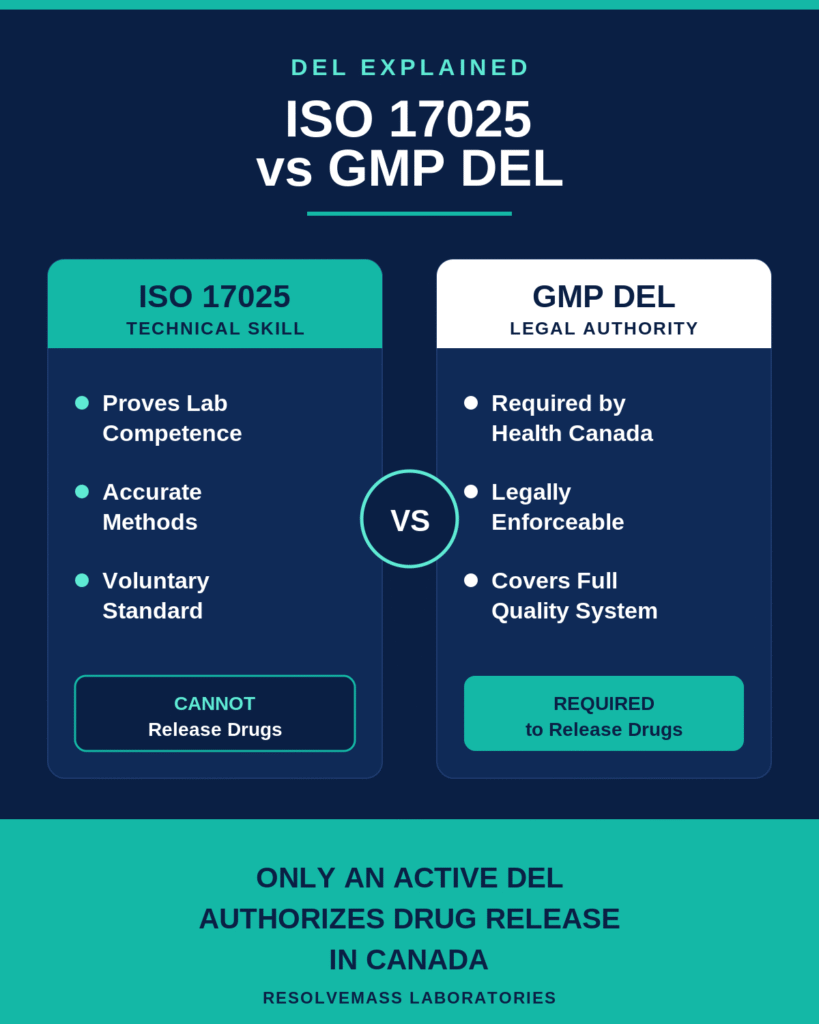
ISO/IEC 17025 accreditation demonstrates a laboratory’s technical competence for performing specific analytical methods, whereas compliance with Health Canada GMP requirements under a Drug Establishment Licence (DEL) represents a legally enforceable, organization-wide regulatory obligation necessary for the release of commercial pharmaceutical products. Although a laboratory may possess ISO/IEC 17025 accreditation, analytical data generated by that laboratory cannot legally support commercial drug release in Canada unless the establishment also maintains an active Drug Establishment Licence.
Quality assurance professionals frequently confuse these two forms of recognition when evaluating external analytical laboratories. ISO/IEC 17025 is an internationally accepted standard that assesses the technical competence, impartiality, and consistency of testing and calibration laboratories. However, the standard does not encompass the comprehensive regulatory requirements established under Division 2 of the Canadian Food and Drug Regulations.
Compliance with GMP under a Drug Establishment Licence requires a significantly broader quality framework. Laboratories must implement a Pharmaceutical Quality System (PQS) that aligns with the principles outlined in ICH Q10, perform routine Product Quality Reviews (PQRs), and maintain oversight by a designated Quality Assurance Person (QAP). This individual must possess a recognized university degree in a relevant scientific discipline, such as chemistry, microbiology, or pharmacy, together with two to five years of pharmaceutical quality assurance experience.
Although ISO/IEC 17025 provides strong assurance of scientific and technical competence, only a fully compliant Drug Establishment Licence Quality System ensures that analytical raw data, method validation activities, documentation practices, and product release procedures will successfully withstand Health Canada regulatory inspections. Leading analytical service providers, including ResolveMass Laboratories Inc., implement integrated quality systems by combining an ISO 9001:2015-certified Quality Management System with an active Health Canada Drug Establishment Licence (3-002945-A) and United States FDA registration, thereby supporting both scientific excellence and regulatory compliance.
Managing Foreign Site Compliance on the DEL Annex
Canadian importers are required to include every foreign analytical testing laboratory on the Foreign Building (FB) Annex of their own Drug Establishment Licence before importing pharmaceutical products tested outside Canada. Maintaining this authorization requires continuous submission of updated GMP compliance evidence before the designated Next Evidence Required By (NERBY) date.
According to Health Canada’s GUI-0080 guidance, whenever drug products are fabricated, packaged, labelled, or analytically tested outside Canada, the foreign establishment must be formally authorized on the Canadian importer’s Drug Establishment Licence. The importer carries the legal responsibility of demonstrating that the foreign facility complies with GMP standards equivalent to those required in Canada. Supporting evidence is submitted to Health Canada’s Regulatory Operations and Enforcement Branch (ROEB) through a Drug Establishment Licence amendment application.
To preserve authorization for the foreign facility, importers must continuously monitor the assigned NERBY date. Before this deadline expires, a complete application containing updated GMP documentation—such as a recent inspection report or a valid Certificate of Compliance (CoC) issued by a Mutual Recognition Agreement (MRA) partner—must be submitted. When the application is received before the NERBY deadline, the foreign establishment remains listed on the Drug Establishment Licence while Health Canada completes its review. Conversely, failure to submit acceptable documentation before the required date may result in removal of the foreign building from the licence. Once removed, the importer is legally prohibited from importing pharmaceutical products tested at that establishment until authorization is restored, a process that may require up to 250 calendar days. Depending on the structure of the international supply chain, importers may also be required to manage multiple DEL annex categories, as summarized below.
| DEL Annex Type | Target Scope & Physical Location | Primary Authorized Activities | Critical Compliance Obligation |
|---|---|---|---|
| Foreign Building (FB) Annex | Foreign establishments performing testing or manufacturing of finished dosage forms (FDF) or sterile active pharmaceutical ingredients (APIs) | Fabrication, packaging, labelling, analytical testing, and release testing | Continuous submission of updated GMP evidence before the NERBY deadline to preserve active import authorization. |
| API Foreign Building Annex | Foreign facilities fabricating, packaging, or testing non-sterile APIs and bulk intermediates | API synthesis, packaging, labelling, and non-release analytical testing | Annual review of Table A during Drug Establishment Licence renewal; amendments are required whenever new API suppliers are added. |
| Alternate Sample Retention (ASR) Annex | Foreign establishments maintaining retention samples on behalf of Canadian importers or distributors | Storage and preservation of finished drug retention samples in accordance with FDR C.02.025 | Maintenance of formal Quality Agreements defining sample retention, storage conditions, and retrieval responsibilities. |
Conclusion
Verifying the compliance status of an analytical contract testing laboratory represents one of the most important regulatory responsibilities in protecting the integrity of the pharmaceutical supply chain. Selecting a laboratory that maintains an active and compliant Drug Establishment Licence (DEL) significantly reduces the risk of regulatory deficiencies, product delays, and enforcement actions.
In conclusion, this Drug Establishment Licence (DEL) Explained guide demonstrates that effective compliance verification requires a systematic and multi-layered evaluation process. Selecting a contract analytical laboratory extends far beyond a routine procurement decision; it is a critical regulatory determination that directly influences the quality, safety, and commercial viability of pharmaceutical products. Laboratories must continuously maintain inspection readiness through validated analytical methods, comprehensive quality systems, strong data integrity controls, and active regulatory licensing. Operating from Laval, Québec, ResolveMass Laboratories Inc. supports pharmaceutical sponsors through advanced analytical services, including nitrosamine testing, custom polymer characterization, and other high-complexity analyses, all performed under its active Health Canada Drug Establishment Licence 3-002945-A, United States FDA registration, and ISO 9001:2015-certified Quality Management System. This integrated quality framework ensures that analytical data remains scientifically robust, regulatory compliant, and suitable for global regulatory submissions.
To initiate a compliant analytical testing program or discuss specialized GMP release testing requirements, pharmaceutical sponsors are encouraged to connect directly with the scientific experts through the official ResolveMass Contact Page.
Frequently Asked Questions (FAQs)
Health Canada generally schedules GMP inspections of domestic drug testing laboratories, fabricators, and packaging facilities on a target cycle of approximately 24 months. Establishments involved in importing, distributing, or wholesaling pharmaceutical products are typically inspected every 36 months. Inspection frequency may be adjusted based on the facility’s compliance history, previous inspection findings, product risk, and overall regulatory performance.
Obtaining a new Drug Establishment Licence usually requires approximately 250 calendar days from the time a complete application is accepted for review. During this period, Health Canada evaluates the applicant’s Pharmaceutical Quality System, supporting documentation, facility readiness, and GMP compliance before conducting an on-site inspection. The licence is issued only after the establishment successfully demonstrates compliance with all applicable regulatory requirements.
A Quality Assurance Person (QAP) is responsible for overseeing the implementation and maintenance of GMP requirements within a licensed pharmaceutical establishment. This individual reviews quality systems, ensures regulatory compliance, approves quality-related activities, and supports inspection readiness. Health Canada expects a QAP to possess a university degree in an appropriate scientific discipline, such as pharmacy, chemistry, or microbiology, together with two to five years of relevant pharmaceutical quality assurance experience.
A “Non-Compliant (NC)” inspection rating can result in the suspension, restriction, or other regulatory actions affecting the laboratory’s Drug Establishment Licence. Once a laboratory loses its compliant status, pharmaceutical sponsors and importers may no longer rely on its analytical testing for regulated activities. To maintain regulatory compliance and prevent disruptions in product supply, testing programs must be transferred to a laboratory that holds an active and compliant Drug Establishment Licence.
Computerized laboratory systems must be validated in accordance with Annex 11 (GUI-0050) to ensure the integrity, security, and reliability of electronic data. Validation activities include confirming that software performs as intended, implementing individual user accounts with controlled access, maintaining secure backup and recovery procedures, and preserving audit trails that accurately record all critical system activities without allowing unauthorized modification.
No. Laboratories performing testing exclusively for Natural Health Products are not required to obtain a Drug Establishment Licence because these products are regulated under the Natural Health Products Regulations rather than Part C, Division 1A of the Food and Drug Regulations. Nevertheless, importers and manufacturers are still expected to demonstrate that contracted laboratories maintain appropriate quality systems, often supported through ISO/IEC 17025 accreditation or equivalent GMP evidence.
To authorize a foreign analytical laboratory, the Canadian importer must submit a Drug Establishment Licence amendment application using Form FRM-0033 together with current GMP compliance documentation. When the foreign establishment is located within a Mutual Recognition Agreement (MRA) partner country, a valid Certificate of Compliance (CoC) is generally acceptable. For facilities outside MRA jurisdictions, Health Canada typically requires a more comprehensive GMP evidence package before approving the Foreign Building Annex listing.
Every active Drug Establishment Licence holder must complete an Annual Licence Review (ALR) and submit the required cost-recovery fees to Health Canada before the annual deadline, typically April 1. During the renewal process, establishments verify the accuracy of facility information, licensable activities, Drug Identification Number (DIN) annexes, and Table A active pharmaceutical ingredient listings. Timely submission helps maintain uninterrupted licence validity and continued regulatory authorization.
Reference:
- Health Canada. (2026, May 22). The drug and health products inspections database (DHPID). Government of Canada. https://www.canada.ca/en/health-canada/services/inspecting-monitoring-drug-health-products/drug-health-product-inspections.html
- Health Canada. (2020, April 1). Guidance on Drug Establishment Licences (GUI-0002). Government of Canada. https://www.canada.ca/en/health-canada/services/drugs-health-products/compliance-enforcement/establishment-licences/directives-guidance-documents-policies/guidance-drug-establishment-licences-drug-establishment-licensing-fees-0002/document.html
- Health Canada. (2023, January 16). Drug establishment licences. Government of Canada. https://www.canada.ca/en/health-canada/services/drugs-health-products/compliance-enforcement/establishment-licences/drug-establishment-licences.html
- Health Canada. (2025, September 4). Good manufacturing practices guide for natural health products (GUI-0158): NHP GMP guidance, section 51. Government of Canada. https://www.canada.ca/en/health-canada/services/drugs-health-products/compliance-enforcement/good-manufacturing-practices/guidance-documents/guide-natural-health-products-0158/section-51.html
- Health Canada. (2016, November 8). Drug & health product inspections. Government of Canada. https://www.drug-inspections.canada.ca/gmp/index-en.html
- Health Canada. (2024, July 18). Submitting DEL amendment applications for foreign buildings (GUI-0080). Government of Canada. https://www.canada.ca/en/health-canada/services/drugs-health-products/compliance-enforcement/good-manufacturing-practices/guidance-documents/guidance-evidence-demonstrate-drug-compliance-foreign-sites-0080/submitting-del-amendment-applications.html
Get In Touch With Us
About The Author


