


Introduction
The evolution of therapeutic peptides from research reagents to approved drugs over the past 50 years represents a major advancement in pharmaceutical science. This progress has transformed highly unstable biological molecules into potent, targeted clinical agents. Peptides occupy a distinct structural category between small-molecule drugs (typically below 500 Da) and complex monoclonal antibodies (often above 150 kDa). Therapeutic peptides commonly contain fewer than 50 amino acid residues, although peptide medicines vary considerably in molecular weight, length, and structural complexity.
Explore how analytical testing supports peptide identity assessment through peptide sameness studies for pharmaceutical development.
Historically, native endogenous peptides were challenging drug candidates because of their short plasma half-lives, rapid enzymatic degradation, limited membrane permeability, and renal elimination. Over five decades, advances in solid-phase chemistry, backbone stabilization, fatty acid lipidation, continuous-flow synthesis, and high-resolution bioanalytical profiling have helped address these pharmacokinetic limitations.
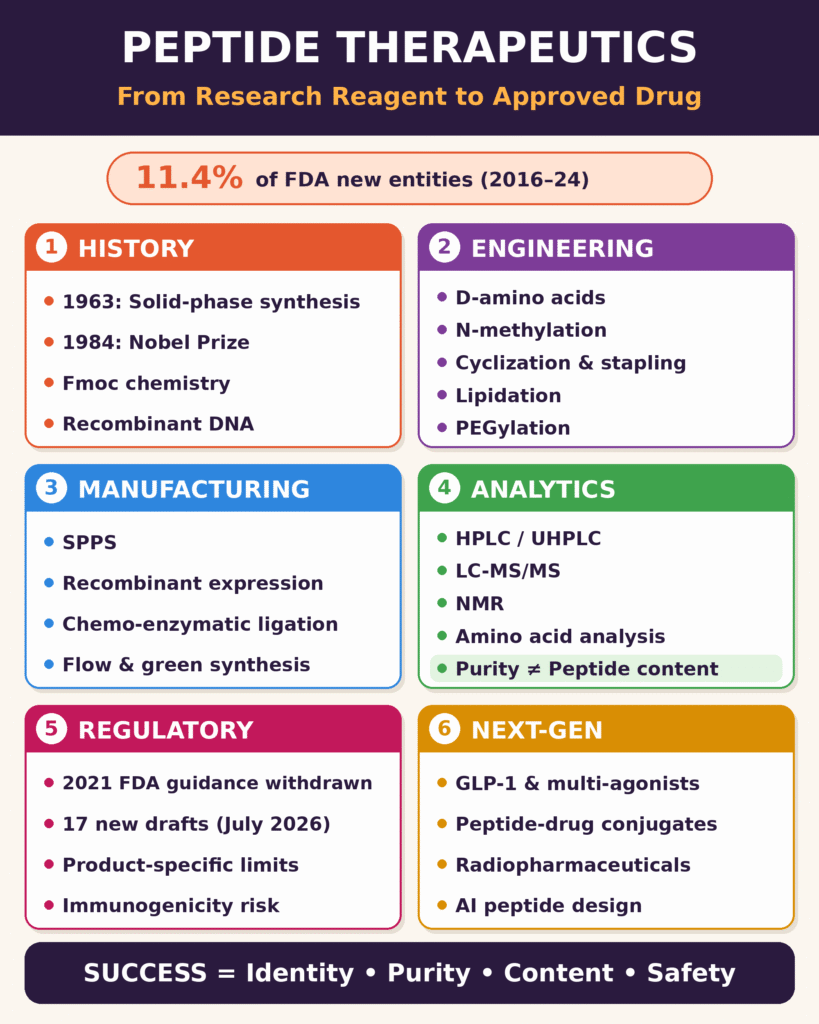
A 2025 review reported that peptides represented approximately 11.4% of novel chemical entities approved by the United States Food and Drug Administration (FDA) between 2016 and 2024, based on the authors’ classification of 48 peptide entities among 420 approvals. This statistic reflects that particular classification and should not be interpreted as the percentage of all FDA-approved medicines that are peptides. Therapeutic peptides are now used or investigated across metabolic, oncologic, cardiovascular, endocrine, and other therapeutic areas.
Share via:
Quick Summary:
- Peptides are a growing drug class. They sit between small molecules and antibodies in size. One 2025 review found peptides made up about 11.4% of FDA novel chemical entities approved from 2016 to 2024.
- Synthesis history: Merrifield’s solid-phase peptide synthesis (1963, Nobel Prize 1984) changed the field. Later came milder Fmoc chemistry and recombinant DNA production, which replaced animal-tissue extraction.
- Structural engineering overcomes the main weaknesses of native peptides: short half-life and rapid breakdown by enzymes. Key strategies are D-amino acids, N-methylation, Aib substitution, cyclization and stapling, lipidation (albumin binding, as in semaglutide), and PEGylation.
- Manufacturing routes are chosen based on sequence length, modifications, and scale. The options are SPPS, recombinant expression, and chemo-enzymatic ligation. Flow chemistry and greener solvents aim to cut solvent waste.
- Analytical quality control uses several complementary methods: HPLC, LC-MS/MS, NMR, and amino acid analysis. HPLC purity is not the same as net peptide content, because a 98%-pure sample may contain only 75% peptide by mass.
- The regulatory landscape is changing. In July 2026 the FDA withdrew its 2021 synthetic peptide ANDA guidance and issued 17 revised draft product-specific guidances. Impurity limits must be set product by product, and immunogenicity risk must be assessed.
- Next-generation applications include GLP-1 and multi-receptor agonists such as tirzepatide, peptide-drug conjugates, Ga-68 and Lu-177 radiopharmaceuticals, and AI-driven peptide design. All of these still require experimental validation.
Historical Milestones in the Evolution of Peptide Therapeutics
The development of peptide therapeutics progressed from natural tissue extraction and solution-phase synthesis to automated solid-phase platforms and rational molecular engineering. These advances improved the reproducibility, purity, and scalability of peptide manufacturing.
Early Peptide Isolation and Chemical Synthesis
Before modern synthetic manufacturing became established, peptide hormones such as insulin, oxytocin, and vasopressin were obtained from biological sources or investigated through early chemical synthesis. Animal tissue extraction presented challenges involving source variability, purification, potential biological contaminants, and consistency between batches.
Liquid-Phase Peptide Synthesis (LPPS) offered a chemical alternative. However, traditional solution-phase synthesis required the separation and purification of intermediates after successive coupling reactions, making long sequences labor-intensive to produce.
The Introduction of Solid-Phase Peptide Synthesis
A major breakthrough occurred in 1963, when Robert Bruce Merrifield introduced Solid-Phase Peptide Synthesis (SPPS). The method involves attaching the growing peptide chain to an insoluble resin. Excess reagents and soluble byproducts can then be removed through washing and filtration without isolating the peptide intermediate after every coupling step.
Merrifield received the Nobel Prize in Chemistry in 1984 for his development of solid-phase chemical synthesis. His work established a foundation for automated peptide synthesis and modern manufacturing of synthetic peptide active pharmaceutical ingredients (APIs).
Advances in Protecting Groups and Recombinant Technology
Early SPPS methods used tert-butoxycarbonyl (Boc) and benzyl (Bzl) protecting-group chemistry. Traditional Boc-based workflows commonly required strong acids, including anhydrous hydrofluoric acid, for final cleavage from the resin. The fluorenylmethyloxycarbonyl (Fmoc)/tert-butyl (tBu) strategy enabled milder base-mediated removal of the N-terminal protecting group, commonly using piperidine, while retaining acid-labile side-chain protection.
Recombinant DNA technology also expanded the production of therapeutic peptides and proteins. Biological expression systems, including Escherichia coli and yeast hosts, enabled the production of selected therapeutic sequences without relying exclusively on animal-derived materials.
Modern Molecular Engineering and Multi-Target Therapeutics
During the 2000s and 2010s, development increasingly focused on rational sequence modification and pharmacokinetic extension. Non-canonical amino acid substitution, backbone modification, cyclization, and fatty acid lipidation helped produce peptide medicines with improved stability or prolonged systemic exposure.
Recent developments include multi-receptor agonists, peptide-drug conjugates, radiolabeled peptides, improved manufacturing processes, and computational approaches to peptide design. These advances are expanding the potential applications of peptides in metabolic disease, oncology, molecular imaging, and targeted drug delivery.
Historical Evolution of Peptide Therapeutics
| Historical Era | Dominant Synthesis Approaches | Manufacturing Platforms | Representative Milestones |
|---|---|---|---|
| 1970s and earlier | Natural peptide isolation and solution-phase coupling | Biological extraction and liquid-phase batch synthesis | Isolation and characterization of endogenous hormones, including insulin and vasopressin |
| 1980s–1990s | Automated SPPS; Boc/Bzl and Fmoc/tBu protecting strategies | Automated batch synthesis and recombinant expression | Merrifield’s 1984 Nobel Prize; recombinant human insulin; synthetic peptides such as leuprolide and octreotide |
| 2000s–2010s | Lipidation, cyclization, backbone modification, and protease-resistance engineering | Large-scale batch SPPS and hybrid recombinant-chemical platforms | Long-acting metabolic peptides, including liraglutide and semaglutide |
| 2020s–present | Multi-receptor targeting, macrocyclization, computational design, and greener synthesis | Advanced SPPS, flow-based processing, and chemo-enzymatic approaches | Multi-agonists such as tirzepatide, peptide radiopharmaceuticals, and emerging peptide-drug conjugates |
Structural Engineering Strategies for Therapeutic Peptides
Rational structural engineering can improve peptide stability, receptor interactions, and pharmacokinetic performance. Native peptides may undergo rapid degradation through exopeptidases, which cleave terminal residues, and endopeptidases, which cleave internal peptide bonds.
Enzymatic Stabilization Through Backbone and Residue Modification
Replacing selected L-amino acids with D-amino acids or non-canonical amino acid analogues can change the steric and electronic properties of peptide bonds and reduce recognition by particular proteases. These modifications must be evaluated carefully because changes that improve stability may also affect receptor binding, biological activity, or selectivity.
Backbone N-methylation replaces an amide hydrogen attached to nitrogen with a methyl group. This modification removes a hydrogen-bond donor at the modified position and can introduce steric hindrance, potentially improving resistance to enzymatic degradation or altering membrane permeability.
A representative example of protease-resistance engineering is the substitution of the alanine residue at position 8 of GLP-1 with alpha-aminoisobutyric acid (Aib). Native GLP-1 is rapidly inactivated by dipeptidyl peptidase-4 (DPP-4) through cleavage involving the N-terminal region. Aib at position 8 contributes to resistance against this cleavage.
Semaglutide incorporates an Aib substitution alongside other structural modifications, including fatty acid attachment. Its prolonged action results from the combined effects of molecular design, albumin association, and resistance to enzymatic degradation rather than from a single modification alone.
For a closer look at mass spectrometry applications in metabolic peptide development, explore LC-MS characterization of GLP-1 peptides to understand how molecular mass and related structural attributes can be assessed.
Conformational Constraint and Macrocyclization
Conformational constraint reduces the rotational freedom of a peptide and can help stabilize a biologically active structure. Depending on the molecule, conformational restriction may reduce the entropic cost of receptor binding or make susceptible backbone regions less accessible to proteases.
Common cyclization and conformational-stabilization strategies include:
- Lactam bridges: Intramolecular amide bonds formed between compatible side-chain functional groups, such as carboxyl groups and amines.
- Disulfide bridges: Intramolecular bonds formed through oxidation of cysteine thiol groups.
- Hydrocarbon stapling: Chemical cross-linking of appropriately positioned side chains, often through ring-closing metathesis, to stabilize selected helical conformations.
Macrocyclization and stapling do not automatically improve every peptide’s drug-like properties. Their effects on potency, solubility, permeability, metabolic stability, and manufacturability must be established experimentally.
Pharmacokinetic Extension Through Lipidation and PEGylation
Pharmacokinetic extension strategies can reduce renal elimination, improve protection from enzymatic degradation, or increase circulation time. The magnitude of these effects depends on peptide size, charge, conformation, binding interactions, and the specific chemical modification.
Lipidation involves attaching a hydrophobic fatty acyl group to a peptide. In selected therapeutic peptides, the lipid group promotes reversible association with human serum albumin, a circulating protein with a molecular weight of approximately 66.5 kDa. Albumin association can reduce renal clearance and contribute to prolonged systemic exposure.
Semaglutide is an example of a lipidated peptide designed for extended action. Its fatty acid-containing side chain promotes albumin binding, while other structural modifications contribute to its pharmacological properties.
For development programs evaluating degradation and storage-related changes, review GLP-1 peptide stability analytical methods to understand how suitable analytical procedures can support stability assessment.
PEGylation involves covalent attachment of polyethylene glycol (PEG) chains. PEG can increase hydrodynamic size and alter circulation time, renal clearance, and proteolytic susceptibility. However, PEGylation may also affect receptor binding, biological activity, product heterogeneity, and the potential for anti-PEG immune responses. These considerations must be evaluated during product development.
Manufacturing and Synthetic Breakthroughs in Peptide Production
Industrial peptide manufacturing uses chemical synthesis, recombinant expression, and hybrid methods selected according to sequence length, structural complexity, modification requirements, production scale, and process economics.
Solid-Phase Synthesis, Recombinant Expression, and Chemo-Enzymatic Ligation
Solid-Phase Peptide Synthesis remains an important route for short-to-medium-length peptides, particularly when the sequence requires D-amino acids, non-canonical residues, backbone modifications, or lipidated side chains. As sequence length increases, incomplete coupling, incomplete deprotection, aggregation, and deletion sequences can reduce the overall yield of the desired product.
Recombinant expression can be advantageous for longer peptides and proteins that can be produced efficiently using suitable biological hosts. However, biological systems may require additional processing to address folding, host-cell proteins, residual host-cell DNA, and other process-related impurities. Incorporating unusual amino acids or complex synthetic modifications may also require specialized approaches.
Chemo-enzymatic ligation combines biological production with chemical or enzymatic joining of peptide fragments. It can enable the assembly of longer sequences or the incorporation of selected synthetic modifications. Its suitability depends on ligation-site requirements, fragment compatibility, process yield, and purification demands.
For projects involving GLP-1 analogs, examine the GLP-1 analog peptide sequencing workflow to understand how sequence analysis can be incorporated into a structured characterization process.
Continuous-Flow Chemistry and Green Synthesis
Conventional batch SPPS can consume substantial quantities of organic solvents, including N,N-dimethylformamide (DMF), N-methyl-2-pyrrolidone (NMP), and dichloromethane (DCM). These solvents present environmental, occupational, and waste-management challenges.
Continuous-flow and fast-flow synthesis approaches can improve reagent delivery, temperature control, and reaction-cycle efficiency. Their performance depends on the resin, solvent system, peptide sequence, equipment design, and process conditions. Claims about reductions in synthesis time or solvent consumption should therefore be supported by data from the specific manufacturing process being described.
Green chemistry approaches include solvent substitution, solvent recovery and recycling, process intensification, and evaluation of alternative solvent systems. Gamma-valerolactone (GVL) and other alternative solvents have been investigated for selected peptide synthesis applications. Their adoption requires assessment of resin compatibility, coupling efficiency, impurity profiles, solvent recovery, worker safety, and final-product quality.
Comparison of Peptide Manufacturing Platforms
| Manufacturing Parameter | SPPS | Recombinant Expression | Chemo-Enzymatic Ligation |
|---|---|---|---|
| Suitable applications | Short-to-medium synthetic peptides and modified sequences | Longer peptides and proteins compatible with biological expression | Selected longer sequences assembled from compatible fragments |
| Non-canonical modifications | Broad flexibility for synthetic residues and side-chain modifications | Often limited without specialized biological engineering | Can incorporate modifications through appropriately designed synthetic fragments |
| Typical impurity concerns | Deletion sequences, incomplete deprotection, oxidation, and related synthetic impurities | Host-cell proteins, residual host-cell DNA, misfolding, and product-related variants | Unreacted fragments, incomplete ligation, and fragment-related impurities |
| Environmental considerations | Organic solvent consumption and chemical waste; recovery and substitution may improve performance | Water, fermentation media, downstream purification, and biological waste requirements | Depends on fragment production, ligation chemistry, purification, and solvent requirements |
| Scale-up considerations | Requires control of coupling efficiency, mixing, heat transfer, and purification at scale | Requires control of fermentation, expression, folding, and downstream processing | Requires reproducible fragment production, ligation efficiency, and purification |
Quality Control, Analytical Characterization, and Regulatory Pathways
Translating a peptide candidate into a pharmaceutical product requires a suitable quality system, validated analytical procedures, characterization of process- and product-related impurities, and stability assessment. The specific requirements depend on the development stage, intended use, manufacturing route, and applicable regulatory framework.
Transitioning From Research Use Only Reagents to GMP APIs
Research Use Only (RUO) peptide reagents are intended for exploratory research and in vitro investigations. Their specifications and manufacturing controls may differ substantially from those required for clinical or commercial pharmaceutical products.
Developing a peptide as a Good Manufacturing Practice (GMP) Active Pharmaceutical Ingredient (API) requires appropriate controls for raw materials, manufacturing operations, traceability, impurity management, analytical methods, and batch consistency. Stability studies and supporting documentation must be designed in accordance with the applicable regulatory requirements and relevant International Council for Harmonisation (ICH) guidelines.
For GLP-1 development programs, review regulatory requirements for peptide characterization to better understand the considerations involved in selecting appropriate analytical studies.
Research-grade purity results alone do not establish that a peptide is suitable for administration to humans. Pharmaceutical development requires a broader assessment of identity, strength, quality, safety, manufacturing controls, and the suitability of the final drug product.
Orthogonal Analytical Methods for Peptide Characterization
Comprehensive characterization uses complementary analytical methods to establish peptide identity, evaluate purity, quantify content, and investigate relevant structural attributes.
- Reverse-Phase High-Performance Liquid Chromatography (RP-HPLC) and UHPLC: These methods separate the target peptide from related substances and can support chromatographic purity assessment when the method is suitably developed and validated.
- Liquid Chromatography-Tandem Mass Spectrometry (LC-MS/MS): LC-MS/MS supports molecular mass confirmation, impurity characterization, and sequence analysis through appropriate fragmentation techniques. Mass measurement alone does not establish every aspect of sequence identity or stereochemistry.
- Nuclear Magnetic Resonance (NMR) Spectroscopy: NMR can provide information about molecular structure, conformation, and dynamics in solution, depending on the molecule and the experiment.
- Amino Acid Analysis (AAA): AAA can support amino acid composition assessment and peptide content determination using an appropriate validated procedure.
- Elemental Analysis: Carbon, hydrogen, and nitrogen analysis can support compositional characterization. It does not independently establish the mass fraction of the target peptide without an appropriate calculation and supporting analytical data.
For sequence-level investigations, explore peptide sequencing of GLP-1 to understand how analytical evidence can help establish the identity of a peptide candidate.
Chromatographic Purity Versus Net Peptide Content
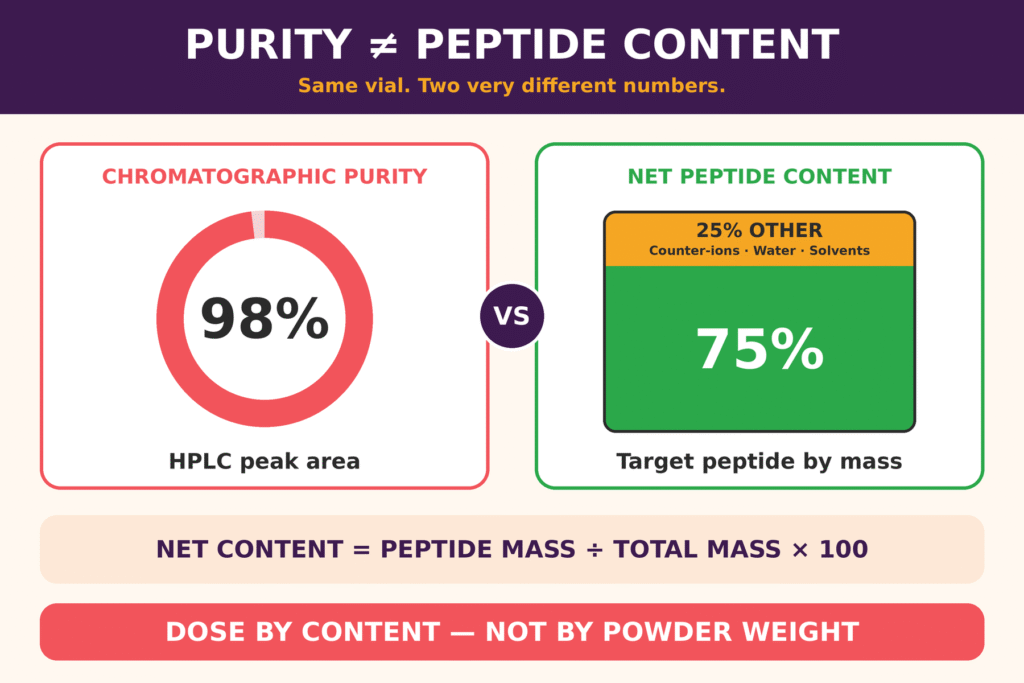
Chromatographic purity and Net Peptide Content are different analytical parameters. Chromatographic purity is commonly reported as the percentage of integrated HPLC peak area attributed to the target peak relative to the included peaks. It does not necessarily represent the percentage of the total powder mass that consists of the target peptide.
Lyophilized peptide powders may contain counter-ions, residual water, residual solvents, and other non-peptide components. Trifluoroacetate (TFA) or acetate may be present depending on the synthesis, purification, and salt form of the product.
Net Peptide Content expresses the mass of the target peptide relative to the total sample mass, using a suitable validated analytical approach. It should not be assumed to fall within a universal range because the result depends on the peptide, counter-ion composition, moisture content, and manufacturing and purification processes.
Net Peptide Content (%) = (Mass of Target Peptide / Total Mass of Sample) × 100
For example, a sample may show 98% chromatographic purity while containing only 75% target peptide by mass. This can occur when non-peptide components contribute to the total sample mass. If the formulation calculation uses gross powder mass without an appropriate potency or content correction, the actual amount of peptide delivered may differ from the intended amount.
For a structured overview of the documentation expected from an external analytical study, consult this peptide characterization CRO deliverables checklist.
FDA Regulatory Guidance and Peptide Impurity Assessment
Peptide-related impurities must be evaluated according to the applicable product-specific requirements and the risks they may present to product quality, safety, efficacy, and immunogenicity.
In May 2021, the FDA issued guidance concerning abbreviated new drug applications (ANDAs) for certain highly purified synthetic peptide drug products that refer to listed drugs of recombinant DNA origin. That guidance discussed impurity characterization and comparative assessment for the specific regulatory context it addressed.
Regulatory update: On July 28, 2026, the FDA announced that it was withdrawing the May 2021 guidance because it no longer reflected the agency’s current scientific thinking. The FDA also published 17 revised draft product-specific guidances for certain generic peptide products. These draft guidances address topics including impurity thresholds, innate immune response testing, higher-order structure, biological activity, and the submission of synthetically, semi-synthetically, or recombinantly produced peptides as ANDAs.
Consequently, impurity limits of 0.1%, 0.5%, or 1.0% must not be presented as universal FDA reporting, identification, or qualification thresholds for every therapeutic peptide. Applicable limits and supporting studies must be determined from the current guidance for the specific product and development pathway.
Developers should review the relevant FDA guidance directly before establishing acceptance criteria or making regulatory claims:
- FDA: Revised Draft Product-Specific Guidances for Certain Generic Peptide Products (July 28, 2026)
- FDA: Drug Guidance Documents
Immunogenicity Risk Assessment
Peptide-related impurities, sequence variants, aggregates, and other product-related attributes may affect immunogenicity. Depending on the molecule and its clinical context, an immune response can lead to antidrug antibody (ADA) formation, potentially altering pharmacokinetics, pharmacodynamics, efficacy, or safety.
Antigen-presenting cells can process a therapeutic peptide or protein into peptide fragments and present selected fragments through major histocompatibility complex (MHC) molecules, including human leukocyte antigen (HLA) Class II molecules. Recognition by T cells can contribute to downstream immune responses and ADA formation. However, the immunogenicity risk of a product cannot be inferred from a single impurity measurement alone.
Risk assessment may incorporate in silico HLA-binding predictions, in vitro immune-cell assays, comparative impurity characterization, aggregation studies, and other appropriate evidence. MHC-associated peptide proteomics (MAPPs) can be used in selected investigations to characterize peptides presented by MHC molecules.
The testing strategy should be scientifically justified and tailored to the product, impurity profile, clinical context, and applicable regulatory expectations.
For targeted impurity investigations, review GLP-1 peptide impurity characterization to explore how peptide-related variants can be assessed as part of a broader quality strategy.
Modern Clinical Applications and Next-Generation Developments
Therapeutic peptide development now encompasses metabolic medicines, targeted delivery systems, radiopharmaceuticals, and computationally designed molecules. These applications build on advances in molecular engineering, analytical characterization, and manufacturing control.
GLP-1 and Multi-Receptor Metabolic Agonists
Glucagon-like peptide-1 (GLP-1) receptor agonists have become an important therapeutic class for metabolic disease. Structural modifications can improve resistance to enzymatic degradation or prolong circulation time, while lipidation can promote reversible albumin association.
Semaglutide illustrates how multiple molecular modifications can support prolonged pharmacological activity. Tirzepatide is a dual glucose-dependent insulinotropic polypeptide (GIP) and GLP-1 receptor agonist that engages both pathways. Additional investigational agents are designed to activate three or more metabolic receptors within a single molecule.
The potential benefits and limitations of multi-receptor agonists must be established through pharmacological studies and clinical evaluation. Receptor activity alone does not determine the safety, efficacy, or suitability of a candidate for a particular indication.
For a broader look at analytical support for GLP-1 development programs, explore CRO services for GLP-1 peptide characterization to understand how specialized testing can support molecular assessment.
Peptide-Drug Conjugates and Targeted Radiopharmaceuticals
Peptide-drug conjugates (PDCs) use peptide ligands to direct an attached payload toward selected biological targets. Depending on the construct, the peptide may recognize a receptor expressed on a target cell, while a chemical linker controls the connection and, in some designs, the release of the payload.
Targeting selectivity depends on receptor expression, binding affinity, internalization, linker stability, payload properties, and exposure in healthy tissues. These factors must be evaluated experimentally rather than assuming that receptor targeting eliminates off-target effects.
Radiolabeled peptides also have applications in molecular imaging and targeted radionuclide therapy. For example, gallium-68 can be used in diagnostic radiopharmaceuticals, while lutetium-177 is used in selected therapeutic radiopharmaceuticals. The peptide component directs the radiolabeled molecule toward a biological target, enabling imaging or delivery of radiation to target-expressing tissues.
Artificial Intelligence and De Novo Peptide Design
Artificial intelligence and computational structural biology are increasingly used to support peptide discovery. Computational models can help generate candidate sequences, estimate structural features, predict potential binding interactions, and prioritize molecules for laboratory evaluation.
Macrocyclic peptide design is one area of interest because conformational constraint may enable interactions with targets that are difficult to address using conventional small molecules. Intracellular targets, including selected protein-protein interaction interfaces, are being investigated through computational and experimental approaches.
However, predicted structures and binding scores do not establish biological activity or drug suitability. Designed candidates require experimental evaluation of binding, selectivity, potency, stability, permeability where relevant, toxicity, and manufacturability before progression through development.
Conclusion: Advancing Therapeutics From Research Reagent to Approved Drug
The evolution of therapeutic peptides from research reagents to approved drugs demonstrates how progress in synthetic chemistry, molecular engineering, and bioanalytical science can address fundamental pharmacokinetic and manufacturing challenges. Advances in solid-phase synthesis, backbone modification, lipidation, conformational constraint, and analytical characterization have expanded the range of peptide structures that can be developed as medicines.
Successful translation requires more than high chromatographic purity. Developers must establish molecular identity, assess related impurities, determine peptide content using suitable methods, demonstrate process consistency, and evaluate stability and immunogenicity risks within the applicable regulatory framework. Regulatory expectations must also be checked against current, product-specific guidance.
ResolveMass Laboratories Inc. supports biopharmaceutical developers with analytical capabilities including high-resolution mass spectrometry, peptide characterization, impurity profiling, and peptide content assessment. These services can contribute to evidence generation during peptide development when supported by appropriately selected and validated methods.
For information about analytical testing and peptide development support, contact the ResolveMass Laboratories team.
Frequently Asked Questions (FAQs)
Natural peptides are often degraded rapidly by enzymes or eliminated through the kidneys, resulting in short circulation times and limited therapeutic effectiveness. Modifications such as D-amino acid substitution, cyclization, and fatty acid lipidation can improve enzymatic stability, extend plasma half-life, and enhance their suitability for therapeutic applications.
Peptide purity, commonly assessed using high-performance liquid chromatography (HPLC), indicates the proportion of the target peptide relative to detectable peptide-related impurities. Net Peptide Content (NPC) measures the actual amount of peptide in a sample by accounting for non-peptide components, including counter-ions, moisture, and residual salts, which can affect accurate dosing.
Solid-Phase Peptide Synthesis (SPPS) builds a peptide chain step by step while it remains attached to an insoluble resin. Excess reagents and by-products can be removed through washing after each coupling cycle, making the process suitable for automation and reducing the need to isolate intermediates compared with conventional liquid-phase synthesis.
Regulatory expectations include appropriate impurity identification, quantification, characterization, and justification of acceptance limits in line with applicable guidance, including relevant ICH quality principles. Immunogenicity risk assessments may combine in silico HLA-binding predictions, in vitro cellular assays, and MHC-associated peptide proteomics (MAPPs) to evaluate potential immune responses and support evidence-based safety assessments.
Lipidation attaches a fatty acid chain to a peptide, which can promote reversible binding to serum albumin and reduce rapid renal elimination. PEGylation involves attaching polyethylene glycol (PEG) chains that increase hydrodynamic size and may slow kidney filtration, helping the therapeutic peptide remain in circulation for longer.
Synthetic peptide characterization typically combines reverse-phase high-performance liquid chromatography (RP-HPLC) with mass spectrometry, including LC-MS/MS, to assess purity, molecular mass, and sequence-related characteristics. Depending on the peptide and testing objectives, NMR spectroscopy and amino acid analysis can provide complementary structural and compositional information, supporting a more reliable assessment of identity and quality.
Chemical synthesis is often suitable for shorter peptides, particularly those containing non-canonical amino acids, D-amino acids, or chemical modifications that cellular expression systems cannot readily incorporate. Recombinant expression can be more practical for longer peptides or protein-like molecules composed primarily of standard L-amino acids, although the optimal approach depends on sequence complexity, yield, purification needs, and production costs.
Artificial intelligence can help researchers predict peptide structures, estimate target-binding interactions, and prioritize promising candidates for experimental testing. Machine learning approaches also support de novo peptide design and lead optimization, including the development of macrocyclic peptides aimed at challenging biological targets, potentially reducing the time needed to identify suitable drug candidates.
Elemental analysis measures the carbon, hydrogen, and nitrogen content of a sample and can provide supporting information about its composition and purity. When combined with appropriate analytical methods, it can help assess Net Peptide Content and account for the effects of counter-ions, moisture, and other non-peptide components, supporting more accurate dose calculations and formulation development.
Reference:
- Wang, L., Wang, N., Zhang, W., Cheng, X., Yan, Z., Shao, G., Wang, X., Wang, R., & Fu, C. (2022). Therapeutic peptides: Current applications and future directions. Signal Transduction and Targeted Therapy, 7, Article 48. https://doi.org/10.1038/s41392-022-00904-4
- Li, Q., Chao, W., & Qiu, L. (2025). Therapeutic peptides: Chemical strategies fortify peptides for enhanced disease treatment efficacy. Amino Acids, 57, Article 25. https://doi.org/10.1007/s00726-025-03454-5
- Hornsby, B. D., Lee, C. H., Steele, C. A., Tuekpe, J. K. K., & Lim, C. S. (2026). Therapeutic peptides and proteins: Status and developments in drug delivery. Journal of Controlled Release, 394, Article 114895. https://doi.org/10.1016/j.jconrel.2026.114895
- Mäde, V., Els-Heindl, S., & Beck-Sickinger, A. G. (2014). Automated solid-phase peptide synthesis to obtain therapeutic peptides. Beilstein Journal of Organic Chemistry, 10, 1197–1212. https://doi.org/10.3762/bjoc.10.118
- Kaprive, J. F., & Merheb, E. (2026). Protein structure and function. In StatPearls. StatPearls Publishing. https://www.ncbi.nlm.nih.gov/books/NBK562260/
- U.S. Food and Drug Administration. (2022, November). Sameness evaluations in an ANDA—Active ingredients: Guidance for industry (Draft guidance). https://www.fda.gov/media/163018/download
Get In Touch With Us
About The Author