


Introduction
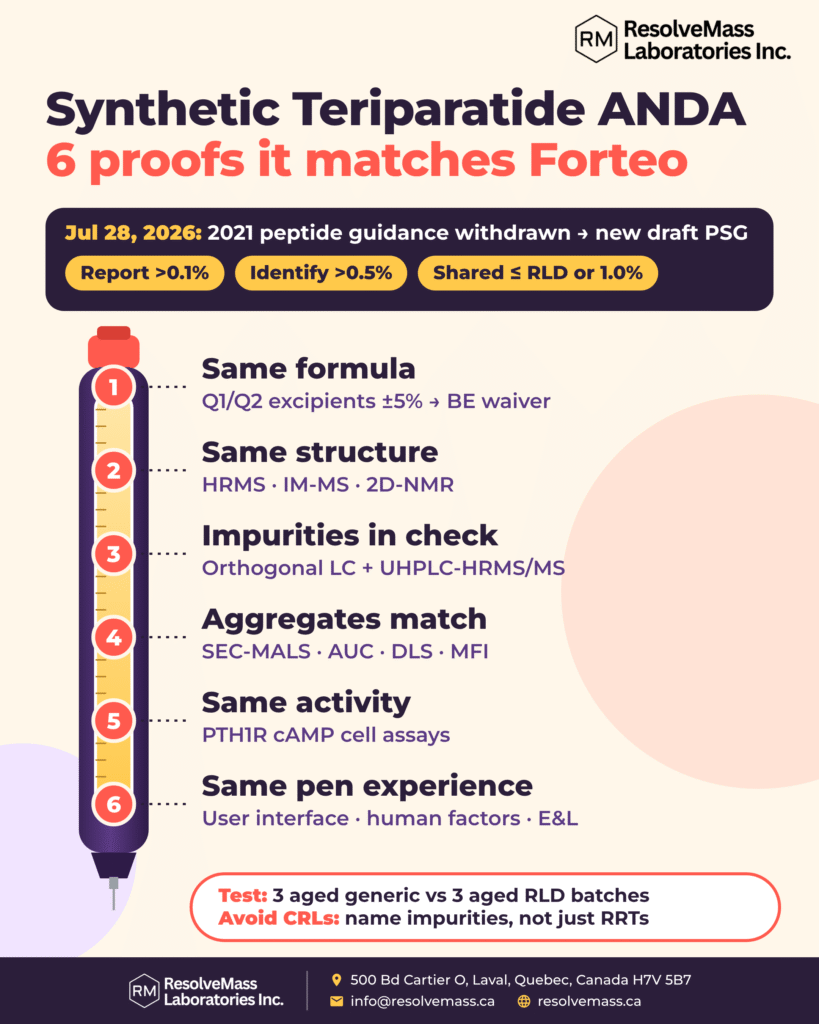
Establishing pharmaceutical and therapeutic equivalence for Generic Teriparatide by Synthesis against Eli Lilly’s recombinant Forteo (NDA 021318) through a Section 505(j) Abbreviated New Drug Application (ANDA) requires a comprehensive demonstration of qualitative and quantitative (Q1/Q2) formulation sameness. Applicants must verify primary and higher-order structural equivalence across aged batches, ensure that active-ingredient-related impurities remain within regulatory limits, demonstrate functional bioidentity, and establish comparability of the pen-injector user interface.
Forteo contains a 34-amino-acid active pharmaceutical ingredient (API) with a molecular weight of 4117.8 Da, produced through recombinant DNA technology in Escherichia coli. In contrast, manufacturing teriparatide through solid-phase peptide synthesis (SPPS) introduces process-specific impurities, including sequence deletions, insertions, and racemized diastereomers, which are not typically associated with the recombinant reference listed drug (RLD). Consequently, generic manufacturers must demonstrate that these synthesis-related variants do not compromise product quality, safety, or therapeutic performance.
The regulatory framework governing these submissions also underwent significant changes in 2026. The first AB-rated synthetic generic products referencing Forteo, including Teva Pharmaceuticals’ ANDA 208569 and Apotex’s ANDA 211097, received approval on November 16, 2023, following review under the FDA’s May 2021 synthetic peptide guidance. However, the FDA formally withdrew that guidance on July 28, 2026, and issued a revised Draft Product-Specific Guidance (PSG) for Teriparatide, together with 16 other generic peptide PSGs.
Preparing a scientifically defensible comparability package under these revised expectations requires comprehensive, orthogonal analytical characterization. Specialized analytical organizations, including ResolveMass Laboratories Inc., can assist ANDA sponsors through advanced characterization techniques such as high-resolution mass spectrometry, 2D-NMR, impurity identification and elucidation, and regulatory Chemistry, Manufacturing, and Controls (CMC) documentation.
Explore formulation development services for generic drug development to support formulation optimization and product comparability.
Share via:
Quick Summary:
- The pathway: A synthetic (SPPS) teriparatide generic can reference Eli Lilly’s recombinant Forteo through a 505(j) ANDA. The first AB-rated synthetic generics, from Teva and Apotex, were approved on November 16, 2023.
- The rules changed in 2026: On July 28, 2026, the FDA withdrew its May 2021 synthetic peptide guidance and issued a revised draft teriparatide PSG. The PSG covers both Forteo (NDA 021318) and NDA 218771 as reference drugs and accepts recombinant, synthetic or semi-synthetic APIs.
- New impurity thresholds: Sponsors must report impurities above 0.1% and identify those above 0.5%. A shared impurity may not exceed the RLD level or 1.0%, whichever is greater, and sponsors should work to keep new impurities below 1.0%. Total impurities above 0.1% must not exceed the RLD total.
- Q1/Q2 sameness can earn a biowaiver: If the generic uses the same excipients as Forteo, each within ±5%, the in vivo bioequivalence study can be waived. Forteo’s excipients are acetic acid, sodium acetate, mannitol and metacresol, at pH 4.0.
- Orthogonal characterization is needed: No single method is enough. Sponsors should combine HRMS, IM-MS, peptide mapping, 2D-NMR and other spectroscopy for structure, and SEC-MALS, AUC, DLS and MFI for aggregates. Testing should compare at least 3 generic batches against 3 RLD batches, all aged.
- Impurities and immunogenicity: SPPS-related variants (deletions, insertions, racemized forms) and shared degradants such as Met8/Met18 oxidation need orthogonal LC with UHPLC-HRMS/MS. Immunogenicity risk is assessed in silico and in vitro. Innate immune testing may be waived if non-peptide impurities meet their limits and aggregates match the RLD.
- Function, device and common pitfalls: PTH1R cAMP bioassays (SaOS-2 and CHO-K1) confirm activity. The pen needs a user-interface comparison, human factors data if the interface differs, and E&L testing. The most common FDA deficiencies were single-method testing, impurities identified only by RRT, and higher aggregate levels than the RLD.
Regulatory Evolution for Generic Teriparatide by Synthesis: May 2021 Guidance vs. July 2026 Draft PSG
Generic Teriparatide by Synthesis ANDAs developed from mid-2026 onward must consider the FDA’s revised July 2026 Draft Guidance on Teriparatide rather than relying on the withdrawn May 2021 synthetic peptide guidance. Although Q1/Q2 biowaiver eligibility, structural equivalence at multiple analytical levels, and comparative impurity control continue to form the foundation of these submissions, the July 2026 PSG introduces several important regulatory adjustments.
These revisions expand the reference listed drug coverage to include both Forteo (NDA 021318) and Almaject’s Teriparatide Injection (NDA 218771). They also modify impurity reporting and identification thresholds and establish specific circumstances in which in vitro innate immune testing may not be necessary.
Under the withdrawn May 2021 guidance, titled ANDAs for Certain Highly Purified Synthetic Peptide Drug Products That Refer to Listed Drugs of rDNA Origin, applicants were expected to identify every peptide-related impurity present at or above 0.10%. New impurities were not permitted to exceed 0.5%, while impurities shared with the RLD had to remain at or below the levels observed in the reference product. Any new or elevated impurity between 0.10% and 0.5% required an individual scientific justification supported by in vitro and in silico immunogenicity assessment (IVISIA).
The July 2026 Draft Teriparatide PSG introduces a different impurity-control framework. It establishes a reporting threshold above 0.1%, an identification threshold above 0.5%, and a 1.0% ceiling for new or common active-ingredient-related impurities. This allowance is conditional on the total amount of active-ingredient-related impurities present above 0.1% not exceeding the corresponding total observed in the RLD.
Industry analyses also indicate that this revised draft precedes an anticipated replacement framework expected later in 2026. Therefore, applicants should carefully monitor regulatory developments when establishing their development and submission strategies.
Comparison of Regulatory Requirements
| Regulatory Parameter | Withdrawn May 2021 Peptide Guidance (Basis for ANDAs 208569 & 211097) | July 2026 Revised Draft PSG for Teriparatide (Current FDA Draft Standard) |
|---|---|---|
| Reference Listed Drugs (RLDs) | Forteo (NDA 021318) | Forteo (NDA 021318) and Teriparatide Injection (NDA 218771) |
| Permitted API Origin | Synthetic API referencing an rDNA-derived RLD | Recombinant, synthetic, or semi-synthetic APIs |
| Batch Testing Scope | Comparative profiling of generic and RLD products, with end-of-shelf-life aging required during review | At least 3 generic batches tested at or near release and at the end of the proposed shelf life, compared with at least 3 RLD batches aged before expiry under conditions consistent with labeled storage requirements |
| Reporting and Identification Thresholds | Identification of all peptide-related impurities at or above 0.10% | Reporting of active-ingredient-related impurities above 0.1% and identification of impurities above 0.5% |
| Shared (Common) Impurity Cap | Same as or below the concentration observed in the RLD | Not greater than the RLD level or 1.0% of the drug substance, whichever is greater |
| New Impurity Cap | No new peptide-related impurities above 0.5%; impurities from 0.10% to 0.5% require immunogenicity and safety justification | Reduced to below 1.0% through appropriate manufacturing and control strategies; outliers may require FDA scientific review |
| Total Impurity Cap | Controlled through individual specifications aligned with the RLD | The total amount of active-ingredient-related impurities above 0.1% must not exceed the corresponding total observed in the RLD |
| Innate Immunogenicity Testing | Comparative evaluation expected for the fully formulated drug product | In vitro innate immune testing may be waived when non-active-ingredient impurities satisfy compendial and toxicological limits and aggregation profiles are comparable to the RLD |
How to Establish Q1/Q2 Formulation Sameness and Secure an In Vivo Biowaiver
An ANDA applicant may qualify for a waiver of in vivo bioequivalence (BE) studies under 21 CFR 320.22(b)(1) when the proposed teriparatide product is a parenteral solution intended exclusively for subcutaneous administration and demonstrates qualitative (Q1) and quantitative (Q2) formulation sameness with Forteo.
Q1 sameness requires the generic formulation to contain the same inactive ingredients as the RLD. Q2 sameness additionally requires the concentration of each inactive ingredient to match the corresponding RLD concentration within ±5% of the target level.
Both Teva and Apotex obtained BE waivers for their approved synthetic teriparatide ANDAs by matching the Q1/Q2 buffer system, tonicity agents, and preservative composition of Forteo. These formulation attributes are important because even minor differences in excipient composition can potentially influence peptide stability, product performance, or safety.
Under 21 CFR 314.94(a)(9)(iii), applicants may propose a parenteral formulation containing a different preservative, buffer, or antioxidant. However, such modifications eliminate the straightforward presumption associated with Q1/Q2 sameness. The applicant must then provide extensive scientific characterization demonstrating that the proposed excipient differences do not adversely affect the product’s safety or efficacy.
Forteo Formulation Composition and Q1/Q2 Acceptance Criteria
| Formulation Component | Functional Role | Target Concentration in RLD Forteo (per mL) | Q1/Q2 Biowaiver Acceptance Criterion |
|---|---|---|---|
| Teriparatide | Active Pharmaceutical Ingredient | 0.250 mg | Active ingredient sameness (0.25 mg/mL; 20 mcg/dose) |
| Glacial Acetic Acid | Buffer component | 0.41 mg | Identical excipient within ±5% of the RLD level |
| Sodium Acetate (Anhydrous) | Buffer component | 0.1 mg | Identical excipient within ±5% of the RLD level |
| Mannitol | Tonicity and stabilizing agent | 45.4 mg | Identical excipient within ±5% of the RLD level |
| Metacresol | Antimicrobial preservative | 3 mg | Identical excipient within ±5% of the RLD level |
| Water for Injection | Aqueous vehicle | q.s. | Must meet USP compendial standards |
| 10% NaOH / 10% HCl | pH adjustment | q.s. to pH 4.0 | Adjustment to match the RLD pH of 4.0 |
Review analytical services for generic drug development for support with analytical method development and comparative product testing.
Orthogonal Analytical Strategy for Active Ingredient Sameness
Demonstrating active ingredient sameness between a chemically synthesized peptide and a recombinant biologic requires an orthogonal analytical strategy covering primary sequence, physicochemical characteristics, higher-order structure (HOS), and oligomeric or aggregation states.
A particularly important consideration is the difference in sample age between newly manufactured generic batches and commercially available RLD products. Comparing freshly synthesized material with aged reference products without accounting for stability-related changes may introduce analytical bias. To address this issue, the July 2026 Draft PSG recommends side-by-side testing of at least three generic batches at or near release and at the end of the proposed shelf life against at least three RLD batches aged before expiry under labeled storage conditions.
Primary Structure, Sequence Confirmation, and Chiral Integrity in Generic Teriparatide by Synthesis
Confirming the primary structure of Generic Teriparatide by Synthesis requires verification of the exact 34-residue amino acid sequence, molecular weight (4117.8 Da), and stereochemical purity of L- and D-amino acids.
During SPPS, individual coupling reactions can introduce amino acid deletions, insertions, or partial racemization. These manufacturing-related changes may produce isobaric variants that cannot be reliably distinguished through low-resolution intact mass measurements alone. Therefore, a combination of complementary analytical techniques is essential for establishing complete sequence identity and stereochemical integrity.
In a peer-reviewed comparative characterization study of synthetic generic teriparatide (Teriparatide BGW) and Forteo, researchers combined Electrospray Ionization High-Resolution Mass Spectrometry (ESI-HRMS) with Travelling Wave Ion Mobility–Mass Spectrometry (TWIMS). This approach enabled direct examination of intact peptide ions from formulated product solutions.
The resulting mirror mass spectra and collision cross-section (CCS) profiles for the m/z 1030 ion (z = 4) demonstrated comparable distributions across three gas-phase conformers, designated C1, C2, and C3.
For more comprehensive sequence confirmation, intact HRMS and IM-MS should be complemented by enzymatic digestion peptide mapping using LC-MS/MS, Edman degradation or tandem MS b- and y-ion sequencing, and quantitative Amino Acid Analysis (AAA). Combining these methods provides a more complete assessment of primary structure, sequence integrity, and amino acid composition.
For advanced intact-mass characterization and molecular identity assessment, explore intact mass analysis approaches used in biopharmaceutical characterization.
Higher-Order Structure (HOS) Verification via 2D-NMR, CD, and Derivative UV-Vis
Evaluating secondary and tertiary higher-order structure in formulated teriparatide requires analytical procedures capable of addressing significant spectral interference from formulation excipients, particularly metacresol and acetate buffer components.
Far-UV and near-UV Circular Dichroism (CD) spectroscopy are useful for examining α-helical and random-coil structural characteristics in isolated API samples. However, when the peptide is analyzed in the finished drug product, formulation excipients can interfere with the UV signals and reduce the reliability of direct structural measurements.
To examine the peptide under conditions that more closely represent its native solution environment, comparative characterization studies use multidimensional Nuclear Magnetic Resonance (NMR) and second-derivative UV-Vis spectroscopy.
In the published Teriparatide BGW study, experiments were conducted using a 600.23 MHz Bruker Avance III spectrometer. One-dimensional proton NMR (1D-¹H NMR), combined with Principal Component Analysis (PCA), Multivariate ANOVA, and Mahalanobis distance modeling, demonstrated API spectral equivalence and consistency of Q1/Q2 excipient composition.
For three-dimensional conformational assessment, samples underwent overnight partial dialysis in 90% H₂O and 10% D₂O to reduce interfering excipient resonances. The researchers subsequently acquired the following spectra:
- 2D-¹H TOCSY using DIPSI2 with a 50 ms mixing time.
- 2D-¹H NOESY using a 140 ms mixing time.
- 2D ¹³C-¹H HSQC spectra.
The resulting spectral information was used to generate structural ensembles through CNS calculations, demonstrating overlapping minimum-energy conformational arrangements.
A complementary approach involved second-derivative UV-Vis spectroscopy across the 250–310 nm wavelength range. Using Savitzky-Golay smoothing and spectral subtraction for metacresol and acetate, this technique evaluates local aromatic residue environments, particularly around phenylalanine and tryptophan residues, including Trp23, with characteristic signals centered near 270 nm.
Oligomerization, Aggregation Profiling, and Summary Analytical Matrix
Soluble oligomers and insoluble aggregates can contribute to both innate and adaptive immune responses. Therefore, ANDA sponsors must demonstrate that their proposed products maintain oligomerization and particulate profiles comparable to the RLD throughout the proposed shelf life.
Conventional Size-Exclusion HPLC (SE-HPLC), when used as the only sizing technique, may not adequately detect weakly associated reversible oligomers. It may also fail to capture larger sub-visible aggregates because of filtration or sample preparation-related losses.
For this reason, FDA reviewers expect complementary analytical techniques that provide information about different molecular sizes and aggregation states. These methods include SEC-UV/MALS, CG-MALS, Dynamic Light Scattering (DLS), Sedimentation Equilibrium and Velocity Analytical Ultracentrifugation (SE-AUC/SV-AUC), Asymmetric Flow Field-Flow Fractionation (AF4), SDS-PAGE, Native PAGE, and Micro-Flow Imaging (MFI).
Summary of Recommended Orthogonal Analytical Methods
| Structural / Quality Tier | Target Quality Attributes | Recommended Orthogonal Analytical Methods |
|---|---|---|
| Primary Sequence and Physicochemical Properties | Exact 34-amino-acid sequence, MW (4117.8 Da), L/D-amino acid content, pI, log P, pH-dependent solubility, and optical rotation | ESI-HRMS, IM-MS (TWIMS), LC-MS/MS peptide mapping, Edman degradation, AAA, chiral chromatography, IR, and UV |
| Secondary Structure (HOS) | Distribution of α-helix, β-sheet, random coil, and unordered conformations | Far-UV CD (on API), FTIR, Raman spectroscopy, and 2D-¹H TOCSY/NOESY NMR |
| Tertiary Structure (HOS) | Overall monomer conformation and aromatic residue microenvironments (Phe and Trp23) | Near-UV CD, second-derivative UV-Vis (250–310 nm), intrinsic fluorescence, DSC, 2D ¹³C-¹H HSQC NMR, and 1D-NMR with PCA |
| Oligomerization and Aggregation | Reversible non-covalent soluble oligomers, irreversible soluble and insoluble aggregates, and sub-visible or visible particles | SEC-UV/MALS, SE-HPLC, CG-MALS, DLS, SE-AUC, SV-AUC, AF4, SDS-PAGE, Native PAGE, and MFI |
| Biological Activity | PTH1R receptor binding and agonist-induced intracellular cAMP signaling | SaOS-2 (HTRF) and CHO-K1 (EFC) cAMP cell-based bioassays, along with USP monograph bioidentity testing |
Learn more about peptide mapping techniques used in advanced peptide characterization.
Comparative Impurity Profiling and Immunogenicity Risk Mitigation
Establishing impurity comparability requires demonstrating that synthesis-related process impurities and degradation products shared with the reference product remain within applicable regulatory limits. Applicants must also show that these impurities do not increase adaptive or innate immunogenicity risks throughout the proposed shelf life.
An effective impurity-characterization strategy combines orthogonal chromatographic separation with high-resolution mass spectrometry. This approach enables developers to distinguish, characterize, and identify trace-level impurities that may otherwise co-elute with major peptide components.
Specialized peptide analytical laboratories, such as ResolveMass Laboratories Inc., can support this process through advanced chromatographic characterization, high-resolution mass analysis, impurity identification, and structural elucidation before ANDA submission.
For assistance with identifying and characterizing peptide-related impurities, explore impurity profiling approaches for complex therapeutic products.
Distinguishing Synthesis-Derived Variants from Shared Degradation Pathways
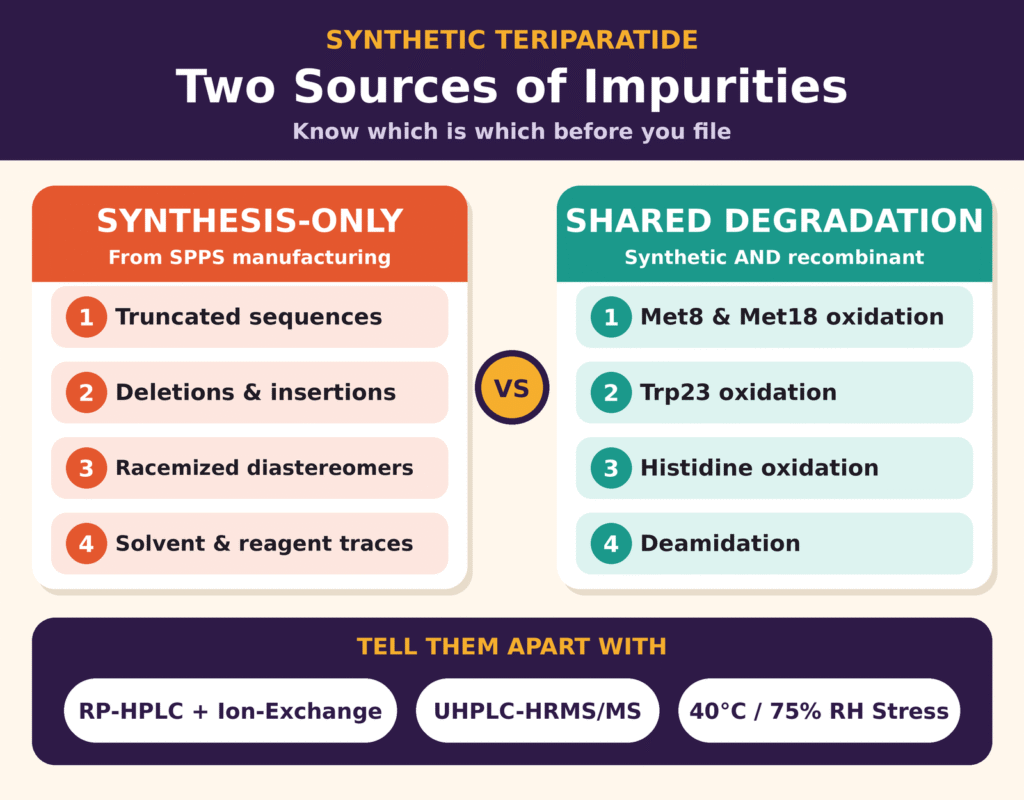
Even when the generic formulation matches the RLD in terms of Q1/Q2 composition, its impurity profile may contain two distinct categories: SPPS-derived manufacturing impurities and chemical degradation products that can occur in both synthetic and recombinant teriparatide.
Synthesis-related impurities may include:
- Sequence truncations.
- Amino acid deletions or insertions.
- Diastereomers resulting from coupling-related racemization.
- Residual solvents and peptide coupling reagents.
In addition to these manufacturing-related impurities, synthetic and recombinant teriparatide may undergo similar chemical degradation pathways during storage. These shared degradation mechanisms include methionine oxidation at Met8 and Met18, producing Met8(O)-, Met18(O)-, and Met8,18(O)-Teriparatide.
Oxidative modifications can also affect tryptophan at Trp23, resulting in species such as Trp23(C=O)- and Trp23(OH)-Teriparatide. Other degradation pathways include histidine oxidation and deamidation.
A single chromatographic separation method may not adequately distinguish all these variants. Co-elution can conceal structurally different impurities, particularly when they exhibit similar retention characteristics. Therefore, FDA reviewers expect impurity characterization using multiple chromatographic separation principles, such as RP-HPLC combined with ion-exchange chromatography or other complementary separation techniques.
These methods should be supported by UHPLC-HRMS/MS for peak matching, peak purity assessment, and structural identification. Comparative forced degradation studies, including stress testing at 40°C / 75% RH, provide additional information about degradation pathways and help establish whether synthetic and recombinant formulations demonstrate comparable degradation kinetics.
Review forced degradation strategies for advanced therapeutic characterization for further information.
Adaptive and Innate Immunogenicity Bridging (IVISIA and IIRMI Frameworks)
Because Section 505(j) ANDAs generally do not include clinical efficacy and safety trials, potential immunogenicity concerns associated with differences in impurity profiles must be evaluated through appropriate non-clinical assessments of adaptive and innate immune responses.
For adaptive immunity, sequence-related impurities such as deletions, insertions, and substitutions that exceed comparative benchmarks should undergo immunogenicity screening. In silico MHC Class II binding models can be used to identify potential T-cell neo-epitopes. When additional investigation is scientifically justified, these assessments may be supplemented with in vitro human Peripheral Blood Mononuclear Cell (PBMC) and T-cell assays under IVISIA protocols.
Innate immunity presents a separate concern. Certain process contaminants and leachables may function as Innate Immune Response Modulating Impurities (IIRMIs). These substances can potentially enhance anti-drug antibody (ADA) formation or contribute to hypersensitivity reactions.
Published FDA-collaborative research has specifically investigated teriparatide using cell-based immunostimulatory assays involving ten model IIRMIs. Such investigations help establish how specific impurities may influence innate immune responses.
However, the July 2026 Draft PSG recognizes that in vitro innate immune testing may not always be scientifically necessary. Testing may be waived when non-active-ingredient impurities satisfy relevant compendial and toxicological acceptance criteria and the aggregation profile remains comparable to the RLD.
The relevant impurity categories include:
- Particulate matter.
- Microbial contaminants.
- Residual organic solvents, as evaluated under USP requirements and ICH Q3C.
- Elemental impurities.
- Extractables and leachables.
Meeting these requirements, together with demonstrating comparable aggregation characteristics, provides an important scientific basis for evaluating whether additional innate immunogenicity testing is necessary.
Functional Bioidentity and Pen-Injector Combination Product Equivalence
The final stage of generic teriparatide equivalence assessment involves confirming biological potency at the type-1 parathyroid hormone receptor (PTH1R) and demonstrating that the proposed generic prefilled multi-dose pen provides a user interface and container-closure system comparable to Forteo.
The July 2026 Draft PSG indicates that biological activity testing may be omitted when an applicant demonstrates that the formulated peptide does not possess functional secondary or higher-order structure. However, teriparatide activity depends on its receptor-binding conformation. Consequently, comparative cell-based potency testing remains a standard component of a scientifically robust comparability package.
Published comparability studies and the USP Teriparatide Injection monograph describe functional equivalence assessment through PTH1R-mediated cyclic AMP (cAMP) signaling assays. These tests evaluate the ability of teriparatide to activate downstream intracellular signaling pathways.
Recommended Cell-Based Bioassays
SaOS-2 Cell-Based Bioassay: This method measures agonist-induced cAMP production in human osteosarcoma cells that naturally express PTH1R. Homogeneous Time-Resolved Fluorescence (HTRF) is used to detect the resulting signaling response.
CHO-K1 Cell-Based Bioassay: This assay evaluates PTH1R activation in engineered Chinese Hamster Ovary cells. Enzyme Fragment Complementation (EFC) technology is used to measure the downstream cAMP response.
Both assays provide complementary evidence of receptor-mediated biological activity and help establish whether the generic product demonstrates functional behavior comparable to the reference formulation.
Pen-Injector User Interface and Combination Product Comparability
Forteo is supplied in a prefilled multi-dose pen injector designed to deliver 20 mcg per daily dose over a 28-day period. Therefore, generic manufacturers must evaluate not only the pharmaceutical formulation but also the delivery device and its operating characteristics.
The July 2026 Draft PSG directs ANDA applicants to examine the RLD’s size, shape, external critical design attributes, and operating principles. Particular attention should be given to the following device characteristics:
- Multi-use fixed-dose delivery format.
- Absence of a priming requirement.
- Dose-setting mechanism.
- Tactile and visual feedback during operation.
The ANDA submission should contain a complete comparative user-interface threshold analysis. When meaningful differences in the user interface are identified, a Comparative Use Human Factors (CUHF) study may be required to demonstrate that the proposed device does not introduce additional risks or difficulties for users.
The comparative human factors review documented in Apotex’s ANDA 211097 package provides a relevant example of this type of assessment.
In addition to human factors evaluation, applicants must perform appropriate extractables and leachables (E&L) assessments covering the primary cartridge and pen assembly. These studies help establish that materials in contact with the drug product do not introduce unacceptable chemical contaminants or compromise product quality during storage and administration.
Common FDA Peptide ANDA Deficiencies and Remediation Strategies
Reviews conducted by the FDA Office of Pharmaceutical Quality Assessment I (OPQAI) of the first wave of teriparatide ANDAs identified five recurring CMC deficiencies associated with Complete Response Letters and delays across multiple review cycles.
These deficiencies highlight the importance of designing analytical characterization programs, impurity specifications, and stability protocols around regulatory expectations from the beginning of product development. Addressing these issues before submission can help reduce avoidable deficiencies and improve the likelihood of a more efficient regulatory review.
Common Review Deficiencies and Recommended Corrective Actions
| Common FDA Review Deficiency | Underlying Regulatory Gap | Required Remediation Strategy |
|---|---|---|
| Impurity profiling restricted to near-release samples using a single HPLC method | Does not adequately identify shelf-life degradation products or co-eluting isobaric impurities | Characterize at least 3 generic batches aged to the end of the proposed shelf life against 3 aged RLD batches using orthogonal chromatographic methods and UHPLC-HRMS/MS |
| Specification tables identify impurities only through Relative Retention Time (RRT) | Does not establish the chemical structures of qualifying impurities | Determine impurity structures using HRMS/MS and revise specification tables to include identified chemical names |
| Inconsistent wording for Any Unspecified Impurity limits | Proposed wording such as “NMT 0.10%” conflicted with the 2021 requirement for identification at or above 0.10% | Ensure specification terminology follows the applicable guidance thresholds, such as “<0.10%” under the 2021 rules or the revised July 2026 thresholds for reporting above 0.1% and identification above 0.5% |
| Impurity limits above 0.5% without adequate RLD comparative evidence | Proposed limits exceed regulatory expectations without sufficient safety or immunogenicity justification | Establish tighter specifications aligned with observed RLD levels or provide appropriate scientific justification supported by immunogenicity and safety data |
| Higher aggregate levels in the generic product than in the RLD | May increase innate and adaptive immunogenicity concerns and indicate inadequate manufacturing control | Conduct a root-cause investigation, optimize API and formulation manufacturing processes, and demonstrate control of aggregates in exhibit batches throughout the proposed shelf life |
Learn more about manufacturing scale-up for generic drugs to support process optimization and reproducible product quality.
Conclusion
Obtaining FDA approval for Generic Teriparatide by Synthesis requires a comprehensive, integrated comparability strategy supported by multiple batches and orthogonal analytical techniques. The development program must establish Q1/Q2 formulation sameness for biowaiver eligibility, demonstrate structural equivalence through HRMS/IM-MS and 2D-NMR, and characterize impurities using UHPLC-HRMS/MS across aged shelf-life samples.
In addition, applicants must demonstrate comparable aggregation profiles, confirm biological activity through cAMP-based bioassays, and establish appropriate pen-injector user interface and human factors alignment. Each of these elements contributes to the overall demonstration that the proposed synthetic generic product is comparable to the recombinant reference product in terms of quality, safety, and functional performance.
Aligning development activities with the FDA’s revised July 2026 Draft PSG is particularly important for ANDA sponsors preparing new submissions. At the same time, manufacturers should proactively address historical review deficiencies, including specifications based exclusively on RRT values, insufficient impurity identification, and reliance on single-method release testing.
A well-designed CMC development strategy that integrates structural characterization, impurity profiling, stability assessment, functional bioidentity, and device comparability provides a stronger scientific foundation for regulatory review and helps minimize the risk of avoidable Complete Response Letters.
For comprehensive analytical and development support, explore comparative testing between generic drugs and their reference listed drugs to strengthen the scientific basis of product comparability and ANDA readiness.
For specialized peptide sameness testing, LC-HRMS/MS sequencing, 2D-NMR HOS characterization, extractables and leachables profiling, or generic peptide CDMO support, connect with the scientific team at ResolveMass Laboratories Inc. through our Contact Us page:
Contact ResolveMass Laboratories Inc.
Frequently Asked Questions
On July 28, 2026, the FDA withdrew its May 2021 synthetic peptide guidance and introduced a revised Draft PSG for Teriparatide (PSG_021318). The updated document includes NDA 218771 as an additional RLD and revises impurity reporting and identification requirements. It also establishes conditions for waiving in vitro innate immune testing when appropriate impurity and aggregation criteria are satisfied.
In vivo bioequivalence studies may be waived when the proposed teriparatide injection meets the eligibility requirements under 21 CFR 320.22(b)(1). This generally requires a parenteral solution with Q1/Q2 formulation sameness compared with Forteo. The generic must contain the same inactive ingredients, with their individual concentrations maintained within ±5% of the corresponding RLD levels.
Mass spectrometry techniques such as ESI-HRMS and LC-MS/MS establish molecular weight, amino acid composition, and primary sequence identity. However, these methods alone cannot fully characterize the peptide’s three-dimensional solution conformation. Techniques such as 2D-¹H TOCSY, NOESY, and ¹³C-¹H HSQC NMR provide additional structural information, with overnight dialysis in 90% H₂O and 10% D₂O helping minimize interference from formulation excipients.
Impurity characterization should cover both manufacturing-related variants and degradation products that develop during storage. Important oxidative degradants include Met8(O)-, Met18(O)-, and Met8,18(O)-Teriparatide, along with Trp23(C=O)- and Trp23(OH)-Teriparatide, histidine oxidation products, and deamidated species. Synthetic process impurities, particularly sequence deletions, insertions, and coupling-related racemized diastereomers, must also be identified and controlled.
The July 2026 Draft PSG recommends a comparative assessment involving a minimum of three generic batches and three RLD batches. Generic samples should be examined at or near their release stage and again at the end of the proposed shelf life. The RLD batches should be aged before expiry under storage conditions consistent with their approved labeling to support a meaningful stability-based comparison.
In vitro innate immune response testing may be unnecessary when the generic product satisfies the specified impurity-control and aggregation requirements. Non-active-ingredient impurities, including particulate matter, microbial contaminants, residual organic solvents, elemental impurities, and leachables, must meet applicable compendial and toxicological acceptance limits. Additionally, the generic product must demonstrate an aggregation profile comparable to the RLD.
Functional equivalence is generally evaluated through cell-based assays measuring PTH1R activation and subsequent intracellular cyclic AMP (cAMP) production. The SaOS-2 assay uses human osteosarcoma cells and Homogeneous Time-Resolved Fluorescence (HTRF) detection. The CHO-K1 assay uses engineered Chinese Hamster Ovary cells with Enzyme Fragment Complementation (EFC) detection, providing complementary evidence of biological activity.
ANDA applicants must compare the proposed generic pen with Forteo in terms of its external design characteristics and operating mechanisms. Important attributes include the multi-use fixed-dose delivery format, absence of a priming requirement, dose-setting mechanism, and tactile or visual feedback. Comparative user-interface analyses are required, and a Comparative Use Human Factors (CUHF) study may be necessary when relevant device differences could affect usability.
A Section 505(j) synthetic ANDA seeks approval by demonstrating the required equivalence to an approved reference product, including applicable active ingredient and Q1/Q2 formulation sameness. Teva and Apotex followed this pathway for their synthetic teriparatide products referencing Forteo. In contrast, follow-on products such as Bonsity (NDA 211939), expressed in Pseudomonas fluorescens, and Almaject’s Teriparatide Injection (NDA 218771) were submitted through separate NDA pathways, including 505(b)(2), and underwent independent regulatory assessments.
Reference:
- U.S. Food and Drug Administration (FDA). Draft Guidance on Teriparatide (PSG_021318) — Recommended Aug 2024; Revised Dec 2025, Jul 2026. https://www.accessdata.fda.gov/drugsatfda_docs/psg/PSG_021318.pdf
- U.S. Food and Drug Administration (FDA). FDA Publishes Revised Draft Product-Specific Guidances for Certain Generic Peptide Products (Withdrawal of May 2021 guidance, July 28, 2026). https://www.fda.gov/drugs/drug-alerts-and-statements/fda-publishes-revised-draft-product-specific-guidances-certain-generic-peptide-products
- U.S. Food and Drug Administration (FDA). ANDA 211097 Approval Package (Apotex Corp. Teriparatide Injection). https://www.accessdata.fda.gov/drugsatfda_docs/nda/2024/211097Orig1s000.pdf
- U.S. Food and Drug Administration (FDA). NDA 218771 Multi-Discipline Review (Almaject, Inc. Teriparatide Injection). https://www.accessdata.fda.gov/drugsatfda_docs/nda/2025/218771Orig1s000MultidisciplineR.pdf
- U.S. Food and Drug Administration (FDA). Complex Generics Research & Extractables and Leachables Considerations. https://www.fda.gov/media/187979/download
- United States Pharmacopeia (USP-NF). Teriparatide Injection Monograph (
USPNF_M80914_01_01). https://doi.usp.org/USPNF/USPNF_M80914_01_01.html
Get In Touch With Us
About The Author