

Introduction
Glycan profiling analysis for biosimilar characterization provides valuable insights into how critical N-glycoforms, particularly afucosylation, sialylation, and high mannose content, influence the biological efficacy, pharmacokinetic behavior, and immunogenic safety profile of therapeutic biosimilars. By identifying and quantifying these structural carbohydrate variations at the molecular level, analytical characterization establishes structural and functional comparability between biosimilar candidates and innovator reference products.
In recombinant therapeutic proteins, particularly monoclonal antibodies (mAbs) and Fc-fusion proteins, post-translational N-glycosylation at conserved sites, such as Asn297 in the CH2 domain of the IgG Fc region, significantly influences higher-order structure and biological activity. Because glycosylation is a non-templated process that depends heavily on host cell physiology and upstream bioprocessing conditions, biosimilars frequently exhibit microheterogeneity in their glycan distributions. Advanced analytical workflows enable characterization teams to investigate this microheterogeneity and obtain quantitative insights into how specific glycoforms influence receptor binding, serum half-life, and potentially adverse immune responses.
Explore our glycosylation analysis services for biosimilars to understand how detailed glycan characterization supports analytical similarity assessments.
Share via:
Quick Summary:
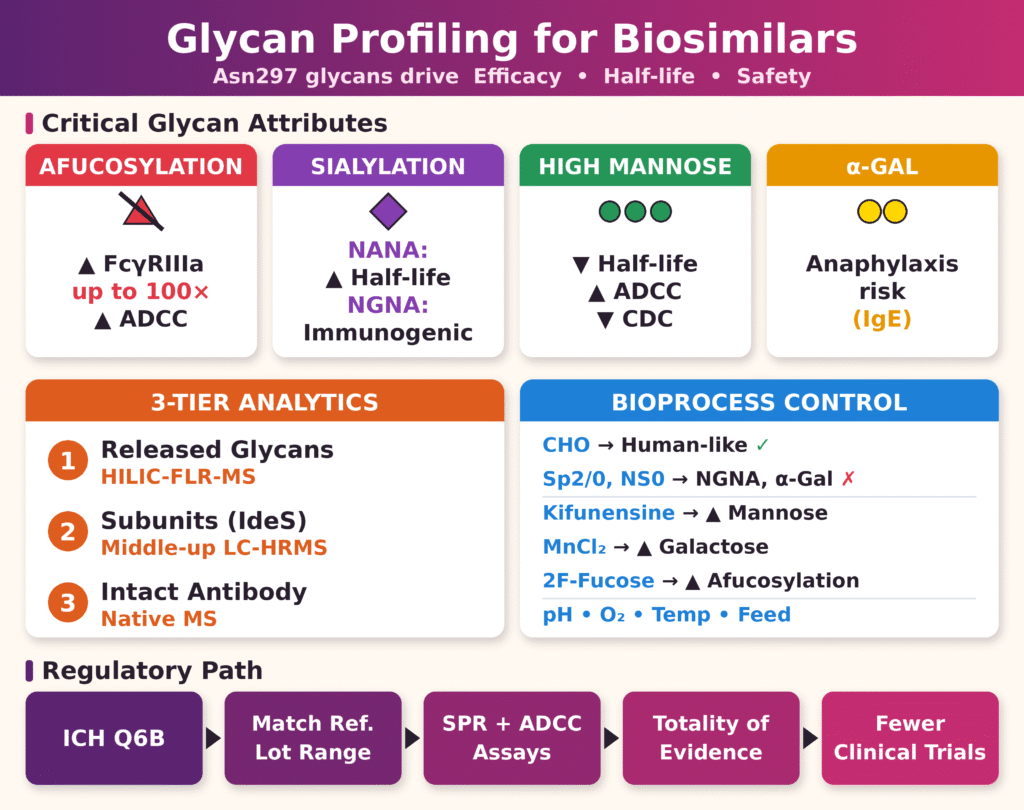
- Why glycans matter: N-glycans at Asn297 in the antibody Fc region shape a biosimilar’s efficacy, half-life and immune safety. Glycan profiling helps show that a biosimilar matches its reference product.
- Afucosylation: Losing the core fucose can raise FcγRIIIa binding up to 100-fold and boost ADCC. Matching this level closely is critical for oncology antibodies such as rituximab and trastuzumab.
- Sialylation: Human-type NANA can extend half-life (especially in Fc-fusion proteins) and add anti-inflammatory activity. Non-human NGNA can trigger immune reactions, faster clearance or hypersensitivity.
- High mannose and α-Gal: High mannose (Man5–Man9) speeds up clearance through mannose receptors, increases ADCC and lowers CDC. α-Gal is a safety concern because it can cause severe allergic reactions.
- Three-tier analytics: The workflow combines three levels:
- Released glycan analysis (HILIC-UPLC-FLR-MS) for precise quantification.
- Middle-up LC-HRMS of IdeS subunits for domain-specific glycan distribution.
- Native intact MS for overall heterogeneity.
- Bioprocess control: CHO cells generally avoid NGNA and α-Gal, while murine lines (Sp2/0, NS0) can produce them. Culture additives fine-tune the glycan profile toward the reference target:
- Kifunensine raises high mannose.
- MnCl₂ with galactose improves galactosylation.
- Fucose analogs raise afucosylation.
- Regulatory expectations: Under ICH Q6B and the totality-of-evidence framework, glycan profiles must fall within the reference product’s lot-to-lot range. Differences need backing from functional assays such as SPR and ADCC. Strong analytical similarity can support reducing some comparative clinical trials.
Impact of Afucosylation, Sialylation, and High Mannose on Biosimilar Efficacy and Safety
Specific N-linked glycan structures attached to the Fc domain directly influence therapeutic antibody effector functions, circulatory half-life, and the potential for adverse immunogenic responses. Quantitative variations in afucosylation, sialylation, and high mannose content can alter receptor-binding kinetics, potentially shifting the safety and efficacy profile beyond the quality range established for the reference product.
Afucosylation and Modulation of FcγRIIIa Binding Affinity in Glycan Profiling Analysis for Biosimilar Characterization
Afucosylation enhances antibody-dependent cellular cytotoxicity (ADCC) by removing steric hindrance associated with core fucose at the Fc Asn297 site. This modification can increase binding affinity to the FcγRIIIa receptor by up to 100-fold. In glycan profiling analysis for biosimilar characterization, matching the reference product’s afucosylation profile is essential for maintaining comparable target-cell killing activity without introducing unintended changes in effector function or potential off-target effects.
The absence of a core α1,6-linked fucose residue on the N-acetylglucosamine (GlcNAc) attached to Asn297 changes the spatial conformation of the Fc region. This structural modification facilitates stronger interactions between the antibody Fc domain and the glycans associated with the FcγRIIIa (CD16a) receptor expressed on natural killer (NK) cells and macrophages. During biosimilar comparability assessments, matching the afucosylation level is particularly important for oncology therapeutics in which ADCC represents a primary mechanism of action (MoA), such as rituximab and trastuzumab. A biosimilar candidate with even a modest increase in afucosylated species, including G0, G1, or G2, compared with the reference product may exhibit increased in vitro ADCC activity, altered therapeutic potency, or changes in the overall safety profile. Such differences can complicate the demonstration of analytical similarity and require additional functional evaluation.
Learn how charge variant analysis in biosimilars complements glycan profiling by helping characterize molecular heterogeneity that may influence product quality and functional consistency.
Sialylation Dynamics: Pharmacokinetics, Immunogenicity, and Fc Receptor Interactions
Sialylation influences systemic clearance, anti-inflammatory activity, and immunogenicity, depending on whether N-acetylneuraminic acid (NANA) or the non-human N-glycolylneuraminic acid (NGNA) is attached to the glycan structure. Terminal NANA sialylation can extend the half-life of certain Fc-fusion proteins and contribute to the anti-inflammatory properties of monoclonal antibodies. In contrast, NGNA can introduce significant immunogenicity concerns because humans may possess pre-existing antibodies against this non-human sialic acid.
- Non-Human Sialic Acid Species (NGNA): Murine cell lines, such as Sp2/0 and NS0, express cytidine monophosphate-N-acetylneuraminic acid hydroxylase (CMAH), an enzyme that converts NANA to NGNA. Because humans lack functional CMAH, NGNA is recognized as a non-human xeno-antigen. Biosimilars containing elevated NGNA levels may encounter pre-existing anti-NGNA antibodies, potentially resulting in accelerated drug clearance, reduced therapeutic efficacy, or severe hypersensitivity reactions.
- Linkage Conformation (α2,3 vs. α2,6): Sialic acid can attach to glycans through α2,3 or α2,6 glycosidic linkages. Glycoproteins containing α2,6-linked sialic acids may interact differently with the liver asialoglycoprotein receptor (ASGPR), depending on their glycan context and terminal sugar composition. These structural differences can influence hepatic recognition and clearance, while α2,3-linked structures may exhibit distinct clearance kinetics in circulation.
- Fc vs. Extracellular Domain Sialylation: In standard IgG mAbs, Fc sialylation has been associated with changes in Fc conformation, reduced FcγRIIIa binding under certain conditions, and attenuated ADCC, while potentially contributing to anti-inflammatory activity. Conversely, in Fc-fusion molecules, such as etanercept and aflibercept, extensive terminal sialylation on non-Fc receptor-binding domains can shield underlying galactose residues from hepatic clearance receptors, thereby helping prolong serum half-life.
Discover how critical quality attributes in biosimilars help developers evaluate structural characteristics associated with biological activity, pharmacokinetics, and product safety.
High Mannose Content and Accelerated Serum Clearance Pathways
High mannose glycoforms (Man5–Man9) can accelerate the systemic clearance of therapeutic antibodies through interactions with hepatic mannose receptors, resulting in a shorter serum half-life and reduced total drug exposure. At the same time, elevated high mannose content can increase FcγRIIIa binding while decreasing C1q-mediated complement activation, potentially producing an effector function profile that differs from that associated with complex biantennary glycans.
High mannose content represents relatively immature intermediate structures in the N-glycosylation pathway that have not undergone complete enzymatic processing in the Golgi apparatus. Monoclonal antibodies carrying high mannose glycans can bind to mannose-binding receptors expressed on liver sinusoidal endothelial cells and macrophages. These interactions promote endocytosis and systemic clearance, potentially reducing the area under the curve (AUC) and terminal half-life (t1/2) of the biosimilar. Furthermore, high mannose glycans can adopt spatial conformations that, like afucosylated structures, facilitate FcγRIIIa binding and enhance ADCC. These glycans may also exhibit reduced binding to the complement component C1q, potentially decreasing Complement-Dependent Cytotoxicity (CDC). The overall effect depends on the specific antibody, glycoform distribution, and biological context.
| Glycan Attribute | Structural Feature | Target / Receptor Interaction | Primary Functional Impact | Clinical Efficacy & Safety Implications |
|---|---|---|---|---|
| Afucosylation | Lack of core α1,6-fucose at Asn297 | FcγRIIIa (CD16a) | Facilitates FcγRIIIa binding and can substantially increase ADCC | Critical for oncology mAbs; excessive afucosylation may alter effector function, increase potential off-target effects, and compromise comparability. |
| Terminal Sialylation (NANA) | α2,3- or α2,6-linked N-acetylneuraminic acid | ASGPR, FcγRIIIa, and anti-inflammatory pathways | May reduce ADCC in mAbs, extend half-life in certain Fc-fusion proteins, and contribute to anti-inflammatory activity | Important for evaluating pharmacokinetic persistence in Fc-fusion proteins and functional comparability. |
| Xeno-Sialylation (NGNA) | Hydroxylated sialic acid produced through the CMAH enzyme pathway | Pre-existing human anti-NGNA IgGs/IgMs | May promote immune complex formation and drug neutralization | Potential immunogenicity, loss of efficacy, and adverse reactions. |
| High Mannose (Man5–Man9) | Incompletely processed oligomannose structures | Mannose receptors, FcγRIIIa, and C1q | Can accelerate serum clearance, increase ADCC, and decrease CDC | May reduce clinical AUC and half-life and produce an effector function profile that differs from the reference product. |
| Alpha-Gal (α-Gal) | Galactose-α-1,3-galactose epitope | Pre-existing human anti-α-Gal IgE/IgG | May trigger acute hypersensitivity reactions through IgE cross-linking | Potential risk of severe anaphylaxis; an important safety CQA for products manufactured using susceptible expression systems. |
Advanced Analytical Technologies in Glycan Profiling Analysis for Biosimilar Characterization
Advanced analytical technologies enable detailed structural elucidation and quantitative assessment of N-glycoforms through complementary separation and detection techniques. Integrating released glycan chromatography with middle-up and intact mass spectrometry supports high-precision evaluation of both site-specific microheterogeneity and whole-molecule macroheterogeneity in glycan profiling analysis for biosimilar characterization.
To achieve comprehensive structural characterization, biopharmaceutical laboratories employ multi-tiered analytical workflows:
- Tier 1: Released N-Glycan Analysis: Enzymatic cleavage followed by fluorophore labeling and hydrophilic interaction chromatography enables precise quantification of individual oligosaccharide species.
- Tier 2: Subunit Middle-Up LC-HRMS: Limited endopeptidase digestion generates Fc/2 and F(ab’)2 subunits, helping verify domain-specific glycan distributions and assess heavy-chain pairing.
- Tier 3: Native Intact Mass Spectrometry: Direct high-resolution mass profiling of non-denatured antibodies enables the evaluation of overall macroheterogeneity and non-glycosylated heavy-chain fractions.
Explore native mass spectrometry for biosimilars to learn how intact protein analysis can complement glycan-specific methods during comprehensive molecular characterization.
Released N-Glycan Analysis via HILIC-UPLC-FLR-MS
Released N-glycan profiling using HILIC-UPLC-FLR-MS provides precise relative quantification and mass confirmation of individual oligosaccharide species. Following enzymatic cleavage with PNGase F and fluorescent labeling, hydrophilic interaction chromatography separates glycoforms and supports the detection and quantification of low-abundance species, including those present at sub-percent levels when the analytical method has adequate sensitivity.
The process begins with enzymatic cleavage using Peptide-N⁴-(N-acetyl-β-glucosaminyl)asparagine amidase (PNGase F) to release N-linked glycans from the polypeptide backbone. The released glycans are subsequently labeled at their reducing ends through reductive amination or other suitable labeling chemistries, using reagents such as 2-aminobenzamide (2-AB), 2-aminobenzoic acid (2-AA), or modern high-sensitivity reagents such as RapiFluor-MS (RFMS). The labeled glycans are separated on amide-based stationary phases using an acetonitrile/ammonium formate gradient. Fluorescence detection enables precise relative quantification through peak-area integration, while inline high-resolution mass spectrometry confirms mass-to-charge (m/z) ratios. Combining these detection techniques facilitates the identification of individual glycoforms, including isobaric species and low-abundance variants, although additional structural analysis may be necessary to distinguish glycans with identical masses.
Learn more about the proteomics approach for biosimilars and how complementary mass spectrometry workflows support detailed assessment of protein structure, sequence, and molecular heterogeneity.
Subunit Mass Spectrometry and Native Intact Protein Analysis
Subunit middle-up LC-HRMS and native intact mass spectrometry help evaluate higher-order glycoform distributions, heavy-chain pairing, and macroheterogeneity across intact therapeutic protein chains. By analyzing Fc/2 and F(ab’)2 subunits generated through IdeS digestion, scientists can rapidly assess site-specific glycan distributions while retaining useful information about the organization of the antibody subunits.
Although released glycan analysis provides chromatographic resolution of individual sugar species, it eliminates information about how glycans are distributed across paired heavy chains within the original antibody molecule. Middle-up LC-HRMS helps address this limitation by digesting monoclonal antibodies with site-specific endopeptidases, such as IdeS, which cleaves below the hinge region, or Gingipain K, to generate F(ab’)2 and Fc-related subunits of approximately 25 kDa, depending on the subunit and cleavage strategy. Analysis of these subunits using high-resolution Orbitrap or Time-of-Flight (TOF) mass spectrometers enables rapid evaluation of Fc-specific glycoforms and helps distinguish heavy-chain glycosylation patterns from domain-specific modifications present in F(ab’) regions. Native intact mass spectrometry further supports the assessment of macroheterogeneity and non-glycosylated heavy-chain (NGHC) fractions without chemical denaturation, preserving non-covalent structural arrangements under suitable analytical conditions.
Bioprocessing Drivers of Glycan Heterogeneity in Host Cell Expression Systems
Host cell selection and bioreactor process conditions determine the cellular enzymatic environment responsible for synthesizing N-glycan structures. By controlling expression cell lines, nutrient feeds, and process parameters, manufacturers can systematically modulate glycosylation patterns to bring the glycan profile closer to that of the reference product.
Glycan microheterogeneity arises from the combined activity of glycosyltransferases and glycosidases present in the host cell’s endoplasmic reticulum and Golgi apparatus. Bioprocess engineers can influence these cellular pathways through appropriate host selection and media supplementation:
- Host Expression System Selection: Selecting between Chinese Hamster Ovary (CHO) cells and murine cell lines, such as Sp2/0 and NS0, establishes the baseline enzymatic capabilities that influence glycan synthesis.
- Bioreactor Operating Conditions: Adjusting dissolved oxygen, pH, temperature, and feeding strategies can influence cellular metabolism and enzymatic activity during cell expansion and protein production.
- Targeted Media Supplementation: Introducing precursor molecules, trace metals, or specific pathway inhibitors can help direct glycan distributions toward the desired target profile.
Discover how cell line development for biosimilars can help establish suitable expression systems and support consistent production of therapeutic proteins with the desired quality attributes.
Host Cell Line Selection and Enzymatic Machinery
Host cell line selection influences the expression and activity of specific glycosyltransferases and sialyltransferases, directly affecting the glycan structures produced and the potential formation of immunogenic epitopes. Murine cell lines, such as Sp2/0, may produce immunogenic α-Gal and NGNA residues because of their enzymatic machinery, whereas Chinese Hamster Ovary (CHO) cells generally lack the relevant functional pathways and produce glycoforms that are more compatible with human therapeutic use.
Chinese Hamster Ovary (CHO) cells are widely used in the biopharmaceutical industry because they generally lack functional α1,3-galactosyltransferase and CMAH pathways associated with the production of α-Gal and NGNA, respectively. Consequently, biosimilars manufactured in CHO systems generally do not express these immunogenic non-human glycan epitopes and predominantly produce human-compatible glycan structures, including NANA-sialylated complex glycans when the relevant biosynthetic pathways are active. In contrast, murine myeloma cell lines, such as Sp2/0 and NS0, may express active α1,3-galactosyltransferase and CMAH enzymes, resulting in the production of α-Gal and NGNA. When a biosimilar is expressed in CHO cells to match a reference product derived from Sp2/0 cells, characterization teams must carefully evaluate these structural differences. They must demonstrate that the absence or reduction of non-human glycans in the biosimilar is adequately characterized and assessed from a safety perspective rather than automatically treating every difference as evidence of non-comparability.
Bioprocess Engineering and Targeted Glycan Modulation
Bioprocess engineering can modify glycan profiles through strategic media supplementation and careful adjustment of bioreactor parameters. The addition of precursor sugars, trace metals, or enzyme inhibitors can selectively influence galactosylation, fucosylation, and mannosylation, helping manufacturers achieve predefined target quality specifications.
During fed-batch or perfusion bioreactor operations, process parameters can be adjusted to achieve specific glycoform targets:
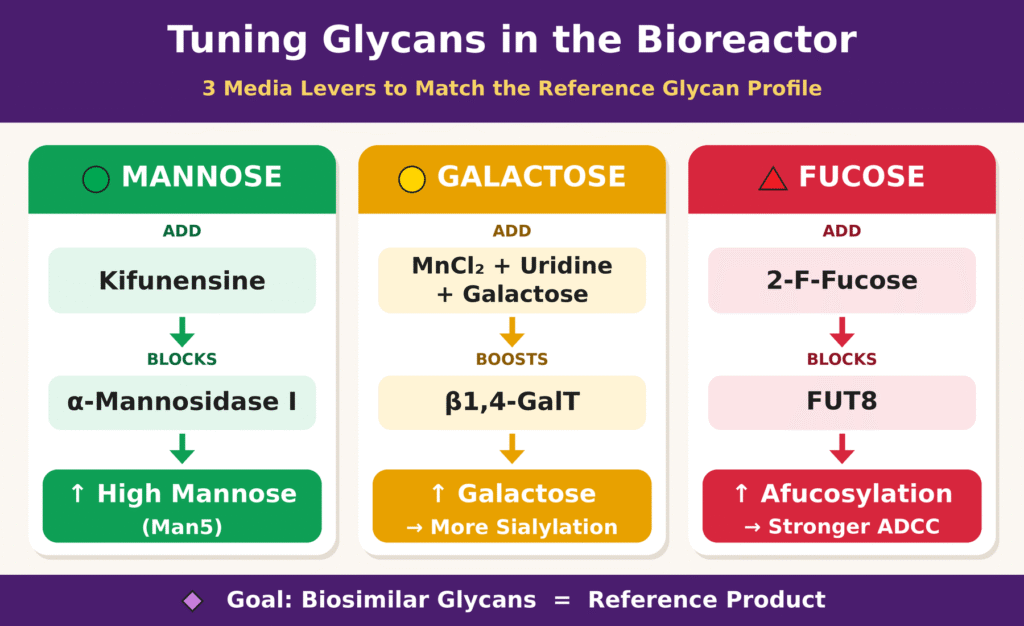
- Mannosylation Control: High mannose accumulation, particularly Man5, can occur when glycan processing is incomplete or when α-mannosidase I activity is inhibited. Supplementing the culture medium with the alkaloid kifunensine inhibits α-mannosidase I and increases high mannose content. In contrast, optimizing glucose feeds, maintaining suitable culture conditions, and extending culture duration where appropriate may support glycan processing by endogenous mannosidases and promote the formation of more extensively processed structures.
- Galactosylation Enhancement: Sialylation requires terminal galactose residues as substrates. Adding manganese chloride (MnCl₂), a cofactor for β1,4-galactosyltransferase, along with uridine and galactose to the culture medium can promote galactosylation and increase the availability of terminal galactose residues for subsequent sialic acid addition.
- Afucosylation Suppression/Promotion: Fucosylation depends on the availability of GDP-fucose, which can be synthesized through the de novo pathway. Adding compounds such as 2-deoxy-2-fluoro-D-fucose or 2-F-peracetyl fucose can inhibit α1,6-fucosyltransferase (FUT8), increasing the proportion of afucosylated glycans. This targeted modification can enhance ADCC when increased FcγRIIIa-mediated activity is desirable, provided that the resulting glycan profile remains appropriate for the intended therapeutic application.
Read about forced degradation studies for biosimilars to understand how controlled stress testing can help assess product stability and identify degradation-related changes that may affect quality.
Regulatory Expectations and the Totality-of-Evidence Framework for Biosimilars
Regulatory agencies expect biosimilar sponsors to demonstrate that critical glycan attributes are adequately characterized and fall within an appropriate range of variability established for the reference product under the Totality-of-Evidence framework. Demonstrating analytical similarity through glycan profiling helps reduce residual uncertainty and may support regulatory justification for reducing or waiving certain comparative clinical efficacy studies when scientifically and regulatorily appropriate.
According to ICH Q6B guidelines, characterization should establish the glycan distribution of the biosimilar and assess it against the variability observed across multiple commercial lots of the reference product. Regulatory expectations depend on the functional significance of each glycoform and the potential consequences of any observed differences:
- Critical Attributes (Afucosylation/High Mannose): When afucosylation or mannosylation levels differ from the reference product’s established range, developers may need to perform complementary functional assays, such as surface plasmon resonance (SPR) binding studies with FcγRIIIa, cell-based ADCC assays, and mannose receptor-binding assessments. Significant differences in these attributes can complicate the demonstration of biosimilarity and require a scientifically justified assessment supported by additional analytical and functional evidence.
- Safety Attributes (NGNA/α-Gal): Regulatory assessments place particular importance on non-human glycan epitopes that may contribute to immunogenicity. The presence of lower levels of potentially immunogenic species in a biosimilar may represent a safety advantage, but this conclusion must be supported by appropriate characterization and risk assessment. Differences from the reference product should be evaluated in the context of the overall quality, safety, and efficacy profile.
- Residual Uncertainty Mitigation: Strong analytical comparability across complex glycan structures can reduce residual uncertainty during the early stages of development. Comprehensive evidence may support requests to reduce or waive certain Phase 3 comparative efficacy trials under applicable regulatory pathways. Such decisions depend on the totality of the evidence, the product’s characteristics, the intended indication, and the relevant regulatory requirements.
Explore our biosimilar comparability studies to learn how structured analytical comparisons help establish evidence of similarity between a biosimilar candidate and its reference product.
Conclusion
In summary, glycan profiling analysis for biosimilar characterization provides a structural foundation for establishing comparability between a biosimilar candidate and its reference product. Quantitative evaluation of afucosylation, sialylation, and high mannose content provides critical insights into FcγRIIIa-mediated ADCC potency, receptor-mediated pharmacokinetic clearance, and potential immunogenicity risks. By implementing high-resolution mass spectrometry and complementary chromatography workflows, analytical teams can investigate structural differences, reduce residual uncertainty early in development, and generate evidence to support regulatory compliance and scientifically justified clinical development strategies.
Explore ResolveMass biosimilar characterization services to learn how integrated analytical testing can support biosimilar development, comparability assessment, and regulatory submissions.
To learn how advanced mass spectrometry and expert characterization services at ResolveMass Laboratories Inc. can support your biosimilar development programs, contact our team through the ResolveMass Laboratories contact page.
Frequently Asked Questions
High mannose glycans can accelerate the removal of therapeutic proteins from circulation by interacting with mannose receptors on hepatic endothelial cells and macrophages. This process promotes cellular uptake and may reduce serum half-life and overall drug exposure, measured by the area under the curve (AUC). Therefore, differences in high mannose content between a biosimilar and its reference product require careful analytical and functional evaluation.
N-glycolylneuraminic acid (NGNA) is a non-human sialic acid that can be produced by host cells expressing the CMAH enzyme. Because humans may possess pre-existing antibodies against NGNA, its presence in therapeutic proteins can trigger immune recognition and potentially promote immune complex formation. Depending on the product and exposure, this may contribute to accelerated drug clearance, reduced efficacy, or hypersensitivity reactions.
Chinese Hamster Ovary (CHO) cells generally lack functional α1,3-galactosyltransferase and CMAH pathways, limiting the production of α-Gal and NGNA glycan epitopes. In contrast, murine Sp2/0 cells can express these enzymes and generate glycan structures containing these potentially immunogenic epitopes. These differences make host cell selection an important consideration when assessing glycan comparability and the safety of therapeutic biosimilars.
HILIC-UPLC-FLR-MS is a widely established analytical approach for characterizing released N-glycans following enzymatic cleavage with PNGase F. Fluorescent labeling reagents, such as 2-aminobenzamide (2-AB) and RapiFluor-MS, support sensitive detection and relative quantification of individual glycan species. Coupling fluorescence detection with mass spectrometry provides complementary information about glycan abundance and molecular mass, supporting more comprehensive structural characterization.
Terminal sialylation can influence the circulation time of Fc-fusion proteins by modifying the accessibility of underlying galactose residues to hepatic clearance receptors. Sialic acid residues may reduce recognition by the asialoglycoprotein receptor (ASGPR), helping limit premature hepatic removal under appropriate structural conditions. Consequently, evaluating sialylation patterns is important for understanding pharmacokinetic behavior and establishing comparability between biosimilars and their reference products.
Regulatory agencies may accept differences in glycan profiles when comprehensive evidence demonstrates that these variations do not adversely affect product quality, safety, or efficacy. The assessment considers the functional significance of each glycan attribute, the variability observed across reference product batches, and supporting analytical and biological data. Under the Totality-of-Evidence framework, differences such as reduced levels of potentially immunogenic glycans may be acceptable when appropriately characterized and scientifically justified.
Middle-up liquid chromatography–high-resolution mass spectrometry (LC-HRMS) involves selective enzymatic digestion, such as IdeS-mediated cleavage, to produce antibody subunits that are easier to analyze than intact monoclonal antibodies. These fragments retain important information about domain-specific glycosylation and can help identify differences in Fc-associated glycoforms. The technique supports the evaluation of glycan distributions, subunit composition, and structural heterogeneity during biosimilar comparability assessments.
Galactosylation of the Fc-associated N-glycans can influence the ability of IgG antibodies to activate the classical complement pathway through interactions involving C1q. In many antibody systems, increased galactosylation is associated with enhanced complement activation, although the magnitude of this effect depends on the antibody structure and experimental conditions. Comparing galactosylated glycoforms, such as G2F, with agalactosylated forms, such as G0F, helps determine whether glycan differences affect CDC activity.
Manufacturers can manage high mannose levels by optimizing glucose feeding, culture duration, pH, dissolved oxygen, and other parameters that influence host cell metabolism and glycan processing. Maintaining suitable culture conditions can support the enzymatic reactions required for N-glycan maturation within the Golgi apparatus. The effectiveness of these strategies depends on the host cell line and manufacturing process, so glycan profiling should be used to verify that the resulting product meets its predefined quality specifications.
Reference:
- Shibata, H., Harazono, A., Kiyoshi, M., Saito, Y., & Ishii-Watabe, A. (2025). Characterization of biosimilar monoclonal antibodies and their reference products approved in Japan to reveal the quality characteristics in post-approval phase. BioDrugs, 39(4), 645–667. https://doi.org/10.1007/s40259-025-00722-4
- Saleem, R., Cantin, G., Wikström, M., Bolton, G., Kuhns, S., McBride, H. J., & Liu, J. (2020). Analytical and functional similarity assessment of ABP 710, a biosimilar to infliximab reference product. Pharmaceutical Research, 37(6), Article 114. https://doi.org/10.1007/s11095-020-02816-w
- Christl, L. (n.d.). Overview of the regulatory pathway and FDA’s guidance for the development and approval of biosimilar products in the US [PowerPoint presentation]. U.S. Food and Drug Administration. https://www.fda.gov/media/99048/download
- Mastrangeli, R., Satwekar, A., & Bierau, H. (2023). Innovative metrics for reporting and comparing the glycan structural profile in biotherapeutics. Molecules, 28(8), Article 3304. https://doi.org/10.3390/molecules28083304
- Cantin, G., Liu, Q., Shah, B., Kuhns, S., Wikström, M., Cao, S., & Liu, J. (2023). Analytical and functional similarity of the biosimilar candidate ABP 654 to ustekinumab reference product. Drugs in R&D, 23(4), 421–438. https://doi.org/10.1007/s40268-023-00441-7
- Singh, S. K., & Lee, K. H. (2022). Characterization of monoclonal antibody glycan heterogeneity using hydrophilic interaction liquid chromatography–mass spectrometry. Frontiers in Bioengineering and Biotechnology, 9, Article 805788. https://doi.org/10.3389/fbioe.2021.805788
Get In Touch With Us
About The Author


