

Introduction
Understanding How to Choose a Peptide CDMO in Canada requires biopharmaceutical companies to carefully assess a contract manufacturer’s regulatory compliance with Health Canada requirements, peptide synthesis capabilities, process development expertise, and analytical characterization infrastructure. Forming a partnership with an accredited domestic contract development and manufacturing organization (CDMO) can simplify regulatory filing activities, improve raw material traceability, and reduce potential cross-border supply chain complications. Therapeutic peptides represent a distinctive category within pharmaceutical development because they possess characteristics that bridge conventional small molecules and complex biological proteins. Their manufacture therefore requires specialized protecting group chemistries, sequential synthetic operations, sophisticated chromatographic purification, high-resolution mass spectrometry, and stringent bioburden control measures.
Within Canada, drug developers must meet regulatory expectations established by Health Canada, including the requirements specified under Part C, Division 2 of the Food and Drug Regulations. Obtaining peptide APIs from offshore suppliers may create additional challenges related to international transportation, differences in regulatory expectations, customs procedures, and potential intervention by the Canada Border Services Agency (CBSA). Working with a Canadian domestic CDMO can provide greater control over regulatory activities associated with Clinical Trial Applications (CTAs), New Drug Submissions (NDSs), and Abbreviated New Drug Submissions (ANDSs), while also allowing sponsors to maintain closer oversight of Chemistry, Manufacturing, and Controls (CMC) activities. This technical buyer’s checklist presents the major factors that should be considered when assessing Canadian peptide CDMOs, including regulatory compliance, peptide synthesis technologies, analytical capabilities, facility containment, and supply chain security.
Explore peptide CDMO services in Canada for development and manufacturing support.
Share via:
Quick Summary:
- Regulatory Compliance: A Canadian peptide CDMO should maintain an active Health Canada Drug Establishment License (DEL), follow GMP/GUI-0104 and ICH Q7, and have a strong inspection and DMF history.
- Peptide Synthesis & Scale-Up: Evaluate expertise in SPPS, LPPS, and hybrid synthesis, along with the ability to scale from gram-level development to multi-kilogram manufacturing.
- Advanced Modifications: Confirm experience with cyclization, lipidation, PEGylation, unnatural amino acids, and radiopharmaceutical conjugation, plus greener solvent strategies.
- Analytical Capabilities: A strong analytical platform should include RP-HPLC/UHPLC, HRMS/LC-MS/MS, SEC, NMR, CD, residual-solvent testing, and endotoxin/bioburden assays for impurity profiling and peptide characterization.
- Peptide Sameness & Quality: The CDMO should demonstrate sequence, structural, purity, and impurity-profile comparability against reference products, with appropriate control of impurities around the 0.10% level where applicable.
- Facility & Containment: Assess Grade A–D cleanrooms, HVAC/pressure controls, isolators, HPAPI containment, validated cleaning, environmental monitoring, and container-closure integrity testing (CCIT) where applicable.
- Supply Chain & Final Checklist: Verify qualified suppliers, raw-material identity testing, representative sampling, full traceability, and domestic logistics. Overall CDMO evaluation should cover five pillars: regulatory licensing, synthetic capability, analytical depth, facility controls, and supply-chain security.
Regulatory Compliance and Health Canada Licensing
A Canadian peptide CDMO operating under GMP expectations should maintain an active Drug Establishment License (DEL) issued by Health Canada and demonstrate compliance with GUI-0104 Good Manufacturing Practices (GMP) for Active Pharmaceutical Ingredients (APIs). These regulatory credentials demonstrate that activities involving API fabrication, packaging, labeling, and testing are conducted within an established quality framework consistent with applicable pharmaceutical manufacturing requirements.
Under Division 1A (Establishment Licensing) and Division 2 (Good Manufacturing Practices) of the Food and Drug Regulations, manufacturers of finished dosage forms are required to obtain APIs from facilities that operate according to applicable cGMP requirements. For synthetic peptides classified as APIs, Canadian CDMOs should establish their Quality Management Systems (QMS) in accordance with International Council for Harmonisation (ICH) Q7 principles, which are reflected in Health Canada’s GUI-0104 guidelines. When a CDMO uses foreign subcontractors for specific intermediate chemical manufacturing activities, those external facilities should likewise provide appropriate regulatory documentation and evidence of compliance accepted under applicable Health Canada frameworks, including GUI-0004 or GUI-0005 where relevant.
| Regulatory Governance | Standard / Reference Document | Key Operational Expectation | Impact on Drug Sponsor |
|---|---|---|---|
| Drug Establishment License (DEL) | FDR Division 1A (C.01A) | Valid license specifically covering API fabrication, packaging, and testing. | Provides legal authorization for the applicable manufacture and handling of clinical and commercial API lots in Canada. |
| API Good Manufacturing Practices | Health Canada GUI-0104 / ICH Q7 | Documented Quality Management System, MBRs, and deviation controls. | Supports consistent batch manufacturing and regulatory filing requirements. |
| Finished Product Standards | Health Canada GUI-0001 | Compliance applicable to aseptic drug product filling and packaging. | Supports parenteral drug product safety and sterility assurance. |
| Quality Risk Management | ICH Q9 Guidelines | Formal risk assessments addressing material sourcing and contamination control. | Helps reduce risks associated with batch failures and significant regulatory observations. |
| CMC Regulatory Filings | Health Canada NDS/ANDS Quality Guidance | Active Type II Drug Master File (DMF) registration with Health Canada. | Can facilitate the regulatory review process for CTAs and NDS filings. |
Biopharmaceutical sponsors should examine the CDMO’s Health Canada inspection history and carefully review previous observations, including those classified under GUI-0023 (Risk Classification of Drug GMP Observations). A thorough assessment should consider the nature and resolution of previous findings rather than relying solely on the number of observations. Sponsors should also verify whether relevant Drug Master Files (DMFs) are actively maintained with Health Canada and, where applicable, the U.S. FDA. These factors can provide important information when assessing the regulatory readiness and quality infrastructure of a prospective CDMO.
Evaluate Canadian peptide manufacturing capabilities when assessing regulatory and quality requirements.
Technical Expertise in Peptide Synthesis and Process Scale-Up
Assessing a CDMO’s technical capabilities involves determining whether its Solid-Phase Peptide Synthesis (SPPS), Liquid-Phase Peptide Synthesis (LPPS), or hybrid manufacturing platforms can reproducibly manufacture the target sequence at the required scale while controlling yield loss, impurity formation, and amino acid racemization. Selection of the appropriate synthetic strategy has a direct influence on coupling efficiency, impurity profiles, solvent consumption, process complexity, and overall unit production economics.
Solid-Phase Peptide Synthesis (SPPS) remains a widely used manufacturing approach for short-to-medium sequence lengths, generally extending to approximately 40–50 amino acids depending on the peptide and process characteristics. This methodology uses Fmoc or Boc protecting group chemistries attached to insoluble polymeric resin matrices. Advanced Canadian CDMOs may employ automated, microwave-assisted, or continuous-flow SPPS reactors to improve coupling kinetics, reduce aggregation, and limit beta-sheet formation during chain elongation. Liquid-Phase Peptide Synthesis (LPPS), in comparison, can be advantageous for shorter peptides, particularly sequences under 10 amino acids, and for selected large-scale commercial campaigns in which resin capacity and associated costs become important process considerations. For longer or structurally complex peptides, hybrid peptide synthesis can combine the advantages of both approaches by producing short, protected fragments through SPPS and subsequently performing LPPS fragment condensation in solution. This strategy can provide favorable yield and purity characteristics for appropriately selected peptide structures.
Learn more about peptide CDMO scale-up services for transitioning peptide processes toward larger manufacturing scales.
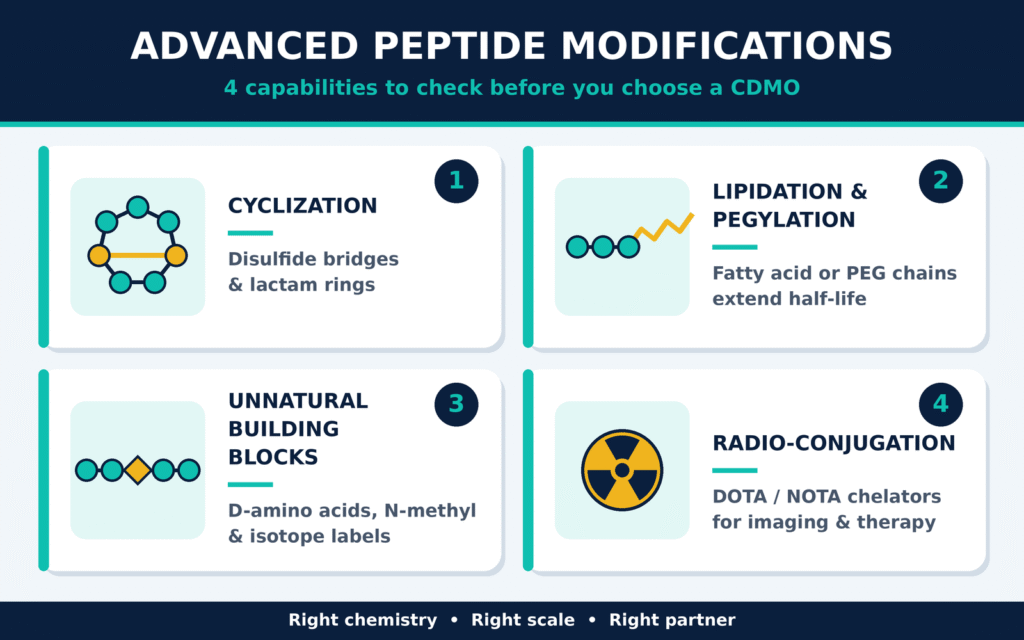
Sponsors should additionally assess whether the CDMO has sufficient experience with advanced post-synthetic chemical modifications, including:
- Cyclization: Formation of disulfide bonds, including mono-, di-, or multi-bridge disulfide pairing, as well as head-to-tail or side-chain-to-side-chain lactam cyclization.
- Lipidation & Pegylation: Site-specific attachment of fatty acid chains, such as C16/C18 diacids used with GLP-1 receptor agonists, or polyethylene glycol (PEG) moieties intended to extend plasma half-life.
- Unnatural Building Blocks: Incorporation of D-amino acids, N-methylated residues, sterically hindered non-canonical amino acids, or isotopic labels into peptide structures.
- Radiopharmaceutical Conjugation: Conjugation of bifunctional chelation agents, including DOTA and NOTA, for radiolabeled therapeutic and diagnostic peptides.
Process development groups should also demonstrate an ongoing focus on sustainable chemistry and manufacturing practices. Replacing hazardous solvents such as Dimethylformamide (DMF) and N-Methyl-2-pyrrolidone (NMP) with greener alternatives, including 2-Methyltetrahydrofuran or 1,3-Dioxolane, can support improved environmental and worker safety considerations while contributing to more sustainable manufacturing processes.
Explore custom peptide synthesis services for specialized peptide development requirements.
Analytical Rigor, Impurity Profiling, and Peptide Sameness
A strong analytical program requires the CDMO to separate, characterize, and quantify process- and product-related impurities at or above the 0.10% threshold applicable under relevant global regulatory expectations. Because peptide synthesis proceeds through multiple sequential chemical steps, numerous side reactions can produce structurally related impurities. These may include deletion sequences, insertion sequences, diastereomers (racemized variants), beta-amyloid aggregates, and incompletely deprotected products.
A capable Canadian CDMO should maintain an analytical characterization laboratory equipped with high-resolution mass spectrometry (HRMS) and complementary liquid chromatography technologies. Conventional Reversed-Phase High-Performance Liquid Chromatography (RP-HPLC), although essential for peptide purity assessment, may not by itself provide sufficient resolution for closely eluting regioisomers or subtle degradation products. Consequently, orthogonal analytical techniques are important for comprehensive peptide characterization and impurity identification.
| Analytical Methodology | Target Measurement | Regulatory Impact |
|---|---|---|
| RP-HPLC / UHPLC | Purity quantification and related substance profiling | Establishes API purity specifications (>98%) and supports quantification of individual impurities. |
| LC-MS/MS / Orbitrap HRMS | Exact mass, sequence validation, and impurity identification | Supports structural elucidation of unknown impurities above 0.10%. |
| Size-Exclusion Chromatography (SEC) | Oligomer and aggregate quantification | Helps demonstrate control of potentially immunogenic high-molecular-weight aggregates. |
| 2D NMR & CD Spectroscopy | Higher-order structure (HOS) and secondary conformation | Supports evaluation of structural “peptide sameness” against RLDs. |
| Karl Fischer / Headspace GC | Residual water and organic solvent determination | Supports verification of compliance with ICH Q3C residual solvent limits. |
| LAL / Bioburden Assays | Bacterial endotoxin and bioburden quantification | Represents an important release parameter for parenteral peptide APIs. |
For generic peptide drug development, including synthetic versions of Liraglutide, Semaglutide, or Teriparatide, Health Canada and the U.S. FDA may require extensive assessments of “peptide sameness.” A qualified CDMO should have the analytical expertise necessary to demonstrate that the synthetic peptide possesses the required primary amino acid sequence, appropriate matching secondary/tertiary conformations, and a suitably characterized impurity profile relative to the Reference Listed Drug (RLD). Such characterization is important for establishing comparability and evaluating whether the manufacturing process introduces potentially relevant novel impurities or immunogenicity-related concerns.
Explore one-stop CDMO analytical services for ANDA development for integrated analytical support.
Facility Architecture, Cleanroom Containment, and Quality Controls
Facility assessment should confirm that cleanroom infrastructure is appropriately designed and maintained in accordance with applicable Health Canada GUI-0104 requirements, including suitable containment arrangements for High-Potency Active Pharmaceutical Ingredients (HPAPIs) and validated environmental monitoring programs. Potent peptide compounds, including cytotoxic peptide-drug conjugates (PDCs) and low-dose hormonal analogs, may require stringent Occupational Exposure Limits (OELs) and specialized engineering controls to protect personnel and prevent cross-contamination.
Health Canada’s GUI-0104 requirements emphasize appropriate segregation and control of manufacturing activities to minimize the potential for cross-contamination. Facilities handling highly active or sensitizing compounds may therefore require dedicated and appropriately air-segregated suites, negative pressure differentials, single-pass HVAC systems, and closed isolator technologies based on the nature of the materials and manufacturing operations.
For sterile peptide APIs or finished parenteral vial manufacturing, cleanroom arrangements should support Grade A (ISO 5) processing environments within appropriate Grade B background zones. Important infrastructure and quality features that should be reviewed during a facility walk-through include:
- Complete prohibition of sinks and drains within Grade A/B aseptic processing areas to reduce the potential for microbiological contamination.
- Continuous monitoring of pressure differentials, supported by automated visual and audible alarms for HVAC system failures.
- Full containment isolators for the controlled handling of lyophilized powders and potent chemical substances.
- Validated cleaning procedures supported by Total Organic Carbon (TOC) or HPLC wipe sampling and scientifically justified acceptance criteria.
- 100% Container Closure Integrity Testing (CCIT) for applicable parenteral drug product containers closed through fusion or stopper insertion.
Review lyophilized peptide injectable formulation considerations for sterile and parenteral peptide products.
Supply Chain Integrity and Raw Material Traceability
Maintaining supply chain integrity requires the CDMO to implement robust ICH Q9 quality risk management procedures and conduct appropriate independent identity testing of incoming raw materials. Transparent and documented supplier qualification systems help reduce the risks associated with raw material adulteration, manufacturing failures, inconsistent material quality, and regulatory delays.
Dependence on inadequately qualified offshore raw material sources can introduce significant financial and quality-related challenges. Protected amino acids or coupling reagents of unsuitable quality may contain undisclosed chiral impurities, trace heavy metals, residual solvents, or bacterial endotoxins. In addition, Health Canada coordinates with the Canada Border Services Agency (CBSA) in relation to regulatory requirements affecting imported products and materials. Consequently, inadequately documented or non-compliant offshore shipments may encounter customs-related delays, holds, or other import complications.
Compare U.S. and overseas peptide CDMO considerations when evaluating international manufacturing and supply-chain options.
A qualified Canadian CDMO should maintain an established vendor qualification program covering critical raw material suppliers. Under applicable cGMP expectations, the CDMO should conduct appropriate identity verification for incoming container batches rather than depending exclusively on the supplier’s Certificate of Analysis (CoA). Raw material sampling procedures should be scientifically justified and designed to represent the material adequately across container subdivisions, such as the top, middle, and bottom, without inappropriate compositing where individual-container assessment is required. These controls help establish material identity and homogeneity before the materials are released for GMP production.
Comprehensive Evaluation Checklist for How to Choose a Peptide CDMO in Canada
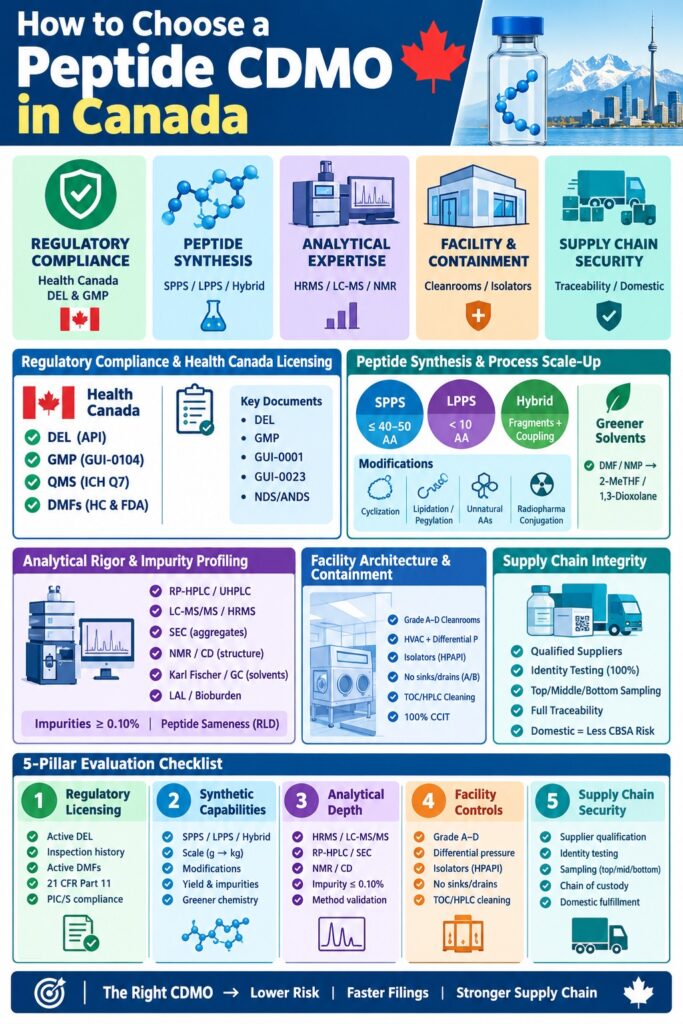
A structured buyer’s checklist can organize CDMO assessment around five major technical pillars: regulatory licensing, synthetic capacity, analytical depth, facility containment, and supply chain security. Biopharmaceutical companies can apply this framework during preliminary vendor qualification, technical evaluations, on-site audits, and final CDMO selection activities.
- Pillar 1: Regulatory Licensing & Compliance Standing
- Confirm an active Health Canada Drug Establishment License (DEL) that specifically covers applicable API fabrication, packaging, labeling, and testing activities.
- Review the CDMO’s Health Canada inspection history and examine risk classifications under GUI-0023.
- Confirm active Type II Drug Master Files (DMFs) registered with Health Canada and applicable foreign health authorities.
- Verify 21 CFR Part 11 and PIC/S data integrity compliance across computerized analytical systems where applicable.
- Pillar 2: Synthetic Capabilities & Scale-Up Engineering
- Assess technical expertise across SPPS, LPPS, and hybrid synthesis methodologies.
- Evaluate reactor capacities spanning pre-clinical gram-scale production through commercial multi-kilogram manufacturing.
- Review technical experience with complex modifications, including disulfide cyclization, lipidation, pegylation, and incorporation of unnatural amino acids.
- Examine process development strategies for reaction yield optimization and the implementation of greener solvent systems.
- Pillar 3: High-Resolution Analytical Depth
- Confirm access to in-house HRMS, LC-MS/MS, RP-HPLC, SEC, NMR, and CD spectroscopy capabilities.
- Verify the ability to isolate, identify, and quantify impurities at or below the 0.10% analytical threshold where applicable.
- Evaluate experience with FDA/Health Canada compliant peptide sameness assessment protocols.
- Review analytical method validation procedures against applicable ICH Q2(R1) standards.
- Pillar 4: Facility Architecture & Containment Controls
- Inspect cleanroom classifications from Grade A through D and review differential pressure HVAC architecture.
- Confirm the availability of isolator technology and appropriate engineering containment for HPAPIs and low-OEL substances.
- Verify the absence of sinks and drains in applicable Grade A/B aseptic processing zones.
- Review validated TOC/HPLC cleaning procedures and scientifically justified residue acceptance criteria.
- Pillar 5: Raw Material Verification & Domestic Logistics
- Confirm appropriate identity testing for 100% of incoming protected amino acid batches where required by the established quality system.
- Audit statistical raw material sampling procedures, including top, middle, and bottom container sampling where applicable.
- Ensure complete chain-of-custody traceability for raw materials, resins, and reagents.
- Consider domestic Canadian fulfillment as a means of reducing potential CBSA customs delays and international import-related supply chain risks.
For peptide programs progressing toward commercial-scale production, explore GLP-1 analog scale-up and GMP manufacturing considerations.
Conclusion
Applying comprehensive evaluation criteria when determining How to Choose a Peptide CDMO in Canada is important for biopharmaceutical companies seeking to reduce development risks and establish a reliable pathway toward regulatory submission and commercialization. A detailed assessment of a prospective partner’s Health Canada DEL status, peptide synthesis and scale-up capabilities, high-resolution analytical infrastructure, facility controls, and raw material traceability can help ensure that the peptide program is supported by an appropriate quality and manufacturing framework. Selecting a CDMO with relevant domestic capabilities can also support regulatory activities associated with CTAs and NDSs while strengthening oversight of intellectual property, manufacturing operations, and supply chain continuity.
Explore peptide CDMO capabilities in Canada for development and manufacturing support.
To discuss specialized analytical characterization, method validation, or custom peptide manufacturing solutions, contact the technical experts at ResolveMass Laboratories Inc. directly through their Contact Us Page.
Frequently Asked Questions (FAQs)
Health Canada’s GUI-0104 establishes Good Manufacturing Practice requirements for facilities involved in Active Pharmaceutical Ingredients (APIs). It incorporates principles from ICH Q7 and addresses areas such as sanitation, equipment qualification, raw material controls, process management, and documentation. These requirements help maintain consistent quality throughout peptide API manufacturing.
Solid-Phase Peptide Synthesis (SPPS) constructs the peptide chain while it remains attached to an insoluble resin and is commonly used for complex and longer sequences. Liquid-Phase Peptide Synthesis (LPPS) performs synthesis in solution and can be advantageous for shorter peptides and selected larger-scale manufacturing processes. The appropriate approach depends on peptide structure, scale, yield, and process economics.
Peptide sameness assessment generally requires multiple complementary analytical techniques rather than relying on a single method. LC-MS/MS, Orbitrap High-Resolution Mass Spectrometry, 2D NMR, Circular Dichroism (CD) spectroscopy, and high-resolution chromatographic methods can collectively evaluate primary structure, higher-order structure, and impurity profiles. The specific analytical package depends on the product and regulatory requirements.
Detailed impurity profiling is important because peptide synthesis can generate closely related variants, including deletion sequences, insertion sequences, and diastereomers. Impurities at or above applicable reporting or identification thresholds may require further characterization to establish their chemical identity and potential significance. Comprehensive profiling therefore supports quality assessment and regulatory evaluation of the peptide API.
High-Potency Active Pharmaceutical Ingredients (HPAPIs) require engineering controls designed to protect operators, products, and the surrounding environment. Depending on the compound, these controls may include negative-pressure cleanroom suites, closed isolators, single-pass air handling systems, and occupational exposure monitoring. Appropriate containment also helps minimize the possibility of cross-contamination.
Using inadequately qualified offshore raw materials can introduce impurities such as chiral contaminants, heavy metals, residual solvents, or other unwanted substances into peptide manufacturing. Inadequate documentation or quality controls may also complicate material release and regulatory review. International shipments can additionally face customs-related delays or holds involving the CBSA.
Mass Spectrometry (MS) is an important analytical tool for confirming the molecular mass and identity of peptide APIs. It can support sequence confirmation and the detection or characterization of low-level process-related impurities when used alongside complementary analytical methods. These results contribute to the overall assessment of batch identity, purity, and quality.
The duration of peptide technology transfer depends on sequence complexity, process maturity, analytical requirements, and manufacturing scale. Activities may include analytical method transfer, process adaptation, engineering runs, documentation, and GMP validation batch execution. A technology transfer program can commonly require several months, with approximately 3 to 6 months often used as a planning range for a standard project.
For Chemistry, Manufacturing, and Controls (CMC) filings, a CDMO may need to provide comprehensive manufacturing and analytical documentation supporting the drug substance. This can include Master Batch Records, validated analytical method protocols, stability study reports, structural characterization data, impurity profiling reports, and an active Drug Master File (DMF) or appropriate technical package. The exact documentation package depends on the development stage and regulatory submission requirements.
Reference:
- Health Canada. (2020). Good manufacturing practices guide for drug products (GUI-0001). Government of Canada. Health Canada — GMP Guide (GUI-0001)
- Health Canada. (2019). Active pharmaceutical ingredients—Good manufacturing practices—Questions and answers. Government of Canada. Health Canada: Active Pharmaceutical Ingredients – GMP Questions and Answers
- Gravante, F., Sacchini, F., Mancin, S., Lopane, D., Parozzi, M., Ferrara, G., Sguanci, M., Morales Palomares, S., Biondini, F., Marfella, F., Cangelosi, G., Caggianelli, G., & Petrelli, F. (2025). Preventing microorganism contamination in starting active materials for synthesis from global regulatory agencies: Overview for public health implications. Microorganisms, 13(7), 1595. https://doi.org/10.3390/microorganisms13071595
- Health Canada. (2024). Quality (chemistry and manufacturing) guidance: New drug submissions (NDSs) and abbreviated new drug submissions (ANDSs). Government of Canada. Health Canada guidance document
- Health Canada. (2019). Radiopharmaceuticals, kits, and generators: Submission information for Schedule C drugs. Government of Canada. Health Canada guidance document
- Petrelli, F., Caraffa, A., Scuri, S., Grappasonni, I., Magrini, E., & Cocchini, A. (2019). The requirements for manufacturing highly active or sensitising drugs comparing Good Manufacturing Practices. Acta Bio-Medica: Atenei Parmensis, 90(2), 288–299. https://doi.org/10.23750/abm.v90i2.8340
Get In Touch With Us
About The Author


