

Introduction:
Nitrosamine leachables in blister packaging have become one of the most closely scrutinized contamination pathways in oral solid dosage manufacturing since regulatory agencies expanded nitrosamine risk assessment requirements beyond active pharmaceutical ingredient (API) synthesis routes. While most nitrosamine investigations historically focused on process-related impurities or degradation products, packaging components — foil laminates, PVC/PVdC blister films, heat-seal coatings, and printing inks — are now recognized as a legitimate and sometimes overlooked source of N-nitrosamine contamination in finished OSD products.
This case study outlines how a systematic investigation identifies, confirms, and resolves a nitrosamine leachable issue traced to blister packaging, using the kind of methodical approach an analytical CRO/CDMO applies when a client’s stability or release testing data flags an unexpected nitrosamine signal. For a broader look at how packaging-derived nitrosamines form and are controlled, see our overview of packaging leachables and nitrosamine E&L testing.
Summary:
- Nitrosamine leachables in blister packaging can form when amine-containing excipients or drug substances react with nitrite impurities present in packaging materials such as PVC/PVdC films, foil laminate adhesives, or printing inks.
- A structured root cause investigation combines extractables & leachables (E&L) testing, LC-MS/MS trace-level analysis, and packaging component risk mapping to isolate the true source.
- Regulatory bodies (FDA, EMA, Health Canada) expect nitrosamine risk assessments to cover packaging-derived contamination, not just synthesis- or degradation-related pathways.
- This case study walks through a real-world-style investigation: detection, root cause analysis, confirmatory testing, and corrective action for a blister-packaged oral solid dosage (OSD) product.
- Analytical strategies discussed include GC-MS/MS, LC-MS/MS, and targeted N-nitrosamine screening methods validated to ICH M7(R2) and regulatory nitrosamine guidance thresholds.
1: Why Do Nitrosamine Leachables Occur in Blister Packaging?
Nitrosamine leachables occur in blister packaging when secondary or tertiary amines present in the drug product, excipients, or packaging materials come into contact with nitrosating agents such as nitrite residues, nitrogen oxides from printing inks, or nitrocellulose-based coatings under specific temperature and humidity conditions.
Common contributing factors include:
- Nitrite-contaminated raw materials used in foil laminate adhesives or paperboard cartons
- Amine-based curing agents in heat-seal lacquers applied to blister lidding foil
- Printing inks and varnishes containing nitrosatable amine compounds
- Recycled paperboard in secondary packaging, a known nitrite source
- Elevated storage temperature/humidity accelerating nitrosation reactions during shelf life
PVC/PVdC and other plastic film components carry their own well-documented contamination profile; see our detailed breakdown of extractables risk in plastic packaging for a deeper look at how these materials contribute beyond nitrosamine formation alone.
| Packaging Component | Potential Nitrosamine Risk Source |
|---|---|
| PVC/PVdC blister film | Trace nitrite from film-forming or plasticizer additives |
| Aluminum foil lidding | Heat-seal lacquer amine content |
| Printing ink on foil/carton | Nitrosatable amine-based pigments or solvents |
| Recycled secondary packaging | Nitrite carryover from recycled pulp |
| Desiccant/insert materials | Trace contamination from manufacturing residues |
2: How Was the Nitrosamine Leachable Contamination First Detected?
The nitrosamine leachable contamination was first identified during routine stability testing, when analytical testing detected a previously unreported low-level peak in the chromatographic profile of a blister-packaged oral solid dosage (OSD) product at an intermediate stability time point.
Unlike manufacturing-related nitrosamine impurities, which are often detected during batch release testing, this impurity was absent or below detectable levels in the initial release samples. However, subsequent stability analyses showed a gradual increase in the nitrosamine signal as the product aged under recommended storage conditions. This time-dependent trend suggested that the impurity was forming during storage rather than being introduced during API synthesis or drug product manufacturing.
The observed pattern redirected the investigation toward the container-closure system (CCS), with particular attention given to the blister packaging materials as a potential source of nitrosamine formation. Scientists initiated a comprehensive extractables and leachables (E&L) investigation, evaluating individual packaging components to determine whether interactions between packaging materials and storage conditions contributed to the detected impurity. This case highlights the importance of long-term stability studies and highly sensitive analytical methods, such as LC-MS/MS, for identifying packaging-related nitrosamine risks that may not be apparent during routine batch release testing.
In most real-world cases, this pattern is the first red flag: the nitrosamine signal is absent or negligible at time-zero release testing but grows measurably over the stability program, suggesting an in-package, time-dependent formation mechanism rather than a synthesis-related impurity carried over from the API. This distinction is critical because it immediately redirects the investigation from process chemistry toward container-closure system (CCS) interaction. It also highlights why robust nitrosamine batch release testing requirements alone are not always sufficient to catch packaging-driven contamination that only emerges later in the shelf-life timeline.
3: Scientific Workflow for Nitrosamine Leachable Investigation
A comprehensive nitrosamine investigation follows a structured analytical workflow.
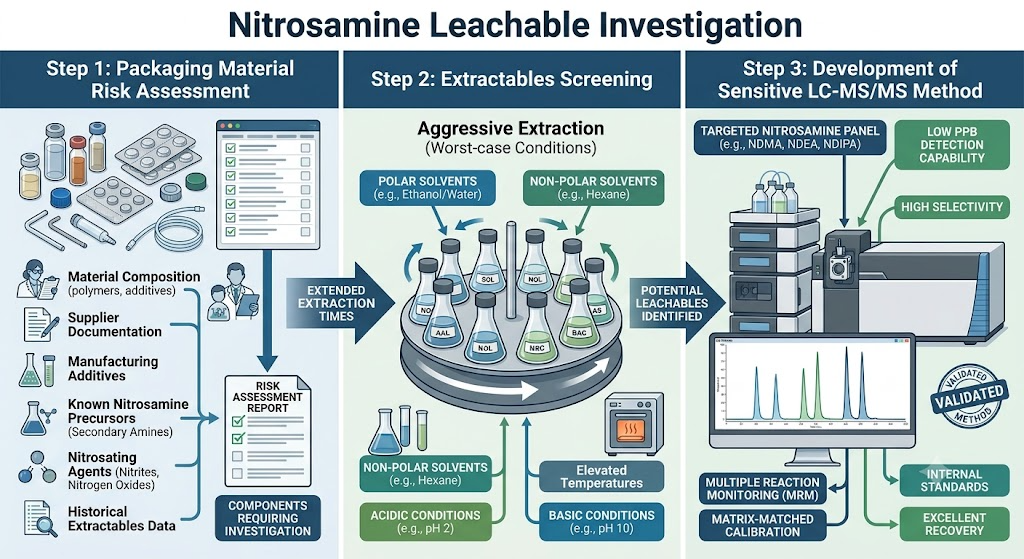
Step 1: Packaging Material Risk Assessment
The investigation began with a detailed review of every packaging component.
Scientists evaluated:
- Material composition
- Supplier documentation
- Manufacturing additives
- Known nitrosamine precursors
- Secondary amines
- Nitrosating agents
- Historical extractables data
This initial assessment identified components requiring targeted analytical investigation.
Step 2: Extractables Screening
Packaging components underwent aggressive extraction using multiple solvents representing worst-case conditions.
Typical extraction conditions included:
- Polar solvents
- Non-polar solvents
- Acidic conditions
- Basic conditions
- Elevated temperatures
- Extended extraction times
The objective was to identify compounds with potential to migrate into the finished dosage form.
Step 3: Development of Sensitive LC-MS/MS Method
Nitrosamines occur at extremely low concentrations.
A highly sensitive LC-MS/MS method was developed featuring:
- Targeted nitrosamine panel
- Low ppb detection capability
- High selectivity
- Multiple Reaction Monitoring (MRM)
- Matrix-matched calibration
- Internal standards
- Excellent recovery
The analytical method was validated according to regulatory expectations.
4: What Is the Investigation Workflow for Nitrosamine Leachables in Blister Packaging?
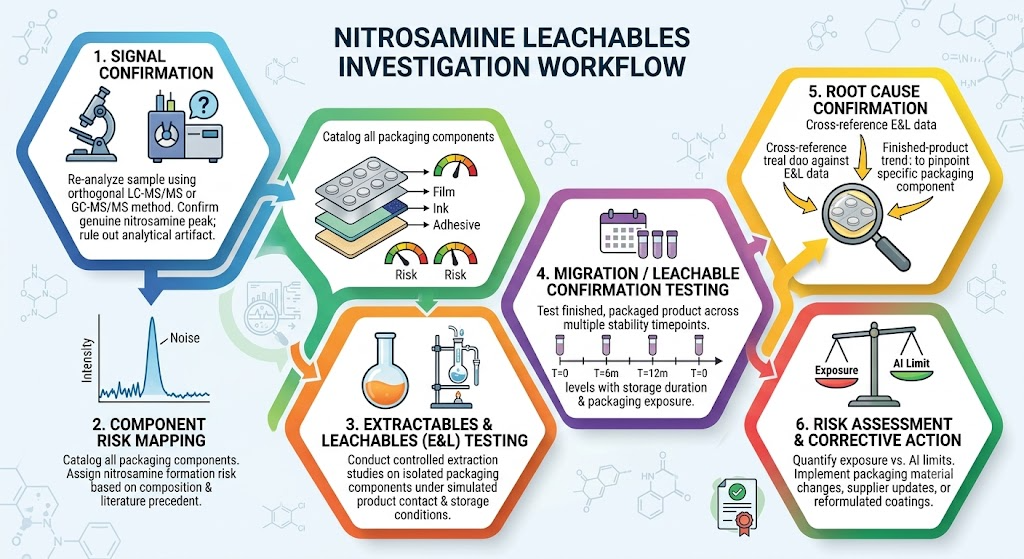
The investigation workflow follows a structured, stepwise approach: signal confirmation, source mapping, extractables & leachables testing, root cause confirmation, and risk-based corrective action. This mirrors the broader methodology used in extractables and leachables testing for container-closure systems, adapted specifically for nitrosamine-focused investigations.
- Signal confirmation — Re-analyze the sample using an orthogonal, validated LC-MS/MS or GC-MS/MS method to confirm the peak is a genuine nitrosamine and rule out analytical artifact.
- Component risk mapping — Catalog every packaging component (film, foil, ink, adhesive, secondary packaging) and assign nitrosamine formation risk based on chemical composition and known literature precedent.
- Extractables & leachables (E&L) testing — Conduct controlled extraction studies on isolated packaging components under conditions simulating actual product contact and storage.
- Migration/leachable confirmation testing — Test the finished, packaged product directly across multiple stability timepoints to correlate nitrosamine levels with storage duration and packaging exposure.
- Root cause confirmation — Cross-reference E&L data against the finished-product trend to pinpoint the specific packaging component responsible.
- Risk assessment and corrective action — Quantify exposure against acceptable intake (AI) limits and implement packaging material changes, supplier qualification updates, or reformulated heat-seal coatings as needed.
Investigations that skip or rush any of these steps often stall out; our analysis of the root causes of failed extractables and leachables studies outlines the most common pitfalls we see across E&L programs generally.
5: Which Analytical Techniques Are Used to Confirm Nitrosamine Leachables?
Confirmation of nitrosamine leachables relies primarily on LC-MS/MS and GC-MS/MS methods capable of quantifying nitrosamines at parts-per-billion (ppb) levels, consistent with regulatory acceptable intake thresholds.
- LC-MS/MS with MRM (multiple reaction monitoring): preferred for polar, non-volatile nitrosamines and complex matrices such as coated tablets or capsule fill
- GC-MS/MS (headspace or direct injection): effective for volatile nitrosamines and simpler extraction matrices like blister film or foil
- High-resolution mass spectrometry (HRMS): used for non-targeted screening when the nitrosamine structure is not yet known, enabling structural elucidation of unexpected leachable peaks
- Controlled extraction studies (simulated migration testing): isolate individual packaging components under accelerated conditions to identify the specific contributing material
Method validation for this class of testing typically follows ICH M7(R2) impurity qualification principles combined with agency-specific nitrosamine testing guidance, ensuring sensitivity, specificity, and reproducibility at trace levels.
The same trace-level analytical rigor applies across other packaging formats and modalities, including E&L testing services for prefilled syringes and extractables and leachables testing for biologics, where container-closure interaction carries similarly high regulatory scrutiny.
6: What Did the Root Cause Analysis Reveal?
The root cause analysis identified the most probable source of the nitrosamine leachable as a nitrosatable amine present in the heat-seal lacquer applied to the aluminum lidding foil. Under elevated temperature and humidity conditions, this compound reacted with trace nitrite associated with adjacent packaging components, leading to the formation of detectable nitrosamine levels over time.
A systematic, component-by-component investigation was conducted to determine the origin of the nitrosamine signal. Analytical data showed a clear correlation between increasing nitrosamine concentrations and product stability time points, indicating that the impurity formed gradually during storage rather than being introduced during manufacturing. Targeted extraction studies revealed a positive nitrosamine signal from the isolated aluminum lidding foil, while the isolated blister cavity film showed no detectable contribution. This comparative approach effectively ruled out the primary blister material as the source of contamination.
The findings demonstrated that the heat-seal lacquer chemistry on the aluminum lidding foil represented the most likely origin of the observed nitrosamine leachable. By systematically evaluating each packaging component and eliminating non-contributing materials, the investigation established a scientifically supported root cause. Such a structured approach provides strong evidence for corrective actions, facilitates regulatory review, and ensures that packaging-related nitrosamine risks are accurately identified and effectively controlled.
7: How Are Nitrosamine Leachable Risks Corrected and Prevented?
Nitrosamine leachable risks are corrected by identifying and eliminating the source of contamination, while prevention focuses on implementing robust packaging controls, supplier qualification, and continuous monitoring throughout the product lifecycle.
When a packaging-related nitrosamine risk is identified, pharmaceutical manufacturers should implement a structured corrective and preventive action (CAPA) strategy to reduce future contamination and maintain regulatory compliance.
Key corrective and preventive measures include:
- Reformulate or replace packaging materials: Replace heat-seal lacquers, adhesives, coatings, or other packaging components with alternatives that have been scientifically assessed for nitrosamine risk.
- Strengthen supplier qualification: Requalify packaging material suppliers and verify that critical materials, such as paperboard, polymers, and coatings, meet predefined nitrite and impurity specifications through appropriate testing and documentation.
- Update the nitrosamine risk assessment: Revise the packaging-specific risk assessment to reflect analytical findings, material changes, and the latest regulatory expectations, ensuring comprehensive documentation of packaging-derived nitrosamine risks.
- Perform ongoing stability monitoring: Continue monitoring nitrosamine leachables at predefined stability intervals using validated analytical methods to confirm that impurity levels remain within acceptable limits throughout the product’s shelf life.
- Implement a robust CAPA program: Document investigation outcomes, root cause analyses, corrective actions, and preventive measures through a formal CAPA system with complete analytical traceability to support regulatory inspections.
An effective control strategy also requires establishing scientifically justified acceptance criteria. Understanding the difference between nitrosamine alert limits and action limits enables manufacturers to determine whether a detected leachable requires routine monitoring or immediate corrective action. Rather than treating nitrosamine testing as a one-time exercise, pharmaceutical companies should integrate packaging evaluations into a comprehensive nitrosamine lifecycle management program, ensuring continuous monitoring, periodic risk reassessment, and ongoing compliance as products, packaging materials, or regulatory expectations evolve
8: What Does This Case Study Mean for Nitrosamine Risk Assessments in OSD Products?
This case study demonstrates that nitrosamine risk assessments for oral solid dosage products must extend beyond API synthesis and formulation chemistry to include a full evaluation of container-closure and packaging materials.
Regulatory expectations from FDA, EMA, and Health Canada increasingly require sponsors to document that packaging components have been evaluated as a potential nitrosamine source, particularly for blister-packaged products where foil laminates, inks, and adhesives are in direct or indirect contact with the dosage form. A reactive, testing-only approach is no longer sufficient; a proactive packaging risk assessment integrated into the broader nitrosamine control strategy is now the expected standard. This same scrutiny extends to more complex dosage forms, including nitrosamine testing in combination products, where device and packaging components add further layers of risk to evaluate.
Conclusion
Investigating nitrosamine leachables in blister packaging requires a disciplined, multi-technique analytical approach — from initial signal confirmation through component-level extractables & leachables testing to final root cause determination. As this case study illustrates, packaging-derived nitrosamine contamination is a real and testable risk that demands the same analytical rigor applied to process-related impurities. For manufacturers managing blister-packaged oral solid dosage products, partnering with an experienced analytical laboratory that understands both the chemistry and the regulatory landscape around nitrosamine leachables in blister packaging is essential to building a defensible, audit-ready risk assessment.
As regulatory expectations continue to evolve, proactive evaluation of packaging-related nitrosamine risks helps reduce development uncertainty, supports successful global submissions, and safeguards product integrity throughout its lifecycle.
ResolveMass Laboratories partners with pharmaceutical innovators to deliver scientifically rigorous nitrosamine investigations, enabling informed decisions backed by high-quality analytical data.
Frequently Asked Questions:
Yes, blister packaging can be a potential source of nitrosamine contamination if certain packaging materials contain nitrosamine precursors or degradation products. Components such as adhesives, sealants, inks, coatings, and polymer films may contribute trace compounds that migrate into the drug product over time. Although the risk is generally low, regulatory agencies recommend evaluating packaging as part of a comprehensive nitrosamine risk assessment. Extractables and leachables (E&L) studies help identify any potential migration. Sensitive LC-MS/MS methods are then used to confirm whether nitrosamines are present in the finished product. These investigations ensure patient safety and support regulatory compliance. Proper packaging selection significantly minimizes the risk of nitrosamine contamination.
A nitrosamine leachable study evaluates all packaging materials that come into direct or indirect contact with the drug product. Commonly assessed components include PVC, PVDC, PCTFE films, aluminum lidding foil, heat-seal lacquers, adhesives, primers, coatings, printing inks, and barrier layers. Scientists review material composition, supplier documentation, and manufacturing processes to identify potential nitrosamine precursors. Each component may undergo extractables testing under worst-case conditions. The results guide targeted leachables studies on the finished product. This systematic approach helps ensure that the packaging system is suitable for long-term pharmaceutical use.
A nitrosamine leachable risk assessment begins with collecting detailed information about the packaging materials, formulation, and manufacturing process. Scientists identify potential nitrosamine sources by reviewing raw material compositions and known nitrosamine-forming substances. Extractables studies are then performed to identify compounds that could migrate from the packaging. Targeted LC-MS/MS methods are used to detect and quantify nitrosamines in the finished drug product. Detected levels are compared with regulatory acceptable intake limits. Toxicological assessments help determine patient exposure and safety. The final risk assessment supports packaging qualification and regulatory submissions.
Several factors affect the migration of nitrosamine leachables from blister packaging into a pharmaceutical product. These include the chemical composition of the packaging materials, storage temperature, humidity, product shelf life, and duration of contact between the drug and packaging. The drug formulation itself, including moisture content and pH, may also influence migration. Packaging barrier properties and sealing quality play important roles in limiting compound transfer. Environmental conditions during storage can accelerate degradation or migration. Comprehensive stability studies evaluate these factors to confirm product safety throughout its lifecycle.
Stability studies help determine whether nitrosamine leachables increase during the product’s shelf life under normal and accelerated storage conditions. Samples are analyzed at predefined intervals to monitor any changes in impurity levels over time. This information provides evidence that the selected packaging system remains chemically compatible with the drug product. Stability data also demonstrate that nitrosamine levels remain within acceptable regulatory limits. These studies are essential for supporting product quality, safety, and shelf-life claims. They also help manufacturers satisfy regulatory expectations before commercialization. Overall, stability studies provide confidence in long-term packaging performance.
Yes, even small changes in packaging materials or manufacturing processes can alter the nitrosamine leachable profile of a pharmaceutical product. Switching suppliers, changing adhesives, coatings, polymer grades, or heat-seal lacquers may introduce different extractable compounds. These changes can potentially influence the migration of trace impurities during storage. For this reason, packaging modifications should be evaluated through scientific risk assessments and analytical testing. Comparative extractables and leachables studies help identify any new risks. Proper change control procedures ensure continued product quality and regulatory compliance. Requalification of the packaging system may also be necessary.
Extractables studies identify compounds that can potentially be released from packaging materials under aggressive laboratory conditions. These studies provide a worst-case assessment of chemicals that might migrate into a pharmaceutical product. Scientists use the results to determine which compounds require targeted monitoring during leachables testing. This risk-based approach improves analytical efficiency and focuses resources on relevant impurities. Extractables data also help evaluate packaging compatibility and supplier materials. Combined with leachables studies, they provide a complete understanding of packaging-related contamination risks. This information is valuable for regulatory submissions and product safety assessments.
Reference
- Dalkılıç O, Demircioğlu İH, Çelik S, Can H, Akman TC, Atila A, Kılıç H, Kandemir L. Method development and validation for determination of N-Nitrosamines in pharmaceutical preparations by LC-MS/MS: Application to extractables and leachables studies. Journal of Chromatography A. 2025 Mar 29;1745:465741.https://www.sciencedirect.com/science/article/pii/S0021967325000901
- Beita-Sandí W, Selbes M, Ersan MS, Karanfil T. Release of nitrosamines and nitrosamine precursors from scrap tires. Environmental Science & Technology Letters. 2019 Mar 20;6(4):251-6.https://pubs.acs.org/doi/abs/10.1021/acs.estlett.9b00172
- Kartop RA, Güleli M, Faruzlu FA, Çalışkan C. Evaluation of a novel LC-MS/MS based analytical method for the risk assessment of nitrosamines in pharmaceutical products and packaging materials. Journal of Pharmaceutical Sciences. 2024 Jun 1;113(6):1597-606.https://www.sciencedirect.com/science/article/pii/S0022354924000170
- Khan HS, Despres-Gnis F, Stults CL, Mullis J, Nugara N, Sen A, Nagao L. An Overview and Discussion of N-Nitrosamine Considerations for Orally Inhaled Drug Products and Relevance to Other Dosage Forms. AAPS PharmSciTech. 2023 Jan 18;24(1):37.https://link.springer.com/article/10.1208/s12249-022-02491-7
- Norwood DL, Mullis JO, Feinberg TN, Davis LK. N-nitrosamines as “special case” leachables in a metered dose inhaler drug product. PDA Journal of Pharmaceutical Science and Technology. 2009 Jul 1;63(4):307-21.https://journal.pda.org/content/63/4/307.short
- Golob N, Ross M, Roškar R. Nitrocellulose blister material as a source of N-nitrosamine contamination of pharmaceutical drug products. International Journal of Pharmaceutics. 2022 Apr 25;618:121687.https://www.sciencedirect.com/science/article/pii/S0378517322002423
About the Author


