Introduction:
Nitrosamine Root Cause Investigation for Sartan APIs has become a defining requirement across pharmaceutical manufacturing following the global recalls involving valsartan, losartan, irbesartan, and other sartan medicines. Regulatory agencies now expect manufacturers to conduct a comprehensive investigation whenever a nitrosamine risk is identified or contamination is detected — not simply to test finished product and report a number. This case study illustrates how a systematic, science-based investigation identifies the true origin of nitrosamine formation, implements effective corrective actions, and establishes a sustainable control strategy that satisfies global regulatory expectations. It is written as a representative, illustrative example modeled on the type of investigative work ResolveMass Laboratories Inc. supports for sartan API manufacturers, and it walks through the reasoning a quality and regulatory team should expect to see in a defensible root cause file. For background on the chemistry involved, see what nitrosamines are and why they matter in pharmaceutical manufacturing.
Summary:
- Nitrosamine Root Cause Investigation for Sartan APIs must trace contamination to its true chemical origin — usually a combination of amine reagents, nitrite exposure, and solvent conditions — rather than stopping at a single confirmed impurity result.
- In this case study, trace NDMA detected in a tetrazole-containing sartan API was traced primarily to residual dimethylamine in recovered DMF reacting with nitrosating species under acidic process conditions.
- A defensible investigation moves through process mapping, raw material screening, ultra-trace LC-MS/MS and HRMS analysis, and laboratory confirmation studies before a control strategy is finalized.
- Effective control strategies are layered: raw material controls, solvent management, process optimization, engineering controls, and a comprehensive analytical testing program.
- FDA, EMA, Health Canada, MHRA, and ICH M7(R2) all expect documented, science-based root cause evidence and lifecycle monitoring, not just a final result below the acceptable intake limit.
1: Why Are Sartan APIs Highly Susceptible to Nitrosamine Formation?
Sartan APIs are particularly vulnerable because their synthetic routes often combine secondary amines, nitrite-containing reagents, and solvents capable of generating nitrosating species under the acidic conditions common in tetrazole chemistry. A detailed breakdown of how these pathways form is covered in our article on nitrosamine formation pathways in API synthesis.
Many sartan manufacturing processes involve one or more of the following:
- Sodium nitrite quenching
- Dimethylformamide (DMF)
- Dimethylacetamide (DMAc)
- N-Methyl-2-pyrrolidone (NMP)
- Triethylamine
- Diisopropylethylamine (DIPEA)
- Tetrazole ring formation chemistry
- Acidic reaction conditions
When these factors coexist, unwanted nitrosamines such as NDMA, NDEA, NMBA, DIPNA, or EIPNA can form even at extremely low concentrations. It’s also worth distinguishing formation mechanisms early: not every nitrosamine risk behaves the same way analytically or toxicologically, and the differences between nitrosamine drug substance-related impurities (NDSRIs) and simple nitrosamines affect how an investigation and its acceptable intake limits are structured. Solvent and catalyst choices are frequently the controllable variable in this equation, which is why solvent and catalyst mitigation strategies are typically addressed early in process redesign.
2: Regulatory Expectations for Nitrosamine Investigation
Regulators expect manufacturers to demonstrate scientific understanding of nitrosamine risk across the entire manufacturing lifecycle, not just at batch release. The table below summarizes the primary expectations by agency.
| Regulatory Agency | Primary Expectation |
|---|---|
| FDA | Risk assessment, confirmatory testing, validated analytical methods, mitigation strategy |
| EMA | Complete root cause investigation and lifecycle monitoring |
| ICH M7(R2) | Risk-based impurity assessment for mutagenic impurities |
| Health Canada | Process understanding and risk mitigation |
| MHRA | Scientific justification for process controls |
Manufacturers are expected to investigate every potential source rather than testing only the final API. Submission requirements also differ depending on application type — the distinctions in nitrosamine submission requirements between NDAs and ANDAs and the specifics of a nitrosamine risk assessment for an ANDA submission shape how this documentation is packaged. Since ICH M7(R2) itself has evolved, teams should also track the impact of recent ICH M7(R2) updates on nitrosamine risk assessment, and it’s useful to understand how ICH M7 guidance compares with FDA nitrosamine guidance where the two frameworks diverge in practice.
3: Case Study Background
Manufacturing site. A commercial manufacturer produced a tetrazole-containing sartan API using a multi-step synthetic process. Routine batch release testing showed trace levels of NDMA approaching the internally established action limit. Although results remained below regulatory reporting thresholds, the company initiated a proactive investigation to prevent future risk — a distinction worth noting given how differently an alert limit is treated compared with an action limit in a nitrosamine control program.
Manufacturing overview. The process consisted of:
- Intermediate synthesis
- Tetrazole formation
- Solvent exchange
- Hydrogenation
- Purification
- Crystallization
- Drying
Initial testing showed intermittent NDMA detection across multiple commercial batches, which ruled out a single isolated event and pointed toward a systemic contributing factor.
Initial Risk Assessment
The first objective of the investigation was identifying every potential nitrosamine formation pathway rather than assuming a single source. A multidisciplinary team was assembled, spanning process chemistry, analytical development, quality assurance, manufacturing, regulatory affairs, toxicology, and external analytical specialists. The team mapped every reagent, solvent, catalyst, cleaning agent, and utility used during production, including reviewing how the site’s supplier qualification program addressed nitrosamine control for incoming materials.
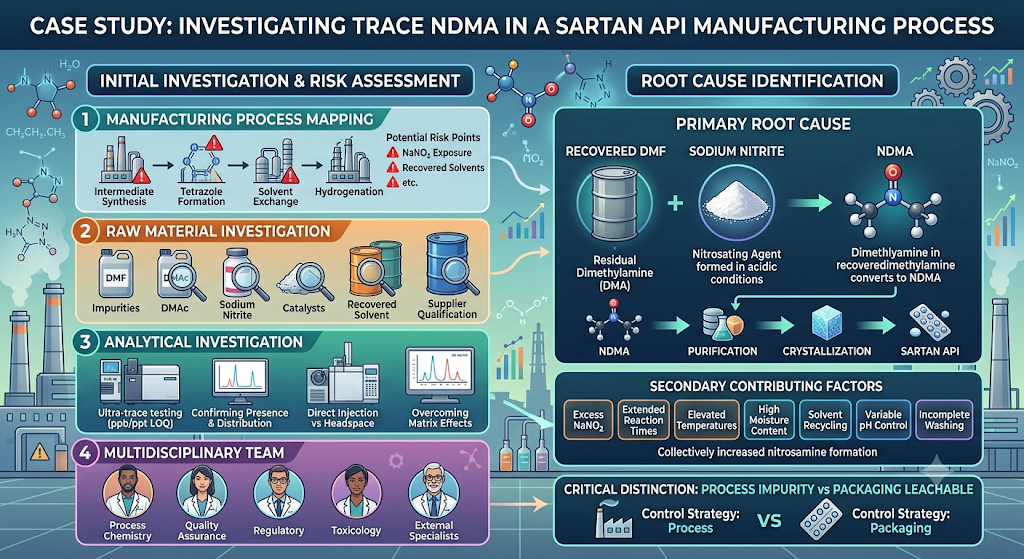
Step 1: Manufacturing Process Mapping
Answering where nitrosamine formation could occur required evaluating each process step individually rather than the process as a whole.
| Process Step | Potential Risk |
|---|---|
| Tetrazole formation | Sodium nitrite exposure |
| Solvent recovery | Cross-contamination |
| Reagent storage | Nitrite degradation |
| Acidification | Nitrosating conditions |
| Waste recycle | Unknown impurity carryover |
| Cleaning validation | Residual amine contamination |
A complete process flow diagram highlighted all possible nitrosamine formation pathways, giving the team a single reference point to prioritize which steps warranted analytical sampling first.
Step 2: Raw Material Investigation
Raw materials are frequently an overlooked nitrosamine source, so each incoming material underwent supplier qualification, nitrite testing, secondary amine screening, certificate verification, impurity profiling, and storage evaluation. Materials investigated included sodium nitrite, DMF, DMAc, hydrochloric acid, sodium hydroxide, catalysts, recovered solvents, and water systems.
Recovered solvents showed elevated impurity variability compared with virgin solvents — a finding consistent with what we see across sartan and other API programs, and one reason reference standard qualification for nitrosamine testing matters as much as the raw material screening itself, since confidence in the result depends on the standard behind it. Excipients deserve the same scrutiny in drug product programs, since nitrosamines can also originate from excipients rather than the API alone.
Step 3: Analytical Investigation
Ultra-trace analytical testing confirmed both the presence and distribution of nitrosamines throughout the manufacturing process. The laboratory employed highly sensitive instrumentation, including LC-MS/MS, GC-MS/MS, LC-HRMS, and GC-HRMS, testing the API, process intermediates, mother liquors, solvents, recovered solvents, waste streams, raw materials, and cleaning rinse samples.
Detection limits reached low parts-per-billion and parts-per-trillion concentrations depending on the analyte, which is only achievable with the right combination of technique and method design. Choosing between direct injection and headspace techniques for nitrosamine analysis directly affects sensitivity and matrix compatibility, and reaching sufficiently low reporting limits depends on achieving an ultra-low limit of quantitation (LOQ) in nitrosamine testing. Complex sartan matrices also introduce interference risk, which is why overcoming matrix effects in LC-MS/MS is a routine part of method development, and HRMS for nitrosamine testing is increasingly used to confirm identity where a screening result needs elevated confidence. This distinction between a first-pass result and a confirmed one maps directly onto the difference between a nitrosamine screening method and a confirmatory method.
Step 4: Root Cause Identification
The investigation identified multiple contributing factors rather than a single point of failure.
Primary root cause. Recovered DMF contained residual dimethylamine. During acidic processing in the presence of sodium nitrite, dimethylamine converted into NDMA, which then carried over into downstream purification. The reaction pathway proceeded as follows: dimethylamine reacts with a nitrosating agent formed from sodium nitrite under acidic conditions, generating NDMA, which is then retained through subsequent purification steps rather than being fully rejected.
Secondary contributors. Additional factors amplified contamination, including excess sodium nitrite, extended reaction hold times, elevated reaction temperature, high moisture content, solvent recycling, variable pH control, and incomplete washing. Each factor alone produced minimal impact, but collectively they increased nitrosamine formation. Distinguishing this kind of process-related impurity from a packaging-derived one matters for how it’s classified and controlled, since the difference between a nitrosamine impurity and a nitrosamine leachable determines which control strategy — process versus packaging — actually applies.
4: Laboratory Confirmation Studies
To scientifically confirm the hypothesis, laboratory simulation experiments were performed, varying nitrite concentration, temperature (20–60°C), pH (2–8), reaction time (30 minutes to 24 hours), dimethylamine concentration, and solvent purity (virgin versus recycled).
Results demonstrated that higher nitrite concentration increased NDMA formation, acidic pH accelerated nitrosation, longer hold times increased impurity levels, and virgin solvent significantly reduced NDMA generation. The laboratory findings matched commercial manufacturing observations, which is what elevates a hypothesis into a defensible root cause. Running these studies well depends on the underlying analytical method itself being fit for purpose, which is why nitrosamine method development and validation services are typically engaged before, not after, a root cause investigation begins.
5: Control Strategy Development
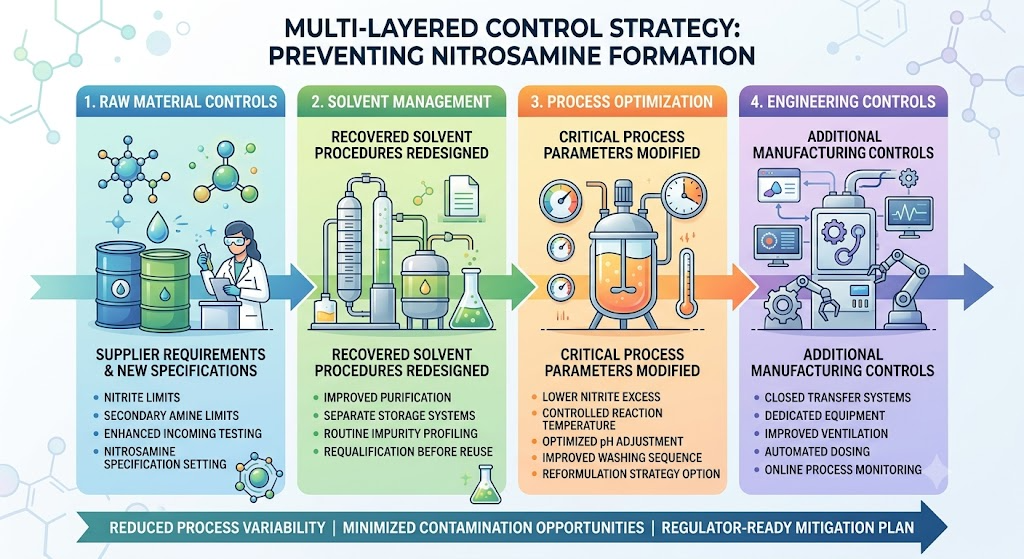
After identifying the root cause, the manufacturer implemented a multi-layered control strategy designed to prevent nitrosamine formation rather than relying solely on end-product testing.
1. Raw material controls. Supplier requirements were updated with new specifications covering nitrite limits, secondary amine limits, solvent impurity specifications, and enhanced incoming testing — formalized through nitrosamine specification setting for each affected material.
2. Solvent management. Recovered solvent procedures were redesigned, including improved purification, separate storage systems, routine impurity profiling, requalification before reuse, and a reduced recycle percentage, consistent with a broader solvent and catalyst mitigation strategy.
3. Process optimization. Critical process parameters were modified: lower nitrite excess, controlled reaction temperature, reduced reaction hold time, optimized pH adjustment, faster work-up, and an improved washing sequence. Where process changes alone cannot sufficiently reduce risk, manufacturers may also evaluate a broader nitrosamine reformulation strategy for the affected product.
4. Engineering controls. Additional manufacturing controls included closed transfer systems, dedicated equipment, improved ventilation, automated dosing, and online process monitoring.
Together, these changes reduced process variability while minimizing contamination opportunities. Where a manufacturer lacks the internal expertise to design this kind of layered strategy, nitrosamine control strategy development services from an experienced analytical partner can shorten the path from root cause to a regulator-ready mitigation plan.
6: Analytical Control Strategy
Routine release testing alone is insufficient to demonstrate control. A comprehensive analytical program should cover incoming materials (nitrite screening), solvents (amine impurities), intermediates (LC-MS/MS), final API (a validated nitrosamine assay), stability studies (ongoing nitrosamine monitoring), and annual review (trend analysis).
| Testing Stage | Analysis |
|---|---|
| Incoming materials | Nitrite screening |
| Solvents | Amine impurities |
| Intermediates | LC-MS/MS |
| Final API | Validated nitrosamine assay |
| Stability studies | Nitrosamine monitoring |
| Annual review | Trend analysis |
Method validation covered specificity, accuracy, precision, recovery, robustness, linearity, LOD, and LOQ. Ongoing testing at commercial scale also needs to reflect current expectations around nitrosamine batch release testing requirements and nitrosamine testing in stability studies, and every result needs to be interpreted against the correct limit — which for multi-nitrosamine profiles means understanding how to calculate the acceptable intake for multiple nitrosamines, how AI limits compare across different nitrosamines, and, for products not dosed over a full lifetime, how less-than-lifetime (LTL) exposure calculations for nitrosamines can adjust the applicable limit.
7: Risk Assessment Following Process Changes
Following implementation, the risk assessment demonstrated a significant reduction in nitrosamine formation, improved batch consistency, reduced process variability, enhanced supplier qualification, and improved regulatory compliance. The revised process consistently maintained nitrosamine levels well below internally established control thresholds.
8: Lifecycle Monitoring
Nitrosamine control is an ongoing lifecycle activity, not a one-time investigation. Manufacturers should establish periodic monitoring for new suppliers, process modifications, solvent recovery efficiency, equipment changes, scale-up, technology transfer, and stability studies. Annual Product Quality Reviews should incorporate nitrosamine trend evaluation to identify emerging risks before they affect commercial production — the full scope of what this involves is covered in our guide to nitrosamine lifecycle management.
9: Lessons Learned from the Investigation
Several observations from this project apply broadly to sartan and non-sartan programs alike:
- Nitrosamine formation is usually multifactorial. Rarely does one factor alone explain contamination.
- Solvent recovery requires continuous monitoring. Recovered solvents can introduce variable impurity profiles if not adequately controlled.
- Process knowledge is essential. Detailed understanding of reaction chemistry enables proactive risk reduction.
- Sensitive analytical methods are critical. Trace-level contaminants require highly selective LC-MS/MS or HRMS methods capable of detecting impurities at very low concentrations.
- Prevention outperforms end-product testing. Designing a robust process minimizes nitrosamine formation rather than relying solely on release testing.
10: Why This Matters Beyond Sartans
The chemistry and investigative logic in this case study extend well past sartan APIs. Nitrosamine risk has now been documented across a wide range of drug substances and product types, including rifampicin, rifapentine, ranitidine, metformin, and beta-blockers — several of which drove the earliest wave of global recalls, a pattern examined in our analysis of nitrosamine-related drug recalls.
Risk also varies by product type and formulation. Manufacturers of injectable drug products, OTC products, combination products, and drug-drug combination products each face distinct assessment considerations, as do sponsors working with highly potent APIs or other high-risk drug classes. Veterinary products are not exempt either — nitrosamine testing for veterinary drug products follows a parallel but distinct framework. Generic manufacturers in particular carry a significant share of this burden, and nitrosamine testing for generic drugs has become a standard part of ANDA lifecycle management.
Packaging and container closure systems add a separate risk dimension. Packaging-related leachable nitrosamines, including nitrosamine leachables in blister packaging specifically, require their own risk assessment separate from the process-related root cause investigation described above.
11: How ResolveMass Laboratories Supports Nitrosamine Investigations
ResolveMass Laboratories provides comprehensive scientific support for pharmaceutical manufacturers addressing nitrosamine risks across APIs, intermediates, drug products, and packaging systems. Our capabilities include nitrosamine risk assessments aligned with FDA, EMA, Health Canada, and ICH M7 guidance; root cause investigations for APIs and finished products; LC-MS/MS and HRMS method development and validation; ultra-trace nitrosamine quantification; unknown impurity identification; raw material and solvent qualification; process optimization support; confirmatory testing for regulatory submissions; CTD-ready analytical reports; and long-term lifecycle monitoring programs.
Many manufacturers choose to bring in outside expertise for this work rather than building it internally — our guide on outsourcing nitrosamine testing to a CRO walks through what to evaluate in a partner, and our overview of a typical nitrosamine testing timeline helps teams plan around submission deadlines.
By combining advanced analytical technologies with deep expertise in pharmaceutical process chemistry, ResolveMass helps manufacturers identify contamination pathways, implement sustainable control strategies, and maintain global regulatory compliance.
Conclusion:
A successful Nitrosamine Root Cause Investigation for Sartan APIs requires far more than detecting impurities in the final product. It demands a science-based understanding of manufacturing chemistry, raw materials, solvent systems, process parameters, and analytical data. As demonstrated in this case study, identifying the true source of nitrosamine formation — in this case, residual dimethylamine in recovered solvent reacting under acidic, nitrite-exposed conditions — and implementing preventive controls can significantly reduce contamination risk while strengthening product quality and regulatory confidence.
Frequently Asked Questions:
Nitrosamine formation in sartan API manufacturing is usually the result of multiple contributing factors rather than a single cause. Common sources include the presence of secondary or tertiary amines reacting with nitrosating agents such as sodium nitrite under acidic conditions. Contaminated or recycled solvents like DMF and DMAc can also introduce amine impurities. High reaction temperatures, prolonged reaction times, and improper pH control may further promote nitrosamine formation. Inadequate cleaning validation and cross-contamination from shared equipment can increase the risk. Raw material impurities and degraded reagents are additional contributors. A systematic root cause investigation is essential to identify and eliminate these risks before they affect product quality.
Final API testing only confirms whether nitrosamines are present in the finished product, but it does not identify how or where they formed. A root cause investigation evaluates the complete manufacturing process, including raw materials, solvents, reagents, equipment, utilities, and process parameters. This approach helps manufacturers pinpoint the exact source of contamination and implement targeted corrective actions. It also prevents recurring issues by addressing the underlying causes rather than the symptoms. Regulatory agencies such as the FDA and EMA expect manufacturers to demonstrate process understanding through comprehensive investigations. Ultimately, this proactive approach improves product quality, regulatory compliance, and patient safety.
Manufacturers should prioritize process steps where nitrosating agents and amines are likely to interact. This includes tetrazole ring formation, sodium nitrite addition, acidification reactions, solvent recovery, purification, and crystallization. Recycled solvent handling and storage conditions should also be carefully reviewed, as they may introduce contaminants. Cleaning procedures, equipment changeovers, and reaction hold times are equally important because they can contribute to cross-contamination or impurity formation. Evaluating each critical process parameter helps identify where nitrosamines may originate. A detailed process map is often the foundation of a successful investigation.
Recovered solvents can accumulate residual amines, degradation products, or process-related impurities during repeated reuse if purification is inadequate. When these solvents are reintroduced into manufacturing, they may react with nitrosating agents such as sodium nitrite to generate nitrosamines. The risk is particularly high in solvents like DMF or DMAc, which can degrade into dimethylamine under certain conditions. Without routine impurity profiling, these contaminants may go undetected. Manufacturers should establish strict qualification criteria, monitor solvent quality regularly, and validate solvent recovery systems. Using high-purity solvents significantly reduces the likelihood of nitrosamine formation.
Yes. Even when raw materials fully comply with their specifications, nitrosamines may still form during manufacturing due to interactions between reagents under certain process conditions. Factors such as acidic environments, elevated temperatures, prolonged reaction times, residual amines, or recycled solvents can create favorable conditions for nitrosamine formation. These impurities are often process-generated rather than introduced directly through raw materials. Therefore, manufacturers must evaluate the complete manufacturing process instead of relying solely on raw material testing. A comprehensive risk assessment and process understanding are essential to prevent unexpected contamination and maintain regulatory compliance.
Reference
- Chourasiya SS, Ranbhan KJ. Nitrosamine impurities in APIs: A comprehensive review. International Journal of Pharmacy and Biological Sciences. 2022;12(1):145-57.https://www.researchgate.net/profile/Sumit-Chourasiya-2/publication/378774327_Nitrosamine_impurities_in_APIs_A_Comprehensive_Review/links/65e947f2adf2362b637d1c67/Nitrosamine-impurities-in-APIs-A-Comprehensive-Review.pdf
- Cioc RC, Joyce C, Mayr M, Bream RN. Formation of N-nitrosamine drug substance related impurities in medicines: a regulatory perspective on risk factors and mitigation strategies. Organic Process Research & Development. 2023 Jul 21;27(10):1736-50.https://pubs.acs.org/doi/abs/10.1021/acs.oprd.3c00153
- Bhangale V, Ayre A. Nitrosamine Impurities in Pharmaceuticals: Regulatory Landscape and Challenges. Pharmaceutical Sciences Asia. 2024 Jul 1;51(3).https://search.ebscohost.com/login.aspx?direct=true&profile=ehost&scope=site&authtype=crawler&jrnl=25868195&AN=179925462&h=5WcRpky2OVxSjrdYdUF7fBoGGwBWfu4Nt9lI%2B%2BPPV71mnP%2BLTpA6O2DzkPky5OiPx0AACRDtAFReaiL83w8msA%3D%3D&crl=c
About the Author