

Introduction:
Nitrosamine testing for proton pump inhibitors has become a non-negotiable part of regulatory compliance for manufacturers of omeprazole, esomeprazole, lansoprazole, pantoprazole, and rabeprazole. Because this drug class shares a benzimidazole-amine core that is structurally prone to nitrosation, PPI manufacturers face risk factors that differ in origin and control strategy from those seen in sartans, metformin, or ranitidine, even though the underlying regulatory expectations from FDA, EMA, and Health Canada are similar. This article breaks down where PPI-specific nitrosamine risk originates in synthesis and formulation, what regulators expect to see in a risk assessment and control strategy, and how a CRO with cross-class nitrosamine testing experience can support method development, validation, and routine lot-release testing for this drug class.
Summary:
- Nitrosamine testing for proton pump inhibitors (PPIs) is required because the benzimidazole and amine-containing structures common to this drug class can form N-nitrosamine impurities during synthesis, formulation, or storage.
- Key risk points include secondary amine intermediates, nitrite-containing excipients or raw materials, and acid-catalyzed degradation pathways relevant to enteric-coated PPI formulations.
- Regulatory agencies (FDA, EMA, Health Canada) expect a documented risk assessment, confirmatory testing, and adherence to class-specific and compound-specific Acceptable Intake limits, including N-Nitroso Drug Substance-Related Impurities (NDSRIs).
- LC-MS/MS and GC-MS methods, validated to sub-ppm sensitivity, are the analytical backbone of PPI nitrosamine testing programs.
- ResolveMass Laboratories provides end-to-end nitrosamine risk assessment, method development/validation, and routine lot-release testing tailored to PPI drug substances and drug products.
1: Why Are Proton Pump Inhibitors a Nitrosamine Risk Class?
Nitrosamine testing for proton pump inhibitors is necessary because molecules in this class — omeprazole, esomeprazole, lansoprazole, pantoprazole, and rabeprazole — contain secondary amine and pyridine/benzimidazole moieties that are structurally predisposed to nitrosation. When these functional groups come into contact with nitrosating agents (commonly nitrite impurities) during synthesis, storage, or formulation, they can form N-nitrosamine impurities, several of which are classified as probable human carcinogens. PPIs are now widely recognized among high-risk drug classes for nitrosamine contamination, alongside sartans, metformin, and ranitidine, the drug whose 2019–2020 market withdrawal first drew regulatory attention to this impurity class.
Unlike drug classes where nitrosamine risk is confined to a single synthetic step, PPIs present risk at multiple points across the manufacturing lifecycle: API synthesis, enteric-coating processes, and long-term storage under varying pH and humidity conditions. Understanding the underlying nitrosamine formation pathways in API synthesis is therefore the starting point for any PPI-specific risk assessment, and forms part of a broader nitrosamine lifecycle management strategy that carries through commercial manufacturing.
2: Key Drug-Class-Specific Risk Factors for PPI Nitrosamine Formation
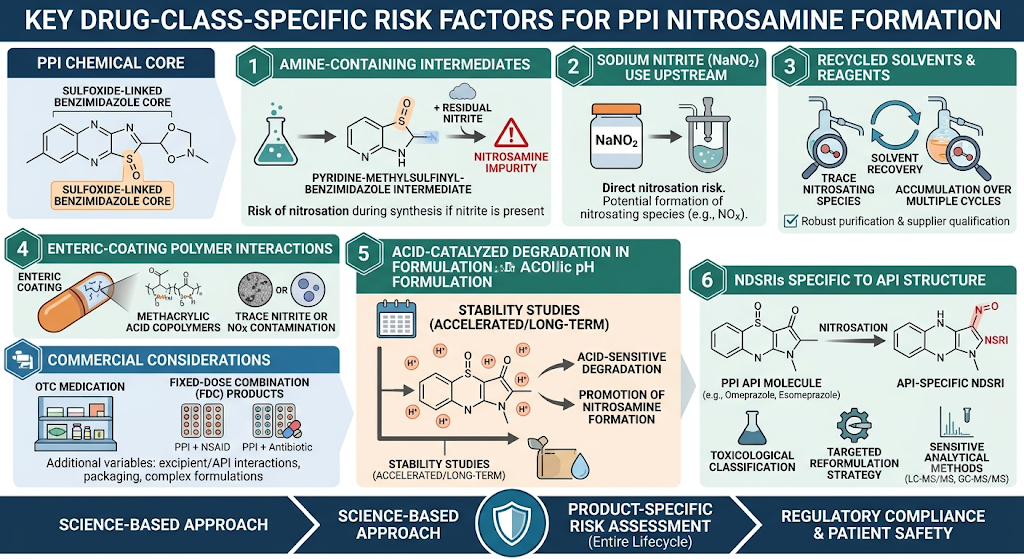
Proton pump inhibitors (PPIs) have unique chemical structures and manufacturing processes that require a drug-class-specific nitrosamine risk assessment. Unlike some other pharmaceutical classes, PPIs contain a sulfoxide-linked benzimidazole core that can contribute to distinct nitrosamine formation pathways during synthesis, formulation, storage, and packaging. Understanding these risk factors enables pharmaceutical manufacturers to implement effective mitigation strategies and meet global regulatory expectations.
Primary risk drivers include:
- Amine-containing synthetic intermediates — Several PPI synthesis routes involve pyridine-methylsulfinyl-benzimidazole intermediates where secondary amine functionality can react with residual nitrite.
Many PPI manufacturing routes involve secondary amine-containing intermediates. If residual nitrite is present, nitrosation reactions may occur, leading to nitrosamine impurity formation. Careful process optimization and impurity monitoring are essential. - Sodium nitrite use in upstream steps — Nitrite is sometimes employed as an oxidizing or diazotization agent in intermediate synthesis, creating a direct nitrosation risk if not adequately controlled through solvent and catalyst mitigation strategies.Without adequate process controls, residual nitrite can react with susceptible amines, increasing the likelihood of nitrosamine generation.
- Recycled solvents and reagents — Solvent recovery and reuse across batches can concentrate trace nitrosating species over time if purification controls are insufficient, which is why supplier qualification programs increasingly screen raw material vendors for nitrosamine precursors. Recovered solvents and reused process reagents may accumulate trace nitrosating agents over multiple manufacturing cycles. Robust purification procedures, supplier qualification, and raw material testing help minimize contamination risks.
- Enteric-coating polymer interactions — Methacrylic acid copolymers and related coating materials can introduce trace nitrite or nitrogen oxide contamination from raw material sourcing, and packaging components should be evaluated for nitrosamine leachables from container closure systems since the mechanism differs from process-related impurities (see our explainer on the nitrosamine impurity vs. nitrosamine leachable distinction). Certain enteric coating polymers, including methacrylic acid copolymers, may contain trace nitrite or nitrogen oxide impurities originating from raw materials. Packaging and container closure systems should also be evaluated to rule out nitrosamine-related extractables and leachables.
- Acid-catalyzed degradation in formulation — Because PPIs are acid-labile by design, nitrosamine testing in stability studies must account for potential nitrosative degradation pathways under accelerated or long-term storage conditions. PPIs are inherently acid-sensitive compounds. During accelerated or long-term stability studies, degradation reactions under acidic conditions may promote nitrosamine formation, making stability testing an important component of the overall risk assessment.
- NDSRIs specific to the API structure — Nitrosation of the parent PPI molecule itself (rather than only intermediates) can generate compound-specific NDSRIs that require individualized toxicological classification and, in some cases, a targeted reformulation strategy to reduce risk at the source.
In some cases, the PPI active pharmaceutical ingredient itself may undergo nitrosation, producing API-specific NDSRIs. These impurities often require dedicated analytical methods, toxicological evaluation, and, where necessary, process or formulation modifications to reduce patient exposure.
Beyond manufacturing-related risks, the commercial use of PPIs can further complicate nitrosamine assessments. Many proton pump inhibitors are available as over-the-counter (OTC) medications and are also marketed in fixed-dose combination (FDC) products with antibiotics or nonsteroidal anti-inflammatory drugs (NSAIDs). These combination formulations introduce additional variables, including potential interactions between multiple active ingredients, excipients, and packaging materials.
As a result, pharmaceutical companies should perform comprehensive, product-specific nitrosamine risk assessments that evaluate the entire product lifecycle—from raw material sourcing and process development to formulation, stability studies, packaging evaluation, and routine commercial manufacturing. A science-based approach supported by sensitive analytical techniques such as LC-MS/MS or GC-MS/MS helps ensure regulatory compliance while maintaining the highest standards of product quality and patient safety.
3: Regulatory Expectations for Nitrosamine Testing in PPIs
Regulatory agencies expect manufacturers of PPI drug substances and drug products to complete a documented nitrosamine risk assessment covering synthetic route, formulation, and packaging, followed by confirmatory testing wherever risk is identified. This applies to both innovator and generic PPI products under NDA and ANDA submission frameworks, and generic manufacturers in particular should review our guidance on nitrosamine risk assessment for ANDA submissions and broader nitrosamine testing requirements for generic drugs.
| Regulatory Body | Framework | Key Requirement for PPIs |
|---|---|---|
| U.S. FDA | 2020 Nitrosamine Guidance (updated) | Risk assessment, confirmatory testing, AI limits per compound; NDSRI-specific limits where applicable |
| EMA | Article 5(3) referral outcomes | Root cause investigation, control strategy, ongoing monitoring |
| Health Canada | Nitrosamine impurity guidance | Alignment with FDA/EMA AI limits; lot-specific testing for marketed products |
| ICH M7(R2) | Mutagenic impurity classification | Applied when compound-specific carcinogenicity data is unavailable |
The 2023 updates to ICH M7(R2) and their impact on nitrosamine risk assessment are particularly relevant for PPI manufacturers still relying on class-based limits for novel NDSRIs. Where compound-specific toxicological data does not yet exist for a given PPI-derived nitrosamine, agencies generally apply a conservative class-based Acceptable Intake limit until a compound-specific limit is established through submitted study data. For products where a patient may take a PPI intermittently rather than daily for life, manufacturers can also apply less-than-lifetime (LTL) exposure calculations to justify a higher permissible limit, and should understand the practical difference between an alert limit and an action limit when setting internal control thresholds. Once limits are established, they should be formally captured through nitrosamine specification setting as part of the product’s regulatory filing. Reviewing nitrosamine-related drug recalls across therapeutic classes, including rifampicin, rifapentine, and beta-blockers, offers useful precedent for how agencies have handled PPI-adjacent contamination events.
4: Analytical Methods for PPI Nitrosamine Testing
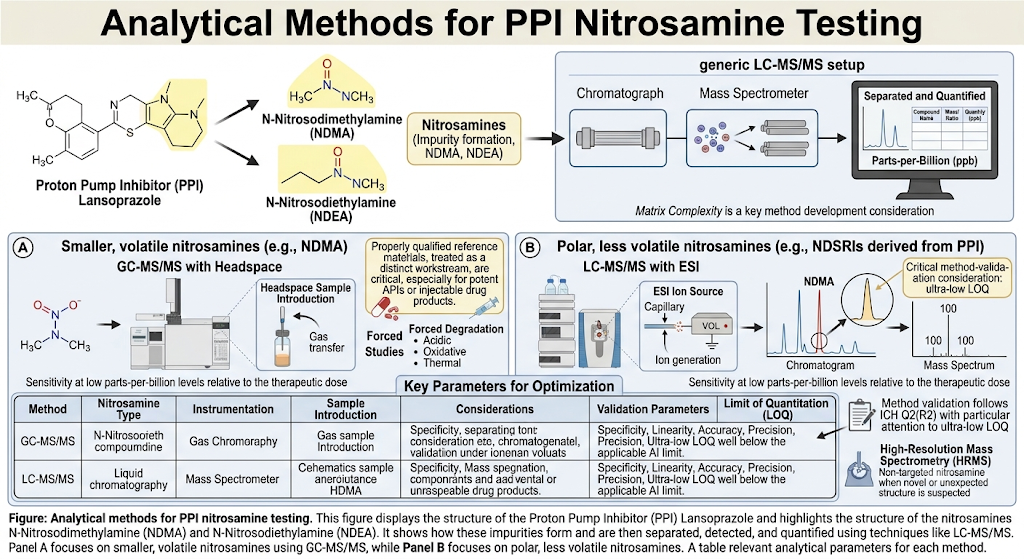
Reliable nitrosamine testing for proton pump inhibitors depends on analytical methods sensitive enough to detect impurities at low parts-per-billion levels relative to the therapeutic dose, since regulatory AI limits are typically expressed in nanograms per day.
Commonly applied methods include:
- LC-MS/MS with electrospray ionization — The preferred approach for polar, less volatile nitrosamines and NDSRIs that are structurally derived from the PPI molecule itself; matrix complexity in these formulations makes overcoming matrix effects in LC-MS/MS a critical method-development consideration.
- GC-MS/MS with headspace or direct injection — Used for smaller, volatile nitrosamines such as NDMA and NDEA that may arise from shared raw materials or cross-contamination; the choice between direct injection and headspace techniques depends on the volatility profile of the target analyte.
- High-resolution mass spectrometry (HRMS) — Applied for non-targeted nitrosamine screening when a novel or unexpected nitrosamine structure is suspected but not yet characterized by a reference standard.
- Forced degradation studies — Conducted under acidic, oxidative, and thermal stress to evaluate whether nitrosamine formation can occur during shelf-life storage of the finished PPI product.
Method validation for these assays follows ICH Q2(R2) parameters — specificity, linearity, accuracy, precision, and limit of quantitation — with particular attention to achieving an ultra-low limit of quantitation (LOQ) well below the applicable AI limit for each nitrosamine of concern. Reliable results also depend on properly qualified reference materials, which is why nitrosamine reference standard qualification is treated as a distinct workstream rather than an afterthought, particularly for testing highly potent APIs or injectable drug products where handling constraints add complexity.
5: How ResolveMass Supports Nitrosamine Testing for PPI Manufacturers
ResolveMass Laboratories works with generic and innovator PPI manufacturers to build nitrosamine control strategies that hold up under FDA, EMA, and Health Canada scrutiny. Our analytical chemistry team has direct experience developing and validating LC-MS/MS and GC-MS methods for benzimidazole-class APIs, including root cause investigations tracing nitrosamine formation back to specific synthetic steps, solvents, or excipients. Many clients come to us specifically to explore outsourcing nitrosamine testing to a CRO after finding internal capacity insufficient to meet batch release testing requirements at scale.
Our nitrosamine testing services for PPIs typically include:
- Structure-based nitrosamine risk assessment covering API synthesis, formulation, and packaging
- Reference standard sourcing or custom synthesis for PPI-specific NDSRIs
- Method development and validation services built around ICH Q2(R2) requirements for LC-MS/MS and GC-MS platforms
- Routine lot-release and stability testing for marketed PPI products, delivered against a clearly scoped nitrosamine testing timeline
- Regulatory documentation support for FDA, EMA, and Health Canada submissions
Because our team works across multiple drug classes with nitrosamine liability — including sartans, metformin, beta-blockers, and other amine-containing APIs — we bring cross-class pattern recognition to PPI-specific investigations, often identifying risk factors that a single-class-focused lab might miss.
Conclusion:
Nitrosamine testing for proton pump inhibitors requires more than applying a generic impurity screening method — it demands an understanding of the specific amine chemistry, synthetic routes, and degradation pathways unique to the benzimidazole PPI class. From risk assessment through validated LC-MS/MS and GC-MS testing, manufacturers need an analytical partner who understands both the regulatory expectations and the underlying chemistry driving nitrosamine formation in this drug class.
Frequently Asked Questions:
Nitrosamine testing is important because proton pump inhibitors (PPIs) may develop nitrosamine impurities during manufacturing, storage, or degradation. These impurities are considered probable human carcinogens, making their control a global regulatory priority. Testing helps manufacturers identify and quantify trace-level impurities before products reach patients. It also supports compliance with FDA, EMA, Health Canada, and ICH M7 guidance. Early detection reduces the risk of product recalls and regulatory observations. Ultimately, comprehensive nitrosamine testing protects patient safety and ensures consistent pharmaceutical quality.
Nitrosamine risk assessments may be required for commonly prescribed PPIs such as omeprazole, esomeprazole, pantoprazole, lansoprazole, dexlansoprazole, and rabeprazole. Each product should be evaluated individually because manufacturing processes and formulations differ. Factors such as raw materials, degradation pathways, and storage conditions influence the likelihood of impurity formation. Regulatory agencies expect manufacturers to perform science-based risk assessments rather than assume all products have the same risk. Confirmatory testing may be necessary if potential nitrosamine formation is identified. A product-specific approach ensures regulatory compliance and patient safety.
Nitrosamine impurities can originate from contaminated raw materials, nitrite-containing reagents, amine-containing intermediates, solvents, catalysts, or manufacturing equipment. They may also form through degradation reactions during storage or under unfavorable environmental conditions. Certain excipients and packaging interactions can further contribute to impurity formation. Even minor process changes may alter nitrosamine risk. Therefore, manufacturers should evaluate every stage of the product lifecycle. A thorough risk assessment helps identify and control these potential sources before commercialization.
Global regulatory authorities such as the U.S. FDA, European Medicines Agency (EMA), Health Canada, MHRA, and several other agencies require manufacturers to evaluate nitrosamine risks. Their recommendations are based on protecting patients from potentially carcinogenic impurities. These expectations align with ICH M7 guidance for assessing and controlling mutagenic impurities. Companies must document their risk assessments and provide analytical evidence when necessary. Failure to comply can result in regulatory actions, product recalls, or delayed approvals. Maintaining compliance requires ongoing monitoring and scientifically validated testing methods.
Nitrosamine testing methods should detect impurities at very low concentrations, often in the parts-per-billion (ppb) range or even lower. The required sensitivity depends on the acceptable intake limits established by regulatory authorities and the product’s maximum daily dose. Highly sensitive instrumentation minimizes the risk of false negatives. Method sensitivity should be demonstrated during validation through established detection and quantification limits. Reliable low-level detection supports accurate risk assessment and regulatory submissions. It also helps manufacturers maintain consistent product quality over time.
A comprehensive nitrosamine risk assessment examines the drug substance, manufacturing process, raw materials, reagents, solvents, excipients, packaging, and storage conditions. It also evaluates potential degradation pathways and contamination sources throughout production. Manufacturers assess whether chemical reactions could generate nitrosamines under normal processing conditions. Historical manufacturing data and supplier information are also reviewed. If significant risks are identified, confirmatory analytical testing is recommended. This systematic approach supports regulatory compliance and reduces long-term product risks.
Method validation demonstrates that an analytical procedure consistently produces accurate and reliable results. Validation typically evaluates specificity, precision, accuracy, linearity, robustness, detection limits, quantification limits, and recovery. System suitability testing ensures instrument performance before sample analysis. Validation should follow internationally accepted regulatory guidelines and industry best practices. Proper documentation is essential for regulatory submissions and quality audits. A fully validated method provides confidence in routine testing and long-term analytical performance.
Nitrosamine testing should be considered throughout the entire product lifecycle rather than only before commercialization. It is recommended during drug development, process optimization, formulation changes, stability studies, technology transfer, and commercial manufacturing. Testing is also advisable when suppliers, raw materials, or manufacturing processes change. Periodic monitoring helps confirm that impurity levels remain within acceptable limits over time. A proactive testing strategy reduces regulatory risk and supports continuous quality improvement. Early identification of impurities can prevent costly recalls and delays.
A reliable CRO should have proven expertise in trace-level impurity analysis and advanced analytical platforms such as LC-MS/MS and GC-MS/MS. Experience with regulatory expectations and method validation is equally important. The CRO should provide comprehensive documentation, scientific consultation, and customized testing strategies. Fast turnaround times and robust quality systems add further value. Strong technical capabilities help manufacturers address complex analytical challenges efficiently. Choosing an experienced CRO improves confidence in both regulatory compliance and analytical accuracy.
Reference
- Vermeer IT, Engels LG, Pachen DM, Dallinga JW, Kleinjans JC, Van Maanen JM. Intragastric volatile N-nitrosamines, nitrite, pH, and Helicobacter pylori during long-term treatment with omeprazole. Gastroenterology. 2001 Sep 1;121(3):517-25.https://www.sciencedirect.com/science/article/pii/S0016508501606620
- Braunstein LZ, Kantor ED, O’Connell K, Hudspeth A, Kucera K, Wu Q, Light DY. Ranitidine use, N-Nitrosodimethylamine (NDMA) production and variations in cancer diagnoses. medRxiv. 2021 Jan 29:2021-01.https://www.medrxiv.org/content/10.1101/2021.01.27.21250656.abstract
- Manchuri KM, Shaik MA, Gopireddy VS, Sultana N, Gogineni S. Analytical methodologies to detect n-nitrosamine impurities in active pharmaceutical ingredients, drug products and other matrices. Chemical Research in Toxicology. 2024 Aug 19;37(9):1456-83.https://pubs.acs.org/doi/abs/10.1021/acs.chemrestox.4c00234
- Vogel M, Escher SE, Weiler E, Londenberg A, Deppenmeier U, Whomsley R. Quantitative Investigation of Nitrosamine Drug Substance‐Related Impurities (NDSRIs) Under Artificial Gastric Conditions by Liquid Chromatography–Tandem Mass Spectrometry and Structure–Activity Relationship Analysis. Drug Testing and Analysis. 2025 Sep;17(9):1772-84.https://analyticalsciencejournals.onlinelibrary.wiley.com/doi/abs/10.1002/dta.3874
- Montenegro MF, Sundqvist ML, Larsen FJ, Zhuge Z, Carlström M, Weitzberg E, Lundberg JO. Blood pressure–lowering effect of orally ingested nitrite is abolished by a proton pump inhibitor. Hypertension. 2017 Jan;69(1):23-31.https://www.ahajournals.org/doi/abs/10.1161/hypertensionaha.116.08081
- Alsayadi YM, Dogra R, Arora V, Shiven A. Innovations in the detection of N-nitrosamine impurities in pharmaceuticals: analytical and regulatory challenges. Critical Reviews in Analytical Chemistry. 2025 May 31:1-26.https://www.tandfonline.com/doi/abs/10.1080/10408347.2025.2512443
About the Author


