
Introduction:
Oligonucleotide CDMO Services give drug developers a single, analytically grounded route from sequence design to GMP drug substance, and the quality of that route is decided largely by how well impurities are characterized and controlled. Oligonucleotide therapeutics modulate gene expression through mechanisms such as antisense inhibition, RNA interference (RNAi) and splice modulation. Their chemically synthesized, heavily modified structures are typically only 15 to 30 nucleotides long, yet every synthesis cycle can leave behind a structurally similar by-product that is hard to see and harder to separate.
Characterization therefore means more than confirming the expected mass or measuring chromatographic purity. Developers must understand the nucleotide sequence, chemical modifications, synthesis-related impurities, degradation pathways and physicochemical properties. This matters most for phosphorothioate antisense oligonucleotides, chemically modified siRNAs and ligand-conjugated oligonucleotides.
ResolveMass Laboratories Inc. is a Canadian analytical CRO/CDMO whose work is built on mass spectrometry-led characterization. This article explains how that discipline applies to oligonucleotide programs: which techniques matter, which impurities cause trouble, and what to look for in a development partner. Each section answers its question first, then adds the detail a CMC team needs to act on it.
Summary:
Oligonucleotide drugs need orthogonal analytical methods and tight impurity control from the first batch, and a specialized CDMO shortens the path from sequence to clinic.
- What a CDMO does: Oligonucleotide CDMO Services cover synthesis, purification, analytical characterization, impurity profiling, stability assessment and CMC documentation support.
- Core analytics: Ion-pair reversed-phase LC (IP-RP-LC), anion-exchange chromatography, LC-MS, high-resolution MS (HRMS), MS/MS, NMR, ICP-MS and residual solvent testing, used together rather than alone.
- Main impurity classes: Shortmers (n-1, n-2), longmers (n+1), deletion sequences, phosphodiester (PO) species, modification-related impurities, degradation products, diastereomers, and residual reagents, solvents and metals.
- Hardest problem: A phosphorothioate oligonucleotide with n linkages can form up to 2^n diastereomers, which blurs chromatographic peaks and masks closely related impurities.
- Complexity drivers: Sequence length, chemical modifications, conjugation, secondary structure and formulation interactions all raise analytical difficulty.
- Regulatory picture: FDA and EMA issued oligonucleotide-specific guidance in 2024, while ICH Q2(R2) and Q14 govern how analytical methods are developed and validated.
- Best practice: Early coordination between analytical scientists, process development teams and the CDMO reduces development risk and improves batch consistency.
1: What Are Oligonucleotide CDMO Services?
Oligonucleotide CDMO Services are specialized development, analytical and manufacturing support for therapeutic oligonucleotides, including antisense oligonucleotides, siRNAs and chemically modified nucleic acid candidates. Depending on the provider, they may include synthesis, purification, analytical characterization, formulation support, stability testing and GMP manufacturing.
Performance and quality depend on the nucleotide sequence, backbone chemistry, sugar modifications, terminal groups and, in some cases, conjugated targeting ligands. Typical CDMO support includes:
- Analytical method development: Chromatographic and mass spectrometric methods for identity, purity and impurity assessment.
- Impurity profiling: Detection and characterization of synthesis-related impurities and degradation products.
- Structural characterization: Confirmation of molecular mass, intended modifications and relevant structural attributes.
- Stability assessment: Investigation of chemical degradation under storage and stress conditions.
- Process support: Evaluation of how synthesis, purification and handling influence product quality.
- CMC documentation support: Analytical data and reports for chemistry, manufacturing and controls sections.
Scope varies by provider. Teams should confirm whether analytical development, GMP release testing, advanced impurity identification and manufacturing are available in-house or through partners. For context on how analytical and development support is structured more broadly, see ResolveMass’s overview of generic drug development CDMO services.
2: What Makes Oligonucleotide CDMO Services Different from Small-Molecule Development?
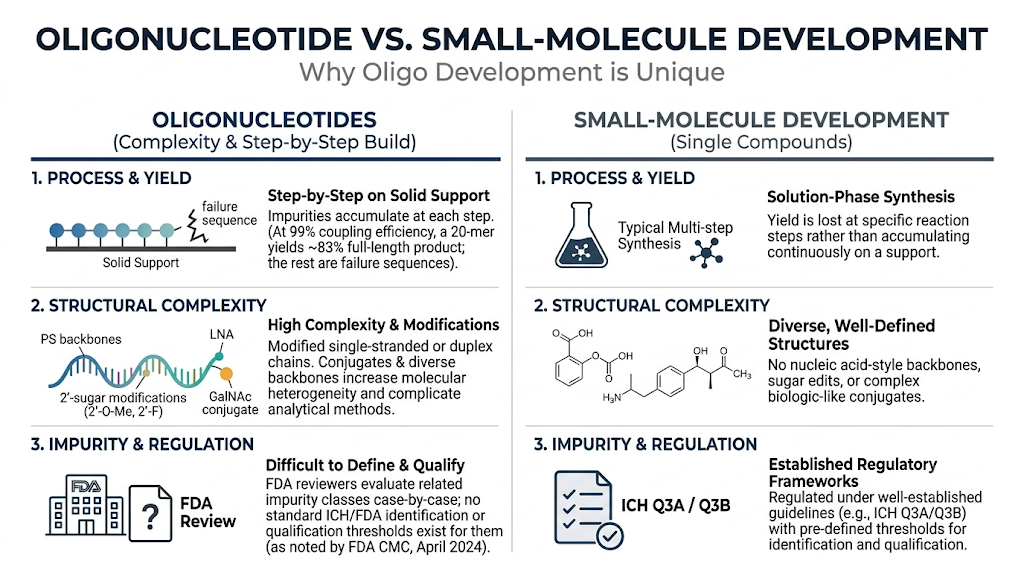
Oligonucleotides are built step by step on a solid support, so impurities accumulate with every cycle, and their size, charge and chemical modifications make standard small-molecule methods unsuitable. A drug substance is therefore a family of closely related molecules, not a single compound, and the CDMO has to define and control that family.
- Cumulative yield loss. At an average coupling efficiency of 99%, a 20-mer built in 19 coupling steps yields roughly 83% full-length product (0.99^19). The rest is failure sequences that must be removed or controlled.
- Chemical modification. Phosphorothioate (PS) backbones, 2′-O-methyl and 2′-fluoro sugars, locked nucleic acids and conjugates such as GalNAc increase molecular heterogeneity and complicate every analytical method.
- Impurity classification. FDA reviewers group oligonucleotide-related impurities by structural class, and FDA CMC staff noted in April 2024 that no ICH or FDA thresholds specifically address identifying and qualifying them (FDA CMC presentation). Limits must be justified case by case.
3: Why Is Analytical Characterization Critical in Oligonucleotide Drug Development?
Analytical characterization establishes whether an oligonucleotide has the expected identity, purity and quality, and whether observed impurities could affect safety, stability or performance. Because oligonucleotides contain closely related molecular species, orthogonal techniques are usually needed for a complete quality profile.
No single method covers every attribute. A chromatographic method may separate the main peak from some impurities without establishing the identity of each peak, while mass spectrometry may confirm mass but leave positional or sequence-related isomers unresolved. A robust strategy addresses:
- Identity: Expected mass, sequence-related characteristics and chemical modifications.
- Purity: The principal oligonucleotide relative to detectable impurities.
- Impurity composition: Identification and, where appropriate, quantification of synthesis- and degradation-related species.
- Chemical integrity: Backbone, sugar, base, terminal and conjugate modifications.
- Stability: Product changes during storage and under relevant stress.
- Batch consistency: Comparison of analytical profiles across development and manufacturing batches.
Early development may prioritize candidate identity and impurity understanding, while later stages need qualified or validated methods and predefined acceptance criteria.
4: Which Analytical Techniques Characterize Oligonucleotide Drug Substances?
IP-RP-LC with UV and mass detection handles purity and impurity profiling, LC-HRMS confirms identity and sequence, and NMR, ICP-MS and GC add structural, elemental and residual solvent data. Orthogonal results from several techniques are what make a characterization package credible.
| Technique | What it answers | Important consideration |
|---|---|---|
| IP-RP-LC-UV/MS (TEA/HFIP) | Purity; n-1 and n+1 species; modification variants | Retention depends on sequence, length, backbone chemistry and ion-pair conditions |
| Anion-exchange LC (AEX) | Charge-based separation; PO versus PS species | Closely related species need careful optimization |
| HILIC | Polar impurities; alternate selectivity | Used as an orthogonal check |
| LC-MS and LC-HRMS | Intact mass, impurity identification | Adducts, ionization and instrument conditions affect results |
| Tandem MS (MS/MS) | Sequence-related structural investigation | Fragmentation depends on structure and conditions |
| Ion mobility MS | Isomeric and diastereomeric species | Advanced characterization of PS isomers |
| UV absorbance | Concentration estimate; chromatographic detection | Does not establish identity or impurity structure |
| Capillary electrophoresis | Selected oligonucleotide-related species | Suitability depends on separation mechanism and sample |
| NMR (including 31P) | Backbone and structural integrity | Sample quantity and molecular size can limit use |
| ICP-MS | Residual metals | Elemental impurity control (ICH Q3D) |
| Headspace GC | Residual solvents | Release testing (ICH Q3C) |
IP-RP-LC is among the most widely used approaches because it resolves truncated sequences and closely related impurities, and TEA/HFIP ion-pairing mobile phases are favoured when the method feeds a mass spectrometer (overview of oligonucleotide impurity techniques). Ion-pair, anion-exchange and HILIC separations are usually tuned to keep peaks sharp for impurity work rather than to split diastereomers (PMC study on GalNAc-siRNA diastereomers).
How Do LC-MS and HRMS Improve Impurity Identification?
LC-MS pairs chromatographic separation with mass detection to show which species are present, and HRMS adds accurate-mass measurement that distinguishes many mass-different impurities. A typical workflow:
- Separate the principal oligonucleotide and related species with a suitable LC method.
- Acquire mass spectra under conditions suited to the oligonucleotide’s length and chemistry.
- Deconvolute multiply charged ions to estimate neutral molecular mass.
- Compare observed and expected masses to flag synthesis- or degradation-related species.
- Use MS/MS or complementary techniques for uncertain assignments.
- Decide whether identified impurities need quantification, process investigation or control.
Interpretation needs care. Salt adducts, counterions, in-source fragmentation and co-eluting species complicate spectra, so assignments should rest on the full body of evidence, not a mass match alone. Mass spectrometry depth is where an analytical CDMO earns its value, because an impurity cannot be controlled until it has been identified.
5: What Impurities Occur in Oligonucleotide Drugs and Where Do They Come From?
Most oligonucleotide impurities come from the synthesis cycle itself: failed couplings give shortmers, extra couplings give longmers, incomplete sulfurization gives PO species, and deprotection reactions leave adducts. Storage and handling add degradation products.
| Impurity class | Typical origin | Detection and control |
|---|---|---|
| Shortmers (n-1, n-2), truncations | Incomplete coupling or capping failure | IP-RP-LC/MS; coupling and capping optimization |
| Longmers (n+1) | Over-coupling or dimeric building blocks | LC-HRMS; phosphoramidite quality control |
| Deletion sequences | Missed internal nucleotide | LC-MS/MS sequencing |
| PO impurities | Incomplete sulfurization of a PS linkage | IP-RP or AEX with mass confirmation |
| Depurination and deamination products | Acidic detritylation, base loss, storage | LC-HRMS; stability studies |
| Adducts (for example acrylonitrile, chloral) | Deprotection and detritylation side reactions | LC-HRMS profiling |
| Diastereomers | Chiral phosphorus centre at each PS linkage | Multi-method fingerprinting; process control |
| Residual solvents, reagents and metals | Reagents, catalysts, equipment | Headspace GC; ICP-MS |
High-resolution LC-MS work on crude phosphorothioate oligonucleotides has identified failure sequences, incomplete sulfurization and desulfurization products, high-molecular-weight species and several adduct types (PMC LC-FTMS study). Sequence-related impurities are managed mainly through manufacturing process control, while process-related impurities such as solvents and metals fall under ICH Q3C and Q3D (regulatory summary of the 2024 draft guidance). Both groups should be tracked across development batches so shifts in the profile are visible early.
Incomplete synthesis and sequence-related impurities
Unsuccessful coupling can generate shorter sequences, while unintended reactions can produce longer or modified species. Common examples are n-1 and n-2 sequences, truncated sequences, n+1 and other extended sequences, internal deletion sequences, and species missing an intended modification. Their retention times and masses sit close to the target and depend on composition, backbone chemistry and length. IP-RP-LC and anion-exchange chromatography help separate them, LC-MS and HRMS assign masses, and isomeric or positional impurities may need extra fragmentation studies or orthogonal techniques.
Chemical modification-related impurities
Modifications improve stability and pharmacology but add routes to impurity formation. Challenges include incomplete incorporation of modified nucleotides, unintended backbone or terminal chemistry, modification-related side products, stereochemical variation at phosphorothioate linkages and incomplete conjugate attachment. Phosphorus stereoisomers share the same molecular mass, so accurate mass alone cannot distinguish them. A suitable strategy combines mass spectrometry with chromatographic separation and, where needed, structural or stereochemical investigation.
Degradation products and stability-related impurities
Degradation can occur during storage, sample preparation or formulation. Key pathways are depurination (loss of a purine base, which can lead to backbone cleavage), oxidation, hydrolysis, deamination, backbone cleavage into shorter fragments and, where applicable, conjugate or linker degradation. Their relative importance depends on sequence, modifications, formulation and storage. Forced-degradation studies should be designed to reveal real degradation pathways without arbitrary stress levels, and stability-indicating methods must separate relevant degradants from the principal component.
Residual reagents and process-related impurities
Residual activators, cleavage and deprotection reagents and their by-products, solvents, purification contaminants, counterions, salts and handling-related impurities may not be captured by the oligonucleotide purity method. Separate methods are often needed for residual solvents, elemental impurities and process reagents, and the control strategy should link each risk to the manufacturing process with scientifically justified acceptance criteria.
6: How Can an Oligonucleotide CDMO Resolve the Hardest Impurity Challenges?
The hardest challenges are co-elution of n-1 species with the full-length product, characterization of phosphorothioate diastereomers, and control of process-related impurities from raw materials. Each calls for a different mix of separation tuning, high-resolution mass spectrometry and upstream process control.
Why do n-1 impurities co-elute with the full-length product?
An n-1 species differs from the target by one nucleotide and shares the same charged backbone, so retention differences are small. In phosphorothioate molecules, partial separation of diastereomers broadens the main peak and reduces resolution between the full-length product and its n-1 and PO impurities (application note on phosphorothioate RNA impurities). Practical remedies:
- Adjust column temperature, ion-pairing agent and mobile-phase pH to suppress diastereomer splitting.
- Use stronger ion-pairing conditions that favour size-based separation.
- Confirm each peak by accurate mass, not retention time alone.
How are phosphorothioate diastereomers characterized?
By combining several methods, because no single one resolves every isomer. A PS oligonucleotide with n linkages can form 2^n diastereomers, and each linkage is either Rp or Sp (PMC study). Fragmenting the molecule by collision-induced dissociation reduces the number of possible diastereomers per fragment, which makes them characterizable, and ion mobility MS has been correlated quantitatively with LC-UV data in the same work. An industry summary of FDA generic-drug science priorities also describes a multi-method package of several LC strategies, MS/MS fragmentation sequencing and 31P NMR for diastereomeric sameness assessment (regulatory summary).
How do Oligonucleotide CDMO Services control residual and process-related impurities?
By controlling them upstream and proving the result downstream: qualifying phosphoramidite starting materials, applying ICH Q9 risk management and ICH Q11 principles to starting-material selection, testing metals by ICP-MS and solvents by headspace GC, and trending results across batches. EMA’s oligonucleotide guidance reiterates these ICH principles and highlights “critical impurities” in starting materials as a driver of process development (Teknoscienze summary).
7: What Makes Reliable Oligonucleotide Analytical Methods Hard to Develop?
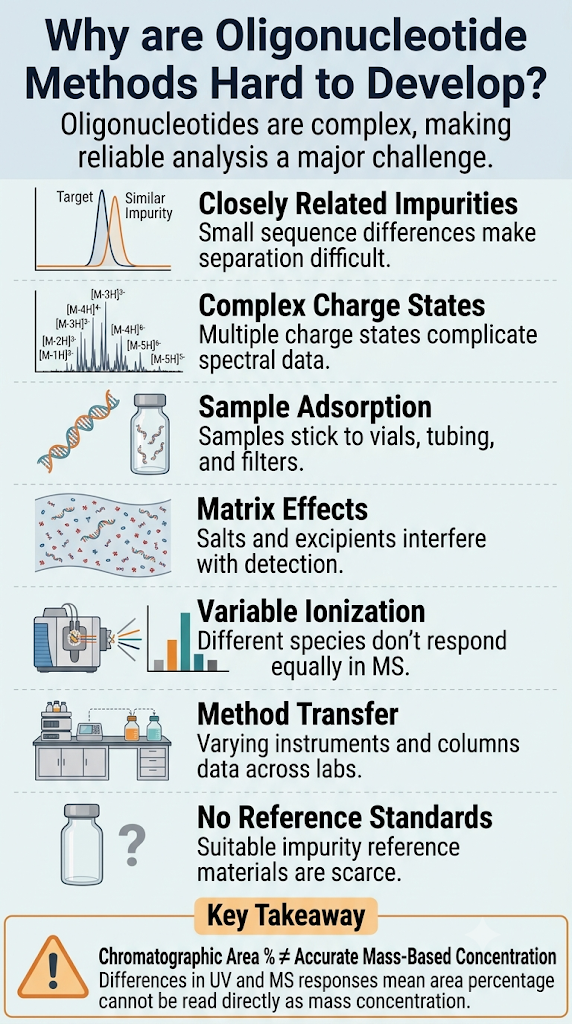
Reliable methods demand careful control of chromatographic selectivity, sample preparation, MS response and data interpretation, and difficulty rises when impurities resemble the target or occur at low abundance. Common challenges:
- Closely related impurities: Small sequence differences give limited separation.
- Complex charge states: Multiple charge states complicate spectral interpretation.
- Sample adsorption: Interactions with vials, tubing or filters affect recovery.
- Matrix effects: Salts and excipients influence detection.
- Variable ionization response: Species may not respond equally in MS, complicating direct quantification.
- Method transfer: Instruments, columns and mobile phases differ across laboratories.
- Reference-standard limits: Suitable impurity reference materials are often unavailable.
A strong program evaluates specificity, precision, accuracy where applicable, sensitivity, linearity or response, robustness and sample stability for the method’s intended use. Analysts should also distinguish chromatographic area percentage from a validated quantitative result. Differences in UV extinction coefficients or MS response mean an area percentage should not automatically be read as an accurate mass-based impurity concentration.
8: Which Regulatory Expectations Shape Oligonucleotide Analytical Methods?
Methods are governed by ICH Q2(R2) and Q14 for development and validation, ICH Q3C and Q3D for solvents and metals, and a growing set of FDA and EMA documents written for oligonucleotide therapeutics. As of October 2026, sponsors should confirm the current status of each document before filing.
| Document | Issued | Why it matters for CMC |
|---|---|---|
| FDA: Clinical Pharmacology Considerations for the Development of Oligonucleotide Therapeutics | June 2024 (final) | Covers QTc, immunogenicity, hepatic and renal impairment and drug interactions |
| FDA: Nonclinical Safety Assessment of Oligonucleotide-Based Therapeutics | November 2024 (draft) | Considers the impact of impurities and degradants on safety |
| EMA guideline on oligonucleotide development and manufacture (summary) | July 2024 (first issued as a draft) | First EMA guideline dedicated to oligonucleotide manufacture and control |
| ICH Q14: Analytical Procedure Development | Effective in the EU 14 June 2024 | Risk-based, lifecycle approach to method development |
| ICH Q2(R2): Validation of Analytical Procedures | Adopted November 2023 | Validation tests for spectroscopic and spectrometric methods, including MS |
Because no dedicated ICH or FDA guideline sets impurity thresholds, a scientific justification built on batch data and safety information is essential. ICH Q14 also encourages an analytical target profile and a documented control strategy, which suits oligonucleotide methods whose performance hinges on details such as ion-pairing conditions.
9: How Do CDMOs Support Regulatory Readiness and CMC Documentation?
CDMOs support readiness by generating reliable analytical data, developing suitable test methods and documenting how quality attributes are evaluated and controlled. Expectations depend on the product, development stage, jurisdiction and submission type. CMC documentation generally covers:
- Product identity: Evidence for the intended sequence and chemical structure.
- Purity and impurities: Characterization of relevant related substances and impurity controls.
- Analytical procedure suitability: Evidence that methods are fit for purpose.
- Specifications: Justified tests and acceptance criteria.
- Stability: Data supporting storage conditions and proposed shelf life.
- Manufacturing consistency: Comparable analytical profiles across representative batches.
- Data integrity: Traceable records, documented calculations, controlled procedures and appropriate review.
Analytical characterization does not replace manufacturing controls or clinical evidence, but it supplies the information a defensible CMC strategy depends on.
Regulatory context also extends to generic oligonucleotide products, where analytical sameness is a central question. Teams planning US filings can review ResolveMass’s perspective on a generic drug development CRO for ANDA programs, while those targeting Europe can look at EU generic drug dossier development and EMA submission. For method work performed in Canada, see analytical development for generic drugs in Canada.
How Do You Choose an Oligonucleotide CDMO Services Partner?
Choose a partner whose analytical depth matches your molecule’s complexity, who confirms key results with orthogonal methods, and who can deliver a data package a regulator can follow. Being able to synthesize or purify an oligonucleotide does not by itself demonstrate expertise in advanced impurity characterization.
| Evaluation area | What to ask and what a strong answer looks like |
|---|---|
| Analytical instrumentation | Are LC-MS, HRMS and complementary platforms available in-house? |
| Impurity characterization | Can the team identify unknown peaks, truncated sequences, modification-related impurities and degradants, with documented structure assignment? |
| Diastereomers and n-1 co-elution | Are multiple orthogonal separations and fragmentation data used, with clear rationale? |
| Method development | Are methods tailored to sequence and chemistry, and built for the lifecycle (analytical target profile, robustness ranges, phase-appropriate validation)? |
| Raw material control | Are phosphoramidite and reagent specifications tied to a risk assessment? |
| Quality systems | Are procedures, data review and data-integrity controls appropriate? |
| Regulatory support | Can the provider produce clear reports and support CMC documentation? |
| Communication | Are deliverables, timelines, sample requirements and responsibilities defined in advance? |
Clarify service boundaries too. Some providers specialize in synthesis and GMP manufacturing, while others offer independent analytical development or specialized impurity investigations. Matching the partner to the actual analytical challenge avoids unnecessary method transfers and repeated investigations.
Where ResolveMass fits. ResolveMass Laboratories Inc. is a Canadian analytical CRO/CDMO with focus areas in mass spectrometry, biosimilar characterization, PLGA-based drug delivery and nitrosamine testing. The same high-resolution MS discipline used for complex biologics and trace-level impurities is what resolves closely related oligonucleotide species. Current scope for a specific oligonucleotide program is best confirmed directly with the team. Teams working on other dosage forms can also explore ResolveMass’s pages on generic drug development for inhaled drug products and CDMO services for generic topical and semisolid drug products, which are relevant when an oligonucleotide is delivered by a non-injectable route.
Conclusion:
Successful oligonucleotide programs treat impurity characterization as a development workstream, not a release formality. The right Oligonucleotide CDMO Services partner identifies n-1 and n+1 species, resolves phosphorothioate diastereomers with orthogonal methods, controls process-related impurities upstream, and builds methods that meet ICH Q2(R2) and Q14 expectations from the start. Addressing analytical challenges early, rather than in late-stage development, supports informed decisions, stronger manufacturing consistency and a more reliable path to regulatory readiness.
Frequently Asked Questions:
Common oligonucleotide impurities include truncated sequences, deletion sequences, incomplete synthesis products, modification-related impurities, and degradation products. Residual reagents, solvents, and other process-related contaminants may also require evaluation. Their presence depends on the synthesis chemistry, purification process, storage conditions, and oligonucleotide structure.
HRMS provides accurate-mass measurements that help investigate molecular composition and identify potential impurities. It can support the characterization of truncated sequences, unexpected modifications, and degradation products. However, accurate mass alone may not distinguish isomers or confirm every structural feature, so complementary analytical techniques may be necessary.
Impurity profiling helps identify and assess unwanted molecular species that may affect product quality, stability, safety, or biological performance. It also supports process optimization, manufacturing consistency, and the development of appropriate impurity controls. A comprehensive impurity profile provides important evidence for chemistry, manufacturing, and controls (CMC) documentation.
Oligonucleotide degradation may result from hydrolysis, oxidation, depurination, backbone cleavage, or other chemistry-dependent reactions. Temperature, pH, formulation composition, moisture, and storage conditions can influence degradation pathways. Stability studies and suitable analytical methods help identify degradation products and establish appropriate storage conditions.
No. HRMS can help identify many impurities with distinct molecular masses, but it cannot independently resolve every isomer, stereoisomer, or structurally similar species. Chromatographic separation, MS/MS fragmentation, and other orthogonal analytical techniques may be required. Impurity assignments should be supported by sufficient evidence for the intended purpose.
Analytical characterization should begin early, ideally during candidate development and process optimization. Early identification of synthesis-related impurities and degradation pathways helps guide purification, improve analytical methods, and establish appropriate quality controls. The analytical strategy can then evolve as the product progresses toward clinical development and regulatory submission.
Reference
- Chen D, Zhang X, Xu S, Liu D. Current CMC challenges in oligonucleotide API development: from IND to NDA. Medicinal Chemistry Research. 2026 Apr 25:1-5.https://link.springer.com/article/10.1007/s00044-026-03569-8
- Jora M, Manz C, Thunberg L, Hölttä M, Leek T, Czechtizky W. The complexities of oligonucleotide therapeutics: analytical challenges and opportunities within early drug discovery. Bioanalysis. 2025 Nov 17;17(22):1415-9.https://www.tandfonline.com/doi/full/10.1080/17576180.2025.2600912
- Pourshahian S. Therapeutic oligonucleotides, impurities, degradants, and their characterization by mass spectrometry. Mass Spectrometry Reviews. 2021 Mar;40(2):75-109.https://analyticalsciencejournals.onlinelibrary.wiley.com/doi/abs/10.1002/mas.21615
- El Zahar NM, Magdy N, El‐Kosasy AM, Bartlett MG. Chromatographic approaches for the characterization and quality control of therapeutic oligonucleotide impurities. Biomedical Chromatography. 2018 Jan;32(1):e4088.https://analyticalsciencejournals.onlinelibrary.wiley.com/doi/abs/10.1002/bmc.4088
About the Author