

Introduction
Physicochemical Assessment for Biosimilar Characterization involves a comprehensive, multi-tiered analytical examination of the structural, chemical, and biophysical quality attributes of a candidate biopharmaceutical in comparison with an originator reference medicinal product (RMP). Regulatory agencies worldwide, including the US Food and Drug Administration (FDA) and the European Medicines Agency (EMA), recognize the importance of this analytical framework under International Council for Harmonisation (ICH) Q6B guidelines. Its purpose is to establish whether a proposed biosimilar demonstrates a high degree of similarity to its reference standard. A thorough Physicochemical Assessment for Biosimilar Characterization therefore serves as a fundamental component of the regulatory “totality-of-the-evidence” strategy, allowing drug developers to provide scientific justification for a streamlined non-clinical and clinical development program.
Biological products—including monoclonal antibodies (mAbs), fusion proteins, and recombinant therapeutic hormones—are inherently complex and heterogeneous macromolecules produced through living expression systems. In contrast to generic small-molecule therapeutics, which generally have well-defined and relatively simple chemical structures, biological products naturally exhibit lot-to-lot microheterogeneity. Such variability can arise during cell culture, downstream purification, and formulation or storage. As a result, obtaining regulatory approval for a candidate biosimilar does not simply involve reproducing clinical efficacy trials independently. Instead, approval depends substantially on demonstrating analytical similarity across an extensive range of critical quality attributes (CQAs) through the application of orthogonal analytical technologies.
Discover how ResolveMass supports Biosimilar Characterization Services with advanced analytical testing.
Through systematic evaluation of primary amino acid sequences, post-translational modifications (PTMs), higher-order structures (HOS), charge variants, and aggregation states, analytical scientists can identify and evaluate structural differences at an early stage of development. This guide presents the attribute-specific analytical requirements, advanced methodologies, and regulatory considerations needed to meet international expectations for biosimilarity.
Share via:
Quick Summary:
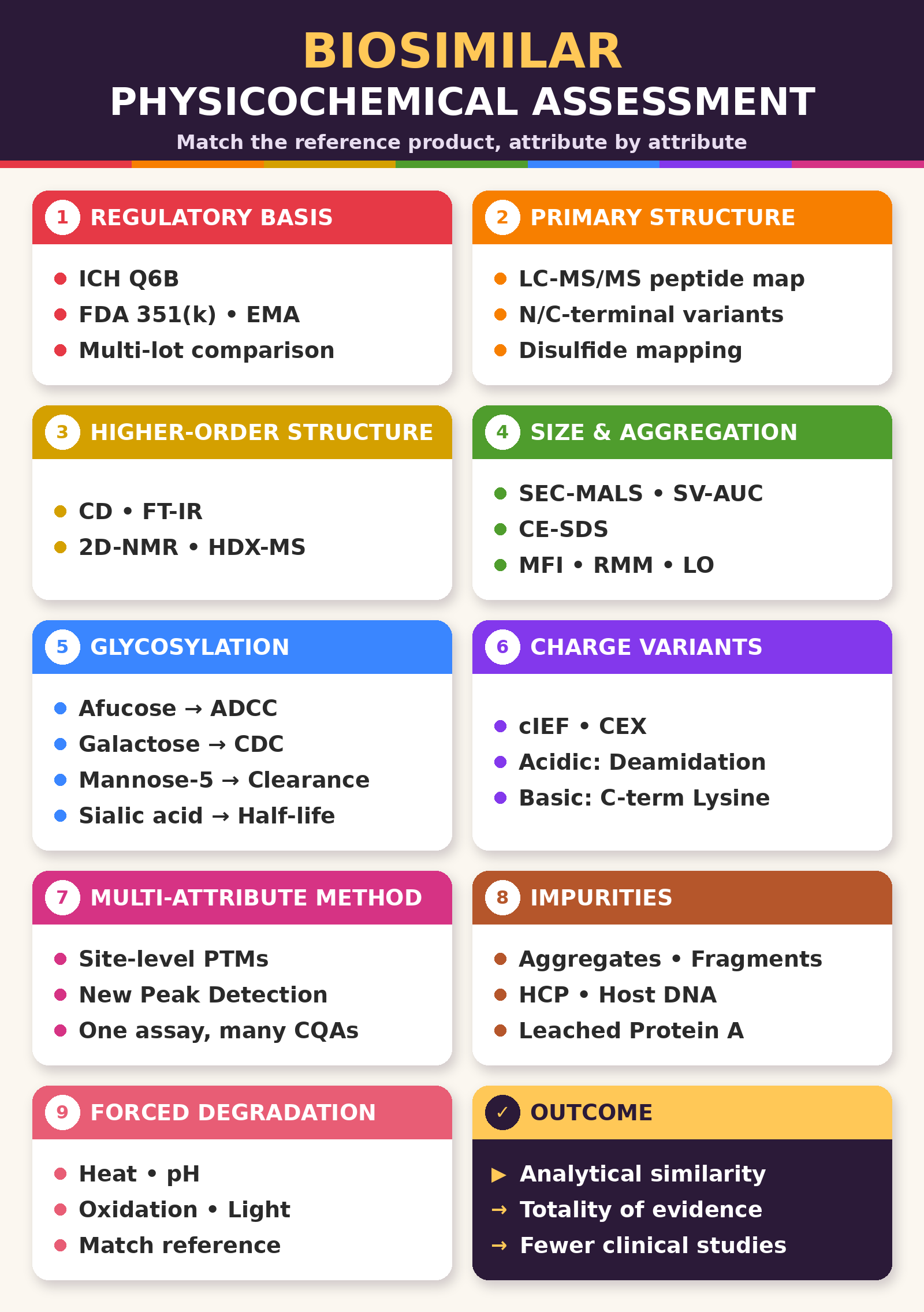
- Purpose: Physicochemical assessment compares a proposed biosimilar with its originator reference product, attribute by attribute. A high degree of analytical similarity is the foundation of the regulatory “totality-of-the-evidence” approach and can justify a shorter non-clinical and clinical program.
- Regulatory framework: ICH Q6B sets the harmonized criteria for characterizing biologics. The FDA 351(k) pathway and EMA guidelines both require comparison across multiple lots of the biosimilar and the reference product, because of natural lot-to-lot variability.
- Primary structure: High-resolution LC-MS/MS peptide mapping confirms an identical amino acid sequence. Related analyses characterize terminal variants (N-terminal pyroglutamate, C-terminal lysine) and verify correct disulfide bond pairing.
- Higher-order structure and size: CD, FT-IR, 2D-NMR and HDX-MS confirm a comparable 3D structure. SEC-MALS, SV-AUC, CE-SDS and particle methods (MFI, RMM, light obscuration) measure aggregates, fragments and sub-visible particles, which can affect immunogenicity.
- PTMs and charge variants: N-glycan profiling tracks attributes that drive function and pharmacokinetics: afucosylation (ADCC), galactosylation (CDC), high-mannose (clearance) and sialic acids (half-life, with Neu5Gc an immunogenicity concern). cIEF and CEX resolve acidic and basic charge variants caused by deamidation, C-terminal lysine and similar modifications.
- Multi-Attribute Method (MAM): This single LC-MS workflow quantifies site-specific modifications such as oxidation, deamidation and glycans. It also flags unexpected peaks through New Peak Detection, so it can replace several conventional QC assays.
- Impurities and forced degradation: Product-related impurities (aggregates, fragments) are distinguished from process-related ones (host cell proteins, host cell DNA, leached Protein A). Thermal, pH, oxidative and light stress studies then confirm that the biosimilar degrades along the same pathways as the reference product.
Regulatory Guidelines for Physicochemical Assessment for Biosimilar Characterization
International regulatory frameworks require comparative analytical characterization to establish a high degree of structural similarity between a proposed biosimilar and its reference product, while demonstrating that there are no clinically meaningful differences in safety, purity, or potency. The prevailing regulatory approach follows a risk-based, totality-of-the-evidence model in which analytical similarity assessment functions as a critical mechanism for reducing uncertainty and clinical development risk.
Learn how Biosimilar Comparability Studies can support your biosimilar development program.
ICH Q6B Harmonized Criteria and Acceptance Limits
The ICH Q6B guideline provides an internationally harmonized framework for establishing specifications, analytical procedures, and acceptance criteria for biotechnological and biological substances. It organizes characterization into several major areas, including structural characterization covering primary and higher-order structures, physicochemical properties, immunochemical properties, biological activity, purity, impurities, and quantity. Meeting ICH Q6B expectations requires the use of advanced and highly discriminative analytical technologies that can identify even subtle changes in structural integrity and purity patterns. When physicochemical analytical methods are capable of comprehensively characterizing structural attributes and demonstrating a strong relationship with functional activity, they become an important foundation for product control and comparability evaluation.
Understand the role of ICH Q6B Guidelines for Biological Characterisation in biosimilar development and analytical assessment.
FDA 351(k) and EMA Biosimilar Comparability Expectations
Both the FDA 351(k) pathway, established under the Biologics Price Competition and Innovation Act, and EMA biosimilar guidelines emphasize comparative testing using multiple manufacturing lots of both the proposed biosimilar and the commercially available reference product. This requirement recognizes the inherent manufacturing variability that may exist throughout the commercial history of the originator product. Within this regulatory framework, analytical similarity assessment functions as an important risk-reduction strategy. A high level of physicochemical similarity can provide sponsors with scientific evidence supporting a reduction in the scope and extent of non-clinical animal studies and human clinical trials.
Get expert support for Biosimilar Comparability Study Design and CRO Services to strengthen your analytical development strategy.
Primary Structure Assessment in Physicochemical Characterization
Primary structural characterization is designed to establish the exact amino acid sequence, peptide map, disulfide connectivity, and terminal residue modifications of a candidate biopharmaceutical. Demonstrating an identical primary sequence is a fundamental regulatory expectation because unexplained or unacceptable amino acid sequence differences can prevent a candidate from qualifying through the biosimilar approval pathway.
Sequence Coverage and Peptide Mapping via High-Resolution LC-MS/MS
Liquid chromatography-tandem mass spectrometry (LC-MS/MS) peptide mapping can provide complete primary sequence coverage while identifying low-abundance point mutations and amino acid substitutions. In this workflow, the denatured, reduced, and alkylated protein is enzymatically digested using site-specific proteases, including trypsin, chymotrypsin, or Lys-C. The resulting complex peptide mixture is separated using reverse-phase ultra-high-performance liquid chromatography (RP-UHPLC) and subsequently analyzed using High-Resolution Accurate Mass (HRAM) mass spectrometry.
Mass spectrometric peptide mapping establishes primary sequence identity by comparing experimentally obtained mass-to-charge (m/z) fragmentation spectra with theoretical sequence databases. Advanced fragmentation strategies, including combined Higher-Energy Collisional Dissociation (HCD) and Electron-Transfer Dissociation (ETD), improve characterization of challenging peptide regions, including leucine/isoleucine-rich and highly hydrophobic sequences. These approaches can facilitate detection of sequence variants at sub-percent levels.
Terminal Variants and Disulfide Bridge Linkage Mapping
Terminal variant characterization measures modifications such as N-terminal pyroglutamate formation and C-terminal lysine truncation, whereas non-reduced peptide mapping is used to verify native disulfide bond pairings. Biopharmaceutical molecules can undergo enzymatic or chemical changes at their terminal residues during cell culture and processing, making quantitative characterization important for demonstrating manufacturing consistency.
Recombinant proteins containing N-terminal glutamine or glutamic acid residues may undergo cyclization, generating N-terminal pyroglutamate (pE). This modification can be quantified using LC-MS/MS. At the C-terminus of monoclonal antibodies, heavy-chain lysine residues are commonly removed by endogenous carboxypeptidases. Treatment with Carboxypeptidase B (CpB), followed by cation exchange chromatography (CEX) or RP-LC-MS analysis, enables characterization of K0, K1, and K2 lysine charge variants.
Non-reduced peptide mapping using LC-MS can additionally characterize intra- and inter-chain disulfide linkages. This analysis verifies native cysteine pairing and helps identify mismatched or scrambled disulfide bonds. Free sulfhydryl (-SH) groups can be independently quantified using Ellman’s reagent (DTNB) or fluorometric alkylation assays, providing additional evidence regarding the completeness of disulfide bond formation.
Higher-Order Structure (HOS) and Biophysical Attributes
Higher-Order Structure (HOS) characterization evaluates the secondary, tertiary, and quaternary spatial conformations that influence protein biological potency, receptor affinity, and stability. A combination of advanced biophysical techniques is used to determine whether a biosimilar exhibits a three-dimensional molecular architecture comparable to that of the reference product.
Spectroscopic and Structural Fingerprinting (CD, FT-IR, 2D-NMR, and HDX-MS)
Advanced spectroscopic and nuclear analytical techniques provide detailed structural fingerprints and information regarding conformational dynamics, enabling direct comparisons between biosimilar and reference molecules. Far-UV Circular Dichroism (CD), typically measured across 190–250 nm, characterizes secondary structural elements such as α-helices, β-sheets, and random coils. Near-UV CD, generally covering 250–320 nm, evaluates the tertiary environments surrounding aromatic side chains, including tryptophan, tyrosine, and phenylalanine. Second-derivative Fourier-Transform Infrared (FT-IR) spectroscopy examines the Amide I vibrational band (1600–1700 cm⁻¹) and can identify subtle differences in backbone hydrogen-bonding patterns.
For more detailed structural characterization, two-dimensional ¹H–¹³C or ¹H–¹⁵N Heteronuclear Single Quantum Coherence (HSQC) Nuclear Magnetic Resonance (NMR) spectroscopy provides highly resolved structural fingerprints at individual atomic coordinates. Hydrogen-Deuterium Exchange Mass Spectrometry (HDX-MS) further evaluates conformational behavior by monitoring the exchange of backbone amide hydrogens with deuterium in solution. Protein regions with comparable tertiary folding and solvent accessibility generally demonstrate similar deuterium uptake kinetics, allowing localized conformational dynamics to be assessed throughout the protein backbone.
Discover how Native Mass Spectrometry for Biosimilars can provide deeper insight into molecular structure and heterogeneity.
Size Heterogeneity and Aggregation Profiling (SEC-MALS and SV-AUC)
SEC-MALS and SV-AUC provide complementary measurements of absolute molar mass and hydrodynamic size and are valuable for detecting soluble aggregates, fragments, and monomeric species. Protein self-association and aggregation are important critical quality attributes because they can potentially increase immunogenicity or adversely affect biological activity. Demonstrating comparable size heterogeneity requires orthogonal analytical approaches capable of evaluating monomeric species, low-molecular-weight (LMW) fragments, high-molecular-weight (HMW) soluble species, and sub-visible particles.
Strengthen your analytical assessment with Aggregation Analysis in Biosimilars for comprehensive evaluation of size-related variants.
| Analytical Method | Size Range / Parameter Evaluated | Primary Analytical Mechanism | Role in Biosimilar Characterization |
|---|---|---|---|
| SEC-MALS | Soluble monomers & HMW aggregates (1–100 nm) | Size exclusion coupled with multi-angle light scattering | Determines absolute molar mass and mass fraction of monomer versus aggregate species. |
| SV-AUC | Soluble monomers & oligomers (1–100 nm) | Hydrodynamic separation through high-speed centrifugal force | Serves as an orthogonal method to SEC and measures sedimentation coefficients under native conditions. |
| CE-SDS (Reduced/Non-Reduced) | Intact monomer, LMW fragments, subunit clips | Electrophoretic separation according to molecular weight in a gel matrix | Quantifies % intact IgG, heavy/light chain ratios, and non-covalent or covalent fragmentation. |
| Flow Imaging Microscopy (MFI) | Sub-visible particles (2–100 μm) | Digital imaging of particles in a microfluidic flow cell | Measures particle concentration, size distribution, and morphological characteristics, including differentiation between protein particles and silicone oil. |
| Resonant Mass Measurement (RMM) | Sub-micron particles (0.1–1 μm) | Buoyant mass measurement within a microchannel resonator | Differentiates proteinaceous aggregates from silicone oil droplets according to differences in fluid density. |
| Light Obscuration (LO – USP) | Sub-visible particles (≥10 μm and ≥25 μm) | Particle light blocking during fluidic passage | Provides a standard release assessment for sub-visible particulate compliance in final parenteral formulations. |
Post-Translational Modifications (PTMs) and Charge Isoform Heterogeneity
Post-translational modification profiling evaluates important chemical variants, including glycosylation, charge isoforms, oxidation, and deamidation, all of which can influence biopharmaceutical pharmacokinetics and immunogenicity. Characterizing this molecular microheterogeneity helps determine whether the biosimilar manufacturing process generates PTM distributions that remain appropriately comparable with those of the originator.
Identify and prioritize key Critical Quality Attributes (CQAs) in Biosimilars to support robust analytical similarity assessment.
N-Glycosylation Profiling and Sialic Acid Assessment
N-glycan profiling characterizes released glycan structures and evaluates important modifications such as afucosylation, galactosylation, high-mannose content, and sialic acid distribution. In therapeutic monoclonal antibodies, N-linked glycans attached to the conserved Asn297 site within the Fc region can substantially influence structural stability and Fc-mediated effector functions.
Typical analytical workflows release glycans using Peptide-N-Glycanase F (PNGase F), followed by fluorescent labeling with reagents such as 2-Aminobenzamide (2-AB) or Procainamide. The labeled glycans are subsequently separated using Hydrophilic Interaction Liquid Chromatography (HILIC-UHPLC) with fluorescence and mass spectrometric detection.
- Afucosylation (G0, G1, G2 forms lacking core fucose): Can substantially increase FcγRIIIa receptor binding affinity and consequently enhance Antibody-Dependent Cellular Cytotoxicity (ADCC).
- Terminal Galactosylation: Can promote C1q binding and thereby influence Complement-Dependent Cytotoxicity (CDC).
- High-Mannose Structures (e.g., Mannose-5/M5): Can increase circulatory clearance rates in human serum.
- Sialic Acids (N-Acetylneuraminic acid / Neu5Ac and N-Glycolylneuraminic acid / Neu5Gc): Can influence terminal half-life. Neu5Gc requires careful control because of its potential to elicit non-human immunogenic responses in human patients.
Charge Variant Resolution via cIEF and Cation Exchange Chromatography
Capillary isoelectric focusing (cIEF) and cation exchange chromatography (CEX) are used to resolve charge heterogeneity into acidic, main, and basic isoform fractions according to differences in overall pI and molecular charge. Charge variants can originate from chemical and enzymatic modifications introduced during cell culture, downstream purification, or storage.
Imaged cIEF (icIEF) separates protein isoforms across a calibrated pH gradient within a capillary, enabling high-resolution quantification of the overall isoelectric point (pI) and charge profile. Cation Exchange Chromatography (CEX-UHPLC) uses salt- or pH-gradient elution to physically separate charge species for offline or online mass spectrometric identification.
Acidic variants can result from asparagine deamidation, which converts neutral asparagine into negatively charged aspartic acid or isoaspartic acid, as well as from sialylation, non-enzymatic glycation, or covalent oxidation. Basic variants can originate from uncleaved C-terminal heavy-chain lysines, succinimide intermediate entrapment, or incomplete N-terminal signal peptide processing.
Learn how Charge Variant Analysis in Biosimilars can help characterize molecular heterogeneity using mass spectrometry.
Multi-Attribute Method (MAM) in Physicochemical Assessment for Biosimilar Characterization
The Multi-Attribute Method (MAM) is an LC-MS-based peptide mapping strategy designed to quantify multiple post-translational modifications while simultaneously screening for previously unidentified impurity peaks within a single analytical workflow. Through the use of High-Resolution Accurate Mass (HRAM) mass spectrometers, MAM moves beyond conventional low-resolution quality control assays toward an integrated mass spectrometry-centered analytical approach.
MAM involves enzymatic digestion of the candidate biopharmaceutical into peptides, separation of those peptides using RP-UHPLC, and direct quantification of selected critical quality attributes at individual amino acid sites. Automated mass spectrometry software extracts peptide ion chromatograms (XIC) and calculates the percentage modification at predefined sites, including Met252 oxidation, Asn325 deamidation, and individual N-glycan distributions.
Beyond targeted attribute quantification, MAM also incorporates automated New Peak Detection (NPD) algorithms. NPD compares high-resolution mass spectra from biosimilar batches with reference product baselines and identifies unexpected chromatographic peaks, sequence variants, or process impurities that exceed established threshold criteria. As a result, MAM can function as a highly integrated alternative to multiple legacy quality control assays by bringing charge variant monitoring, glycan characterization, and oxidation assessment into a unified mass spectrometry workflow.
Purity, Impurity Profiles, and Forced Degradation Studies
Purity and impurity characterization distinguishes product-related variants from process-related contaminants, while forced degradation studies determine whether a biosimilar demonstrates degradation pathways comparable to those of its reference product. Developing a comprehensive purity profile requires the integration of sensitive analytical separation technologies with controlled and scientifically designed degradation stress studies.
Product-Related and Process-Related Impurities
Product-related impurities include inactive or potentially immunogenic variants such as aggregates and fragments, whereas process-related impurities include host cell proteins (HCPs), host cell DNA, and leached processing reagents. ICH Q6B guidelines differentiate acceptable product-related substances, which may retain biological activity, from unwanted impurities that arise during production or processing.
Product-related impurities may include high-molecular-weight aggregates, fragmented clips, and extensively oxidized or misfolded proteins. Process-related impurities originate from host cell expression systems and downstream processing operations. Host Cell Proteins (HCPs) are monitored using sensitive multiplex ELISA or liquid chromatography-nano-electrospray tandem mass spectrometry (nanoLC-MS/MS). Residual host cell DNA (hcDNA) can be quantified using droplet digital PCR (ddPCR), while leached Protein A affinity ligands are evaluated using specialized immunoassays.
Discover advanced approaches for Impurity Profiling of Biosimilars to support comprehensive product and process-related impurity assessment.
Comparative Forced Degradation Stress Testing
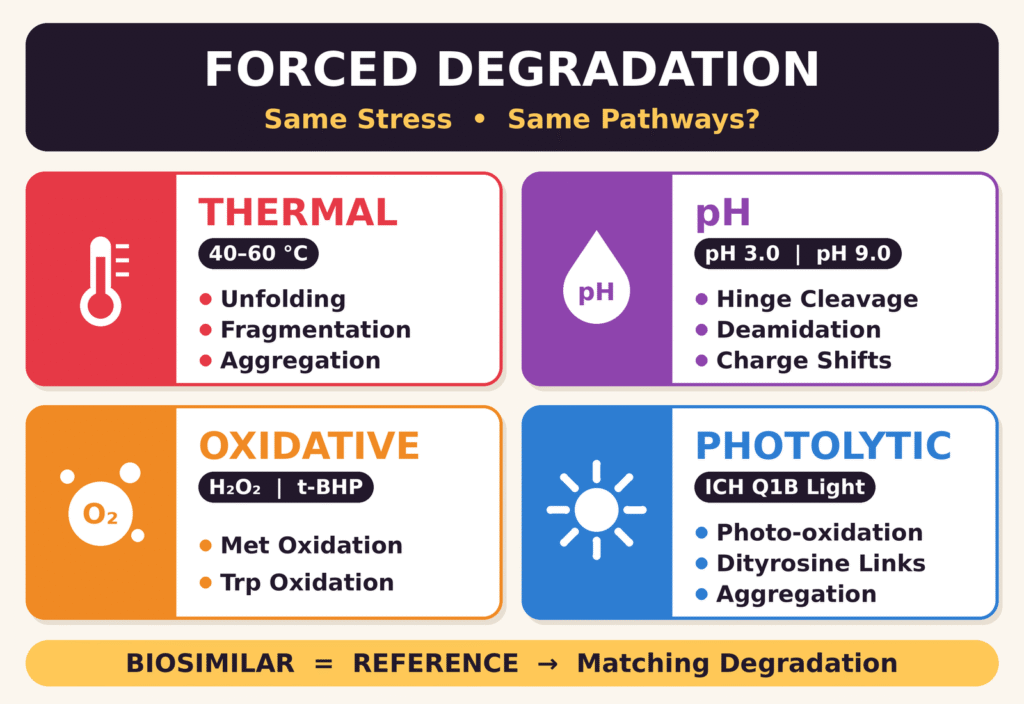
Comparative forced degradation involves exposing candidate biosimilar and reference product lots to thermal, oxidative, pH, and photolytic stress conditions to compare degradation kinetics and degradation-product formation. Applying equivalent stress conditions to both molecules helps establish whether the candidate biosimilar demonstrates comparable degradation pathways and chemical susceptibilities to the reference medicinal product.
- Thermal Stress: Samples are exposed to elevated temperatures (40°C–60°C) to investigate thermal unfolding, fragmentation, and aggregation kinetics. Differential Scanning Calorimetry (DSC) measures thermal transition midpoints (Tm1, Tm2, Tons).
- pH Stress: Exposure to acidic (pH 3.0) and alkaline (pH 9.0) conditions can accelerate hinge-region peptide cleavage, base-catalyzed deamidation, and redistribution of charge isoforms.
- Oxidative Stress: Exposure to oxidizing agents, including hydrogen peroxide (H2O2) or tert-butyl hydroperoxide (t-BHP), targets susceptible methionine (Met252/Met428) and tryptophan residues, which can subsequently be quantified using MAM LC-MS.
- Photolytic Stress: Exposure to visible and ultraviolet light under ICH Q1B conditions can promote photo-oxidation, dityrosine cross-linking, and light-induced aggregation.
Multi-Attribute Summary for Biosimilar Physicochemical Assessment
A comprehensive physicochemical assessment requires a structured analytical matrix in which every quality attribute domain is supported by primary and orthogonal analytical techniques. Such an approach facilitates regulatory compliance by providing a systematic overview of the structural parameters, analytical methodologies, and regulatory considerations necessary to establish biosimilar comparability.
| Quality Attribute Domain | Specific Parameter Evaluated | Primary Analytical Method | Secondary / Orthogonal Method | Regulatory Impact Focus |
|---|---|---|---|---|
| Primary Sequence | Amino Acid Sequence Identity | Tryptic RP-UHPLC-MS/MS Mapping | MALDI-TOF MS / Edman Degradation | Verifies 100% primary sequence identity with the reference product. |
| Terminal Structure | N- & C-Terminal Variants | LC-MS/MS & CEX Chromatography | CpB Digestion + cIEF Profiling | Characterizes N-pyroglutamate formation and C-terminal lysine truncation. |
| Disulfide Connectivity | Cysteine Pairing & Free -SH | Non-Reduced LC-MS/MS Mapping | Ellman’s Assay (Free Sulfhydryls) | Confirms native intra- and inter-chain disulfide bonds and checks for scrambling. |
| Secondary Structure | α-Helix, β-Sheet content | Far-UV Circular Dichroism (CD) | FT-IR (Amide I Band Analysis) | Demonstrates superimposable secondary structural spectra. |
| Tertiary Structure | 3D Folding & Dynamics | Near-UV CD & 2D ¹H–¹³C NMR | HDX-MS (Hydrogen-Deuterium Exchange) | Probes aromatic environments and localized solvent accessibility kinetics. |
| Size Variants | Soluble Aggregates / Monomers | SEC-MALS (Light Scattering) | SV-AUC (Analytical Ultracentrifugation) | Quantifies monomer purity and controls HMW aggregates. |
| Size Variants | Low-MW Clips & Fragments | Reduced & Non-Reduced CE-SDS | RP-UHPLC-MS | Assesses intact protein purity and non-enzymatic fragmentation clips. |
| Glycosylation | Released N-Glycan Profiles | HILIC-UHPLC-FLR-MS (2-AB/Procainamide) | Intact / Subunit LC-MS Mass Analysis | Measures afucosylation, galactosylation, M5, and sialic acid distributions. |
| Charge Heterogeneity | Acidic & Basic Variants | Capillary Isoelectric Focusing (cIEF / icIEF) | Cation Exchange Chromatography (CEX-UHPLC) | Evaluates pI profiles, charge isoform distributions, and CQA modifications. |
| Chemical Modifications | Site-Specific Oxidation & Deamidation | LC-MS Multi-Attribute Method (MAM) | RP-UHPLC Tryptic Mapping | Quantifies site-specific Met oxidation and Asn deamidation levels. |
Conclusion on Physicochemical Assessment for Biosimilar Characterization
A comprehensive Physicochemical Assessment for Biosimilar Characterization is fundamental to establishing analytical similarity and meeting regulatory expectations across global biosimilar approval pathways. A detailed, attribute-by-attribute evaluation provides comprehensive insight into primary sequence identity, higher-order structures, post-translational modification profiles, charge variant distributions, and overall purity characteristics.
By integrating high-resolution mass spectrometry, Multi-Attribute Methods (MAM), biophysical spectroscopy, and orthogonal separation technologies, biopharmaceutical developers can generate a robust analytical package that supports the regulatory totality-of-the-evidence framework. Early identification and characterization of critical quality attributes can reduce clinical development risk while supporting a more efficient pathway toward regulatory approval of modern biosimilar therapies.
Strengthen your regulatory strategy with ResolveMass’s End-to-End Biosimilar Analytical Package for Regulatory Submission.
To discuss your analytical comparability strategy, mass spectrometry workflows, or Multi-Attribute Method (MAM) development with senior biopharmaceutical scientists, contact ResolveMass Laboratories Inc. Contact Page.
Frequently Asked Questions (FAQs)
Biosimilar physicochemical characterization is primarily conducted within the framework of ICH Q6B, FDA 351(k) regulatory requirements, and applicable EMA scientific guidelines. These frameworks establish expectations for analytical characterization, specifications, acceptance criteria, and comparative testing. Together, they support a structured assessment of the candidate product against the reference medicinal product.
High-resolution liquid chromatography-mass spectrometry (LC-MS) provides highly accurate molecular mass measurements and detailed structural information required for biosimilar characterization. It can support primary sequence confirmation, disulfide bond mapping, and site-specific assessment of post-translational modifications. HRAM LC-MS also provides the sensitivity needed to identify low-level structural variants and molecular differences.
Higher-Order Structure (HOS) is investigated using complementary analytical techniques such as Far-UV and Near-UV Circular Dichroism (CD), Fourier-Transform Infrared (FT-IR) spectroscopy, 2D HSQC NMR, Hydrogen-Deuterium Exchange Mass Spectrometry (HDX-MS), and SEC-MALS. These methods examine different aspects of protein conformation and molecular behavior. Together, they provide orthogonal evidence for comparable secondary, tertiary, and quaternary structures.
N-glycosylation can influence protein stability, circulatory half-life, clearance, immunogenicity, and Fc-mediated effector functions such as ADCC and CDC. Changes in glycan structures may alter interactions with receptors and other components of the immune system. For instance, afucosylation can affect FcγRIIIa binding, while terminal galactosylation can influence C1q interaction and CDC activity.
The Multi-Attribute Method (MAM) is an LC-MS-based analytical approach that enables simultaneous monitoring of multiple product quality attributes within a single workflow. It can quantify modifications such as oxidation and deamidation while also supporting glycan characterization and New Peak Detection. This integrated strategy can simplify analytical monitoring compared with performing several independent attribute-specific assays.
High-molecular-weight (HMW) aggregates and soluble molecular species can be evaluated using Size-Exclusion Chromatography coupled with Multi-Angle Light Scattering (SEC-MALS) and Sedimentation Velocity Analytical Ultracentrifugation (SV-AUC). These techniques provide complementary information about molecular size and distribution. Sub-visible particulates can additionally be assessed using Flow Imaging Microscopy (MFI) and Light Obscuration.
Product-related impurities originate from modifications or alterations of the therapeutic protein itself and may include aggregates, fragmented clips, oxidized species, or misfolded forms. Process-related impurities arise from manufacturing materials, cell culture systems, or purification operations. Examples include host cell proteins (HCPs), host cell DNA, and leached Protein A.
Comparative forced degradation studies challenge both the candidate biosimilar and reference product under controlled thermal, oxidative, pH, and photolytic conditions. The resulting degradation profiles help determine whether the two products exhibit comparable degradation pathways and chemical sensitivities. These studies provide additional evidence supporting similarity in structural stability and degradation behavior.
The number of reference product lots required depends on the applicable regulatory strategy, product characteristics, and agency expectations rather than a universal fixed number. Sponsors generally evaluate multiple representative commercial lots collected across the reference product’s manufacturing history. Using several lots helps capture natural manufacturing variability and supports scientifically justified comparisons of critical quality attributes.
Reference:
- U.S. Food and Drug Administration. (1999, August). Q6B specifications: Test procedures and acceptance criteria for biotechnological/biological products. https://www.fda.gov/regulatory-information/search-fda-guidance-documents/q6b-specifications-test-procedures-and-acceptance-criteria-biotechnologicalbiological-products
- :European Medicines Agency. (1999, September 1). ICH Q6B: Test procedures and acceptance criteria for biotechnological/biological products. https://www.ema.europa.eu/en/scientific-guidelines/ich-q6b-specifications-test-procedures-acceptance-criteria-biotechnological-biological-products
- U.S. Food and Drug Administration. (2015, April). Quality considerations in demonstrating biosimilarity of a therapeutic protein product to a reference product: Guidance for industry. https://www.fda.gov/media/135612/download
- European Medicines Agency. (2014, December 18). Guideline on similar biological medicinal products containing biotechnology-derived proteins as active substance: Non-clinical and clinical issues (Revision 1) (EMA/CHMP/BMWP/42832/2005 Rev. 1). https://www.ema.europa.eu/en/documents/scientific-guideline/guideline-similar-biological-medicinal-products-containing-biotechnology-derived-proteins-active-substance-non-clinical-and-clinical-issues-revision-1_en.pdf
- Ventola, C. L. (2013). Biosimilars: Part 1: Proposed regulatory criteria for FDA approval. P&T, 38(5), 270–287. https://pmc.ncbi.nlm.nih.gov/articles/PMC3737980/
Get In Touch With Us
About The Author


