


Introduction to Biosimilar Cell Line Engineering
In the biopharmaceutical industry, Cell Line Development for Biosimilars is a highly regulated, comparability-driven engineering process designed to generate host cell lines capable of producing therapeutic proteins that are analytically and functionally equivalent to an approved reference biologic. Unlike conventional cell line development (CLD) for innovative biologics, which primarily focuses on maximizing volumetric productivity, biosimilar cell line development is fundamentally guided by the target product profile (TPP) established by the originator molecule.
Biosimilars are large, structurally complex glycoproteins, ranging from approximately 10,000 Da to more than 150,000 Da in the case of monoclonal antibodies, and are produced using living cellular expression systems. Due to the inherent complexity of biological manufacturing, even subtle differences in host cell selection, metabolic engineering, or upstream culture conditions can significantly influence post-translational modifications (PTMs), protein folding efficiency, and impurity profiles. This concept, commonly referred to as the “process is the product” principle, requires bioprocess engineers to carefully reconstruct the cellular production system despite having no access to the proprietary manufacturing process of the reference product. Consequently, establishing a robust, genetically stable, and high-performing production cell line forms the essential biological and regulatory foundation for all downstream manufacturing activities, including process scale-up, purification, analytical characterization, and clinical evaluation.
To ensure regulatory success, developers must establish biosimilar comparability studies early to align their development efforts with industry expectations.
Article Summary:
Article Summary
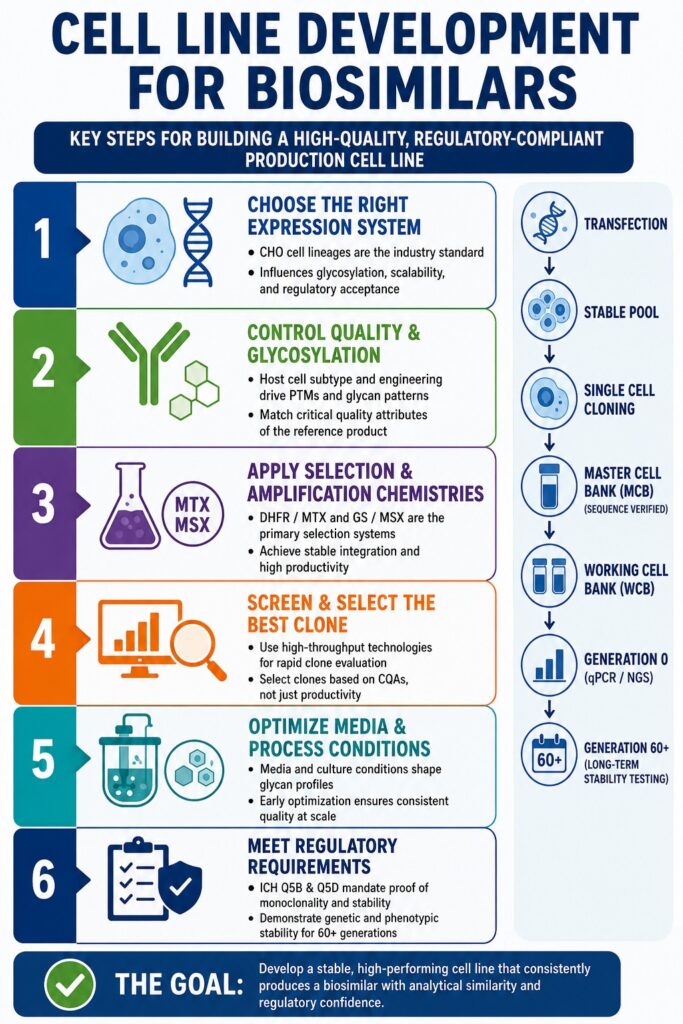
- Cell line development is the foundation of biosimilar manufacturing, focusing on producing therapeutic proteins that closely match the reference biologic in quality, safety, efficacy, and regulatory compliance rather than simply maximizing protein yield.
- CHO-based expression systems, especially CHO-K1, CHO-DG44, and CHO-GS, are the preferred production platforms because they offer excellent genetic stability, scalable manufacturing, and human-compatible post-translational modifications essential for biosimilar production.
- Host cell selection and engineering directly influence product quality, including glycosylation patterns, protein folding, and biological activity. Advanced genetic modifications help replicate reference-product characteristics or enhance therapeutic functions such as antibody-dependent cellular cytotoxicity (ADCC).
- Stable cell line generation relies on proven selection technologies, primarily the DHFR/MTX and GS/MSX systems, while newer site-specific integration approaches like RMCE improve expression consistency, reduce genetic variability, and accelerate development.
- Clone selection prioritizes analytical similarity over productivity, with developers screening critical quality attributes (CQAs) such as glycan profiles, charge variants, and structural integrity to identify clones that most closely resemble the originator product.
- Modern high-throughput screening and optimized bioprocess conditions significantly shorten development timelines, while automated cloning platforms, microbioreactors, and media optimization help improve productivity and maintain consistent glycosylation during scale-up.
- Regulatory compliance requires comprehensive evidence of cell line stability and monoclonality, including genetic verification, long-term stability testing, and advanced analytical characterization to ensure the biosimilar remains structurally and functionally comparable throughout commercial manufacturing.
Which Host Expression Systems Are Selected for Cell Line Development for Biosimilars?
The most widely used host expression systems for cell line development for biosimilars are Chinese Hamster Ovary (CHO) cell lineages, particularly CHO-K1, CHO-DG44, and CHO-GS. These cell lines are favored because of their excellent genetic stability, adaptability to suspension culture, scalability in commercial bioreactors, and ability to perform human-compatible post-translational modifications. These host systems are commonly combined with specific metabolic selection markers to establish stable, high-yield expression platforms.
Selecting the appropriate host expression system is one of the earliest and most influential decisions in biosimilar development because it directly impacts downstream purification strategies, manufacturing scalability, product quality, and global regulatory acceptance. Although several other mammalian expression platforms, including mouse myeloma NS0, SP2/0, Baby Hamster Kidney (BHK) cells, and Human Embryonic Kidney (HEK293) cells, continue to be used for selected therapeutic applications, CHO cells remain the industry standard and are responsible for manufacturing more than 70% of currently approved biotherapeutic products.
Parental CHO Lineage (1956)
       │
       ├──► CHO-K1 (Ancestral, suspension-adapted)
       │           │
       │           └──► CHO-GS (Glutamine Synthetase system)
       │
       └──► Mutagenesis
                 │
                 └──► CHO-DXB11 (Single Dhfr mutation; potential reversion)
                          │
                          └──► Double Allele Deletion
                                     │
                                     └──► CHO-DG44 (Complete Dhfr deletion; stable selection)
For specialized therapeutic candidates, review our insulin biosimilar characterization services.
How Do Host Cell Subtypes Influence Product Quality and Glycosylation Patterns?
Host cell subtypes play a direct role in determining a biosimilar’s N-linked glycosylation profile, protein folding efficiency, and overall post-translational modification pattern because different mammalian cell lines express distinct levels and combinations of glycosyltransferases. For instance, ancestral CHO-K1 cells generally provide enhanced galactosylation and sialylation profiles, whereas genetically engineered platforms such as CHOSOURCE ADCC+ are specifically designed to generate afucosylated glycoforms that maximize antibody-dependent cellular cytotoxicity (ADCC).
Ensure the correct glycan structure through rigorous glycosylation analysis of biosimilars.
Many reference biologics approved between 1994 and 2011 were originally manufactured using murine cell lines such as NS0 or SP2/0. These murine hosts naturally express active α-1,3-galactosyltransferase (GGTA1) and cytidine monophosphate-N-acetylneuraminic acid hydroxylase (CMAH), which introduce galactose-α-1,3-galactose (α-Gal) and N-glycolylneuraminic acid (Neu5Gc/NGNA) glycan epitopes onto recombinant proteins. Because these glycan structures are highly immunogenic in humans and are absent in both human cells and wild-type CHO cells, biosimilar manufacturers encounter additional challenges when attempting to reproduce the glycosylation profile of a murine-derived reference biologic.
To overcome these differences, host cell engineering techniques are employed to introduce functional CMAH and GGTA1 genes into CHO cells, enabling the production of murine-like glycan structures while preserving biological activity and pharmacokinetic behavior. Conversely, for contemporary oncology biosimilars, including antibodies targeting HER2 or CD20, enhanced ADCC activity is often desirable. In these cases, developers frequently utilize FUT8 knockout host cell lines, such as CHOSOURCE ADCC+. Eliminating α-1,6-fucosyltransferase activity prevents core fucosylation of the IgG Fc region, resulting in completely afucosylated antibodies that can demonstrate up to a 100-fold increase in FcγRIIIa receptor binding affinity.
Gain deeper insights into post-translational modifications (PTMs) in biosimilars.
What Selection and Amplification Chemistries Are Used in Cell Line Development for Biosimilars?
The two principal metabolic selection systems employed during cell line development for biosimilars are the dihydrofolate reductase (DHFR)/methotrexate (MTX) system and the glutamine synthetase (GS)/methionine sulphoximine (MSX) system. These selection strategies promote stable integration and amplification of the therapeutic transgene, allowing production cell lines to achieve titers reaching approximately 8 g/L under optimized manufacturing conditions.
The selection chemistry chosen during development significantly influences transgene copy number, expression stability, development timeline, and long-term manufacturing consistency. Although both systems achieve the same objective, their biological mechanisms differ substantially.
To maintain production purity, utilize impurity profiling of biosimilars to detect host-cell proteins or residual culture components.
The DHFR/MTX Selection System
The DHFR selection platform utilizes DHFR-deficient host cell lines, including CHO-DG44 and genetically engineered DHFR- CHO-K1 cells. Following transfection, cells receive an expression vector containing both the gene of interest (GOI) and a functional Dhfr selection marker. Since DHFR is essential for converting dihydrofolate into tetrahydrofolate, an indispensable step in purine and pyrimidine biosynthesis, transfected cells must be cultured in nucleoside-free media. Exposure to methotrexate (MTX), a competitive inhibitor of DHFR, forces surviving cells to amplify the genomic region containing both the Dhfr gene and the GOI, thereby increasing transgene copy number and recombinant protein expression.
The GS/MSX Selection System
The GS selection strategy relies on the enzyme glutamine synthetase, which catalyzes the conversion of glutamate and ammonia into glutamine. Host cells lacking endogenous GS activity, such as CHO-GS, are transfected with plasmids expressing both the GOI and the GS gene. Cells are subsequently cultured in glutamine-free media while methionine sulphoximine (MSX) inhibits residual GS activity. Compared with the DHFR system, GS/MSX selection generally requires fewer amplification cycles, allowing developers to progress from transfection to a single-cell clone (SCC) within approximately 16 weeks.
To minimize variability associated with random genomic integration and gene amplification, many organizations increasingly employ recombinase-mediated cassette exchange (RMCE). This site-specific integration technology inserts transgenes into transcriptionally active genomic “hot spots,” including loci such as C12orf35 on chromosome 8. Targeted integration enables highly reproducible, copy number-controlled expression while significantly reducing chromosomal instability and long-term phenotypic drift.
| Parameter / Feature | DHFR / MTX Selection System | GS / MSX Selection System |
|---|---|---|
| Host Cell Subtypes | CHO-DG44, CHO-DXB11, DHFR- CHO-K1 | CHO-GS, CHO-K1SV, GS -/- Host Lines |
| Selection Marker | Dihydrofolate Reductase (Dhfr) | Glutamine Synthetase (Glul) |
| Inhibitor / Selective Agent | Methotrexate (MTX) | Methionine Sulphoximine (MSX) |
| Media Requirements | Nucleoside-free (−HT) media | Glutamine-free media |
| Primary Mechanism | Multi-step genomic amplification | Strict metabolic selection with minimal amplification |
| Development Timeline | Approximately 18–22 weeks from DNA to RCB | Approximately 14–16 weeks from DNA to RCB |
| Volumetric Yield Range | 4–6 g/L in optimized fed-batch culture | 5–10 g/L in optimized fed-batch culture |
| Genetic Reversion Risk | Low in DG44; moderate in DXB11 | Extremely low, remaining stable for more than 60 generations |
What Clone Selection Strategies Match Critical Quality Attributes and Analytical Similarity?
Developing an effective clone selection strategy for biosimilars requires a comprehensive, multi-attribute screening process that prioritizes critical quality attributes (CQAs) rather than focusing exclusively on volumetric productivity. Early-stage clone ranking evaluates glycan composition, charge variants, size heterogeneity, and other analytical characteristics to ensure the selected production clone closely resembles the originator biologic.
In traditional biologics development, clone selection primarily emphasizes maximizing volumetric yield. Biosimilar development, however, requires a fundamentally different approach centered on analytical similarity. Highly productive clones frequently experience metabolic saturation or limitations within their post-translational processing pathways, leading to increased glycan heterogeneity, incomplete disulfide bond formation, or undesirable shifts in acidic and basic charge variants.
Map out critical quality attributes (CQAs) in biosimilars early to define your analytical acceptance criteria.
Advancing a clone based solely on productivity may introduce quality variations during manufacturing scale-up, potentially resulting in regulatory concerns, process redevelopment, or expensive re-cloning efforts. Therefore, developers perform comprehensive analytical characterization during the earliest stages of clone selection to ensure that the molecular characteristics consistently remain within predefined statistical acceptance criteria, often within 1.5 standard deviations of the historical reference product mean established during comparability assessments.
Explore our approach to peptide mapping in biosimilars.
How Do High-Throughput Screening Technologies Accelerate Cell Line Development for Biosimilars?
High-throughput screening technologies significantly accelerate cell line development for biosimilars by integrating automated single-cell isolation, continuous imaging, and early productivity analysis within unified screening platforms. Advanced technologies, including the Beacon Select optofluidic system, CellCelector nanowell technology, and Ambr 15 automated microbioreactors, replace labor-intensive plate-based workflows and reduce the timeline required to establish a clonal production cell bank to approximately 10 to 16 weeks.
Historically, cell line development relied heavily on limiting dilution cloning (LDC), which required thousands of wells and depended on statistical probability to infer monoclonality. Modern automated technologies have transformed this process.
Understand the physical behavior of your chosen clone by mitigating risks through aggregation analysis in biosimilars.
Optofluidic Microfluidic Systems (e.g., Beacon Select)
These systems utilize optoelectronic positioning (OEP) technology to isolate individual cells into NanoPen chambers within silicon-based microfluidic chips. Non-destructive fluorescent assays continuously monitor cell growth, IgG secretion rates, productivity, and quality attributes over several days. Thousands of individual clones can be evaluated simultaneously, allowing developers to reduce conventional plate-based screening timelines by as much as eight weeks.
Automated Image-Verified Single-Cell Pickers (e.g., CellCelector)
This technology employs high-density nanowell arrays using the HT-NIC methodology. Individual cells are deposited into approximately 200 μm nanowells, where automated brightfield and fluorescence imaging immediately verifies monoclonality. Only healthy, viable colonies demonstrating superior outgrowth are subsequently retrieved for expansion, resulting in outgrowth rates exceeding 90%.
Automated Parallel Microbioreactors (e.g., Ambr 15)
Following clone isolation, promising candidates are transferred directly into automated microbioreactor systems rather than conventional shake flasks. Operating 24 or 48 independent stirred-tank reactors at approximately 10 to 15 mL working volumes enables simultaneous evaluation of growth kinetics, specific productivity (qP), metabolite profiles, dissolved oxygen, pH control, temperature regulation, and CQA stability under manufacturing-relevant conditions.
| High-Throughput Technology | Operational Scale | Primary Analytical Metrics | Throughput and Velocity | Core Biosimilar Advantage |
| Beacon Select | Nanofluidic NanoPen chips | Specific productivity, doubling time, glycan profiling | Very high throughput | Consistently demonstrates >99% proof of monoclonality while reducing development time by approximately eight weeks |
| CellCelector | Approximately 200 μm nanowell arrays | Image-verified cell count, viability, morphology | Medium to high throughput | Eliminates edge-of-well settling while providing immediate visual confirmation of monoclonality |
| Ambr 15 | 10–15 mL stirred microbioreactors | pH, dissolved oxygen, metabolites, productivity | Medium throughput using 24–48 parallel reactors | Provides an accurate scale-down model for large-scale bioreactor mixing and mass transfer |
How Do Media Optimization and Bioprocess Conditions Drive Glycan Profiling?
Media optimization and bioreactor operating conditions strongly influence glycan profiling by regulating cellular enzymatic activity in response to nutrient availability, pH, temperature, dissolved oxygen, and other environmental variables. Careful optimization of chemically defined media formulations, combined with targeted glycan-modulating supplements, can improve recombinant protein productivity by as much as 30% while maintaining glycosylation profiles that closely resemble the reference biologic.
Since glycosylation is not directly encoded by DNA, glycan biosynthesis remains highly responsive to the surrounding cell culture environment. Even relatively small process variations may produce measurable structural changes in glycan composition.
Nutrient Availability and Media Supplements
Excessive glucose feeding can alter intracellular sugar nucleotide precursor pools, resulting in incomplete glycan occupancy. To regulate individual glycan structures, developers frequently incorporate chemically defined supplements such as SAFC EX-CELL Glycosylation Adjust (Gal+), which selectively increases terminal galactose incorporation by converting glycoforms such as G0F into G1F or G2F without negatively affecting cell growth or volumetric productivity.
Bioreactor Shear Stress and Dissolved Carbon Dioxide (dCO₂)
During commercial-scale manufacturing in bioreactors ranging from 2,000 L to 15,000 L, mass transfer limitations may result in elevated dissolved carbon dioxide concentrations. Increased dCO₂ lowers intracellular pH, inhibits specific glycosyltransferases, and alters terminal sialylation patterns. Performing early media optimization and feed strategy evaluation within automated microbioreactor platforms such as Ambr 15 enables developers to define robust process design spaces that maintain consistent product quality throughout commercial manufacturing.
Maintain strict control over quality by employing charge variant analysis in biosimilars.
How Do Regulatory Agencies Enforce Standards for Cell Line Development for Biosimilars?
Global regulatory agencies enforce stringent standards for cell line development for biosimilars through comprehensive requirements outlined in ICH Q5B and ICH Q5D. These guidelines require complete documentation of cell line lineage, unequivocal proof of monoclonal origin, construct sequence verification, and demonstration of long-term genetic stability. Developers must provide time-course imaging documenting a single progenitor cell at day zero while confirming transgene stability across at least 60 cell generations.
Because biosimilars are manufactured throughout extended commercial lifecycles, regulators require compelling evidence that production cell lines remain genetically and phenotypically stable to prevent structural changes that could compromise product safety, efficacy, or comparability.
Documenting Single-Cell Origin (ICH Q5D Compliance)
Under ICH Q5D, the Master Cell Bank (MCB) must originate from a single progenitor cell. Older production cell lines generated using conventional limiting dilution techniques frequently lack sufficient imaging evidence and may no longer satisfy current FDA or EMA expectations.
Modern workflows therefore integrate high-resolution brightfield and fluorescence imaging throughout the cloning process. Continuous software-assisted monitoring of NanoPen chambers or nanowell arrays provides clear visual documentation confirming monoclonality. For organizations utilizing legacy Master Cell Banks, specialized CDMOs may employ advanced analytical techniques, including deep sequencing and phenotypic characterization, to verify clonality and achieve regulatory compliance without requiring complete redevelopment or re-banking under current cGMP standards.
Characterizing Construct Sequence and Long-Term Stability (ICH Q5B Compliance)
According to ICH Q5B, manufacturers must verify the complete coding sequence of the integrated transgene within the production cell substrate. This verification confirms that no point mutations, deletions, insertions, or codon substitutions have occurred during cell line engineering.
In addition, developers must evaluate genetic stability throughout the anticipated commercial passage window, typically extending beyond 60 generations from the Master Cell Bank through the maximum in vitro cell age.
This evaluation generally includes:
- Transgene Copy Number: Quantified using quantitative polymerase chain reaction (qPCR) or droplet digital PCR (ddPCR) to confirm stable copy number throughout early, intermediate, and late passages.
- Chromosomal Integration Site Integrity: Verified using next-generation sequencing (NGS) to confirm genomic integration coordinates and exclude chromosomal rearrangements or translocations.
- Phenotypic Consistency: Continuous monitoring of specific growth rate (μ), doubling time (dT), and product-specific productivity (qP) throughout extended culture to detect potential phenotypic drift.
Transfection
      │
      ▼
Stable Pool
      │
      ▼
Single Cell Cloning
      │
      ▼
Master Cell Bank (MCB)
      │        (Sequence verified)
      ▼
Working Cell Bank (WCB)
      │
      ▼
Generation 0 (qPCR/NGS)
      │
      ▼
Generation 60+ (Long-term stability testing)
For advanced verification, utilize native mass spectrometry for biosimilars to confirm higher-order structure.
Conclusion: Integrated Strategies for Cell Line Development for Biosimilars
In summary, successful cell line development for biosimilars depends on the careful integration of robust expression platforms, advanced host cell engineering, automated high-throughput screening technologies, and comprehensive analytical characterization. Selecting the optimal production clone requires much more than achieving high expression levels; it demands confirmation that the molecular fingerprint of the biosimilar consistently falls within the stringent comparability limits established for the reference product.
As the biopharmaceutical industry continues advancing toward increasingly sophisticated therapeutic modalities, including bispecific antibodies, fusion proteins, and engineered glycoproteins, the analytical complexity associated with cell line development continues to expand. Although innovations in genetic engineering, platform technologies, and laboratory automation have substantially accelerated development timelines, high-resolution analytical techniques such as mass spectrometry remain essential for confirming that the selected production cell line consistently generates a molecule equivalent to the reference biologic.
Leverage our proteomics approach for biosimilars to identify production clones with the highest structural similarity.
Specialized CDMOs and analytical laboratories, including ResolveMass Laboratories Inc., provide advanced analytical capabilities such as intact mass analysis, sequence verification, peptide mapping, capillary electrophoresis profiling, and other high-resolution structural characterization methods. These analytical services enable biosimilar developers to identify production clones with the highest structural similarity during the earliest stages of development, thereby reducing development risk, strengthening regulatory compliance, supporting process robustness, and ultimately increasing the likelihood of achieving clinical equivalence.
Discover our full range of biosimilar characterization services.
For organizations seeking customized analytical programs that accelerate biosimilar development and strengthen bioprocess validation strategies, contact the mass spectrometry specialists at ResolveMass Laboratories Inc. through the ResolveMass Contact Page.
Frequently Asked Questions
CHO cell systems are widely preferred because they can produce complex monoclonal antibodies with the correct three-dimensional structure and human-compatible post-translational modifications. These cells efficiently form disulfide bonds and generate the N-linked glycosylation patterns required for therapeutic function and safety. In contrast, microbial hosts such as Escherichia coli and yeast are well suited for producing simple proteins but cannot accurately replicate the complex glycosylation and folding required for mammalian antibodies. As a result, CHO cells remain the leading platform for manufacturing biosimilar monoclonal antibodies.
The selection timeline depends largely on the metabolic selection strategy associated with each host cell line. CHO-DG44 cells require DHFR-mediated gene amplification using gradually increasing concentrations of methotrexate (MTX), making the development process longer and typically extending to 18–22 weeks. In comparison, CHO-GS-based systems rely on glutamine synthetase selection, which generally requires fewer amplification steps and can produce stable single-cell clones within approximately 14–16 weeks. Therefore, the chosen host system directly influences development speed and overall project timelines.
The FUT8 gene encodes the enzyme responsible for adding core fucose residues to the Fc region of immunoglobulin G (IgG) antibodies. Core fucosylation reduces the antibody’s ability to bind efficiently to FcγRIIIa receptors found on natural killer (NK) cells, thereby limiting ADCC activity. When the FUT8 gene is knocked out, antibodies become afucosylated, significantly improving receptor binding and enhancing immune-mediated tumor cell destruction. This strategy is commonly used in oncology biosimilars to improve therapeutic performance.
The C12orf35 locus is recognized as a highly active transcriptional region within the CHO genome, making it an ideal location for stable transgene insertion. Site-specific integration at this locus reduces the variability commonly associated with random gene insertion, including inconsistent expression levels and gene silencing. Technologies such as CRISPR/Cas9 and Recombinase-Mediated Cassette Exchange (RMCE) allow developers to insert genes precisely into this genomic region. This targeted strategy improves productivity, maintains genetic stability, and supports consistent protein expression throughout long-term manufacturing.
Automated microbioreactors such as the Ambr 15 simulate commercial manufacturing conditions on a small laboratory scale while providing precise control of pH, dissolved oxygen, temperature, and agitation. Unlike traditional shake flasks, these systems continuously monitor and regulate critical process parameters, creating conditions that closely resemble large-scale bioreactors. This enables researchers to identify production clones that maintain consistent growth, productivity, and critical quality attributes during scale-up. As a result, process development becomes more predictive and reduces the likelihood of manufacturing challenges later in development.
Biosimilars are described as “highly similar” rather than identical because they are produced in living cells, where natural biological variability cannot be completely eliminated. Although the amino acid sequence and overall biological function closely match the reference product, minor differences may occur in clinically inactive attributes. Regulatory authorities require extensive analytical, functional, and clinical studies to demonstrate that these differences have no meaningful impact on safety, efficacy, or product quality. Therefore, biosimilars achieve therapeutic equivalence without being exact molecular copies.
During large-scale bioprocessing, dissolved carbon dioxide (dCO₂) can accumulate because gas removal becomes less efficient in high-volume bioreactors. Elevated dCO₂ levels alter intracellular pH, which can reduce the activity of glycosyltransferase enzymes involved in glycan synthesis. These changes may influence terminal sialylation, galactosylation, and fucosylation patterns, ultimately affecting the biosimilar’s structural consistency and biological performance. Careful control of dCO₂ is therefore essential to maintain product quality throughout commercial manufacturing.
Before submitting an Investigational New Drug (IND) application, developers must provide evidence confirming the identity, purity, and genetic stability of the production cell line. This typically includes cell line authentication, microbiological testing for mycoplasma and adventitious viruses, and sequence verification of the integrated transgene. Preliminary stability studies across the intended production passage range are also expected to demonstrate consistent expression. More extensive genomic characterization, including detailed integration site analysis, is generally completed during later regulatory submissions.
Reference:
- Lai, T., Yang, Y., & Ng, S. K. (2013). Advances in mammalian cell line development technologies for recombinant protein production. Pharmaceuticals, 6(5), 579–603. https://doi.org/10.3390/ph6050579
- Mangalampalli, V. R., Wycuff, D., Chen, M., Berlinger, D., Scheideman, E. H., Menon, A., Fabozzi, G., Hussain, A., & Schwartz, R. M. (2015). CHO-DHFR cell line development platform: Application of ClonePix and automated mini bioreactor (AMBR) technologies to meet accelerated timelines. BMC Proceedings, 9(Suppl. 9), P52. https://doi.org/10.1186/1753-6561-9-S9-P52
- U.S. Food and Drug Administration. (1998, September). Q5D: Quality of biotechnological/biological products: Derivation and characterization of cell substrates used for production of biotechnological/biological products. https://www.fda.gov/regulatory-information/search-fda-guidance-documents/q5d-quality-biotechnologicalbiological-products-derivation-and-characterization-cell-substrates-used
- International Council for Harmonisation of Technical Requirements for Pharmaceuticals for Human Use. (1995, November 30). Q5B: Quality of biotechnological products: Analysis of the expression construct in cells used for production of r-DNA derived protein products. https://database.ich.org/sites/default/files/Q5B%20Guideline.pdf
- European Medicines Agency. (1998, March 31). ICH Q5D: Derivation and characterisation of cell substrates used for production of biotechnological/biological products – Scientific guideline. https://www.ema.europa.eu/en/ich-q5d-derivation-characterisation-cell-substrates-used-production-biotechnological-biological-products-scientific-guideline
- International Council for Harmonisation of Technical Requirements for Pharmaceuticals for Human Use. (1997, July 16). Q5D: Derivation and characterisation of cell substrates used for production of biotechnological/biological products. https://database.ich.org/sites/default/files/Q5D%20Guideline.pdf
Get In Touch With Us
About The Author


