

Introduction
How Does a Comprehensive E&L Program Mitigate Risk in Prefilled Syringe Development?
A comprehensive Extractables & Leachables (E&L) program plays a critical role in minimizing both clinical and regulatory risks during the development of prefilled syringes. By identifying, characterizing, and qualifying chemical compounds that migrate from container closure components into the drug formulation, manufacturers can proactively address potential safety and quality concerns. Conducting dedicated Extractables & Leachables (E&L) Testing Services for Prefilled Syringes is essential for evaluating material compatibility, understanding drug-device interactions, and preserving the therapeutic performance and biological safety of combination drug products.
Learn more about Extractables and Leachables testing for prefilled syringes by visiting our dedicated prefilled syringe services page
Compared with conventional glass vials, which generally involve a simple contact interface consisting of glass and a single elastomeric closure, prefilled syringes present a significantly more complex material contact profile. Throughout storage, the drug formulation remains in constant contact with multiple components, including the syringe barrel, elastomeric plunger stopper, stainless steel staked needle, and the photocurable epoxy adhesive used to secure the needle. During long-term storage, often extending over several years, these materials may release both organic and inorganic impurities into the formulation. To support global regulatory submissions and reduce the likelihood of costly late-stage product failures, pharmaceutical sponsors should collaborate with qualified cGMP laboratories such as ResolveMass Laboratories Inc. to establish structured, risk-based chemical characterization programs.
Explore the potential root causes of failed E&L studies by checking our troubleshooting guide
Share via:
Article Summary:
- Extractables & Leachables (E&L) testing is essential for identifying chemicals that may migrate from prefilled syringe components into drug products, helping ensure patient safety, product quality, and global regulatory compliance.
- Each syringe component presents unique chemical risks. Glass or polymer barrels, elastomeric plunger stoppers, staked needles, adhesives, and silicone lubricants can release contaminants such as metals, polymer additives, oligomers, curing agents, and silicone oil droplets during storage.
- A structured USP-based E&L strategy combines extractables and leachables studies. Extractables testing identifies potential contaminants under worst-case laboratory conditions, while leachables testing confirms the actual compounds that migrate into the drug product during real-time and accelerated stability studies.
- Advanced analytical technologies including GC-MS, HS-GC-MS, UHPLC-HRMS/MS, and ICP-MS are used to detect and quantify organic and inorganic impurities at trace levels, enabling comprehensive chemical characterization of packaging materials.
- The Analytical Evaluation Threshold (AET) provides a science-based screening limit that helps laboratories prioritize compounds requiring toxicological evaluation, ensuring sensitive and consistent assessment of potential leachables.
- Packaging-derived contaminants can affect biologic drug stability. Residual tungsten and migrated silicone oil may promote protein aggregation, reduce therapeutic performance, and increase the risk of immunogenicity, making robust E&L evaluation especially important for biologics.
- Integrating E&L testing throughout the product lifecycle—from material selection and development through regulatory submission, commercial manufacturing, and post-approval change control—helps reduce development risks, support regulatory approvals, and maintain long-term product safety.
What Are the Primary Components and Chemical Risks of Prefilled Syringes?
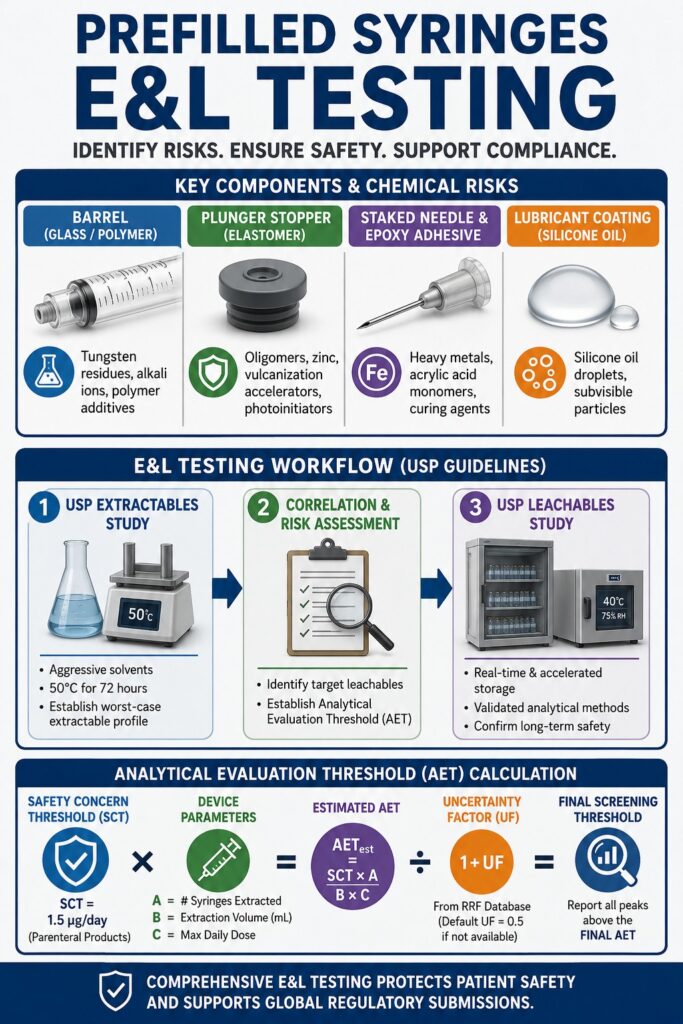
Prefilled syringes are sophisticated combination products composed of multiple interacting components, including the syringe barrel, plunger stopper, staked needle, and lubricant coatings. Each component is manufactured from specialized materials that possess distinct chemical characteristics and may generate unique extractable compounds when exposed to pharmaceutical formulations. Consequently, every material contributes its own chemical risk profile involving polymer additives, elemental impurities, curing agents, lubricants, and other potential leachables.
┌────────────────────────────────────────────────────────────────────────┐
│                      Prefilled Syringe Assembly                       │
├─────────────────┬──────────────────┬─────────────────┬─────────────────┤
│ Barrel (Glass/  │ Plunger Stopper  │ Staked Needle   │ Lubricant Coating│
│   Polymer)      │ (Halobutyl/      │ & Epoxy Adhesive│ (Polydimethyl-   │
│                 │ Fluoropolymer)   │                 │ siloxane)        │
└────────┬────────┴────────┬─────────┴────────┬────────┴────────┬────────┘
         ▼                 ▼                  ▼                 ▼
   Tungsten residues,   Oligomers, zinc,   Heavy metals,       Silicone oil
   alkali ions, or      vulcanization      acrylic acid        droplets,
   polymer additives    accelerators,      monomers,           subvisible
                         photoinitiators    curing agents       particles
Syringe Barrels: Glass Versus Polymer Materials
For decades, Type I borosilicate glass has been considered the preferred material for parenteral packaging because of its exceptional gas and oxygen barrier properties and its long history of regulatory acceptance. Despite these advantages, glass barrels are associated with several potential concerns, including alkali ion leaching, glass delamination, and residual tungsten contamination resulting from the manufacturing process.
As an alternative, Cyclic Olefin Polymer (COP) syringes have gained widespread acceptance due to their superior mechanical durability, excellent dimensional precision, and elimination of tungsten residues and needle-mounting adhesives. These characteristics make COP an attractive option for many biologic and specialty pharmaceutical products.
However, COP is not without limitations. Compared with borosilicate glass, it exhibits lower resistance to oxygen permeation and introduces its own category of organic extractables, including polymer oligomers, phenolic antioxidants, ultraviolet stabilizers, and slip agents.
Discover low-leachables packaging material options by visiting our materials guide
Comparative Characteristics of Syringe Barrel Materials
| Material Property / Parameter | Borosilicate Glass (Type I) | Cyclic Olefin Polymer (COP) |
|---|---|---|
| Mechanical Integrity | Susceptible to breakage during filling, transportation, and clinical use | Excellent impact resistance with improved structural durability |
| Manufacturing Tolerances | Broader dimensional tolerances associated with glass-forming processes | Extremely precise tolerances achieved through injection molding |
| Gas and Oxygen Barrier | Outstanding barrier performance | Lower barrier performance with greater oxygen permeability |
| Tungsten Residues | Residual tungsten typically ranges from 50–500 ppb following manufacturing | Completely free of tungsten contamination |
| Needle Attachment | Generally requires epoxy acrylate adhesives or specialized dry needle technologies | Compatible with integrated Luer lock systems or adhesive-free designs |
| Primary Extractables | Sodium, calcium, boron, aluminum, and tungsten | Polymer oligomers, antioxidants, UV stabilizers, and processing additives |
Elastomeric Plunger Stoppers and Closure Components
Plunger stoppers and tip caps are commonly manufactured using elastomeric materials such as chlorobutyl or bromobutyl rubber. These elastomers are formulated with curing agents, vulcanization accelerators, antioxidants, and plasticizers to achieve the desired mechanical performance. Without protective surface treatments, these rubber components can release zinc, sulfur-containing compounds, and low-molecular-weight rubber oligomers directly into the pharmaceutical formulation.
To reduce chemical migration, many manufacturers apply fluoropolymer barrier coatings to elastomeric components. Although these coatings substantially decrease extractable levels, continuous movement of the plunger during storage may still promote the migration of residual uncured monomers and oligomeric species into the drug product.
To improve analytical consistency, the United States Pharmacopeia (USP) has introduced Rubber Oligomer Analytical Reference Materials (ARMs) that enable laboratories to standardize the identification and quantification of elastomer-derived leachables.
Staked Needles and Mounting Adhesives
In prefilled syringe systems equipped with permanently attached (staked) needles, the needle assembly is typically fabricated from stainless steel. Over time, this material may release trace quantities of transition metals such as iron, chromium, nickel, and cobalt into the drug formulation.
An even greater chemical concern originates from the photocurable epoxy acrylate adhesive used to bond the needle to the glass cone. This adhesive can contain residual acrylic acid monomers, photoinitiators such as isopropylthioxanthone, curing catalysts, and other low-molecular-weight compounds.
During long-term stability storage, these residual compounds may gradually migrate into the formulation, where they have the potential to interact chemically with the active pharmaceutical ingredient (API), potentially causing degradation, instability, or reduced product performance.
Learn how ICP-MS is utilized for metal detection by visiting our elemental analysis resource
Lubricant Coatings (Silicone Oil)
Polydimethylsiloxane, commonly known as silicone oil, is applied to the interior surface of the syringe barrel and the plunger stopper to reduce break-loose and glide forces during injection. Proper lubrication ensures smooth syringe operation during both manual administration and auto-injector use.
Despite these functional benefits, silicone oil can migrate into aqueous drug formulations, particularly when formulations contain nonionic surfactants such as Polysorbate 20, Polysorbate 80, or Poloxamer 188.
Migrated silicone oil may form free-floating subvisible emulsion droplets that are detected as particulate matter during quality testing. These droplets can also serve as nucleation sites for therapeutic protein aggregation, presenting an additional risk for biologic products.
Modern siliconization technologies, including baked-on silicone emulsions, significantly reduce the amount of free silicone oil present within the syringe and may lower the free silicone burden to less than 10% of that observed with conventional spray siliconization techniques.
Find specific E&L testing solutions for autoinjectors by visiting our autoinjector testing page
Standardizing Extractables & Leachables (E&L) Testing Services for Prefilled Syringes Under USP Guidelines
Regulatory compliance for prefilled syringes is achieved through the sequential implementation of USP extractables studies followed by USP leachables studies. Together, these complementary evaluations establish the complete chemical risk profile of packaging materials while confirming the actual migration of chemical compounds under intended storage conditions.
[USP Extractables Study]
   • Aggressive aqueous and organic extraction solvents
   • Elevated temperatures (for example, 50°C for 72 hours)
   • Establishes the worst-case extractable profile

              │
              ▼

[Correlation and Risk Assessment]
   • Identifies target leachable compounds
   • Establishes the Analytical Evaluation Threshold (AET)

              │
              ▼

[USP Leachables Study]
   • Real-time and accelerated stability storage
   • Product-specific validated analytical methods
   • Confirms long-term safety of the commercial formulation
USP: Controlled Extractables Studies
Controlled extractables studies are designed to characterize the complete inventory of chemical compounds that may be released from syringe components before contact with the pharmaceutical product. Individual syringe materials are exposed to multiple solvent systems representing a broad range of chemical polarities under deliberately aggressive extraction conditions.
A typical extraction protocol includes three solvent categories:
- Acidic aqueous medium: Water adjusted to pH 2.0–2.5.
- Alkaline aqueous medium: Water adjusted to pH 9.5–10.0.
- Organic or semi-polar medium: Isopropanol (IPA), hexane, or ethanol-water mixtures such as 50:50 ethanol/water.
Extraction may be performed using sonication, reflux, or sealed-vessel thermal extraction, typically at 50°C for approximately 72 hours.
Before extraction begins, analytical laboratories perform feasibility studies to verify that selected solvents do not chemically degrade or physically dissolve the polymeric materials. This precaution prevents the generation of artificial degradation products that could produce misleading analytical results.
The extractables profile generated during USP studies serves as the scientific foundation for designing the subsequent product-specific leachables evaluation.
Review best practices for selecting solvents for extractables studies by visiting our solvent guide
USP: Leachables and Stability Testing
Leachables studies determine which compounds actually migrate from syringe components into the finished pharmaceutical product during its intended shelf life. Unlike extractables testing, these studies use the commercial drug formulation under actual storage conditions.
Testing is typically performed under recommended storage temperatures, such as 2–8°C or 25°C, together with accelerated stability conditions of 40°C at 75% relative humidity.
Samples are analyzed at predetermined stability intervals, commonly 0, 3, 6, 12, and 24 months, allowing laboratories to establish migration kinetics throughout the product’s shelf life.
Comparison of USP Extractables and USP Leachables Studies
| Parameter | USP Extractables Study | USP Leachables Study |
| Primary Objective | Identify every potential chemical extractable from packaging components | Quantify actual patient exposure within the final formulation |
| Test Matrix | Standardized polar, semi-polar, and non-polar solvents | Commercial drug formulation |
| Exposure Conditions | Aggressive laboratory extraction, such as 50°C for 72 hours | Real-time and accelerated stability storage |
| Typical Study Duration | Approximately 8–12 weeks, including method development | Typically 3–12 months alongside stability studies |
| Analytical Strategy | Non-targeted chemical screening | Validated targeted quantitative analysis |
Read about monitoring leachables during stability studies by visiting our stability testing resource
Single-Use Systems (SUS) and Manufacturing Equipment-Related Leachables
Chemical risk assessment extends beyond the primary container closure system. Single-use systems (SUS) and fill-finish manufacturing equipment may also introduce leachable compounds into pharmaceutical products. Common sources include silicone tubing, disposable mixing bags, sterilizing filters, and connector assemblies.
Under USP guidance and recommendations from the Bio-Process Systems Alliance (BPSA), manufacturers are expected to evaluate process equipment-related leachables (PERLs) as part of an overall E&L risk assessment strategy.
Recent regulatory inspections demonstrate that agencies such as the FDA increasingly issue observations when sponsors fail to provide adequate E&L data for manufacturing process components. Consequently, laboratories must evaluate hold times, flushing procedures, and manufacturing workflows to demonstrate that processing operations do not introduce chemical contaminants exceeding established safety limits.
Analytical Instrumentation for Extractables & Leachables (E&L) Testing Services for Prefilled Syringes
Comprehensive identification and quantification of trace-level organic and inorganic impurities require the use of multiple complementary analytical technologies, including GC-MS, high-resolution LC-MS, and ICP-MS. Because pharmaceutical formulations often contain complex mixtures of active ingredients, buffers, surfactants, and excipients, laboratories must employ highly sensitive validated analytical methods capable of detecting contaminants at parts-per-billion (ppb) concentrations.
Understand the technical comparison between GC-MS and LC-MS for E&L testing by visiting our analytical methods comparison page
Volatile Organic Compounds (VOCs)
Volatile compounds, including residual solvents and low-molecular-weight siloxanes, are analyzed using Headspace Gas Chromatography-Mass Spectrometry (HS-GC-MS). During analysis, samples are heated in sealed vials to allow volatile compounds to partition into the headspace. The headspace gas is then transferred into the gas chromatograph, eliminating direct injection of the complex pharmaceutical matrix and improving analytical performance.
Semi-Volatile Organic Compounds (SVOCs)
Semi-volatile compounds such as phenolic antioxidants, phthalate plasticizers, and slip agents are commonly analyzed using Gas Chromatography-Mass Spectrometry (GC-MS) with direct liquid injection. Sample extracts are vaporized within a heated injector, separated on a capillary chromatographic column according to their boiling points and interactions with the stationary phase, and subsequently identified by mass spectrometry.
To improve quantitative accuracy when analyzing complex mixtures, laboratories maintain validated Relative Response Factor (RRF) databases that compare detector responses between analytes and internal standards at known concentrations. This strategy reduces dependence on surrogate standards while enhancing screening reliability.
Non-Volatile Organic Compounds (NVOCs)
Highly polar or high-molecular-weight compounds, including polymer oligomers, vulcanization accelerators, curing agents, and adhesive-derived photoinitiators, are analyzed using Ultra-High Performance Liquid Chromatography (UHPLC) coupled with High-Resolution Electrospray Ionization Tandem Mass Spectrometry (UHPLC-ESI-HRMS/MS).
For therapeutic protein formulations, direct extraction of organic leachables is often complicated by protein binding and significant matrix effects. To overcome these challenges, laboratories commonly employ pepsin enzymatic digestion before solvent extraction. This pretreatment degrades the protein matrix, allowing efficient recovery and analysis of trace organic leachables at low parts-per-million concentrations.
Inorganic and Elemental Impurities
Elemental leachables, including transition metals released from stainless steel needles and silicon- or boron-derived species originating from glass barrels, are quantified using Inductively Coupled Plasma Mass Spectrometry (ICP-MS).
ICP-MS provides highly sensitive multielement analysis at ultra-trace concentrations and remains the preferred analytical technique for demonstrating compliance with ICH Q3D requirements governing elemental impurities.
What Is the Mathematical and Toxicological Framework for Calculating the Analytical Evaluation Threshold (AET)?
The Analytical Evaluation Threshold (AET) is a scientifically established concentration limit derived from the Safety Concern Threshold (SCT). Chemical species that migrate below this threshold generally do not require additional toxicological assessment. Establishing an appropriate AET is fundamental to an effective Extractables & Leachables (E&L) program because it minimizes the likelihood of false-negative results while ensuring that analytical efforts remain focused on compounds with genuine toxicological significance.
Learn how the Analytical Evaluation Threshold (AET) is derived for E&L studies by visiting our AET methodology guide
[Determine Safety Concern Threshold (SCT)]
   • SCT = 1.5 µg/day for parenteral products
             │
             ▼
[Collect Device Parameters]
   • A = Number of syringes extracted
   • B = Extraction solvent volume (mL)
   • C = Maximum daily clinical dose
             │
             ▼
[Calculate Estimated AET]
   • AETestimated = (SCT × A) / (B × C)
             │
             ▼
[Apply Uncertainty Factor]
   • Assess method-specific RRF database
   • Final AET = AETestimated / (1 + UF)
             │
             ▼
[Final Screening Threshold]
   • Identify and report all chromatographic peaks above the final AET
Read about the toxicological qualification of leachables by visiting our toxicological assessment page
Deriving the Estimated AET
For Parenteral Drug Products (PDPs), the Product Quality Research Institute (PQRI) recommends a Safety Concern Threshold (SCT) of 1.5 µg/day per patient. The estimated Analytical Evaluation Threshold (AET), expressed in µg/mL or µg/g, is determined using the following equation:
[
\text{AET}_{\text{estimated}}=\frac{\text{SCT}\times A}{B\times C}
]
Where:
- SCT = Safety Concern Threshold (1.5 µg/day)
- A = Number of prefilled syringe devices extracted to prepare the analytical sample
- B = Total extraction solvent volume (mL)
- C = Maximum number of prefilled syringes administered per patient each day according to the approved clinical labeling
This mathematical model enables laboratories to establish a scientifically justified reporting threshold that reflects actual patient exposure while maintaining consistency across E&L studies.
Integrating Analytical Uncertainty
Analytical methods inherently exhibit variability in chromatographic response factors (RFs) among different chemical compounds. To minimize the possibility of false-negative results caused by these response differences, the estimated AET is adjusted using an Uncertainty Factor (UF).
The final Analytical Evaluation Threshold is calculated as:
[
\text{AET}{\text{final}}=\frac{\text{AET}{\text{estimated}}}{1+\text{UF}}
]
The Uncertainty Factor (UF) is statistically derived from the standard deviation and relative standard deviation (%RSD) of Relative Response Factors (RRFs) established within a validated chemical reference database.
According to PQRI recommendations, when a laboratory-specific RRF database is unavailable, a default uncertainty factor of 50% (UF = 0.5) is applied. This conservative adjustment effectively lowers the reporting threshold, increasing analytical sensitivity and reducing the likelihood of overlooking toxicologically relevant compounds.
Ensure your data meets regulatory standards by reviewing our data integrity protocols
Special Considerations: mAET and the Cohort of Concern
The conventional AET calculation is not directly applicable to elemental impurities because traditional dose-based threshold models do not adequately account for inorganic toxicological profiles. Consequently, laboratories determine a metal-specific Analytical Evaluation Threshold (mAET) using Dose-Based Thresholds (DBTs) established under ICH Q3D. This approach allows elemental contaminants to be evaluated using toxicological criteria specifically developed for metallic impurities.
Similarly, the standard AET framework does not apply to chemicals classified within the Cohort of Concern, including:
- N-nitrosamines
- Polycyclic aromatic hydrocarbons (PAHs)
- Alkylating agents
Because these substances possess exceptionally high mutagenic potential, they require highly sensitive targeted analytical methods capable of detecting concentrations substantially below the standard calculated AET.
What Are the Critical Case Studies in Biotherapeutic Stability and Protein Aggregation?
Biologic drug products stored in prefilled syringes are particularly susceptible to protein aggregation induced by packaging-derived contaminants. Residual tungsten compounds and silicone oil-water interfaces represent two of the most significant contributors to chemically induced protein instability. Owing to the highly complex tertiary and quaternary structures of biotherapeutics, even minimal interactions with packaging-derived leachables can trigger conformational changes, reduce biological activity, or increase immunogenicity.
Case Study 1: Residual Tungsten-Induced Protein Aggregation
During the manufacturing of glass prefilled syringes, tungsten pins are used at temperatures ranging from 800°C to 1200°C to form the syringe cone and fluid channel. This manufacturing process leaves trace deposits of tungsten trioxide (WO₃) on the inner surface of the syringe tip.
When low-pH biologic formulations, including certain monoclonal antibodies, are filled into these syringes, residual tungsten can dissolve and polymerize, generating polyoxoanionic tungstate complexes according to the following reaction:
[
nWO_4^{2-}+2nH^+\rightleftharpoons[W_nO_{3n+1}]^{2-}+nH_2O
]
These negatively charged tungstate polymers interact with positively charged domains on therapeutic proteins, disrupting the proteins’ electrostatic balance. This interaction destabilizes their native tertiary structure, ultimately promoting rapid aggregation and precipitation.
To assess this risk, analytical laboratories perform dedicated tungsten extraction studies. Syringes are extracted using 0.5% ammonium hydroxide (pH 11) together with elevated temperatures of 75°C and ultrasonic treatment. This extraction procedure achieves efficiencies exceeding 90%, allowing trace tungsten concentrations to be accurately quantified by ICP-MS using an iridium internal standard. The analytical method routinely achieves a detection limit of 0.05 µg/L.
Case Study 2: Silicone Oil Droplet Emulsification and Capillary Forces
Silicone oil is routinely applied to the internal surface of glass syringe barrels to reduce injection forces and improve syringe performance. However, under long-term storage conditions, portions of the silicone coating may detach from the glass surface and migrate into the drug formulation, forming subvisible silicone oil droplets.
The presence of nonionic surfactants, particularly Polysorbate 80, significantly accelerates this migration process by lowering interfacial tension and promoting emulsification. Once dispersed, therapeutic proteins adsorb onto the hydrophobic silicone oil-water interface, producing multilayer protein coatings according to the following mechanism:
[
\text{Protein (aq)}+\text{Silicone Oil (droplet)}
\rightleftharpoons
\text{Adsorbed Protein Layer}
\xrightarrow{\text{Agitation}}
\text{Subvisible Particle Aggregate}
]
Transportation and routine product handling introduce continuous rotational and vibrational forces that generate air bubbles inside the syringe. These bubbles create a three-phase interface consisting of silicone oil, water, and air. Capillary forces acting at this interface pull silicone oil droplets together with associated protein aggregates into the bulk solution, producing stable subvisible protein-silicone complexes.
To investigate these interactions, laboratories employ localized Nuclear Magnetic Resonance (NMR) spectroscopy. The resulting spectra demonstrate characteristic line broadening as therapeutic proteins approach the silicone interface, indicating reduced molecular mobility and conformational changes associated with hydrophobic surface adsorption.
How Are E&L Evaluations Integrated into Lifecycle Management and Regulatory Submissions?
Successful integration of Extractables & Leachables (E&L) evaluations into product lifecycle management requires proactive risk assessment, comprehensive stability programs, and detailed regulatory documentation. Rather than viewing E&L testing as a final regulatory requirement, manufacturers should incorporate chemical characterization strategies early in product development to minimize regulatory delays and reduce long-term development risks.
[Early Development]
   • Collect supplier material certificates
   • Review historical E&L data
             │
             ▼
[Investigational Submission]
   • Complete controlled USP extractables studies
   • Perform in silico toxicological assessments
             │
             ▼
[Commercial Approval]
   • Validate product-specific leachable methods
   • Complete real-time USP stability studies
             │
             ▼
[Post-Approval Lifecycle]
   • Conduct change control assessments
   • Perform equivalency studies following material or supplier modifications
Developing a Comprehensive Regulatory Strategy
Regulatory agencies including the FDA, EMA, and China’s NMPA expect manufacturers to demonstrate that packaging systems and drug delivery devices are safe, compatible with the pharmaceutical product, and incapable of introducing harmful chemical contaminants. These expectations are reflected in standards such as USP, ISO 10993, and the draft ICH Q3E guideline.
An effective regulatory strategy should include the following key elements:
Compendial Screening
Confirm that all packaging materials comply with applicable pharmacopeial standards, including relevant USP chapters governing plastic materials and elastomeric closures. Early verification of material compliance establishes a strong foundation for subsequent E&L evaluations.
In Silico Toxicological Assessment
Use validated computational toxicology platforms, including software such as Derek or Sarah, to evaluate potential extractable compounds for mutagenic, genotoxic, sensitization, and other toxicological concerns. These predictive assessments help prioritize analytical testing while reducing dependence on animal studies.
Change Control and Post-Approval Lifecycle Management
Under ICH Q12, any modification involving container closure components, adhesives, label inks, packaging materials, or manufacturing processes requires a formal risk assessment. Whenever changes have the potential to alter patient exposure or modify the established leachable profile, sponsors should perform equivalency studies demonstrating that the revised materials do not introduce additional chemical risks.
Conclusion
Implementing comprehensive Extractables & Leachables (E&L) Testing Services for Prefilled Syringes remains an essential requirement for achieving regulatory approval and protecting patient safety. The complex multi-material construction of prefilled syringe systems introduces numerous potential sources of chemical migration, including adhesive-derived organic monomers, transition metals, polymer additives, and silicone oil microemulsions. Successfully addressing these challenges requires structured, science-based testing programs developed in accordance with applicable USP standards and PQRI recommendations.
For general information on E&L testing costs, visit our pricing overview page
To maintain development timelines and reduce the likelihood of regulatory setbacks, pharmaceutical and biopharmaceutical organizations should work with experienced, cGMP-compliant analytical laboratories. ResolveMass Laboratories Inc. provides validated analytical methodologies, comprehensive toxicological assessments, and regulatory documentation designed to support successful global submissions.
Learn more about specialized E&L testing for inhalation and nasal drug products by visiting our inhalation/nasal testing page
Organizations seeking expert guidance in developing customized Extractables & Leachables testing strategies for prefilled syringe products are encouraged to contact ResolveMass Laboratories Inc. to establish a comprehensive testing program tailored to their specific product and regulatory requirements.
Frequently Asked Questions (FAQs)
USP Extractables studies are designed to identify all potential chemical compounds that could be released from syringe components under aggressive laboratory extraction conditions. In contrast, USP Leachables studies determine which of those compounds actually migrate into the drug product during normal storage and stability testing. Together, these studies provide a comprehensive understanding of chemical risks associated with prefilled syringe systems and support regulatory compliance.
Transition metals may enter a drug formulation through prolonged contact with stainless steel needle assemblies and certain elastomeric components used in prefilled syringes. Metals such as iron, chromium, nickel, cobalt, zinc, and aluminum can gradually migrate under specific formulation conditions, particularly when the product contains acidic or reactive ingredients. Evaluating these elemental impurities is essential for maintaining product quality and patient safety.
Silicone oil migration occurs when the lubricant coating applied to the syringe barrel becomes destabilized during storage or handling. Nonionic surfactants commonly present in biologic formulations can reduce interfacial tension, making silicone droplets more likely to disperse into the drug solution. Factors such as shipping vibration, repeated plunger movement, and temperature fluctuations can further accelerate this migration and contribute to protein aggregation.
The Analytical Evaluation Threshold (AET) establishes a scientifically justified reporting limit based on toxicological safety principles and expected patient exposure. It ensures that chemical compounds present at potentially significant levels are identified, evaluated, and appropriately qualified before a product reaches patients. By focusing investigations on compounds above the calculated threshold, laboratories can efficiently prioritize impurities that may pose meaningful toxicological risks.
A combination of complementary analytical techniques is typically required to identify unknown organic leachables. Gas Chromatography-Mass Spectrometry (GC-MS) is commonly used for volatile and semi-volatile compounds, while Liquid Chromatography coupled with High-Resolution Tandem Mass Spectrometry (LC-MS/MS) is preferred for polar and non-volatile species. Using multiple analytical platforms enables comprehensive chemical characterization across a broad range of compound classes.
Photocurable epoxy adhesives used in staked-needle syringe assemblies may release residual monomers, photoinitiators, and curing agents into the drug product over time. These reactive compounds can interact with therapeutic proteins by altering their surface charge, structural stability, or molecular conformation. Such interactions may increase the likelihood of protein aggregation, reduce biological activity, or negatively impact overall product stability.
Although labeling inks and packaging adhesives do not directly contact the drug product, volatile compounds from these materials can migrate through semi-permeable polymer syringe barrels under certain storage conditions. Conducting a baseline extractables study helps identify these potential contaminants before commercialization. This evaluation supports comprehensive risk assessment and ensures that all possible sources of chemical migration are adequately controlled.
Biologic formulations contain high concentrations of proteins that can interfere with the extraction and analysis of migrated silicone oil. Pepsin enzymatic digestion breaks these complex proteins into smaller peptide fragments, significantly reducing matrix interference. This pretreatment improves extraction efficiency and enables more accurate quantification of silicone oil using sensitive chromatographic analytical methods.
The conventional AET calculation is based on toxicological data developed primarily for organic compounds and does not adequately account for the unique toxicity profiles of metals. For this reason, elemental impurities are evaluated using a metal-specific Analytical Evaluation Threshold (mAET) derived from the permitted daily exposure limits established in the ICH Q3D guideline. This approach provides a more appropriate and scientifically justified assessment of inorganic leachables.
Reference:
- Zeiss, Bernd (2022). Silicone-oil-free prefilled syringe systems: Guidance for selecting the appropriate packaging materials and for siliconization. Pharma Industrie, 84(8), 1021–1029. ResearchGate
- Gerhardt, A., McGraw, N. R., Schwartz, D. K., Bee, J. S., Carpenter, J. F., & Randolph, T. W. (2014). Protein aggregation and particle formation in prefilled glass syringes. Journal of Pharmaceutical Sciences, 103(6), 1601–1612. https://doi.org/10.1002/jps.23973
- Jenke, D. R. (2014). Extractables and leachables considerations for prefilled syringes. Expert Opinion on Drug Delivery, 11(10), 1591–1600. https://doi.org/10.1517/17425247.2014.928281
- U.S. Food and Drug Administration. (2023). Container closure systems for packaging human drugs and biologics: Chemistry, manufacturing, and controls documentation (Guidance for Industry). U.S. Department of Health and Human Services. https://www.fda.gov/media/168951/download
- U.S. Pharmacopeia. (n.d.). Extractables and leachables. https://www.usp.org/impurities/extractables-and-leachables
- U.S. Food and Drug Administration. (2025). Q3E guideline for extractables and leachables: Draft guidance for industry. U.S. Department of Health and Human Services. https://www.fda.gov/media/189890/download
- Gerhardt, A., McGraw, N. R., Schwartz, D. K., Bee, J. S., Carpenter, J. F., & Randolph, T. W. (2014). Protein aggregation and particle formation in prefilled glass syringes. Journal of Pharmaceutical Sciences, 103(6), 1601–1612. https://doi.org/10.1002/jps.23973
Get In Touch With Us
About The Author


