
Introduction
Scale-Up and Tech Transfer in CMC represents a critical operational pathway through which bench-scale drug formulation and synthesis are transformed into fully validated, commercial-scale pharmaceutical manufacturing processes. Successful implementation requires maintaining consistent Quality Target Product Profiles (QTPP) and Critical Quality Attributes (CQAs) as processing volumes increase substantially, progressing from milligram-scale development batches to multi-kilogram active pharmaceutical ingredient (API) synthesis or multi-thousand-liter bioprocessing campaigns.
Within Chemistry, Manufacturing, and Controls (CMC), transferring a drug candidate across different operational scales involves considerably more than simply increasing manufacturing volumes. It is an integrated scientific, regulatory, and engineering discipline. Scaling individual unit operations can significantly influence fluid dynamics, thermodynamic transfer rates, mechanical shear stress, and analytical measurement dynamics. Therefore, successful technology transfer depends on structured knowledge management, mathematical scaling models, Quality by Design (QbD) principles, and comprehensive Quality Risk Management (QRM) practices. Industry organizations such as ResolveMass Laboratories Inc. address these physical and regulatory complexities through the application of empirical physics, risk-based technology transfer packages, and harmonized global compliance standards.
Effective pharmaceutical development and manufacturing require a coordinated approach to CMC services that supports quality and regulatory requirements throughout the product lifecycle.
Share via:
Quick Summary:
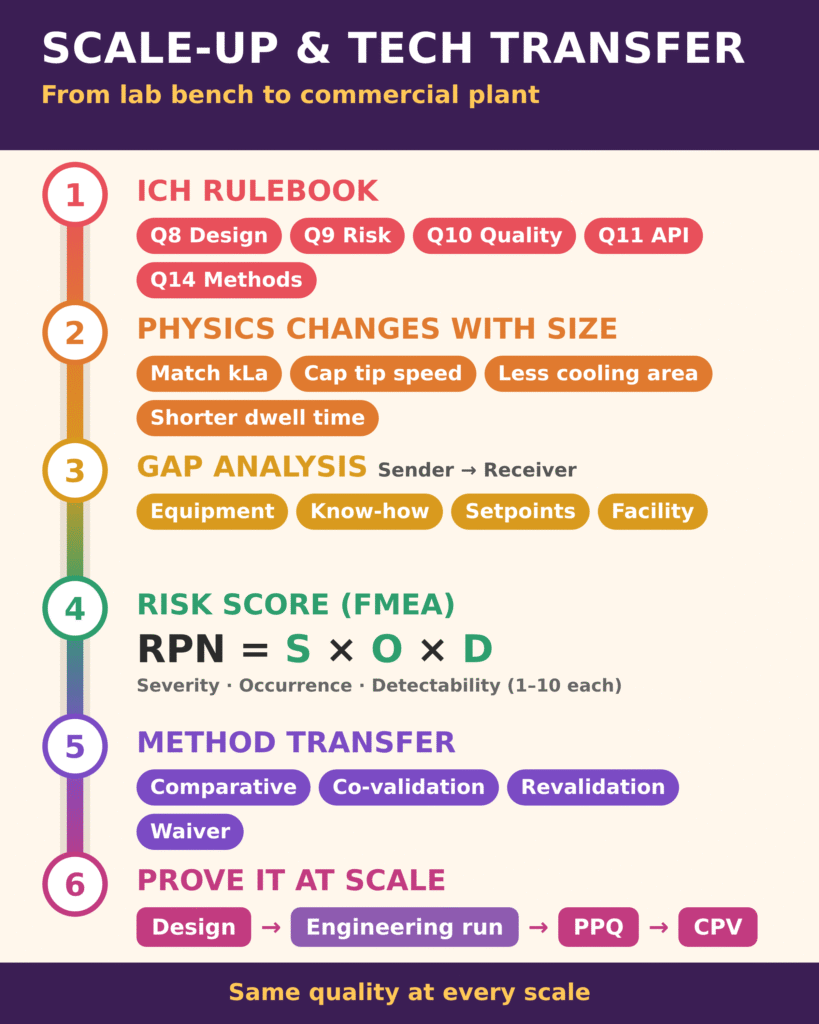
- What it is: Scale-up and tech transfer turns a drug process that works at lab scale into a validated commercial process. The QTPP and CQAs must stay the same as volumes grow.
- Regulatory backbone: ICH Q8(R2) covers development, design space and CPPs, Q9(R1) covers risk management, and Q10 covers the quality system and site transfers. Q11 addresses drug substance, while Q14 and Q2(R2) govern analytical methods.
- Physics changes with size: Bioreactors must keep the same oxygen transfer (kLa) while holding impeller tip speed down to protect cells. In chemical reactors, heat output grows with volume but cooling area grows only with surface, so hot spots and impurities become a risk. Chromatography keeps bed height and flow speed constant, and tableting must deal with shorter dwell times on high-speed presses.
- Gap analysis: The sending and receiving sites are compared on equipment, undocumented know-how, setpoints and automation limits, and facility infrastructure.
- Risk scoring: Each gap goes through FMEA, where RPN = Severity × Occurrence × Detectability. High scores need mitigation, such as CFD studies, reaction calorimetry or line qualification.
- Analytical method transfer: The receiving QC lab qualifies the methods through comparative testing, co-validation, revalidation or a transfer waiver, and the control strategy is kept tied to the approved design space.
- Proving it at scale: Non-GMP engineering runs catch problems early. Validation then follows three stages: process design, process qualification through PPQ batches, and continued process verification using statistical monitoring.
Regulatory Frameworks Governing Scale-Up and Tech Transfer in CMC
Regulatory compliance throughout Scale-Up and Tech Transfer in CMC requires adherence to internationally recognized guidelines established by the International Council for Harmonisation (ICH), particularly ICH Q8(R2), Q9(R1), Q10, Q11, and Q14. These regulatory frameworks establish requirements for managing scale-dependent process parameter adjustments within predefined design spaces to maintain consistent end-product safety, identity, strength, purity, and quality.
ICH Quality Guidelines and Lifecycle Control Strategy
The regulatory lifecycle framework establishes a science-driven and risk-based foundation for pharmaceutical technology transfer and process development. ICH Q8(R2) addresses Pharmaceutical Development and provides the framework for establishing Quality Target Product Profiles (QTPP), identifying Critical Quality Attributes (CQAs), and determining Critical Process Parameters (CPPs).
ICH Q9(R1) outlines Quality Risk Management (QRM) methodologies, including Failure Mode and Effects Analysis (FMEA), to systematically assess variables that may change during manufacturing scale-up. ICH Q10 establishes the expectations for a Pharmaceutical Quality System (PQS), including the management of manufacturing site transfers, deviation controls, and continuous improvement throughout the product lifecycle.
Additional regulatory guidance is provided through ICH Q11, which addresses drug substance development and manufacturing. Meanwhile, ICH Q14 and Q2(R2) establish specific expectations for analytical procedure development, analytical method validation, and the transfer of analytical procedures between different Quality Control (QC) facilities.
| Regulatory Guideline | Technical Focus Area | Mandate for Scale-Up & Technology Transfer |
|---|---|---|
| ICH Q8(R2) | Pharmaceutical Development | Establishes QTPP, CQAs, CPPs, and Design Space boundaries across different manufacturing scales. |
| ICH Q9(R1) | Quality Risk Management | Defines systematic assessment tools (FMEA, PHA) to evaluate and quantify risks associated with scale-dependent parameter changes. |
| ICH Q10 | Pharmaceutical Quality System | Establishes requirements for site-to-site transfer protocols, change control systems, and lifecycle product governance. |
| ICH Q11 | Drug Substance Development & Manufacture | Provides regulatory guidance for chemical synthesis and biological expression systems during process scaling. |
| ICH Q14 / Q2(R2) | Analytical Procedure & Validation Lifecycle | Establishes expectations for analytical method development, risk-based modifications, and transfer criteria across QC facilities. |
A well-structured regulatory strategy is particularly important when preparing early-stage clinical submissions. Organizations can strengthen their submission readiness through specialized IND CMC services that address chemistry, manufacturing, and quality documentation requirements.
Engineering Kinetics and Mathematical Modeling for Scale-Up and Tech Transfer in CMC
Engineering kinetics in Scale-Up and Tech Transfer in CMC depend on carefully established scale-up criteria derived from mass transfer, fluid dynamics, and thermodynamics. These principles help preserve comparable reaction micro-environments across manufacturing vessels with different operating volumes. Directly extrapolating laboratory-scale operating parameters to commercial manufacturing equipment frequently results in process inconsistencies or batch failures because physical conditions do not change proportionally with equipment size.
Bioreactor Aeration and Hydrodynamic Shear Kinetics
Scaling upstream bioprocessing from laboratory bioreactors, typically operating at 5 L, to commercial production vessels ranging from 2,000 L to 20,000 L requires carefully balancing oxygen mass transfer rates with the risk of cellular damage caused by hydrodynamic shear. The volumetric gas-liquid mass transfer coefficient (kLa) determines the availability of dissolved oxygen within the bioreactor. Its behavior can be described using empirical power-law relationships that incorporate volumetric power consumption (P/V) and superficial gas velocity (vs):
kLa = C × (P/V)α × (vs)β
In this equation, C, α, and β represent fluid dynamic constants specific to the system being evaluated.
Maintaining an equivalent kLa value at commercial manufacturing scale frequently requires adjustments to impeller agitation or sparging velocity. However, increasing these operating parameters can also intensify shear stress within the bioreactor. To minimize cell lysis and prevent undesirable changes in biological post-translational modifications, including variations in glycosylation profiles, the agitator tip speed (vt) must be accurately calculated and maintained within acceptable limits:
vt = π × N × D
Here, N represents the impeller rotational speed in revolutions per second, while D denotes the impeller diameter in meters.
Shear-sensitive mammalian expression systems generally require maximum tip speed limits within the range of 1.5 m/s to 3.0 m/s. In comparison, more robust microbial fermentation systems can tolerate higher tip speeds, reaching approximately 8.0 m/s.
Thermodynamic Modeling in Chemical API Synthesis
Scaling up small-molecule chemical synthesis requires careful management of heat removal rates as reaction volumes increase. Heat generation (qH) increases cubically with vessel volume (V ∝ D3), whereas the operational heat removal capacity (qR) through jacketed reactor walls increases according to the available surface area (A ∝ D2):
qR = U × A × ΔTlm
Where U represents the overall heat transfer coefficient, A denotes the heat exchange surface area, and ΔTlm represents the log-mean temperature difference.
As reactor dimensions increase, the surface-area-to-volume ratio (A/V) decreases considerably. This reduction can contribute to localized heat accumulation, undesirable side reactions, thermal degradation, and unexpected changes in impurity profiles.
During crystallization, controlled cooling rates, generally ranging from 0.5°C/hr to 2.0°C/hr, are necessary to maintain the desired crystal habit. Proper temperature management also helps minimize the risk of polymorphic transitions and excessive broadening of the Particle Size Distribution (PSD).
Maintaining consistent drug substance quality during manufacturing scale-up requires careful control of synthesis conditions and material characteristics. Comprehensive drug substance chemistry and manufacturing controls support the development of reliable manufacturing processes.
Downstream Separation and Solid Oral Dosage Scaling
Scaling preparative chromatography requires maintaining consistent bed height (H) and fluid linear velocity (u), while adjusting the column diameter (D) proportionally to accommodate changes in feed load:
Dcommercial = Dlab × √(Volcommercial / Vollab)
For solid oral dosage forms, scaling high-shear granulation and tableting operations requires adjustments to account for changes in dwell time and compression force ratios when transitioning to high-speed industrial tablet presses. As turret speeds increase, the available dwell time decreases. Without appropriate adjustments to feeder depth and pre-compression stages, these changes can contribute to tablet capping, lamination, and alterations in dissolution rates.
| Parameter / Metric | Lab Scale Baseline | Commercial Scale Operational Range | Primary Physical Risk Upon Scale-Up |
|---|---|---|---|
| Bioreactor Mass Transfer (kLa) | 30–50 hr⁻¹ (5 L Vessel) | Matched 30–50 hr⁻¹ (2,000 L Vessel) | CO₂ accumulation, pH drift, and cellular shear damage. |
| Agitator Tip Speed (vt) | 0.8–1.2 m/s | 1.8–2.8 m/s | Cell membrane disruption and changes in glycosylation patterns. |
| Heat Removal Capacity (A/V) | High (>20 m⁻¹) | Low (<3 m⁻¹) | Thermal runaway, impurity formation, and polymorphic drift. |
| Chromatography Linear Velocity | 150–300 cm/hr | Matched 150–300 cm/hr | Loss of resolution if bed height or velocity changes. |
| Tablet Press Dwell Time | 30–50 ms (Single-station) | 5–15 ms (Rotary press) | Tablet capping, hardness variations, and dissolution failure. |
Scale-dependent changes in reaction conditions can also affect impurity formation and product purity. Robust impurity profiling in CMC helps identify and characterize these changes throughout pharmaceutical process development.
Risk Management and Gap Analysis Protocols for Scale-Up and Tech Transfer in CMC
Risk management and gap analysis protocols in Scale-Up and Tech Transfer in CMC provide a systematic approach to identifying technical, equipment-related, and procedural differences between the Sending Unit (SU) and Receiving Unit (RU). Performing comprehensive assessments before initiating pilot-scale or engineering batches helps prevent unexpected quality deviations, manufacturing failures, and regulatory non-compliance.
Sending Unit to Receiving Unit Operational Alignment
Gap analysis involves examining differences in facility capabilities, equipment configurations, system geometries, automation infrastructure, and environmental controls between the sending and receiving manufacturing locations.
Operational gaps generally fall into four major categories:
Equipment Geometry Discrepancies: Differences in reactor aspect ratios, impeller design configurations, dryer conduction arrangements, or filtration surface-area-to-volume ratios can influence process performance and equipment functionality following technology transfer.
Missing Tacit Knowledge: Incomplete documentation of operational details, unrecorded laboratory observations, historical batch deviations, or insufficient information regarding raw material attribute sensitivities can create significant knowledge gaps. These missing details may affect the reproducibility of the transferred manufacturing process.
Boundary Conflicts: Differences between established setpoints and operational range limits in historical laboratory batch records and the automation systems used at the receiving manufacturing facility can create operational inconsistencies. These discrepancies may involve Distributed Control System (DCS) and Supervisory Control and Data Acquisition (SCADA) boundaries.
Facility Infrastructure and Environmental Gaps: Differences in cleanroom classifications under EU GMP Annex 1, Water for Injection (WFI) loop capacities, or the efficiency of automated Clean-in-Place (CIP) cycles can influence the receiving facility’s ability to reproduce the original manufacturing conditions.
Failure Mode and Effects Analysis Execution
Technical gaps identified during the assessment process are evaluated through Failure Mode and Effects Analysis (FMEA), following the principles established under ICH Q9. Multidisciplinary technical teams assign numerical scores ranging from 1 to 10 to three risk assessment parameters: Severity (S), Occurrence (O), and Detectability (D).
These scores are used to calculate the overall Risk Priority Number:
RPN = S × O × D
Potential failure modes associated with elevated RPN values require appropriate risk mitigation measures. Depending on the identified risks, these measures may involve implementing engineering controls, conducting scale-down experimental validation, or modifying operational protocols before commercial-scale manufacturing batches are initiated.
| Transfer Phase | Identified Technical Gap | High-Risk Failure Mode | Impacted Quality Metric | Engineering Mitigation Protocol |
|---|---|---|---|---|
| Upstream Processing | Impeller geometry mismatch (Pitch vs. Rushton) | Inefficient gas dispersion and inadequate mixing | Biomass yield and target protein expression | Conduct Computational Fluid Dynamics (CFD) studies and optimize the gas sparging strategy. |
| Chemical Synthesis | Reduced jacket heat exchange area | Localized thermal spikes during acid addition | Impurity profile escalation | Perform scale-down reaction calorimetry and introduce controlled, metered dosing. |
| Formulation & Fill | Tubing material substitution (Silicone vs. TPE) | Leachables interaction or protein adsorption | Drug potency and sub-visible particulate counts | Conduct an extractables/leachables risk assessment and establish material compatibility. |
| Finished Packaging | Increased automated line speed | Incomplete vial sealing or induction crimping | Container Closure Integrity (CCI) and sterility | Perform high-speed line qualification and thermal sealing mapping. |
Material compatibility assessments are especially important when manufacturing equipment or packaging components change during technology transfer. A structured extractables and leachables assessment helps evaluate potential chemical interactions and associated product quality risks.
Analytical Method Transfer and Lifecycle Control Strategies in Scale-Up and Tech Transfer in CMC
Analytical Method Transfer (AMT) and lifecycle control strategies in Scale-Up and Tech Transfer in CMC ensure that the Quality Control (QC) laboratory at the Receiving Unit produces reliable analytical results that are comparable to those generated by the Sending Unit. Analytical method performance is fundamental to successful manufacturing scale-up because product release testing and process validation activities depend on qualified and appropriately transferred analytical procedures.
Formal Pathways for Analytical Method Transfer
In accordance with ICH Q2(R2) and ICH Q14 frameworks, Analytical Method Transfer can be performed through one of four regulatory pathways. The appropriate approach is selected according to the analytical method’s complexity, associated risks, and the technical capabilities of the receiving laboratory.
Comparative Testing: This is the standard method transfer approach, in which the Sending Unit and Receiving Unit independently analyze identical split samples obtained from predefined batch lots using a single, pre-approved protocol. The acceptance criteria require evidence of statistical equivalence between the results generated by both laboratories. This may include demonstrating that the 95% confidence interval of the mean difference remains within the established analytical tolerance limits.
Co-Validation: This approach is implemented when the receiving laboratory participates directly in a multi-laboratory validation study alongside the sending laboratory. Both facilities generate analytical data simultaneously, allowing the assessment of intermediate precision and reproducibility across the participating laboratories.
Revalidation: Revalidation is performed when the receiving laboratory introduces changes to established analytical method parameters. Examples include modifications to stationary phase column chemistry, mobile phase gradients, or detection wavelengths. It may also be necessary when the historical validation documentation provided by the sending laboratory is incomplete or insufficient to support the transferred method.
Transfer Waivers: Transfer waivers may be considered when the receiving laboratory already possesses substantial experience with the specific analytical procedure and has access to identical instruments and equivalent sample matrices. This approach can be appropriate when existing documented evidence adequately demonstrates the receiving laboratory’s capability to perform the method reliably.
Analytical consistency across laboratories depends on appropriately developed, validated, and documented procedures. Specialized analytical method development for IND and NDA submissions supports reliable testing throughout the regulatory development lifecycle.
Maintaining Control Strategy Integrity Across Facilities
A comprehensive control strategy incorporates input material specifications, in-process controls (IPCs), Process Analytical Technology (PAT) tools, continuous process parameter monitoring, and finished product specifications.
During the scale-up of individual unit operations, material attributes can interact differently with larger manufacturing equipment. For example, variations in raw material particle size distribution or excipient moisture content may produce different processing outcomes when transferred from laboratory-scale equipment to larger commercial manufacturing machinery.
Maintaining the integrity of the established control strategy requires systematically linking variations in process parameters to the approved Design Space. This approach helps preserve the flexibility required for post-transfer manufacturing operations while ensuring that process adjustments remain within established regulatory boundaries and do not unnecessarily trigger major regulatory filings.
A clearly defined impurity control strategy in CMC further strengthens quality management by establishing appropriate monitoring, assessment, and mitigation measures for process-related impurities.
Engineering Runs, Validation, and Commercial Execution in Scale-Up and Tech Transfer in CMC
Engineering runs, validation protocols, and commercial execution in Scale-Up and Tech Transfer in CMC constitute the final verification activities required to establish manufacturing readiness before commercial product distribution. This stage marks the transition from pilot-scale process optimization to fully compliant commercial manufacturing under current Good Manufacturing Practice (cGMP) requirements.
Non-GMP Engineering Runs as Risk Mitigation
Non-GMP engineering runs function as full-scale operational trials intended to assess equipment suitability, evaluate master batch records, verify automated control sequences, and prepare manufacturing personnel for commercial production activities.
Conducting engineering batches under commercial manufacturing parameters allows technical teams to identify potential operational limitations before initiating formal commercial production. These issues may include pipe fouling, filter blinding, and thermal lag. Identifying such challenges during engineering runs helps prevent unnecessary risks to high-value cGMP materials and reduces the likelihood of initiating formal regulatory deviation investigations during subsequent manufacturing activities.
The information collected during engineering runs provides valuable empirical evidence for establishing the final Process Performance Qualification (PPQ) protocol parameter ranges. It also supports the verification of equipment performance, process reproducibility, and overall manufacturing readiness.
Collaborating with experienced CMC CRO service providers can support process development, technical execution, and manufacturing readiness across different stages of pharmaceutical development.
The Three-Stage Process Validation Lifecycle
Process validation follows a three-stage lifecycle model that aligns with regulatory expectations established by the FDA, EMA, and ICH Q10 guidelines. Each stage serves a distinct purpose in demonstrating that the manufacturing process is appropriately designed, consistently reproducible, and maintained within a state of control throughout routine commercial production.
Stage 1: Process Design
The first stage involves developing and defining the commercial manufacturing process using accumulated developmental knowledge, Quality by Design (QbD) parameters, Design Space mapping, and comprehensive risk assessments. This stage establishes the scientific and technical foundation required for manufacturing scale-up and subsequent process qualification.
Stage 2: Process Qualification
The second stage demonstrates that the established process design can consistently deliver reproducible results at commercial manufacturing scale. This phase culminates in the execution of Process Performance Qualification (PPQ) batches under full cGMP conditions.
Although historical regulatory guidance commonly referenced three consecutive validation batches, contemporary risk-based approaches emphasize determining the appropriate number of PPQ batches according to process complexity, manufacturing variability, and the overall depth of available process knowledge.
Stage 3: Continued Process Verification (CPV)
The final stage involves maintaining continuous assurance throughout routine commercial manufacturing that the process remains in a validated and controlled state. Continued Process Verification (CPV) uses statistical process control (SPC) tools to monitor trends in Critical Process Parameters (CPPs), in-process controls (IPCs), and Critical Quality Attributes (CQAs).
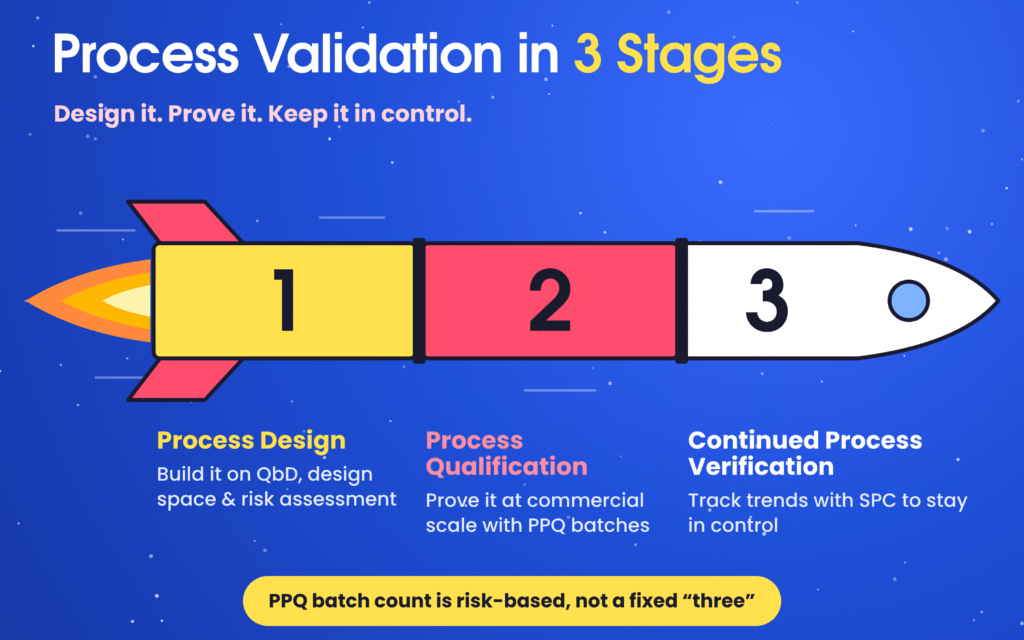
Regular evaluation of these parameters helps identify emerging process variations, detect potential deviations, and support proactive continuous improvement throughout the commercial product lifecycle.
Conclusion: Driving Excellence in Scale-Up and Tech Transfer in CMC
Successfully implementing Scale-Up and Tech Transfer in CMC is essential for transforming early-stage scientific discoveries into scalable, commercially viable therapeutics. Integrating fluid dynamics, thermodynamic heat transfer principles, Quality by Design frameworks, and structured Quality Risk Management methodologies enables pharmaceutical originators and manufacturing partners to preserve critical product quality attributes while increasing production capacity.
Comprehensive gap analyses, formal analytical method transfer procedures, and well-defined process validation lifecycles contribute to manufacturing consistency and long-term operational reliability. These practices also strengthen regulatory compliance and support the consistent production of high-quality pharmaceutical products, ultimately helping ensure patient access to safe and effective medicines.
For guidance from scientific specialists on advanced process scale-up modeling, analytical method transfers, and CMC lifecycle technical strategies, connect with the experienced team at ResolveMass Laboratories Inc.
Contact ResolveMass Laboratories Inc.
Frequently Asked Questions (FAQs)
FDA and EMA guidelines do not prescribe a universally fixed number of three validation batches. The number of Process Performance Qualification (PPQ) batches should be scientifically justified using process knowledge, risk assessments, and historical manufacturing data. Nevertheless, three consecutive successful commercial-scale cGMP batches remain a widely recognized industry practice.
Non-GMP engineering batches allow manufacturers to evaluate commercial-scale equipment and operational procedures before beginning formal cGMP production. They help verify automation systems, batch documentation, material handling procedures, and operator readiness. Identifying equipment-related or process-related problems at this stage reduces the likelihood of costly manufacturing failures during qualification.
Quality by Design (QbD) establishes a scientific understanding of how manufacturing parameters influence Critical Quality Attributes. It defines an acceptable Design Space within which process adjustments can be made without compromising established product quality requirements. This framework provides manufacturing flexibility when transferring processes between facilities with different equipment configurations.
Insufficient transfer of tacit knowledge is a major contributor to pharmaceutical technology transfer failures. Important operational details, including equipment-specific observations, laboratory findings, and process parameter sensitivities, may not be adequately captured in formal documentation. Without effective communication and collaboration between sending and receiving teams, these knowledge gaps can result in manufacturing inconsistencies.
Preparative chromatography columns are scaled by maintaining consistent bed height and mobile phase linear velocity while increasing the column’s inner diameter according to the required processing capacity. This approach helps preserve comparable flow conditions, sample residence times, and interactions between the sample and resin matrix. Maintaining these parameters supports consistent separation performance across different manufacturing scales.
The volumetric gas-liquid mass transfer coefficient (kLa) is a critical parameter governing oxygen transfer during bioreactor scale-up. It determines how efficiently oxygen moves from the gas phase into the culture medium. Engineers optimize power input per unit volume (P/V), gas sparging rates, and agitator tip speed to achieve the required oxygen availability while limiting excessive shear stress and cellular damage.
A complete Technology Transfer Package (TTP) contains the scientific, technical, and quality documentation necessary to reproduce a manufacturing process at the receiving facility. Important components include the Quality Target Product Profile (QTPP), process flow diagrams, bill of materials, Critical Quality Attribute matrices, Critical Process Parameter ranges, development reports, FMEA assessments, analytical method protocols, and raw material specifications. These documents establish a consistent reference for manufacturing execution and quality oversight.
Analytical Method Transfer involves testing identical split samples at both the Sending Unit and Receiving Unit under a predefined, approved protocol. The resulting analytical data are compared against established statistical acceptance criteria to demonstrate equivalence between the laboratories. Depending on the method and transfer design, assessments may include mean difference evaluations, intermediate precision, and two one-sided t-tests (TOST).
Continued Process Verification (CPV) represents Stage 3 of the process validation lifecycle and focuses on monitoring manufacturing performance during routine commercial production. Statistical Process Control (SPC) tools are used to evaluate trends in Critical Process Parameters (CPPs), in-process controls, and finished product quality attributes. This ongoing assessment helps identify process variations at an early stage, allowing manufacturers to investigate potential issues and implement corrective measures before product quality is affected.
Reference:
- Van Buskirk, G. A., Asotra, S., Balducci, C., Basu, P., DiDonato, G., Dorantes, A., Eickhoff, W. M., Ghosh, T., González, M. A., Henry, T., Howard, M., Kamm, J., Laurenz, S., MacKenzie, R., Mannion, R., Noonan, P. K., Ocheltree, T., Pai, U., Poska, R. P., … Thombre, A. G. (2014). Best practices for the development, scale-up, and post-approval change control of IR and MR dosage forms in the current quality-by-design paradigm. AAPS PharmSciTech, 15(3), 665–693. https://doi.org/10.1208/s12249-014-0087-x
- International Council for Harmonisation of Technical Requirements for Pharmaceuticals for Human Use. (2026, May). ICH Q8, Q9, and Q10 questions and answers (R5): Guidance for industry. U.S. Food and Drug Administration, Center for Drug Evaluation and Research & Center for Biologics Evaluation and Research. https://www.fda.gov/media/78668/download
- International Council for Harmonisation of Technical Requirements for Pharmaceuticals for Human Use. (2011, December 6). ICH-endorsed guide for ICH Q8/Q9/Q10 implementation: Points to consider (R2). https://database.ich.org/sites/default/files/Q8_Q9_Q10_Q%26As_R4_Points_to_Consider_2.pdf
- International Council for Harmonisation of Technical Requirements for Pharmaceuticals for Human Use. (2008, June 4). ICH Q10: Pharmaceutical quality system. European Medicines Agency. https://www.ema.europa.eu/en/documents/scientific-guideline/international-conference-harmonisation-technical-requirements-registration-pharmaceuticals-human-guideline-q10-pharmaceutical-quality-system-step-5_en.pdf
- International Council for Harmonisation of Technical Requirements for Pharmaceuticals for Human Use. (n.d.). ICH Q8, Q9 and Q10 questions and answers. European Medicines Agency. https://www.ema.europa.eu/en/scientific-guidelines/ich-q8-q9-q10-questions-answers
Get In Touch With Us
About The Author