

Introduction
Container Closure System Selection and Qualification for generic parenteral drug products involves the systematic evaluation and validation of primary packaging components, including vials, stoppers, seals, and prefilled syringes, to ensure product sterility, chemical compatibility, and therapeutic stability throughout the commercial shelf life. Implementing this process within a Contract Development and Manufacturing Organization (CDMO) requires integration of analytical characterization, high-speed manufacturing line machinability, and regulatory dossier preparation for an Abbreviated New Drug Application (ANDA) submission. Because sterile injectable products present a particularly high risk of packaging-related patient harm, regulatory authorities subject container closure documentation to rigorous technical evaluation.
Generic drug developers are not legally obligated to use a primary packaging configuration that is identical to that of the Reference Listed Drug (RLD). However, any proposed alternative configuration must provide equivalent or superior protection, material safety, compatibility, and drug-delivery performance without adversely affecting the drug product’s safety profile or labeled conditions of use. Demonstrating this level of equivalence requires structured collaboration between generic drug sponsors and CDMOs to align physical component specifications with manufacturing line machinability, extractable and leachable safety thresholds, and validated deterministic integrity testing.
Explore CDMO Capabilities: 👉 Learn how to select the right CDMO partner in the US for your packaging and development needs
Share via:
Quick Summary:
- Container closure system (CCS) selection ensures sterility, chemical compatibility, stability, and safe drug delivery throughout the product shelf life.
- Regulatory compliance requires alignment with FDA guidance and key USP chapters, especially for elastomeric closures, glass/plastics, package integrity, E&L, and biological reactivity.
- Material selection should consider formulation pH, light sensitivity, oxidation, and interaction risks; options include Type I glass, COP/COC polymers, and coated bromobutyl/chlorobutyl elastomers.
- Extractables & Leachables (E&L) studies combine controlled extraction with real-time leachables monitoring using GC-MS, LC-MS/MS, and ICP-MS to assess patient safety.
- Deterministic CCIT provides quantitative, reproducible package-integrity testing using methods such as vacuum decay, HVLD, laser headspace analysis, and helium mass spectrometry.
- CDMO manufacturing qualification must demonstrate high-speed machinability, proper stopper/crimp sealing, siliconization control, component sterilization, and three-stage process validation.
- ANDA/eCTD Module 3 documentation must integrate CCS development, specifications, E&L and CCIT data, vendor DMFs, exhibit batches, and stability results to demonstrate packaging suitability and reduce regulatory risk.
Regulatory Architecture and Compendial Framework for Container Closure System Selection and Qualification
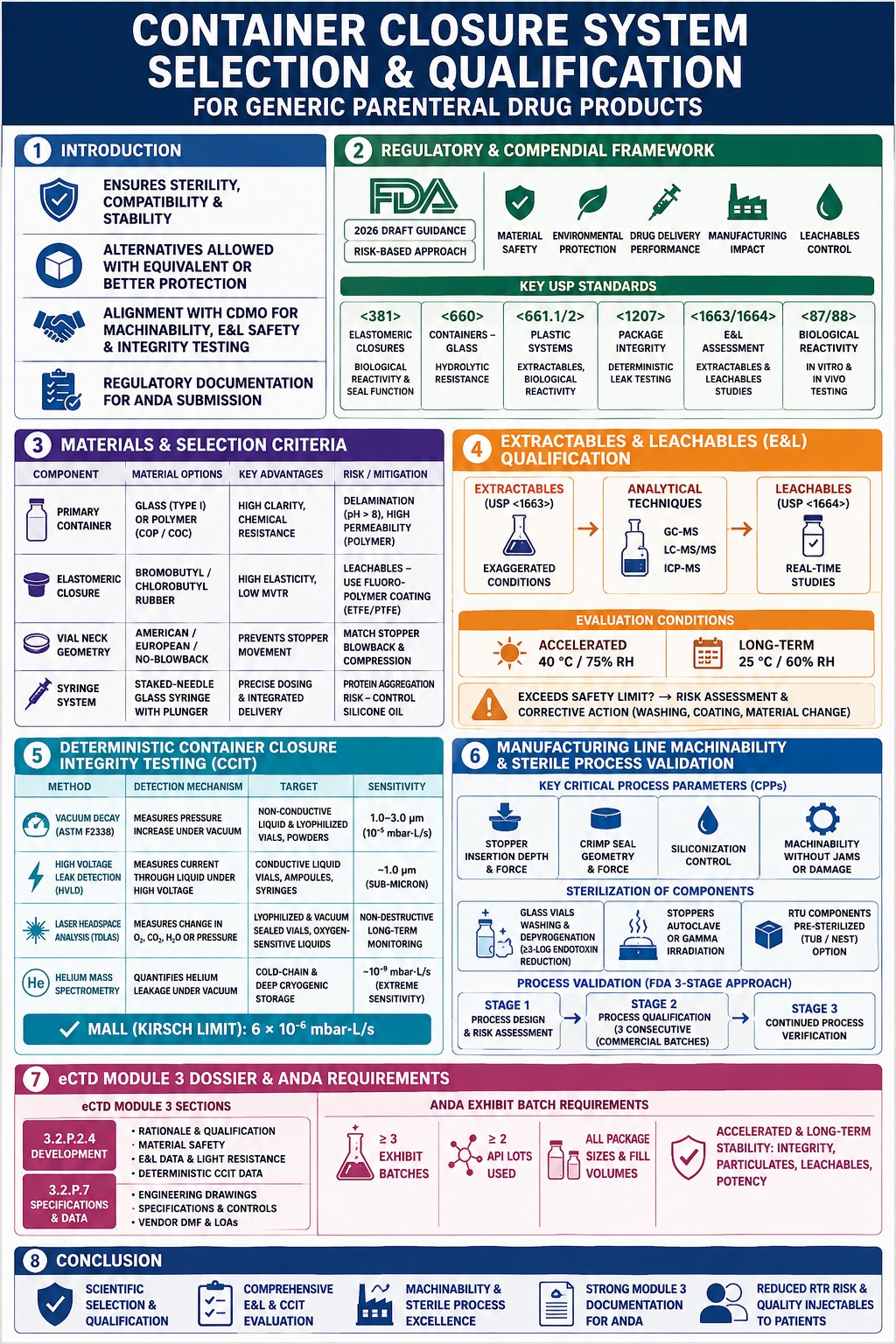
The regulatory architecture governing generic parenteral packaging requires sponsors to demonstrate compliance with current FDA guidance documents and USP compendial standards to establish packaging safety, protection, compatibility, and performance. Modern regulatory frameworks, including the FDA’s 2026 Draft Guidance Container Closure Systems for Human Drugs and Biological Products, emphasize a risk-based assessment of primary packaging materials, extractables and leachables, and container closure integrity.
The 2026 FDA guidance modernized the regulatory framework by replacing the legacy 1999 guidance and the 2002 Q&A document. The updated framework emphasizes continuous quality risk management across five operational pillars: material safety, environmental protection, drug-delivery performance, the impact of commercial manufacturing processes, and leachables control.
Regional CDMO Comparisons: 👉 Compare US vs. Canadian CDMO operational standards and regulatory frameworks
To prepare a defense-ready eCTD Module 3 submission, CDMOs and generic drug sponsors must demonstrate compliance across a defined matrix of United States Pharmacopeia (USP) general chapters:
| Compendial Standard | Scope and Mandatory Technical Objective | Primary Testing and Evaluation Focus |
|---|---|---|
| USP <381> | Elastomeric Closures for Injections | Biological reactivity, physicochemical evaluation, including extractable heavy metals and acidity/alkalinity, as well as seal functionality assessments such as penetrability, fragmentation, and self-sealing. |
| USP <660> | Containers — Glass | Determination of hydrolytic resistance across applicable glass types, including Type I borosilicate and treated soda-lime glass, to minimize surface etching and flake formation. |
| USP <661.1> & <661.2> | Plastic Packaging Systems and Materials of Construction | Plastic characterization, extractable metals, non-volatile residues, UV absorbance, and biological reactivity assessment. |
| USP <1207> | Package Integrity Evaluation | Evaluation of Container Closure Integrity Testing (CCIT), with emphasis on deterministic quantitative leak-testing methods rather than legacy probabilistic approaches. |
| USP <1663> & <1664> | Extractables and Leachables Assessment | Framework for controlled extraction studies (USP <1663>) and real-time leachables evaluation in finished drug formulations (USP <1664>). |
| USP <87> & <88> | Biological Reactivity Testing | In vitro cytotoxicity (USP <87>) and in vivo systemic toxicity/intracutaneous reactivity (USP <88>) for applicable direct-contact packaging components. |
Under this updated regulatory structure, probabilistic leak-testing methodologies, including dye ingress and microbial challenge testing, are increasingly unsuitable as the primary approaches for stability validation and batch release testing. Regulatory agencies expect quantitative, deterministic methodologies capable of providing repeatable defect detection at micron-level thresholds.
Domestic vs. Overseas Sourcing: 👉 Analyze the trade-offs between US-based and overseas CDMO partners
Materials of Construction and Technical Selection Criteria
Primary container closure materials must be selected according to formulation pH, light sensitivity, oxidation vulnerability, and container-product interaction risks to maintain API stability throughout the product lifecycle. High-risk conditions, including glass delamination in basic formulations and extractable or leachable migration from elastomeric components, require tailored material selection strategies that may include coated elastomers and advanced polymeric materials.
During container closure system selection, stress testing is used to evaluate physical and chemical interactions between the drug formulation and packaging materials. Formulations with an elevated pH (>8.0) may present a significant risk of glass delamination, in which thin silica-containing flakes separate from the internal glass surface during storage. This phenomenon can occur in standard Type I tubular glass vials under certain formulation and storage conditions. To reduce the risk of delamination, CDMOs may use specialized surface-treated glass, internal glass coatings, or advanced polymeric substrates such as Cyclic Olefin Copolymer (COC) or Cyclic Olefin Polymer (COP). These materials offer resistance to breakage, high chemical inertness, and low elemental impurity profiles.
Complex Drug Formulations: 👉 Review formulation strategies for lyophilized peptide injectables and packaging selection
Elastomeric stoppers and syringe plungers are commonly manufactured from halogenated butyl rubbers, including bromobutyl or chlorobutyl rubber, because these materials provide low gas permeability and low moisture vapor transmission rates (MVTR). However, uncoated elastomers may adsorb active pharmaceutical ingredients or preservatives and may also release vulcanization-related byproducts, including nitrosamines, polycyclic aromatic hydrocarbons, and heavy metal catalysts, into the drug formulation. Applying a fluoropolymer coating, such as ethylene tetrafluoroethylene (ETFE) or polytetrafluoroethylene (PTFE), to drug-contact surfaces establishes a protective barrier that can reduce leachables migration and API adsorption.
Small Molecule vs. Peptide Differences: 👉 Understand structural and packaging differences between peptide and small molecule drugs
| Packaging Component | Material Options | Key Advantages | Technical Considerations and Risk Mitigation |
|---|---|---|---|
| Primary Container | Type I Molded or Tubular Borosilicate Glass | High optical clarity, superior gas barrier properties, and broad thermal tolerance. | Risk of glass delamination at pH > 8.0; potential tungsten oxide contamination in staked-needle prefilled syringes. |
| Polymeric Container | Cyclic Olefin Polymer (COP / COC) | Unbreakable, low elemental extractables, and high pH tolerance. | Higher oxygen and moisture permeability compared with glass; increased raw material cost. |
| Elastomeric Closure | Bromobutyl or Chlorobutyl Rubber | High elasticity, low moisture vapor transmission, and reliable compression sealing. | Potential leachability of curing agents; fluoropolymer coating (ETFE/PTFE) may be required for sensitive formulations. |
| Vial Neck Geometry | American, European, or No-Blowback Neck | Helps prevent stopper movement during freeze-drying and crimping operations. | Neck dimensions must correspond to stopper blowback geometry to maintain the targeted compression ratios. |
| Syringe System | Staked-Needle Glass Syringe with Plunger | Integrated delivery device and precise dosing capability. | Risk of protein aggregation associated with silicone oil layers; requires tungsten-free laser drilling where applicable. |
Extractables and Leachables (E&L) Qualification and Toxicological Assessment
Extractables and leachables (E&L) qualification establishes that organic and inorganic chemical compounds capable of migrating from packaging components into parenteral formulations remain within toxicologically acceptable limits. This two-tiered testing strategy consists of controlled extraction studies conducted under exaggerated conditions (USP <1663>), followed by real-time monitoring of leachables during stability studies (USP <1664>) using advanced analytical instrumentation.
The E&L program is based on a characterization strategy defined by USP <1663> and USP <1664>. Controlled Extraction Studies (Extractables) expose empty primary packaging components to exaggerated solvent conditions, including acidic, basic, organic, and aqueous media, under elevated thermal stress. This approach generates a worst-case extractables profile representing potential chemical migrants from the packaging system. Orthogonal analytical techniques are then applied to characterize the extracted compounds:
- Gas Chromatography-Mass Spectrometry (GC-MS): Used to identify volatile and semi-volatile organic compounds, including plasticizers, unreacted monomers, and residual solvents.
- Liquid Chromatography-Tandem Mass Spectrometry (LC-MS/MS): Used to detect non-volatile organic compounds, including rubber vulcanization accelerators, antioxidants, and oligomers.
- Inductively Coupled Plasma-Mass Spectrometry (ICP-MS): Used to quantify trace elemental impurities, including aluminum, arsenic, lead, silicone, zinc, and tungsten residues.
Impurity Guidelines: 👉 Discover impurity control strategies under ICH Q3A for drug product packaging and active ingredients
After the extractable profile has been established, targeted Leachables Studies are performed to monitor compounds that actually migrate into the packaged drug product under defined storage conditions. Drug products are evaluated under accelerated (40 °C/75% RH) and long-term (25 °C/60% RH) stability conditions. Any leachable compound detected above the analytical Qualification Threshold (QT) or a Threshold of Toxicological Concern (TTC)-based Acceptable Intake (AI) requires formal toxicological risk assessment. When a leachable exceeds an established safety limit, the CDMO may need to revise component washing procedures, modify siliconization levels, introduce barrier coatings, or select alternative primary packaging materials.
Analytical Services: 👉 Learn about one-stop CDMO analytical testing services for ANDA submissions
Deterministic Container Closure Integrity Testing (CCIT) Method Validation
Deterministic container closure integrity testing (CCIT) quantitatively evaluates package integrity through non-destructive and highly reproducible analytical methods designed to prevent microbial contamination and gas ingress throughout the product shelf life. In accordance with USP <1207> and EU GMP Annex 1, deterministic testing establishes a Maximum Allowable Leakage Limit (MALL) for sterile injectable products.
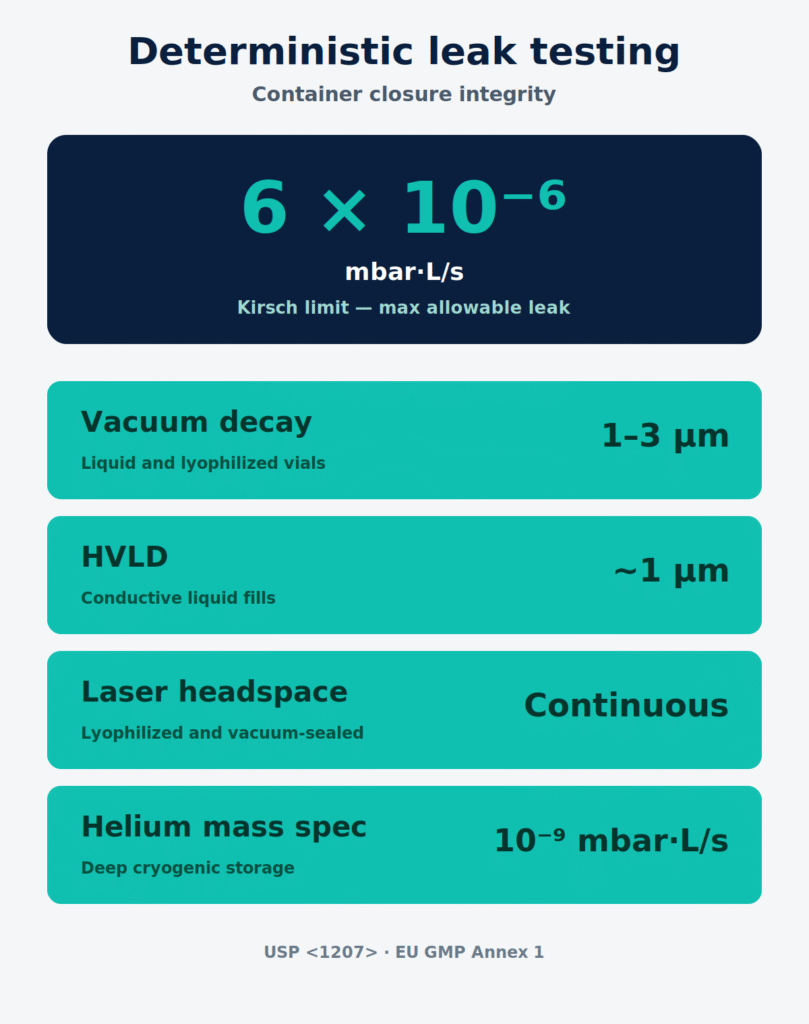
Under USP <1207> and EU GMP Annex 1, probabilistic testing approaches, including dye ingress and microbial challenge testing, have limitations for primary container integrity validation because of their variable sensitivity and, in many cases, destructive execution. Deterministic CCIT methodologies provide quantitative, non-destructive, and repeatable measurements and can be calibrated against physical micro-orifice standards. For rigid parenteral container closure systems, package integrity is evaluated by establishing the Maximum Allowable Leakage Limit (MALL). A commonly referenced MALL threshold for rigid parenteral packaging is 6 × 10⁻⁶ mbar·L/s (the Kirsch limit), below which the probability of microbial ingress is considered to approach zero.
| CCIT Methodology | Detection Mechanism | Target Presentation | Sensitivity Threshold |
|---|---|---|---|
| Vacuum Decay (ASTM F2338) | Measures the pressure increase within a sealed test chamber containing the package under vacuum conditions. | Non-conductive liquid vials, lyophilized vials, and powder-filled containers. | Detects defects down to approximately 1.0–3.0 µm (10⁻⁵ mbar·L/s). |
| High Voltage Leak Detection (HVLD) | Measures electrical current flow across a liquid-filled container exposed to high-voltage pulses. | Conductive liquid-filled glass/plastic vials, ampoules, and prefilled syringes. | Sub-micron sensitivity, approximately 1.0 µm. |
| Laser Headspace Analysis (TDLAS) | Measures changes in headspace gas concentration (O₂, CO₂, H₂O) or pressure through laser absorption. | Lyophilized products, vacuum-sealed vials, and oxygen-sensitive liquids. | Non-destructive monitoring over long-term stability. |
| Helium Mass Spectrometry | Quantifies helium gas leakage under vacuum following helium flooding or vacuum sniffing. | Cold-chain storage validation and deep cryogenic integrity (−80 °C to −196 °C). | Extreme sensitivity, approximately 10⁻⁹ mbar·L/s. |
CCIT validation protocols generally require evaluation of an appropriate sample size, often including N=30 units per packaging configuration, together with positive controls consisting of containers containing laser-drilled micro-orifices of known dimensions and negative controls consisting of flawless production containers. Method qualification must demonstrate repeatability and reproducibility and establish a statistically justified correlation between physical leak rate and microbial safety.
CDMO Manufacturing Line Machinability and Sterile Process Validation
Packaging component machinability within a CDMO depends on optimizing physical tolerances and manufacturing line parameters to prevent component breakage, stopper displacement, and loss of seal integrity during high-speed fill-finish operations. Successful commercialization requires qualification of critical process parameters (CPPs) and component sterilization processes through a structured three-stage lifecycle approach.
A generic drug developer working with a CDMO must verify component machinability, meaning the ability of primary packaging components to feed, transport, fill, stopper, and seal effectively on high-speed commercial manufacturing lines without causing jams, generating glass particulates, or damaging sealing surfaces. Key operational variables, identified as Critical Process Parameters (CPPs), must be established and evaluated during engineering line trials:
- Stopper Insertion Depth and Force: The stopper must reach the targeted insertion depth without damaging the elastomeric flange or causing stopper pop-up because of compressed headspace gas.
- Crimp Seal Geometry and Force: Aluminum crimp caps must provide uniform 360° seal compression of the stopper flange against the vial crown while avoiding fracture or damage to the glass neck finish.
- Siliconization Control: Silicone oil applied to stoppers or syringe barrels supports machinability and plunger movement but must be carefully controlled to minimize sub-visible particulate generation and potential interactions with the active drug.
Manufacturing Scale-Up: 👉 Explore CDMO scale-up services for complex drug products and APIs
For non-terminally sterilized parenteral products manufactured through aseptic processing, each primary packaging component undergoes an appropriate preparation and sterilization process. Glass vials pass through high-pressure washing systems and continuous thermal depyrogenation tunnels capable of achieving ≥3-log endotoxin reduction, while stoppers may be sterilized through moist heat autoclaving or gamma irradiation, depending on the component and validated process. CDMOs may also use pre-sterilized Ready-to-Use (RTU) components supplied in tub/nest configurations, which can eliminate the need for in-house washing and depyrogenation operations. Process validation follows the FDA three-stage approach: Stage 1 (Process Design and risk assessment), Stage 2 (Process Qualification using 3 consecutive commercial-scale production batches), and Stage 3 (Continued Process Verification across the product lifecycle).
eCTD Module 3 Dossier Strategy and ANDA Submission Requirements
Obtaining ANDA approval for a generic injectable drug product requires packaging information to be systematically organized within eCTD Sections 3.2.P.2.4 (Pharmaceutical Development) and 3.2.P.7 (Container Closure System) to demonstrate appropriate equivalence to the Reference Listed Drug (RLD). Regulatory submissions should integrate vendor Type III Drug Master Files (DMFs), complete component specifications, and stability data generated from three exhibit batches.
Regulatory review depends on the logical presentation and organization of technical information within the applicable eCTD Module 3 sections:
- Section 3.2.P.2.4 (Container Closure System – Development): Includes the scientific rationale for container closure selection and qualification, detailed material safety evaluations, E&L study findings, light resistance data, and deterministic CCIT validation protocols.
- Section 3.2.P.7 (Container Closure System – Specifications and Data): Includes engineering drawings, material safety datasheets, component release specifications, analytical control procedures, and vendor Type III Drug Master File (DMF) Letters of Authorization (LOAs).
eCTD Dossier Preparation: 👉 Understand CMC documentation requirements at a CDMO for successful ANDA filings
For generic ANDA submissions, FDA requires specific packaging considerations for exhibit batches:
- Batch Execution: At least three primary exhibit batches must be manufactured and packaged using the proposed container closure system.
- API Diversity: At least two distinct lots of Active Pharmaceutical Ingredient (API) should be used across the three primary drug product exhibit batches.
- Presentation Coverage: All proposed commercial package sizes, fill volumes, and container closure presentations should be represented in the stability program.
- Stability Proof: Accelerated (40 °C/75% RH) and long-term (25 °C/60% RH) stability studies must demonstrate that seal integrity, sub-visible particulate levels, leachables profiles, and drug potency remain within established specifications throughout the proposed shelf life.
RLD Reverse Engineering: 👉 Learn about Reference Listed Drug (RLD) sourcing and reverse engineering for generics
When a generic applicant proposes permissible packaging differences relative to the RLD, the ANDA submission must provide sufficient scientific justification and supporting data to demonstrate that these differences do not adversely affect product quality, delivery performance, or patient safety.
Generic Drug Development: 👉 Discover bioequivalence study design strategies for complex generic drug products
Conclusion
A scientifically rigorous Container Closure System Selection and Qualification process is critical for minimizing regulatory risk and supporting successful commercialization of generic parenteral ANDA products. Comprehensive extractable and leachable evaluations, high-speed manufacturing line machinability assessments, deterministic container closure integrity testing, and well-structured eCTD Module 3 documentation enable generic drug sponsors and CDMOs to reduce refuse-to-receive (RTR) risks and support the timely delivery of high-quality sterile injectable products to patients.
For technical consultations on analytical packaging qualification, deterministic CCIT validation, and CDMO eCTD Module 3 filing strategies, connect with our expert team at ResolveMass Laboratories Inc. via our Contact Us Page.
Frequently Asked Questions (FAQs)
Extractables are substances that can be intentionally driven out of packaging components when they are exposed to aggressive solvents, elevated temperatures, or other exaggerated laboratory conditions. Leachables, in contrast, are compounds that migrate from the container closure system into the actual drug product during routine storage. Therefore, extractables studies help identify potential migrants, while leachables studies determine what actually enters the formulation.
Deterministic CCIT techniques, including vacuum decay, HVLD, and TDLAS, provide measurable and reproducible information about package leakage without necessarily destroying the tested container. These methods can be correlated with calibrated physical defects, allowing more consistent assessment of container closure integrity. Probabilistic techniques such as dye ingress depend on variable events and visual observations, which can make detection of smaller defects less reliable.
For rigid sterile parenteral container closure systems, a commonly referenced Maximum Allowable Leakage Limit (MALL) is 6 × 10⁻⁶ mbar·L/s, often referred to as the Kirsch limit. This value is used as a benchmark for evaluating whether a package can adequately resist microbial ingress and maintain its protective function. The applicable leakage limit should be scientifically justified according to the specific product and packaging configuration.
The ANDA stability program generally includes three primary exhibit batches of the generic drug product. The packaging configuration used for these batches should adequately represent the proposed commercial presentations, including applicable container closure configurations and fill volumes. The stability program should also incorporate at least two distinct lots of Active Pharmaceutical Ingredient (API), where required by the applicable regulatory expectations.
High-pH injectable formulations, particularly those above pH 8.0, may increase the potential for glass delamination in certain Type I glass containers. Delamination can result in the release of thin glass flakes or silica-containing particles into the drug product. Risk reduction strategies may include surface-treated glass, protective internal coatings, or alternative materials such as Cyclic Olefin Polymer (COP) and Cyclic Olefin Copolymer (COC), depending on product-specific compatibility assessments.
USP <381>, Elastomeric Components in Injectable Pharmaceutical Product Packaging/Delivery Systems, provides requirements relevant to the evaluation of elastomeric components used with injectable products. Qualification can include assessments of biological reactivity, physicochemical properties, and functional characteristics. Physical performance evaluations may address attributes such as penetrability, fragmentation, and self-sealing capability, depending on the applicable component and testing requirements.
Fluoropolymer coatings such as ETFE and PTFE establish a protective interface between the elastomeric material and the drug formulation. This barrier can reduce direct contact between the formulation and the rubber matrix, thereby limiting potential migration of extractables and leachables. It can also help minimize adsorption of active pharmaceutical ingredients or preservatives onto the closure surface.
A Type III Drug Master File (DMF) contains confidential technical information concerning a packaging component, which may include its materials of construction, manufacturing processes, specifications, and quality controls. The packaging manufacturer maintains this confidential information with the FDA, while the ANDA applicant can reference the applicable DMF through a Letter of Authorization (LOA). This arrangement allows FDA reviewers to evaluate relevant packaging information without requiring the manufacturer to disclose proprietary details directly in the ANDA.
CDMO manufacturing line requirements are an important consideration when selecting a container closure system because packaging components must operate reliably at commercial production speeds. Vial dimensions, neck finish geometry, stopper insertion characteristics, surface friction, and crimping parameters must be compatible with the filling and sealing equipment. Poorly matched components can contribute to stopper displacement, glass damage, particulate generation, equipment interruptions, or loss of container closure integrity.
Reference:
- Kolluru, L. P. (2017). Basic considerations for container closure selection of parenteral drug products. Pharmaceutica Analytica Acta, 8(5), e189. https://doi.org/10.4172/2153-2435.1000e189 (researchgate.net)
- U.S. Food and Drug Administration. (n.d.). Questions and answers on quality-related controlled correspondence. U.S. Food and Drug Administration
- U.S. Food and Drug Administration. (2026, August). Container closure systems for human drugs and biological products: Guidance for industry (Draft guidance). U.S. Department of Health and Human Services. FDA guidance document
- Abbreviated new drug application (ANDA) filing checklist: Emerging initiatives summary, ANDA submission checklist, FDA ANDA review checklist, ANDA process for generic drugs, ANDA checklist for CTD or eCTD. (n.d.). ResearchGate. ResearchGate publication
Get In Touch With Us
About The Author


