

Introduction
Modern biosimilar development increasingly depends on high-resolution structural and functional data as the principal surrogate for demonstrating therapeutic equivalence. This evolution has effectively positioned analytical characterization at the center of the clinical evidence strategy. Selecting an experienced CRO For Biosimilar Analytical Characterization enables drug developers to establish comprehensive, regulator-ready data packages that align with international regulatory expectations while potentially eliminating redundant comparative clinical efficacy trials.
Explore comprehensive Biosimilar Characterization Services to strengthen your analytical development strategy.
The traditional dependence on large Phase III comparative efficacy trials involving hundreds of patients has been reassessed by major international regulatory authorities, including the US Food and Drug Administration (FDA), European Medicines Agency (EMA), and Health Canada. Although clinical trials have historically been considered the gold standard for demonstrating the efficacy and safety of new medicines, modern analytical assays can detect subtle structural differences in complex therapeutic proteins with greater sensitivity than clinical studies. Recent draft guidance and regulatory updates have formalized a more tailored development strategy in which analytical similarity, complemented by comparative clinical pharmacokinetics (PK) and pharmacodynamics (PD), provides the fundamental basis for marketing authorization. Consequently, much of the scientific and financial risk has shifted toward the early characterization stage. Analytical gaps or unidentified differences in critical quality attributes (CQAs) can no longer be adequately offset by clinical trial outcomes. Therefore, partnering with a contract research organization that possesses specialized biophysical infrastructure and strong regulatory expertise is essential for successfully navigating this evolving regulatory environment.
Share via:
Quick Summary:
- Analytics now drive biosimilar approval. The FDA, EMA and Health Canada increasingly accept strong analytical similarity data, plus comparative PK/PD, in place of large Phase III efficacy trials, because lab methods can detect structural differences more sensitively than clinical studies.
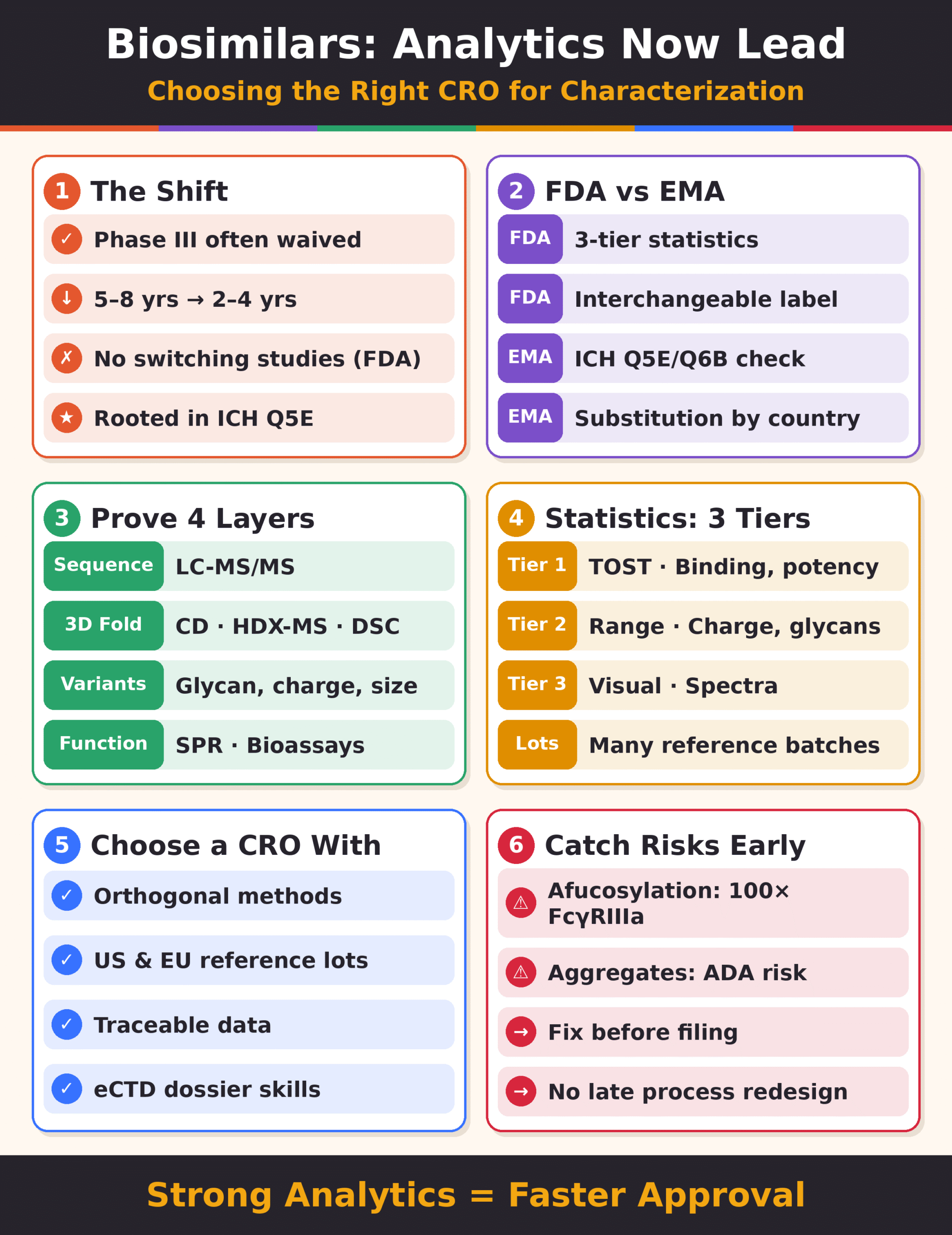
- The regulatory shift is formalized. Building on ICH Q5E comparability principles, the FDA’s October 2025 draft guidance and the EMA’s April 2025 reflection paper no longer treat efficacy trials as automatic. This could cut development from 5–8 years to 2–4 years, and the FDA has also dropped mandatory switching studies for interchangeability.
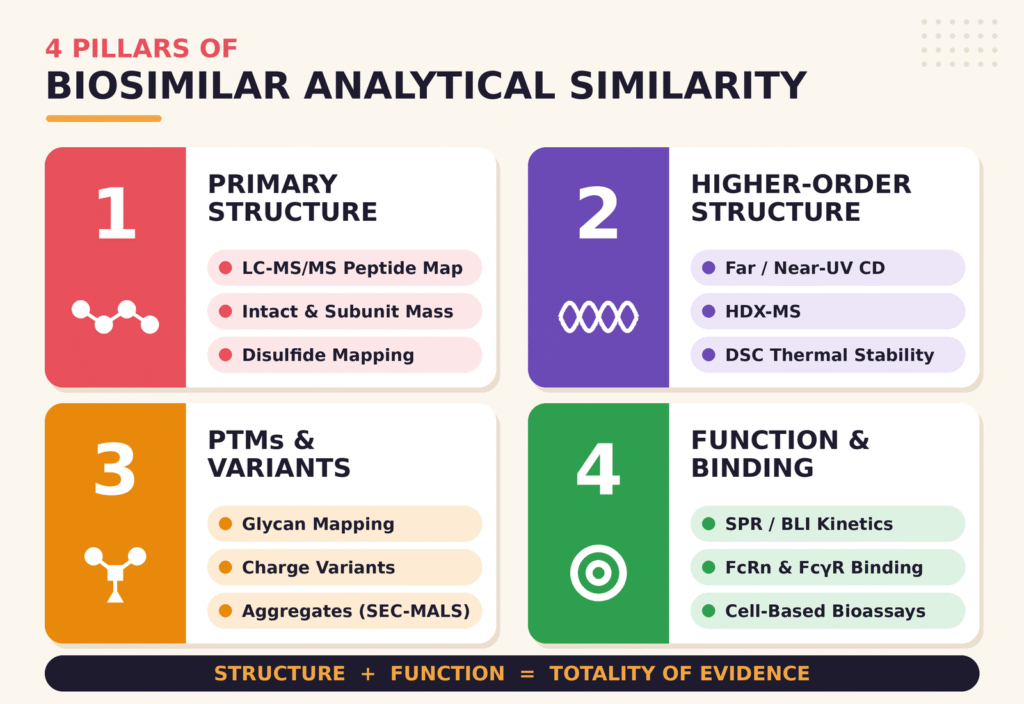
- Similarity must be shown across four layers. These are primary structure (LC-MS/MS peptide mapping, intact mass, disulfides), higher-order structure (CD, FTIR, HDX-MS, DSC), post-translational modifications and variants (glycans, charge, size), and function (SPR/BLI binding kinetics, Fc receptor binding, cell-based bioassays).
- Results are judged with a three-tier statistical framework. Tier 1 uses TOST equivalence testing for high-risk attributes like binding and potency, Tier 2 uses quality ranges for attributes like charge variants, and Tier 3 uses visual overlays for attributes like spectral profiles.
- Choosing the right CRO is critical. Key criteria are orthogonal methods for each attribute, sourcing and tracking of US and EU reference product lots, traceable data with system suitability controls, and experience writing and defending eCTD Module 3 dossiers.
- Catching differences early reduces risk. Small process changes can raise afucosylation and increase FcγRIIIa binding up to 100-fold, which boosts ADCC. Sub-visible aggregates can trigger anti-drug antibodies. Finding these early avoids regulatory objections and late process redesign.
- The analytical package now decides success. Sponsors that partner with an expert CRO can build defensible dossiers, avoid unnecessary clinical trials, and reach the market faster.
The Paradigm Shift: How Analytics Replaced Comparative Efficacy Studies
Regulatory authorities increasingly prioritize high-resolution analytical characterization over comparative clinical efficacy studies because physical chemistry techniques and functional bioassays can identify subtle molecular differences with substantially greater sensitivity. This regulatory evolution creates an opportunity for sponsors to avoid expensive Phase III clinical trials when comprehensive analytical similarity and comparative pharmacokinetic evidence have been convincingly demonstrated.
Learn more about the analytical foundation of Biosimilar Comparability Studies.
The scientific foundation for this transition originates from decades of post-approval biomanufacturing experience governed by International Council for Harmonisation (ICH) Q5E guidelines. Originator pharmaceutical manufacturers routinely make changes to cell culture conditions, purification processes, and manufacturing facilities without conducting new clinical efficacy trials. Instead, they rely on extensive analytical comparability assessments to establish that the modified manufacturing process continues to produce a product with comparable quality characteristics. Applying these established comparability principles to biosimilar development, regulatory reforms—including the FDA’s October 2025 draft guidance and the EMA’s April 2025 reflection paper—have moved away from treating comparative clinical efficacy studies as an automatic requirement. These regulatory developments are intended to reduce biosimilar development timelines from approximately 5–8 years to 2–4 years while potentially reducing total development expenditures by tens of millions of dollars. In addition, the FDA’s streamlined framework eliminates mandatory clinical switching studies for interchangeable biosimilars, recognizing that extensive structural and functional characterization, together with clinical PK studies, can provide sufficient evidence to establish therapeutic safety and equivalence.
| Regulatory Domain | US Food & Drug Administration (FDA) | European Medicines Agency (EMA) | Strategic Impact on Analytics |
|---|---|---|---|
| Primary Basis of Approval | Tiered analytical similarity demonstrating strong structural and functional equivalence. | Physicochemical and biological comparability exercise per ICH Q5E/Q6B. | Elevates characterization to the primary driver of regulatory approval. |
| Comparative Efficacy Trials | Waived when analytical, functional, and comparative PK/PD data are sufficiently robust. | Tailored approach generally favors waiving efficacy trials for therapeutic proteins when justified by the totality of evidence. | Shifts residual uncertainty resolution primarily toward analytical characterization. |
| Non-Clinical In Vivo Studies | Reduced or eliminated and evaluated according to a case-specific, risk-based strategy. | Explicitly discouraged or waived where unnecessary to minimize animal testing. | Requires appropriate in vitro biological assays to establish functional equivalence. |
| Interchangeability Status | Distinct designation; switching studies eliminated under updated guidance. | No centralized interchangeability designation; pharmacy substitution is managed at the member-state level. | Requires highly comparable higher-order structure and target-binding kinetics. |
| Statistical Framework | Three-tiered methodology comprising Tier 1 TOST, Tier 2 Quality Range, and Tier 3 Graphical comparison. | Range-based and visual comparability against the reference product target profile. | Requires high-throughput testing across multiple reference product lots. |
Core Technical Requirements for Biosimilar Analytical Similarity
Demonstrating analytical similarity requires a comprehensive, multi-tiered testing strategy capable of establishing structural, conformational, and functional comparability between a biosimilar candidate and its reference product. This totality-of-evidence strategy encompasses primary sequence confirmation, higher-order structure assessment, post-translational modification characterization, and cell-based biological activity testing.
Review the key Critical Quality Attributes (CQAs) in Biosimilars that should be considered during analytical characterization.
For global regulatory submissions under eCTD Module 3 (3.2.R), analytical programs must evaluate the complete hierarchy of molecular structure and biological activity. Each relevant attribute must be assessed using validated, state-of-the-art analytical technologies capable of accurately measuring the physical, chemical, and biological characteristics of the product.
Primary Structure and Sequence Integrity
Primary sequence analysis establishes whether the amino acid sequence and disulfide bonding patterns of the biosimilar correspond to those of the reference biologic. High-resolution mass spectrometry provides the sensitivity required to achieve comprehensive sequence coverage and detect low-level expression variants that could indicate primary structural differences.
Tandem mass spectrometry (LC-MS/MS) peptide mapping using multiple complementary enzymatic digests, including trypsin, Lys-C, and Glu-C, provides comprehensive sequence coverage across both heavy and light chains. Intact and subunit mass deconvolution using Ultra-High-Performance Liquid Chromatography coupled with High-Resolution Mass Spectrometry (UHPLC-HRMS) confirms terminal processing events, including C-terminal lysine clipping and N-terminal pyroglutamate formation. Disulfide bond connectivity and free sulfhydryl concentrations must also be quantified to verify appropriate covalent linkages. In addition, low-level sequence variants caused by amino acid misincorporation during cell culture expression must be identified, characterized, and appropriately risk-assessed.
Discover advanced Proteomics Approaches for Biosimilars for comprehensive sequence and molecular characterization.
Higher-Order Structure and Biophysical Conformational Dynamics
Higher-order structure (HOS) characterization determines whether secondary, tertiary, and quaternary protein conformations remain comparable under physiologically relevant conditions. Analytical techniques such as Circular Dichroism, Hydrogen-Deuterium Exchange Mass Spectrometry (HDX-MS), and Differential Scanning Calorimetry (DSC) provide complementary information regarding conformational folding, molecular dynamics, and thermodynamic stability.
Secondary structural components, including α-helices, β-sheets, and random coils, are routinely characterized using Far-UV Circular Dichroism (CD) and Fourier-Transform Infrared Spectroscopy (FTIR). Tertiary structural integrity is evaluated through Near-UV CD, intrinsic fluorescence, and Hydrogen-Deuterium Exchange Mass Spectrometry (HDX-MS). HDX-MS provides peptide-level spatial information regarding solvent accessibility and protein backbone dynamics. Differential Scanning Calorimetry (DSC) evaluates thermal unfolding behavior by measuring transition temperatures (Tm1, Tm2) and unfolding enthalpy (ΔH), thereby providing evidence for comparable conformational stability between the biosimilar and reference product.
Explore Native Mass Spectrometry for Biosimilars for advanced assessment of intact molecular states and higher-order structural characteristics.
Post-Translational Modifications and Charge Variants
Characterization of post-translational modifications (PTMs) provides critical information about glycosylation patterns, charge heterogeneity, and size-related variations that may influence biological activity, pharmacokinetics, or immunogenicity. Advanced chromatographic and capillary electrophoresis platforms enable the separation and quantification of acidic and basic variants, N-glycan distributions, and aggregate populations.
Glycosylation mapping using Hydrophilic Interaction Liquid Chromatography with Fluorescence and Mass Spectrometry Detection (HILIC-FLR-MS) quantifies core fucosylation, high-mannose structures, galactosylation, and terminal sialic acid levels. Charge variant distributions are evaluated using Capillary Isoelectric Focusing (cIEF) and Cation Exchange Chromatography (CEX), allowing acidic and basic species associated with deamidation, oxidation, and glycation to be quantified. Size variants, including soluble aggregates and fragments, are characterized using Size-Exclusion Chromatography with Multi-Angle Light Scattering (SEC-MALS), complemented by Sedimentation Velocity Analytical Ultracentrifugation (SV-AUC).
Learn more about Charge Variant Analysis in Biosimilars and advanced approaches for evaluating molecular heterogeneity.
Functional Activity and Target Receptor Binding Kinetics
Biological functional assays and receptor-binding kinetic studies demonstrate whether a biosimilar interacts with its intended target and Fc receptors with comparable potency and affinity to the originator molecule. Techniques such as Surface Plasmon Resonance (SPR), Bio-Layer Interferometry (BLI), and cell-based bioassays provide complementary evidence regarding target engagement, FcRn binding, and effector functions.
Surface Plasmon Resonance (SPR) and Bio-Layer Interferometry (BLI) determine real-time binding kinetics (ka, kd, KD) for primary target antigens and Fc receptors, including FcγRIIIa, FcγRIIa, FcγRI, FcRn, and C1q. Neonatal Fc receptor (FcRn) binding is directly associated with in vivo pharmacokinetic half-life, whereas FcγRIIIa binding contributes to antibody-dependent cellular cytotoxicity (ADCC). Cell-based bioassays, including reporter gene assays, cell proliferation inhibition assays, and cell-mediated cytotoxicity assays, establish whether receptor engagement results in comparable biological responses.
Statistical Equivalence Frameworks in Analytical Similarity
Regulatory assessments use structured statistical tiers to determine whether critical quality attributes satisfy predefined mathematical criteria for biosimilarity. Tier 1 attributes are evaluated using two one-sided equivalence testing (TOST), Tier 2 attributes are assessed through quality range approaches, and Tier 3 attributes are generally evaluated using visual overlay comparisons.
Under FDA guidance, quality attributes are assigned to a three-tiered statistical framework according to their potential risk and clinical relevance. Tier 1 encompasses high-risk attributes that are directly associated with the clinical mechanism of action, such as target binding and biological potency. These attributes are evaluated using Two One-Sided Tests (TOST) with stringent equivalence margins derived from the variability observed in the reference product. Tier 2 includes moderate-risk attributes, such as charge variants and sub-visible aggregates, which are assessed using Quality Range methods (μ ± x · σ). Tier 3 attributes, such as secondary structure spectral profiles, are assessed primarily through graphical overlays and descriptive statistical comparisons.
| Quality Domain | Target Parameter | Primary Method | Orthogonal Method | Regulatory Statistical Tier |
|---|---|---|---|---|
| Primary Structure | Sequence identity & Disulfide map | LC-MS/MS Peptide Mapping | HRMS Intact/Subunit Mass | Tier 3 (100% Sequence Match) |
| Higher-Order Structure | Secondary & Tertiary folding | Far-UV / Near-UV CD | HDX-MS / Fluorescence | Tier 2 (Quality Range) |
| Thermal Stability | Unfolding Tm and thermodynamics | Differential Scanning Calorimetry | Differential Scanning Fluorimetry | Tier 2 (Quality Range) |
| Glycan Architecture | N-glycosylation & Sialylation | HILIC-FLR-MS | MALDI-TOF-MS / CE-LIF | Tier 2 (Quality Range) |
| Size Heterogeneity | Soluble aggregates & Fragments | SEC-MALS | SV-AUC | Tier 1 (TOST Equivalence) |
| Charge Heterogeneity | Acidic & Basic charge variants | Capillary Isoelectric Focusing | Cation Exchange Chromatography | Tier 2 (Quality Range) |
| Target Kinetics | Antigen KD, ka, kd parameters | Surface Plasmon Resonance (SPR) | Bio-Layer Interferometry (BLI) | Tier 1 (TOST Equivalence) |
| Effector Function | ADCC, CDC, Fc receptor binding | Cell-based Reporter Assays | FcγRIIIa Affinity LC / SPR | Tier 1 (TOST Equivalence) |
Key Criteria for Selecting a CRO For Biosimilar Analytical Characterization
Selecting a CRO For Biosimilar Analytical Characterization requires a detailed assessment of the partner’s instrumentation redundancy, orthogonal analytical capabilities, regulatory history, and ability to identify and contextualize residual analytical uncertainty. A qualified contract laboratory should be capable of converting complex analytical results into scientifically defensible submission packages that meet the expectations of global regulatory authorities.
See how an integrated Biosimilar Analytical Characterization Service can support comprehensive structural, physicochemical, and functional testing.
Assessment of contract testing organizations should extend beyond their standard analytical service portfolios. Sponsors should evaluate whether the laboratory has the high-resolution infrastructure, scientific expertise, and regulatory experience necessary for complex biosimilar programs. Important selection criteria include:
- Orthogonal Technical Architecture: Depending on a single analytical technology can introduce significant regulatory risk. A capable contract laboratory should maintain complementary analytical platforms across each major characterization domain. For example, aggregate analysis can combine SEC-MALS with SV-AUC, while higher-order structure characterization can integrate Far-UV CD with HDX-MS to provide independent and complementary measurements.
- Reference Product Sourcing and Characterization Logistics: Biosimilar comparability programs require direct head-to-head assessment against numerous commercial originator batches obtained from US and EU markets over extended development periods. The testing partner should have the infrastructure and processes required to manage reference standard procurement, cold-chain integrity, storage conditions, lot documentation, and historical lot tracking. These capabilities are essential for establishing realistic target product profiles based on representative reference product variability.
- Data Traceability and System Suitability: High-resolution analytical platforms require rigorous system suitability controls and consistent data-management practices. Incorporating standard reference materials, such as human monoclonal antibody standards like SigmaMAb™, supports long-term method performance, analytical consistency, and data comparability across extended testing programs.
- Regulatory Dossier Authoring and Uncertainty Resolution: Producing analytical datasets alone is not sufficient unless the results can be translated into regulator-ready eCTD Module 3 dossiers. The laboratory’s scientific and regulatory teams should have demonstrated experience preparing comparative quality summaries, interpreting minor analytical differences, and scientifically defending comparability packages before authorities such as the FDA, EMA, and Health Canada.
De-risking Biosimilar Programs by Resolving Residual Analytical Uncertainty
Resolving residual analytical uncertainty early in development can significantly reduce program risk by identifying subtle physicochemical differences before regulatory submission. High-sensitivity analytical characterization enables sponsors to detect potentially meaningful variations at an early stage, reducing the likelihood of late-stage delays, regulatory objections, or the need for extensive manufacturing process redesign.
In contemporary biosimilar development, unidentified physicochemical differences cannot necessarily be addressed through downstream clinical trial data. For instance, relatively small changes in cell culture bioreactor conditions may modify N-glycosylation profiles and increase the proportion of afucosylated glycans. Afucosylation can increase FcγRIIIa binding affinity by up to 100-fold, potentially resulting in increased ADCC activity. If a testing laboratory does not identify such a variation early through high-resolution HILIC-MS glycan mapping and SPR kinetic assays, the sponsor may face regulatory concerns or potentially be required to make late-stage changes to the bioprocess.
Explore Aggregation Analysis in Biosimilars to understand orthogonal strategies for evaluating aggregate and particle-related risks.
Sub-visible aggregates are another important consideration because they can contribute to anti-drug antibody (ADA) induction. Combining advanced native mass spectrometry, HDX-MS, SEC-MALS, and SV-AUC enables developers to identify structural variants at an early stage, compare those findings with historical originator product ranges, and address technical uncertainties before they become significant regulatory or development risks.
Review the ICH Q6B Guidelines for Biological Characterisation for additional context on characterization expectations for biological products.
Conclusion
The increasing emphasis on analytically driven biosimilar approvals makes the selection of an expert CRO For Biosimilar Analytical Characterization one of the most important strategic decisions in biopharmaceutical development. By combining high-resolution mass spectrometry, orthogonal analytical assay suites, and structured statistical equivalence frameworks, sponsors can develop scientifically defensible dossiers that address FDA, EMA, and Health Canada expectations while potentially avoiding unnecessary comparative clinical trials.
As regulatory authorities worldwide continue to establish pathways for waiving comparative clinical efficacy studies and streamline interchangeability requirements, the scientific quality of analytical comparability packages increasingly determines the success of a biosimilar development program. Biosimilar developers should therefore collaborate with contract testing organizations that provide extensive scientific expertise, advanced biophysical instrumentation, comprehensive analytical capabilities, and demonstrated regulatory knowledge. Addressing analytical uncertainties early in development can support smoother regulatory interactions, strengthen comparability assessments, and accelerate potential market entry.
Discuss your requirements with ResolveMass Laboratories and explore tailored Biosimilar Comparability Studies for your development program.
To optimize your biosimilar characterization strategy and explore head-to-head analytical comparability solutions, contact the scientific team at ResolveMass Laboratories Inc. – Contact us.
Frequently Asked Questions
The FDA and EMA both require comprehensive analytical characterization supported by complementary and orthogonal testing strategies. The FDA uses a defined statistical framework that includes TOST equivalence testing, quality ranges, and graphical assessment, whereas the EMA applies product-specific scientific requirements and comparative quality assessments. Their approaches differ in regulatory structure, but both emphasize analytical evidence and risk-based justification.
Higher-order structure (HOS) characterization generally combines techniques such as Far-UV/Near-UV Circular Dichroism (CD), Differential Scanning Calorimetry (DSC), intrinsic fluorescence, and Hydrogen-Deuterium Exchange Mass Spectrometry (HDX-MS). Far-UV CD evaluates secondary structural elements, while Near-UV CD and fluorescence provide information about tertiary structure. HDX-MS adds localized information about protein dynamics and solvent accessibility.
Sedimentation Velocity Analytical Ultracentrifugation (SV-AUC) evaluates protein species directly in solution without relying on a chromatographic stationary phase. This makes it a valuable orthogonal technique for confirming aggregate and oligomer distributions identified using SEC-MALS. Because SEC can be influenced by column interactions or limitations in separating certain high-molecular-weight species, SV-AUC provides an independent assessment under native solution conditions.
Surface Plasmon Resonance (SPR) and Bio-Layer Interferometry (BLI) provide quantitative measurements of real-time interactions between the biosimilar and relevant targets or receptors. Parameters such as association, dissociation, and binding affinity help connect molecular structure with biological function. For therapeutic antibodies, these assays can evaluate interactions involving target antigens, FcRn, C1q, and Fc gamma receptors and support the overall functional similarity assessment.
Residual analytical uncertainty describes potentially meaningful differences between the biosimilar and reference product that remain unresolved after the initial analytical comparison. Sponsors address these differences through targeted orthogonal characterization, functional assays, additional reference-lot testing, or other scientifically justified investigations. The potential clinical relevance of each difference is assessed according to its relationship with critical quality attributes (CQAs), mechanism of action, and available supporting evidence.
The FDA framework organizes quality attributes into three statistical tiers according to their risk and relevance. Tier 1 uses Two One-Sided Tests (TOST) for critical attributes, while Tier 2 applies quality-range approaches to moderately important characteristics. Tier 3 generally uses graphical comparisons and descriptive statistics for attributes where numerical equivalence testing is less appropriate.
Post-translational modifications (PTMs), including N-glycosylation, C-terminal lysine clipping, deamidation, and oxidation, can influence protein stability, biological activity, pharmacokinetics, and immunogenicity. Comprehensive PTM analysis determines whether the biosimilar’s modification profile remains consistent with the natural variability of the reference product. Certain modifications may directly affect receptor interactions, clearance, aggregation, or antigen-binding performance.
The number of reference product lots depends on the molecule, attribute risk, regulatory strategy, and available reference-product history rather than one universally fixed number. Biosimilar programs commonly evaluate numerous independent commercial lots from relevant geographic markets to capture normal manufacturing variability. A sufficiently broad lot set helps establish meaningful quality ranges and distinguish genuine differences from expected reference-product variation.
An experienced CRO can accelerate biosimilar characterization by providing validated analytical platforms, complementary testing capabilities, efficient method execution, and regulatory expertise. Strong analytical planning can reduce repeat testing, identify comparability issues early, and minimize the risk of regulatory delays or additional studies. A CRO with expertise in mass spectrometry, biophysical characterization, and eCTD Module 3 documentation can also help convert complex analytical results into a scientifically defensible regulatory package.
Reference:
- U.S. Food and Drug Administration. (2025, October). Scientific considerations in demonstrating biosimilarity to a reference product: Updated recommendations for assessing the need for comparative efficacy studies: Draft guidance for industry. https://www.fda.gov/regulatory-information/search-fda-guidance-documents/scientific-considerations-demonstrating-biosimilarity-reference-product-updated-recommendations
- Kirchhoff, C. F., Wang, X.-Z. M., Conlon, H. D., Anderson, S., Ryan, A. M., & Bose, A. (2017). Biosimilars: Key regulatory considerations and similarity assessment tools. Biotechnology and Bioengineering, 114(12), 2696–2705. https://doi.org/10.1002/bit.26438
- Health Canada. (2026, May 19). Guidance on information and submission requirements for biosimilar biologic drugs: Quality information requirements. Government of Canada. https://www.canada.ca/en/health-canada/services/drugs-health-products/biologics-radiopharmaceuticals-genetic-therapies/applications-submissions/guidance-documents/information-submission-requirements-biosimilar-biologic-drugs/quality.html
- European Medicines Agency. (2015, April 30). Guideline on similar biological medicinal products (Rev. 1) (CHMP/437/04 Rev. 1). https://www.ema.europa.eu/en/scientific-guidelines/similar-biological-medicinal-products
Get In Touch With Us
About The Author


