

Regulatory Mechanisms Driving the Overlap of Elemental Leachables and ICH Q3D
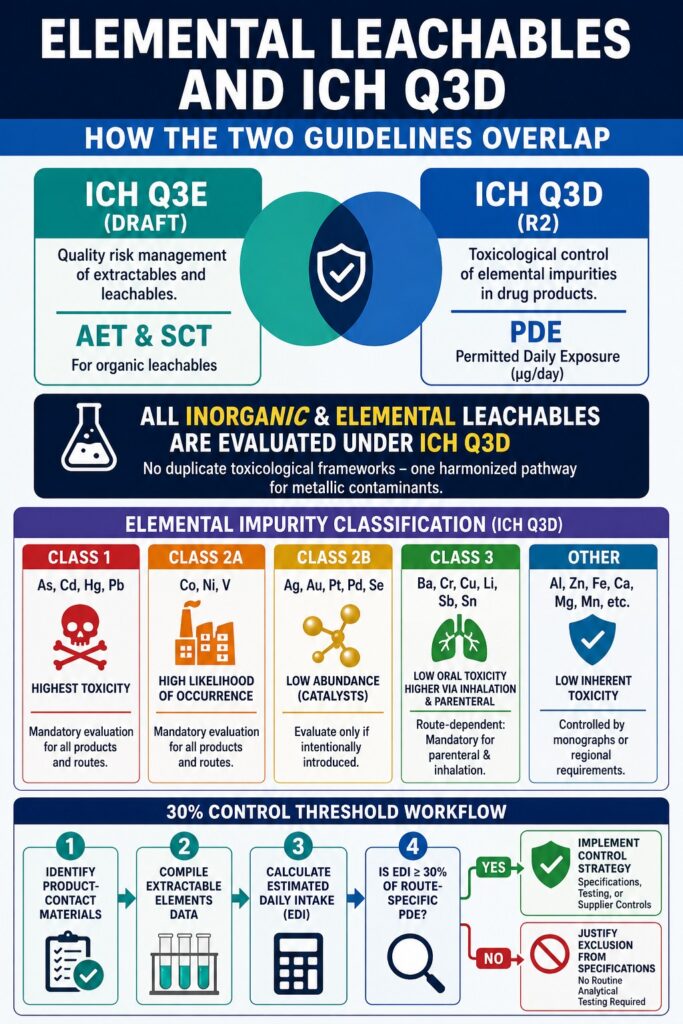
The principal intersection between elemental leachables and the toxicological limits established under ICH Q3D arises from the direct assignment of safety assessment responsibilities for inorganic packaging-derived migrants to the elemental impurities framework. Under the draft ICH Q3E guideline for extractables and leachables, organic leachables are assessed using Safety Concern Thresholds (SCT) and Qualification Thresholds (QT). In contrast, all inorganic and elemental leachables are evaluated directly according to the requirements outlined in ICH Q3D. This alignment eliminates the need for duplicate toxicological frameworks and creates a harmonized pathway for managing metallic contaminants that may migrate into pharmaceutical formulations from container closure systems (CCS), manufacturing equipment, and packaging materials.
To learn more about the evolving landscape of inorganic migrant management, read our expert guide on Extractables and Leachables in Biologics and ATMPs.
This regulatory relationship has evolved alongside international quality standards. The International Council for Harmonisation (ICH) introduced the draft ICH Q3E guideline to establish a globally harmonized quality risk management approach for extractables and leachables. Following public consultation completed in late 2025, finalization is targeted for June 2027. Simultaneously, the well-established ICH Q3D guideline continues to govern systemic toxicological risk through the application of strict Permitted Daily Exposure (PDE) limits for 24 elemental impurities across multiple routes of administration. When an elemental impurity enters a drug product through contact with packaging materials or processing equipment, it effectively transitions from a potential extractable or leachable to a regulated elemental impurity falling within the scope of ICH Q3D. As a result, a complete elemental risk assessment for a pharmaceutical product must incorporate detailed characterization of all packaging and product-contact materials.
| Regulatory Guideline | Primary Scope of Core Framework | Evaluation Threshold Metrics | Direct Interface Area |
|---|---|---|---|
| ICH Q3D (R2) | Toxicological control of elemental impurities in finished pharmaceutical drug products. | Permitted Daily Exposure (PDE) expressed in μg/day and the 30% Control Threshold. | Functions as the toxicological assessment standard for all inorganic migrants identified during packaging studies. |
| ICH Q3E (Draft Step 2) | Quality risk management of organic and inorganic extractables and leachables. | Analytical Evaluation Threshold (AET) and Safety Concern Threshold (SCT). | Explicitly assigns the derivation of limits for metal-based leachables to ICH Q3D. |
| USP <232>/<233> | Compendial limits and analytical procedures for elemental impurities in products marketed in the United States. | Target concentration limit (J) derived from clinical dosage. | Establishes mandatory testing protocols used to verify elemental migration from container closure systems. |
| Ph. Eur. 2.4.35 | Standardized extraction of metallic elements from plastic materials used in pharmaceutical manufacturing. | Analytical characterization without fixed pass/fail criteria. | Provides quantitative extractable data that feeds directly into the product-specific ICH Q3D assessment dossier. |
Stay informed on the shifting regulatory requirements by reviewing the Future of Extractables and Leachables Testing.
Article Summary:
- ICH Q3E and ICH Q3D work together to manage elemental leachables, with ICH Q3E addressing extractables and leachables broadly, while all inorganic and metal-based leachables are assessed using the toxicological limits established in ICH Q3D.
- Elemental impurities are classified according to toxicity and occurrence risk, enabling manufacturers to prioritize assessments for highly hazardous elements such as arsenic, cadmium, mercury, and lead, while applying route-specific evaluations for other metals.
- Packaging systems, manufacturing equipment, and process materials are major sources of trace metal contamination, including borosilicate glass, elastomeric closures, polymeric components, and stainless-steel surfaces that can release elemental impurities into drug products.
- Regulatory standards such as USP <232>/<233> and Ph. Eur. 2.4.35 provide the framework for testing and characterization, generating quantitative extractables data that supports product-specific elemental risk assessments.
- Risk management decisions are based on comparing Estimated Daily Intake (EDI) to the ICH Q3D Permitted Daily Exposure (PDE), with the 30% PDE threshold serving as a key trigger for implementing specifications, testing programs, or supplier controls.
- ICP-MS is the preferred analytical technology for elemental impurity testing, offering highly sensitive multi-element detection and supporting compliance through validated methods aligned with USP <233> and ICH requirements.
- A unified, science-based approach to elemental leachables and ICH Q3D improves patient safety and regulatory compliance, helping pharmaceutical manufacturers control inorganic contamination while reducing unnecessary testing and supporting global product approvals.
Classification and Toxicological Risk Profiling Under the Guidelines
Inorganic contaminants are categorized into distinct toxicological classes according to their intrinsic hazard characteristics and likelihood of occurrence within finished pharmaceutical products. This classification framework determines the depth and focus of risk assessments, enabling manufacturers to prioritize resources toward highly toxic elements while establishing route-dependent thresholds for elements with lower toxicological concern.
The classification system established by ICH Q3D and harmonized within USP <232> organizes elemental impurities to support risk-based testing strategies. Class 1 elements, including arsenic, cadmium, mercury, and lead, exhibit the highest level of human toxicity and generally provide little or no utility in pharmaceutical manufacturing. Since these elements may be present as unintended contaminants in mined excipients and raw materials, they must be considered in every elemental risk assessment regardless of administration route.
Explore how specific thresholds are derived in our detailed analysis: Extractables and Leachables: Carcinogenicity Testing.
Class 2 elements are regarded as route-dependent toxicants and are subdivided into two categories. Class 2A elements, including cobalt, nickel, and vanadium, possess a high probability of occurrence and therefore require evaluation across all products. Class 2B elements, such as gold, palladium, platinum, and selenium, are relatively rare and generally require assessment only when intentionally introduced as catalysts during synthesis.
Class 3 elements, including barium, chromium, copper, lithium, antimony, and tin, demonstrate relatively low toxicity when administered orally but require careful evaluation for parenteral and inhalation products due to increased systemic bioavailability through these routes. Additional elements such as aluminum, zinc, and iron do not possess established PDE values because of their comparatively low systemic toxicity and are typically controlled through monographs or regional regulatory requirements.
| Elemental Class | Identified Elements | Toxicological Risk Profile | Risk Assessment Mandate |
| Class 1 | As, Cd, Hg, Pb | High systemic human toxicity; commonly encountered as environmental and naturally occurring contaminants. | Mandatory evaluation across all potential sources and routes of exposure. |
| Class 2A | Co, Ni, V | High probability of occurrence in manufacturing streams and alloy compositions. | Mandatory evaluation across all potential sources and routes of exposure. |
| Class 2B | Ag, Au, Ir, Os, Pd, Pt, Rh, Ru, Se, Tl | Low natural abundance and typically associated with synthetic catalysts. | Required only when intentionally introduced during drug substance or excipient synthesis. |
| Class 3 | Ba, Cr, Cu, Li, Mo, Sb, Sn | Low oral toxicity but increased toxicity through parenteral and inhalation routes. | Route-dependent; mandatory for parenteral and inhalation products. |
| Other | Al, B, Ca, Fe, K, Mg, Mn, Na, W, Zn | Low inherent toxicity but may influence product quality or degradation pathways. | Excluded from standard PDE assessments and controlled through quality monographs. |
For insights into managing these risks in modern therapeutics, see Extractables and Leachables (E&L) in Emerging Biologics and Advanced Therapies.
Sourcing Trace Metals from Polymeric, Glass, and Elastomeric Packaging
Trace metals may migrate into pharmaceutical products from packaging materials, container closure systems, and manufacturing equipment when exposed to solvents, formulation components, and environmental stressors. Understanding the potential elemental leachables associated with borosilicate glass, elastomeric closures, and polymeric process materials enables manufacturers to correlate material characteristics with finished product quality and patient safety.
Glass Containers and Delamination Risk
Type I borosilicate glass remains the preferred material for parenteral vials, ampoules, and prefilled syringes. Although it is highly resistant to chemical attack, borosilicate glass consists of a complex network containing silicon dioxide, boron trioxide, aluminum oxide, sodium oxide, and alkaline earth oxides such as calcium, magnesium, and barium. During prolonged storage, particularly in the presence of alkaline formulations, elevated salt concentrations, or organic buffering systems including citric acid, phosphate buffers, and sodium bicarbonate, the glass surface may undergo hydrolytic degradation and delamination.
This degradation process can release silicon, boron, aluminum, and barium into the formulation. Within the elemental impurity framework, barium is classified as a Class 3 element and possesses an established parenteral PDE of 150 μg/day under USP requirements. Consequently, assessments of glass-derived leachables play a critical role in demonstrating that barium levels remain within acceptable toxicological limits and do not compromise finished product specifications.
Elastomeric Closures and Accelerators
Elastomeric components, including vial stoppers, syringe plungers, and tip caps, are produced through vulcanization processes involving vulcanization agents, accelerators, stabilizers, and pigments. These formulations frequently utilize zinc oxide as an inorganic activator, resulting in measurable levels of extractable zinc.
Additionally, elastomer compounding may introduce other elements of concern, including antimony, lead, cadmium, and cobalt. Historically, USP <381> focused on non-specific heavy metals testing and extractable zinc limits. However, modernization efforts and the implementation of USP <382>, effective December 1, 2025, place greater responsibility on drug manufacturers. Companies must now perform targeted elemental leachables studies to demonstrate that impurities such as antimony, a Class 3 element, or lead, a Class 1 element, do not migrate into liquid formulations at levels that pose toxicological concerns.
Polymeric Systems and Stainless Steel Alloys
Single-use polymeric manufacturing systems, including bioreactor bags, tubing assemblies, and filtration devices, often contain transition-metal catalysts, slip agents, and mineral fillers. Polyethylene and polypropylene materials may retain residual titanium, chromium, or nickel catalysts that can migrate into process intermediates under sterilization conditions or in the presence of aggressive solvents.
Similarly, stainless steel equipment surfaces and metal injection needles may release iron, nickel, chromium, cobalt, and copper when exposed to acidic or corrosive process environments. Because nickel, chromium, and cobalt are categorized as Class 2A or Class 3 elemental impurities, their cumulative contribution throughout the manufacturing process represents a critical consideration within the overall product risk assessment.
Learn more about addressing these specific packaging challenges in our resource on Packaging Leachables: Nitrosamine & E&L.
Extractable Elements Testing and the Impact on Elemental Leachables and ICH Q3D Risk Profiling
The quantitative evaluation of extractable elements provides the scientific foundation required to predict and control the long-term migration of metallic contaminants throughout a product’s shelf life. To bridge the gap between material science and toxicological evaluation, regulatory authorities have established pharmacopoeial chapters that require targeted elemental extraction studies for plastic materials used in pharmaceutical manufacturing.
Ensure your regulatory filings are compliant by checking our guide on E&L Testing for Drug Safety for NDA/ANDA Submissions.
European Pharmacopoeia Chapter 2.4.35, titled Extractable Elements in Plastic Materials for Pharmaceutical Use, together with USP General Chapters <661.1> and <661.2>, describes rigorous extraction procedures designed to simulate worst-case leaching conditions.
These compendial methods employ standardized extraction solvents, including acidified aqueous solutions and organic solvent mixtures, under autoclave conditions to liberate metallic species embedded within polymer matrices. Quantification using ICP-MS generates material-specific datasets that provide a detailed understanding of elemental extractables.
Importantly, modern compendial chapters have moved away from fixed pass/fail limits for plastic materials. Instead, they emphasize risk-based evaluations supported by recommendations outlined in Ph. Eur. General Text 5.42. This approach enables manufacturers to use quantitative extractables data generated under Chapter 2.4.35 directly as input for comprehensive ICH Q3D risk assessments.
Risk Management Frameworks and the 30% Control Threshold Workflow
The determination of whether routine analytical testing or process controls are required for a specific elemental impurity depends on comparison of its Estimated Daily Intake (EDI) with 30% of the corresponding PDE value. Through a structured Quality Risk Assessment (QRA) consistent with ICH Q9 principles, manufacturers can scientifically justify excluding low-risk elements from routine product specifications.
Workflow
Start QRM Process: Identify Product-Contact Materials
↓
Compile Extractable Elements Data (Ph. Eur. 2.4.35 / USP <661.1>)
↓
Calculate Estimated Daily Intake (EDI) of Trace Metals
↓
Is EDI ≥ 30% of Route-Specific PDE?
YES → Implement Control Strategy: Specifications, Testing, or Supplier Controls
NO → Justify Exclusion from Specifications: No Routine Analytical Testing Required
Hazard Identification
Manufacturers must establish a comprehensive inventory of all formulation-contact materials, including active pharmaceutical ingredients (APIs), excipients, packaging components, and manufacturing equipment. This stage relies on raw material testing, certificate of analysis reviews, and supplier-generated extractable element datasets to identify potential contamination sources.
Risk Analysis
For each identified element, analysts estimate potential finished-product exposure based on clinical dosing. Under USP <232>, manufacturers may apply the summation approach, which combines elemental contributions from all product components according to the following equation:
Estimated Daily Intake (EDI) = Σ(Ci × Wi) × DD
Where:
- Ci represents the concentration of the target element in component i (μg/g).
- Wi represents the weight of component i within a single dosage unit (g/unit).
- DD represents the maximum number of dosage units administered per day (units/day).
When raw material concentrations are unavailable, Option 1 employs a conservative assumption of a maximum daily drug product intake of 10 g/day for calculating acceptable concentration limits.
Integrated Risk Evaluation
The calculated EDI is directly compared with the applicable route-specific PDE. If the EDI remains consistently below 30% of the PDE, the associated risk is considered low and the element may be excluded from routine specifications. Values between 30% and 100% of the PDE require implementation of an appropriate control strategy to ensure continued compliance. Any exposure exceeding 100% of the PDE necessitates corrective action, alternative material sourcing, or robust scientific justification.
Advanced ICP-MS Methodology and USP <233> Method Validation
Inductively Coupled Plasma Mass Spectrometry (ICP-MS) is recognized as the leading analytical technique for demonstrating compliance with elemental impurity requirements. Its exceptional sensitivity and multi-element detection capabilities make it particularly suitable for quantifying trace metals in complex pharmaceutical matrices and packaging extracts.
Derivation of the Target Concentration (J)
USP <233> requires that all method validation parameters be linked to the target concentration value (J). This value represents the maximum allowable concentration of an element in the analytical sample solution and is calculated using the following equation:
J = PDE / (MDD × DF)
Where:
- PDE is the route-specific Permitted Daily Exposure (μg/day).
- MDD is the Maximum Daily Dose of the drug product (g/day or mL/day).
- DF is the sample preparation dilution factor, expressed as the ratio of final analytical volume to initial sample mass (mL/g).
Sample Preparation and Matrix Stabilization
Because elemental impurities differ significantly in chemical behavior and toxicity, sample preparation procedures must be demonstrated to be compatible with the specific material being evaluated. Closed-vessel microwave digestion using ultra-pure nitric acid and hydrochloric acid remains the preferred approach for dissolving polymeric and elastomeric matrices.
The closed-vessel design minimizes loss of volatile elements such as mercury and lead. Mercury, in particular, is susceptible to memory effects resulting from adsorption to sample containers and nebulizer surfaces. To mitigate this phenomenon, a gold stabilizer, typically 200 ppb Au³⁺, is added to form a stable amalgam, promoting rapid washout and consistent recovery.
Compendial Validation Parameters
Alternative ICP-MS methods must be validated according to USP <233> and ICH Q2(R2) requirements using spiked samples prepared before digestion.
Linearity: Demonstrated using a minimum of three calibration standards across a concentration range from 0.5J to 2.0J. Calibration curves must achieve a correlation coefficient (r ≥ 0.99). Internal standards such as scandium, yttrium, indium, or bismuth are typically employed to compensate for matrix effects and instrumental drift.
Accuracy: Evaluated through analysis of samples spiked at 0.5J, 1.0J, and 1.5J (or 2.0J) in triplicate. Mean recovery must fall within 70% to 150%.
Repeatability (System Precision): Determined by analyzing six independently prepared spiked samples at 1.0J. The relative standard deviation (%RSD) must not exceed 20%.
Ruggedness (Intermediate Precision): Demonstrated through variations involving analysts, instruments, or testing days. The overall intermediate precision must satisfy a %RSD ≤ 25%.
Specificity: Established by demonstrating freedom from spectral and polyatomic interferences. Modern ICP-MS instruments employ helium collision-cell technology with kinetic energy discrimination to eliminate interfering species, such as ArCl⁺ interference with arsenic measurements at m/z 75.
For a deeper dive into pharmacopoeial compliance, refer to USP Extractables and Leachables.
Industry Implications and the Role of Authoritative Laboratories
Successful execution of extractables and leachables programs, together with compendial elemental impurity testing, requires access to specialized cGMP-compliant laboratories possessing extensive expertise in material characterization and toxicological evaluation. As regulatory agencies continue to enforce compliance with USP <232>/<233>, USP <382>, and the forthcoming ICH Q3E guideline, pharmaceutical developers must generate robust scientific data packages capable of withstanding rigorous regulatory review.
To get started with professional testing, visit ResolveMass Extractables and Leachables Testing.
Specialized contract testing organizations, including ResolveMass Laboratories Inc., play a critical role in connecting raw material suppliers with finished product authorization holders. The selection of extraction solvents, autoclave exposure parameters, and Analytical Evaluation Thresholds (AETs) requires sophisticated scientific judgment and product-specific risk assessment strategies.
For organizations looking for premier analytical support, consult our guide: Best CRO for Extractables and Leachables (E&L) Testing in Canada.
Through the integration of advanced ICP-MS instrumentation and validated analytical workflows, these laboratories generate highly accurate and traceable datasets needed to demonstrate compliance with global safety standards. Collaboration with experienced analytical partners helps pharmaceutical manufacturers reduce regulatory risk, streamline qualification of high-risk materials, and maintain audit-ready quality systems throughout the commercial lifecycle of a product.
Conclusion: The Unified Paradigm of Elemental Leachables and ICH Q3D
A unified regulatory and analytical framework provides the most effective strategy for controlling inorganic contamination while supporting efficient global regulatory approvals. By recognizing packaging-derived metallic contaminants as significant contributors to finished product impurity profiles, the coordinated implementation of Elemental Leachables and ICH Q3D methodologies ensures patient safety without creating unnecessary testing redundancy.
Modern pharmaceutical development has moved beyond outdated qualitative heavy metals tests and now relies on quantitative, risk-based assessments that identify and manage material-related hazards early in the product lifecycle. This proactive approach enables manufacturers to establish robust control strategies that integrate material characterization, supply-chain transparency, and validated ICP-MS testing into a comprehensive compliance framework.
Organizations seeking to qualify container closure systems or perform GMP-compliant trace metal testing can develop customized study programs through the ResolveMass Laboratories Inc. contact portal, ensuring alignment with evolving global regulatory expectations while maintaining the highest standards of product quality and patient safety.
Frequently Asked Questions
The toxicological impact of elemental leachables is strongly influenced by the route through which a drug product is administered. Different administration pathways expose patients to varying levels of systemic absorption and biological defense mechanisms. For example, certain elements may present relatively low risk when ingested orally because of limited absorption through the gastrointestinal tract. However, the same elements can become significantly more hazardous when delivered through parenteral or inhalation routes, where they enter systemic circulation more directly and may accumulate in tissues or trigger toxic responses.
The 30% control threshold serves as a key decision point within the elemental impurities risk assessment process. It helps manufacturers determine whether routine monitoring or specification limits are necessary for a particular element. When analytical data demonstrate that an elemental leachable consistently remains below 30% of its applicable PDE throughout the product lifecycle, the associated risk is generally considered minimal. This allows companies to justify a reduced testing burden while maintaining compliance with regulatory expectations.
USP <661.1> and ICH Q3D were developed for different regulatory purposes, which explains the differences in the elements they emphasize. USP <661.1> focuses on understanding the composition and quality characteristics of plastic materials used in pharmaceutical applications. As a result, it evaluates elements commonly associated with polymer manufacturing processes, such as titanium, zirconium, and germanium. In contrast, ICH Q3D prioritizes elements based on their potential impact on patient safety and systemic toxicity, placing greater emphasis on toxicologically significant metals such as lead, arsenic, cadmium, and mercury.
The target concentration limit (J) is a critical parameter used during USP <233> method validation to establish clinically meaningful analytical performance criteria. It is calculated by dividing the route-specific Permitted Daily Exposure (PDE) by the product of the Maximum Daily Dose (MDD) and the dilution factor (DF). This calculation ensures that method validation activities, including assessments of accuracy, precision, and linearity, are conducted at concentration levels that directly reflect patient exposure limits. As a result, the validated method remains aligned with toxicological requirements and regulatory expectations.
Validation of an ICP-MS method for elemental leachables requires demonstration of several critical performance characteristics. These include specificity, linearity, accuracy, repeatability, intermediate precision, and quantitation capability. Regulatory guidelines require the method to accurately measure target elements across a defined concentration range while maintaining acceptable recovery and precision criteria. Together, these parameters confirm that the analytical procedure can reliably detect and quantify elemental impurities within complex pharmaceutical matrices and packaging extracts.
Although Type I borosilicate glass is widely recognized for its chemical durability, it can still contribute elemental impurities under certain storage conditions. Exposure to alkaline formulations, high ionic strength solutions, or aggressive buffering systems may gradually degrade the glass surface through hydrolytic attack or delamination. This process can release elements such as silicon, boron, aluminum, and barium into the drug product. Because some of these elements are regulated under elemental impurity guidelines, their potential migration must be considered during product risk assessments.
Mercury presents unique analytical challenges because of its volatility and tendency to adhere to sample introduction components within ICP-MS systems. This behavior can lead to memory effects, causing inaccurate results and contamination of subsequent analyses. The addition of gold ions stabilizes mercury in solution by forming a chemically stable complex that minimizes adsorption and carryover. As a result, analytical performance improves significantly, providing more accurate quantification and reproducible recovery of mercury during testing.
The implementation of USP <382> represents a significant modernization of elastomeric closure testing requirements. Rather than focusing solely on material-specific characteristics, the updated chapter places greater emphasis on evaluating the performance of closures within the complete packaging system. Physical attributes such as self-sealing capability, fragmentation resistance, and functional integrity are assessed more comprehensively. At the same time, traditional qualitative heavy metals tests have been phased out, increasing the importance of targeted extractables and leachables studies.
Reference:
- International Council for Harmonisation of Technical Requirements for Pharmaceuticals for Human Use. (2025). ICH Q3E guideline for extractables and leachables (Draft Step 2 guideline). European Medicines Agency. https://www.ema.europa.eu/en/documents/scientific-guideline/draft-ich-q3e-guideline-extractables-leachables_en.pdf
- U.S. Food and Drug Administration. (2025). Q3E guideline for extractables and leachables: Draft guidance for industry. https://www.fda.gov/media/189890/download
- International Council for Harmonisation of Technical Requirements for Pharmaceuticals for Human Use. (2020). ICH Q3E: Guideline for extractables and leachables (E&L): Final concept paper. https://database.ich.org/sites/default/files/ICH_Q3E_ConceptPaper_2020_0710.pdf
- International Council for Harmonisation of Technical Requirements for Pharmaceuticals for Human Use. (2022). Q3D(R2): Guideline for elemental impurities. U.S. Food and Drug Administration. https://www.fda.gov/media/148474/download
- European Medicines Agency. (2025). ICH Q3E extractables and leachables – Scientific guideline. https://www.ema.europa.eu/en/ich-q3e-extractables-leachables-scientific-guideline
- International Council for Harmonisation of Technical Requirements for Pharmaceuticals for Human Use. (2022). ICH Q3D(R2) guideline for elemental impurities (Step 4 version). https://database.ich.org/sites/default/files/Q3D-R2_Guideline_Step4_2022_0308.pdf
- United States Pharmacopeial Convention. (2025). 〈233〉 Elemental impurities—Procedures. United States Pharmacopeia. https://www.usp.org/sites/default/files/usp/document/our-work/chemical-medicines/key-issues/233_ElementalImpuritiesProcedures.pdf
Get In Touch With Us
About The Author


