

Introduction
Extractables & Leachables (E&L) Testing for Veterinary Drug Products is an essential safety and regulatory requirement designed to ensure that packaging materials do not release harmful chemical substances into pharmaceutical formulations throughout their intended shelf-life. In accordance with VICH guidelines, this testing verifies that interactions between the drug product and its container-closure system do not negatively affect the product’s stability, efficacy, or overall safety. The reliability and therapeutic performance of animal health products rely significantly on the comprehensive qualification of packaging materials, making Extractables & Leachables (E&L) Testing for Veterinary Drug Products a critical element of contemporary veterinary pharmaceutical development.
Learn more about our comprehensive Extractables & Leachables (E&L) Testing Services for Veterinary Drug Products
Although earlier regulatory frameworks primarily emphasized compliance for human medicinal products, regulatory authorities such as the FDA Center for Veterinary Medicine (CVM), the European Medicines Agency (EMA), and Health Canada have progressively strengthened their expectations regarding packaging systems used for veterinary pharmaceuticals. Veterinary container closure systems (CCS) encompass a wide variety of specialized designs, including large-volume parenteral containers intended for livestock, intramammary syringes, and multidose vials fitted with thick elastomeric stoppers. These diverse packaging configurations create an increased potential for interactions between packaging materials and drug formulations. When chemical migration remains unidentified or insufficiently characterized, it can reduce drug potency, modify important physical characteristics, or introduce potentially harmful compounds directly into sensitive animal species. As a result, implementing a comprehensive, scientifically justified validation strategy that complies with internationally recognized quality guidelines is essential for achieving successful regulatory approval and market authorization.
Share via:
Article Summary:
- Extractables & Leachables (E&L) testing is a critical part of veterinary drug development, ensuring that packaging materials do not release harmful chemicals that could compromise product quality, stability, efficacy, or animal safety throughout the product’s shelf life.
- Compliance with VICH guidelines, particularly VICH GL3(R), GL51, GL8(R), and GL58, requires manufacturers to evaluate chemical migration under both long-term and accelerated storage conditions using scientifically validated stability and statistical approaches.
- Species-specific toxicology plays a major role in veterinary E&L assessments because different animals metabolize chemical contaminants differently. For example, cats are highly sensitive to certain phenolic compounds, while dogs have limited ability to detoxify aromatic amines.
- Packaging-derived contaminants can accumulate in food-producing animals, making residue evaluation essential to ensure compliance with Maximum Residue Limits (MRLs) and to protect consumers from chemical exposure through meat, milk, and eggs.
- The Analytical Evaluation Threshold (AET) is calculated using toxicological safety limits, dosing volume, and analytical uncertainty factors to determine which leachable compounds require identification and toxicological qualification.
- Comprehensive analytical characterization relies on advanced techniques such as GC-MS, LC-MS, ICP-MS, and high-resolution mass spectrometry to detect, identify, and quantify organic and elemental leachables across diverse packaging materials.
- An effective E&L strategy combines risk-based packaging qualification, USP requirements, stability studies, and regulatory compliance, helping manufacturers ensure safe veterinary medicines, strengthen regulatory submissions, and achieve successful global product approvals.
VICH GL51 Compliance and Extractables & Leachables (E&L) Testing for Veterinary Drug Products
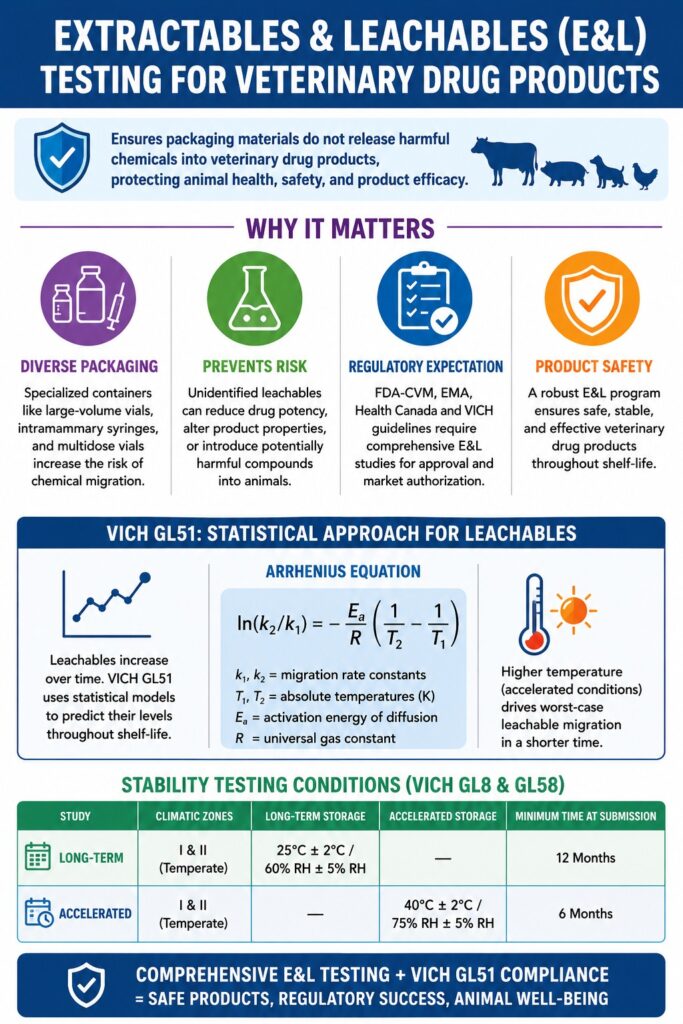
VICH GL51 provides the statistical framework used to assess quantitative stability data and establish scientifically supported projections for drug product shelf-life or retest periods. Within the context of extractables and leachables studies, this statistical methodology is applied to evaluate the progression of migrating chemical compounds under both long-term and accelerated storage conditions, ensuring that established safety thresholds remain within acceptable limits throughout the product lifecycle. While the parent guideline, VICH GL3(R), defines the fundamental requirements for veterinary stability testing, VICH GL51 introduces the statistical rigor necessary to justify shelf-life extensions through regression analysis and poolability assessments.
Read about Leachables monitoring during stability studies to ensure ongoing product safety.
Because leachable compounds gradually migrate into pharmaceutical formulations over time, their concentrations should be regarded as independent, time-dependent impurity profiles. Conventional stability programs primarily focus on the degradation of the active pharmaceutical ingredient (API); however, a complete VICH GL51 submission requires leachable migration kinetics to be evaluated as quantitative stability-indicating attributes. Under standard storage conditions, the migration rate is influenced by several factors, including temperature, humidity, and the physicochemical characteristics of the packaging polymers. This migration process is commonly described using Fickian diffusion principles, while its dependence on temperature is projected using the Arrhenius equation:
ln(k2/k1) = −Ea/R (1/T2 − 1/T1)
Where k1 and k2 denote the migration rate constants at the absolute temperatures T1 and T2, respectively, Ea represents the activation energy of diffusion, and R corresponds to the universal gas constant. This thermodynamic relationship clearly explains why accelerated stability testing conditions (40°C ± 2°C / 75% RH ± 5% RH) are indispensable for generating worst-case leachable accumulation within significantly reduced study timelines.
Understand the root causes of failed extractables and leachables (E&L) studies to avoid regulatory setbacks.
VICH GL51 also establishes a structured decision-making process for determining whether data generated from multiple manufacturing batches can be pooled for statistical analysis. When the regression slopes and intercepts describing leachable concentration profiles are statistically comparable ((p > 0.25)), the resulting datasets may be combined to generate a single, robust shelf-life projection with enhanced statistical confidence. Conversely, when significant batch-to-batch variability exists ((p \le 0.25)), the proposed shelf-life must be determined using the batch that demonstrates the most rapid rate of leachable accumulation. According to VICH GL51, when long-term stability data confirm that leachable concentrations consistently remain well below established safety limits, and accelerated studies demonstrate no “significant change” (generally defined as exceeding an established safety or potency threshold within three months), the proposed shelf-life may be scientifically extrapolated up to 1.5 times the duration of the available long-term stability data, with the total extension limited to a maximum of six months.
The table below summarizes the standard stability testing conditions applicable across various climatic zones as specified in VICH GL8(R) and VICH GL58. These guidelines define the environmental stress conditions used to generate leachable migration kinetics and support stability evaluations.
| Study | Climatic Zones | Storage Conditions | Minimum Time Period at Submission |
|---|---|---|---|
| Long-Term | I and II (Temperate / Subtropical) | 25°C ± 2°C / 60% RH ± 5% RH or 30°C ± 2°C / 65% RH ± 5% RH | 12 Months |
| Long-Term | III (Hot and Dry) | 30°C ± 2°C / 35% RH ± 5% RH | 12 Months |
| Long-Term | IVA (Hot and Humid) | 30°C ± 2°C / 65% RH ± 5% RH | 12 Months |
| Long-Term | IVB (Hot and Very Humid) | 30°C ± 2°C / 75% RH ± 5% RH | 12 Months |
| Intermediate | I and II | 30°C ± 2°C / 65% RH ± 5% RH | 6 Months |
| Accelerated | I, II, III, IVA, and IVB | 40°C ± 2°C / 75% RH ± 5% RH (or ≤25% RH for dry Zone III) | 6 Months |
Species-Specific Toxicological Risks and Target Animal Safety
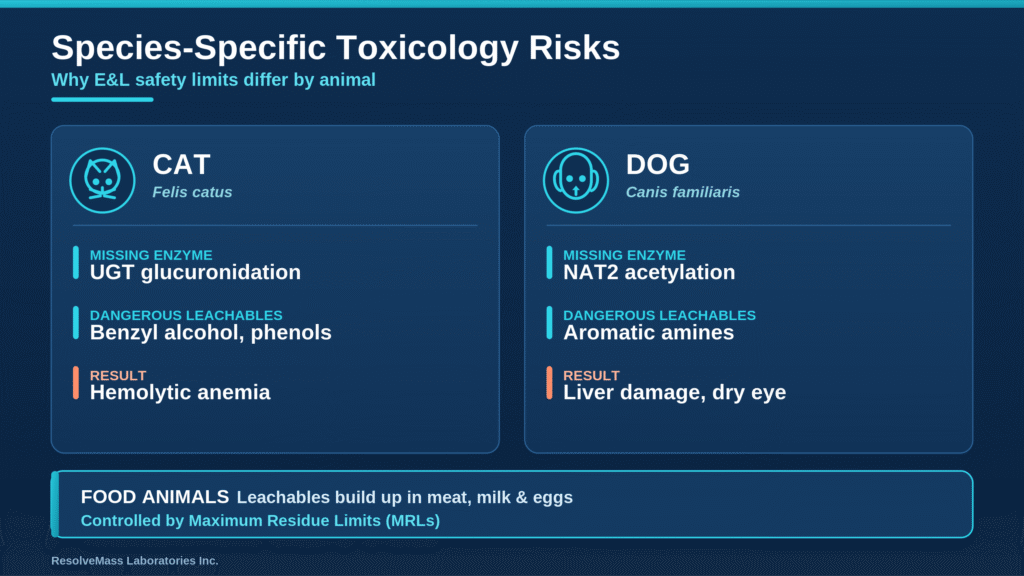
Target animal safety assessments must carefully consider species-specific metabolic characteristics because certain veterinary species exhibit pronounced sensitivity to chemical migrants that may produce little or no toxicity in humans or other animal species. In particular, domestic felines and canines possess inherited enzymatic deficiencies that substantially increase their susceptibility to specific categories of packaging-derived leachables. Consequently, Extractables & Leachables (E&L) safety evaluations should be developed using toxicological thresholds that are specific to the intended animal species rather than relying exclusively on generalized human-based toxicological models.
Learn how to perform toxicological qualification of leachables effectively.
Feline Glucuronidation and Glycine Conjugation Deficiencies
Domestic cats (Felis catus) and other members of the Felidae family lack the principal hepatic phenol UDP-glucuronosyltransferase (UGT) enzymes, particularly UGT1A6 and UGT1A9, which play a vital role in the metabolic conjugation and elimination of planar phenolic xenobiotics. In the majority of mammalian species, potentially toxic aromatic compounds undergo conjugation with glucuronic acid, allowing them to be efficiently eliminated through urine or bile. In cats, however, this detoxification pathway is essentially absent because the UGT1A6 gene exists as a mutated pseudogene containing multiple frame-shift mutations and premature stop codons that have become fixed throughout the evolutionary history of the Felidae lineage.
This metabolic limitation has direct implications for several common packaging-derived leachables, including:
Benzyl Alcohol and Benzoic Acid: These compounds are widely used as preservatives in injectable formulations and may also be present as leachable contaminants originating from elastomeric closures and label adhesives. In most animal species, benzyl alcohol is first oxidized to benzoic acid, which is subsequently conjugated with either glycine or glucuronic acid before being excreted. Cats, however, are unable to glucuronidate benzoic acid and possess only a limited capacity for glycine conjugation, resulting in a slow and easily saturated detoxification process. Consequently, exposure can lead to benzoic acid toxicity, which is characterized by severe metabolic acidosis, hyperesthesia, muscle tremors, and potentially fatal neurotoxicity.
Phenolic Compounds and Propofol: Chemical substances such as 2,6-diisopropylphenol (propofol) and phenolic antioxidants, including octadecyl di-tert-butyl-hydroxyhydrocinnamate, are eliminated considerably more slowly in cats than in many other species. Repeated exposure to these compounds may result in prolonged recovery periods and oxidative damage to feline red blood cells (RBCs). Feline hemoglobin contains an unusually high concentration of sulfhydryl groups, making it especially susceptible to oxidative denaturation. Clinically, this manifests as Heinz body hemolytic anemia and methemoglobinemia.
Canine Acetylation Deficiencies
Dogs (Canis lupus familiaris) possess a distinct metabolic deficiency resulting from the complete genetic absence of the arylamine N-acetyltransferase 2 (NAT2) gene. As a result, canines are incapable of acetylating primary aromatic amines (PAAs) and hydrazine derivatives, both of which are commonly encountered as degradation products originating from polyurethane adhesives, synthetic colorants, and vulcanizing agents used in multilayer packaging laminates. In the absence of a functional acetylation pathway, these chemical compounds are forced to undergo alternative metabolic processing through oxidative mechanisms, including cytochrome P450-mediated metabolism. This alternative pathway generates reactive and highly toxic intermediate metabolites. The accumulation of these metabolites can produce serious clinical consequences, including acute hepatocellular necrosis, methemoglobinemia, and keratoconjunctivitis sicca (dry eye syndrome) resulting from direct toxic injury to the acinar cells of the lacrimal glands.
Impact on Food-Producing Animals and Maximum Residue Limits
Packaging-derived residues associated with veterinary drug products have the potential to migrate into the tissues of food-producing animals, thereby entering the human food chain and potentially exceeding internationally established food safety standards. Consequently, leachables present in veterinary formulations intended for livestock must be evaluated against established Maximum Residue Limits (MRLs) and incorporated into residue depletion studies. Protecting human consumers from exposure to these contaminants represents one of the major distinctions between veterinary pharmaceutical development and human pharmaceutical development.
When livestock species such as beef cattle, dairy cattle, swine, or poultry receive therapeutic veterinary medications, any packaging-derived migrant contained within the formulation is administered directly to the animal alongside the active pharmaceutical ingredient. Highly lipophilic leachables, including phthalates such as di(2-ethylhexyl) phthalate (DEHP), bisphenols such as BPA, and alkylphenol ethoxylates, preferentially partition into lipid-rich tissues. As a result, these compounds may bioaccumulate in edible products including meat, milk, and eggs.
To safeguard public health by minimizing chronic dietary exposure to these chemical impurities, international regulatory authorities, including the European Medicines Agency under Regulation EU 37/2010 and the FDA Center for Veterinary Medicine (CVM), establish stringent Maximum Residue Limits (MRLs) for active pharmaceutical ingredients, excipients, and associated impurities present in food products of animal origin. Under VICH GL49, residue depletion studies are required to establish scientifically justified withdrawal periods. If a packaging-derived leachable demonstrates slow elimination kinetics or possesses bioaccumulative characteristics, it may remain within animal tissues long after the active pharmaceutical ingredient has been eliminated, thereby increasing the likelihood of violative residues being detected at the time of slaughter or milk collection.
Derivation of the Analytical Evaluation Threshold for Veterinary Packaging
The Analytical Evaluation Threshold (AET) represents the concentration limit at or above which an organic extractable or leachable must be identified and subjected to toxicological qualification. For veterinary drug products, determining the AET involves converting dosage-based toxicological safety thresholds into concentration-based values by considering the maximum daily dose administered to the target animal species. Because dosing regimens and body weights vary substantially among veterinary species, the derivation of the AET is highly dependent upon these parameters and represents one of the most demanding aspects of analytical method validation.
Understand the necessity of AET for extractables and leachables studies in ensuring drug safety.
The Core Mathematical Formula for AET Calculation
The Safety Concern Threshold (SCT) defines the maximum acceptable daily intake of an individual organic leachable, typically expressed in (\mu\text{g}/\text{day}), below which the associated toxicological risk is considered negligible. For parenteral drug products, the widely accepted baseline SCT is (1.5\ \mu\text{g}/\text{day}), corresponding to an estimated lifetime cancer risk of less than 1 in 1,000,000. The Analytical Evaluation Threshold (AET) is derived directly from this toxicological threshold using the following equation:
AET (µg/mL) = [SCT (µg/day) / Maximum Daily Volume (mL/day)] × UF
In this equation, UF represents the analytical Uncertainty Factor. The Uncertainty Factor serves as a critical correction multiplier that lowers the analytical reporting threshold to compensate for differences in the relative response factors (RRFs) of unknown analytes when analyzed using High-Performance Liquid Chromatography (HPLC) and Gas Chromatography (GC) detection systems. When an unknown leachable exhibits a substantially lower detector response than the internal calibration standard, the application of the UF helps ensure that the compound remains detectable and is appropriately reported. Typical UF values generally range from 0.1 to 0.5 for hyphenated analytical techniques such as GC-MS and LC-MS.
Specific Calculation for a Bovine Large-Volume Parenteral
Determining the AET for bovine large-volume parenteral formulations frequently produces exceptionally low concentration thresholds because of the large daily administration volumes involved. For a typical 500 mL daily infusion, the required analytical sensitivity may extend into the sub-parts-per-billion (sub-ppb) range, creating significant analytical and instrumental challenges.
Clinical Scenario: A dairy cow receives a 500 mL intravenous calcium infusion as a single daily dose for the treatment of milk fever.
Parameters: SCT = 1.5 µg/day, Maximum Daily Volume = 500 mL/day, Conservative UF = 0.2
Calculation:
AETbovine = (1.5 µg/day ÷ 500 mL/day) × 0.2 = 0.003 × 0.2 = 0.0006 µg/mL (0.6 ppb)
Achieving reliable detection at this sub-ppb concentration presents an exceptional analytical challenge. The direct detection and structural identification of unknown organic compounds at 0.6 ppb within a complex pharmaceutical matrix are generally beyond the capabilities of conventional screening methodologies. To overcome these limitations, analytical laboratories must employ extensive sample preparation procedures, including liquid-liquid extraction (LLE) or solid-phase extraction (SPE) with substantial concentration factors, followed by analysis using highly sensitive High-Resolution Accurate Mass Spectrometry (HRAM-MS/Orbitrap) instrumentation.
Specific Calculation for a Canine Small-Volume Injection
The calculation of the Analytical Evaluation Threshold (AET) for low-volume canine injectable products produces a substantially higher concentration threshold that is considerably easier to achieve using conventional analytical instrumentation. For a typical daily administration volume of 2 mL, standard gas chromatography and liquid chromatography platforms are capable of reliably detecting and quantifying leachable compounds present above the calculated threshold.
Clinical Scenario: A 15 kg canine receives a small-volume subcutaneous antibiotic injection.
Parameters: SCT = 1.5 µg/day, Maximum Daily Volume = 2.0 mL/day, UF = 0.2
Calculation:
AETcanine = (1.5 µg/day ÷ 2.0 mL/day) × 0.2 = 0.75 × 0.2 = 0.15 µg/mL (150 ppb)
An Analytical Evaluation Threshold of 150 ppb falls comfortably within the standard limit of quantitation (LOQ) achievable by modern HPLC-UV/MS and GC-MS instrumentation, eliminating the need for complex sample concentration procedures. As a result, routine analytical validation can be performed with greater precision while minimizing the likelihood of matrix-induced signal suppression, thereby improving overall analytical reliability.
Explore how ICP-MS in extractables and leachables testing complements organic analysis for elemental safety.
Analytical Screening in Extractables & Leachables (E&L) Testing for Veterinary Drug Products
Analytical screening strategies employ multiple orthogonal detection techniques to comprehensively evaluate the full volatility range of potential migrating compounds, ensuring that no chemical species present above the calculated Analytical Evaluation Threshold remains undetected. This multi-detector analytical approach is fundamental for demonstrating packaging safety, generating comprehensive chemical profiles, and supporting compliance with VICH GL51 requirements.
Compare GC-MS vs LC-MS in extractables and leachables testing to determine the best analytical approach for your study.
The table below summarizes the toxicological safety thresholds and analytical classification framework commonly applied in both human and veterinary pharmaceutical evaluations.
| Threshold Category | Unit of Measure | Target Values & Application | Primary Toxicological Concern |
|---|---|---|---|
| Safety Concern Threshold (SCT) | µg/day | ≤ 0.15 (OINDP) ≤ 1.5 (Parenterals) | Carcinogenicity, mutagenicity, and severe acute systemic toxicity. |
| Qualification Threshold (QT) | µg/day | ≤ 5.0 (Non-mutagens) | Non-carcinogenic systemic toxicity and chronic target organ toxicity. |
| Cramer Class I (Low Risk) | µg/day | ≤ 50.0 | Simple chemical structures associated with a low probability of systemic toxicity. |
| Cramer Class II (Moderate Risk) | µg/day | ≤ 5.0 | Chemical structures containing features that indicate a potential toxicological concern. |
| Cramer Class III (High Risk) | µg/day | ≤ 1.5 | Chemical structures that do not permit an initial assumption of safety or may indicate carcinogenic potential. |
Aligning Manufacturing and Packaging Standards with USP General Chapters
The safety of polymeric materials used during veterinary pharmaceutical manufacturing and in final packaging systems is achieved by integrating VICH stability requirements with standardized USP General Chapters. While USP chapters governing manufacturing systems require a risk-based approach for evaluating polymeric process equipment, separate USP chapters addressing extractables and leachables establish expectations for characterizing final container closure systems. This integrated regulatory strategy provides a comprehensive risk assessment that extends from the earliest manufacturing operations through the entire shelf life of the finished veterinary medicinal product.
Discover the importance of data integrity in extractables and leachables testing to meet rigorous compliance standards
USP General Chapters for Polymeric Manufacturing Systems
Effective beginning May 1, 2026, the applicable USP General Chapter establishes standardized requirements for evaluating extractables and leachables originating from polymer-based plastic components used during the manufacture of pharmaceutical substances and finished drug products. This mandatory chapter applies to both single-use systems (SUS) and reusable processing equipment, including tubing, sterilizing filters, single-use bioreactor bags, connectors, and gaskets that come into direct contact with manufacturing process streams.
Under the guidance provided by this USP chapter, a structured risk-based assessment matrix is applied to categorize manufacturing components as low-, moderate-, or high-risk according to factors such as contact duration, operating temperature, and the chemical characteristics of the process fluid. Components classified as moderate or high risk require comprehensive chemical characterization using three standardized extraction media: an acidic solution (pH 3.0), a basic solution (pH 10.0), and an organic co-solvent such as 54% ethanol. These extraction conditions are designed to generate a complete profile of potential process equipment-related leachables (PERLs) that may migrate from manufacturing equipment into pharmaceutical products.
Learn more about selecting low-leachables packaging materials to proactively mitigate risks.
USP General Chapters for Final Packaging Qualification
Whereas USP requirements for manufacturing systems focus on polymeric processing equipment, qualification of the marketed primary packaging system remains governed by the USP General Chapters dedicated to extractables characterization and leachables monitoring. Controlled Extractables Studies (CES) are conducted under intentionally exaggerated laboratory conditions using elevated temperatures, solvents with varying polarities, and extreme pH environments to establish a comprehensive chemical fingerprint of the packaging materials.
After potential extractable compounds have been identified, targeted analytical methods developed under Good Manufacturing Practice (GMP) requirements are validated and implemented to monitor and quantify the migration of these compounds as actual leachables within the finished drug product. These studies are performed under realistic long-term and accelerated stability storage conditions throughout the product’s shelf life in accordance with the timelines established under VICH GL3(R) and VICH GL51.
The table below correlates commonly used polymeric membrane materials in veterinary sterile manufacturing with their principal characteristics, typical extractables profiles, and recommended filtration applications.
| Membrane Material | Primary Material Feature | Extractables Profile | Major Extractables & Additives | Recommended Filter Application |
|---|---|---|---|---|
| Polyethersulfone (PES) | High flow rate with low protein binding. | Very Low | Polymeric oligomers and membrane wetting agents. | Sterile filtration of biological products, vaccines, and aqueous parenteral formulations. |
| Polyvinylidene Fluoride (PVDF) | Low protein binding characteristics. | Low | Low-molecular-weight oligomers and fluoropolymer residues. | Protein-rich formulations, HPLC sample clarification, and biotechnology processing. |
| Polytetrafluoroethylene (PTFE) | Excellent chemical compatibility. | Very Low | Fluorinated residues and hydrophilic surfactants. | Filtration of aggressive organic solvents, sterile gas venting, and strong acid/base applications. |
| Nylon | High mechanical strength with hydrophilic properties. | Low | Polyamide oligomers and residual monomers. | General aqueous filtration and HPLC mobile phase preparation. |
View our detailed breakdown of E&L testing cost and services.
Conclusion
Achieving regulatory compliance with VICH GL51 for Extractables & Leachables (E&L) Testing for Veterinary Drug Products requires the successful integration of statistical stability modeling, migration kinetics, species-specific toxicological assessment, and standardized compendial testing practices. By implementing scientifically justified, risk-based chemical characterization strategies together with targeted leachable stability studies, pharmaceutical manufacturers can effectively protect animal health while satisfying increasingly rigorous global regulatory expectations. Ultimately, performing comprehensive Extractables & Leachables (E&L) Testing for Veterinary Drug Products in full accordance with VICH GL51 helps ensure that veterinary pharmaceuticals maintain their safety, stability, quality, and therapeutic effectiveness throughout the entirety of their commercial shelf life.
The unique physiological characteristics encountered in veterinary medicine, including feline glucuronidation deficiencies and canine acetylation deficiencies, require highly specialized and exceptionally sensitive toxicological assessment strategies. In addition, with the mandatory implementation of the applicable USP General Chapter beginning on May 1, 2026, pharmaceutical developers must establish a fully compliant Extractables & Leachables strategy that encompasses both single-use manufacturing systems and finished packaging configurations. By utilizing advanced hyphenated chromatography techniques together with high-resolution mass spectrometry platforms, pharmaceutical organizations can accurately characterize migration kinetics, strengthen regulatory submissions, and support successful product approvals across international markets.
To develop a scientifically robust, fully compliant Extractables & Leachables (E&L) testing program or to address existing regulatory data gaps associated with your veterinary drug products, collaborate with the analytical specialists at ResolveMass Laboratories Inc. Let’s connect – Contact us
Frequently Asked Questions (FAQs)
Cats possess a unique metabolic limitation because the UGT1A6 gene responsible for glucuronidation is non-functional. As a result, they are unable to efficiently detoxify many phenolic and aromatic compounds that other species eliminate with relative ease. Packaging-derived chemicals such as benzyl alcohol and phenolic antioxidants may therefore accumulate within the body, increasing the risk of metabolic acidosis, neurological toxicity, oxidative damage to red blood cells, and Heinz body hemolytic anemia. This species-specific sensitivity must be considered during toxicological risk assessments.
A comprehensive Extractables & Leachables (E&L) study requires multiple analytical techniques because no single instrument can detect every type of chemical compound. Headspace GC-MS is typically used for volatile organic compounds (VOCs), while direct injection GC-MS analyzes semi-volatile organic compounds (SVOCs). Non-volatile organic compounds (NVOCs) are commonly evaluated using UHPLC coupled with High-Resolution Accurate Mass Spectrometry (HRAM-MS/Orbitrap) and UV detection, whereas ICP-MS is employed for elemental impurity analysis.
Large-volume parenteral formulations administered to cattle often involve daily doses ranging from several hundred milliliters to one liter. Because the Safety Concern Threshold (SCT) is distributed across a much larger administration volume, the resulting Analytical Evaluation Threshold becomes extremely low, frequently reaching sub-parts-per-billion concentrations. Detecting compounds at these trace levels requires highly sensitive instrumentation, advanced extraction techniques, and carefully optimized analytical methods to ensure accurate identification and quantification.
VICH GL51 recommends using a significance level of p = 0.25 when assessing whether stability data generated from multiple manufacturing batches can be combined for statistical analysis. This relatively conservative threshold helps identify meaningful differences between batches before data are pooled. If the calculated p-value falls below 0.25, the batches are considered statistically different, and shelf-life determinations should be based on individual batch performance rather than combined datasets.
Primary aromatic amines (PAAs) may originate as residual compounds or degradation products from polyurethane adhesives, synthetic azo dyes, and other materials used in multilayer packaging systems. Dogs lack the NAT2 enzyme required for normal N-acetylation of these compounds, preventing efficient detoxification. Instead, PAAs undergo alternative oxidative metabolism, producing reactive intermediates that can contribute to liver injury, methemoglobinemia, and keratoconjunctivitis sicca (dry eye syndrome).
VICH GL58 expands veterinary stability testing requirements by addressing climatic Zones III and IV, which represent hot, dry, and hot, humid environmental conditions that may not be fully covered by earlier guidance. VICH GL8(R) provides additional recommendations for medicated premixes intended for animal feed, including stability assessments under elevated temperature and humidity conditions. These guidelines help ensure that veterinary medicines remain stable, effective, and safe across a wide range of global environmental conditions.
Reference:
- United States Pharmacopeia. (n.d.). Extractables and leachables. https://www.usp.org/impurities/extractables-and-leachables
- Health Canada. (2019, July 31). Post-notice of compliance (NOC) changes: Guidance for quality of veterinary drugs. Government of Canada. https://www.canada.ca/content/dam/hc-sc/documents/services/drugs-health-products/veterinary-drugs/post-notice-compliance-changes-guidance-quality/post-notice-compliance-changes-guidance-quality.pdf
- U.S. Food and Drug Administration. (2014, May). CVM GFI #219 (VICH GL51): Statistical evaluation of stability data. https://www.fda.gov/regulatory-information/search-fda-guidance-documents/cvm-gfi-219-vich-gl51-statistical-evaluation-stability-data
- Health Canada. (2024). Guidance for industry: Preparation of veterinary new drug submissions and abbreviated new drug submissions (new and generic drugs) – Quality requirements: Drug product. Government of Canada. https://www.canada.ca/en/health-canada/services/drugs-health-products/veterinary-drugs/guidance-industry-preparation-new-drug-submissions-abbreviated-quality-requirements/drug-product.html
- European Medicines Agency. (2007, February 19). VICH GL11: Impurities in new veterinary medicinal products – Scientific guideline. https://www.ema.europa.eu/en/vich-gl11-impurities-new-veterinary-medicinal-products-scientific-guideline
- European Medicines Agency. (2013, March 13). VICH GL51: Quality: Statistical evaluation of stability data (EMA/CVMP/VICH/858875/2011). https://www.ema.europa.eu/en/documents/scientific-guideline/vich-gl51-quality-statistical-evaluation-stability-data_en.pdf
- International Council for Harmonisation of Technical Requirements for Pharmaceuticals for Human Use. (2025, September). ICH Q3E: Guideline for extractables and leachables: Step 2 draft guideline – Released for comments [PowerPoint presentation]. https://database.ich.org/sites/default/files/ICH_Q3E_Step2_Presentation_2025_0826.pdf
Get In Touch With Us
About The Author


