

Introduction
Under the FDA’s Draft Guidance on Comparative Efficacy Studies, prospective biosimilar applicants may be able to avoid routine Phase III comparative clinical efficacy studies by providing a comprehensive comparative analytical assessment (CAA), supported by clinical pharmacokinetic, pharmacodynamic, and immunogenicity evaluations. This regulatory approach places greater emphasis on high-resolution biophysical testing, which can identify subtle molecular and structural differences that clinical trials may not reliably detect. Published in October 2025, this draft guidance aligns the United States regulatory approach for therapeutic protein products under Section 351(k) of the Public Health Service (PHS) Act with international regulatory frameworks established by the UK’s Medicines and Healthcare products Regulatory Agency (MHRA) and the European Medicines Agency (EMA).
By reducing dependence on comparative clinical trials, the Food and Drug Administration aims to address a major financial and time-related obstacle in biological drug development. Traditionally, Phase III comparative efficacy studies have represented one of the most expensive and time-consuming stages of biosimilar development, generally costing between 20 million and 28 million per program and taking 1 to 3 years to complete. Evidence accumulated over more than fifteen years of biosimilar regulatory reviews suggests that clinical efficacy endpoints, which typically operate within broad statistical equivalence margins of 15% to 20%, may be less sensitive to subtle molecular differences than advanced analytical platforms capable of detecting variations at approximately the 1% to 2% level.
Waiving Phase III comparative efficacy trials can reduce overall development expenditures by an average of 25 million per program, shorten development timelines by 1.5 to 3 years, improve risk-adjusted net present value (NPV) by 25% to 29%, and lower the minimum peak sales threshold required for commercial viability from 300 million to 250 million or less. However, securing a Phase III clinical waiver places greater scientific responsibility on the sponsor to establish biosimilarity through analytical evidence. To address residual analytical uncertainty, applicants must provide a comprehensive analytical package demonstrating a high degree of structural, biophysical, and functional similarity across all critical quality attributes (CQAs).
Strengthen your regulatory strategy with an end-to-end biosimilar analytical package that brings essential characterization evidence together for regulatory submissions.
Share via:
Quick Summary:
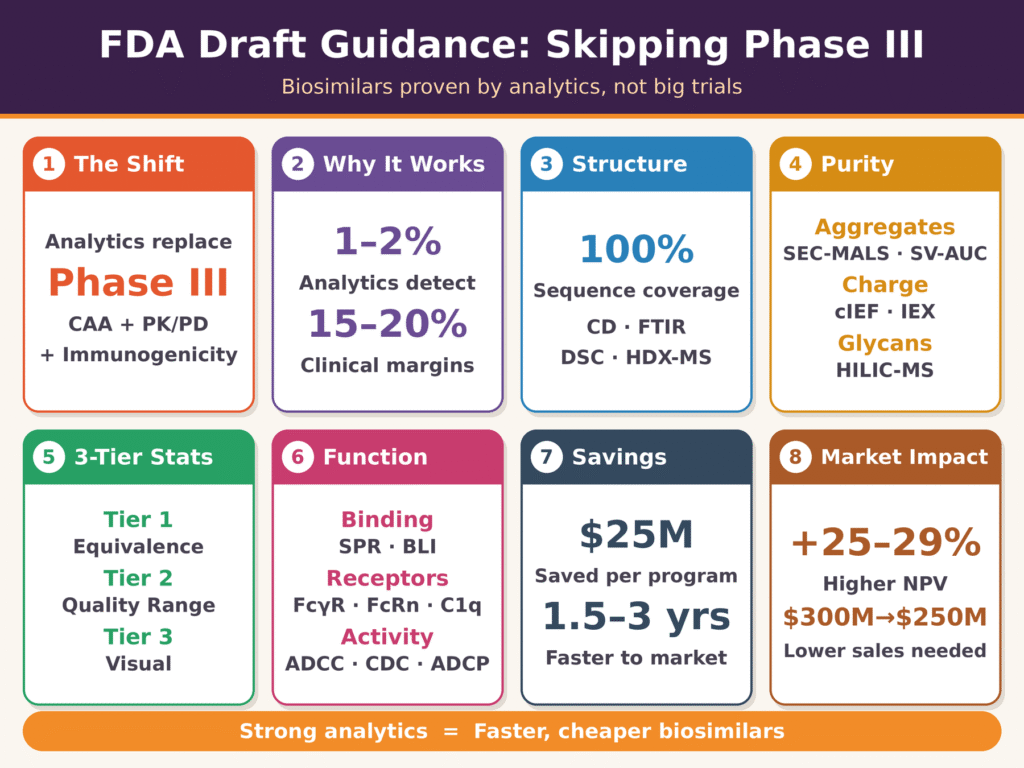
- What changed: The FDA’s October 2025 draft guidance lets biosimilar sponsors skip routine Phase III comparative efficacy trials. To qualify, they need a strong comparative analytical assessment (CAA) supported by PK/PD and immunogenicity data. This brings the US in line with the EMA and MHRA.
- Why it works: Modern analytics can detect molecular differences of about 1–2%. Clinical trials work within 15–20% equivalence margins and are affected by patient variability, so analytics are the more sensitive test of biosimilarity.
- Structural proof: Sponsors must show an identical primary sequence with 100% coverage, using LC-MS/MS peptide mapping and intact mass analysis. They must also confirm disulfide bonds and show comparable higher-order structure using CD, FTIR, DSC and HDX-MS.
- Purity and quality: Aggregates are measured with SEC-MALS, with SV-AUC as a column-free cross-check. Charge variants are profiled by cIEF and IEX, and glycans by HILIC-FLD-MS, including checks for immunogenic Gal-α-Gal and NGNA.
- Statistical framework: Attributes are sorted into three tiers by risk. Tier 1 uses equivalence testing (TOST) for potency and binding. Tier 2 uses quality ranges for structure, glycans and aggregates. Tier 3 uses visual comparison for general profiles.
- Functional comparability: SPR and BLI measure binding to the target, the FcγR receptors, FcRn and C1q. Cell-based assays such as ADCC, CDC and ADCP confirm activity across every mechanism of action, which supports extending approval to other indications.
- Business impact: Skipping Phase III saves about $25M per program and cuts development time by 1.5–3 years. It also raises NPV by 25–29% and lowers the sales needed for viability from $300M to $250M or less, which makes smaller niche biologics worth developing.
Scientific Principles Behind the FDA’s Draft Guidance on Comparative Efficacy Studies
The scientific foundation of the FDA’s Draft Guidance on Comparative Efficacy Studies is based on the ability of modern analytical technologies to detect molecular differences that conventional clinical efficacy trials may fail to identify. Advanced biophysical characterization platforms can resolve certain molecular variations at approximately the 1% to 2% level, whereas comparative clinical efficacy studies generally use broad statistical margins of 15% to 20%. Consequently, clinical outcomes may not reveal subtle structural differences that could be identified through sensitive analytical measurements.
Clinical efficacy endpoints measured in patient populations are influenced by several sources of biological variability, including differences between individual patients, underlying disease progression, and the effects of concomitant medications. These factors introduce statistical noise and can reduce the sensitivity of clinical trials to small changes in molecular structure, conformation, or post-translational modifications. By comparison, orthogonal physicochemical analytical platforms directly examine molecular identity, primary sequence integrity, higher-order folding, glycosylation patterns, and sub-visible particulate distributions.
Under Section 351(k)(2)(A)(i)(I) of the PHS Act, the agency has statutory discretion to waive comparative clinical elements when the available scientific evidence establishes that those elements are unnecessary. Accumulated international regulatory experience indicates that when a biosimilar demonstrates an identical primary structure, comparable higher-order conformation, equivalent functional bioactivity, and similar single-dose human pharmacokinetic profiles, the available evidence may sufficiently support a conclusion of biosimilarity without a separate comparative efficacy trial. Therefore, high-resolution comparative analytical data provides the principal scientific foundation for demonstrating biosimilarity, while clinical PK/PD and immunogenicity assessments help establish comparable systemic exposure and safety profiles.
Discover how biosimilar comparability studies help establish analytical similarity through a systematic evaluation of the proposed product against its reference biologic.
Structural and Higher-Order Structure (HOS) Requirements under the FDA’s Draft Guidance on Comparative Efficacy Studies
To support a request to waive Phase III clinical trials under the FDA’s Draft Guidance on Comparative Efficacy Studies, sponsors must establish that the proposed biosimilar has an identical primary amino acid sequence and comparable higher-order structure (HOS) through orthogonal biophysical characterization techniques. Demonstrating structural identity requires comprehensive peptide mapping, intact mass analysis, and multi-technique conformational profiling covering secondary, tertiary, and quaternary structural levels.
Primary sequence confirmation requires 100% sequence coverage, supported by peptide mapping using high-resolution liquid chromatography-tandem mass spectrometry (LC-MS/MS), intact mass measurements, and liquid chromatography-electrospray ionization quadrupole time-of-flight mass spectrometry (LC-ESI-QTOF-MS). In addition, disulfide bond connectivity and free sulfhydryl levels must be characterized to confirm native cysteinyl pairing and identify potential disulfide scrambling or other misfolding-related variations.
Evaluate essential molecular attributes with biosimilar analytical characterization services designed to support comprehensive structural comparisons between biosimilar candidates and reference products.
Orthogonal Biophysical Technologies for Higher-Order Structure Characterization
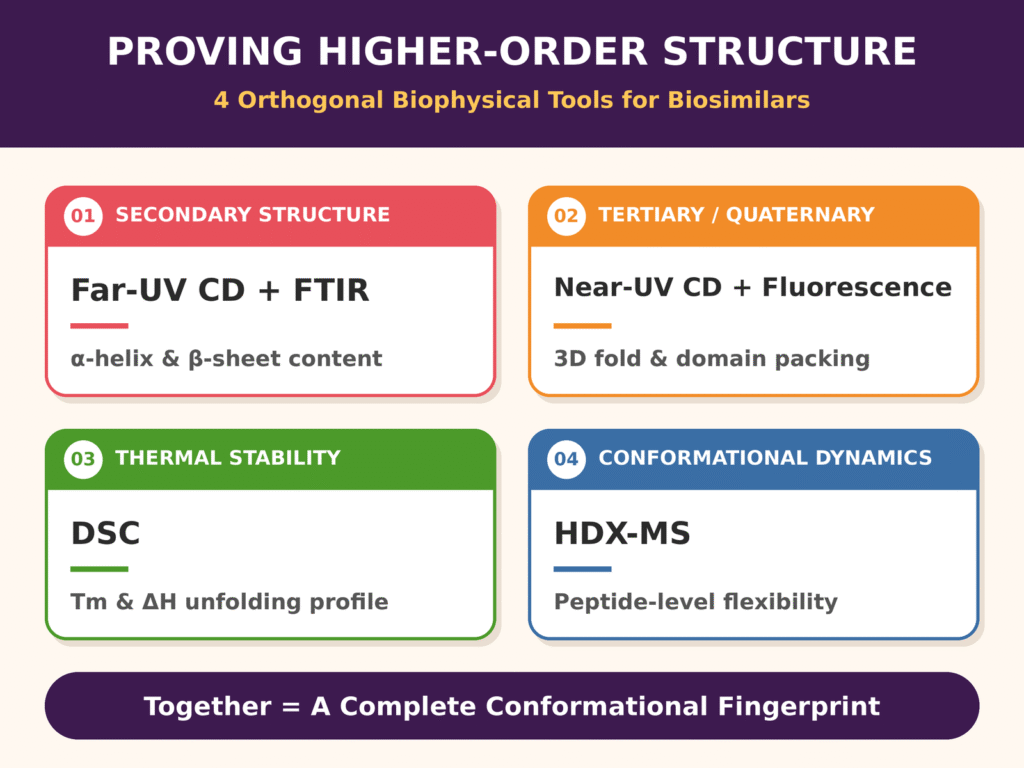
A comprehensive evaluation of higher-order structural comparability requires a multi-layered analytical strategy that combines spectroscopy, calorimetry, and mass spectrometry to assess conformational similarity. Integrating Far/Near-UV Circular Dichroism (CD), Fourier-Transform Infrared (FTIR) spectroscopy, Differential Scanning Calorimetry (DSC), and Hydrogen-Deuterium Exchange Mass Spectrometry (HDX-MS) enables detailed conformational characterization, including information about individual peptide backbones and regional structural dynamics.
- Secondary Structure Profiling: Far-Ultraviolet Circular Dichroism (Far-UV CD, 190–250 nm) and Fourier-Transform Infrared (FTIR) spectroscopy quantify the relative proportions of α-helix, β-sheet, β-turn, and random coil domains. Spectral deconvolution algorithms are used to evaluate whether the backbone hydrogen-bonding networks of the biosimilar correspond to those of the reference product.
- Tertiary & Quaternary Structural Fingerprinting: Near-Ultraviolet Circular Dichroism (Near-UV CD, 250–350 nm) and intrinsic tryptophan/tyrosine fluorescence spectroscopy characterize the local chemical environments of aromatic side chains. These measurements help assess protein domain packing and identify potential differences in the overall three-dimensional structure.
- Thermal Conformational Stability: Differential Scanning Calorimetry (DSC) establishes thermodynamic unfolding profiles by measuring transition melting temperatures (Tm1, Tm2) and enthalpy values (ΔH). Comparing these parameters helps determine whether the biosimilar and reference product exhibit comparable domain stability under thermal stress.
- Peptide-Level Conformational Dynamics: Hydrogen-Deuterium Exchange Mass Spectrometry (HDX-MS) measures the exchange of backbone amide hydrogen atoms with deuterium over time. This technique provides regional information about conformational flexibility and solvent accessibility, enabling the detection of subtle structural perturbations that may remain unresolved through optical spectroscopy alone.
Explore native mass spectrometry for biosimilars to understand how advanced mass spectrometric techniques can complement conventional structural characterization methods.
Purity Profiling, Aggregate Quantification, and Statistical Tiering
Establishing comparable purity profiles and controlling aggregate levels are essential components of a biosimilar analytical assessment, particularly when sponsors seek to justify waiving Phase III clinical trials. Sub-visible protein aggregates may contribute to clinical immunogenicity and adverse safety outcomes, making aggregate characterization an important element of product quality and risk assessment. The analytical package should combine a three-tiered statistical evaluation framework with orthogonal sizing techniques to establish comparability across structural variants and other relevant quality attributes.
Protein aggregation is a critical safety-related quality attribute. Size Exclusion Chromatography coupled with Multi-Angle Light Scattering (SEC-MALS) is an important analytical approach for quantifying soluble high-molecular-weight (HMW) species, low-molecular-weight (LMW) fragments, and monomeric purity. However, SEC columns may introduce nonspecific interactions with the stationary phase or result in the loss of certain aggregates during sample processing. For this reason, Sedimentation Velocity Analytical Ultracentrifugation (SV-AUC) can provide an orthogonal, matrix-free assessment. SV-AUC measures hydrodynamic sedimentation rates directly in native solution, enabling aggregate quantification without potential artifacts associated with column interactions.
At the same time, charge variant profiles must be characterized using Capillary Isoelectric Focusing (cIEF) and Ion-Exchange Chromatography (IEX-HPLC). These techniques help distinguish acidic, main, and basic species associated with modifications such as C-terminal lysine cleavage, N-terminal pyroglutamate conversion, and deamidation. N-linked glycan structures must also be quantified using hydrophilic interaction liquid chromatography with fluorescence detection and mass spectrometry (HILIC-FLD-MS). The analytical assessment should establish the absence or appropriate control of potentially immunogenic non-human glycan epitopes, including galactose-α-1,3-galactose (Galα1-3Gal) and N-glycolylneuraminic acid (NGNA).
Learn how impurity profiling of biosimilars can help identify and assess product-related variants, degradation products, and other potentially relevant impurities.
Quality attributes should be assigned to a three-tiered statistical testing framework according to their clinical relevance, associated risks, and relationship to the product’s mechanism of action.
Three-Tiered Statistical Framework for Biosimilar Analytical Assessment
| Statistical Tier | Evaluation Method | Target Quality Attributes | Primary Analytical Platforms | Acceptance Criteria |
|---|---|---|---|---|
| Tier 1 | Two One-Sided Tests (TOST) Equivalence | Biological Potency, Target Antigen Binding, Primary Effector Activity | Surface Plasmon Resonance (SPR), Cell-Based Bioassays, BLI | The 90% or 95% confidence intervals for the biosimilar mean fall within predefined equivalence margins of ±xσ. |
| Tier 2 | Quality Range (μ ± xσ) | Higher-Order Structure (HOS), Glycosylation, Aggregation, Charge Variants | Far/Near-UV CD, DSC, FTIR, SEC-MALS, HILIC-MS, cIEF | At least 90% of biosimilar lot values fall within the established reference product quality range. |
| Tier 3 | Graphical & Visual Comparison | General Characterization, Minor Impurities, Mass Distribution | SDS-PAGE, Capillary Electrophoresis, Visual Concordance | Side-by-side visual comparisons demonstrate overall profile similarity. |
Review critical quality attributes (CQAs) in biosimilars to understand how quality attributes can be prioritized according to their potential impact on product safety, efficacy, and overall comparability.
Functional Bioassays and Binding Kinetics Alignment
Demonstrating functional comparability across all relevant mechanisms of action (MoA) is necessary to support the extrapolation of clinical indications without conducting separate Phase III efficacy studies for every indication. Biosimilar applicants must characterize real-time binding kinetics using Surface Plasmon Resonance (SPR) and establish comparable cell-based biological potency across target antigen binding, Fc receptor engagement, and relevant effector functions.
Surface Plasmon Resonance (SPR) and Bio-Layer Interferometry (BLI) measure real-time association rate constants (ka), dissociation rate constants (kd), and equilibrium dissociation constants (KD). For complex therapeutic proteins, including monoclonal antibodies, kinetic characterization should cover all functionally relevant molecular interactions:
- Target Antigen Binding: Quantitative affinity (KD) measurements for the primary therapeutic antigen help establish comparable target recognition and provide evidence of baseline pharmacological activity.
- Fc Gamma Receptor Engagement: Comprehensive affinity profiling across FcγRIa (CD64), FcγRIIa (CD32a), FcγRIIIa (CD16a, V158/F158 variants), and FcγRIIb (CD32b) evaluates receptor interactions associated with immune cell activation and potential effector functions.
- Recycling and Complement Receptors: Binding kinetic measurements for the neonatal Fc receptor (FcRn) help characterize interactions involved in systemic half-life and endosomal recycling. Complement protein C1q binding should also be evaluated when relevant to the therapeutic mechanism of action and complement-mediated activity.
In addition to biophysical binding measurements, cell-based bioassays quantify physiological biological activity. Depending on the therapeutic mechanism of action, these assays should establish comparable Target Neutralization, Antibody-Dependent Cellular Cytotoxicity (ADCC), Complement-Dependent Cytotoxicity (CDC), or Antibody-Dependent Cellular Phagocytosis (ADCP). Biological potency assays are evaluated under Tier 1 statistical criteria, with Two One-Sided Tests (TOST) used where appropriate to determine whether functional potency falls within predefined equivalence margins. Establishing functional comparability across all relevant mechanisms of action provides an important scientific basis for extrapolating clinical efficacy to additional approved reference product indications, provided the applicable regulatory requirements are satisfied.
See how a structured biosimilar comparability exercise can integrate analytical and functional evidence to support scientifically justified regulatory decisions.
Economic and Strategic Impact of Waiving Phase III Trials
Applying the Phase III trial waiver framework described in the FDA’s Draft Guidance on Comparative Efficacy Studies may reduce biosimilar development costs by 20 million to 30 million per program while accelerating market entry by as much as 3 years. These financial and scheduling advantages can improve project net present value (NPV), strengthen investment decisions, and make the development of biological products with more limited revenue potential economically feasible.
Historically, clinical development expenditures ranging from 100 million to 300 million have restricted biosimilar development primarily to blockbuster biologics with annual sales exceeding 1 billion. Under an analytical-centric development strategy, total asset development costs may decline toward 10 million to 25 million per program. This reduced cost structure can lower the commercial peak sales threshold required for program viability from 300 million to 250 million or less, potentially expanding biosimilar development to specialized and niche biological therapies.
Plan a more efficient development pathway with biosimilar comparability study design and CRO support to help align analytical study planning with the product’s scientific and regulatory requirements.
Economic Comparison of Traditional and Streamlined Biosimilar Development
| Commercial & Operational Metrics | Traditional Pathway (Phase III CES Required) | Streamlined Pathway (Phase III Waiver) | Strategic Impact & Advantage |
|---|---|---|---|
| Phase III Direct Trial Costs | 20 million–28 million | 0 (Trial Waived) | Average direct savings of 25 million per program. |
| Total Development Timeline | 6 to 9 years | 3.5 to 5 years | Development timeline reduced by 1.5 to 3 years. |
| Risk-Adjusted NPV | Baseline standard | 25%–29% improvement | Potentially substantial improvement in asset financial valuation. |
| Minimum Peak Sales Viability | 300 million | 250 million or lower | Potentially expands commercial viability to specialized therapies. |
| Primary Evaluation Basis | Clinical endpoints (15%–20% margin) | Biophysical analytics (1%–2% resolution) | Greater analytical sensitivity for evaluating molecular biosimilarity. |
Conclusion: Maximizing Analytical Success under the FDA’s Draft Guidance on Comparative Efficacy Studies
The FDA’s Draft Guidance on Comparative Efficacy Studies represents a significant development in the movement toward analytical-centric biosimilar development. By allowing sponsors to seek waivers from costly Phase III comparative efficacy trials when scientifically justified, this approach places greater emphasis on robust biophysical characterization and comprehensive analytical evidence. A scientifically rigorous comparative analytical assessment (CAA) can provide regulators with the integrated evidence needed to evaluate biosimilarity while potentially accelerating commercial development.
Build a robust foundation for biosimilar development with specialized biosimilar characterization services that support detailed analytical evaluation and evidence-based comparability assessments.
Developing an analytical package that meets regulatory expectations requires high-precision biophysical characterization, advanced structural mass spectrometry, and comprehensive functional bioassay capabilities. Sponsors must carefully evaluate critical quality attributes, select complementary analytical techniques, and establish appropriate statistical acceptance criteria to address residual uncertainty and support their regulatory strategy.
To assess your biosimilar analytical similarity testing strategy or develop an orthogonal characterization package, connect with the scientific team at ResolveMass Laboratories Inc. through the ResolveMass Contact Us Page.
Frequently Asked Questions
Advanced analytical techniques can identify subtle molecular, structural, and functional variations with greater precision than clinical efficacy endpoints in many situations. Clinical trials may be affected by patient variability, disease progression, and concomitant medications, which can make small differences difficult to distinguish. Analytical assessments therefore provide detailed evidence of molecular similarity between a proposed biosimilar and its reference product.
Higher-order structure characterization typically combines several complementary techniques, including Far-UV and Near-UV Circular Dichroism (CD), Fourier-Transform Infrared (FTIR) spectroscopy, Differential Scanning Calorimetry (DSC), and Hydrogen-Deuterium Exchange Mass Spectrometry (HDX-MS). These methods examine protein folding, thermal stability, and conformational dynamics at different structural levels. Using orthogonal techniques helps identify differences that may not be detected by a single analytical method.
Size Exclusion Chromatography coupled with Multi-Angle Light Scattering (SEC-MALS) can characterize protein monomers, aggregates, and fragments according to their size and molecular properties. Sedimentation Velocity Analytical Ultracentrifugation (SV-AUC) provides complementary information by measuring sedimentation behavior directly in solution. Using both techniques helps assess aggregate levels while reducing the risk of relying on artifacts associated with a single analytical platform.
Analytical similarity assessments may use different statistical approaches according to the clinical relevance and risk associated with each critical quality attribute. Tier 1 attributes, such as biological potency and target binding, may be evaluated using Two One-Sided Tests (TOST), while Tier 2 attributes may be assessed using quality range approaches such as μ ± xσ. Tier 3 attributes are generally examined through graphical and visual comparisons, with the overall strategy tailored to the specific product and available evidence.
No, a waiver of Phase III comparative clinical efficacy studies does not automatically remove the need for other clinical evaluations. Sponsors may still need comparative human pharmacokinetic (PK), pharmacodynamic (PD), and immunogenicity assessments to investigate systemic exposure, biological responses, and potential safety concerns. The required studies depend on the product, existing evidence, and applicable regulatory expectations.
Hydrogen-Deuterium Exchange Mass Spectrometry (HDX-MS) evaluates the exchange of backbone amide hydrogen atoms with deuterium, providing information about protein flexibility and solvent accessibility. Its peptide-level resolution can reveal regional conformational differences that may not be apparent through conventional spectroscopic techniques. These findings strengthen the comparative analytical assessment and can help address uncertainties about higher-order structure.
Functional characterization of monoclonal antibody biosimilars generally includes target antigen binding measurements using Surface Plasmon Resonance (SPR) or Bio-Layer Interferometry (BLI). Depending on the antibody’s mechanism of action, testing may also assess Fcγ receptor interactions, neonatal Fc receptor (FcRn) binding, and complement protein C1q interactions. Cell-based bioassays evaluating Antibody-Dependent Cellular Cytotoxicity (ADCC), Complement-Dependent Cytotoxicity (CDC), or neutralization activity provide additional evidence of functional comparability.
When a Phase III comparative efficacy study is scientifically unnecessary and a waiver is accepted, sponsors may avoid substantial trial-related expenses and potentially shorten biosimilar development timelines. The estimated savings in the supplied development model are approximately 25 million per program, with timelines potentially reduced by 1.5 to 3 years. These benefits may improve risk-adjusted net present value (NPV), although actual savings depend on the development program and regulatory requirements.
Sponsors should seek early regulatory engagement with the FDA to discuss their proposed biosimilar development strategy and the evidence needed to support a potential waiver. Biosimilar Biological Product Development (BPD) meetings can provide an opportunity to review the comparative analytical assessment (CAA), reference product characterization, statistical evaluation strategy, and orthogonal analytical methods. Early discussions help identify evidence gaps and clarify the clinical and analytical studies that may be necessary before late-stage development.
Reference:
- U.S. Food and Drug Administration. (2025, October). Scientific considerations in demonstrating biosimilarity to a reference product: Updated recommendations for assessing the need for comparative efficacy studies: Draft guidance for industry. https://www.fda.gov/regulatory-information/search-fda-guidance-documents/scientific-considerations-demonstrating-biosimilarity-reference-product
- U.S. Food and Drug Administration. (2025, October). Scientific considerations in demonstrating biosimilarity to a reference product: Updated recommendations for assessing the need for comparative efficacy studies: Draft guidance for industry. https://www.fda.gov/media/189366/download
- Ranbhor, R., & Kulkarni, P. (2026). Net present value impact of FDA’s Phase 3 waivers on monoclonal antibody biosimilar development. Biologics: Targets and Therapy, 20, 581013. https://doi.org/10.2147/BTT.S581013
Get In Touch With Us
About The Author