


Introduction
Method Validation for Leachables Testing in a Good Manufacturing Practice (GMP) laboratory provides documented, objective evidence that an analytical procedure can reliably detect, identify, and quantify trace-level migrating contaminants in final drug products at concentrations relevant to regulatory safety thresholds. Global health authorities, including the US Food and Drug Administration (FDA), European Medicines Agency (EMA), and Health Canada, require the use of validated analytical procedures to demonstrate that container-closure systems (CCS), drug delivery devices, and single-use manufacturing systems (SUS) do not compromise drug safety, efficacy, or product quality throughout the product’s shelf life.
During the early stages of pharmaceutical development, controlled extraction studies are conducted to identify potential leachables under exaggerated solvent and thermal stress conditions. However, as a product progresses into formal stability programs and commercial batch release, regulatory authorities require fully quantitative target leachables testing. The primary technical challenge during method validation is achieving adequate sensitivity and precision within complex final drug product formulations. Active pharmaceutical ingredients (APIs) and excipients can frequently cause significant matrix suppression or analytical interference. Consequently, advanced sample preparation techniques, including liquid-liquid extraction, solid-phase extraction (SPE), and protein precipitation, may be required before chromatographic separation and detection.
Discover how choosing the right solvents for extractables studies sets the foundation for compliant target leachables method validation.
To meet international compliance expectations, analytical laboratories must develop validation packages that are aligned with internationally harmonized guidelines. These packages must demonstrate that every targeted compound can be measured reliably against its calculated Safety Concern Threshold (SCT) and Analytical Evaluation Threshold (AET).
Plan your product stability protocols with expert insights on leachables monitoring during stability studies.
Share via:
Article Summary:
- Leachables method validation demonstrates that a GMP analytical procedure can reliably detect, identify, and quantify migrating substances in finished drug products at safety-relevant concentrations.
- Regulatory compliance is built around key frameworks such as ICH Q2(R2), ICH Q14, ICH Q3E, USP <1663>/<1664>, USP <661.1>/<661.2>, ISO 10993 standards, and PQRI recommendations.
- Safety thresholds guide analytical sensitivity. The SCT, QT, and AET help translate toxicological exposure limits into practical concentration targets for laboratory testing, with the AET determining the required method sensitivity.
- A validated method must demonstrate key performance characteristics, including specificity, linearity, accuracy, precision, LOQ/LOD, robustness, and system suitability within the actual drug product matrix.
- Instrument selection depends on the chemical nature of the leachable: GC-MS/GC-FID is suited to volatile and semi-volatile compounds, LC-MS/MS to non-volatile and polar organic compounds, and ICP-MS to elemental and metal impurities.
- Common regulatory concerns include unjustified uncertainty factors, severe matrix effects, insufficient sensitivity for high-risk compounds such as nitrosamines, and failure to reassess methods after formulation or packaging changes.
- A scientifically justified, lifecycle-based validation strategy helps generate reliable data, maintain regulatory compliance, support product quality and patient safety, and reduce the risk of delays during regulatory review.
Regulatory Frameworks Governing Method Validation for Leachables Testing
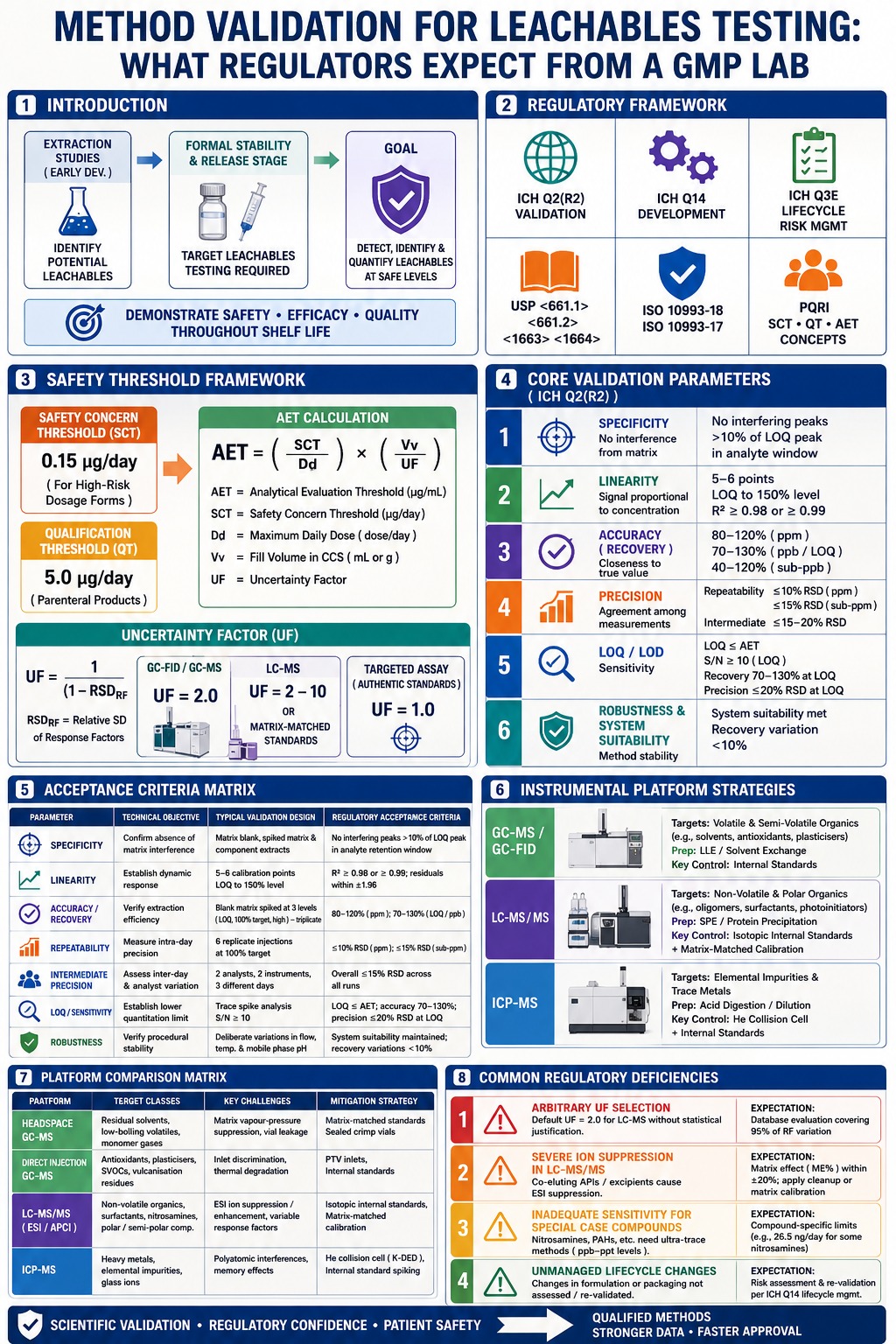
Regulatory authorities evaluate leachables validation dossiers through an interconnected framework of international standards. The primary guidelines include ICH Q2(R2) for analytical procedure validation, ICH Q14 for analytical procedure development, and ICH Q3E for holistic lifecycle risk management. Compliance with these frameworks helps ensure that analytical methodologies are scientifically sound and capable of withstanding regulatory scrutiny during FDA, EMA, and Health Canada inspections and audits.
Harmonized International Guidelines
ICH Q2(R2) and ICH Q14
Guidance on analytical procedure validation under ICH Q2(R2), combined with the analytical procedure development principles described in ICH Q14, forms the foundation of modern analytical method validation. ICH Q14 emphasizes Quality by Design (QbD) principles and encourages laboratories to conduct initial risk assessments, use Design of Experiments (DoE) to evaluate operational boundaries, and establish appropriate method control strategies before initiating formal validation activities.
ICH Q3E (Draft Guideline)
ICH Q3E provides a dedicated and holistic framework for evaluating and controlling leachable impurities throughout the drug product lifecycle. The framework covers pharmaceuticals, biopharmaceuticals, cell and gene therapies, and drug-device combination products.
Ensure your complex combination devices stay compliant by exploring our guide on E&L testing for pre-filled syringes
and our specialized solutions for extractables and leachables testing for autoinjectors.
USP <661.1>, USP <661.2>, USP <1663>, and USP <1664>
United States Pharmacopeia chapters USP <661.1> and USP <661.2> establish requirements related to the evaluation of plastic and polymeric materials used in pharmaceutical packaging systems. Informational chapters USP <1663> and USP <1664> provide the scientific framework for extractables characterization and leachables safety assessment, respectively.
ISO 10993-18:2020 and ISO 10993-17
ISO 10993-18:2020 and ISO 10993-17 establish expectations for the chemical characterization and toxicological risk assessment of medical device components and drug-delivery combinations. ISO 10993-18, including Amendment 1:2022, introduces standardized approaches for evaluating analytical uncertainty factors during threshold calculations.
PQRI Recommendations
The Product Quality Research Institute (PQRI) working groups, including those focused on Orally Inhaled and Nasal Drug Products (OINDP) and Parenteral and Ophthalmic Drug Products (PODP), established the foundational concepts of Safety Concern Thresholds (SCT), Qualification Thresholds (QT), and Analytical Evaluation Thresholds (AET). These concepts continue to underpin current regulatory approaches to extractables and leachables assessment.
Safety Threshold Frameworks: SCT, QT, and AET Derivation
The derivation of the Analytical Evaluation Threshold (AET) converts toxicological exposure limits, particularly the Safety Concern Threshold (SCT), into a drug-specific analytical concentration threshold. This threshold defines the required limit of quantitation (LOQ) for the analytical method. Establishing an accurate AET ensures that any migrating leachable present at a concentration capable of potentially affecting patient safety is detected, reported, and subjected to appropriate toxicological assessment.
Safety Concern Threshold (SCT) and Qualification Threshold (QT)
The Safety Concern Threshold (SCT) represents a daily exposure threshold below which a leachable substance is considered to present negligible safety risks concerning carcinogenic and non-carcinogenic toxicities. For high-risk dosage forms, including OINDPs and parenteral products, PQRI established an SCT of 0.15 µg/day for individual organic leachables.
The Qualification Threshold (QT), typically set at 5.0 µg/day for parenteral products, represents the exposure level above which non-genotoxic leachables must undergo structural identification and qualification through toxicological evaluation.
Master the math behind safety boundaries by reading our guide to AET for extractables and leachables studies.
Mathematical Calculation of the AET
To apply the daily toxicological threshold (SCT) to analytical laboratory measurements, the SCT must be converted into a drug product concentration threshold known as the estimated or final AET. This mathematical conversion incorporates the maximum daily dose of the pharmaceutical formulation, the container-closure fill volume, and an Analytical Uncertainty Factor (UF):
AET = (SCT / Dd) × (Vv / UF)
Where:
- AET = Analytical Evaluation Threshold (µg/mL or ppm).
- SCT = Safety Concern Threshold (µg/day, for example, 0.15 µg/day).
- Dd = Maximum daily dose of the drug product (dose/day or mL/day).
- Vv = Volume or mass of the drug formulation contained within the packaging component (mL or g).
- UF = Uncertainty Factor accounting for analytical response factor variation across different chemical structures.
Defining and Justifying the Uncertainty Factor (UF)
When non-target screening is performed using surrogate reference standards, response factors (RF) between the surrogate standard and unknown leachables can vary considerably. This variation requires the use of an uncertainty factor to adjust the AET downward. Under ISO 10993-18:2020/Amd 1:2022, the Uncertainty Factor can be calculated statistically by evaluating response factor variation across a database of representative extractables:
UF = 1 / (1 − RSDRF)
Where RSDRF represents the relative standard deviation of response factors for target compounds within a specific analytical method.
For gas chromatography with flame ionization detection (GC-FID) or electron ionization mass spectrometry (GC-MS), UF = 2.0 is commonly applied because these techniques generally demonstrate more uniform response behavior. In contrast, for liquid chromatography-mass spectrometry (LC-MS), response factors can vary by several orders of magnitude. Therefore, a higher UF, such as UF ≥ 2.0 to 10, or calibration using matrix-matched authentic standards may be required.
In targeted, fully validated GMP leachables assays where authentic reference standards are synthesized or purchased and individually calibrated, the analytical response factor is directly measured. In such cases, the Uncertainty Factor can be defined as UF = 1.0.
Learn how threshold data translates into regulatory risk reports with our overview of toxicological qualification of leachables.
Core Analytical Parameters for Method Validation for Leachables Testing Under ICH Q2(R2)
The core validation parameters described under ICH Q2(R2) require experimental evidence demonstrating that the targeted analytical method maintains specificity, linearity, accuracy, precision, and sensitivity within the specific formulation matrix. Acceptance criteria must be clearly defined and scientifically justified in validation protocols before the study is executed in a GMP environment.
1. Specificity and Selectivity
Specificity ensures that target leachables can be unequivocally identified and quantified in the presence of matrix components, API, excipients, and degradation products. Validation studies require the analysis of blank drug product matrices, drug product matrices spiked with target leachables, individual packaging component extracts, and forced degradation samples.
Chromatographic co-elution or spectral interference at the retention times of target analytes must be absent. Mass spectrometry methods must demonstrate spectral purity or consistent ion abundance ratios, such as qualifying and quantifying ion transitions in LC-MS/MS or GC-MS, within ±15% of authentic standards.
2. Linearity and Range
Linearity demonstrates that the analytical signal is directly proportional to analyte concentration across a defined operational range. Laboratories generally evaluate a minimum of 5 to 6 concentration levels extending from the Limit of Quantitation (LOQ) to 120%–150% of the maximum expected leachable concentration.
Linear regression analysis must produce a coefficient of determination (R²) of ≥0.98 or ≥0.99, depending on the trace concentration levels and the method’s intended application. Plotting studentized residuals against theoretical concentrations should demonstrate a random distribution within ±1.96 standard deviations, supporting the conclusion that linearity is maintained throughout the dynamic range.
3. Accuracy (Recovery)
Accuracy demonstrates the closeness of agreement between the true accepted value and the value obtained using the analytical method. Analysts perform recovery studies by spiking known quantities of authentic target leachable standards into a blank drug product matrix or matrix-matched vehicle at a minimum of 3 concentration levels. These levels may include the LOQ, the 100% target level, and the upper range limit. Each concentration level is typically analyzed in triplicate.
For target concentrations at the part-per-million (ppm / µg/mL) level, average spike recoveries should generally fall within 80%–120%. For ultra-trace concentrations at the part-per-billion (ppb / ng/mL) level near the LOQ, broader acceptance ranges of 70%–130% may be appropriate. For sub-ppb applications, an acceptance range of 40%–120% may be considered acceptable when scientifically and toxicologically justified.
4. Precision (Repeatability and Intermediate Precision)
Precision measures the degree of agreement among a series of measurements obtained from multiple samplings of the same homogeneous sample.
Repeatability (Intra-assay Precision)
Repeatability is evaluated using a minimum of 6 replicate determinations at 100% of the target test concentration or 3 replicates across 3 concentration levels. The percent relative standard deviation (%RSD) should satisfy %RSD ≤ 10% for ppm concentrations and %RSD ≤ 15% for trace ppb levels.
Intermediate Precision (Ruggedness)
Intermediate Precision evaluates variations within the same laboratory across different days, analysts, and instrument systems or column lots. The overall intermediate precision should generally remain within 15%–20% RSD, depending on the concentration range and intended application of the method.
5. Limit of Quantitation (LOQ) and Limit of Detection (LOD)
The LOQ defines the lowest concentration of a target leachable that can be quantitatively determined with acceptable accuracy and precision. Analysts determine the LOQ and LOD using signal-to-noise (S/N) ratios, with S/N ≥ 10 typically used for the LOQ and S/N ≥ 3 for the LOD, or by evaluating the standard deviation of the response and the slope of the calibration curve.
The validated LOQ must be less than or equal to the final calculated AET (LOQ ≤ AET). Replicate analysis at the LOQ should demonstrate precision of %RSD ≤ 20%, with spike recoveries between 70% and 130%.
6. Robustness and System Suitability
Robustness assesses the ability of an analytical method to remain unaffected by small, deliberate variations in procedural parameters. Parameters evaluated may include minor changes in HPLC/GC column temperature (±2 °C), mobile phase organic composition (±2%), mobile phase pH (±0.2 units), flow rate (±10%), and electrospray ion source parameters.
System suitability criteria established before batch analysis may include retention time repeatability (%RSD ≤ 1.0%), a peak tailing factor (T ≤ 2.0), chromatographic resolution (Rs > 1.5), and calibration check recoveries of 90%–110%.
Acceptance Criteria Matrix for Method Validation for Leachables Testing
| Validation Parameter | Technical Objective | Typical Validation Design | Regulatory Acceptance Criteria |
|---|---|---|---|
| Specificity | Confirm the absence of interference from the formulation matrix. | Compare the matrix blank, spiked matrix, and individual component extracts. | No interfering peaks greater than 10% of the target LOQ peak area within the analyte retention window. |
| Linearity | Establish the dynamic response relationship. | Use 5 to 6 calibration points spanning the LOQ to 150% of the target level. | R² ≥ 0.98 or ≥ 0.99; studentized residuals within ±1.96. |
| Accuracy / Recovery | Verify analyte extraction efficiency. | Analyze a blank matrix spiked at 3 levels, including the LOQ, 100% target level, and upper range limit, in triplicate. | 80%–120% recovery at ppm levels; 70%–130% recovery at LOQ/ppb levels. |
| Repeatability | Measure intra-day precision. | Analyze 6 replicate injections of a 100% target-level spiked sample. | %RSD ≤ 10% for ppm concentrations; %RSD ≤ 15% for sub-ppm levels. |
| Intermediate Precision | Assess inter-day and analyst variation. | Use 2 analysts, 2 instruments, and 3 distinct test days. | Overall %RSD ≤ 15% across all combined analytical runs. |
| LOQ / Sensitivity | Establish the lower quantitation boundary. | Perform trace spike analysis meeting S/N ≥ 10. | LOQ ≤ AET; accuracy of 70%–130% and precision of %RSD ≤ 20% at the LOQ. |
| Robustness | Verify procedural stability. | Introduce deliberate variations in flow rate, temperature, and mobile phase pH. | System suitability parameters maintained; recovery variations <10%. |
Instrumental Platform Strategies in Method Validation for Leachables Testing
Validating analytical methods across GC-MS, LC-MS/MS, and ICP-MS platforms requires tailored strategies to address platform-specific challenges, including inlet discrimination, ionisation suppression, and polyatomic spectral interferences. The selection of the appropriate instrumental technique depends on the volatility, polarity, molecular weight, and elemental composition of the target leachables.
Gas Chromatography-Mass Spectrometry (GC-MS / GC-FID)
Gas chromatography is the preferred analytical platform for volatile organic compounds (VOCs) and semi-volatile organic compounds (SVOCs). Target leachables evaluated using GC-MS may include rubber oligomers, residual solvents, monomer residues, antioxidants such as BHT, Irganox 1010, and Irgafos 168, as well as plasticisers, including phthalates.
Headspace GC-MS is commonly validated for low-boiling VOCs, whereas direct injection GC-MS, using capillary columns such as DB-5MS, is applied for the analysis of SVOCs. Internal standardisation using deuterated analogues or structurally similar, non-interfering compounds, such as 2-fluorobiphenyl, is critical for correcting variations in injection volume and inlet discrimination.
Liquid Chromatography-Tandem Mass Spectrometry (LC-MS/MS)
High-performance or ultra-high-performance liquid chromatography coupled with tandem mass spectrometry (LC-MS/MS) is required for the analysis of non-volatile organic compounds (NVOCs), polar leachables, surfactants, slip agents such as erucamide and oleamide, synthetic photoinitiators, and special case compounds.
Electrospray Ionisation (ESI) and Atmospheric Pressure Chemical Ionisation (APCI) sources are susceptible to matrix suppression or enhancement caused by co-eluting APIs or formulation excipients. Validation protocols must therefore evaluate matrix factors by comparing matrix-spiked calibration curves with solvent-based calibration curves.
Stable-isotope-labelled internal standards, including ¹³C- or ²H-labelled compounds, are used wherever feasible to ensure robust recovery and quantitative precision.
Compare instrumentation capabilities by reading our technical review on GC-MS vs LC-MS in extractables and leachables testing.
Inductively Coupled Plasma-Mass Spectrometry (ICP-MS)
ICP-MS is the primary technique used for the analysis of inorganic elemental leachables. It can quantify trace metals migrating from glass vials, including silicon, boron, aluminium, and barium; catalytic residues from elastomeric stoppers, such as zinc, platinum, and titanium; and heavy metal contaminants evaluated in accordance with ICH Q3D guidelines.
Validation requires microwave-assisted acid digestion or direct dilution workflows optimised to minimise matrix viscosity effects. Collision/reaction cell technology using helium or hydrogen gas must be validated to eliminate polyatomic spectral interferences. For example, ⁴⁰Ar³⁵Cl⁺ can interfere with the detection of ⁷⁵As.
Learn more about elemental analysis setup in our overview of ICP-MS in extractables and leachables testing.
Platform Comparison Matrix for Leachables Validation
| Instrumental Platform | Target Leachable Classes | Primary Sample Preparation | Key Validation Challenges | Mitigation Strategy |
|---|---|---|---|---|
| Headspace GC-MS | Residual solvents, low-boiling volatiles, and monomer gases. | Direct headspace sampling and thermal desorption. | Matrix-related vapour-pressure suppression and vial leakage. | Matrix-matched headspace standards and sealed crimp vials. |
| Direct Injection GC-MS | Antioxidants, plasticisers, vulcanisation residues, and SVOCs. | Liquid-liquid extraction and solvent exchange. | Inlet discrimination and thermal degradation in the injector. | Programmed temperature vaporising (PTV) inlets and internal standards. |
| LC-MS/MS (ESI/APCI) | Non-volatile oligomers, photoinitiators, surfactants, nitrosamines, and other polar or semi-polar compounds. | Solid-phase extraction (SPE) and protein precipitation. | ESI ion suppression or enhancement and variable response factors. | Isotopic internal standards and matrix-matched calibration. |
| ICP-MS | Heavy metals, elemental impurities, and glass delamination ions. | Acid digestion using HNO₃/H₂O₂ and dilution. | Polyatomic ion interferences and memory effects. | Helium collision cell mode, including K-DED, and internal standard spiking. |
Common Regulatory Deficiencies and Technical Challenges in GMP Leachables Validation
Regulatory deficiency letters frequently arise from scientifically unjustified uncertainty factors, unmitigated matrix suppression in mass spectrometry, inadequate validation of special case compound assays at ultra-trace concentrations, and poorly managed lifecycle changes. Proactively addressing these analytical failure modes during method development can help prevent costly regulatory delays during drug authorisation.
Protect your study timelines by reviewing the root causes of failed extractables and leachables (E&L) studies.
1. Arbitrary Selection of Uncertainty Factors
Applying a default Uncertainty Factor of UF = 2.0 for LC-MS screening assays without statistical justification is a frequent audit observation. Regulatory reviewers expect comprehensive database evaluations demonstrating that the selected UF adequately covers 95% of potential response factor variations across the target compound class.
When response factor variation is substantial, such as when RSDRF > 50%, higher UF values, for example UF = 4 to 10, or target-specific authentic standards must be used.
2. Severe Ion Suppression in LC-MS/MS
High concentrations of active pharmaceutical ingredients (APIs) or hydrophobic formulation excipients that co-elute with target leachables can cause severe ESI signal suppression. Method validation must therefore include explicit matrix effect calculations (ME%).
If ME% deviates by more than ±20% from neat solvent standards, optimisation of sample cleanup, such as through orthogonal chromatographic separation or SPE, or the use of matrix-matched calibration curves becomes necessary.
3. Inadequate Sensitivity for Special Case Compounds
Attempting to evaluate highly potent toxic compounds, including N-nitrosamines, polycyclic aromatic hydrocarbons (PAHs), or 2-mercaptobenzothiazole, using general screening AET thresholds can lead to regulatory rejection. Special case compounds are excluded from standard AET calculations.
Regulatory authorities enforce compound-specific acceptable daily intakes. For example, certain high-potency nitrosamines may be subject to an acceptable daily intake of 26.5 ng/day. Such compounds require specialised, high-sensitivity MRM LC-MS/MS methods validated to achieve quantitation limits in the low parts-per-billion or parts-per-trillion range.
4. Unmanaged Lifecycle Changes and Re-Validation Requirements
Validating a leachables method using initial formulation lots but failing to reassess method suitability when subsequent changes are made to the drug product composition, pH, or packaging components can create significant compliance vulnerabilities. Even seemingly minor changes may alter the extraction behaviour, matrix characteristics, analyte recovery, or overall analytical response of the method.
Under ICH Q14 lifecycle management principles, any modification to the primary container-closure system, formulation excipient supplier, or storage conditions requires a formal risk assessment. Depending on the potential impact of the change, partial re-validation may also be necessary. This assessment should evaluate critical method characteristics, including specificity, LOQ, and recovery, to confirm that the analytical procedure continues to perform reliably under the revised product or packaging conditions.
A documented lifecycle management strategy is therefore essential for maintaining the validated state of a leachables method. Changes should be evaluated through an established change-control process, with the extent of re-validation scientifically justified according to the potential impact on method performance and patient safety.
Ensure regulatory audit readiness with our detailed study on data integrity in extractables and leachables testing.
Conclusion: Ensuring Regulatory Acceptance with Validated Leachables Testing
Executing a compliant Method Validation for Leachables Testing strategy is essential for demonstrating drug product safety, batch-to-batch consistency, and regulatory readiness. A scientifically sound validation package developed in accordance with ICH Q2(R2) and ICH Q14 principles provides documented evidence that targeted leachables can be reliably detected, identified, and quantified throughout the intended analytical range.
Successful method validation must address the specific analytical challenges associated with leachables testing, including complex drug product matrices, trace-level analyte concentrations, matrix suppression, variable response factors, and the need for specialized analytical techniques. Properly established validation parameters also help ensure that analytical results remain scientifically defensible during regulatory review.
Navigating complex drug matrices, controlling matrix suppression, calculating statistically justified Uncertainty Factors, and validating specialized trace-level assays for special case compounds require advanced analytical infrastructure, experienced scientific personnel, and a thorough understanding of international regulatory expectations. Partnering with a specialized GMP analytical laboratory can help ensure that method validation packages meet global compliance requirements and provide the technical documentation necessary to support regulatory submissions.
A comprehensive and scientifically justified Method Validation for Leachables Testing strategy can reduce regulatory risk, strengthen confidence in analytical data, support ongoing product quality, and help accelerate drug product approval.
Learn about budget considerations and pricing structures by visiting our detailed guide on E&L testing cost factors.
To discuss your target leachables method validation strategy or request support for upcoming regulatory submissions, contact our expert analytical team directly.
Contact ResolveMass Laboratories Inc.
Frequently Asked Questions (FAQs)
The Analytical Evaluation Threshold (AET) is derived by converting the Safety Concern Threshold (SCT) into a concentration relevant to the specific drug product. The calculation considers the maximum daily dose, the volume or mass of product associated with the packaging component, and the Analytical Uncertainty Factor (UF). The resulting AET establishes the analytical sensitivity level that the validated method must be capable of achieving for reliable leachables assessment.
AET = (SCT / Daily Dose) × (Container Volume / UF)
An Uncertainty Factor is used to account for differences in analytical response among chemically diverse leachables, particularly when surrogate standards are used for screening. The factor lowers the analytical threshold to help ensure that compounds with weaker detector responses are not overlooked. For targeted methods using individually calibrated authentic reference standards, the response of each analyte is directly established, and UF = 1.0 may be applied.
For target leachables present at part-per-million (ppm) concentrations, mean spike recovery is generally expected to fall within 80%–120%. When compounds are present at trace part-per-billion (ppb) concentrations near the Limit of Quantitation (LOQ), a broader recovery range of 70%–130% may be appropriate. The final acceptance criteria should be scientifically justified according to the concentration range, matrix complexity, and intended application of the method.
ICH Q2(R2) establishes a modern framework for demonstrating that an analytical procedure is fit for its intended purpose. For leachables methods, this includes evaluating parameters such as specificity, linearity, accuracy, precision, LOQ, and robustness across defined operating conditions. The guideline also supports a lifecycle-based approach and works alongside ICH Q14 principles for science- and risk-based analytical procedure development.
Special case compounds are highly potent toxicants or carcinogenic substances that may present safety concerns at extremely low exposure levels. Examples include N-nitrosamines, polycyclic aromatic hydrocarbons (PAHs), and 2-mercaptobenzothiazole. Standard AET calculations may not be suitable for these compounds; instead, analytical methods are developed and validated against compound-specific toxicological intake limits, often requiring low-ppb or ppt-level sensitivity.
USP <665> establishes requirements for evaluating extractables and leachables associated with plastic components and systems used in biopharmaceutical manufacturing. The assessment helps identify chemical substances that may migrate from single-use systems (SUS) and other polymeric components into process streams, intermediates, or drug substances. Analytical procedures must be appropriately developed and validated to support reliable detection and quantification of relevant manufacturing-related leachables.
LC-MS/MS matrix suppression can be controlled by improving sample preparation and chromatographic separation. Techniques such as solid-phase extraction (SPE), liquid-liquid extraction, and protein precipitation can reduce interfering formulation components before analysis. Matrix-matched calibration and stable-isotope-labeled internal standards, including ¹³C- or ²H-labelled compounds, further improve quantitative accuracy and compensate for variable ionisation behaviour.
A change to container-closure materials or component suppliers can introduce a different chemical profile and may affect analyte recovery, matrix interactions, and method performance. A documented risk assessment under ICH Q14 principles should determine the appropriate level of analytical evaluation. Depending on the impact of the change, partial re-validation focused on parameters such as specificity, LOQ, and recovery may be sufficient, while more extensive changes may require broader re-validation.
Reference:
- International Council for Harmonisation of Technical Requirements for Pharmaceuticals for Human Use. (2025, August 18). ICH Q3E guideline for extractables and leachables (Draft version, Step 2b). European Medicines Agency. Source document
- International Council for Harmonisation of Technical Requirements for Pharmaceuticals for Human Use. (2023, November 1). ICH harmonised guideline: Validation of analytical procedures Q2(R2). ICH Q2(R2) Guideline
- International Organization for Standardization. (2022). Biological evaluation of medical devices—Part 18: Chemical characterization of medical device materials within a risk management process: Amendment 1: Determination of the uncertainty factor (ISO 10993-18:2020/Amd.1:2022). ISO 10993-18:2020/Amd.1:2022

