

Introduction
Under Section 351(k) of the Public Health Service (PHS) Act, the U.S. Food and Drug Administration (FDA) defines a No Clinically Meaningful Differences Biosimilar as a biological product that demonstrates no clinically meaningful differences from an FDA-licensed reference product in terms of safety, purity, and potency. This regulatory standard allows biopharmaceutical developers to pursue approval through the abbreviated licensing pathway established under the Biologics Price Competition and Innovation Act of 2009 (BPCI Act), which was enacted as part of the Patient Protection and Affordable Care Act of 2010. Unlike the traditional Section 351(a) Biologics License Application (BLA), which requires an independent demonstration of safety and efficacy, the 351(k) pathway relies on the totality of scientific evidence to establish that a proposed biological product is highly similar to a single U.S.-licensed reference product, despite minor differences in clinically inactive components.
The statutory foundation of biosimilar approval rests on two distinct requirements: demonstrating that the molecule is “highly similar” in terms of analytical structure and function, and establishing that there are “no clinically meaningful differences between the biological product and the reference product in terms of safety, purity, and potency.” Within regulatory science, safety, purity, and potency serve as the statutory criteria for evaluating a product’s safety and clinical effectiveness. Safety assessments examine potential adverse events and immunogenic responses, purity testing determines the extent to which the product is free from process-related impurities and degraded molecular species, and potency testing measures biological activity per unit dose. Meeting these requirements necessitates an integrated, multi-tiered testing strategy that progresses systematically from physicochemical characterization to comparative clinical pharmacology.
Share via:
Quick Summary:
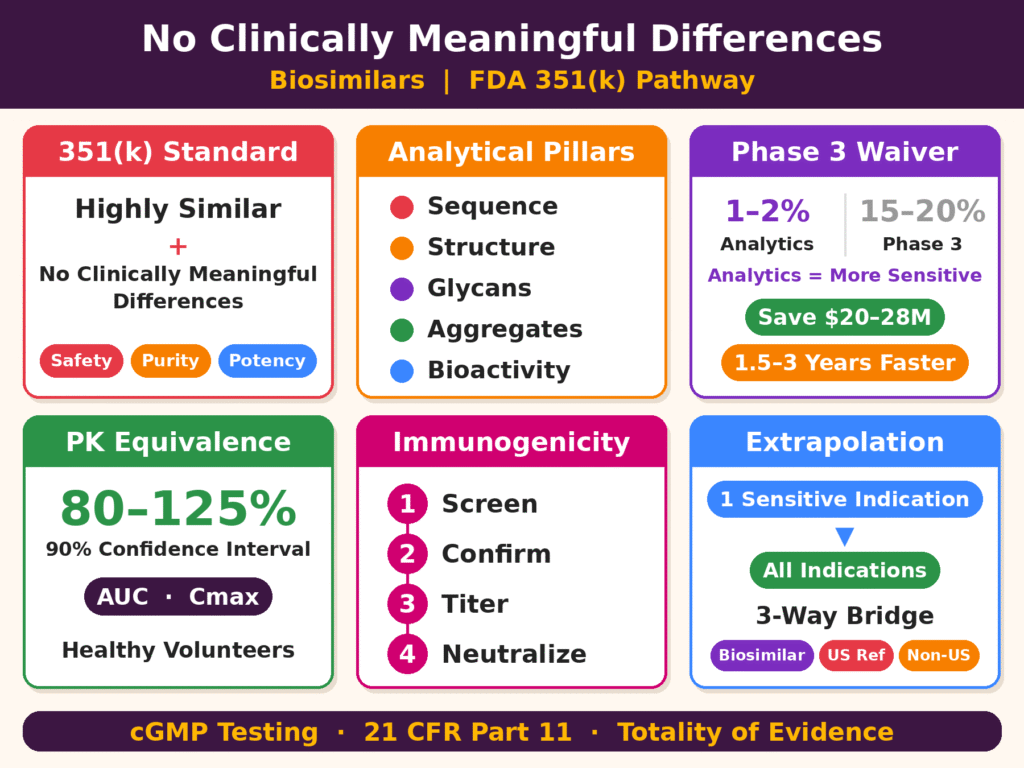
- Regulatory standard: Under Section 351(k) of the PHS Act, a biosimilar must be highly similar to a single FDA-licensed reference product, with no clinically meaningful differences in safety, purity, and potency. It is approved through the abbreviated pathway created by the BPCI Act of 2009.
- Analytical foundation: Comparative analytical assessments use orthogonal methods to compare critical quality attributes across multiple lots. These include LC-MS/MS peptide mapping for sequence, CD, NMR and DSC for higher-order structure, and HILIC/CZE for glycosylation. They also cover SEC-MALS and AUC for aggregates, and bioassays and SPR for potency.
- Minor differences allowed: Small variations in clinically inactive components, such as excipients, charge heterogeneity, or low-abundance glycoforms, don’t rule out biosimilarity. They must be backed by a scientific risk assessment showing no impact on binding, potency, or safety.
- Phase 3 waiver: The FDA’s October 2025 draft guidance supports waiving Phase 3 comparative efficacy studies when analytical and PK data are strong enough. Analytics detect differences of about 1–2%, versus 15–20% margins in clinical trials. A waiver could cut $20–28M (18–25% of R&D costs) and 1.5–3 years per candidate.
- Clinical pharmacology: PK studies, usually in healthy volunteers, compare AUC and Cmax. Equivalence requires the 90% confidence interval to fall within 80.00–125.00%. PD biomarkers such as neutrophil count for filgrastim add supporting evidence where they’re available.
- Immunogenicity: Anti-drug antibodies are assessed in four tiers: screening, confirmation, titer, and neutralizing antibodies. Biosimilarity doesn’t require zero immune response, only that incidence, titers, and clinical impact don’t differ meaningfully from the reference product.
- Extrapolation and bridging: Data from one sensitive indication can support approval for all of the reference product’s indications if the mechanism of action and other evidence justify it. When a non-US comparator is used, a three-way analytical and PK bridge is needed. This is backed by cGMP-compliant, 21 CFR Part 11–aligned bioanalytical testing.
Analytical and Structural Pillars of a No Clinically Meaningful Differences Biosimilar Assessment
The assessment of a No Clinically Meaningful Differences Biosimilar begins with comparative analytical assessments (CAA), which employ high-resolution orthogonal analytical techniques to examine critical quality attributes (CQAs). These advanced methodologies identify structural, functional, and biochemical differences between the proposed biological candidate and the reference product before clinical evaluations are undertaken. The resulting comparative analytical data establish the scientific foundation of the 351(k) regulatory submission and help determine the nature and extent of additional animal or clinical studies required to address any remaining uncertainty.
Strengthen your analytical assessment by identifying the critical quality attributes in biosimilars that influence product quality, safety, and performance.
To account for the batch-to-batch variability associated with cell-based biological manufacturing, sponsors conduct side-by-side comparative analyses involving multiple commercial lots of the reference product and representative batches of the proposed biosimilar. Orthogonal analytical strategies, which apply different testing principles to examine the same attribute, support comprehensive characterization of primary, secondary, tertiary, and quaternary structures, as well as post-translational modifications (PTMs) and cell-based bioactivity. For example, mass spectrometry-based peptide mapping is used to confirm primary amino acid sequences, whereas circular dichroism, differential scanning calorimetry, and nuclear magnetic resonance spectroscopy help characterize higher-order structures. Glycosylation patterns, including N-glycan distributions, terminal sialylation, and core fucosylation, are also extensively evaluated because these attributes can directly influence serum half-life, receptor binding, and effector functions such as antibody-dependent cellular cytotoxicity (ADCC).
Establish a stronger scientific foundation with biosimilar comparability studies that evaluate structural, physicochemical, and functional similarity.
| Quality Attribute Domain | Primary Analytical Methodologies | Evaluation Criteria & Target Attributes | Regulatory Impact on Biosimilarity |
|---|---|---|---|
| Primary Structure & Sequence | LC-MS/MS, intact mass analysis, peptide mapping | 100% amino acid sequence identity, intact molecular mass | Essential for confirming product identity; sequence variations can alter primary structure. |
| Higher-Order Structure (HOS) | Circular dichroism (CD), NMR, differential scanning calorimetry (DSC) | Secondary and tertiary folding profiles, thermal transition profiles | Confirms appropriate target folding and structural stability. |
| Post-Translational Modifications | Hydrophilic interaction LC (HILIC), capillary zone electrophoresis (CZE) | Glycoform distribution, galactosylation, fucosylation, sialylation levels | Helps determine clearance rates, Fc-receptor binding, and ADCC activity. |
| Purity & Size Variants | SEC-MALS, analytical ultracentrifugation (AUC), CE-SDS | Soluble/insoluble aggregates, low molecular weight fragments | Supports the assessment and minimization of risks associated with aggregate-induced clinical immunogenicity. |
| Biological Activity & Potency | Cell-based bioassays, Surface Plasmon Resonance (SPR), ELISA | Target receptor affinity (KD), enzymatic activity, EC50 bioassay response | Confirms functional similarity in the mechanism of action (MoA). |
Minor differences in clinically inactive components, including small variations in formulation excipients, limited charge heterogeneity, or low-abundance glycoforms, do not automatically prevent a product from being classified as biosimilar. Nevertheless, applicants must provide a comprehensive, scientifically justified risk assessment demonstrating that these structural variations do not adversely affect target-binding affinity, functional potency, or safety profiles. When comparative analytical assessments establish a high degree of structural similarity and leave minimal residual uncertainty, the regulatory assessment can place greater emphasis on focused clinical verification rather than extensive clinical trials.
Regulatory Paradigm Evolution: Streamlining Phase 3 Efficacy Studies for Biosimilar Approvals
The FDA’s evolving regulatory framework supports waiving routine Phase 3 comparative clinical efficacy studies (CES) when high-resolution analytical comparability and clinical pharmacokinetic (PK) equivalence provide sufficient evidence to establish biosimilarity. This approach recognizes that comparative analytical assessments can detect molecular differences with greater sensitivity than clinical efficacy trials, which typically use relatively broad equivalence margins. In October 2025, the FDA released draft guidance titled “Scientific Considerations in Demonstrating Biosimilarity to a Reference Product: Updated Recommendations for Assessing the Need for Comparative Efficacy Studies,” outlining a streamlined approach to evaluating therapeutic protein products.
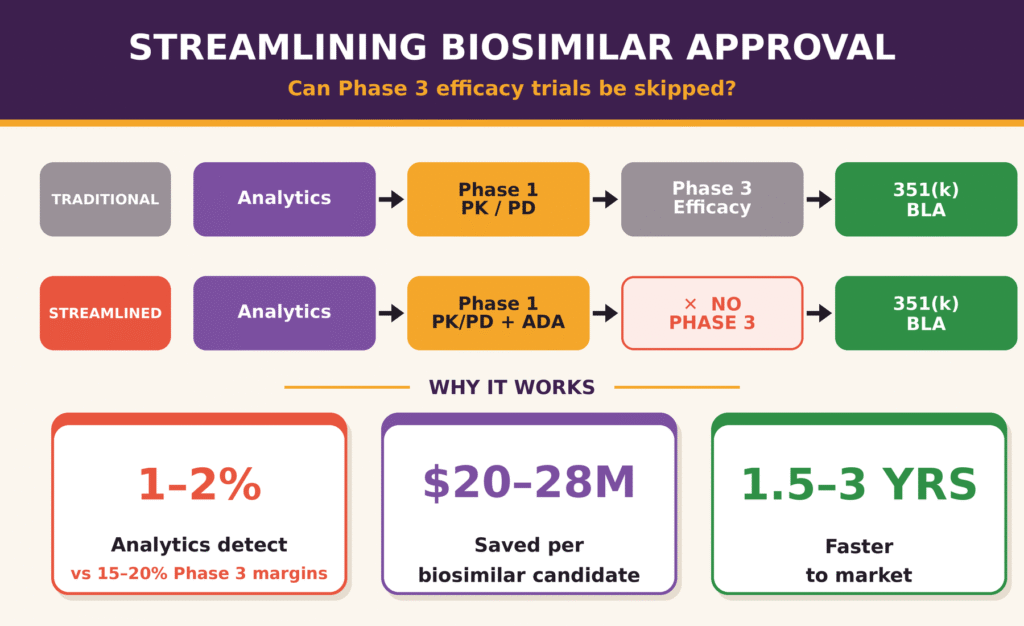
Comparative analytical assessments can identify minor structural variations at precision levels of approximately 1–2%. In contrast, traditional Phase 3 clinical efficacy trials commonly employ clinical equivalence margins ranging from 15% to 20%. As a result, Phase 3 studies may serve primarily as confirmatory assessments rather than as the most sensitive means of identifying molecular differences between biological products. More than fifteen years of regulatory experience, together with meta-analyses conducted by the Center for Drug Evaluation and Research (CDER), has supported the role of analytical similarity and PK equivalence in evaluating biosimilarity. However, the need for additional clinical evidence must still be determined according to the specific product, its available data, and any unresolved scientific uncertainty.
The transition from traditional biosimilar development to a streamlined regulatory approach involves several distinct milestones:
- Traditional Development Pathway: Development begins with analytical characterization and animal studies, followed by Phase 1 comparative PK/PD trials and large Phase 3 comparative clinical efficacy studies (CES) before submission of the 351(k) BLA.
- Streamlined Regulatory Pathway: Development prioritizes comprehensive analytical characterization and orthogonal assays, followed by Phase 1 comparative PK/PD and immunogenicity evaluations. When the totality of evidence adequately addresses residual uncertainty, sponsors may submit a 351(k) application without conducting a Phase 3 efficacy study.
Waiving Phase 3 efficacy studies can produce substantial economic and operational benefits. Industry economic modeling indicates that eliminating Phase 3 clinical trials may reduce biosimilar development costs by 20 million to 28 million per candidate, representing an estimated 18% to 25% reduction in overall research and development (R&D) expenditure. Such changes may also shorten development timelines by approximately 1.5 to 3 years. These efficiencies can enable biosimilars to reach the market sooner, improve patient access, and strengthen market competition. Nevertheless, additional clinical efficacy studies may still be necessary when residual analytical uncertainty cannot be adequately resolved, suitable and sensitive PK/PD endpoints are unavailable, or specific safety concerns require further clinical evaluation.
Support evidence-based development decisions with a scientifically robust comparability exercise in biosimilar development that addresses analytical similarities and remaining uncertainties.
Clinical Pharmacology and Immunogenicity in Establishing a No Clinically Meaningful Differences Biosimilar
Clinical pharmacology studies and multi-tiered immunogenicity assessments provide essential clinical evidence for evaluating whether a proposed product meets the requirements for a No Clinically Meaningful Differences Biosimilar. These investigations compare human drug exposure, pharmacokinetic (PK) parameters, pharmacodynamic (PD) biomarkers, and anti-drug antibody (ADA) responses to assess potential differences in clinical safety and efficacy. Comparative PK studies are frequently conducted in healthy adult volunteers to minimize confounding factors associated with underlying diseases and concomitant immunosuppressive therapies. However, patient populations may be required when testing in healthy volunteers is inappropriate or raises ethical concerns.
Comparative pharmacokinetic studies evaluate key exposure parameters, including the area under the concentration-time curve from time zero to infinity (AUC0–∞), the area under the curve from time zero to the last quantifiable concentration (AUC0–t), and the maximum serum concentration (Cmax). To demonstrate PK equivalence, the 90% confidence intervals for the geometric mean ratios of these parameters between the proposed biosimilar and the reference product are generally expected to fall within the standard bioequivalence range of 80.00% to 125.00%, subject to the applicable product-specific regulatory requirements. When validated pharmacodynamic biomarkers are available, such as absolute neutrophil count for filgrastim or serum uric acid levels for pegloticase, comparative PD endpoints may also be evaluated to provide additional evidence of biological activity in vivo.
Immunogenicity assessments follow a multi-tiered analytical strategy designed to characterize immune responses and determine their potential clinical significance:
- Tier 1: Screening Assays: Sensitive immunoassay formats, including electrochemiluminescence and direct ELISA, are used to screen samples for binding anti-drug antibodies (ADAs).
- Tier 2: Confirmatory Assays: Competitive inhibition testing with unlabeled drug substance is used to confirm that detected ADA signals are specific to the biological therapeutic.
- Tier 3: Titer Quantitation: Serial sample dilutions are used to determine antibody titers and evaluate the magnitude of the immune response over time.
- Tier 4: Neutralizing Antibody (NAb) Assays: Cell-based or competitive ligand-binding assays assess whether detected antibodies interfere with the biological activity of the product or its ability to bind to the intended target.
Establishing biosimilarity does not require the complete absence of an immune response. Instead, the evaluation considers whether the incidence, antibody titers, and clinical consequences of ADAs in biosimilar-treated populations differ meaningfully from those observed in populations receiving the reference product. The interpretation of these findings considers both statistical evidence and clinical relevance, including whether any observed differences could affect safety, efficacy, or immunogenicity.
Improve impurity assessment and product-quality evaluation through comprehensive impurity profiling of biosimilars that identifies and characterizes relevant impurity species.
Extrapolation of Indications, Labeling, and Three-Way Bridging Frameworks
Indication extrapolation allows a biosimilar supported by evidence from an appropriately selected sensitive clinical indication to receive approval for additional indications authorized for the reference product, provided that the totality of evidence scientifically supports such extrapolation. This assessment considers shared mechanisms of action and other relevant scientific factors across the proposed indications. When sponsors use non-U.S.-licensed comparator products during development, a scientifically justified three-way analytical and clinical bridging framework may be required to establish the relevance of the comparator data to the U.S.-licensed reference product. Extrapolation is an important feature of Section 351(k), as it can eliminate the need for separate clinical testing in every indication approved for the reference product when the available evidence adequately supports the proposed uses.
Scientific justifications for indication extrapolation include assessments of target receptor binding, tissue distribution, mechanism of action (MoA) across indications, and the consistency of critical quality attributes (CQAs) across commercial manufacturing batches. FDA labeling practices generally align biosimilar prescribing information with the relevant clinical safety and efficacy information of the reference product, together with other information required for the biosimilar’s approved labeling. Comparative biosimilarity trial results are not ordinarily presented as a separate clinical efficacy claim in the product label, helping maintain consistent prescribing information for healthcare professionals.
When comparative clinical data are generated using a non-U.S.-licensed comparator, sponsors may need to establish a three-way bridging strategy that includes the following elements:
- Pairwise analytical comparability between the proposed biosimilar candidate and the U.S.-licensed reference product.
- Pairwise analytical comparability between the proposed biosimilar candidate and the non-U.S.-licensed comparator product.
- Pairwise pharmacokinetic and bioanalytical comparability between the U.S.-licensed reference product and the non-U.S.-licensed comparator product.
A scientifically robust bridging assessment across all three comparisons helps establish whether data generated using a non-U.S.-licensed comparator can support U.S. regulatory requirements under the 351(k) pathway. The adequacy of the bridging strategy depends on the comparability data, study design, and applicable FDA recommendations.
Align biological product characterization with ICH Q6B guidelines to support a structured approach to specifications and quality assessment.
Bioanalytical Characterization and Strategic Regulatory Compliance
Advanced bioanalytical testing methodologies and cGMP-compliant laboratory infrastructure are essential for generating the precise structural and functional data required to support 351(k) regulatory submissions. Specialized analytical partners, such as ResolveMass Laboratories Inc., provide advanced liquid chromatography, mass spectrometry, and cell-based bioassay capabilities that help characterize biological products and investigate residual analytical uncertainty.
Build a more complete analytical evidence package through specialized biosimilar characterization services covering critical structural and functional attributes.
High-resolution bioanalytical testing supports detailed characterization of protein primary sequences, higher-order structures, post-translational modifications, and host-cell protein (HCP) impurity profiles. Conducting comprehensive comparative analytical assessments early in development can help identify structural and functional variations before clinical pharmacology studies begin. Contract bioanalytical services can support biosimilar developers through cGMP-compliant stability testing, batch release profiling, and validated analytical method execution, with applicable electronic records and electronic signatures managed in accordance with 21 CFR Part 11 requirements. Building a comprehensive analytical comparability package within an appropriate regulatory framework helps sponsors address FDA expectations for 351(k) submissions and establish a robust scientific basis for demonstrating biosimilarity.
Strengthen stability and purity assessments by investigating aggregation in biosimilars and its potential implications for product quality.
Conclusion: The Future Standard for No Clinically Meaningful Differences Biosimilar Approval
The regulatory evaluation of a No Clinically Meaningful Differences Biosimilar increasingly emphasizes high-resolution bioanalytical characterization and clinical pharmacology rather than routinely relying on extensive Phase 3 clinical efficacy trials. The FDA’s evolving guidance highlights the importance of comparative analytical assessments, comparative PK/PD evaluations, and multi-tiered immunogenicity testing in identifying and assessing product differences. When the totality of evidence adequately demonstrates biosimilarity, a streamlined 351(k) development strategy may reduce development expenditure and accelerate time to market while maintaining the required standards for safety, purity, and potency.
Prepare for regulatory review with a comprehensive end-to-end biosimilar analytical package that integrates essential characterization data for submission.
Biopharmaceutical developers that integrate advanced bioanalytical technologies with scientifically justified regulatory strategies are better positioned to meet evolving expectations for biosimilar development and licensure. For specialized bioanalytical support, structural comparability testing, and assistance with regulatory submissions, contact the expert team at ResolveMass Laboratories Inc. through the Contact Us Page.
Frequently Asked Questions
A Section 351(a) Biologics License Application (BLA) generally requires comprehensive evidence establishing the safety, purity, and potency of a biological product. In contrast, the Section 351(k) pathway evaluates a proposed biosimilar through comparison with an already licensed reference product. This abbreviated approach relies on analytical characterization, clinical pharmacology, and other relevant evidence to establish biosimilarity.
The FDA supports a risk-based approach in which Phase 3 comparative clinical efficacy studies may be unnecessary when analytical and clinical pharmacology data sufficiently establish biosimilarity. Advanced analytical techniques can detect molecular differences that clinical trials may not identify reliably. The need for additional efficacy studies depends on the totality of evidence and whether any clinically relevant uncertainty remains unresolved.
Immunogenicity is assessed using validated assays that detect and characterize immune responses against a biological product. The evaluation commonly includes screening, confirmatory testing, antibody titer determination, and neutralizing antibody assays. Results are compared with those for the reference product to determine whether differences in antibody responses could affect clinical safety, efficacy, or product performance.
Indication extrapolation allows a biosimilar to receive approval for additional indications of its reference product without requiring separate clinical efficacy studies for every condition. This decision depends on the totality of evidence, including analytical similarity, mechanism of action, pharmacokinetics, and relevant safety information. Scientific justification must support the use of the biosimilar across the proposed indications.
A three-way bridging strategy compares the proposed biosimilar, the U.S.-licensed reference product, and a non-U.S.-licensed comparator to establish the relevance of the comparator data. The assessment generally includes analytical comparisons and appropriate comparative pharmacokinetic and bioanalytical evaluations. Adequate bridging evidence can support the use of relevant non-U.S. clinical data in a U.S. Section 351(k) submission.
A biosimilar must demonstrate high similarity to its reference product and no clinically meaningful differences in safety, purity, and potency. An interchangeable biological product must also satisfy additional statutory requirements concerning expected outcomes when the product is substituted for the reference product. Where permitted by applicable state law, an interchangeable product may qualify for pharmacy-level substitution without the intervention of the prescribing healthcare provider.
Biosimilar labeling generally draws on the reference product’s established information about indications, dosage, administration, safety, and clinical use, as applicable to the approved biosimilar. This approach helps healthcare professionals use the biosimilar within an established clinical framework. The labeling also includes product-specific information and follows applicable FDA requirements rather than presenting comparative study results as a separate efficacy claim.
Reference:
- U.S. Food and Drug Administration. (2018, July). Labeling for biosimilar products: Guidance for industry. https://www.fda.gov/files/drugs/published/Labeling-for-Biosimilar-Products-Guidance-for-Industry.pdf
- Lim, S. (n.d.). Overview of the regulatory framework and FDA’s guidance for the development and approval of biosimilar and interchangeable products in the US [Presentation slides]. U.S. Food and Drug Administration. https://www.fda.gov/files/drugs/published/Overview-of-the-Regulatory-Framework-and-FDA%27s-Guidance-for-the-Developmet-and-Approval-of-Biosmiliar-and-Interchangeable-Products-in-the-US.pdf
- U.S. Food and Drug Administration. (2026, March). New and revised draft Q&As on biosimilar development and the BPCI Act (Revision 4): Guidance for industry. U.S. Department of Health and Human Services. https://www.fda.gov/media/119278/download
- Hung, A., Vu, Q., & Mostovoy, L. (2017). A systematic review of U.S. biosimilar approvals: What evidence does the FDA require and how are manufacturers responding? Journal of Managed Care & Specialty Pharmacy, 23(12), 1234–1244. https://doi.org/10.18553/jmcp.2017.23.12.1234
- U.S. Food and Drug Administration. (2015, April). Quality considerations in demonstrating biosimilarity of a therapeutic protein product to a reference product: Guidance for industry. U.S. Department of Health and Human Services. https://www.fda.gov/media/135612/download
- U.S. Food and Drug Administration. (2025, October). Scientific considerations in demonstrating biosimilarity to a reference product: Updated recommendations for assessing the need for comparative efficacy studies: Guidance for industry (Draft guidance). U.S. Department of Health and Human Services. https://www.fda.gov/media/189366/download
- U.S. Food and Drug Administration. (2025, October). Scientific considerations in demonstrating biosimilarity to a reference product: Updated recommendations for assessing the need for comparative efficacy studies: Guidance for industry. U.S. Department of Health and Human Services. https://www.fda.gov/regulatory-information/search-fda-guidance-documents/scientific-considerations-demonstrating-biosimilarity-reference-product-updated-recommendations
Get In Touch With Us
About The Author