

Introduction
Outsourcing Extractables and Leachables (E&L) Testing to a Drug Establishment License (DEL) holder ensures that analytical data is generated in accordance with Part C, Division 1A and Division 2 of Health Canada’s Food and Drug Regulations, facilitating acceptance by regulatory authorities worldwide. Contract Research Organizations (CROs) and pharmaceutical sponsors frequently select a Health Canada DEL-licensed analytical laboratory because it minimizes regulatory submission risks, maintains strict Quality Assurance Person (QAP) oversight, and delivers fully validated trace-level analytical testing within recognized Mutual Recognition Agreement (MRA) frameworks. As regulatory agencies across the globe intensify their focus on chemical migration originating from container-closure systems (CCS), drug delivery devices, and single-use manufacturing components, dependence on unaccredited or non-GMP laboratories can expose drug developers to significant regulatory setbacks, including clinical holds and submission deficiencies. Collaborating with an accredited laboratory helps ensure that sophisticated trace-characterization studies satisfy the stringent safety, quality, and efficacy requirements necessary for successful global product approvals.
Share via:
Article Summary:
- Health Canada DEL-licensed labs provide E&L testing under GMP requirements, supporting regulatory-grade and legally defensible analytical data.
- Global regulatory recognition through Health Canada’s MRAs helps CROs use E&L data across major markets, including the US, EU, and UK.
- Strong quality oversight includes QAP review, GMP compliance, data integrity controls, validated methods, and routine Health Canada inspections.
- Advanced analytical technologies such as GC-MS/MS, LC-HRMS, and ICP-MS enable sensitive detection of VOCs, SVOCs, NVOCs, and elemental impurities.
- ICH Q3E introduces a risk-based, lifecycle approach to leachables, including Class 1, 2, and 3 categories with different control strategies.
- Outsourcing reduces CRO costs and risks by providing access to specialized instruments, expert scientists, toxicology support, and extensive spectral libraries without major capital investment.
- Supplier qualification is critical: CROs should verify active DEL status, QAP credentials, analytical sensitivity, data integrity systems, and alignment with ICH Q3E and compendial standards.
Regulatory Compliance and Global Recognition in Outsourcing Extractables and Leachables (E&L) Testing
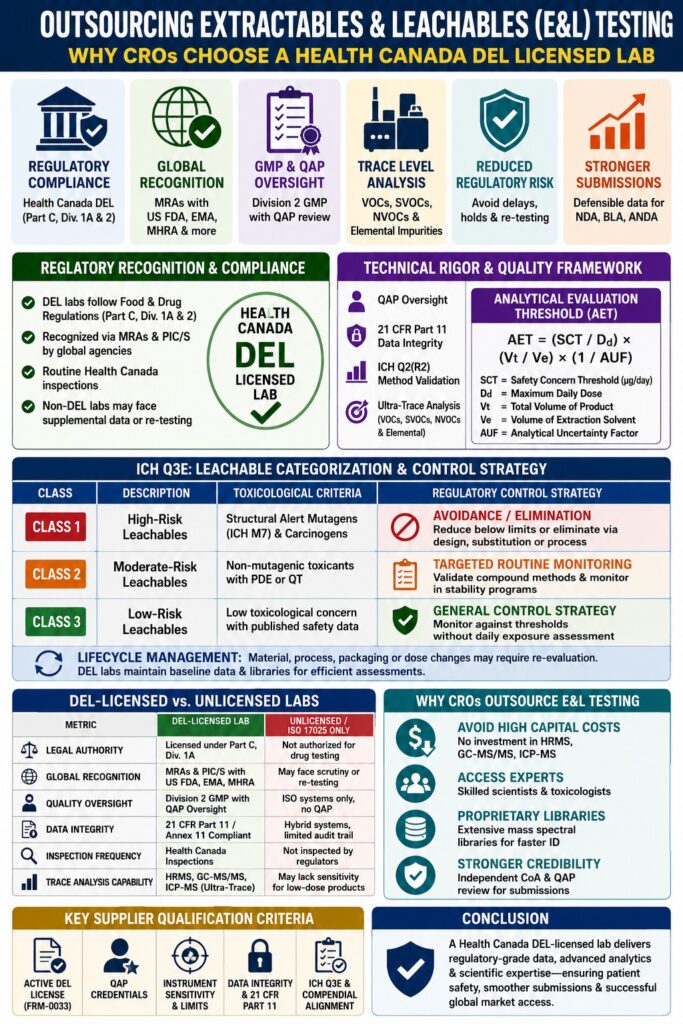
Outsourcing Extractables and Leachables (E&L) Testing to a laboratory holding a Health Canada Drug Establishment License (DEL) provides scientifically robust and legally defensible data generated under the mandatory Good Manufacturing Practice (GMP) requirements outlined in Division 2 of the Food and Drug Regulations. A DEL serves as a statutory authorization issued under Part C, Division 1A of Canada’s Food and Drug Regulations and legally requires facilities involved in the fabrication, packaging, labeling, distribution, importation, or testing of pharmaceutical products to comply with comprehensive quality standards.
Health Canada’s regulatory system functions within a well-established network of international Mutual Recognition Agreements (MRAs) with comparable regulatory agencies, including the United States Food and Drug Administration (US FDA), the European Medicines Agency (EMA), and the United Kingdom Medicines and Healthcare products Regulatory Agency (MHRA). Through these MRA arrangements, analytical testing performed by a Health Canada DEL-licensed laboratory is recognized as meeting equivalent GMP expectations, allowing CROs and pharmaceutical sponsors to leverage a single E&L testing package across multiple regulatory jurisdictions without repeating analytical studies.
Facilities operating without a DEL, including many academic and non-GMP laboratories, do not possess the regulatory oversight required to support commercial product release activities or critical clinical trial submissions. When CROs rely on non-DEL testing providers, regulatory agencies often request supplemental information or mandate repeat testing to establish compliance, resulting in costly delays to development timelines. In contrast, a DEL-licensed laboratory undergoes routine and, when necessary, unannounced inspections conducted by Health Canada. These inspections evaluate the entire Quality Management System (QMS), facility controls, equipment qualification and maintenance programs, personnel training, and data governance practices. Continuous inspection readiness provides CRO vendor qualification teams with a high degree of confidence in the laboratory’s compliance status.
To avoid compliance gaps that lead to costly submission delays, explore the Root Causes of Failed Extractables and Leachables Studies and how to mitigate them early in product development.
Technical Rigor and Analytical Quality Frameworks under Health Canada Division 2 GMP Standards
Health Canada Division 2 GMP requirements obligate DEL-licensed analytical laboratories to maintain stringent Quality Assurance Person (QAP) oversight, implement 21 CFR Part 11 compliant data governance systems, and perform analytical method validation activities consistent with ICH Q2(R2). The successful execution of E&L characterization studies demands ultra-trace analytical sensitivity capable of detecting, identifying, and quantifying volatile organic compounds (VOCs), semi-volatile organic compounds (SVOCs), non-volatile organic compounds (NVOCs), and elemental impurities that may migrate from polymeric, elastomeric, or other packaging-related materials.
For a detailed breakdown of instrumentation choices for volatile and semi-volatile screening, read about GC-MS vs. LC-MS in Extractables and Leachables Testing.
A Health Canada DEL-licensed laboratory conducts E&L programs through the integration of recognized compendial and international standards, including USP for extractables identification, USP for leachables quantification, and ISO 10993-18 for medical device chemical characterization. Validation studies are designed to comprehensively assess analytical performance characteristics such as specificity, linearity, range, accuracy, precision, limit of detection (LOD), and limit of quantitation (LOQ) across challenging pharmaceutical matrices.
Discover how trace elemental contaminants and inorganic impurities are accurately characterized using ICP-MS in Extractables and Leachables Testing.
To establish scientifically justified reporting thresholds, laboratories calculate the Analytical Evaluation Threshold (AET), which defines the concentration level above which unknown compounds must undergo identification and toxicological assessment:
AET = (SCT / Dd) × (Vt / Ve) × (1 / AUF)
In this equation, SCT represents the Safety Concern Threshold (μg/day) established through toxicological evaluation. Dd corresponds to the maximum daily dose of the drug product (mL/day or dosage units/day). Vt represents the total volume of the drug product preparation, while Ve refers to the volume of extraction solvent utilized during analytical sample preparation. AUF represents the Analytical Uncertainty Factor, which accounts for response factor variability commonly associated with semi-quantitative screening techniques such as Gas Chromatography-Mass Spectrometry (GC-MS), Liquid Chromatography-High Resolution Mass Spectrometry (LC-HRMS), and Inductively Coupled Plasma-Mass Spectrometry (ICP-MS). Within a DEL-compliant QMS environment, all threshold calculations are independently reviewed and verified to reduce the risk of false-negative assessments involving toxicologically significant migrant compounds.
Calculate precise reporting limits for your specific dosage form with our guide on AET for Extractables and Leachables Studies.
Impact of the Draft ICH Q3E Guideline on Outsourcing Extractables and Leachables (E&L) Testing
The draft ICH Q3E guideline introduces a harmonized and risk-based international framework that transforms E&L assessment from a one-time analytical exercise into a comprehensive lifecycle-managed control strategy. The guideline integrates material characterization, toxicological risk assessment, and quality risk management principles described in ICH Q9 to ensure patient safety across all routes of drug administration.
Outsourcing Extractables and Leachables (E&L) Testing to a technologically advanced analytical laboratory enables CROs and sponsors to receive study designs that are fully aligned with emerging ICH Q3E expectations. The guideline formalizes specific approaches for leachable categorization and introduces more refined expectations regarding toxicological qualification and risk management.
| Leachable Categorization | Toxicological Criteria | Required Regulatory Control Strategy |
|---|---|---|
| Class 1 Leachables | High-risk compounds, including structural alert mutagens (ICH M7) and highly potent carcinogens. | Avoidance / Elimination: Exposure should be reduced below compound-specific acceptable intake limits or eliminated through packaging redesign, material substitution, or process optimization. |
| Class 2 Leachables | Non-mutagenic toxicants with established Permitted Daily Exposure (PDE) values or Qualified Thresholds (QT). | Targeted Routine Monitoring: Compound-specific analytical methods should be validated and incorporated into ongoing stability and monitoring programs. |
| Class 3 Leachables | Compounds with low toxicological concern supported by published safety data, structural monographs, and toxicological databases. | General Control Strategy: Monitoring is performed against established threshold limits without the need for compound-specific daily exposure evaluations. |
Under ICH Q3E, analytical control strategies must also address lifecycle management requirements. Changes in resin suppliers, modifications to packaging sterilization processes, adjustments to container-closure contact geometry, or revisions to clinical dosing regimens may trigger the need for a formal re-evaluation of the leachable profile. DEL-licensed laboratories maintain baseline analytical datasets, mass spectral libraries, method validation packages, and historical study records, enabling CROs to perform lifecycle assessments efficiently without repeating entire testing programs.
Evaluate compound safety profiles effectively by understanding the process of Toxicological Qualification of Leachables.
Comparative Analysis: Health Canada DEL-Licensed vs. Unlicensed Analytical Facilities
A Health Canada DEL-licensed laboratory operates within a regulated environment governed by mandatory statutory inspections and pharmaceutical regulations, whereas standard ISO 17025 accredited facilities do not possess the same regulatory authority required for pharmaceutical release testing and clinical submission support. Operating without a DEL limits a laboratory’s ability to provide data that can be directly relied upon for regulated pharmaceutical applications within highly regulated markets.
| Quality & Regulatory Metric | Health Canada DEL-Licensed Laboratory | Unlicensed / ISO 17025 Only Facility |
|---|---|---|
| Legal Authority for Drug Testing | Officially licensed under Food and Drug Regulations Part C, Division 1A. | Not legally authorized for commercial drug release or regulated pharmaceutical stability testing in Canada. |
| Global Regulatory Recognition | Recognized through Health Canada MRAs and PIC/S alignment with agencies such as the US FDA, EMA, and MHRA. | May be subject to regulatory scrutiny, additional justification requests, or re-testing requirements. |
| Quality Oversight Structure | Division 2 GMP compliant with mandatory Quality Assurance Person (QAP) oversight. | Operates under ISO quality systems without pharmaceutical GMP obligations or QAP requirements. |
| Data Integrity Enforcement | Mandatory compliance with 21 CFR Part 11 and Annex 11 requirements for electronic records and audit trails. | Data governance practices vary and may rely on hybrid systems with limited audit trail functionality. |
| Inspection Frequency | Subject to direct Health Canada inspections at established intervals and risk-based schedules. | Generally not inspected by pharmaceutical regulatory authorities. |
| Trace Analysis Capabilities | Specialized Orbitrap HRMS, GC-MS/MS, and ICP-MS platforms optimized for ultra-low AET investigations. | Standard instrumentation may not consistently achieve the sensitivity required for low-dose pharmaceutical products. |
This comparison highlights why reliance solely on ISO 17025 accreditation can create regulatory vulnerabilities in pharmaceutical development programs. Although ISO 17025 demonstrates technical competence and laboratory quality, it does not require the pharmaceutical-grade data governance systems, QAP oversight, GMP compliance framework, or regulatory inspection requirements mandated under a Health Canada DEL.
Ensure your compliance framework withstands audit scrutiny by reviewing Data Integrity in Extractables and Leachables Testing.
Operational and Strategic Drivers for CROs Outsourcing Extractables and Leachables (E&L) Testing
Outsourcing Extractables and Leachables (E&L) Testing allows CROs to avoid substantial capital expenditures associated with high-resolution mass spectrometry platforms while gaining immediate access to specialized analytical and toxicological expertise. Establishing internal trace-analysis laboratories requires major investments in sophisticated instrumentation such as Orbitrap LC-HRMS, thermal desorption GC-MS/MS, and ICP-MS, in addition to recruiting and retaining highly trained scientists capable of interpreting complex analytical datasets.
By partnering with an established DEL-licensed analytical provider such as ResolveMass Laboratories Inc., CROs can transform fixed infrastructure costs into flexible project-based expenditures. Dedicated E&L laboratories maintain extensive proprietary mass spectral libraries containing thousands of packaging additives, antioxidant degradation products, vulcanization accelerators, slip agents, processing aids, and plasticizer-related compounds. These resources significantly accelerate the identification of unknown chromatographic peaks observed during extraction and migration studies.
Proactively prevent chemical migration risks at the design phase by selecting Low-Leachables Packaging Materials.
Outsourcing E&L programs to an independent DEL-licensed laboratory also strengthens the credibility and defensibility of a sponsor’s regulatory submission package. Independent Certificates of Analysis (CoAs) and analytical study reports reviewed and approved by a QAP provide objective scientific evidence that can withstand regulatory scrutiny during NDA, BLA, or ANDA assessments.
Learn how real-time stability tracking safeguards product shelf-life in Leachables Monitoring During Stability Studies.
Key Supplier Qualification Criteria when Outsourcing Extractables and Leachables (E&L) Testing
Selecting an E&L testing partner requires vendor management teams to verify active DEL status within Health Canada’s official database, assess QAP qualifications, and evaluate the laboratory’s data integrity infrastructure. Conducting a comprehensive supplier qualification audit helps minimize compliance risks before analytical testing activities begin.
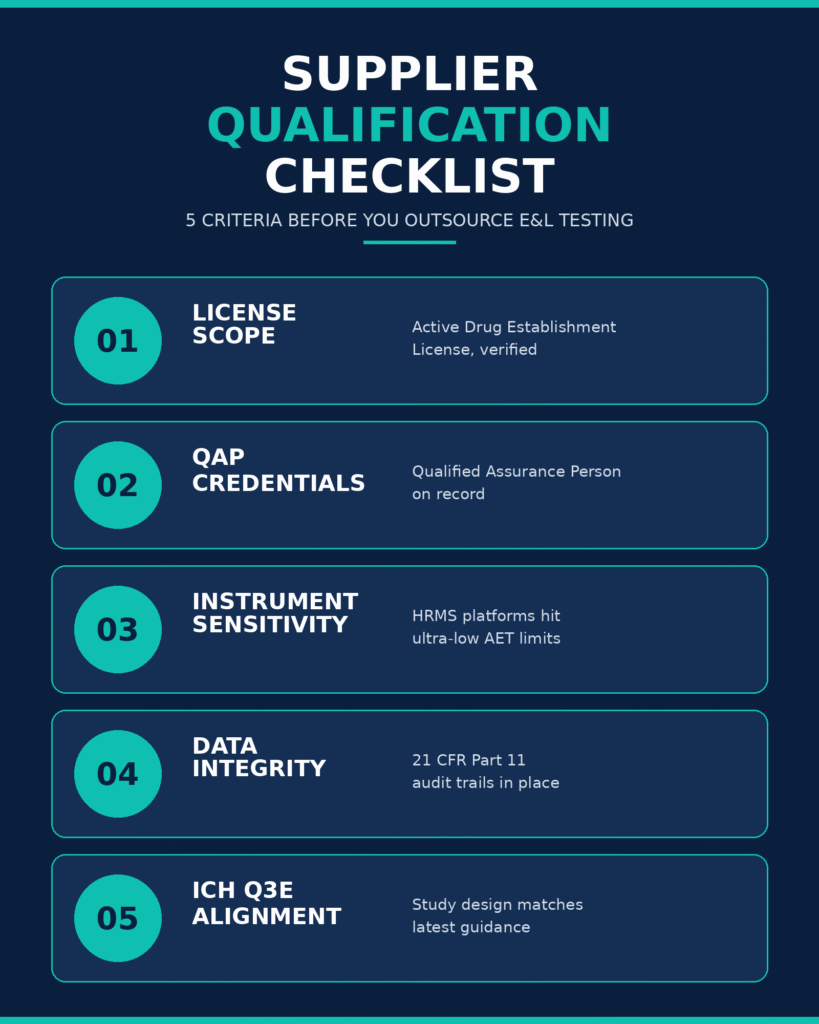
Vendor qualification teams should evaluate the following critical criteria:
- License Scope Verification: Confirm the laboratory maintains an active Drug Establishment License (Form FRM-0033) and is authorized to conduct pharmaceutical testing activities under Division 1A requirements.
- Quality Assurance Person Credentials: Verify that the designated QAP possesses appropriate academic qualifications in relevant scientific disciplines together with substantial pharmaceutical quality assurance and regulatory experience.
- Instrument Sensitivity and Limits: Assess high-resolution mass spectrometry capabilities to ensure analytical sensitivity and limits of quantitation support ultra-low Analytical Evaluation Thresholds (AET) for high-risk dosage forms.
- Data Integrity Architecture: Review system access controls, electronic signature management, audit trail functionality, disaster recovery processes, and data backup procedures to confirm full compliance with 21 CFR Part 11 expectations.
- ICH Q3E and Compendial Alignment: Examine study design methodologies, toxicological assessment frameworks, and compound identification workflows to ensure alignment with the latest draft ICH Q3E guidance and relevant compendial requirements.
Plan your project budgets and timeline expectations effectively with our full breakdown of E&L Testing Costs.
Conclusion
Outsourcing Extractables and Leachables (E&L) Testing to a Health Canada DEL-licensed analytical partner enables pharmaceutical sponsors and CROs to obtain regulatory-grade analytical data capable of meeting the expectations of major global health authorities. As international regulatory agencies continue to align with the principles outlined in the draft ICH Q3E framework, the importance of risk-based and lifecycle-managed chemical characterization programs continues to increase. A partnership with a DEL-licensed laboratory provides the regulatory credibility, advanced analytical instrumentation, and scientific expertise necessary to safeguard patient safety, streamline regulatory submissions, reduce development risks, and support successful global market access.
To learn more about outsourcing specialized analytical programs or to discuss your upcoming Extractables and Leachables testing requirements with expert analytical chemists, visit the ResolveMass Laboratories Contact Page.
Frequently Asked Questions
A Health Canada DEL supports international regulatory confidence because Canadian GMP requirements are recognized through established regulatory cooperation frameworks, including Mutual Recognition Agreements (MRAs) and participation in the Pharmaceutical Inspection Co-operation Scheme (PIC/S). As a result, analytical data generated by DEL-licensed laboratories is often considered reliable and consistent with internationally accepted quality standards. This can simplify multi-region regulatory submissions and reduce the need for duplicate testing activities.
The Quality Assurance Person (QAP) plays a central role in maintaining compliance within a DEL-licensed facility. Responsibilities include overseeing the Quality Management System, reviewing and approving analytical procedures, ensuring that validated methods are properly implemented, and verifying compliance with data integrity requirements. The QAP also reviews final analytical results and authorizes official quality documents before they are issued to clients or regulatory authorities.
The Analytical Uncertainty Factor (AUF) is included in AET calculations to account for differences in analytical response among unknown compounds detected during screening studies. Since various chemicals may ionize or respond differently in mass spectrometry-based techniques, relying solely on reference standards can underestimate certain compounds. Applying the AUF provides a more conservative assessment approach and helps ensure potentially significant migrants are not overlooked.
The draft ICH Q3E guideline introduces a globally harmonized and risk-based approach to managing extractables and leachables throughout a product’s lifecycle. It places greater emphasis on toxicological risk assessment, material characterization, and continuous monitoring strategies. The guideline also encourages lifecycle management practices, ensuring that changes in materials, manufacturing processes, or product configurations are evaluated for their potential impact on patient safety.
Lifecycle re-evaluation may become necessary whenever significant changes occur that could alter the chemical migration profile of a pharmaceutical product. Common triggers include changes in raw material suppliers, modifications to packaging components, updates to sterilization processes, formulation adjustments, or revisions to dosing regimens. These changes can influence the nature or quantity of leachables and therefore require reassessment to maintain regulatory compliance and product safety.
Obtaining a Health Canada Drug Establishment License involves a detailed regulatory review process that includes application assessment, facility evaluation, and GMP inspection activities. The overall timeline can extend for several months depending on the complexity of the operation and regulatory workload. Because the licensing process requires substantial preparation and review, many organizations choose to partner with already licensed laboratories to accelerate development and testing timelines.
Single-use systems used in biomanufacturing, including bioreactor bags, tubing assemblies, connectors, and filtration components, contain polymeric materials that may release trace chemical compounds during processing. These compounds can interact with biological products, potentially affecting cell culture performance, product quality, or long-term stability. Comprehensive E&L characterization helps identify and assess these risks, supporting product safety, process reliability, and regulatory compliance throughout the manufacturing lifecycle.
Reference:
- Health Canada. (n.d.). Drug establishment licences. Government of Canada. Retrieved August 11, 2026, from https://www.canada.ca/en/health-canada/services/drugs-health-products/compliance-enforcement/establishment-licences/drug-establishment-licences.html
- Health Canada. (n.d.). Mutual recognition agreements. Government of Canada. Retrieved August 11, 2026, from https://www.canada.ca/en/health-canada/services/drugs-health-products/compliance-enforcement/international/mutual-recognition-agreements.html
- International Council for Harmonisation of Technical Requirements for Pharmaceuticals for Human Use (ICH). (2025, August 1). ICH Q3E draft guideline available now on the ICH website. https://www.ich.org/news/ich-q3e-draft-guideline-available-now-ich-website
- European Medicines Agency. (2025, August 14). ICH Q3E extractables and leachables: Scientific guideline. https://www.ema.europa.eu/en/ich-q3e-extractables-leachables-scientific-guideline
- Health Canada. (2023, June 1). GUI-0127: Management of drug establishment licence applications and performance. Government of Canada. https://www.canada.ca/en/health-canada/services/drugs-health-products/compliance-enforcement/establishment-licences/directives-guidance-documents-policies/management-applications-performance-drug-establishment-licences-0127.html
Get In Touch With Us
About The Author


