


Introduction
Liquid chromatography-tandem mass spectrometry (LC-MS/MS) offers the sensitivity, mass accuracy, and structural resolution necessary for detecting, localizing, and quantifying trace-level Sequence Variants and Misincorporation in Peptide Biosimilars below the regulatory 0.1% threshold. Comprehensive characterization of these primary structure impurities during bioprocess development and biosimilar comparability studies is essential for supporting drug safety, potency, product consistency, and compliance with global regulatory guidelines.
Recombinant expression systems, including Chinese Hamster Ovary (CHO) cells and Saccharomyces cerevisiae, as well as solid-phase peptide synthesis (SPPS), inherently carry potential risks for unintended primary sequence modifications. These product-related impurities may originate from point mutations within host cell DNA, transcriptional mistranslation, depletion of amino acids during fermentation, or incomplete coupling reactions during chemical synthesis. If such variants remain undetected, non-native amino acid substitutions may affect therapeutic efficacy, produce unpredictable immunogenic responses, or modify pharmacokinetic profiles.
Explore Biosimilar Comparability Studies at ResolveMass Laboratories to ensure your biotherapeutic meets regulatory requirements.
Regulatory organizations such as the Food and Drug Administration (FDA), European Medicines Agency (EMA), and World Health Organization (WHO) require extensive structural comparability assessments between biosimilars and reference products (RPs), including appropriate evaluation of low-level sequence heterogeneity. Advanced bottom-up peptide mapping supported by high-resolution mass spectrometry (HRMS) provides the mass accuracy, analytical sensitivity, and fragmentation capabilities needed to distinguish genuine sequence modifications from bioinformatic software artifacts. This approach supports comprehensive and reliable quality oversight throughout the product lifecycle.
Share via:
Article Summary:
- LC-MS/MS is a powerful approach for detecting, localizing, and quantifying trace-level sequence variants and misincorporation in peptide biosimilars, including variants below the 0.1% regulatory benchmark.
- Sequence variants can arise from multiple sources, including host-cell mutations, transcriptional or translational errors, amino acid depletion during fermentation, and incomplete coupling or racemization during Solid-Phase Peptide Synthesis (SPPS).
- High-resolution LC-MS/MS and peptide mapping provide accurate mass measurements and detailed fragmentation, enabling reliable identification of low-abundance variants while distinguishing genuine modifications from analytical or bioinformatic artifacts.
- HCD, ETD, and EThcD provide complementary fragmentation capabilities. HCD supports routine sequence mapping, ETD preserves labile PTMs, while EThcD offers enhanced localization and can distinguish challenging isomeric residues such as Leucine and Isoleucine.
- Bioinformatic validation is essential to reduce false-positive variant assignments. Key checks include retention-time consistency, fragment-ion continuity, isotopic distribution matching, strict mass-error limits, and instrument-setting audits.
- A multi-tiered regulatory strategy combines NGS, amino acid analysis (AAA), and HRMS peptide mapping to identify genetic mutations, detect process-related amino acid depletion, and confirm sequence variants at approximately 0.01–0.1% abundance.
- Maintaining sequence variants below 0.1% supports biosimilar quality, safety, potency, and comparability. Variants above this level or within critical quality attribute (CQA) regions require additional risk assessment covering immunogenicity, binding, and potential clinical impact.
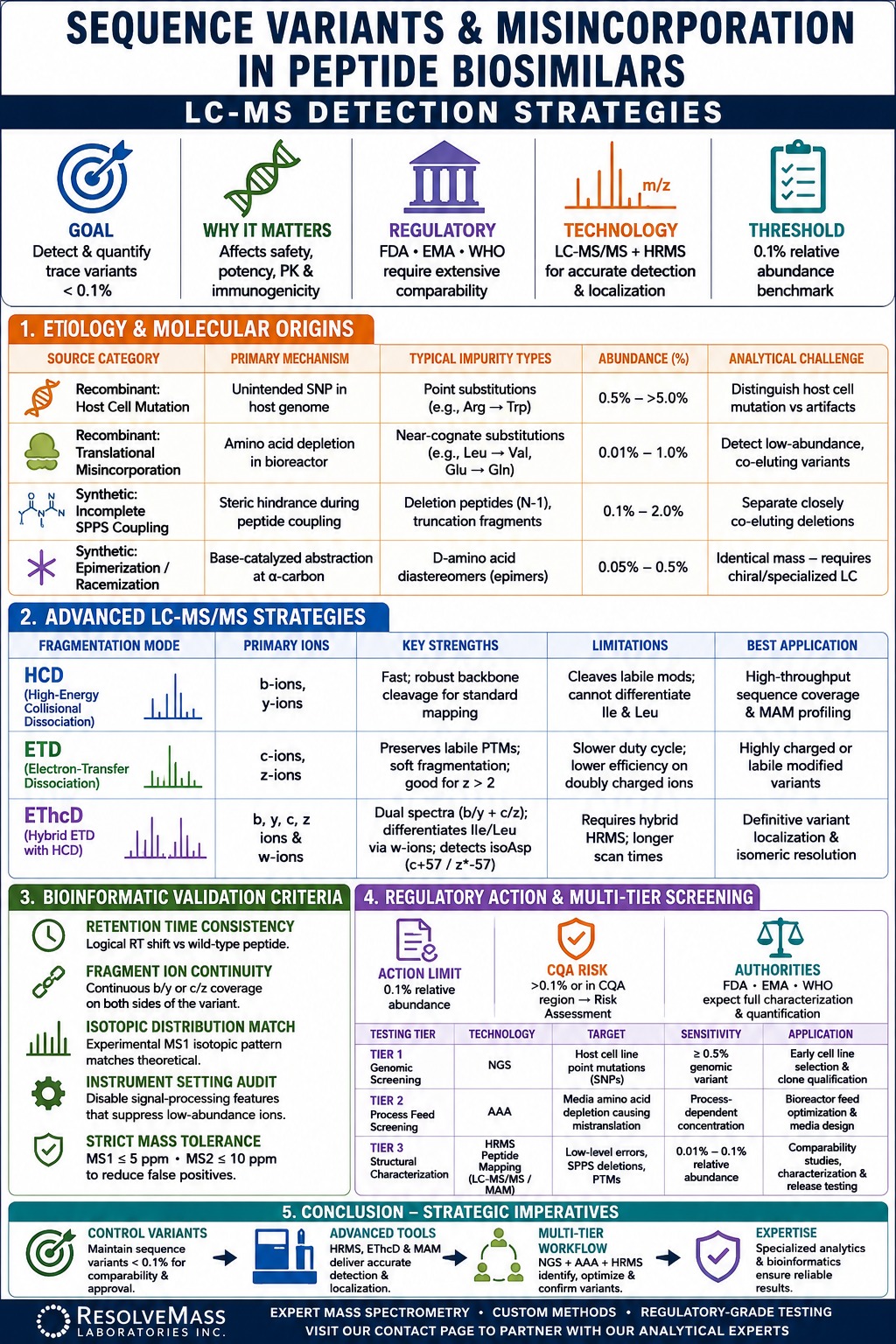
Etiology and Molecular Origins of Sequence Variants and Misincorporation in Peptide Biosimilars
Unintended sequence variants in peptide biotherapeutics can result from host cell genomic point mutations, transcriptional mistranslation, depletion of amino acids within bioreactor systems, or incomplete chemical coupling during solid-phase peptide synthesis. Determining the specific molecular source of each variant allows manufacturers to implement targeted improvements in fermentation media, cell culture conditions, or chemical synthesis procedures and thereby minimize primary sequence heterogeneity.
Learn more about our customized Cell Line Development for Biosimilars to mitigate genomic mutation risks early in development.
In recombinant production systems, primary sequence heterogeneity can develop through three major biological pathways: genetic single-nucleotide polymorphisms (SNPs) within the host cell genome, transcriptional errors during RNA polymerase readout, and translational errors occurring at the ribosome during protein biosynthesis. Translational misincorporation can become more frequent when particular amino acid pools become depleted during high-density cell culture in bioreactors. Under conditions of amino acid starvation, aminoacyl-tRNA synthetases may incorrectly charge near-cognate or non-cognate amino acids onto tRNAs. Examples include the substitution of norvaline or valine for leucine and the mistranslation of glutamine for glutamic acid. Such events can introduce measurable microheterogeneity into the final therapeutic protein.
For synthetic peptide biosimilars manufactured through Solid-Phase Peptide Synthesis (SPPS), sequence variants arise through chemical mechanisms rather than biological transcriptional or translational processes. These mechanisms include incomplete amino acid coupling reactions, incomplete Fmoc/tBu deprotection, deletion peptides (N-1), truncation fragments, and base-catalyzed epimerization/racemization. Diastereomeric impurities generated through α-carbon racemization are particularly challenging to characterize because they possess molecular weights identical to those of the intended peptide. Consequently, their reliable detection generally requires specialized chromatographic retention and separation strategies before mass spectrometry analysis.
Read about our advanced methodologies for Impurity Profiling of Biosimilars to isolate and identify trace-level degradation and synthesis artifacts.
| Source Category | Primary Mechanism | Typical Impurity Types | Abundance Range (%) | Primary Analytical Challenge |
|---|---|---|---|---|
| Recombinant: Host Cell Mutation | Unintended SNP in host coding sequence | Fixed point substitutions (e.g., Arg to Trp) | 0.5% – >5.0% | Distinguishing host cell line mutations from clone selection artifacts. |
| Recombinant: Translational Misincorporation | Depletion of amino acid pools in bioreactor media | Near-cognate substitutions (e.g., Leu to Val, Glu to Gln) | 0.01% – 1.0% | Detecting low-abundance, co-eluting isobaric/near-isobaric variants. |
| Synthetic: Incomplete SPPS Coupling | Steric hindrance during peptide bond formation | Deletion peptides (N-1), truncation fragments | 0.1% – 2.0% | Chromatographic separation of closely co-eluting deletion sequences. |
| Synthetic: Epimerization / Racemization | Base-catalyzed abstraction at the α-carbon | D-amino acid diastereomers (epimers) | 0.05% – 0.5% | Identical molecular mass requires chiral or specialized RP-LC retention. |
Advanced LC-MS/MS Analytical Strategies for Sequence Variants and Misincorporation in Peptide Biosimilars
The characterization of low-abundance sequence variants requires high-resolution precursor mass spectrometry together with advanced tandem dissociation techniques, including HCD, ETD, and EThcD. These complementary approaches support extensive sequence coverage while helping differentiate isobaric or isomeric amino acid substitutions. High resolving power (>120,000 at m/z 200) combined with sub-ppm mass accuracy enables trace peptide modifications to be distinguished from high-abundance wild-type signals.
Contemporary peptide mapping workflows commonly employ high-resolution Orbitrap mass spectrometers configured for Multi-Attribute Method (MAM) analysis. High-resolution full precursor spectra (MS1) provide accurate mass measurements within sub-ppm tolerances, substantially narrowing the range of possible amino acid substitutions. However, accurate localization and confirmation of a suspected misincorporation generally require tandem mass spectrometry (MS2). Higher-Energy Collisional Dissociation (HCD) efficiently produces backbone b- and y-type fragment ions for conventional sequence mapping, but it may not adequately differentiate isomeric residues, such as Leucine and Isoleucine, or preserve certain fragile post-translational modifications (PTMs) because of the relatively high vibrational activation energy involved.
Discover how Native Mass Spectrometry for Biosimilars preserves higher-order structures during analytical screening.
To address these structural limitations, advanced analytical workflows can incorporate hybrid Electron-Transfer/Higher-Energy Collision Dissociation (EThcD). EThcD produces complementary fragmentation spectra containing b/y and c/z ion series within a single acquisition scan. This fragmentation strategy can generate diagnostic secondary w-type ions (z-43 and z-29), supporting definitive differentiation between Leucine and Isoleucine residues. In addition, EThcD can produce diagnostic c+57 and z*-57 ions that assist in distinguishing isoaspartic acid (isoAsp) rearrangements from native aspartic acid. These fragmentation characteristics provide structural confirmation even when the variant is present at trace concentrations of approximately 0.026%–0.18% abundance.
Explore our comprehensive Proteomics Approach for Biosimilars for in-depth protein sequence and modification analysis.
| Fragmentation Mode | Primary Fragment Ions Generated | Key Strengths in Variant Detection | Limitations / Challenges | Optimal Application |
|---|---|---|---|---|
| HCD (Higher-Energy Collisional Dissociation) | b-ions, y-ions | Fast spectral acquisition; robust backbone cleavage for standard sequence mapping. | Cleaves labile modifications; cannot differentiate isomeric Leucine and Isoleucine. | High-throughput baseline sequence coverage and MAM profiling. |
| ETD (Electron-Transfer Dissociation) | c-ions, z-ions | Preserves labile PTMs; soft non-ergodic fragmentation; effective for charge states z > 2. | Slower duty cycle; lower fragmentation efficiency on doubly charged precursor ions. | Characterizing highly charged or labile modified sequence variants. |
| EThcD (Hybrid ETD with HCD) | b, y, c, z ions, and diagnostic w-ions | Rich dual-fragment spectra; differentiates Ile/Leu via w-ions; identifies isoAsp (c+57/z*-57). | Requires hybrid HRMS instrumentation; slightly longer scan times. | Definitive sequence variant localization and isomeric resolution. |
Bioinformatic Workflows and Elimination of Mass Spectrometry Artifacts
Bioinformatic sequence variant analysis commonly relies on error-tolerant search algorithms, including Mascot ETS or Byologic, to identify potential point modifications. However, stringent filtering criteria are essential because these workflows can produce false-positive assignments associated with isobaric dipeptides, near-isobaric species, and artifactual modifications. Tight control of precursor mass tolerances, combined with expert manual assessment of fragment spectra, can substantially decrease false discovery rates, with reductions of up to 93% reported under appropriate analytical conditions.
Unrestricted error-tolerant search engines, including Mascot ETS, PepFinder, and Expressionist, can generate numerous candidate sequence variant assignments within a single experiment. One important source of false-positive results is the presence of isobaric or near-isobaric dipeptide substitutions, such as Serine-Alanine (158.069 Da) compared with Glycine-Threonine (158.069 Da). In such cases, algorithms may incorrectly assign the primary sequence of otherwise standard tryptic peptides. Search engines may also generate artificial modification assignments, including artificial succinylation on Aspartate residues, or incorrectly interpret isotopic peaks as deamidation, particularly when attempting to force a mass match against spectra that have not undergone adequate refinement.
Review our specialized services for Forced Degradation of Biosimilars to establish robust degradation profiles.
To minimize software-derived artifacts while retaining genuine low-abundance sequence variants, analytical workflows apply strict mass-error thresholds together with structural filtering criteria. High-resolution Orbitrap MS precursor scans using narrow mass tolerances, such as sub-5 ppm for MS1 and sub-10 ppm for MS2, can eliminate a substantial proportion of bioinformatic false-positive assignments. In addition, disabling specific instrument signal-processing features on Orbitrap platforms that contribute to the relative under-quantitation of low-abundance precursor ions can help restore the true linear dynamic range. Such optimization may also reduce data-processing turnaround times from approximately six weeks to two weeks.
Bioinformatic Validation Criteria for Confirming Sequence Variants
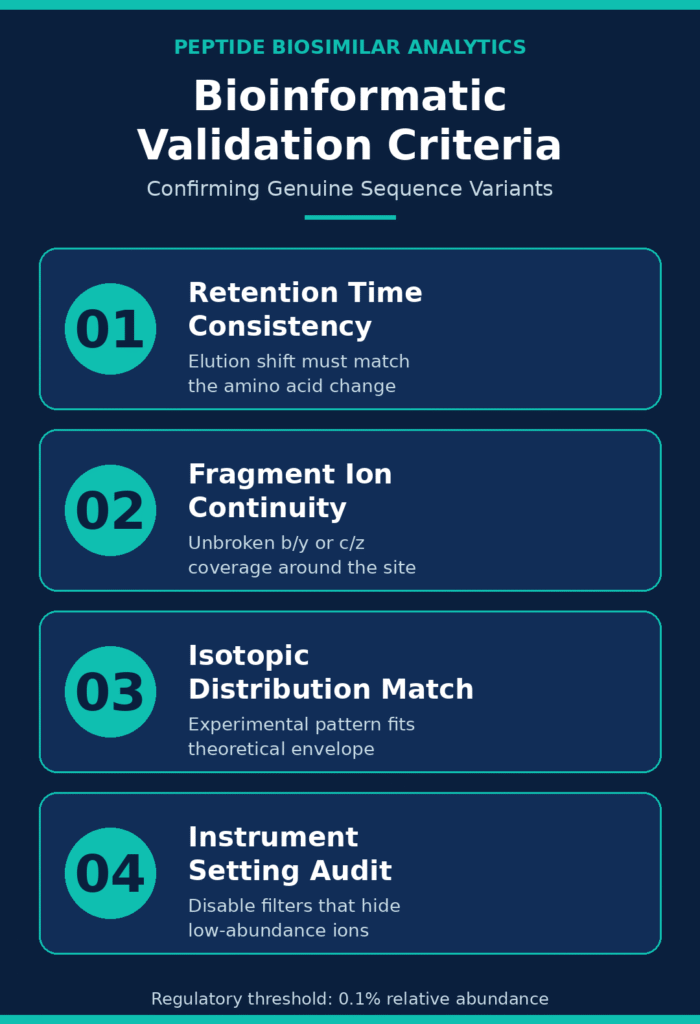
- Retention Time Consistency: Confirm that the candidate sequence variant exhibits a logical chromatographic retention-time shift relative to the corresponding wild-type peptide during reversed-phase LC. For example, substitutions involving more hydrophobic amino acids may result in later elution.
- Fragment Ion Continuity: Verify continuous b/y or c/z fragment-ion coverage on both sides of the modified residue. This helps demonstrate that the observed mass difference is localized to a specific amino acid rather than resulting from a dipeptide rearrangement.
- Isotopic Distribution Match: Establish that the experimental MS1 isotopic envelope corresponds with the expected theoretical isotopic distribution and is not significantly affected by spectral overlap from co-eluting, high-abundance peptides.
- Instrument Setting Audit: Review and deactivate automated instrument signal-processing features that may suppress low-abundance ion signals, thereby helping preserve the expected linear dynamic range.
Learn about our Charge Variant Analysis in Biosimilars using mass spectrometry.
Regulatory Action Limits, Multi-Tiered Screening, and Comparability Frameworks
Global regulatory authorities use a general benchmark threshold of 0.1% relative abundance for individual sequence variants in biotherapeutics, supporting the need for multi-tiered screening strategies during cell line development and final lot release. Combining genomic sequencing, amino acid analysis, and LC-MS/MS multi-attribute methods enables manufacturers to identify potential sequence heterogeneity at different stages of development and establish appropriate regulatory controls.
Review the application of ICH Q6B Guidelines for Biological Characterisation in designing biotherapeutic specifications.
Regulatory agencies, including the FDA, EMA, and WHO, expect comprehensive characterization and quantification of product-related impurities as part of biosimilar development and regulatory submissions. Industry benchmark assessments of approved therapeutic proteins indicate that individual sequence variants maintained below 0.1% relative abundance at individual amino acid sites are generally considered acceptable and are unlikely to significantly affect biological activity or produce adverse immunogenic responses. Nevertheless, when a sequence variant exceeds 0.1%, or when it is located within a Critical Quality Attribute (CQA) region such as a complementarity-determining region (CDR) or receptor-binding domain, a comprehensive risk assessment may be required. Such an assessment considers factors including immunogenicity potential, binding kinetics, and potential effects on clinical dosage.
Read how we define Critical Quality Attributes (CQAs) in Biosimilars to streamline your risk management process.
To minimize sequence heterogeneity during cell line and process development, biopharmaceutical testing facilities implement multi-tiered analytical strategies. Next-Generation Sequencing (NGS) can be used to evaluate host cell master seed lines for genetic point mutations, whereas specialized Amino Acid Analysis (AAA) can identify cell culture media imbalances that may contribute to translational misincorporation. High-resolution LC-MS/MS peptide mapping is then applied to purified drug substances to provide structural confirmation and absolute quantitation of sequence variants at sub-0.1% levels.
Explore our workflows for Aggregation Analysis in Biosimilars to protect biotherapeutic safety and potency.
| Testing Tier | Primary Technology | Target Mechanism | Sensitivity / Detection Limit | Typical Application Phase |
|---|---|---|---|---|
| Tier 1: Genomic Screening | Next-Generation Sequencing (NGS) | Host cell line point mutations (SNPs) | ≥ 0.5% genomic variant frequency | Early cell line selection and clone qualification. |
| Tier 2: Process Feed Screening | High-Performance Amino Acid Analysis (AAA) | Media amino acid depletion inducing mistranslation | Process-dependent concentration | Bioreactor feed optimization and culture media design. |
| Tier 3: Structural Characterization | HRMS Peptide Mapping (LC-MS/MS / MAM) | Low-level translational errors, SPPS deletions, PTMs | 0.01% – 0.1% relative abundance | Comparability studies, characterization, and release testing. |
Conclusion: Strategic Imperatives for Sequence Variants and Misincorporation in Peptide Biosimilars
Establishing primary sequence identity and controlling trace-level misincorporation to below 0.1% is an important regulatory consideration for demonstrating biotherapeutic comparability and supporting drug approval. Advanced high-resolution LC-MS/MS platforms, hybrid EThcD fragmentation, and multi-tiered analytical workflows provide the comprehensive structural characterization required to evaluate Sequence Variants and Misincorporation in Peptide Biosimilars throughout product development.
Accurately resolving trace-level sequence variants at sub-0.1% thresholds requires a combination of advanced analytical instrumentation, multi-attribute analytical strategies, and specialized bioinformatic expertise. By integrating orthogonal testing tiers, including NGS, AAA, and HRMS peptide mapping, biopharmaceutical developers can identify host cell line mutations, optimize bioreactor feed parameters, and distinguish genuine sequence variants from false-positive bioinformatic assignments. ResolveMass Laboratories Inc. provides expert mass spectrometry characterization, customized analytical method development, and regulatory-grade comparability testing designed for complex synthetic and recombinant peptide therapeutics. Biopharmaceutical organizations seeking to establish sequence variant testing strategies or assess biosimilar quality attributes can consult with the analytical team through the ResolveMass Laboratories Contact Page.
Frequently Asked Questions (FAQs)
Sequence variants in synthetic peptides are generally associated with chemical synthesis-related issues, including incomplete coupling, inadequate deprotection, truncation, deletion sequences, and racemization. In contrast, recombinant biosimilar variants can develop because of host cell genetic changes, transcriptional errors, or translational misincorporation. Therefore, the underlying mechanisms and analytical strategies used to investigate these variants can differ substantially.
A commonly applied benchmark for individual sequence variants is 0.1% relative abundance at a specific amino acid position. Variants exceeding this level may require additional scientific evaluation rather than being automatically considered unacceptable. The assessment can include potential effects on biological activity, target binding, immunogenicity, product quality, and clinical performance.
High-resolution mass spectrometry directly examines the manufactured peptide or protein and can reveal sequence changes that are actually present in the final drug substance. NGS primarily evaluates genetic information and is therefore useful for identifying DNA-level mutations but cannot independently reveal every translational error or synthesis-related impurity. LC-MS/MS consequently provides important product-level evidence for final structural characterization.
EThcD combines Electron-Transfer Dissociation with Higher-Energy Collision Dissociation to generate complementary b/y and c/z fragment ion information. This broader fragmentation pattern improves sequence localization while helping preserve certain labile structural features. Diagnostic w-type ions can also provide additional evidence for distinguishing isomeric residues such as Leucine and Isoleucine.
False-positive assignments can arise when different peptide sequences have identical or very similar masses, making automated identification challenging. Isobaric dipeptide combinations, incorrect interpretation of isotopic peaks, and inappropriate assignment of artificial modifications can all contribute to erroneous sequence variant calls. Inadequate mass accuracy or insufficient spectral quality can further increase the likelihood of incorrect assignments.
False-positive results can be minimized by combining high-resolution Orbitrap MS acquisition with stringent precursor and fragment mass-error criteria. Applying sub-5 ppm MS1 and sub-10 ppm MS2 tolerances, reviewing instrument signal-processing settings, and manually evaluating diagnostic MS/MS fragments can strengthen variant confirmation. These measures help distinguish genuine low-level sequence changes from computational artifacts.
The Multi-Attribute Method (MAM) uses high-resolution LC-MS-based peptide mapping to monitor multiple product quality attributes within a single analytical workflow. Depending on the method design, it can evaluate sequence variants alongside post-translational modifications and other product-related attributes. This integrated approach can improve analytical efficiency and support comparability, characterization, and quality control activities.
High-Performance Amino Acid Analysis (AAA) can be used to monitor amino acid concentrations and consumption patterns during cell culture. Process teams can use this information to adjust nutrient feeds before critical amino acid pools become depleted. Maintaining suitable amino acid availability can help support accurate tRNA charging and reduce the likelihood of translational misincorporation.
D- and L-amino acid epimers have the same molecular mass, so conventional mass measurement alone cannot reliably distinguish them. Their differentiation generally requires an effective chromatographic separation step before MS detection, such as chiral chromatography or a suitably optimized reversed-phase UHPLC method. Combining chromatographic retention behavior with MS characterization provides stronger evidence for identifying these stereochemical variants.
Reference:
- Cadang, L., Tam, C. Y. J., Moore, B. N., Fichtl, J., & Yang, F. (2023). A highly efficient workflow for detecting and identifying sequence variants in therapeutic proteins with a high resolution LC-MS/MS method. Molecules, 28(8), 3392. https://doi.org/10.3390/molecules28083392
- Zhang, A., Chen, Z., Li, M., Qiu, H., Lawrence, S., Bak, H., & Li, N. (2020). A general evidence-based sequence variant control limit for recombinant therapeutic protein development. mAbs, 12(1), 1791399. https://doi.org/10.1080/19420862.2020.1791399
- Thakur, A., Nagpal, R., Ghosh, A. K., Gadamshetty, D., Nagapattinam, S., Subbarao, M., Rakshit, S., Padiyar, S., Sreenivas, S., Govindappa, N., Pai, H. V., & Melarkode Subbaraman, R. (2021). Identification, characterization and control of a sequence variant in monoclonal antibody drug product: A case study. Scientific Reports, 11, 13233. https://doi.org/10.1038/s41598-021-92338-1
- Lin, T. J., Beal, K. M., Brown, P. W., DeGruttola, H. S., Ly, M., Wang, W., Chu, C. H., Dufield, R. L., Casperson, G. F., Carroll, J. A., Friese, O. V., Figueroa, B., Marzilli, L. A., Anderson, K., & Rouse, J. C. (2019). Evolution of a comprehensive, orthogonal approach to sequence variant analysis for biotherapeutics. mAbs, 11(1), 1–12. https://doi.org/10.1080/19420862.2018.1531965
- Dobrowolski, M., Urbaniak, M., & Pietrucha, T. (2025). Peptide mapping for sequence confirmation of therapeutic proteins and recombinant vaccine antigens by high-resolution mass spectrometry: Software limitations, pitfalls, and lessons learned. International Journal of Molecular Sciences, 26(20), 9962. https://doi.org/10.3390/ijms26209962
- Yu, Q., Wang, B., Chen, Z., Urabe, G., Glover, M. S., Shi, X., Guo, L.-W., Kent, K. C., & Li, L. (2017). Electron-transfer/higher-energy collision dissociation (EThcD)-enabled intact glycopeptide/glycoproteome characterization. Journal of the American Society for Mass Spectrometry, 28(9), 1751–1764. https://doi.org/10.1007/s13361-017-1701-4
Get In Touch With Us
About The Author


