

Introduction
Extractables & Leachables (E&L) Testing for Auto-Injectors involves the specialized chemical characterization and surveillance of substances that migrate from components of combination devices into pharmaceutical formulations. This testing serves as an essential regulatory safeguard, ensuring that materials coming into contact with the drug product do not release harmful impurities that may compromise product stability or pose risks to patient safety. Contemporary drug-device combination products, including automated needle-based injection systems (NIS-AUTO) and on-body delivery systems (OBDS), contain highly sophisticated chemical contact interfaces. Unlike conventional glass vial packaging, an auto-injector or wearable delivery device consists of a complex combination of structural polymers, elastomeric plungers, metal staked-in needles, lubricants, radiation-cured adhesives, and numerous additional construction materials. Because biopharmaceutical formulations are extremely sensitive to trace-level chemical contaminants, the migration of impurities, even at the microgram level, can induce protein denaturation, aggregation, or degradation of the active pharmaceutical ingredient (API). Furthermore, unidentified chemical migrants may result in systemic toxicity, localized tissue irritation, or immunogenic responses in patients. Therefore, developing a comprehensive Extractables & Leachables (E&L) profile throughout the complete lifecycle of the drug-device interface is essential for minimizing clinical risks and supporting successful regulatory submissions worldwide.
Learn more about our specialized solutions: Extractables & Leachables testing for autoinjectors
A clear understanding of the distinction between extractables and leachables is essential when establishing a testing strategy for these sophisticated combination systems. Extractables are chemical compounds that can be released from packaging systems, delivery devices, or medical device components under controlled laboratory conditions through the use of aggressive solvents, elevated temperatures, or other exaggerated extraction techniques. These studies are intentionally designed to represent worst-case conditions, allowing investigators to identify compounds with the potential to migrate into the drug product. In contrast, leachables are the chemical compounds that actually migrate into the pharmaceutical formulation during normal manufacturing, storage, and clinical use, thereby representing the substances to which patients may ultimately be exposed. Under ideal circumstances, leachables constitute a subset of the extractables identified during laboratory investigations. However, interactions between primary leachables and drug formulation components may produce secondary leachables that are absent from the original extractables profile. ResolveMass Laboratories Inc. employs high-resolution mass spectrometry together with validated analytical methodologies to investigate these complex chemical interactions, enabling precise identification, characterization, and monitoring of every migrant throughout the product’s intended shelf life.
Optimize your study design: Solvents for extractables studies
Share via:
Article Summary:
- Extractables & Leachables (E&L) testing is a critical safety process for auto-injectors and wearable drug delivery systems, ensuring that chemicals migrating from device materials do not compromise drug stability or patient safety.
- Drug-device combination products contain complex materials like polymers, elastomers, adhesives, and metals, which can release trace contaminants that may affect biologics or trigger toxicological risks.
- A clear distinction exists between extractables (chemicals released under aggressive lab conditions) and leachables (chemicals that migrate during real-world use), both of which must be carefully evaluated throughout a product’s lifecycle.
- Regulatory compliance requires alignment with multiple frameworks, including ISO 10993-18, USP standards, and the emerging ICH Q3E guideline, with oversight based on the product’s primary mode of action (PMOA).
- Different delivery systems (prefilled syringes vs cartridge-based devices) show distinct contamination risks due to differences in adhesives, silicone lubrication, tungsten residues, and needle design.
- Analytical evaluation thresholds (AET) and toxicological limits such as PDE and TI are used to define safety boundaries, supported by advanced mass spectrometry techniques for detecting ultra-trace compounds.
- Modern E&L strategies rely on orthogonal analytical methods, lifecycle risk management, and continuous monitoring of manufacturing changes to ensure consistent product safety and regulatory readiness.
Regulatory Frameworks and Compendial Standards for Combination Products
Achieving regulatory compliance for drug-device combination products requires the integration of pharmaceutical impurity guidelines with biological safety standards established for medical devices. This harmonized approach is accomplished by combining the chemical characterization principles defined in ISO 10993-18 with the pharmaceutical packaging requirements described in USP and USP . Since combination products include both pharmaceutical and medical device constituents, regulatory authorities evaluate them according to their Primary Mode of Action (PMOA). Within the United States, regulatory oversight is coordinated by the FDA’s Office of Combination Products (OCP), which determines whether primary review responsibility resides with the Center for Drug Evaluation and Research (CDER) or the Center for Devices and Radiological Health (CDRH), depending on the product’s principal therapeutic function.
The regulatory environment has become increasingly rigorous following the publication of the draft ICH Q3E guideline in August 2025, with final adoption anticipated in 2027. The purpose of ICH Q3E is to establish a unified, science-based, and risk-oriented framework for evaluating chemical migrants originating from packaging materials, container-closure systems, and drug delivery device components. This guideline provides a consistent methodology for assessing extractables and leachables across combination products. To facilitate compliance with these overlapping regulatory expectations, the following table summarizes the principal differences among the major compendial frameworks and their corresponding study design requirements.
| Parameter | USP & ISO 10993-18:2020 | Draft ICH Q3E Guideline |
|---|---|---|
| Primary Regulatory Focus | Pharmaceutical container-closure systems and drug delivery systems | Medical devices evaluated within a risk management framework; new drug products and drug-device combination systems |
| Definition of Leachables | Chemical migrants detected under established storage and stability conditions | Chemical compounds released during simulated clinical use or under established manufacturing and labeled storage conditions |
| Extraction Conditions | Stressed or exaggerated laboratory conditions utilizing elevated temperatures together with polar and non-polar solvents | Exhaustive, exaggerated, simulated-use, or customized risk-based extraction approaches tailored to material susceptibility and product contact conditions |
| Key Threshold Metrics | Safety Concern Threshold (SCT) and Analytical Evaluation Threshold (AET) | Tolerable Intake (TI), Dose-Based Threshold (DBT), Qualification Threshold (QT), SCT, and study-specific AET |
| Analytical Scope | Non-targeted screening combined with targeted validation for VOCs, SVOCs, and NVOCs | Comprehensive chemical characterization of construction materials together with holistic lifecycle assessment of both organic and inorganic leachables |
Beyond these foundational standards, the United States Pharmacopeia continues to expand its General Chapters by introducing dosage form-specific guidance for Extractables & Leachables (E&L) studies. These developments recognize that different routes of administration present unique chemical exposure pathways and therefore require tailored extraction methodologies and safety evaluations. The growing USP E&L series currently includes:
- USP <1664.1>: Assessment of Leachables in Orally Inhaled and Nasal Drug Products (OINDP).
- USP <1664.2>: Assessment of Leachables in Parenteral Drug Products (Intramuscular, Intravenous, and Subcutaneous).
- USP <1664.3>: Assessment of Leachables in Topical Ophthalmic Drug Products.
- USP <1664.4>: Assessment of Leachables in Topical and Transdermal Drug Products.
These individual chapters ensure that extraction procedures, analytical strategies, and safety thresholds are scientifically appropriate for each specific dosage form and route of patient exposure.
Ensure your data meets global standards: Data integrity in extractables and leachables testing
Syringe versus Cartridge Systems: Material Dynamics in Extractables & Leachables (E&L) Testing for Auto-Injectors
Within Extractables & Leachables (E&L) Testing for Auto-Injectors, the choice between a prefilled syringe and a cartridge-based system has a significant influence on the profile of potential chemical migrants. Variations in needle assembly design, adhesive usage, tungsten processing, and silicone lubrication methods create distinct extractables and leachables profiles for each system. Although both technologies are designed for injectable drug delivery, their structural differences substantially affect the interaction between the pharmaceutical formulation and the primary container throughout storage and administration.
Traditional auto-injector platforms generally utilize a spring-driven mechanical mechanism that activates a glass prefilled syringe (PFS). These prefilled syringes contain a staked-in needle permanently attached to the glass barrel using radiation-curable, photo-polymerizing acrylate adhesives. When ultraviolet (UV) radiation does not fully penetrate the adhesive layer because of geometric shadowing or assembly limitations, residual unreacted monomers, including isobornyl acrylate (IBOA), together with photoinitiators and other curing by-products, may remain within the adhesive matrix. These residual compounds have the potential to leach directly into aqueous pharmaceutical formulations, presenting clinically relevant concerns such as skin sensitization, allergic reactions, and contact dermatitis. In addition, manufacturing glass syringes requires the use of tungsten pins to create the needle channel. This manufacturing process may leave behind trace tungsten oxides, which have been associated with protein oxidation, aggregation, and reduced stability in sensitive biologic drug products.
Explore solutions for specific delivery formats: EL testing for pre-filled syringes
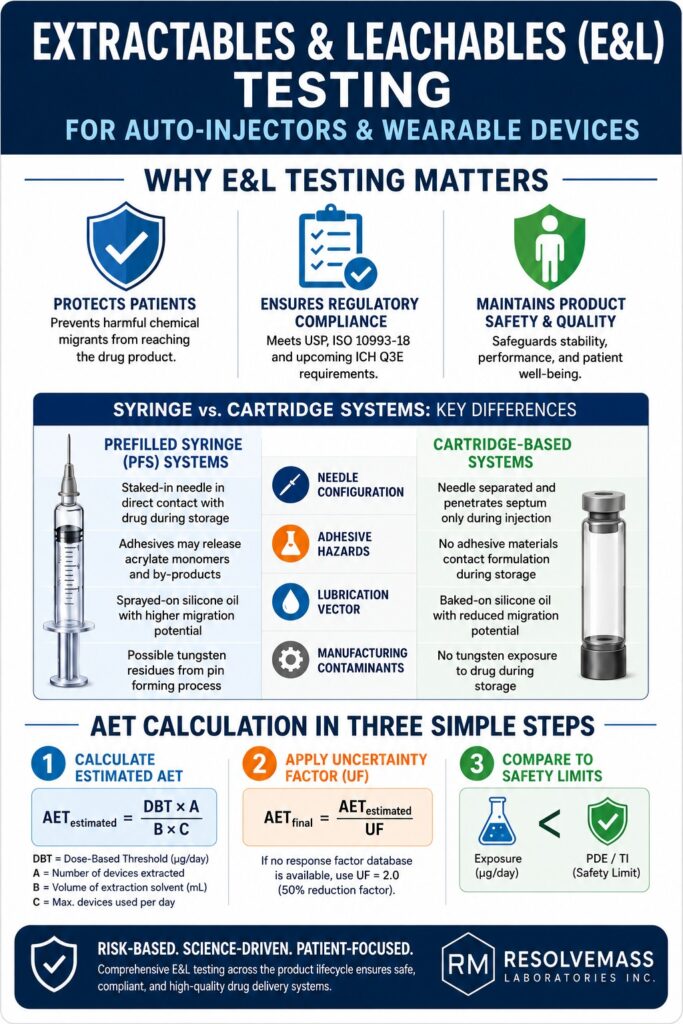
Cartridge-based delivery systems, including pen injectors and several next-generation cartridge auto-injectors, utilize a different engineering approach. Unlike prefilled syringes, the needle does not remain in direct contact with the drug product during storage. Instead, the formulation is sealed by an elastomeric septum secured beneath a crimp cap, while the injection needle penetrates the septum only at the time of administration. Additionally, cartridge systems commonly employ baked-on siliconization, a process that polymerizes the silicone lubricant onto the glass surface. This manufacturing technique substantially decreases the amount of free silicone oil capable of migrating into the pharmaceutical formulation when compared with the sprayed-on siliconization method frequently used in conventional prefilled syringes. The following table summarizes these important material differences.
| Material Vector | Prefilled Syringe (PFS) Systems | Cartridge-Based Injection Systems |
|---|---|---|
| Needle Configuration | Staked-in needle remains in direct and continuous contact with the drug product during storage | Needle remains physically separated and penetrates the elastomeric septum only during injection |
| Adhesive Hazards | Elevated risk of acrylate monomers, photoinitiators, and residual curing compounds | No adhesive materials contact the formulation during storage |
| Lubrication Vector | Sprayed-on silicone oil with a relatively high potential for free silicone droplet migration | Baked-on silicone oil with significantly reduced particulate migration |
| Manufacturing Contaminants | Potential presence of tungsten residues originating from the pin-forming manufacturing process | No tungsten exposure to the drug product during storage |
| Flange & Shoulder Mechanics | Glass flanges may experience stress fracturing under elevated spring forces | Robust flange-free cylindrical glass or cyclic olefin polymer (COP) construction |
To minimize adhesive-derived and lubricant-related leachables, many modern drug-device combination products are transitioning toward ready-to-fill (RTF) syringe and cartridge systems manufactured from Cyclic Olefin Polymers (COP). These advanced polymer-based container systems can be integrated with patented, silicone oil-free and per- and polyfluoroalkyl substances (PFAS)-free plunger stoppers. This design approach significantly reduces the generation of subvisible particles associated with silicone migration while simultaneously minimizing the regulatory concerns linked to fluorinated extractables, thereby improving the overall chemical compatibility and long-term stability of combination drug products.
Understand potential failure modes: Root causes of failed extractables and leachables (EL) studies
Mathematical Derivation of the Analytical Evaluation Threshold (AET)
The Analytical Evaluation Threshold (AET) is the concentration-based reporting threshold above which every detected extractable or leachable compound must undergo structural identification and toxicological qualification. Establishing this threshold ensures that the analytical sensitivity of the testing methodology is appropriately aligned with recognized limits for patient exposure. By defining an evidence-based reporting threshold, laboratories can ensure that compounds capable of posing a toxicological concern are consistently detected, identified, and evaluated throughout Extractables & Leachables (E&L) studies.
Master your threshold calculations: AET for extractables and leachables studies
The AET calculation begins with the selection of an appropriate Dose-Based Threshold (DBT), such as the Safety Concern Threshold (SCT). The Product Quality Research Institute (PQRI) recommends an SCT of 1.5 µg/day for parenteral drug products, including intravenous, subcutaneous, and intramuscular formulations. In comparison, Orally Inhaled and Nasal Drug Products (OINDP) utilize a considerably lower SCT of 0.15 µg/day because the pulmonary mucosal barrier is highly sensitive to chemical contaminants. The estimated Analytical Evaluation Threshold is determined using the following mathematical relationship:
AETestimated = (DBT × A) / (B × C)
Where:
- DBT = Dose-Based Threshold (µg/day)
- A = Total number of combination devices extracted to prepare the analytical sample
- B = Total volume of extraction solvent used to recover the extracted compounds (mL)
- C = Maximum number of devices administered to a patient each day according to the approved product labeling
To compensate for variations in analytical response among different chemical classes during non-targeted screening, an Uncertainty Factor (UF) is applied to the estimated AET. Incorporating this adjustment produces a more conservative reporting threshold that accounts for differences in detector response and analytical variability. This correction becomes especially important because products with lower daily doses or larger extraction volumes require exceptionally low reporting thresholds, often approaching the limits of analytical detection. The adjusted threshold is calculated using the following equation:
AETfinal = AETestimated UF
Alternatively, the Product Quality Research Institute (PQRI) recommends determining the uncertainty factor using the relative standard deviation (%RSD) of response factors obtained from an established analytical response database. When compound-specific response factor databases are unavailable, PQRI recommends applying a conservative 50% reduction factor, corresponding to an uncertainty factor of UF = 2.0.
Assess patient safety impact: Toxicological qualification of leachables
During toxicological risk assessment, the estimated patient exposure associated with each identified chemical migrant is compared with its Permitted Daily Exposure (PDE) or Tolerable Intake (TI) to determine the Margin of Safety (MoS). Since PDE values are dependent upon patient body weight, toxicologists standardize exposure calculations using representative body weight categories. These standardized assumptions ensure that exposure assessments remain consistent across different patient populations while providing adequate protection for more vulnerable groups.
| Target Patient Population | Standardized Body Weight Assumption (kg) | Clinical Significance in E&L Exposure Calculations |
|---|---|---|
| Adult Male | 70.0 | Baseline reference standard for general therapeutic exposure calculations |
| Adult Female / General Adult | 60.0 | Conservative body weight assumption representing the overall adult population |
| Child (>1 Year to ≤16 Years) | 10.0 | Requires proportional adjustment of PDE values for pediatric drug formulations |
| Infant (<1 Year) | 3.5 | Represents a highly sensitive patient population with reduced metabolic clearance capacity |
| Very Low Birthweight Infant | 1.5 | Requires substantial reduction in acceptable chemical exposure limits |
| Very Low Birthweight Neonate | 0.5 | Represents the most sensitive exposure category for neonatal intensive care therapies |
Advanced Orthogonal Analytical Methods for High-Sensitivity Screening
Comprehensive chemical characterization of unknown organic and inorganic migrants requires a multidimensional analytical strategy that combines gas chromatography, liquid chromatography, and inductively coupled plasma mass spectrometry. Employing orthogonal analytical platforms enables investigators to detect, characterize, and quantify compounds possessing a broad range of chemical properties while minimizing the occurrence of unidentified residues. High-resolution accurate mass instrumentation further enhances structural elucidation by providing exceptional mass accuracy and isotope pattern analysis.
Compare your analytical options: GC-MS vs LC-MS in extractables and leachables testing
At ResolveMass Laboratories Inc., scientists utilize an integrated suite of orthogonal analytical technologies to ensure reliable detection and quantification of volatile, semi-volatile, and non-volatile compounds at ultra-trace concentrations. Headspace Gas Chromatography-Mass Spectrometry (HS-GC-MS) is employed for the separation and identification of highly volatile organic compounds (VOCs) together with residual solvents retained within elastomeric closures, polymeric housings, and other device components. For the analysis of semi-volatile organic compounds (SVOCs), including antioxidant degradation products, plasticizers, stabilizers, curing agents, and related process residues, Gas Chromatography coupled with Tandem Mass Spectrometry (GC-MS/MS) serves as the principal analytical technique.
To improve analytical sensitivity in aqueous extraction matrices, laboratories frequently combine Solid-Phase Microextraction (SPME) with GC-MS. During this process, organic analytes are selectively adsorbed onto a coated extraction fiber while water molecules remain largely excluded from adsorption. This selective extraction enhances analytical sensitivity, reduces interference from aqueous matrices, and protects the gas chromatographic system from excessive water exposure.
The analysis of polar and non-volatile organic compounds (NVOCs) is performed using Liquid Chromatography-Tandem Mass Spectrometry (LC-MS/MS) together with High-Resolution Mass Spectrometry (HRMS) platforms, including Orbitrap and Time-of-Flight (TOF) technologies. HRMS provides highly accurate mass measurements combined with detailed isotope distribution analysis, allowing scientists to assign chemical structures to unknown compounds with a high degree of confidence. To ensure consistent analytical performance throughout non-targeted screening studies, laboratories routinely employ System Suitability Standards (SSS) for both GC-MS and LC-MS platforms. These standards verify instrument sensitivity, chromatographic resolution, retention time reproducibility, and mass accuracy before analytical data are accepted for regulatory evaluation.
Detect trace elemental contaminants: ICP-MS in extractables and leachables testing
Critical Process Parameters and Lifecycle Management under ICH Q3E
Effective lifecycle management under the emerging ICH Q3E guideline requires continuous risk assessment, ongoing monitoring of manufacturing processes, validation of critical operational parameters, and periodic re-evaluation whenever manufacturing processes or patient exposure conditions change. Rather than viewing chemical compatibility assessment as a one-time regulatory requirement, manufacturers are expected to implement comprehensive change-control programs that maintain the safety and quality of combination products throughout their commercial lifecycle.
To establish documented evidence demonstrating that manufacturing and assembly processes consistently produce safe and compliant combination products, manufacturers must identify, validate, and continuously control Critical Process Parameters (CPPs) while simultaneously monitoring the associated Critical Quality Attributes (CQAs). For example, during the application of adhesives used to secure staked needles, both the ultraviolet (UV) LED curing energy and the cleanliness of the glass hub surface represent important Critical Process Parameters. If the delivered curing energy falls below the validated specification, the associated Critical Quality Attributes, particularly adhesive cure completeness and bond integrity, may be adversely affected. Incomplete curing can subsequently result in elevated concentrations of unreacted acrylate monomers and related leachable compounds entering the pharmaceutical formulation.
Manage risks during production: Leachables monitoring during stability studies
Under the ICH Q3E framework, any modification introduced after regulatory approval that affects these validated parameters requires a formal scientific risk assessment to determine whether the established Extractables & Leachables (E&L) profile remains applicable. The principal changes that typically require comprehensive re-evaluation include:
- Formulation or Packaging Changes: Modifications to formulation pH, ionic strength, surfactant concentration, excipient composition, or changes to the elastomer formulation used in plunger stoppers, seals, or other packaging components.
- Manufacturing and Sterilization Adjustments: Changes such as replacing gamma irradiation with ethylene oxide sterilization, modifying cleaning procedures, introducing different molding release agents, or altering manufacturing process parameters that could influence chemical compatibility.
- Altered Patient Exposure Parameters: Changes to clinical dosing frequency, duration of therapy, including transitions from acute treatment to chronic administration, modifications in dosage strength, or changes in the intended route of administration that may alter cumulative patient exposure.
- New Toxicological and Pharmacological Data: The emergence of newly identified toxicological concerns for previously characterized compounds, revisions to internationally recognized toxicity databases, or updated pharmacological evidence that changes the acceptable limits for patient exposure.
Wearable Drug Delivery Systems: Adhesives and Electro-Chemical Challenges
The evaluation of wearable drug delivery systems and on-body delivery devices requires careful consideration of the unique degradation mechanisms associated with skin-contact adhesives, flexible electronic components, and integrated power sources operating under physiological conditions. Unlike conventional drug delivery devices, wearable systems are continuously exposed to body heat, movement, moisture, and mechanical stress, all of which can influence material stability. In addition, the incorporation of microelectronic components creates localized thermal gradients that may accelerate polymer degradation and increase the migration of chemical substances from device materials into surrounding environments.
Wearable patch pumps and connected drug delivery platforms remain in direct contact with the patient’s skin for extended periods, often ranging from several days to multiple weeks. Because of this prolonged skin contact, both biocompatibility and skin tolerability become critical engineering and regulatory considerations. The medical-grade pressure-sensitive adhesives (PSAs) used to secure these devices must undergo comprehensive biological safety evaluation to ensure they do not produce skin irritation, sensitization, or cytotoxic effects during prolonged use. Under the ISO 10993 biological evaluation framework, adhesive materials are expected to comply with testing requirements established in ISO 10993-5 for cytotoxicity, ISO 10993-10 for irritation, and ISO 10993-23 for sensitization. These evaluations help demonstrate that the adhesive system remains safe throughout the intended wear period without adversely affecting patient health.
Select safer delivery components: Low leachables packaging materials
Unlike passive primary container systems, wearable drug delivery devices incorporate active electronic circuitry, sensors, communication modules, and battery systems housed within a polymer enclosure. During normal device operation, heat generated by battery discharge and electronic components can elevate the internal temperature of the device, thereby accelerating hydrolytic and oxidative degradation of adjacent polymers, adhesives, elastomeric materials, and other construction components. Since these devices are routinely exposed to perspiration, humidity, bathing, and other environmental conditions encountered during everyday activities, moisture can function as an effective extraction medium. Sweat may penetrate adhesive layers and structural interfaces, facilitating the migration of low-molecular-weight monomers, adhesive constituents, flame retardants originating from printed circuit boards, plastic additives, or trace heavy metal ions directly onto the skin surface. To accurately characterize these real-world exposure scenarios, Extractables & Leachables (E&L) laboratories perform simulated-use extraction studies utilizing artificial sweat or physiological saline under dynamic thermal conditions. These studies more accurately reproduce clinical use environments and enable comprehensive qualification of potential patient exposure risks associated with wearable drug delivery technologies.
Conclusion
In conclusion, establishing a comprehensive and scientifically advanced program for Extractables & Leachables (E&L) Testing for Auto-Injectors is essential for preserving the biochemical stability of sensitive biopharmaceutical products while ensuring patient safety throughout self-administration. A well-designed E&L strategy supports regulatory compliance, minimizes chemical compatibility risks, and provides confidence that combination drug-device products maintain their safety and performance throughout their intended shelf life. Collaborating with a specialized Contract Research Organization allows pharmaceutical developers to address these complex analytical and regulatory requirements using scientifically validated methodologies, robust quality systems, and data generated with the highest level of analytical integrity.
Review our comprehensive service offerings: Extractables leachables (EL) testing services for prefilled syringes
As self-administration continues to become the preferred approach for delivering long-acting biologics and increasingly sophisticated biotherapeutic products, the chemical interfaces present within automated needle-based injection systems continue to evolve in both complexity and regulatory significance. Successfully managing these challenges requires moving beyond traditional “one-size-fits-all” testing strategies toward scientifically justified, risk-based, and lifecycle-oriented evaluation programs. From identifying and quantifying residual needle-staking acrylate monomers to evaluating localized thermal degradation processes within wearable drug delivery devices, every phase of Extractables & Leachables (E&L) assessment should be supported by advanced mass spectrometry technologies, orthogonal analytical techniques, and validated mathematical threshold calculations to ensure reliable and reproducible results.
ResolveMass Laboratories Inc. supports pharmaceutical innovators and combination device manufacturers through the application of high-resolution analytical instrumentation, extensive regulatory expertise, and customized Extractables & Leachables (E&L) study designs tailored to specific product requirements. By establishing a scientifically robust correlation between worst-case extractables characterization and long-term real-time leachables stability studies, the laboratory helps manufacturers demonstrate compliance with ISO 10993-18, USP, USP, and the emerging ICH Q3E guideline. This comprehensive approach enables developers to strengthen regulatory submissions, simplify global approval pathways, reduce development timelines, and deliver safe, reliable, and high-quality drug delivery systems to patients worldwide.
To discuss customized chemical characterization strategies and establish a regulatory-compliant Extractables & Leachables (E&L) testing program for your combination product, contact the specialists at ResolveMass Laboratories Inc. through the ResolveMass Contact Page.
Frequently Asked Questions (FAQs)
Silicone oil is widely used as a lubricant to facilitate smooth plunger movement within syringe systems. However, free silicone droplets or subvisible silicone particles may migrate into the drug product over time, particularly during storage and transportation. These particles can promote protein aggregation in biologic formulations, influence formulation stability, and alter device performance by affecting plunger movement. As a result, monitoring silicone-related leachables is an important component of comprehensive E&L testing.
Although both standards contribute to product safety, they address different regulatory objectives. ISO 10993-18 focuses on the chemical characterization of medical device materials to evaluate potential biological risks under simulated clinical-use conditions. In contrast, USP guidance primarily addresses pharmaceutical packaging systems by evaluating the migration of leachables into drug products during storage and stability studies. Together, these standards provide complementary information for assessing drug-device combination products.
The Analytical Evaluation Threshold (AET) is established by applying a scientifically justified Dose-Based Threshold to the product-specific extraction conditions and expected patient exposure. The calculation considers factors such as extraction volume, the number of devices tested, and the maximum daily dose administered to the patient. An analytical uncertainty factor is then incorporated to compensate for variations in detector response among different chemical compounds. This process establishes a conservative reporting threshold for extractables and leachables studies.
Residual monomers, including compounds such as isobornyl acrylate (IBOA), may remain within pressure-sensitive adhesive systems if polymerization is incomplete. During prolonged skin contact, these substances can migrate through perspiration and prolonged exposure at the skin surface. Such migration may lead to allergic sensitization, contact dermatitis, skin irritation, and, in some situations, broader toxicological concerns. Therefore, adhesive materials used in wearable drug delivery devices require extensive biological safety evaluation.
Yes. The draft ICH Q3E guideline has been developed to provide a harmonized international framework for evaluating chemical migrants associated with pharmaceutical products, including drug-device combination systems. This guidance applies to products such as auto-injectors, prefilled syringes, wearable injectors, and patch pumps that are regulated as pharmaceuticals or biologics. Its objective is to standardize risk assessment approaches for both organic and inorganic extractables and leachables across global regulatory agencies.
Wearable injectors contain electronic components and batteries that generate heat during routine operation. This localized increase in temperature can accelerate hydrolytic and oxidative degradation of nearby polymers, adhesives, and elastomeric materials. Elevated temperatures may also increase the rate at which chemical compounds migrate from structural materials into adjacent components or skin-contact surfaces. Consequently, wearable devices require specialized E&L evaluations performed under realistic thermal and environmental conditions.
Inductively Coupled Plasma Mass Spectrometry (ICP-MS) is the preferred analytical technique for detecting inorganic leachables at ultra-trace concentrations. The method provides exceptional sensitivity for measuring metallic contaminants, including tungsten, iron, chromium, nickel, zinc, and other elemental impurities that may originate from manufacturing materials or packaging components. ICP-MS plays a critical role in evaluating the elemental safety profile of prefilled syringe systems used for sensitive pharmaceutical formulations.
Reference:
- U.S. Food and Drug Administration. (2025, November 28). Q3E guideline for extractables and leachables: Draft guidance for industry. https://www.fda.gov/media/189890/download
- International Council for Harmonisation of Technical Requirements for Pharmaceuticals for Human Use. (2025, September). ICH Q3E: Guideline for extractables and leachables: Step 2 draft guideline – Released for comments [PowerPoint slides]. https://database.ich.org/sites/default/files/ICH_Q3E_Step2_Presentation_2025_0826.pdf
- European Medicines Agency. (2026, April 9). Overview of comments received on the ICH Q3E guideline and supporting documentation for extractables and leachables (EMA/CHMP/ICH/236669/2025 and EMA/CHMP/ICH/236668/2025) (EMA/2613/2026 Rev. 1). https://www.ema.europa.eu/en/documents/comments/overview-comments-received-ich-q3e-guideline-supporting-documentation-extractables-leachables-ema-chmp-ich-236669-2025-ema-chmp-ich-236668-2025_en.pdf
- U.S. Food and Drug Administration. (2024, July). Container closure system and component changes: Glass vials and stoppers: Guidance for industry. https://www.fda.gov/media/168951/download
- Kaja, R. K. (2025, December 18). Extractables and leachables testing: Driving global standards through dialogue. Quality Matters. U.S. Pharmacopeia. https://qualitymatters.usp.org/extractables-and-leachables-testing-driving-global-standards-through-dialogue
- Skufca, P. (2014). Method for reducing leachables and extractables in syringes (U.S. Patent No. 8,720,165 B2). U.S. Patent and Trademark Office. https://patents.google.com/patent/US8720165B2/en
- Khadka, B., Lee, B., & Kim, K.-T. (2023). Drug delivery systems for personal healthcare by smart wearable patch system. Biomolecules, 13(6), 929. https://doi.org/10.3390/biom13060929
Get In Touch With Us
About The Author


