

Introduction:
Trastuzumab biosimilar analytical characterization is the foundation on which any HER2-targeted biosimilar’s regulatory approval is built, since agencies require sponsors to demonstrate that their molecule is highly similar to the reference product across structural, physicochemical, and functional dimensions before a single comparative clinical efficacy trial is even considered necessary. For a molecule as structurally complex as trastuzumab — a humanized IgG1 monoclonal antibody with multiple glycosylation sites, disulfide bonds, and Fc-mediated functions — this analytical burden is substantial. This case study walks through how a systematic characterization program moves from initial Critical Quality Attribute (CQA) mapping to a finished comparability package, using the kind of workflow ResolveMass Laboratories applies routinely for biosimilar developers.
Summary:
- Trastuzumab biosimilar analytical characterization requires a multi-orthogonal testing strategy covering primary structure, higher-order structure (HOS), glycosylation, charge variants, aggregation, and biological activity.
- A structured Critical Quality Attribute (CQA) risk-ranking framework, informed by mechanism-of-action data on HER2 binding and Fc-mediated effector functions, drives which attributes require tight similarity margins.
- Orthogonal analytical methods — peptide mapping, HDX-MS, capillary electrophoresis, ion-exchange chromatography, and cell-based potency assays — together build statistically defensible comparability evidence for FDA and EMA biosimilar submissions.
- A real-world case study workflow illustrates how CQA mapping, analytical testing, statistical equivalence assessment, and comparability report assembly come together into a submission-ready package.
- ResolveMass Laboratories’ mass spectrometry and biophysical characterization services support each stage of this process for sponsors developing trastuzumab and other mAb biosimilars.
1: What Is CQA Mapping and Why Does It Matter for Biosimilars?
CQA mapping is the process of identifying which physicochemical and biological attributes of a molecule could affect its safety or efficacy, then ranking them by risk so testing effort is focused where it matters most. For trastuzumab biosimilars, this means systematically linking each structural feature — from N-glycan composition to Fc-receptor binding — back to a known or plausible mechanism of clinical action. A well-documented critical quality attribute (CQA) framework is also one of the first things regulatory reviewers look for when assessing whether a sponsor understands their molecule.
The risk-ranking approach typically follows a tiered model:
| Risk Tier | Attribute Examples | Clinical Relevance |
|---|---|---|
| High | Fc glycosylation (afucosylation, galactosylation), FcγRIIIa binding, ADCC activity | Directly affects effector function and potency |
| Medium | Charge variants, aggregation/fragments, disulfide bond integrity | May affect PK, immunogenicity risk |
| Lower | Minor sequence variants, trace host cell protein, subvisible particles outside spec | Monitored but rarely drives clinical differentiation alone |
This tiering isn’t arbitrary — it draws on published structure-function data for trastuzumab, where afucosylated glycoforms are known to enhance FcγRIIIa binding and antibody-dependent cellular cytotoxicity (ADCC), one of trastuzumab’s key mechanisms in HER2-positive breast cancer. Getting this ranking wrong is a common root cause of a biosimilar comparability failure, since under-testing a high-risk attribute can surface as an unexplained difference much later in development.
2: Which Analytical Methods Are Used to Characterize a Trastuzumab Biosimilar?
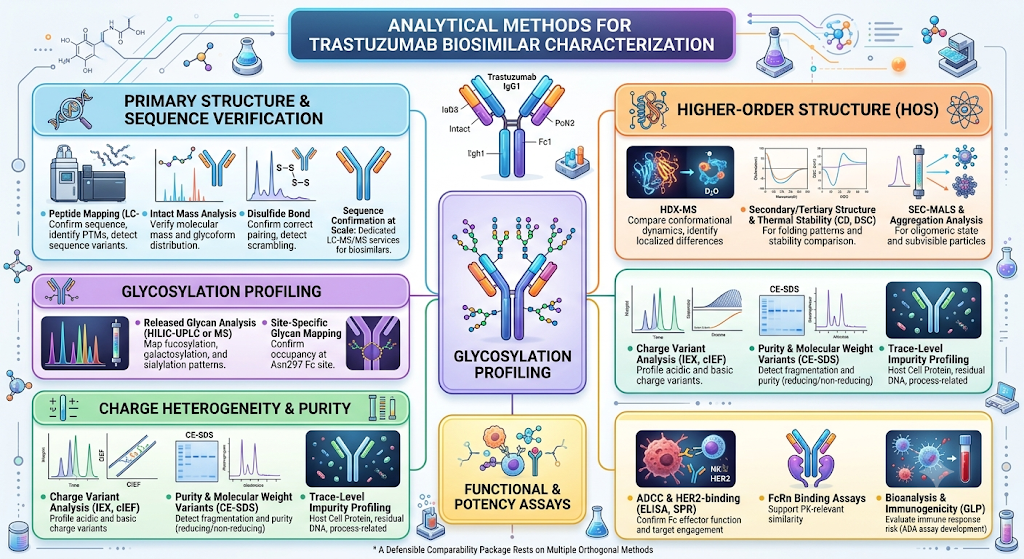
A defensible comparability package rests on multiple orthogonal methods rather than any single assay, because no individual technique can fully characterize a molecule as structurally complex as an IgG1 monoclonal antibody. Analytical programs generally combine primary structure confirmation, higher-order structure comparison, glycan profiling, charge heterogeneity mapping, and potency/binding assays, drawing on a broad biosimilar characterization using mass spectrometry toolkit alongside complementary biophysical techniques such as native mass spectrometry for biosimilars.
Primary structure and sequence verification
- Peptide mapping by LC-MS/MS to confirm amino acid sequence, identify post-translational modifications, and detect sequence variants, often paired with broader peptide mapping and sequence analysis workflows
- Intact mass analysis to verify overall molecular mass and glycoform distribution
- Disulfide bond mapping to confirm correct pairing and detect scrambling or free thiols
- Dedicated LC-MS/MS services for biosimilars and peptide biosimilar characterization using LC-MS to support sequence confirmation at scale
Higher-order structure (HOS)
- Hydrogen-deuterium exchange mass spectrometry (HDX-MS) to compare conformational dynamics and identify localized structural differences between biosimilar and reference product
- Circular dichroism (CD) and differential scanning calorimetry (DSC) for secondary/tertiary structure and thermal stability comparison
- Size-exclusion chromatography with multi-angle light scattering (SEC-MALS), supported by dedicated aggregation analysis in biosimilars and biosimilar aggregation analysis workflows for oligomeric state and subvisible particle assessment
Glycosylation profiling
- Released glycan analysis by HILIC-UPLC or MS to map fucosylation, galactosylation, and sialylation patterns through comprehensive glycosylation analysis of biosimilars
- Site-specific glycan mapping to confirm occupancy at the conserved Asn297 Fc site
Charge heterogeneity and purity
- Ion-exchange chromatography (IEX) and capillary isoelectric focusing (cIEF) to profile acidic/basic charge variants, using mass-spectrometry-driven charge variant analysis in biosimilars for heterogeneity assessment
- Capillary electrophoresis-SDS (CE-SDS) for purity, fragmentation, and molecular weight variants under reducing and non-reducing conditions
- Trace-level impurity profiling of biosimilars to detect host cell protein, residual DNA, and process-related impurities
Functional and potency assays
- Cell-based ADCC and HER2-binding ELISA or SPR-based binding assays to confirm Fc-mediated effector function and target engagement, supported by a broader proteomics approach for biosimilars
- FcRn binding assays to support PK-relevant similarity assessment
- Complementary biosimilar bioanalysis and immunogenicity assessment in biosimilar development, including anti-drug antibody (ADA) assay development, to evaluate immune response risk under GLP bioanalytical services
3: How Is Statistical Equivalence Established for a Comparability Package?
Statistical equivalence for a trastuzumab biosimilar is established by testing multiple reference product lots against multiple biosimilar lots and confirming the biosimilar’s results fall within predefined similarity acceptance criteria, typically calculated using a tiered statistical approach based on attribute risk ranking. Tier 1 (highest-risk) attributes generally require formal equivalence testing with statistically derived acceptance ranges, Tier 2 attributes use quality range comparisons, and Tier 3 attributes are assessed by visual or descriptive comparison.
This tiered statistical framework, aligned with FDA and ICH Q5E guidance, is what transforms a set of individual analytical results into a defensible “highly similar” claim rather than a simple side-by-side data table. It also underpins the broader totality-of-evidence approach in biosimilar approval, where analytical, nonclinical, and clinical data are weighed together rather than any single dataset carrying the full burden of proof.
4: What Does the Comparability Package Actually Contain?
A trastuzumab biosimilar comparability package assembles the CQA risk assessment, all analytical method results, statistical equivalence analyses, and forced-degradation/stability comparison data into a single regulatory-ready dossier that supports the sponsor’s biosimilarity claim under FDA’s 351(k) pathway or the EMA’s biosimilar guideline, and the expected content differs somewhat between the two under the FDA vs. EMA biosimilar regulatory pathways. The package typically includes:
- CQA risk-ranking rationale and justification
- Full analytical method reports (structural, HOS, glycan, charge, purity, potency)
- Side-by-side and statistical comparison summaries against multiple reference product lots
- Forced degradation and biosimilar stability testing data from a dedicated biosimilar forced degradation study
- Bridging data connecting process development lots, including data generated during cell line development for biosimilars, to clinical and commercial material
- A complete set of analytical tests for biosimilar regulatory submission mapped against agency expectations
Case Study Workflow Summary
The table below illustrates how a typical trastuzumab biosimilar characterization program progresses from planning to submission-ready output.
| Stage | Activity | Output |
|---|---|---|
| 1. CQA Mapping | Risk-rank attributes using mechanism-of-action and literature data | Tiered CQA list |
| 2. Method Selection | Choose orthogonal methods per attribute tier | Analytical test plan |
| 3. Lot Testing | Test multiple biosimilar and reference product lots | Raw analytical datasets |
| 4. Statistical Analysis | Apply tiered equivalence testing | Similarity assessment report |
| 5. Package Assembly | Compile CQA, method, and statistical data | Comparability package |
5: Why Does This Matter for Biosimilar Sponsors?
Regulatory agencies scrutinize biosimilar analytical packages closely, and gaps in orthogonal method coverage or weak statistical justification are among the most common reasons for additional information requests during review. Understanding why biosimilars fail regulatory approval — and how that differs from the distinct regulatory logic behind biosimilar vs. generic drug differences — helps sponsors set realistic testing budgets and timelines from the start. A rigorously executed trastuzumab biosimilar analytical characterization program, built on sound CQA mapping and multi-method testing, reduces the risk of costly review delays and strengthens the scientific basis for a reduced clinical data package, a trend that mirrors broader momentum across generic and complex injectable development.
Conclusion:
Trastuzumab biosimilar analytical characterization is a multi-stage discipline that starts with mechanism-informed CQA mapping and ends with a statistically robust comparability package suitable for FDA and EMA submission. Success depends on combining orthogonal structural, biophysical, and functional methods — peptide mapping, HDX-MS, glycan profiling, charge variant analysis, and potency assays — into a coherent, risk-based testing strategy rather than relying on any single technique. For biosimilar developers navigating this process, partnering with an analytical CRO experienced in monoclonal antibody characterization and comparability study design can materially improve both the quality and defensibility of the final submission package.
Related ResolveMass Resources
The principles applied in this trastuzumab case study extend to other biosimilar modalities as well, including insulin biosimilar characterization and formulation-focused work such as peptide-PLGA interaction analysis.
ResolveMass Laboratories supports biosimilar developers across each stage of this workflow, from CQA risk assessment through full comparability package assembly. To discuss a trastuzumab biosimilar or other monoclonal antibody characterization program, contact the ResolveMass team.
Frequently Asked Questions:
CQA mapping begins by identifying product characteristics that influence clinical performance based on scientific knowledge, regulatory guidance, and reference product data. Developers assess each attribute for its potential impact on safety, efficacy, pharmacokinetics, and immunogenicity. Risk assessment tools are then used to prioritize the most critical attributes for detailed evaluation. Orthogonal analytical methods are selected to measure each CQA accurately. Multiple reference product lots are analyzed to establish acceptable variability ranges. This structured approach ensures that analytical efforts focus on clinically relevant quality attributes. The resulting CQA map serves as the foundation for the biosimilar comparability strategy.
A comprehensive characterization strategy combines multiple orthogonal analytical techniques to evaluate every important quality attribute. Common methods include LC-MS/MS peptide mapping, intact mass analysis, glycan profiling, size exclusion chromatography (SEC-HPLC), capillary electrophoresis (CE-SDS), ion exchange chromatography (IEX), and capillary isoelectric focusing (icIEF). Higher-order structure is assessed using circular dichroism (CD) and differential scanning calorimetry (DSC). Functional similarity is evaluated using ELISA, Surface Plasmon Resonance (SPR), and cell-based bioassays. Using complementary methods provides a more complete understanding of the biosimilar. This multi-technique approach increases confidence in analytical similarity.
Glycosylation is one of the most critical quality attributes because it influences the biological activity and stability of trastuzumab. The glycan profile affects antibody-dependent cellular cytotoxicity (ADCC), Fc receptor binding, serum half-life, and overall therapeutic performance. Even small changes in glycosylation may impact clinical outcomes if not properly controlled. Advanced analytical methods such as LC-MS glycan profiling are used to compare glycan structures between the biosimilar and reference product. Multiple glycan species, including high mannose, afucosylated, galactosylated, and sialylated glycans, are carefully evaluated. Maintaining comparable glycosylation profiles is essential for regulatory acceptance. Accurate glycan analysis supports both product quality and patient safety.
A biosimilar comparability package is a comprehensive collection of analytical data demonstrating that the biosimilar is highly similar to the reference product. It typically includes product characterization, CQA mapping, structural and physicochemical analyses, glycosylation profiling, impurity assessment, biological activity studies, and stability data. Statistical analyses are performed to compare the biosimilar with multiple reference product batches. The package also documents analytical methods, validation data, and scientific justifications for observed differences. Regulatory agencies review this information as part of the biosimilar approval process. A well-prepared comparability package significantly strengthens regulatory submissions and supports successful product development.
Regulatory agencies evaluate analytical similarity using a science-based and risk-based framework that emphasizes the totality of evidence. Developers are expected to compare multiple quality attributes using validated analytical methods and orthogonal techniques. Several batches of the reference product are analyzed to establish acceptable variability ranges. Statistical tools are used to determine whether any observed differences are clinically meaningful. The analytical package is reviewed alongside functional, non-clinical, and clinical data when required. Agencies focus on demonstrating that the biosimilar performs similarly to the reference product without compromising safety or efficacy. Strong analytical evidence often reduces the need for extensive clinical studies.
Peptide mapping is a critical analytical technique used to confirm the primary amino acid sequence and identify post-translational modifications in a trastuzumab biosimilar. The protein is enzymatically digested into smaller peptides, which are analyzed using high-resolution LC-MS/MS. This process verifies sequence identity, detects amino acid substitutions, and identifies modifications such as oxidation or deamidation. Peptide mapping also provides extensive sequence coverage, often exceeding 99%. It is one of the most reliable methods for confirming molecular identity and structural integrity. Regulatory agencies consider peptide mapping a key component of analytical characterization. Accurate peptide mapping strengthens confidence in biosimilarity.
Reference:
- Rathore AS, Suryanarayanan R, Nejadnik R, Gurvich VJ, Singh SK, Sarin D. Best practices for performing analytical and functional biosimilarity assessment of recombinant monoclonal antibody biosimilars. The AAPS Journal. 2026 Feb 18;28(2):62.https://link.springer.com/article/10.1208/s12248-026-01206-1
- Lee J, Kang HA, Bae JS, Kim KD, Lee KH, Lim KJ, Choo MJ, Chang SJ. Evaluation of analytical similarity between trastuzumab biosimilar CT-P6 and reference product using statistical analyses. InMAbs 2018 May 19 (Vol. 10, No. 4, pp. 547-571). Taylor & Francis.https://www.tandfonline.com/doi/abs/10.1080/19420862.2018.1440170
- Joshi S, Rathore AS. Assessment of Structural and Functional Comparability of Biosimilar Products: Trastuzumab as a Case Study: S. Joshi, AS Rathore. BioDrugs. 2020 Apr;34(2):209-23.https://link.springer.com/article/10.1007/s40259-020-00404-3
- Shrivastava A, Patil SS, Shah R, Rathore AS. An Automated Tool for Glycosimilarity Assessment of mAb Therapeutic Biosimilars: Trastuzumab and Bevacizumab as Case Studies: A. Shrivastava et al. BioDrugs. 2025 Mar;39(2):333-45.https://link.springer.com/article/10.1007/s40259-025-00704-6
- Dakshinamurthy PK, Gothandam KM. Comprehensive Analytical Characterization of the Proposed Biosimilar Trastuzumab. INDIAN JOURNAL OF PHARMACEUTICAL EDUCATION AND RESEARCH. 2022 Apr 1;56(2):438-47.https://pdfs.semanticscholar.org/2ff8/558fb752219b7e7347b2e78a1c47b14134d0.pdf
- Aithal R, Majedi OM, McCarthy D, Atouf F, Peckham N. Review of Quality Attributes and Analytical Methods Used for Comparative Analytical Assessment of Monoclonal Antibodies as Part of Successful Biosimilar Approvals in the United States and European Union. BioDrugs. 2026 Jun 17:1-20.https://link.springer.com/article/10.1007/s40259-026-00786-w
About the Author


