

Introduction
Producing audit-ready Extractables and Leachables (E&L) data depends on a scientifically defensible, cGMP-compliant testing architecture capable of proving that the chemical impurities migrating from packaging systems, single-use manufacturing components, or drug-delivery devices do not undermine a medicine’s safety, potency, or overall quality. Health Canada, the United States Food and Drug Administration (FDA), and the European Medicines Agency (EMA) all impose stringent chemical characterization requirements before a product can receive market authorization. Migrating chemicals—including plasticizers, antioxidants, vulcanization accelerators, heavy metals, and rubber oligomers—are capable of altering active pharmaceutical ingredients (APIs), producing clinical toxicity, or provoking hazardous immunogenic responses. Conducting these highly specialized analytical studies inside a Drug Establishment Licence (DEL) accredited laboratory that operates under cGMP guidelines secures alignment with Health Canada’s GUI-0080 as well as the relevant international standards, safeguarding regulatory filings against expensive deficiency letters, compliance holds, and delayed market entry.
Share via:
Article Summary:
- Audit-ready E&L data requires a scientifically robust, cGMP-compliant testing strategy to demonstrate that chemicals migrating from packaging, manufacturing components, or drug-delivery systems do not compromise product quality or patient safety.
- Regulatory compliance is built on global standards, including Health Canada’s GUI-0080 and FDR requirements, FDA container-closure regulations, USP <1663>/<1664>, ISO 10993 standards, and the evolving ICH Q3E framework.
- A complete E&L program combines controlled extractables studies with long-term leachables monitoring. Advanced techniques such as GC-MS, LC-HRMS, and ICP-MS help identify volatile, semi-volatile, non-volatile, and elemental impurities.
- The Analytical Evaluation Threshold (AET) determines which compounds require detailed identification and toxicological assessment. AET calculations consider factors such as the Safety Concern Threshold, maximum daily dose, sample concentration, and analytical uncertainty.
- Toxicological risk assessment is essential for evaluating patient exposure. Identified compounds are assessed using measures such as Permitted Daily Exposure (PDE), Estimated Daily Intake (EDI), and Margin of Safety (MoS).
- Common weaknesses in E&L submissions include inappropriate extraction solvents, missing AET calculations, non-validated methods, tentative compound identification, and incomplete toxicological evaluations. These deficiencies can increase regulatory scrutiny and delay approvals.
- A DEL-accredited testing laboratory strengthens regulatory submission defense through cGMP quality systems, ALCOA+ data integrity, validated analytical methods, reference-standard confirmation, and submission-ready documentation for global regulatory review.
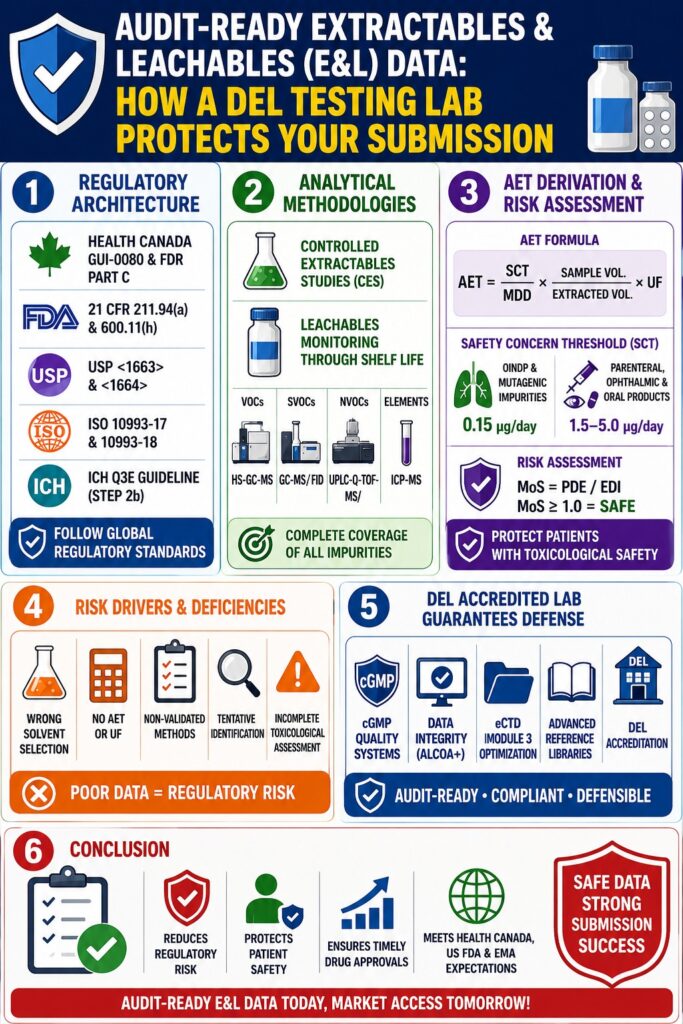
The Regulatory Architecture Governing Audit-Ready Extractables and Leachables (E&L) Data
The worldwide regulatory framework covering audit-ready Extractables and Leachables (E&L) data calls for thorough risk assessments, tightly controlled extraction studies, and toxicological evaluations that confirm container closure systems (CCS) and manufacturing contact equipment do not modify a drug’s safety or efficacy beyond permitted limits. The authorities expect complete impurity profiling that spans every primary and secondary packaging system, all single-use bioprocessing components, and each combination drug-device contact surface.
Within the United States, compliance is grounded in 21 CFR 211.94(a) for finished pharmaceuticals and 21 CFR 600.11(h) for biological products; both provisions require that drug containers and closures remain non-reactive, non-additive, and non-absorptive. In Canada, Health Canada exercises regulatory control through Part C, Division 2 of the Food and Drug Regulations (FDR) together with the GUI-0080 guidance document (How to demonstrate foreign building compliance with drug good manufacturing practices). Any domestic or foreign testing facility that supplies data for Canadian drug submissions must hold a valid Drug Establishment Licence (DEL) or otherwise demonstrate equivalent cGMP compliance.
Harmonized testing methodologies draw on the compendial standards issued by the United States Pharmacopeia (USP), the European Pharmacopoeia (Ph. Eur.), the International Organization for Standardization (ISO), and the International Council for Harmonisation (ICH):
- USP <1663>: Establishes the framework for Controlled Extractables Studies (CES), detailing solvent selection, extraction conditions, and analytical identification strategies.
- USP <1664> and <1664.1>: Governs the design, execution, and reporting of drug product leachables studies, setting the criteria for leachables-extractables correlation and safety thresholds.
- USP <661.1> and <661.2>: Defines the characterization, extraction, and safety criteria for plastic materials of construction and for finished plastic packaging systems.
- USP <665> and <1665>: Requires chemical characterization and risk-based assessment for the polymeric components used throughout biopharmaceutical manufacturing streams.
- ISO 10993-18 and ISO 10993-17: Prescribes the chemical characterization protocols and toxicological risk assessment principles applied to medical devices and combination delivery systems.
- ICH Q3E Guideline: Serves as the harmonized international standard (currently at Step 2b) intended to align global regulatory expectations for E&L assessment across the entire drug lifecycle.
| Regulatory Directive / Standard | Governing Authority / Body | Core Scope & Operational Mandate | Key Compliance Deliverables |
|---|---|---|---|
| Health Canada GUI-0080 & FDR Part C | Health Canada | Canadian cGMP compliance and foreign building licensing. | Validated analytical procedures, complete raw-data integrity, and DEL building listing. |
| 21 CFR 211.94(a) & 600.11(h) | US FDA | Container closure integrity and non-reactivity mandates. | Evidence that packaging does not alter drug safety, identity, or strength. |
| USP <1663> & USP <1664> | United States Pharmacopeia | Extractables identification and quantitative leachables monitoring. | Extraction profiling, AET calculation, and real-time stability leachables data. |
| ISO 10993-17 & ISO 10993-18 | ISO | Chemical characterization and toxicological safety of devices. | Chemical inventory, Margin of Safety (MoS) derivation, and Biological Evaluation Report. |
| ICH Q3E Guideline (Step 2b) | ICH Assembly | Harmonized global lifecycle management of E&L impurities. | Unified reporting thresholds, lifecycle control strategies, and toxicological alignment. |
Advanced Analytical Methodologies to Generate Audit-Ready Extractables and Leachables (E&L) Data
Generating audit-ready Extractables and Leachables (E&L) data calls for an integrated, orthogonal testing strategy that pairs controlled extractables profiling under exaggerated stress conditions with targeted, quantitative leachables monitoring across the drug product’s shelf life. Deploying complementary hyphenated analytical instruments makes it possible to comprehensively identify and quantify ultra-trace organic and inorganic impurities across the full range of chemical polarities and volatilities.
Because leachables can accumulate gradually rather than appear all at once, sponsors should plan for leachables monitoring throughout stability studies instead of relying on a single end-point measurement.
Controlled Extractables Studies (CES) expose primary packaging, single-use bioprocessing bags, tubing, and stopper components to exaggerated extraction conditions built around aggressive solvents, elevated temperatures, and extended contact times. Solvent choices are governed by the pH, ionic strength, polarity, and solvating behavior of the finished formulation, and they span aqueous media, organic mixtures, and amphiphilic solutions. This forced-extraction approach generates a complete profile of the chemical hazards that could conceivably appear.
The strength of an extractables profile depends heavily on the extraction chemistry, so it is worth understanding how to choose the right solvents for extractables studies that genuinely reflect your formulation.
Once extraction profiling is complete, analytical scientists move on to targeted leachables simulation and real-time stability testing. The methods are tuned to screen for unknown impurities while simultaneously quantifying targeted leachables down to trace concentrations. The multi-technique analytical workflow encompasses:
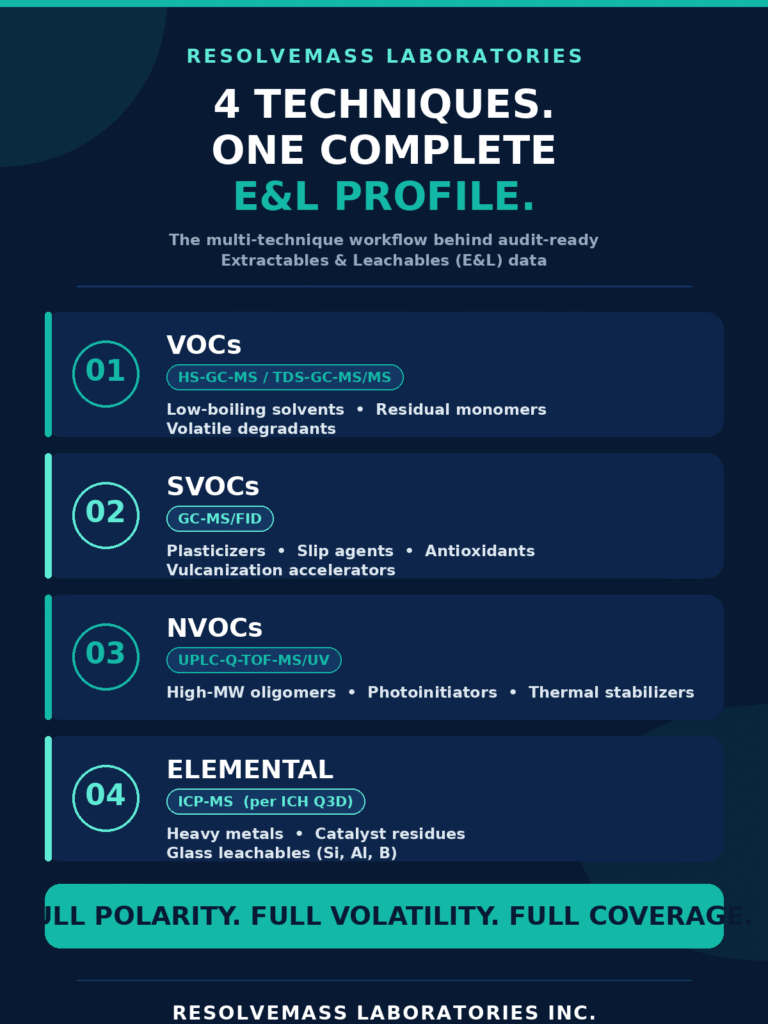
- Volatile Organic Compounds (VOCs): Screened by Headspace Gas Chromatography-Mass Spectrometry (HS-GC-MS) or Thermal Desorption GC-MS (TDS-GC-MS/MS) to capture low-boiling solvents, residual monomers, and volatile degradants.
- Semi-Volatile Organic Compounds (SVOCs): Characterized through direct-injection Gas Chromatography-Mass Spectrometry (GC-MS/FID) to reveal plasticizers, slip agents, antioxidants, and vulcanization accelerators.
- Non-Volatile Organic Compounds (NVOCs): Detected using Ultra-High Performance Liquid Chromatography coupled with High-Resolution Mass Spectrometry (UPLC-Q-TOF-MS/UV) to pinpoint high-molecular-weight oligomers, photoinitiators, and thermal stabilizers.
- Elemental and Inorganic Impurities: Assessed by Inductively Coupled Plasma Mass Spectrometry (ICP-MS) in line with ICH Q3D to detect trace heavy metals, catalyst residues, and glass leachables such as silica, aluminum, and boron.
Selecting the correct instrument for each compound class is critical to full coverage, and it helps to understand how GC-MS and LC-MS compare in extractables and leachables testing.
Derivation of the Analytical Evaluation Threshold (AET) and Toxicological Risk Assessment
The Analytical Evaluation Threshold (AET) defines the exact numerical concentration at or above which an extractable or leachable compound has to be structurally identified and put through a formal toxicological evaluation. Pairing the AET calculation with a Toxicological Risk Assessment (TRA) guarantees that a patient’s exposure to chemical impurities stays beneath toxicological thresholds for the entire shelf life of the product.
Getting this number right underpins the entire study, so explore how to correctly derive the AET for extractables and leachables studies.
The mathematical basis of the AET is tied to the Safety Concern Threshold (SCT)—the absolute daily dose beneath which a leachable presents negligible mutagenic or non-mutagenic safety risk. In accordance with PQRI, USP <1663>, and ICH M7 guidance, an SCT of 0.15 μg/day is used for high-risk administration routes such as Orally Inhaled and Nasal Drug Products (OINDP) and for mutagenic impurities. For parenteral, ophthalmic, and oral dosage forms, an SCT of 1.5 μg/day or 5.0 μg/day is frequently justified on the basis of treatment duration.
These stringent thresholds are especially demanding for inhaled and nasal therapies, which is why specialized E&L testing for inhalation and nasal drug products is so often required.
The concentration-based AET (μg/mL) for a liquid drug product formulation is calculated with the following equation:
AET = (SCT / MDD) × (Sample Volume / Extracted Volume) × UF
Where:
- SCT = Safety Concern Threshold (μg/day).
- MDD = Maximum Daily Dose of the finished drug product (mL/day or dosage units/day).
- Sample Volume / Extracted Volume = the sample concentration factor achieved during sample preparation.
- UF = Analytical Uncertainty Factor, derived from response-factor variation observed across non-targeted analytical screening databases.
The Uncertainty Factor compensates for the variation in relative response factors (RRF) that arises when unknown compounds are quantified against internal standards. When a laboratory’s database displays substantial response-factor dispersion (for example, a relative standard deviation large enough to warrant a 50% adjustment), a UF of 0.5 is applied, which effectively drives the reporting threshold lower and guards against false-negative reporting.
Any compound detected at or above the finalized AET is subjected to a formal Toxicological Risk Assessment. Board-certified toxicologists determine the Permissible Daily Exposure (PDE) or Tolerable Intake (TI) for each identified compound and then compute the Margin of Safety (MoS):
MoS = PDE / Estimated Daily Intake (EDI)
An MoS ≥ 1.0 confirms that patient exposure levels are safe, supplying robust documentation with which to defend the dossier during regulatory agency review.
When a compound exceeds the AET, expert safety review becomes essential, so learn how the toxicological qualification of leachables is carried out to defend the dossier.
Identifying Risk Drivers and Deficiencies in E&L Submissions
Regulatory rejection of E&L submission packages usually originates from flawed experimental design, insufficient analytical sensitivity, or incomplete toxicological justification. Pinpointing these data vulnerabilities early on averts agency deficiency letters, multi-month review holds, and formal Refusal-to-File (RTF) actions.
One of the leading sources of regulatory non-compliance is dependence on generic supplier Certificates of Analysis (CoA). Vendor extractables data are often generated with solvents that fail to mirror the solvating strength, pH, or surfactant characteristics of the genuine drug matrix. In addition, secondary manufacturing operations—such as gamma irradiation, ethylene oxide sterilization, washing, or autoclaving—can markedly change polymer cross-linking and generate distinctive degradation compounds.
Many of these pitfalls are avoidable once they are properly understood, so it is worth reviewing the common root causes of failed extractables and leachables studies.
| Critical Evaluation Parameter | Deficient / Non-Compliant E&L Package | Audit-Ready E&L Package |
|---|---|---|
| Extraction Solvent Selection | Uses generic solvents that do not represent the drug formulation’s pH or polarity. | Custom solvent matrices matched to the formulation’s pH, ionic strength, and solvating properties. |
| Threshold Calculation | Applies arbitrary reporting cutoffs with no AET or Uncertainty Factor incorporated. | Rigorous AET derived from the SCT, MDD, and empirical RRF database variability. |
| Method Validation | Applies non-validated screening methods to real-time cGMP stability testing. | Targeted leachables quantitative methods validated per ICH Q2(R1) under cGMP. |
| Structural Identification | Relies on tentative mass spectral library matches without reference-standard confirmation. | Confirmed identification using authentic reference materials and high-resolution MS. |
| Toxicological Assessment | Omits API-leachable reaction products and secondary degradation species. | Comprehensive TRA evaluating PDE, EDI, API interactions, and the Margin of Safety. |
How a DEL Accredited Testing Laboratory Guarantees Submission Defense
Collaborating with a Drug Establishment Licence (DEL) accredited testing laboratory ensures that extractables and leachables studies conform precisely to Part C, Division 2 of Health Canada’s Food and Drug Regulations and to the requirements of GUI-0080. This regulatory accreditation underpins cGMP compliance, disciplined data integrity, and full defensibility throughout health authority audits and marketing authorization reviews.
Regulators scrutinize not only the results but how they were captured, so see why data integrity in extractables and leachables testing is fundamental to an audit-ready package.
A DEL accredited facility sustains a standardized quality infrastructure engineered to protect complex analytical data as it passes through regulatory review:
- cGMP Quality Systems: Analytical studies are executed under validated Master Protocols, formal Change Controls, and audited Standard Operating Procedures (SOPs).
- Data Integrity and ALCOA+ Principles: Complete electronic audit trails span the chromatographic software platforms (GC-MS, LC-MS), delivering full traceability from raw-data acquisition through to the final regulatory summaries.
- eCTD Module 3 Optimization: Technical data are assembled specifically for the electronic Common Technical Document (eCTD) Module 3.2.P.2 (Pharmaceutical Development) and Module 3.2.P.7 (Container Closure System) filings.
- Advanced Reference Libraries: Direct access to authentic reference standards—including specialized rubber oligomers, fluoropolymer degradants, and plastic additives—supports reliable structural confirmation.
Carrying out E&L characterization programs inside a DEL accredited testing laboratory removes foreign building compliance friction, allowing the analytical packages that support Abbreviated New Drug Submissions (ANDS), New Drug Submissions (NDS), and Biologics License Applications (BLA) to progress smoothly through regulatory evaluation.
Planning a program of this scope also means budgeting for it appropriately, so it helps to understand what drives the cost of an E&L testing program.
Conclusion
Producing audit-ready Extractables and Leachables (E&L) data is an essential undertaking for reducing regulatory risk, safeguarding patient safety, and securing timely commercial drug approvals. Working alongside a Drug Establishment Licence (DEL) accredited testing laboratory ensures that the analytical execution, AET calculations, and toxicological evaluations fully satisfy Health Canada, US FDA, and EMA guidelines. Disciplined cGMP testing protocols shield regulatory filings from deficiency holds and smooth the pathway to market authorization.
For expert technical support, tailored E&L protocol design, and cGMP analytical testing services, reach out to ResolveMass Laboratories Contact Us.
Frequently Asked Questions:
A Drug Establishment Licence demonstrates that a testing facility satisfies the cGMP obligations set out in Part C, Division 2 of the Food and Drug Regulations and in Health Canada’s GUI-0080 guidance. Health Canada expects the analytical data underpinning drug release, stability, and container-closure safety to be generated inside DEL-compliant buildings, precisely because that status assures dependable data integrity. Without it, a submission can be challenged on the basis of where and how the data were produced. Partnering with a DEL-accredited laboratory therefore eliminates a common source of foreign building compliance friction and reinforces the overall dossier.
Selection of the SCT is driven by the route of administration, the dosage form, and how long the patient is expected to be treated. High-risk routes—such as Orally Inhaled and Nasal Drug Products (OINDP), along with mutagenic impurities governed by ICH M7—call for a conservative SCT of 0.15 μg/day. Lower-risk presentations, including many parenteral and oral dosage forms, may instead justify an SCT of 1.5 μg/day or 5.0 μg/day. Matching the threshold to the clinical context ensures the resulting AET is neither needlessly strict nor dangerously permissive.
The Uncertainty Factor intentionally lowers the calculated AET to account for the fact that different compounds respond unequally on non-targeted screening detectors. Because unknown extractables are quantified against internal standards, an analyte with a weak relative response factor could be present at a meaningful level yet still fall beneath the reporting threshold. Applying an empirically derived UF widens the safety margin so that these poorly responding species are captured and reported rather than overlooked. This safeguard is what protects the study against false-negative outcomes that might otherwise pass unnoticed through review.
The draft ICH Q3E guideline introduces a single, harmonized international framework for evaluating extractables and leachables throughout the entire drug product lifecycle. Instead of leaving sponsors to reconcile fragmented regional expectations, it consolidates them into unified reporting thresholds, standardized risk-assessment matrices, and clear lifecycle control requirements. For laboratories and manufacturers, this means an E&L strategy can be designed once against a common global benchmark rather than reworked for each market. As the guideline advances, aligning early with its principles helps future-proof submissions against shifting regional requirements.
Comprehensive characterization depends on an orthogonal analytical platform in which several complementary techniques cover different chemical classes. Volatile organics are handled with HS-GC-MS, semi-volatile organics with direct-injection GC-MS, non-volatile organics with UPLC-Q-TOF-MS, and elemental impurities with ICP-MS. Taken together, these methods span the full range of polarity, volatility, and molecular weight found in real samples. Reliable identification is then achieved by pairing spectral library matching with confirmation against authentic reference standards, which secures both the qualitative identity and the quantitative result.
Elastomeric parts such as stoppers and syringe plungers are known to shed low-molecular-weight rubber oligomers together with vulcanization agents and residual curing catalysts. Detecting and quantifying these species reliably requires extraction solvents tailored to the elastomer chemistry rather than generic media. The analysis typically relies on specialized GC-MS or LC-MS methods validated using purified rubber oligomer reference standards. This targeted approach ensures that elastomer-derived leachables—which are easily missed by broad screening alone—are accurately characterized and confirmed.
Deficiency notices most often arise when leachables monitoring relies on unvalidated screening procedures, or on methods that lack sufficient precision, accuracy, and sensitivity within the specific drug product matrix near the AET limit. Regulators expect the quantitative leachables methods used for release and stability decisions to be fully validated under cGMP in accordance with ICH Q2(R1). When that validation is incomplete or absent, the reliability of the reported data cannot be defended. Addressing method validation rigorously and early is therefore one of the most effective ways to avoid these recurring findings.
The greatest migration risk comes from primary packaging in direct contact with the liquid, including elastomeric stoppers, plasticized administration tubing, solvent-based adhesives, internal barrel coatings, and printed secondary labeling. These materials carry additives and residues that can leach into the formulation over time. The risk is magnified when the product is an aqueous formulation containing organic co-solvents or surfactants, since such matrices are considerably more aggressive at extracting compounds. For this reason, liquid and parenteral products warrant especially close scrutiny of every contact surface.
Controlled extractables profiling belongs early in development—during material selection and pre-formulation—so that high-risk polymers can be screened out before they are engineered into the product. As the program matures, formal leachables simulation and real-time cGMP stability monitoring should be carried out on the pivotal clinical trial batches that support registration. Generating the data in this staged sequence ensures that potential problems are caught while changes are still inexpensive to make. It also creates a coherent evidence trail that regulators can follow from initial risk identification through to final submission.
Get In Touch With Us
About The Author


