

Introduction:
Biosimilar development guide breaks down every stage of the journey, from initial molecule selection and reference product characterization through to market authorization. Successful development depends on robust analytical strategies such as biosimilar characterization using mass spectrometry and a strong understanding of the totality of evidence approach in biosimilar approval.
Biosimilars hold transformative potential for global healthcare: they increase patient access to complex biologic therapies — including monoclonal antibodies, fusion proteins, peptide-based biologics, and recombinant hormones — at significantly reduced cost. But unlike small-molecule generics, biosimilars cannot be chemically synthesized to be identical to their reference products. Their manufacture involves living cells, inherent molecular heterogeneity, and critical quality attributes (CQAs) that must be comprehensively characterized and matched.
At ResolveMass Laboratories Inc., we work at the forefront of biosimilar analytical science. Our scientific team supports biosimilar sponsors with advanced characterization, formulation support, and regulatory-ready data packages — built on decades of collective experience in biopharmaceutical analysis.
Summary:
- A biosimilar is a biological medicine that is highly similar to an already-approved reference biologic, with no clinically meaningful differences in safety or efficacy.
- The biosimilar development process follows a structured, stepwise “totality of evidence” approach mandated by regulatory agencies such as the FDA and EMA.
- Key development stages include: reference product characterization, analytical similarity assessment, formulation and manufacturing process development, preclinical studies, clinical pharmacology studies, and confirmatory clinical trials.
- Analytical characterization — particularly physicochemical and functional testing — is the cornerstone of any biosimilar development guide, forming the largest share of the data package. Comprehensive biosimilar characterization services and advanced biosimilar bioanalysis are critical for establishing similarity.
- Regulatory pathways vary by market (FDA 351(k), EMA, Health Canada), but all share the same scientific foundation.
- Contract research organizations (CROs) like ResolveMass Laboratories Inc. provide specialized analytical and characterization services that directly support biosimilar sponsors at every stage.
1: What Is a Biosimilar?
A biosimilar is a biological product that is demonstrated to be highly similar to an FDA-, EMA-, or Health Canada–approved reference biologic (also called the innovator or originator product), with no clinically meaningful differences in terms of safety, purity, or potency.
Unlike small-molecule generics, biosimilars require extensive comparability exercises because of the fundamental biosimilar vs generic drug differences.
Key terms you will encounter throughout this biosimilar development guide:
- Reference Product (RP): The approved innovator biologic against which the biosimilar is compared.
- Critical Quality Attributes (CQAs): Physicochemical, biological, and immunological properties that must be within defined ranges to ensure product quality. Understanding critical quality attributes (CQAs) in biosimilars is fundamental to successful biosimilar development.
- Totality of Evidence: The cumulative analytical, functional, preclinical, and clinical data that together establish biosimilarity. Regulatory agencies evaluate biosimilars using a structured totality of evidence approach in biosimilar approval.
- Interchangeability: A higher designation (in the U.S.) indicating the biosimilar can be substituted for the reference product without prescriber intervention.
- Fingerprint-like Similarity: The concept that the analytical profile of a biosimilar should closely match that of the reference product across a wide range of orthogonal assays.
2: Why Biosimilar Development Is Uniquely Complex
Biosimilars are not generic drugs. Their development is fundamentally different and substantially more complex for the following reasons:
| Factor | Small-Molecule Generic | Biosimilar |
|---|---|---|
| Molecular Size | Small (< 1 kDa) | Large (15,000–150,000+ Da) |
| Structural Complexity | Well-defined, simple | Highly complex; contains glycans, disulfide bonds, higher-order structures |
| Manufacturing | Chemical synthesis | Living cell expression systems (CHO, E. coli, yeast) |
| Characterization | Straightforward | Requires extensive orthogonal analytical methods |
| Regulatory Pathway | Abbreviated NDA (505(j)) | 351(k) BLA (FDA); similar EMA/Health Canada pathways |
| Development Cost | ~$1–5 million | ~$100–300 million |
| Development Timeline | 2–4 years | 7–12 years |
Sponsors must also understand key differences between FDA vs EMA biosimilar regulatory pathways when planning global development programs.
The complexity highlighted above explains why peptide sameness vs biosimilar comparability represents a fundamentally different scientific challenge than demonstrating pharmaceutical equivalence for traditional generics.
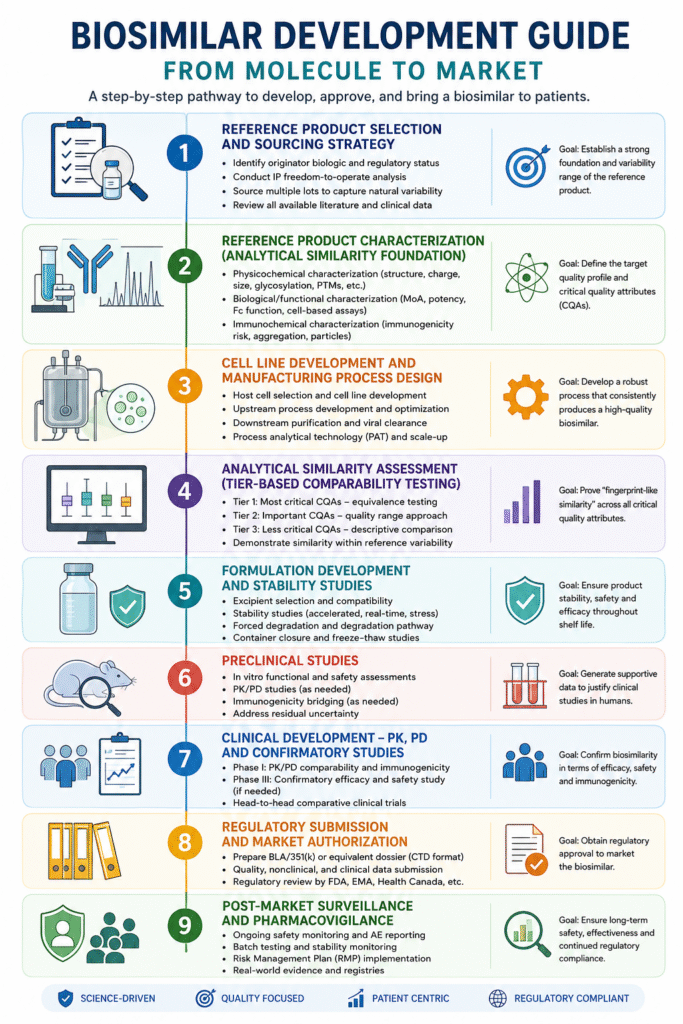
3: Step-by-Step Biosimilar Development Guide: From Molecule to Market
Step 1: Reference Product Selection and Sourcing Strategy
The first step is identifying the appropriate reference product and establishing a robust sourcing strategy. Regulatory agencies require that biosimilarity be demonstrated against the authorized reference product in the target market.
Key activities at this stage:
- Identify the originator biologic and its regulatory status in target markets (FDA, EMA, Health Canada, etc.)
- Conduct an intellectual property (IP) freedom-to-operate analysis
- Source multiple reference product lots from different markets and manufacturing time points to capture natural batch-to-batch variability
- Review all publicly available literature, regulatory documents (e.g., FDA product-specific guidance), and originator clinical data
ResolveMass Insight: Sourcing a statistically meaningful number of reference product batches — typically 10–20+ lots — is critical for establishing the natural variability envelope against which your biosimilar will be benchmarked.
Step 2: Reference Product Characterization (Analytical Similarity Foundation)
This is the most analytically intensive and scientifically critical stage of the entire biosimilar development guide. Comprehensive characterization of the reference product defines the target quality profile that the biosimilar must match.
Characterization domains include:
A. Physicochemical Characterization
- Primary structure: amino acid sequence, peptide mapping in biosimilars, disulfide bond mapping in biosimilars, N- and C-terminal analysis.
- Higher-order structure (HOS): secondary and tertiary structure by CD spectroscopy, FTIR, and fluorescence; quaternary structure by SEC-MALS or AUC
- Glycosylation profiling: comprehensive glycosylation analysis of biosimilars using LC-MS/MS.
- Charge heterogeneity: IEF, icIEF, and cation exchange chromatography. Advanced charge variant analysis in biosimilars using orthogonal analytical methods.
- Size heterogeneity: SEC-HPLC, DLS, and CE-SDS (reduced and non-reduced)
- Hydrophobic variants: HIC and RP-HPLC
- Post-translational modifications: detailed assessment of post-translational modifications (PTMs) in biosimilars.
Modern characterization programs frequently incorporate native mass spectrometry for biosimilars and intact mass analysis biosimilars workflows to evaluate higher-order structural integrity.
B. Biological/Functional Characterization
- Mechanism-of-action (MoA) assays: receptor binding, enzyme activity, or cytotoxicity assays
- Fc effector function: FcγR binding, FcRn binding, CDC, ADCC, ADCP (for monoclonal antibodies)
- Cell-based potency assays
C. Immunochemical Characterization
Evaluation of aggregation risk often includes dedicated aggregation analysis in biosimilars and advanced biosimilar aggregation analysis workflows.
- Immunogenicity risk assessment
- Aggregation propensity and particle analysis
At ResolveMass Laboratories, our analytical team uses a suite of orthogonal methods — including LC-MS, HRMS, GC-MS, DSC, and advanced HPLC platforms — to build exhaustive reference product profiles that form the backbone of your comparability data package.
Step 3: Cell Line Development and Manufacturing Process Design
The biosimilar’s expression system and upstream/downstream manufacturing process must be designed to reproducibly generate a molecule with quality attributes matching the reference product profile established in Step 2.
Key activities:
- Host cell selection (CHO, NS0, Sp2/0, E. coli, yeast depending on the biologic type)
- Gene construct design and cell line engineering
- Clone screening based on expression level and product quality
- Upstream process development: media, feeding strategy, culture conditions
- Downstream purification process development: chromatography, filtration, viral clearance
- Process analytical technology (PAT) integration
- Scale-up feasibility from laboratory to manufacturing scale
Step 4: Analytical Similarity Assessment — Tier-Based Comparability Testing
With a candidate biosimilar molecule in hand, formal analytical similarity assessment is conducted by comparing the biosimilar directly against the reference product across all characterized CQAs. Sponsors often leverage advanced LC-MS/MS services for biosimilar programs and comprehensive biosimilar comparability studies to establish fingerprint-like similarity.
The FDA recommends a tier-based statistical approach:
| Tier | Type of Testing | Statistical Approach |
|---|---|---|
| Tier 1 | Most sensitive CQAs (e.g., potency, Fc function) | Equivalence testing with pre-specified acceptance criteria |
| Tier 2 | Important quality attributes | Quality range approach based on reference product variability |
| Tier 3 | Less critical attributes | Descriptive statistics and graphical comparison |
The goal is to demonstrate that the biosimilar falls within the natural variability of the reference product across all attribute tiers — a concept sometimes described as “fingerprint-like similarity.”
Step 5: Formulation Development and Stability Studies
Once analytical similarity is established at the drug substance level, formulation development focuses on achieving a finished drug product that is physically and chemically stable throughout its shelf life.
Key activities:
- Excipient selection and compatibility studies
- pH optimization and buffer system development
- Surfactant and stabilizer screening
- Accelerated, real-time, and stress stability studies (ICH Q1A/Q1B guidelines)
- Forced degradation studies to identify degradation pathways. Regulatory agencies expect comprehensive biosimilar forced degradation study programs and long-term biosimilar stability testing data to support shelf-life claims.
- Container closure system compatibility testing
- Freeze-thaw and shipping stress studies
Many developers also perform forced degradation of biosimilars to better understand degradation pathways and product robustness.
Stability data must demonstrate that the biosimilar maintains its CQAs and similarity profile over its intended shelf life and under real-world handling conditions.
Step 6: Preclinical Studies
Preclinical studies for biosimilars are generally more limited in scope than for novel biologics because the safety profile of the reference product is already well-characterized. However, targeted nonclinical studies are still required to support clinical entry.
Typical preclinical studies include:
- In vitro receptor binding and functional assays (often already covered in Step 2)
- PK/PD studies in relevant animal models (if needed based on residual uncertainty)
- Local tolerance studies
- Immunogenicity bridging studies in animal models (in some cases)
The scope of preclinical work is guided by the “residual uncertainty” principle — only studies needed to address gaps not resolved by analytical similarity are required.
Step 7: Clinical Development — PK, PD, and Confirmatory Studies
Clinical development for biosimilars follows an abbreviated pathway compared to novel biologics but still requires robust human data to confirm similarity.
Clinical biosimilar development stages:
7a. Clinical Pharmacology Studies (Phase I)
- PK comparability studies: single-dose or multiple-dose PK studies comparing AUC, Cmax, and Tmax between biosimilar and reference product
- PD comparability: relevant PD markers measured alongside PK
- Immunogenicity assessment: anti-drug antibody (ADA) incidence and characterization. Robust anti-drug antibody (ADA) assay development services are often required to support immunogenicity evaluations during biosimilar clinical development.
- These studies are typically conducted in healthy volunteers (for non-oncology products) or in patient populations
Clinical programs should align with a comprehensive bioanalytical strategy for drug development to ensure reliable PK, PD, and immunogenicity data.
7b. Confirmatory Clinical Efficacy and Safety Study (Phase III)
- Head-to-head comparative clinical trial in a sensitive patient population
- Equivalence or non-inferiority design
- Co-primary endpoints covering efficacy, safety, and immunogenicity
- May not be required if analytical similarity and PK/PD studies sufficiently resolve all residual uncertainty (increasingly accepted by FDA and EMA)
Step 8: Regulatory Submission and Market Authorization
A Biologics License Application (BLA) under the 351(k) pathway (FDA), or equivalent submission to EMA or Health Canada, consolidates the totality of evidence into a structured dossier.
Regulatory expectations continue to evolve, particularly for complex molecules such as GLP-1 biosimilar characterization programs, insulin biosimilar characterization, and peptide therapeutics.
Submission dossier components (CTD format):
- Module 1: Administrative and prescribing information
- Module 2: Summaries — Quality Overall Summary (QOS), Non-Clinical Overview, Clinical Overview
- Module 3: Quality (analytical characterization, manufacturing, stability)
- Module 4: Nonclinical study reports
- Module 5: Clinical study reports
Regulatory review timelines (approximate):
| Agency | Standard Review | Priority/Expedited |
|---|---|---|
| FDA (CDER/CBER) | 12 months | 6 months (BRT) |
| EMA | 210 days (active review) | — |
| Health Canada | 300 days | 180 days |
Sponsors developing peptide therapeutics should also understand GLP-1 peptide characterization regulatory requirements and GLP-1 peptide mapping regulatory requirements.
Step 9: Post-Market Surveillance and Pharmacovigilance
Regulatory approval is not the end of the biosimilar development journey. Post-marketing commitments include:
- Ongoing batch release testing and stability monitoring
- Pharmacovigilance and adverse event reporting
- Risk Management Plan (RMP) implementation
- Immunogenicity surveillance in real-world patient populations
- Participation in registries and post-marketing studies (if required by regulators)
4: How ResolveMass Laboratories Supports Your Biosimilar Development Program
At ResolveMass Laboratories Inc., we serve as an expert analytical and development partner at every stage of biosimilar development. Our capabilities are specifically designed to support the data-intensive demands of biosimilar comparability science.
Our expertise spans monoclonal antibodies, recombinant proteins, peptide therapeutics, and specialized peptide biosimilar characterization using LC-MS workflows.
Our Core Analytical Services for Biosimilar Development:
- Higher-Order Structure (HOS) Characterization: Circular dichroism (CD), differential scanning calorimetry (DSC), intrinsic fluorescence, and FTIR for secondary, tertiary, and thermal stability assessment
- Mass Spectrometry Services: High-resolution MS (HRMS), LC-MS/MS, proteomics approach for biosimilars, peptide mapping, glycan profiling, and advanced prove biosimilarity using LC-MS workflows for regulatory comparability studies.
- Chromatographic Analysis: SEC-HPLC, IEX, HIC, and RP-HPLC for purity, charge, and size heterogeneity profiling
- Impurity Profiling: Comprehensive impurity profiling of biosimilars, including host cell proteins (HCPs), residual DNA, and process-related contaminants.
- Stability and Forced Degradation Studies: ICH-compliant stability programs designed to support IND-enabling and BLA-stage packages
- Formulation Development Support: Excipient compatibility and preformulation analytical characterization
Our scientific team brings direct experience with regulatory submissions for biosimilar products in the Canadian, U.S., and international markets — ensuring that every dataset we generate is built for regulatory defensibility from day one.
5: Key Regulatory Guidance Documents for Biosimilar Development
| Document | Issuing Agency | Scope |
|---|---|---|
| 351(k) of the PHS Act | FDA | U.S. biosimilar approval pathway |
| FDA Guidance: Scientific Considerations in Demonstrating Biosimilarity | FDA | Totality of evidence framework |
| CHMP Guideline on Similar Biological Medicinal Products | EMA | EU biosimilar framework |
| Health Canada Guidance: Information and Submission Requirements for Biosimilar Biologic Drugs | Health Canada | Canadian biosimilar pathway |
| ICH Q6B | ICH | Specifications for biotechnological products |
| ICH Q5E | ICH | Comparability of biotechnological products after manufacturing changes |
6: Biosimilar Development Guide: Common Pitfalls to Avoid
- Insufficient reference product lots: Underestimating natural RP variability leads to unrealistic similarity benchmarks.
- Premature cell line selection: Proceeding before CQA impact of expression system differences is fully understood.
- Inadequate HOS characterization: Overlooking structural differences that may not appear in primary sequence analysis but affect function.
- Misaligned formulation: Failure to match RP formulation conditions during comparability studies, introducing confounding variables.
- Tier assignment errors: Misclassifying high-sensitivity attributes into lower analytical tiers, leading to regulatory pushback.
- Insufficient immunogenicity data: Under-powered ADA studies that fail to meet equivalence margins.
Conclusion:
The biosimilar development process is a multi-year, multi-disciplinary endeavor — but with the right scientific foundation and expert partners, it is entirely achievable. This biosimilar development guide has walked you through each stage of the journey: from reference product characterization and analytical similarity, through formulation and clinical development, to regulatory submission and post-market surveillance.
Whether developing monoclonal antibodies, recombinant proteins, peptide therapeutics, or GLP-1 analogs, success depends on rigorous characterization, robust comparability studies, and regulatory alignment. Working with experienced analytical partners offering specialized biosimilar characterization services can significantly reduce development risk and accelerate timelines.
At ResolveMass Laboratories Inc., we understand that the quality of your analytical data is the single most important driver of biosimilar regulatory success. Our team is ready to support your program — whether you are just beginning reference product characterization or preparing your BLA data package for submission.
Frequently Asked Questions:
A generic drug is a chemically identical copy of a small-molecule drug and can be manufactured through straightforward chemical synthesis. A biosimilar, by contrast, is a highly similar — but not identical — version of a complex biological medicine made from living cells. Because biologics are large, structurally intricate molecules with inherent batch-to-batch variability, an exact copy is scientifically impossible. Biosimilars must instead demonstrate “no clinically meaningful differences” in safety, purity, and potency through an extensive comparability data package.
In the United States, a biosimilar designated as interchangeable by the FDA can be substituted by a pharmacist without the prescriber’s intervention — similar to how a generic is dispensed. However, standard biosimilar approval (without the interchangeability designation) does not automatically permit pharmacy-level substitution in all U.S. states. In Canada and the EU, substitution policies vary by province/country and are governed by local health authority guidelines rather than the regulatory approval itself.
Yes. Regulatory agencies — including the FDA, EMA, and Health Canada — only approve a biosimilar after it has demonstrated through rigorous analytical, preclinical, and clinical data that it has no clinically meaningful differences in safety or efficacy compared to the reference product. Approved biosimilars undergo the same post-market pharmacovigilance requirements as all other biologics.
Biosimilars can be developed for any approved reference biologic, including monoclonal antibodies (e.g., adalimumab, trastuzumab, bevacizumab), fusion proteins (e.g., etanercept), recombinant hormones (e.g., insulin, erythropoietin, growth hormone), peptide-based biologics, colony-stimulating factors, and interferons.
The full biosimilar development timeline — from cell line development through regulatory approval — typically spans 7 to 12 years, depending on the complexity of the molecule, the regulatory markets being targeted, and the clinical study design required. Analytical characterization and manufacturing process development alone can take 2–4 years before clinical studies begin.
Totality of evidence is the regulatory concept that biosimilarity is established not by any single study, but by the cumulative weight of all analytical, functional, preclinical, and clinical data together. No single data package element is sufficient on its own. A robust analytical similarity package can reduce — or in some cases eliminate — the need for extensive clinical trials, depending on the residual uncertainty remaining after the analytical and PK/PD comparisons.
Higher-order structure refers to the secondary (alpha helices, beta sheets), tertiary (overall 3D folding), and quaternary (multi-subunit assembly) structure of a biologic molecule. HOS directly determines how a biologic interacts with its target receptor and influences potency, immunogenicity risk, and stability. Even if a biosimilar’s amino acid sequence is identical to the reference product, differences in HOS can translate into functional differences — making HOS characterization one of the most critical analytical elements in any biosimilar development program.
Reference
- Mascarenhas-Melo F, Diaz M, Gonçalves MB, Vieira P, Bell V, Viana S, Nunes S, Paiva-Santos AC, Veiga F. An overview of biosimilars—development, quality, regulatory issues, and management in healthcare. Pharmaceuticals. 2024 Feb 11;17(2):235.https://www.mdpi.com/1424-8247/17/2/235
- Kaur S, Yadav S, Sahu V, Sharma N, Shukla VK. Biosimilar regulations: Current framework and future prospects. Current Drug Safety. 2025 May 23.https://www.benthamdirect.com/content/journals/cds/10.2174/0115748863360017250509063745
- Kim YS, Choi BW, Yang SW, Shin SM, Nam SW, Roh YS, Lee JY, Lee KJ, Kim YJ, Kwon JY, Kim DI. Biosimilars: Challenges and path forward. Biotechnology and bioprocess engineering. 2014 Sep;19(5):755-65.https://link.springer.com/article/10.1007/s12257-013-0756-8
- Patil N, Ranjan A, Gaurav, Mukherjee D, Panda BK, Diksha, Komal, Narang RK, Singh A. Navigating biosimilar regulatory pathways in emerging markets: Insights from BRICS nations. Applied Drug Research, Clinical Trials and Regulatory Affairs. 2024 Nov 6.https://www.benthamdirect.com/content/journals/adctra/10.2174/0126673371316219240929170401
- Litvinova EV, Posilkina OV, Maslova NF. Formation of patent strategy at all stages of biosimilar development and implementation. Research Journal of Pharmacy and Technology. 2018;11(7):3081-6.https://indianjournals.com/article/rjpt-11-7-065
- Ratih R, Asmari M, Abdel-Megied AM, Elbarbry F, El Deeb S. Biosimilars: Review of regulatory, manufacturing, analytical aspects and beyond. Microchemical Journal. 2021 Jun 1;165:106143.https://www.sciencedirect.com/science/article/pii/S0026265X21002277
About the Author


