

Introduction:
The Etanercept Biosimilar Higher-Order Structure is one of the most critical attributes evaluated during biosimilar development because even subtle structural differences can affect biological activity, stability, immunogenicity, and clinical performance. While primary amino acid sequence is relatively straightforward to confirm through peptide mapping and sequence analysis, demonstrating comparable higher-order structure requires highly sensitive analytical technologies and a clear understanding of peptide sameness versus biosimilar comparability.
Traditional characterization methods such as circular dichroism (CD), fluorescence spectroscopy, SEC-MALS, and DSC provide valuable information but may not detect localized conformational changes. Hydrogen-Deuterium Exchange Mass Spectrometry (HDX-MS), one of several proteomics approaches for biosimilars, has emerged as one of the most powerful tools for detecting these subtle differences at peptide-level resolution.
This case study illustrates how HDX-MS was used to identify, investigate, and ultimately resolve a higher-order structural discrepancy observed during analytical comparability assessment of an etanercept biosimilar candidate, and how it fits into a broader bioanalytical strategy for drug development.
Summary:
- A developer’s etanercept biosimilar showed an unexplained higher-order structure (HOS) discrepancy versus Enbrel(R) reference product during routine comparability testing, threatening the analytical similarity package.
- ResolveMass Laboratories used hydrogen-deuterium exchange mass spectrometry (HDX-MS) to map conformational and dynamic differences at peptide-level resolution across the Fc and TNF-receptor domains.
- The root cause was traced to a localized destabilization in the Fc CH2 domain linked to a subtle glycosylation pattern shift, not a sequence variant or misfolding event.
- Targeted process adjustments resolved the discrepancy, and follow-up HDX-MS confirmed conformational equivalence, supporting a stronger regulatory submission.
- The case illustrates why Etanercept Biosimilar Higher-Order Structure analysis needs orthogonal, high-resolution tools beyond circular dichroism (CD) and differential scanning calorimetry (DSC) alone.
1: Why Higher-Order Structure Matters for Etanercept Biosimilars
Etanercept is a fusion protein, not a simple monoclonal antibody, which makes its higher-order structure unusually sensitive to manufacturing changes. The molecule combines the TNF receptor 2 (TNFR2) extracellular domain with an IgG1 Fc region, so any biosimilar development program has to demonstrate conformational equivalence across two structurally distinct domains simultaneously, not just one. This structural complexity is part of what separates fusion protein biosimilars from more straightforward molecules, a distinction covered in more depth in our overview of biosimilar versus generic drug differences.
Regulatory agencies expect biosimilar sponsors to demonstrate that HOS is highly similar to the reference product as part of a defined set of critical quality attributes (CQAs) in biosimilars, because even minor conformational shifts can alter receptor binding, effector function, or immunogenicity risk. For a fusion protein like etanercept, an Etanercept Biosimilar Higher-Order Structure mismatch can originate from the TNFR2 domain, the Fc domain, the hinge linker, or the interplay between them, which is exactly what made this case study analytically challenging.
2: The Problem: An Unexplained HOS Discrepancy in Routine Comparability Testing
During a routine comparability study, a client developing an etanercept biosimilar observed a subtle but reproducible difference in thermal transition behavior between their candidate molecule and the Enbrel(R) reference product. Differential scanning calorimetry (DSC) showed a shifted melting temperature (Tm) in one domain, while circular dichroism (CD) spectra remained largely superimposable.
This is a common and frustrating scenario in biosimilar development, and one that, left unresolved, is a leading contributor to biosimilar comparability failure: bulk spectroscopic techniques can miss localized structural differences because they report on the protein’s overall secondary or tertiary structure, not on specific regions. The client needed to know:
- Was the discrepancy real, or an artifact of sample handling or buffer mismatch?
- If real, which domain (TNFR2, Fc, or hinge) was affected?
- Was the root cause a folding difference, a post-translational modification, or an aggregation-related effect that would warrant a dedicated aggregation analysis in biosimilars?
- Would the discrepancy pose a regulatory risk for the analytical similarity package, of the kind detailed in our review of why biosimilars fail regulatory approval?
3: Why HDX-MS Was Selected Over Standard HOS Methods
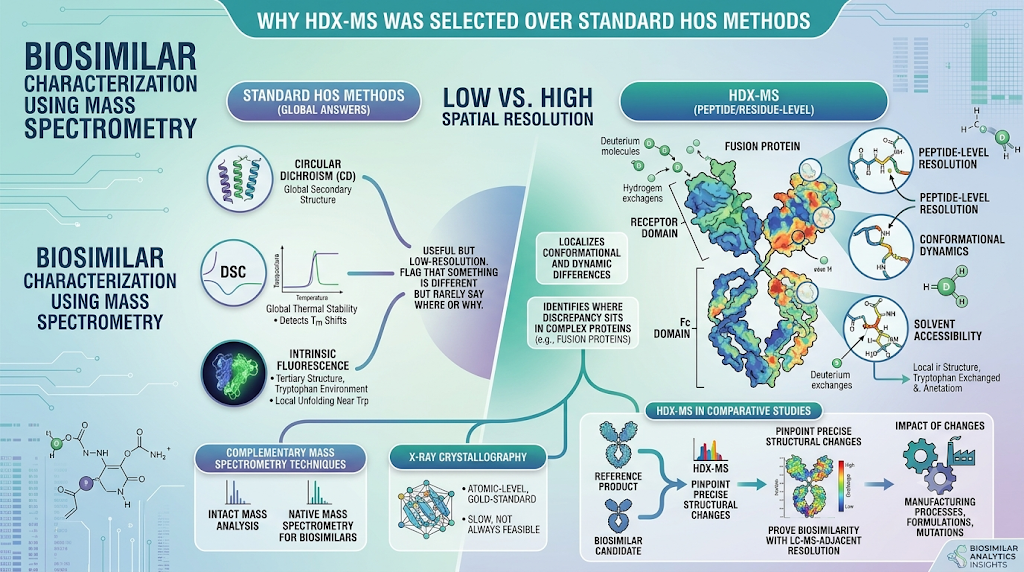
Standard HOS toolkits such as CD, DSC, and intrinsic fluorescence give useful but low-resolution answers. They can flag that something is different but rarely say where or why. Hydrogen-deuterium exchange mass spectrometry (HDX-MS), a technique central to modern biosimilar characterization using mass spectrometry, was selected specifically because it provides peptide-level, and in some cases residue-level, spatial resolution of conformational dynamics and solvent accessibility.
| Technique | Resolution | Strength | Limitation |
|---|---|---|---|
| Circular Dichroism (CD) | Global secondary structure | Fast, low sample use | No domain-level detail |
| DSC | Global thermal stability | Detects Tm shifts | Cannot localize the affected region |
| Intrinsic Fluorescence | Tertiary structure, tryptophan environment | Sensitive to local unfolding near Trp residues | Limited to Trp-proximal regions |
| HDX-MS | Peptide/residue-level | Localizes conformational and dynamic differences | Requires MS expertise and method development |
| X-ray Crystallography | Atomic-level | Gold-standard structural detail | Slow, not always feasible for glycosylated fusion proteins |
For a fusion protein where the discrepancy could be sitting in either the receptor domain or the Fc domain, HDX-MS was the only technique in the panel that could realistically prove biosimilarity using LC-MS-adjacent resolution without requiring a crystal structure, complementing other orthogonal tools such as native mass spectrometry for biosimilars and intact mass analysis.
4: The HDX-MS Investigation: Method and Findings
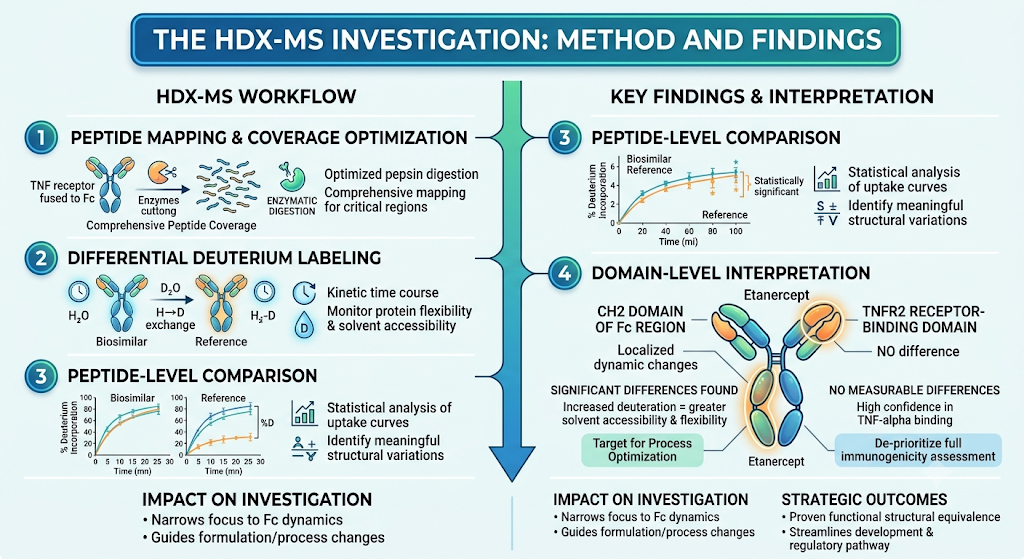
HDX-MS revealed the source of the structural discrepancy by identifying localized conformational differences that were not detectable with conventional analytical methods. The investigation followed a structured differential HDX-MS workflow, comparing the biosimilar candidate with the reference etanercept under carefully matched buffer composition, pH, and temperature conditions to ensure meaningful, reproducible results, consistent with a well-controlled biosimilar comparability study.
Step 1: Peptide mapping and coverage optimization.
The first step involved optimizing pepsin digestion to achieve comprehensive peptide coverage across both the TNFR2 receptor-binding domain and the Fc region, building on standard peptide mapping in biosimilars practices. High sequence coverage was essential because incomplete mapping of either domain could have masked subtle conformational differences. The optimized digestion protocol generated robust peptide coverage, enabling detailed monitoring of higher-order structural dynamics throughout the molecule.
Step 2: Differential deuterium labeling.
Next, both the biosimilar candidate and the reference product were incubated in deuterated buffer at multiple exchange time points. Rather than relying on a single measurement, the study monitored deuterium incorporation over a kinetic time course. This approach provided a more complete picture of protein flexibility, solvent accessibility, and regional stability under native-like conditions.
Step 3: Peptide-level comparison.
Deuterium uptake was quantified for every identified peptide using LC-MS/MS services, and uptake curves from the biosimilar were compared directly with those of the reference product. Statistical analysis was performed using predefined confidence intervals and replicate measurements, ensuring that only scientifically meaningful differences were identified. This rigorous evaluation minimized false-positive findings and strengthened confidence in the observed structural variations.
Step 4: Domain-level interpretation.
The analysis revealed that nearly all statistically significant differences were localized within the CH2 domain of the Fc region. Peptides in this region exhibited increased deuterium uptake in the biosimilar candidate compared with the reference product, indicating greater solvent accessibility and increased conformational flexibility. Importantly, these findings suggested a localized dynamic alteration rather than global protein unfolding or extensive structural disruption, and ruled out issues such as disulfide bond mapping irregularities or charge variant heterogeneity as contributing factors.
Equally significant was what the analysis did not detect. The TNFR2 receptor-binding domain showed no measurable differences in deuterium uptake between the two molecules. This negative finding provided strong evidence that the biosimilar’s ability to bind and neutralize TNF-alpha was unlikely to be affected, and helped de-prioritize a full immunogenicity assessment escalation, narrowing the investigation instead to Fc-region structural dynamics and guiding subsequent formulation and process optimization efforts.
5: Root Cause: A Glycosylation-Linked Conformational Effect
Because the affected region mapped to the CH2 domain near the conserved Asn297 glycosylation site, the investigation was extended to glycan profiling, a core part of routine glycosylation analysis of biosimilars. Comparative glycan analysis identified a shift in the ratio of afucosylated and high-mannose glycoforms between the biosimilar candidate and the reference product, a category of post-translational modification (PTM) in biosimilars that is frequently implicated in HOS discrepancies.
This glycosylation pattern shift, arising from differences in cell line development for biosimilars and clonal selection along with bioreactor conditions, was the mechanistic link between the manufacturing process and the observed Etanercept Biosimilar Higher-Order Structure discrepancy. Glycan occupancy and composition at Asn297 are known to influence local CH2 domain packing and flexibility, which explained both the DSC Tm shift and the localized HDX-MS signal, while leaving the CD spectrum and TNFR2 domain largely unaffected. A parallel impurity profiling review confirmed no process-related impurities were contributing to the effect.
Resolution and Verification
With the root cause identified, the client’s process development team adjusted upstream cell culture conditions to shift the glycoform distribution closer to that of the reference product. ResolveMass then executed a follow-up HDX-MS comparability study on the revised material, alongside a supporting biosimilar forced degradation study and biosimilar stability testing to confirm the change did not introduce new liabilities.
- Deuterium uptake in the CH2 domain peptides returned to within the predefined similarity envelope of the reference product.
- DSC thermal transitions realigned, with the previously shifted Tm now matching the reference product within assay variability.
- Glycan profiling confirmed the glycoform ratio was now consistent with the reference product’s established range.
- No new differences emerged elsewhere in the molecule, and a follow-up biosimilar aggregation analysis confirmed the fix was targeted and did not introduce secondary structural changes.
This closed-loop verification, problem identification, root cause determination, process correction, and re-confirmation by the same orthogonal method, is the kind of evidence package regulatory reviewers look for when evaluating analytical similarity claims under both FDA and EMA biosimilar regulatory pathways.
6: What This Case Study Means for Biosimilar Developers
For any organization developing a complex biotherapeutic, whether an Fc-fusion protein, a GLP-1 biosimilar, or an insulin biosimilar, the lesson from this Etanercept Biosimilar Higher-Order Structure investigation is that bulk biophysical methods alone are often insufficient to catch or explain subtle HOS discrepancies in multi-domain molecules. HDX-MS earns its place in a comparability package specifically because it can:
- Localize structural differences to a specific domain or peptide region, supported by peptide biosimilar characterization using LC-MS.
- Distinguish true conformational effects from assay artifacts.
- Connect structural findings to upstream causes such as glycosylation, oxidation, or deamidation, the same PTM categories tracked during GLP-1 peptide characterization for regulatory requirements and GLP-1 peptide mapping for regulatory requirements.
- Provide before-and-after verification data once a process change is implemented, feeding directly into the broader battery of analytical tests for biosimilar regulatory submission.
Biosimilar programs that build HDX-MS into their HOS characterization strategy early, rather than reaching for it only after a discrepancy appears, tend to move through regulatory review with fewer information requests and a more defensible totality of evidence approach to biosimilar approval.
Conclusion:
Assessing Etanercept Biosimilar Higher-Order Structure is essential for demonstrating analytical similarity and ensuring product quality, safety, and efficacy. While traditional characterization methods remain indispensable, they may not detect localized conformational differences that can influence protein function, which is why comprehensive biosimilar characterization services increasingly rely on multiple orthogonal techniques working together.
This case study demonstrates how Hydrogen-Deuterium Exchange Mass Spectrometry (HDX-MS) successfully identified subtle structural discrepancies, enabled root cause analysis, and confirmed corrective actions after formulation optimization. By integrating HDX-MS with orthogonal analytical techniques and a well-designed biosimilar bioanalysis program, developers can build a comprehensive evidence package that strengthens biosimilar comparability and supports regulatory confidence, whether the work is being carried out through an established generic pharmaceutical CDMO in Canada or an internal analytical team.
For increasingly complex biologics, HDX-MS is becoming an invaluable analytical tool for resolving higher-order structure questions with precision, making it a key component of modern biosimilar development strategies.
Frequently Asked Questions:
Higher-order structure (HOS) discrepancies in etanercept biosimilars typically arise from subtle differences in the manufacturing process rather than changes in the amino acid sequence. Factors such as cell line characteristics, upstream fermentation conditions, purification processes, formulation buffers, glycosylation patterns, storage conditions, and freeze-thaw cycles can all influence protein folding and conformational stability. Even when standard quality attributes such as purity, potency, and primary structure appear comparable, localized structural differences may still exist. Identifying and understanding these variations is essential because higher-order structure directly affects protein stability, biological activity, and immunogenicity, making it a critical quality attribute during biosimilar development.
Yes. Hydrogen-Deuterium Exchange Mass Spectrometry (HDX-MS) is significantly more sensitive than many traditional structural characterization techniques, including Circular Dichroism (CD) and Differential Scanning Calorimetry (DSC), when detecting localized conformational changes. While CD provides information about overall secondary structure and DSC measures global thermal stability, neither technique can pinpoint subtle regional differences in protein dynamics. HDX-MS measures deuterium uptake at the peptide level, revealing changes in solvent accessibility and structural flexibility across specific protein regions. This high-resolution capability makes HDX-MS particularly valuable for investigating biosimilar comparability when conventional methods show similar results but questions about higher-order structure remain.
HDX-MS is not currently a mandatory regulatory requirement for biosimilar higher-order structure (HOS) assessment. Regulatory agencies such as the U.S. FDA, European Medicines Agency (EMA), and Health Canada require developers to demonstrate that a biosimilar is highly similar to its reference product using a comprehensive analytical comparability approach. The choice of analytical methods is science-based and depends on the complexity of the molecule and the specific development challenges encountered. HDX-MS is increasingly recognized as a powerful orthogonal technique for resolving higher-order structural questions, particularly when conventional methods produce inconclusive results or when subtle conformational differences need further investigation. Including HDX-MS data can strengthen the overall analytical evidence package and provide additional confidence during regulatory review.
HDX-MS provides peptide-level information about protein flexibility, solvent accessibility, and conformational dynamics under near-native conditions. Unlike many conventional techniques that assess only global structural features, HDX-MS can detect localized structural changes that may otherwise remain undetected. This makes it particularly valuable for biosimilar comparability studies and higher-order structure investigations.
Yes. Changes in cell culture conditions, purification processes, formulation composition, buffer systems, storage conditions, and freeze-thaw cycles can all influence protein folding and conformational stability. Even small process variations may alter localized higher-order structure, which is why manufacturers perform extensive analytical characterization throughout development and process validation.
Orthogonal analytical techniques provide complementary information about different aspects of protein structure and stability. Combining methods such as HDX-MS, CD, DSC, peptide mapping, glycan analysis, and functional bioassays improves confidence in analytical similarity, reduces uncertainty, and aligns with regulatory expectations for a comprehensive characterization strategy.
Reference
- Cho IH, Lee N, Song D, Jung SY, Bou-Assaf G, Sosic Z, Zhang W, Lyubarskaya Y. Evaluation of the structural, physicochemical, and biological characteristics of SB4, a biosimilar of etanercept. InMAbs 2016 Aug 17 (Vol. 8, No. 6, pp. 1136-1155). Taylor & Francis.https://www.tandfonline.com/doi/abs/10.1080/19420862.2016.1193659
- Beck A, Sanglier-Cianférani S, Van Dorsselaer A. Biosimilar, biobetter, and next generation antibody characterization by mass spectrometry. Analytical chemistry. 2012 Jun 5;84(11):4637-46.https://pubs.acs.org/doi/full/10.1021/ac3002885
- Beck A, Debaene F, Diemer H, Wagner‐Rousset E, Colas O, Dorsselaer AV, Cianférani S. Cutting‐edge mass spectrometry characterization of originator, biosimilar and biobetter antibodies. Journal of Mass Spectrometry. 2015 Feb;50(2):285-97.https://analyticalsciencejournals.onlinelibrary.wiley.com/doi/abs/10.1002/jms.3554
- Pan J, Zhang S, Borchers CH. Comparative higher-order structure analysis of antibody biosimilars using combined bottom-up and top-down hydrogen-deuterium exchange mass spectrometry. Biochimica et Biophysica Acta (BBA)-Proteins and Proteomics. 2016 Dec 1;1864(12):1801-8.https://www.sciencedirect.com/science/article/pii/S1570963916301698
- Hageman TS, Wrigley MS, Weis DD. Statistical equivalence testing of higher-order protein structures with differential hydrogen exchange-mass spectrometry (HX-MS). Analytical chemistry. 2021 Apr 29;93(18):6980-8.https://pubs.acs.org/doi/abs/10.1021/acs.analchem.0c05279
- Beck A, Diemer H, Ayoub D, Debaene F, Wagner-Rousset E, Carapito C, Van Dorsselaer A, Sanglier-Cianferani S. Analytical characterization of biosimilar antibodies and Fc-fusion proteins. TrAC Trends in Analytical Chemistry. 2013 Jul 1;48:81-95.https://www.sciencedirect.com/science/article/pii/S0165993613001003
About the Author


